INTRODUCTION
Diel rhythms of feeding have been reported for several calanoid copepods including Centropages furcatus (Checkley et al., Reference Checkley, Dagg and Uye1992), C. typicus (Dagg & Grill, Reference Dagg and Grill1980; Christaki et al., Reference Christaki, Gaudy and Kerambrum1998; Calbet et al., Reference Calbet, Saiz, Irigoien, Alcaraz and Trepat1999, Reference Calbet, Carlotti and Gaudy2007), Acartia clausi (Kouassi et al., Reference Kouassi, Pagano, Saint-Jean, Arfi and Bouvy2001; Pagano et al., Reference Pagano, Kouassi, Arfi, Bouvy and Saint-Jean2004), A. longiremis, A. omorii (Saito & Taguchi, Reference Saito and Taguchi1996), A. tonsa (Hassett & Blades-Eckelbarger, Reference Hassett and Blades-Eckelbarger1995), Calanus euxinus (Besiktepe et al., Reference Besiktepe, Svetlichny, Yuneva and Shulman2005), C. finmarchicus (Marshall & Orr, Reference Marshall and Orr1955) and C. pacificus (Dagg et al., Reference Dagg, Frost and Newton1998) with ingestion mostly at night. Many copepod species also exhibit a diel rhythm in egg production: e.g. Acartia tonsa (Stearns et al., Reference Stearns, Tester and Walker1989; Cervetto et al., Reference Cervetto, Gaudy, Pagano, Saint-Jean, Verriopoulos, Arfi and Leveau1993), C. pacificus (Runge, Reference Runge1985), C. finmarchicus (Harding et al., Reference Harding, Marshall and Orr1951), C. helgolandicus (Mullin, Reference Mullin1968), Labidocera aestiva (Marcus, Reference Marcus1985), A. erythraea, A. pacifica and C. furcatus (Checkley et al., Reference Checkley, Dagg and Uye1992). Gophen (Reference Gophen1978) suggested that the diel egg production of copepods was a reflection of rhythmic feeding. Many studies have considered the combinations of these two processes, feeding and spawning, but most of those were restricted to the quantitative relationship between them, e.g. C. finmarchicus (Mayor et al., Reference Mayor, Anderson, Irigoien and Harris2006) and C. furcatus (Checkley et al., Reference Checkley, Dagg and Uye1992). Only a few studies have examined the lag times between maxima of feeding and spawning rates of several species (Stearns et al., Reference Stearns, Tester and Walker1989; Tester & Turner, Reference Tester and Turner1990; Cervetto et al., Reference Cervetto, Gaudy, Pagano, Saint-Jean, Verriopoulos, Arfi and Leveau1993; Pagano et al., Reference Pagano, Kouassi, Arfi, Bouvy and Saint-Jean2004). And there is considerable interspecific variability in the lag time for conversion of ingested food to egg production (Tester & Turner, Reference Tester and Turner1990). Yet other factors associated with the lag time have not been demonstrated. Wu et al. (Reference Wu, Wang and Li2006) had assumed that the seawater temperature would work on the lag times of copepods, since it is one of the most important environmental factors to influence the metabolic velocity of animals; to date, this has not been proven.
Centropages tenuiremis is a common and dominant copepod species in Xiamen Bay (Huang et al., Reference Huang, Xu and Li1986; Wu et al., Reference Wu, Wang, Jiang and Li2007), and especially in winter–spring it plays a prominent role in terms of biomass in the zooplankton community. The aim of this study was to investigate the feeding and spawning diel rhythms of C. tenuiremis in relation to temperatures in Xiamen Bay, in order to analyse their relationships and to examine the effect of seawater temperature on the lag times between their peak times.
MATERIALS AND METHODS
Diel variations in gut pigment content and egg production of Centropages tenuiremis in Xiamen Bay, People's Republic of China were measured in this study. Five experiments were carried out from March to May 2006.
Sampling
Zooplankton samples were collected at night using a plankton net with 300 µm mesh on the surface of Xiamen waters, People's Republic of China. The samples were carefully diluted into 15 l polythene barrels with ambient seawater and transported to the laboratory within 30 minutes. The ambient seawater (~40 l) for incubation was collected through 50 µm filters, and its temperature was measured at the same time. In the laboratory within about 30 minutes, the vigorous and mature females of C. tenuiremis were selected using a wide-mouth pipette for spawning and feeding experiments.
Feeding experiments
Diel variation in feeding was determined by measuring the gut pigment contents of pooled samples of copepods over a 24 hour period. The selected females (~300 ind.) were bulk incubated in two incubators containing approximately 2 l of fresh seawater (i.e. in situ seawater filtered through 50 µm mesh), and the light condition was natural light in laboratory without direct radiation. One sample of 20 females was gently sorted out from each of the incubators at 4 hour intervals and immediately filtered onto a 100 µm nylon sieve and rinsed with 0.45 µm filtered seawater. The sample was transferred to a 5 ml centrifuge tube and then kept in the dark at –20°C. 3 ml 90% acetone solution was added in the tube for pigment extraction during 12 hours at 4°C in darkness. Fluorescence was then measured with a Shimadzu RF25301 fluorometer before and after acidification. Chlorophyll-a-equivalent gut content in zooplankton was estimated following the methods of Parsons et al. (Reference Parsons, Maita and Lalli1984) and used as an index of feeding activity.
Spawning experiments
The selected females were individually introduced into incubators containing approximately 40 ml fresh seawater. To avoid the bias of egg production in situ from experimental food (Saiz et al., Reference Saiz, Calbet, Trepat, Irigoien and Alcaraz1997), the ambient seawater filtered with 50 µm mesh from sampling site was used as food source during experimental incubation. The incubators were modified from Burkart & Kleppel (Reference Burkart and Kleppel1998) under natural light conditions in the laboratory without direct radiation. Samples of 24 females were tested at 4 hour intervals over 24 hours, and at the same time the incubating seawater was renewed. During these examinations the numbers of eggs produced by each female were counted under a dissecting microscope. The individual daily egg production rate was calculated by integrating these egg productions over a 24 hour period.
Since clutch size and egg production of different females in a species, even the same female in different days, varies depending on female size and other factors (Runge, Reference Runge1984), relative production rates of night-time and daytime were used to examine the seasonal variations in diel production pattern.
Statistical analysis
One-way analysis of variance (ANOVA) was conducted to compare the seasonal differences in egg production rates. Cochran and Kolmogorov–Smirnov tests were used to test for the normality and homogeneity of variances, respectively, before the comparisons. To avoid the abnormal distribution resulted from much zero value data in each examination, only females spawned were analysed. Statistical analyses were performed using the SPSS 16.0 statistical package.
Diel variations in egg production of C. tenuiremis were analysed by circular statistics (Zar, Reference Zar2010). The median time of each examination interval was transformed into an angular direction, and the histogram bar represents the percentage of eggs laid during this interval in one day. The peak time and the intensity of egg production were evaluated by calculation of a mean vector defined by a mean angle (α) and a mean length (r). The significance of the length of the mean vector was tested with the Rayleigh test (z). Circular distribution plots were graphed using Grapher 8.2.460 software showing the diel changes in the eggs production of C. tenuiremis.
RESULTS
Gut pigment content
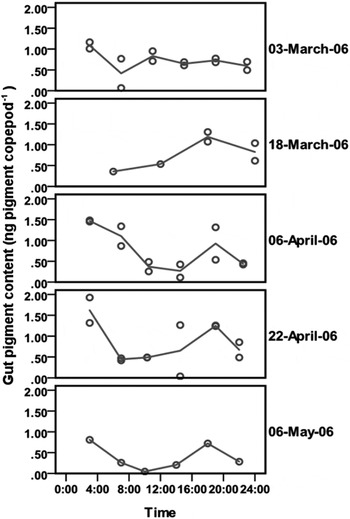
A nocturnal increase of the gut pigment of Centropages tenuiremis females was observed from March to May (Figure 1). In general, the copepods had the highest gut contents during the night (about 3 a.m.), the lowest ones around noon, and the second peaks during the dusk (about 7 p.m). The only exception is on 18 March with a lack of examination at 3 a.m. A two-way ANOVA confirmed that this diel variation was significant when considering the 5 surveys together (for diel effect, P = 0.022; for date, P = 0.224). Slightly lower mean value of gut pigment content was found in May compared with March and April, but this was not significant (Table 1).
Daily variations of gut pigment contents of copepods (circles) and of average values (continuous lines).

Date, temperature, egg production rate, and gut pigment content.

SD, standard deviation; the numbers of spawning females are shown in parentheses.
Spawning
Daily egg production rates of C. tenuiremis varied remarkably in the different surveys (Table 1, F = 4.04, P = 0.005). The present results showed that egg production rates were higher during the cold periods than the warm periods. And there was no significant correlation between mean daily feeding activity and egg production rate (P = 0.692, N = 5).
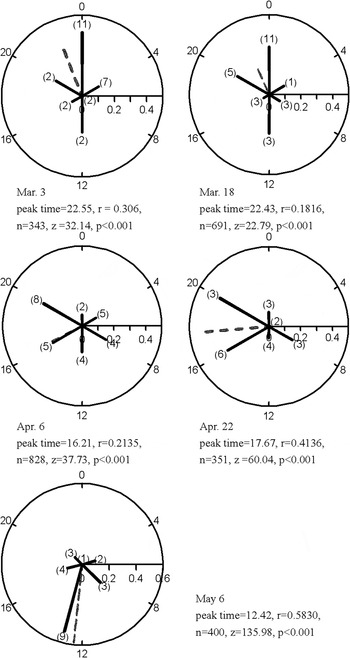
Diel variation in egg production rate was apparent, but the patterns were different in each survey (Figure 2). The spawning peak mainly occurred earlier with the increasing of temperature. The relative rates were much higher during night than day on 3 March (paired t-test, t = 3.22, P = 0.003; time classification by grouping day and night value) and 18 (t = 1.76, P = 0.049), while it was not the case on 6 April (t = −0.178, P = 0.431) and 22 (t = −0.708, P = 0.245). However, the relative rates were much lower during night than day on 6 May (t = −2.08, P = 0.025).
Circular distribution showing the diel changes in the eggs production of Centropages tenuiremis. The numbers of spawning females are shown in parentheses. The direction of the broken line indicates the mean angle (i.e. the peak time), and the length of the line expressed r (i.e. the intensity of egg production). n, the number of eggs produced; z, the value of Rayleigh test for circular distribution.

Lag time
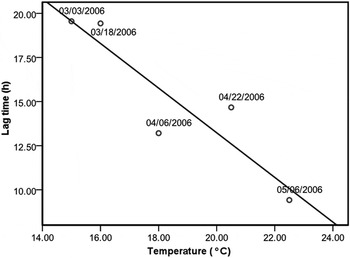
The lag times between peak times of gut pigment content and spawning could be estimated from the data above. A negative linear relationship between time and temperature was observed (Figure 3; time = −1.265 temperature + 38.533, r = 0.912, P = 0.031). The lag time in March was long, whereas in May it was short.
Relationship between lag time and temperature. Lag time = −1.265 temperature + 38.533 (r = 0.912, P = 0.031). Lag time represents the time interval between peak times of gut pigment content and spawning.

DISCUSSION
Diel rhythms in feeding and spawning were investigated in Centropages tenuiremis from Xiamen waters. Their feeding activities were higher during the night-time and their spawning peak occurred earlier during warmer seasons.
Feeding rhythms
The gut pigment content could reflect the feeding activity of copepods, although there was some bias for omnivorous copepods (Boyd et al., Reference Boyd, Smith and Cowles1980). High feeding activity during the night was confirmed for C. tenuiremis in the incubation experiment from 3 March to 6 May 2006. Nocturnal feeding may be a common behaviour in planktonic copepods, having been documented for many species, and especially for C. typicus even under ‘low’ natural food (Calbet et al., Reference Calbet, Saiz, Irigoien, Alcaraz and Trepat1999). Several hypotheses for diel feeding mechanism had been proposed: e.g. diel vertical migration (Boyd et al., Reference Boyd, Smith and Cowles1980), diel changes in food availability (Huntley & Brooks, Reference Huntley and Brooks1982), escape of predation (Stearns, Reference Stearns1986), endogenous feeding rhythm (Stearns, Reference Stearns1986; Calbet et al., Reference Calbet, Saiz, Irigoien, Alcaraz and Trepat1999), etc. The nocturnal feeding pattern of C. tenuiremis was not obviously originated by diel changes in food availability, since the food source was the same, i.e. 50 µm filtered seawater in situ collected the day before. We speculated that the persistence of a diel feeding rhythm in C. tenuiremis was indicative of an endogenous feeding rhythm. This feeding pattern might result from previous feeding history (Huntley, Reference Huntley1988) and be formed by cyclical pattern in gut-cell development (Hassett & Blades-Eckelbarger, Reference Hassett and Blades-Eckelbarger1995). Perhaps the endogenous nocturnal feeding pattern was the response to in situ diel vertical migration (Wu et al., 2006). It was not certain whether there was a food limit influencing the feeding rhythms in Xiamen waters during the experimental period, for the lack of measuring the chlorophyll-a concentration in situ. But in general scarcely was the concentration of phytoplankton very low during March to May in Xiamen coastal waters (Wu et al., 2007). However, the diel feeding pattern of C. tenuiremis was stable whatever the food composition and quantity according to the consistent feeding rhythms in March to May.
Spawning rhythms and lag time
Reproduction is an important process in population dynamics. Many studies, both experimental and field, have shown that egg production depends on both maternal factors (e.g. size of females and gonad stage) and environmental conditions (e.g. available food and temperature). Some investigations have suggested that there was a direct effect of feeding rhythms on spawning variations (Stearns et al., Reference Stearns, Tester and Walker1989; Tester & Turner, Reference Tester and Turner1990; Cervetto et al., Reference Cervetto, Gaudy, Pagano, Saint-Jean, Verriopoulos, Arfi and Leveau1993; Wu et al., Reference Wu, Wang and Li2006). Our results showed that the peak times for spawning varied with temperature in situ, that is to say, the lag times between peak times of gut pigment content and spawning were different during the experimental period.
There was considerable interspecific variability in the time required for copepods to convert ingested food to egg production (Tester & Turner, Reference Tester and Turner1990). And the lag times for females often revealed their different gonad morphology and maturation types. For example, the lag time for Acartia tonsa (9.5 hours) with Acartia-type gonad was much shorter than for C. typicus (89 hours) with Calaus-type gonad in similar cold season (Tester & Turner, Reference Tester and Turner1990; Niehoff, Reference Niehoff2007). Unlike Calanus species, Centropages species apparently have no internal store that can fuel oocyte development and the release of eggs (Marshall & Orr, Reference Marshall and Orr1952; Niehoff, Reference Niehoff2007). Thus, Centropages species were more vulnerable to direct effect of feeding behaviour than Calanus species.
Hirche et al. (Reference Hirche, Meyer and Nieho1997) found that the response time of egg production to feeding was related to temperature. The effect of temperature on lag times is not surprising since most metabolic processes (such as the rate of gut evacuation) depend on temperature (Christoffersen & Jespersen, Reference Christoffersen and Jespersen1986). Our results showed that the spawning peak times for C. tenuiremis were earlier in warmer periods, just as in Calanus finmarchicus (Marshall & Orr, Reference Marshall and Orr1952). So we confirmed our suggestion that the warmer seawater temperature in situ accelerated the process of converting ingested food to egg production in copepods (Wu et al., Reference Wu, Wang and Li2006). Thus, the effect of temperature cannot be ignored in the investigation of the population dynamics of this copepod. For example, when seawater temperatures rise quickly, the daily fecundity is likely to be over-estimated in experiments without regard to the shortened lag time, and vice versa. However, temperature is not the only factor affecting the lag times. The nutrient value of food ingested could also impact on them, since high value food is more effective for egg production (Marshall & Orr, Reference Marshall and Orr1961).
In summary, a stable nocturnal feeding pattern and a remarkable earlier shift in spawning peak time with warmer seawater were revealed in this study. There was a direct effect of feeding rhythms on egg production variations in copepods, and the seawater temperature would work on the converting time (from ingested food to egg production) and then influence the spawning peak time. So the effect of temperature cannot be ignored in the investigation of the effects of feeding on egg production.
ACKNOWLEDGEMENT
This work was supported by the National Natural Science Foundation of China (grant number 40806061).