Introduction
Although the previous literature has focused largely on healthcare-associated (HA) Clostridium difficile infection (CDI), the incidence, prevalence, and severity of community-acquired (CA) CDI has also increased.Reference Freeman, Bauer and Baines 1 Kuntz et alReference Kuntz, Chrischilles, Pendergast, Herwaldt and Polgreen 2 reported similar incidence rates for CA-CDI (11.2 cases/100,000 person-years) and HA-CDI (12.1 cases/100,000 person-years) in the United States. Moreover, the emergence of “hypervirulent” strains of C. difficile in the community among patients previously considered to be at low risk of CDI (ie, young adults without antimicrobial exposure) clearly shows that the epidemiology of CDI is changing and that CDI is no longer exclusively a nosocomial infection, as it was previously considered.Reference Freeman, Bauer and Baines 1 It seems that the risk profile of patients from the community points more to increased numbers of younger patients without comorbidities, whereas in the hospital setting, elderly inpatients with multiple morbidities and exposed to polypharmacy remain most at risk.
Research, including through meta-analysis, has attempted to describe the risk of CDI specifically in the community setting and found that clindamycin, fluoroquinolones, cephalosporins, macrolides, penicillins, and sulphonamides/trimethoprim are associated with an increased CA-CDI risk.Reference Deshpande, Pasupuleti and Thota 3 , Reference Brown, Khanafer, Daneman and Fisman 4 The evidence, however, remains uncertain because these meta-analyses used the random effects (RE) model, which has been questioned for its overconfident results.Reference Noma 5 Exposure to gastric-acid suppressive drugsReference Kwok, Arthur, Anibueze, Singh, Cavallazzi and Loke 6 – Reference Shukla, Shukla, Guha and Mehboob 11 and the presence of comorbiditiesReference Goodhand, Alazawi and Rampton 12 – Reference Bajaj, O'Leary and Reddy 14 are associated with an increased risk of HA-CDI; but as with antimicrobials, the evidence remains inconclusive in the community setting. Therefore, the current meta-analysis was undertaken to pool the evidence from observational studies so that the magnitude and direction of the association between commonly prescribed medications and comorbidities with CA-CDI can be documented.
Methods
Search Methodology
A systematic search was undertaken in 5 medical and life sciences databases (PubMed, Embase, Cochrane CENTRAL, Cumulative Index to Nursing and Allied Health Literature [CINAHL], and Scopus) from their inception to March 1, 2014 (Appendix 1). A related citation search was also performed; by combining the systematic search with the first 20 studies from the related citation search of selected articles in PubMed, a comprehensive evaluation of the published evidence can be achieved.Reference Waffenschmidt, Janzen, Hausner and Kaiser 15
Eligibility Criteria
The inclusion of studies was restricted to human studies, full-text articles written in English, studies reporting CA-CDI, and data presented in an extractable format. Conference presentations and abstracts, studies that exclusively compared CA-CDI with HA-CDI, and studies that presented data in a nonextractable format (ie, graphical representations) were excluded. Exclusions were also made for studies that investigated specific groups (ie, patients with human immunodeficiency virus or cirrhosis) because these were not considered representative of the general population.
Study Selection and Data Extraction
Two authors (L.F.-K. and J.C.S.) independently evaluated all the citations by titles and abstracts for studies that met the eligibility criteria. Full-text version articles of all potentially relevant studies were retrieved and independently assessed for eligibility. Data from the included studies were then independently extracted using a predefined tool (Appendix 2) and summarized in a spreadsheet by the same 2 authors. Extracted data were cross-checked by the 2 authors, and discrepancies during the selection of studies or data extraction were resolved through discussion and consensus following independent evaluation by another author (S.A.R.D.).
Quality Assessment
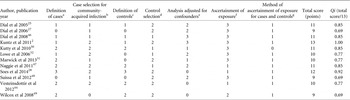
The quality of each study was assessed using a modified version of the Newcastle-Ottawa quality assessment scale for case-control studies. The modified scale assessed whether 7 safe-guards against bias had been undertaken by the authors: (1) definition of cases and methods employed for C. difficile diagnosis, (2) selection of CA infection, (3) control definition and the method used to rule out C. difficile, (4) selection of controls from the community, (5) analysis adjusted for confounders, (6) method used for ascertainment of exposure, and (7) same method used to ascertain exposure for cases and controls. The quality criteria were combined into a univariate score as outlined in Table 1. The quality score was rescaled between zero and 1 (called Qi); this was done by summing the points of each component (maximum sum=17) and dividing it by the highest sum obtained by a study within the meta-analysis, ensuring that the best quality study always had a Qi of 1.
Modified Newcastle-Ottawa Quality Assessment Scale for Case-Control Studies Included in the Meta-analysis

a Definition of cases: Method used for Clostridium difficile diagnosis: stool culture (3 points), toxin detection (2 points), clinical diagnosis or International Classification of Diseases (ICD) code (1 point), other or no description (0 points).
b Case selection for community-acquired infection: Patient not previously hospitalized and not a resident of a nursing home (2 points), patient not previously hospitalized or not a resident of a nursing home (1 point), no description (0 points).
c Definition of controls: Method used for exclusion (noninfection) of C. difficile: stool culture (3 points), toxin detection (2 points), clinical diagnosis or ICD code (1 point), other or no description (0 points).
d Control selection: Community (2 points), community and hospital (1 point), no description (0 points).
e Analysis adjusted for exposures other than the primary exposure of interest (sex, age, antimicrobial exposure, gastric acid–suppressive medication exposure or presence of comorbidities). Adjusted for 5 factors (3 points), 3–4 factors (2 points), 1–2 factors (1 point), or nonadjusted (0 points).
f Ascertainment of exposure: Objective methods, ie, charts or medical records (3 points), reported by the general practitioner (2 points), self-reported (1 point), no description (0 points).
g Method of ascertainment of exposure for cases and controls: Same (1 point), different (0 points).
Statistical Analyses
The outcome measure was the odds ratio (OR) for the association of CA-CDI with exposure to risk factors, such as antimicrobial drugs, gastric acid suppressant drugs (proton-pump inhibitors [PPI] and histamine-2-receptor antagonists), nonsteroidal anti-inflammatory drugs, aspirin, steroids, and the presence of comorbidities. The OR was pooled using 3 meta-analytic models. This was justified because some have expressed skepticism regarding the appropriateness of the conventional RE modelReference DerSimonian and Laird 16 owing to its documented underestimation of the statistical error, which leads to overconfident results.Reference Noma 5 , Reference Senn 17 – Reference Poole and Greenland 19 The other 2 models that were used were the quality effects (QE) model Reference Doi and Thalib 20 – Reference Doi, Barendregt and Mozurkewich 21 and a novel method, the inverse variance heterogeneity (IVhet) model.Reference Barendregt and Doi 22 The QE model uses the Qi to redistribute the inverse variance weights in favor of the studies with higher methodologic quality and thus studies that provided higher quality of evidence contributed with a higher weighting towards the overall effect size.Reference Doi, Barendregt and Mozurkewich 21 This use of quality information via a univariate score does not imply that quality deficiencies can quantify bias. Rather, the quality score is used to rank studies by methodologic rigor and this rank is then linked with a synthetic bias variance that is added to the random error variance.Reference Doi and Thalib 20 The other model used was the IVhet model that does not require input of quality information and so is less rigorous than the QE model.Reference Barendregt and Doi 22 Both of the latter models use a quasi-likelihood-based variance structure without distributional assumptions and thus have coverage probabilities for the confidence interval (CI) well above the nominal level.Reference Barendregt and Doi 22 The reported results are based on the IVhet model; results using the QE and RE models have been presented for comparative purposes.
Statistically significant heterogeneity was defined as tau-squared statistic (τ 2)>0, Cochran's Q test P<.1, or I 2 index >0%. A sensitivity analysis was conducted to determine the degree to which the findings vary depending on the geographic location where the studies were conducted (America or Europe) and life stages of the participants (children aged <2 years, children and adults, adults, or adults aged >65 years).
The Doi plots were used to evaluate the presence of publication bias, which plots the lnOR against the absolute value of the z-score for each study.Reference Onitilo, Doi and Barendregt 23 Funnel plots were not reported because the graphical assessment of publication bias requires at least 10 studies and even then can be difficult to interpret.Reference Sterne, Sutton and Ioannidis 24
The results of the analyses were considered statistically significant if the 95% CI did not include zero. Analyses were conducted using MetaXL, version 2.0 (EpiGear International).
Results
Yield of Search Strategy
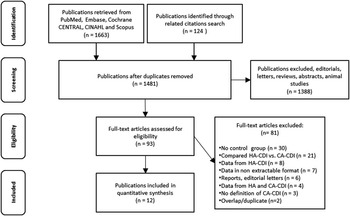
The initial search identified 1,663 publications. An additional 124 publications were retrieved throughout the related citations search. After excluding duplicate citations, 1,481 publications remained. After screening the publications by title and abstract, 1,388 were excluded. A full-text review of 93 publications was conducted, and 12 met the eligibility criteria and were selected for the meta-analysis (Figure 1).
Preferred Reporting Items for Systematic Reviews and Meta-Analysis flowchart of the literature search conducted on March 1, 2014, for the meta-analysis.

There was overlap in subjects between 2 sets of publications. Two publications (Dial et alReference Dial, Delaney, Barkun and Suissa 25 and Delaney et alReference Delaney, Dial, Barkun and Suissa 26 ) used data from the UK General Practice Research Database between 1994 and 2004 and a positive toxin test result for CDI as case definition to assess the risk of CA-CDI with antimicrobial exposure. Although Dial et alReference Dial, Delaney, Schneider and Suissa 27 also used data from the UK General Practice Research Database, the authors reported that there was no overlap between this and Dial et alReference Dial, Delaney, Barkun and Suissa 25 because they used different case definitions for CDI.Reference Dial, Delaney, Schneider and Suissa 27 Additionally, 2 publications (Soes et alReference Soes, Holt and Bottiger 28 and Soes et alReference Soes, Holt and Bottiger 29 ) reported results from the same Danish cohort. Therefore, Delaney et alReference Delaney, Dial, Barkun and Suissa 26 and Soes et alReference Soes, Holt and Bottiger 29 were excluded from the analyses.
Characteristics of the Included Studies
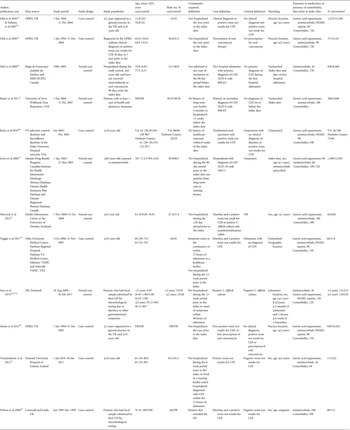
Twelve publications were included in the meta-analysis. Two publications reported results divided into groups. Kutty et alReference Kutty, Woods and Sena 30 presented the results of 2 populations (Veterans Affairs and Durham County residents), whereas Soes et alReference Soes, Holt and Bottiger 28 , Reference Soes, Holt and Bottiger 29 presented the results divided into 2 age groups (<2 years and ≥2 years). Among the included studies, 7 were case-control studies and 5 were nested case-control studies. The studies included covered more than 35 years of research and 56,776 patients in 6 different countries. The age of the participants ranged from 3 months to 101 years. Only one studyReference Soes, Holt and Bottiger 28 , Reference Soes, Holt and Bottiger 29 used exclusively positive C. difficile culture in the case definition and another studyReference Marwick, Yu and Lockhart 31 used a combination of C. difficile culture or toxin test results in the case definition. All studies evaluated exposure to medication for at least 6 weeks and presence of comorbidities for at least 12 weeks prior to the index date, respectively (Table 2). The quality score of the studies ranged from 9 to 13 of 17 (Table 1).
Characteristics of the Studies Included in the Meta-analysis

NOTE. CDI, Clostridium difficile infection; GP, general practitioner; GPRD, General Practice Research Database; ICD, International Classification of Disease; index date, the date when the cases were identified; MED-ECHO, provincial hospital discharge summary; NR, not reported; NSAID, nonsteroidal anti-inflammatory drug; VA, Veterans Affairs.aPresented in 2 groups: Patients from the VA and Durham County.bPresented in 2 groups: Patients aged <2 years and ≥2 years.cAge, median (range), years.
Quantitative Synthesis
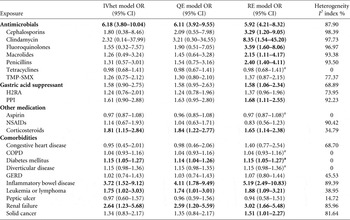
When examining the association between drug exposures and CA-CDI using the IVhet model, exposure to antimicrobials (OR, 6.18; 95% CI, 3.80–10.04) and corticosteroids (1.81; 1.15–2.84) were significantly associated with CA-CDI. Gastric acid–suppressing drugs were not associated with increased odds of CA-CDI (both PPIs and histamine-2-receptor antagonists: OR,1.58; 95% CI, 0.90–2.75; just PPIs: 1.61, 0.90–2.88; just histamine-2-receptor antagonists:1.24, 0.76–2.01). Statistically significant associations were found between CA-CDI and the presence of inflammatory bowel disease (OR, 3.72; 95% CI, 1.52–9.12), renal failure (2.64, 1.23–5.68), leukemia or lymphoma (1.75, 1.02–3.03), and diabetes mellitus (1.15, 1.05–1.27) (Table 3).
Pooled Effect Size Using the IVhet Model, QE Model, and the RE Model

NOTE. COPD, chronic obstructive pulmonary disease; GERD, gastroesophageal reflux disease; H2RA, histamine-2-receptor antagonists; IVhet, inverse variance heterogeneity; NSAIDs, nonsteroidal anti-inflammatory drugs; OR, odds ratio; PPI, proton-pump inhibitors; QE, quality effects; RE, random-effects; TMP-SMX, trimethoprim-sulfamethoxazole. Boldface type indicates statistically significant ORs.
a No heterogeneity, pooled estimated report using the inverse variance model.
Visual inspection of the forest plots, Cochran's Q test (Appendix 3), τ 2 (results not shown), and I 2 index (Table 3 and Appendix 3) confirmed heterogeneity across studies, except for exposure to tetracyclines or aspirin and the presence of chronic obstructive pulmonary disease, diabetes, or diverticular disease.
Sensitivity Analysis
A sensitivity analysis was possible only for antimicrobial and PPI exposure because of the small number of studies in the other categories. When stratifying the studies by geographic location, the sensitivity analysis showed that antimicrobial exposure had a greater association with CA-CDI in the United States (OR, 9.16; 95% CI, 5.47–15.34) compared with European countries (4.54, 2.68–7.70; Appendix 4.1). Conversely, exposure to PPIs had a stronger association with CA-CDI in Europe (OR, 2.56; 95% CI, 1.40–4.71) compared with the United States (1.12, 0.64–1.95; Appendix 4.2).
The subgroup analysis by life stages showed that older adults (>65 years) had the highest risk (OR, 10.16; 95% CI, 5.56–18.58) of CA-CDI when exposed to antimicrobials, followed by children and adults (5.98, 4.67–7.67; Appendix 4.3). When exposed to PPIs, adults had the highest risk of CA-CDI (OR, 2.78; 95% CI, 2.02–3.81; Appendix 4.4).
Publication Bias
On visual inspection of the Doi plots, there was gross asymmetry for some exposures, suggesting publication bias in relation to cephalosporins, fluoroquinolones, macrolides, penicillin, presence of congestive heart failure, and presence of gastroesophageal reflux disease. The bias was toward selective publication that reported medication exposure and presence of comorbidities as risk factors for CA-CDI (Appendix 3).
Discussion
Exposure to antimicrobials remained the strongest risk factor associated with CA-CDI. No statistical significance was observed in most analyses by antimicrobial class, likely because the largest study (Lowe et alReference Lowe, Mamdani, Kopp, Low and Juurlink 32 ) reported ORs close to the null value. However, point estimates confirmed a trend toward an association with CA-CDI regardless of antimicrobial class exposure. These observations corroborated previous findings published by Deshpande et alReference Deshpande, Pasupuleti and Thota 3 and Brown et alReference Brown, Khanafer, Daneman and Fisman 4 that suggested an increased risk of CA-CDI as a result of antimicrobial exposure.
Despite the growing evidence in the past decade with respect to increased risk of HA-CDI after exposure to PPIsReference Kwok, Arthur, Anibueze, Singh, Cavallazzi and Loke 6 , Reference Janarthanan, Ditah, Adler and Ehrinpreis 7 , Reference Tleyjeh, Bin Abdulhak and Riaz 9 – Reference Shukla, Shukla, Guha and Mehboob 11 or histamine-2-receptor antagonists,Reference Tleyjeh, Abdulhak and Riaz 8 , Reference Dial, Delaney, Barkun and Suissa 25 no significant association was observed in the community setting. The observed difference between the risk of CA-CDI and HA-CDI with gastric-acid suppressive medication can be explained by the overuse of these medications in healthcare facilities.Reference Durand, Willett and Desilets 33 Exposure to corticosteroids was associated with CA-CDI. In contrast to antimicrobials that disrupt the normal gut microbiome, facilitating the proliferation of C. difficile,Reference Johnson and Gerding 34 and in contrast to gastric-acid suppressive medication that may allow survival of vegetative forms of C. difficile,Reference Jump, Pultz and Donskey 35 a plausible biological mechanism for the observed association could be the negative impact of corticosteroids on the gastrointestinal mucosal integrity.Reference Hernández-Díaz and Rodríguez 36
Previous studies found that gastrointestinal comorbidities such as inflammatory bowel diseaseReference Goodhand, Alazawi and Rampton 12 and cirrhosisReference Bajaj, O'Leary and Reddy 14 were associated with a worse prognosis in patients with CDI. Similarly, congestive heart disease, chronic pulmonary disease, renal failure, and malignant neoplasms were also associated with higher mortality rates among inpatients with CDI.Reference Ahmed, Kuo, Kuo and Davis 13 Among the comorbidities examined in this meta-analysis, inflammatory bowel disease was the strongest risk factor for CA-CDI, followed by renal failure and hematologic cancers. In patients with the described comorbidities, early identification and prompt treatment of CA-CDI may reduce mortality rates. The associations found between CA-CDI and comorbidities may be confounded by medication exposure, given that polypharmacy is common among patients with multiple comorbidities. Furthermore, the heterogeneous definition of CA-CDI across the studies (ie, not hospitalized the year prior to the index date versus not hospitalized 6 weeks prior to the index date) may also be a source of misclassification between CA- and HA-CDI, considering that patients with multiple comorbidities are more likely to be admitted to hospitals.
The sensitivity analyses suggested that risk of CA-CDI with exposure to antimicrobials and PPI differed between Europe and America. The observed difference might be due to the dissimilar prescription of antimicrobialsReference Patrick, Marra, Hutchinson, Monnet, Ng and Bowie 37 and/or the presence of different strains of C. difficile in Europe and America.Reference Cheknis, Sambol and Davidson 38 Similarly, the risk of CA-CDI with exposure to antimicrobials and PPI varied among the life stages. These findings were consistent with Sandora et al,Reference Sandora, Flaherty and Helsing 39 who reported a negative correlation between age and CA-CDI among pediatric populations, and with Lessa et al,Reference Lessa, Gould and McDonald 40 who reported a higher incidence of CDI among patients at both extremes of life (1–4 years of age and older than 65 years). In the past 2 decades, a 12-fold increased incidence of CA-CDI among the pediatric populationReference Khanna, Baddour and Huskins 41 and numerous outbreaks in long-term care facilitiesReference Simor, Bradley, Strausbaugh, Crossley and Nicolle 42 have been reported, indicating that infants, toddlers, and older adults should be considered at high risk of CA-CDI.
Although a comprehensive systematic search for studies was performed, publication bias could have resulted in additional positive associations being published, such as those between CA-CDI and exposure to cephalosporins, fluoroquinolones, macrolides, and penicillins and the presence of congestive heart disease and gastroesophageal reflux disease. The actual risks attributable to these risk factors could be less than what we have reported. Nevertheless, heterogeneity across studies could also result in effect size asymmetry, and this represents an alternative explanation to selective publication of positive results.
Recent meta-analyses have investigated the risk of CDI associated with exposure to antimicrobialsReference Deshpande, Pasupuleti and Thota 3 , Reference Brown, Khanafer, Daneman and Fisman 4 , Reference Kwok, Arthur, Anibueze, Singh, Cavallazzi and Loke 6 and gastric acid suppressant drugsReference Kwok, Arthur, Anibueze, Singh, Cavallazzi and Loke 6 – Reference Tleyjeh, Bin Abdulhak and Riaz 9 using the widely adopted RE model.Reference DerSimonian and Laird 16 However, the coverage probability of the RE CI can be substantially below the nominal level of 95% and thus does not adequately reflect the statistical error, especially when there are few included studies.Reference Noma 5 , Reference Barendregt and Doi 22 , Reference Brockwell and Gordon 43 By underestimating the statistical error, the RE model produces tight CIs that potentially cause overconfident results prone to type 1 error. Moreover, the assumption of normally distributed random effects is not easily verified.Reference Brockwell and Gordon 43 The use of a moment-based common varianceReference DerSimonian and Laird 16 within this model is in the redistribution of the weights from larger to smaller studies.Reference Al Khalaf, Thalib and Doi 18 The QE and IVhet models have both been created to do away with the problems that affect the RE model and both have coverage of the CI at or above the nominal level.Reference Barendregt and Doi 22 As an example, with the clindamycin pooled estimates, the IVhet model distributed the weight (83.5%) toward the biggest study (Lowe et alReference Lowe, Mamdani, Kopp, Low and Juurlink 32 ; n=13,692). The QE model took into account the extra information regarding the quality of the studies and penalized the biggest study by reducing the assigned weight (from 83.5% to 69.0%) because it had the lowest quality score; whereas the RE model redistributed the weights by equalizing weights (by transferring from big to small studies) and thus, it gave a weight percentage to the biggest study (Lowe et alReference Lowe, Mamdani, Kopp, Low and Juurlink 32 ; n=13,692; weight 25.85%) that was similar to that of the smallest study (Vesteinsdottir et alReference Vesteinsdottir, Gudlaugsdottir, Einarsdottir, Kalaitzakis, Sigurdardottir and Bjornsson 44 ; n=333; weight 23.98%). Moreover, the RE model produced a tighter CI (with a statistically significant result), but its coverage may have been under the nominal level and thus may not have captured the true value of the effect (Appendix 3.3).
Several limitations of the present meta-analysis were noted. Kuntz et alReference Kuntz, Chrischilles, Pendergast, Herwaldt and Polgreen 2 and Marwick et alReference Marwick, Yu and Lockhart 31 reported a positive relationship between duration of exposure to antimicrobials and CA-CDI. However, the small number of studies precluded a subgroup analysis by duration of exposure to antimicrobials. All studies included in this meta-analysis were conducted in Northern Hemisphere countries. A recent study has described a different seasonal pattern of CDI in Australia that remains largely unexplained.Reference Furuya-Kanamori, Robson and Soares Magalhãesa 45 The epidemiologic patterns of C. difficile transmission and infection may differ between hemispheres and thus generalizability of the findings to Southern Hemisphere countries is limited.
In conclusion, while antimicrobial use remains the dominant risk factor for CA-CDI, corticosteroid use should also be considered an important risk factor. Given these are commonly prescribed medications in the community, the attributable risk of CDI due to exposure may be high and thus further research is warranted. In addition, patients with inflammatory bowel disease, renal failure, and hematologic cancer are at higher risk of CA-CDI, making them appropriate populations for interventional studies of screening for C. difficile.
Acknowledgments
Financial support. Endeavour Postgraduate Scholarship (3781 2014 to L.F.-K.), an Australian National University Higher Degree Scholarship (to L.F.-K.), a Fondo para la Innovación, Ciencia y Tecnología Scholarship (095-FINCyT-BDE-2014 to L.F.-K.), and an Australian National Health and Medical Research Council Senior Research Fellowship (1058878 to A.C.C.).
Potential conflicts of interest. All authors report no conflicts of interest relevant to this article.
SUPPLEMENTARY MATERIAL
Supplementary material To view supplementary material for this article, please visit http://dx.doi.org/10.1017/ice.2014.39.