Implications
An efficient heifer-rearing system is crucial to the future income and sustainability of a dairy enterprise. Heifer development (body weight (BW) and body condition score) has been shown to be critical to the production potential and longevity as cows. Heifer guidelines generally recommend a BW target of 60% to 65% of mature BW at mating start date; however, few demonstrate the implications of underdeveloped or overdeveloped heifers. The current study has demonstrated the implications of over rearing and under rearing heifers with regard to their future production potential profitability.
Introduction
An efficient heifer-rearing system is crucial as it determines the future income and sustainability of a dairy enterprise. Following feeding costs, heifer rearing is the second largest expense in the dairy system, accounting for ∼20% of total costs (Gabler et al., Reference Gabler, Tozer and Heinrichs2000), and thus it is essential that high-quality heifers are reared to optimise their potential as lactating animals to maintain profitable dairy enterprises. Calving replacement dairy heifers at 24 months of age is a necessity in order to obtain maximum lifetime productivity, particularly in seasonal calving pasture-based systems of dairy production, similar to those that predominate in Ireland.
The time of puberty is an important factor in determining pregnancy rate in heifers. Age at puberty is particularly important as a production trait when heifers are bred to calve as 2-year-olds and in systems that impose restricted breeding periods (Ferrell, Reference Ferrell1982). Onset of puberty usually occurs in dairy heifers at 30% to 40% of their expected mature body weight (BW) (Heinrichs, Reference Heinrichs1993; Van Amburgh et al., Reference Van Amburgh, Galton, Bauman, Everett, Fox, Chase and Erb1998). Age and BW are closely interconnected, that is, the negative effect of early calving can be explained by high BW gain before puberty or a too low BW at first calving (Sejrsen and Purup, Reference Sejrsen and Purup1997). Ferrell (Reference Ferrell1982) reported that age at puberty was not related to body condition score (BCS) of heifers at 452 days of age. However, heifers that are bred later have been shown to have a higher BCS and have an increased incidence of dystocia at parturition (Hoffman et al., Reference Hoffman, Brehm, Price and Prill-Adams1996).
There is evidence to suggest that first lactation milk yield is reduced when heifers calve before 2 years of age (Heinrichs and Vazquez-Anon, Reference Heinrichs and Vazquez-Anon1993). However, Lin et al. (Reference Lin, McAllister, Batra, Lee, Roy, Vesely, Wauthy and Winter1988) reported that early calving heifers had more days of productive life and higher lifetime milk yields when compared with late-calving heifers. In contrast, Hoffman and Funk (Reference Hoffman and Funk1992) documented that research efforts to reduce the age at first calving below 22 to 24 months of age have generally resulted in reduced milk yield. Abeni et al. (Reference Abeni, Calamari, Stefanini and Pirlo2000) reported that milk fat concentration was decreased when age at first calving was reduced, whereas other studies have found that protein percentage was higher (Pirlo et al., Reference Pirlo, Capelletti and Marchetto1997) with an earlier calving date. Extending age at first calving beyond 750 days of age was found not to improve the performance of primiparous cows, and the highest economic return was observed when cows first calved between 700 and 740 days of age (Ettema and Santos, Reference Ettema and Santos2004).
Wiltbank et al. (Reference Wiltbank, Roberts, Nix and Rowden1985) reported that heifers heavier at mating start date (MSD) showed more oestrus events, and a greater proportion became pregnant in the first 20 days of the breeding season and had an overall higher pregnancy rate at the end of the first breeding season compared with lighter heifers. Many experiments have shown a positive relationship between BW at first calving and first lactation milk yield. However, Macdonald et al. (Reference Macdonald, McNaughton, Verkerk, Penno, Burton, Berry, Gore, Lancaster and Holmes2007) reported that BW at first calving and post-pubertal growth rate are important for first lactation milk production, but had no effect on subsequent milk production. Grummer et al. (Reference Grummer, Hoffman, Luck and Berters1995) concluded that a BW at first calving >660 kg did not enhance lactation performance. Carson et al. (Reference Carson, Dawson, McCoy, Kilpatrick and Gordon2002) reported that increasing the BW of Holstein–Friesian heifers at first calving from 540 to 620 kg pre-calving increased milk yield but tended to also increase calving interval.
Although several studies have been completed that examine the effect of age, BW and BCS at first calving on subsequent production, there is limited information on the effect of these parameters at MSD on production performance during the first and subsequent lactations. The objectives of this study were to determine the relative influence of BW, BCS and age at MSD on the rate of puberty in maiden heifers, as well the subsequent impact on dairy cow milk production performance, longevity and profitability under Irish production circumstances.
Material and methods
Farms and animals
Data were available from 871 Holstein–Friesian dairy heifers from 48 commercial dairy farms. All farms were part of the Dairy Management Information System (Dairy MIS) at Teagasc Moorepark (Teagasc, Animal and Grassland Research and Innovation Centre, Moorepark, Fermoy, Co. Cork, Ireland). Dairy MIS is a recorder-based computerised database where detailed information regarding stock, farm inputs and production events are recorded on a regular basis. These heifers were part of a breed comparison study, detail of which is available from Begley et al. (Reference Begley, Buckley, Pierce, Fahey and Mallard2009) and Archbold et al. (Reference Archbold, Buckley, Pierce, Begley and Mee2011). Herds were visited once, on average 9 (s.d. 5.2) days before MSD (23 April 2005, s.d. 12.6 days), as maiden heifers. During this visit, heifers were weighed, body condition scored, blood samples were collected and transrectal ultrasonography was conducted. As cows, they were weighed and body condition scored once during May and June 2006, 2007 and 2008. These visits coincided with the breeding period, which in Irish seasonal calving herds typically begins in late April (Buckley et al., Reference Buckley, O'Sullivan, Mee, Evans and Dillon2003).
Data collection
All procedures were carried out under experimental licence issued by the Irish Department of Health and Children, in accordance with the European Communities (Amendment of Cruelty to Animals Act 1876) Regulations 2005.
Puberty
Heifers were deemed to be pubertal or non-pubertal as defined by Archbold et al. (Reference Archbold, Buckley, Pierce, Begley and Mee2011). In brief, data from heifers having both plasma progesterone concentration (P4) and ultrasonography records were combined to assign pubertal status. Heifers with an identifiable corpus lutuem (CL) in the presence or absence of large follicles and peri-ovulatory signs and with a P4 concentration ⩾1 ng/ml were classified as pubertal. In addition, heifers without an identifiable CL in the presence or absence of large follicles and peri-ovulatory signs but with a P4 concentration ⩾1 ng/ml were also classified as pubertal. Pre-pubertal heifers had no identifiable CL or a P4 concentration <1 ng/ml.
BCS and BW
BCS was recorded on a scale of 1 to 5 (1 = emaciated and 5 = extremely fat with increments of 0.25) by the same experienced recorder, similar to that described by Lowman et al. (Reference Lowman, Scott and Somerville1976). BW was recorded electronically using portable weighing scales and the Winweigh software package (Tru-Test Ltd, Auckland, New Zealand). The scales were calibrated weekly against a permanent scale at the Moorepark Dairy Production Research Centre and again on arrival at each farm using known weights.
Milk production and longevity
Individual test-day milk records, milk yield, fat content and protein content along with 305-days predicted yields (reflecting 305-days production potential) derived using the Standard Lactation Curve method (Olori and Galesloot, Reference Olori and Galesloot1999), which adjusted for calving month, age at calving, parity and season of calving, were obtained from the Irish Cattle Breeding Federation. The data spanned from 2006 to 2008. Cows were milk recorded on average 5.45 (s.d. 2.02) times per lactation. During the data editing process, the final test-day record for each cow's lactation, reflecting the incorporation of maximum recordings per cow lactation with respect to the prediction of 305-days performance, was used. Milk solids yield (MS) was subsequently calculated as fat plus protein yield. Longevity was defined as reappearance in subsequent lactations.
Statistical analysis
All data editing and statistical analyses were carried out using appropriate procedures in SAS (SAS, 2006). Data pertaining to BW and age were categorised on the basis of quantiles generated using the PROC UNIVARIATE procedure in SAS. Four BW categories (quartiles) were formed: ⩽290 kg, 291 to 316 kg, 317 to 342 kg and ⩾343 kg. Four BCS categories were formed: ⩽2.75, 3.00, 3.25 and ⩾3.50, based on biological plausibility. Age was categorised into thirtiles: ⩽421 days, 422 to 435 days and ⩾436 days. Three age categories were deemed appropriate, given the relatively narrow spread in age available, because of the seasonal nature of calving. All independent variables were analysed using Proc GLM procedure in SAS (SAS Institute Inc., Cary, NC, USA) with the fixed effects of herd and the categorised variables for age, BW and BCS.
Economic modelling
The Moorepark dairy systems model (Shalloo et al., Reference Shalloo, Dillon, Rath and Wallace2004), a stochastic budgetary simulation model, was used to simulate a representative farm integrating biological data from the current study with respect to each of the MSD BW categories. The model integrates animal inventory and valuation, milk production, feed requirements, land labour utilisation and an economic analysis. Variable costs including fertiliser, contractor charges, medical and veterinarian, artificial insemination, silage and reseeding, fixed costs (machinery maintenance and running costs, farm maintenance, car, telephone, electricity and insurance) and sales values (milk) were incorporated at current prices. Land area was treated as an opportunity cost, with additional land rented when required and leased when not required for on-farm feeding of animals. The model was limited at 40 ha of land and 13 t dry matter of grass was assumed to be grown based on the studies of Dillon et al. (Reference Dillon, Crosse, Stakelum and Flynn1995). Concentrate cost (€200/t), the opportunity cost of land (€267/ha), provision of winter housing cost (capital cost €1500/cow), labour cost per labour unit (€1905/month) and the ratio of the value of protein to fat (2.6 : 1) were common to all scenarios. Cow numbers were determined ensuring adequate supply of both grazed grass and grass silage for the annual feed budget. The base milk price was assumed to be 27 c/l at 33.0 g/kg protein and 36.0 g/kg fat with a ratio of protein to fat being 2.6 : 1. All cows were assumed to be dried off on a fixed date – the 15th of December. It is assumed that all calves were sold from the farm at 4 weeks of age. Female calves were assumed to realise €330 and the male calves €80. All replacements were assumed to be purchased onto the farm at the time of first calving. Differences associated with heifer growth (rearing stage), maintenance, survivability, milk production and cull values were incorporated taking cognisance of the biological outcomes established during the study. Milk production potential, BW, replacement rate and costs were calculated using data available from the statistical analysis of the biological data.
Results
The effect of herd, which represents the sum of many herd-level factors that differ among herds but not included in the model, was found to be significant in all analyses.
Age at MSD
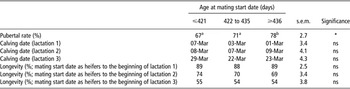
The association between age at MSD and pubertal rate, as well as both calving date and longevity during the first to third lactations are presented in Table 1. Age at MSD was significantly associated with the proportion of heifers cycling before MSD. Older heifers (⩾436 days of age) displayed a greater pubertal rate (78%; P < 0.001) than those that were younger (⩽421 days of age; 67% and 422 to 435 days of age; 71%) at MSD. There was no association between age at MSD and calving date or longevity during subsequent lactations.
The effect of age at mating start date on pubertal rate, subsequent calving dates and longevity over three lactations

abMeans within a row with different superscripts differ (P < 0.05).
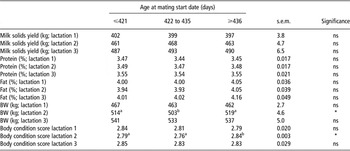
Age at MSD was not found to be associated with total milk solids production in the three subsequent lactations (Table 2). It was also shown to have no significant association with protein percentage or fat percentage in any of the three lactations recorded. During the second lactation, heifers aged between 422 and 435 days at MSD had a lower BW (P < 0.05) than the other two age groups. Age at MSD had no impact on BW during the first and third lactations. The only difference in BCS was observed in the second lactation when heifers aged ⩾436 days at MSD had a greater BCS (P < 0.05) compared with the other groups.
Effect of age at mating start date as heifers on the 305-days milk solids yield, protein %, fat %, BW and body condition score over three lactations

BW = body weight.
abMeans within a row with different superscripts differ (P < 0.05).
BW at MSD
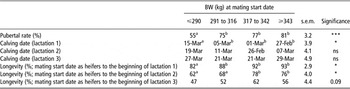
Heifer BW at MSD significantly influenced the proportion of heifers pubertal at the start of the breeding season (Table 3). Pubertal rate increased (P < 0.001) with increasing BW at MSD. Heavier heifers at MSD tended to have earlier calving dates in the first lactation and survived longer compared with lighter heifers.
The effect of BW at mating start date on pubertal rate, subsequent calving dates and longevity over three lactations

BW = body weight.
abMeans within a row with different superscripts differ (P < 0.05).
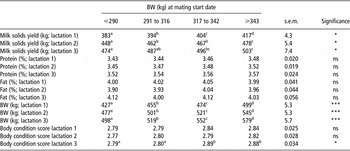
Table 4 shows that heifer BW at MSD was significantly associated with subsequent MS yield potential. On the basis of 305-days production details, larger heifers (⩾343 kg) were estimated to produce 30 kg more MS per lactation compared with the lightest heifers (⩽290 kg). Variation in heifer BW at MSD was not associated with differences in milk fat or protein concentrations during lactation. Heifers that were heavier at MSD were heavier as lactating cows and BW differences increased with time. Heifer BW at MSD was not associated with BCS as lactating cows. There was a tendency for lighter heifers at MSD to maintain lower BCS as lactating cows.
Effect of BW at mating start date as heifers on the 305-days milk solids yield, protein %, fat %, BW and body condition score over three lactations

BW = body weight.
abcdMeans within a row with different superscripts differ (P < 0.05).
BCD at MSD
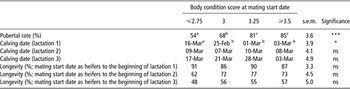
Heifer BCS at MSD was associated with the proportion of heifers pubertal at the start of the breeding season (Table 5), with poor-conditioned heifers exhibiting a lower rate of puberty compared with well-conditioned heifers. Heifers with poor BCS at MSD (⩽2.75) had delayed calving dates in first lactation.
The effect of body condition score at mating start date on pubertal rate, subsequent calving dates and longevity over three lactations

abcMeans within a row with different superscripts differ (P < 0.05).
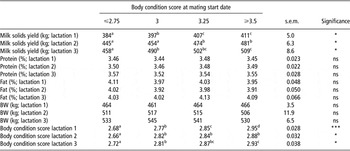
Heifer BCS at MSD had no association with subsequent BW in the three lactations. However, BCS at MSD was in line with BCS as lactating cows. Heifers with a BCS of 3.25 or greater at MSD had the greatest MS in lactations 1 and 2 (Table 6). No effect of BCS at MSD was evident with regard to milk composition over the three lactations.
Effect of body condition score at mating start date as heifers on the 305-days milk solids yield, protein %, fat %, BW and body condition score over three lactations

BW = body weight.
abcdMeans within a row with different superscripts differ (P < 0.05).
Economic implications
It is clear from the biological findings that all three independent variables examined were associated with subsequent rate of puberty and cow performance. The impact of age was observed to be less pronounced compared with BW and BCS, with BW having the greatest impact. Hence, because of the ease of measurement of BW, the objective nature and an increasing awareness of it among proactive Irish dairy farmers as an important management tool, it was decided to restrict the economic analysis to this trait.
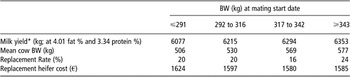
On the basis of the biological findings of the current study, milk production, BW, replacement rate and replacement costs are presented in Table 7. Milk fat and protein content values are similar for each of the BW categories in line with the biological findings. Highest replacement costs were assumed for the lightest heifers. This is primarily attributed to the greater number of heifers not calving as 2-year-olds in this category. These animals were assumed to have incurred similar rearing costs but were sold as beef. Differences in replacement rate reflected differences in survival observed during lactations 1 to 3.
Key model assumptions included in this analysis

BW = body weight.
*Mean milk fat and protein content observed in the current study.
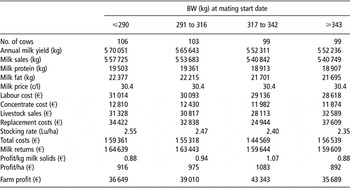
The simulated effect of BW category at MSD on herd parameters and overall farm profit is presented in Table 8. Although mean 305-days milk yields are expected to range from 6077 to 6353 kg, from the lightest to the heaviest MSD BW categories, total herd productivity and sales were decreased with increasing heifer weight. Variables such as stocking rate, labour costs and concentrate costs were reduced with increasing heifer weight. Farm profit was highest for the 317 to 342 kg BW category.
Physical and financial outputs derived from the Moorepark Dairy Systems Model

BW = body weight.
Farm profit was reduced in the ⩾343 kg category by €7654 compared with the 317 to 342 kg category, associated primarily with the increase in replacement rate (24% v. 16%) and consequent replacement costs (€12 665). There was also an increase in labour, concentrate and replacement costs, whereas livestock sales were higher. When compared with the 317 to 342 kg category, farm profit was reduced in both the ⩽290 and 291 to 316 kg categories by €6694 and €4333, respectively. This decrease in farm profit was associated with a larger number of cows (and associated costs) in both the ⩽290 and 291 to 316 kg categories and an increase in replacement rate (20% v. 16%).
Discussion
Implications of age, BW and BCS at MSD with regard to pubertal rate
The objectives of the current study were to evaluate a number of factors with regard to their association with the onset of puberty in Holstein–Friesian heifers, subsequent cow performance and to evaluate their potential impact on farm profitability, based on data accrued during the first three lactations. The factors investigated were age, BW and BCS before MSD. Although age at MSD was associated with the proportion of heifers deemed pubertal, its relative influence compared with that of BW and BCS was less pronounced. It is logical, however, that age would be a predetermining factor in the onset of puberty (Joubert, Reference Joubert1963; Nelsen et al., Reference Nelsen, Long and Cartwright1982). Although age at puberty is critical where heifers are targeted to be bred at 14 to 15 months of age, the findings of the current study indicate that its influence on pubertal rates and subsequent cow performance are minimal within the context of the variation available within the current study.
BW and BCS were found to have the greatest influence on pubertal status at MSD in the current study. The importance of BW and BW gain is supported by the findings of many studies. Macdonald et al. (Reference Macdonald, Penno, Bryant and Roche2005) reported that attainment of puberty was influenced by BW gain in their study where BW gain was manipulated by varying feed allowances. This is in line with earlier studies by Arjie and Wiltbank (Reference Arjie and Wiltbank1971), Short and Bellows (Reference Short and Bellows1971) and Foldager et al. (Reference Foldager, Serjsen and Sorensen1988), whereby level of nutrition and average daily gain (ADG) were reported to significantly reduce the age at which animals reached puberty. Smith et al. (Reference Smith, Fitzhugh, Cundiff, Cartwright and Gregory1976) reported that correlations between BW gains and puberty indicated that increased growth rate of heifers reduced the age at puberty. Similarly, a more recent study by Brickell et al. (Reference Brickell, Bourne, McGowan and Wathes2009) involving 13 UK dairy herds showed increased BW gain to be favourably associated with age at first breeding. This study concluded that suboptimal growth associated with increased age at first calving could be alleviated by improved monitoring of replacement heifers during the rearing period. It is clear from the findings of the current study that to maximise the proportion of heifers (Holstein–Friesian) in puberty at MSD, heifers should be managed to attain a minimum mean BW of ∼330 kg (equivalent to an ADG of 0.67 kg per day from birth, assuming a birth weight of 38 kg; Olson et al., Reference Olson, Cassell, McAllister and Washburn2009) and a mean BCS of between 3.25 and 3.50.
Although BCS was found to be strongly associated with pubertal rate in the current study, this is in contrast with some published studies. Ferrell (Reference Ferrell1982) reported that age at puberty was not related to BCS of heifers at 452 days of age with a range of Bos Taurus cattle breeds. Grass et al. (Reference Grass, Hansen, Rutledge and Hauser1982) also failed to observe a relationship between the attainment of puberty and heifer BCS. This variance from previous studies may be because of the substantially larger scale and power of the current study and range of data recorded. In the current study, the effects of BW and BCS are observed as independent effects and not confounded, as maybe the case in the previous studies where both have not been recorded/evaluated. Variation in BCS is expected to reflect differences in nutrition/energy balance status of growing heifers. Therefore, it is logical to expect differences in pubertal rate among heifers of contrasting BCS.
Studies by Lamond (Reference Lamond1970) and Taylor and Fitzhugh (Reference Taylor and Fitzhugh1971) indicate that puberty can be expected to occur at a genetically predetermined size among individual animals, suggesting that a lower BW at puberty and hence target at MSD may be acceptable for heifers with a greater proportion of British or New Zealand Friesian genetics compared with heifers of North American genetic background. Evidence to support this hypothesis is provided by the study of Macdonald et al. (Reference Macdonald, McNaughton, Verkerk, Penno, Burton, Berry, Gore, Lancaster and Holmes2007) who examined the variation in growth, development and puberty of three strains of Holstein–Friesian heifers under a pastoral environment. In the current study, 45% percent of heifers weighing ⩽291 kg had not reached puberty before MSD compared with 19% of heifers weighing ⩾343 kg. In seasonal, pasture-based systems of milk production, which are reliant on a 365 days calving interval, heifers must reach puberty by 15 months of age and calve by 24 months of age. Failure to do so distorts calving spread, reduces lactation length and puts pressure on first-calved heifers to get back in calf because of a reduced opportunity to breed.
Performance post partum
The objective of this part of the study was to determine carryover effects of age, BW and BCS at MSD on animal performance post partum. It is clear from the analysis that age at MSD (within the range of the current study) had no impact on subsequent lactation performance or indeed on survival to either first or subsequent lactations. The production potential of ‘younger’ v. ‘older’ heifers was identical during all three lactations investigated. This is perhaps surprising as previous studies such as Hoffman and Funk (Reference Hoffman and Funk1992) found a reduction in first lactation milk production when the age at first calving was reduced. Lin et al. (Reference Lin, McAllister, Batra, Lee, Roy, Vesely, Wauthy and Winter1988), however, reported that a reduction in milk yield was confined to first lactation, with heifers mated at a younger age producing similar amounts of milk in subsequent lactations. Vukasinovic et al. (Reference Vukasinovic, Moll and Casonova2001) found that the risk of being culled increased linearly with increasing age at first calving. This was attributed to decreased fertility in older (later calving) heifers. The findings of the current study, however, are similar to the findings of Ducrocq (Reference Ducrocq1994) who noted that the amount of variation in longevity explained by age at first calving is minimal.
Previous studies have reported milk production benefits from increased first calving BW under grazing conditions in Ireland (Crosse and Gleeson, Reference Crosse and Gleeson1988). However, it is evident from the current study that BW at MSD, which is presumably reflective of rearing management, had a significant impact on production potential not only during first lactation but also as a long-term effect. These findings suggest that heifer development is critical to long-term milk solids production potential and survival. Interestingly, the variation in milk solids production was driven by differences in volume rather than differences in composition. These findings are in line with the studies of Gardner et al. (Reference Gardner, Smith and Park1988), Abeni et al. (Reference Abeni, Calamari, Stefanini and Pirlo2000) and Dobos et al. (Reference Dobos, Nandra, Riley, Fulkerson, Lean and Kellaway2001), who all showed a positive relationship between BW at first calving and subsequent milk production performance. In contrast, Macdonald et al. (Reference Macdonald, Penno, Bryant and Roche2005) found that BW at first calving is important for first lactation milk production, but its effect diminished in subsequent lactations. As reported by Carson et al. (Reference Carson, Dawson, McCoy, Kilpatrick and Gordon2002), heifers reared to calve at 620 kg lost more weight in early lactation and had a longer interval up to the first recorded oestrus than those reared to calve at 540 kg. In addition, heifers reared to calve at 620 kg tended to have a longer inter-calving interval. In the current study, there was greater attrition over the three lactations with cows that weighed ⩾343 at MSD as heifers, resulting in an erosion of potential profit from this weight category. In addition, of note is the fact that lighter heifers tended to have reduced BCS as lactating cows indicating a predisposition towards depletion of body reserves, likely due to reduced intake capacity. No adverse effect of increasing BW (BW gain) on production potential was evident in the current study. The negative effects of feeding intensity pre-puberty on milk yield potential because of mechanisms responsible for reduced mammary development have been widely documented (Le Cozler et al., Reference Le Cozler, Lollivier, Lacasse and Disenhaus2008). However, this effect is less certain under grass-based systems (Macdonald et al., Reference Macdonald, Penno, Bryant and Roche2005), likely because of the less intensive nature of the rearing process. In the current study, only 4.8% of heifers gained more than 0.8 kg per day from birth (birth weight of 38 kg assumed; Olson et al., Reference Olson, Cassell, McAllister and Washburn2009), the threshold above which adverse consequences for milk production have been indicated (Zanton and Heinrichs, Reference Zanton and Heinrichs2005).
Perhaps surprising was the finding that BCS at MSD, as heifers, was significantly associated with subsequent productivity. The effect was consistent across all three lactations and of a magnitude similar to the effect of the variations in the BW examined. The reason for this association is unclear but may be reflective of variations in overall management/feeding policy across the study herds, suggesting that herds where heifer rearing is superior adequate nutrition of lactating cows is also prioritised. This is supported by the fact that heifers in good body condition also tended to have better BCS as lactating cows. Hence, it is not considered that this is a carryover effect from heifer management. Waltner et al. (Reference Waltner, McNamara and Hillers1993) evaluated the relationship between BCS at first calving and first lactation milk yield. Milk yield potential was shown to increase rapidly when BCS at first calving was increased from 1 to 3 and was optimum at a BCS of 3.5. To eliminate the possibility that the effects observed in the current study are because of genetic differences rather than variations in heifer-rearing management, an analysis was conducted incorporating the value for the ‘Maintenance’ sub-index for each animal in the statistical model to determine its impact on the results. The Maintenance sub-index represents one of six sub-indices within the Irish dairy selection index – the Economic breeding index. This sub-index takes cognisance of cow weight reflecting its contribution to feed costs per lactation in Euros (http://www.icbf.com/publications/files/Annual_Report_2010.pdf). The Maintenance sub-index value was neither associated with pubertal rate nor had an impact on the relative effects of age, BW and BCS.
Heifers that were heavier at puberty continued to be heavier throughout all three lactations. The question arises whether or not an economic benefit accrues from larger heifers, given the cost of rearing and higher maintenance costs thereafter. The analysis shows, in a fixed land-based scenario, that a weight of between 317 and 342 kg is desirable in order to achieve optimum subsequent economic performance and consequent farm profit. Lighter (⩽291 kg) heifers at MSD are less likely to reach first lactation as 2-year-olds, are less productive compared with well-grown heifers and result in higher total costs, thereby decreasing farm profit. Larger, well-grown heifers are more productive, necessitate lower per cow fixed costs, and thereby justify the additional costs of rearing and maintaining a larger cow. However, in line with the findings of Carson et al. (Reference Carson, Dawson, McCoy, Kilpatrick and Gordon2002), in the present study, greater attrition reduced the benefit of very large heifers (⩾343 kg). Tozer and Heinrichs (Reference Tozer and Heinrichs2001) have also shown the impact of varying replacement rates have on the cost of rearing replacement heifers, as a high replacement rate requires more replacements to be raised until calving. Heifer-rearing guidelines generally cite a BW target of 60% to 65% of mature BW at MSD (Patterson et al., Reference Patterson, Corah, Brethour, Spire, Higgins, Kiracofe, Stevenson and Simms1991). It is clear from the current study that mature BW (third lactation) is influenced by MSD BW. However, the results of the current study indicate that optimal economic performance will result where heifers are managed to a target weight of ∼330 kg at MSD, corresponding to a mature cow BW of ∼550 kg.
Conclusions
Pubertal rate in maiden heifers pre-breeding is affected by age, BW and BCS. However, BW and BCS have been shown to be of greater relative importance. Age at MSD, albeit within the confines of seasonal calving, did not impact upon subsequent animal performance, whereas heifer development (BW and BCS) is critical to the production potential and longevity as cows. The economic analysis indicates that larger, well-grown heifers will be more profitable because of superior production potential, all else being equal. However, because of the finding of poorer reproductive efficiency in heifers grown more than 343 kg at MSD, heifers at ∼330 kg at MSD are deemed optimal. This will correspond to mature cow BW of ∼550 kg.