Do democracies suffer from higher inflation than non-democracies? One of the long-standing debates in comparative political economy concerns the effect of regime type and regime characteristics on macroeconomic performance. The implications of democracy and dictatorship for price stability, in particular, have retained an important place in these debates at least since the inflationary crises in developing countries in the 1980s. During the transitions in the former socialist countries throughout the 1990s, these issues were revisited with renewed interest. Two decades of theoretical and empirical work, however, have yielded conflicting opinions on how political authority in different regimes determines the choice of economic policy.
Political theories of inflation that address regime effects fall into two contrasting categories: populist approaches and state-capture approaches. The first approach argues that democratically elected politicians use inflation to generate revenues in response to public demands for redistribution. In the second, incumbent politicians and their elite patrons obtain private benefits from money creation, and are themselves the cause of price instability. These approaches, consequently, lead to diverging conclusions regarding the influence of democratic institutions and procedures on inflation. In populist approaches, the institutional features of democracy—electoral competition, separation of powers, partisanship, and political participation—increase pressures on politicians to use the inflation tax; inflation is less likely if governments with consolidated, autonomous—even dictatorial—powers are able to avoid these pressures. In state-capture approaches, in contrast, democratic accountability promotes price stability, since use of the inflation tax is eroded once elites face credible challenges to their authority. The populist view has enjoyed something of a consensus among scholars of developing countries for many years. Drawing heavily upon evidence from the post-Communist transitions over the past decade, however, the state-capture view has challenged the argument that authoritarian states are more capable than democracies of maintaining price stability.
These approaches identify different players in the making of monetary policy: in the populist approach, the (relatively poorer) majority demand high inflation; in the state-capture approach, demands for inflation come from the (relatively richer) elite. Thus, populist theories assume that politicians merely repsond to the “omnipotence of the majority,” in Tocqueville's phrase, while state-capture theories assume that politicians are essentially clients of elites. We seek to reconcile these divergent hypotheses, arguing that the distribution of income in a society, together with the differing abilities of the rich and poor to avoid the inflation tax, shapes underlying preferences for inflation. As a result, the influence of political regime-type on inflation is contingent upon these preferences, as well as the extent to which rich and poor have access to and representation in decision making. Our analysis counsels some caution to proponents of both approaches, suggesting instead that certain socioeconomic conditions will inevitably constrain the “marketplace” for economic policies and, thus, proscribe the impact of political institutions.
DEMOCRACY AND INFLATION
Two Views on the Politics of Easy Money
Political explanations of inflation remain closely tied to theories of group conflict. To paraphrase Albert Hirschman (1985), pressure groups are the political scientist's “monotonous equivalent of the economist's untiring stress on the undue expansion of the money supply” as an explanation of inflation. The implications of democracy for price stability, naturally, derive from the view that the role and significance of interest groups are a function of the effectiveness of their mobilization and, ultimately, the mechanisms by which they are represented.
We consider the main existing political explanations of inflation and group conflict as belonging to one of two categories, depending upon which particular groups are considered salient and the nature of group demands.1
A more recent body of theory—partially related to group-based theories—examines the impact of changing the number of veto players on policy choice in unidimensional or multidimensional settings (e.g., Birchfield and Crepaz 1998; Cox and McCubbins 2001). The central implication of these models—that expanding the number of veto points leads to a status quo policy bias—has been examined with respect to inflation by Treisman (2000). Our chief interest, in contrast, is in the level of inflation, rather than its inertia.
The first is a “populist” view of inflation that, put simply, considers inflation a result of public demands for government spending, especially in the presence of conflicts over the apportionment of economic gains and losses. In one variant of the populist perspective, inflation is linked to tax-transfer schemes, in which governments maximize the welfare of the representative consumer through money creation (
Calvo 1978). This basic idea has appeared in formal models and empirical analyses of the political business cycle, which have suggested that inflation may be a consequence of opportunistic or partisan politicians who manipulate the levers of fiscal and monetary policy in order to appease voters (
Alesina, Roubini, and Cohen 1997;
Clark and Reichert 1998). In another variant, coalitions of organized, special interests—especially labor unions—make two kinds of policy demands. The first is for accommodative monetary policies that allow wages, salaries, rents, and interest payments to be inflation-indexed, which gives these groups initial advantages during inflationary bouts but, in turn, increases the vulnerability of the whole economy to price shocks (
Alvarez, Garrett, and Lange 1991;
Olson 1982). The second is for greater fiscal laxity, especially increased public spending.
2 Treisman (2000) refers to these variants as “commitment” and “collective action” approaches, respectively. In the first, inflation occurs because there is a general preference for inflation (due to its output-expanding properties) that is uniform across the population. In the second, inflation occurs because of coordination failures among groups. Both approaches assume that the demands of the representative consumer or representative interest group for inflationary financing will be acted upon by monetary and fiscal authorities unless those authorities are autonomous and insulated, and for this reason we consider them variants on the “populist” theme.
In the end, governments resort to the inflation tax—the main component of seignorage—because of the ease with which inflationary financing can be generated compared to financing from tax revenues and because inflation obviates the need for protracted legislative bargaining typically required for increases in taxation.
Beginning with the participation-crisis theories of the 1960s and 1970s (Huntington 1968; Weiner 1971), the populist perspective has viewed “raw pluralism” as a detriment to economic performance. The central implication of these theories is that competition and participation simply exacerbate demands for inflation as well as the coordination problems inherent in preventing inflationary spirals. Governments that are characterized by electoral uncertainty, moreover, are more likely to turn to the inflation tax, which is both remunerative and easy to levy. Such explanations of inflation hold little affection for the procedural or structural features of democratic government, namely, electoral competition, pluralism, and divided government. Indeed, in the populist view, there is a simple policy prescription to avoid inflation: insulate policymakers and institutions from public pressures. Thus, arguments have been made that price instability may be avoided by concentrating power in a strong executive (Nelson 1993), that monetary policy needs to be in the hands of independent, professional “technocrats” (Williamson 1994), that centralized authority is needed to overcome partisanship and division (Haggard and Kaufman 1992), and that authoritarian regimes may be more capable of resolving economic crises than pluralistic democracies (O'Donnell, Schmitter, and Whitehead 1986).
The “state-capture” approach, in contrast, is focused on the power of rent-seeking elites, rather than on the public (see Hellman et al. 2000). This view suggests that the chief source of inflation is not the demand for seignorage revenues, but the internal opposition within the ruling class to limiting the inflation tax. Inflation does not arise from voters or consumers pressuring politicians to ease monetary or fiscal constraints but, rather, because elites (and indeed, incumbent politicians) derive two kinds of potential private benefits from money and credit creation. First, credits issued by the central bank can be channeled to favored enterprises or sectors directly or through the commercial banks using portfolio requirements, directed credit programs, and other forms of selective financial “repression.” Second, resulting inflation lowers real interest rates and erodes the real value of outstanding liabilities that have to be repaid (both the loans held by borrowers and the deposits held by banks). If the power of the elites—in whose hands money creation processes are held—is not credibly challenged, their access to rents under the status quo remains unchanged (Bates and Krueger 1993; Geddes 1995). The state-capture approach leads to conclusions that are sharply opposed to those of the populist view. Indeed, the very elements of political regimes that induce inflationary binges in the populist view—partisanship, separations of powers, and excessive political participation—serve the opposite function in the state-capture view, namely, they constrain the power of incumbents. In short, inflation in the state-capture view occurs in the absence of political contestation. The central challenge of price stability in the state-capture view, then, is not to insulate policymakers from the public but, rather, to force accountability upon incumbents in order to limit their private accumulation of wealth.
The Evidence
Recent econometric studies have emphasized the need for an understanding of the political determinants of inflation in both developed and developing countries (e.g., Campillo and Miron 1997; Gasiorowski 2000; Treisman 2000). Similarly, empirical analyses have also examined the role of political–constitutional arrangements in promoting credible commitments to monetary stability (Keefer and Stasavage 2002). Yet fundamental disagreements remain about the impact of democracy and democratization on inflation. What distinguishes both statistical and case-study research is that evidence supporting sharply contrasting claims has been found, depending upon the region or set of countries examined.
The populist conclusion—that democracy has contributed to inflationary crises—draws much of its support from Latin America (and other developing countries) during the debt crisis of the 1980s, when inflation was blamed on economic mismanagement that ensued when democracies became prone to political stalemates during times of economic trouble (Haggard and Kaufman 1995). In particular, the intransigence of left-wing and populist parties in Latin America—supported by militant labor unions—is identified as a key factor in the failures of Bolivia under Siles, Peru—first under Belaúnde and then under García—and Argentina in the second Perón era to maintain price stability (Cantritot 1975; Herrera 1985). Similarly, Alfonsín's Argentina, Brazil under Sarney, and Chile under Ibañez and Allende suffered from fragmented political structures that enabled single constituencies—business, labor, or agriculture—to resist tax reforms and spending cuts and to force governments to embark on radical redistribution programs (Ffrench-Davis and Muñoz 1990; Kaufman 1985). In contrast, authoritarian Latin American states appear to have been more successful in forcing workers “unresistingly to absorb all price shocks” (Whitehead 1989). Chile and Mexico, among other cases, are cited as examples of more successful attempts to restrain inflation, accomplished under dictatorship in the case of Chile, and under a dominant-party system that effectively coopted opposition leaders in the case of Mexico (Silva 1993; Velasco 1988).
The state-capture approach, on the other hand, derives much support from the cases of the post-Communist transition countries, most of which experienced very high inflations in the early 1990s as a result of price liberalization and the release of their monetary overhang. By 1993–1994, the Czech Republic, Slovakia, Slovenia, Poland, and Hungary had all brought down inflation to moderate rates, averaging slightly over 20% a year, while in the worst cases (Ukraine, Belarus, Azerbaijan, Turkmenistan, and Tajikistan), inflation hovered above 2,000%. The group of countries that struggled to bring inflation under control throughout the 1990s—Belarus, Tajikistan, Turkmenistan, and Uzbekistan—tend to be characterized by single-party systems with quasi-dictatorial heads of state. The countries that liberalized their political systems rapidly, on the other hand, were able to bring inflation under moderate levels by 1995. The persistence of high inflation in transition countries has been explained as a consequence of the failure of democratic procedures and institutions to take root and the unconstrained behavior of elites who profited personally from rapid money creation in a liberalizing economy (e.g., Åslund, Boone, and Johnson 1996; Hellman 1998; Mikhailov 1997). In some countries, large commercial banks themselves were inflation's indirect beneficiaries, profiting from commissions, fees, and other rents involved in allocating credits to the industrial and agricultural sectors—casting doubt on the traditional wisdom that strong financial sectors demand price stability (Shleifer and Treisman 2000).
A BASIC MODEL OF POLITICAL REPRESENTATION AND THE INFLATION TAX
Formal political–economic models of inflation have focused almost exclusively on the time-consistency problem examined by Kydland and Prescott (1977) and by Barro and Gordon (1983). The perception that output can be raised in the short run by expansionist monetary or fiscal policies induces governmental authorities to implement less restrictive policies than would be consistent with low inflation, creating an inflationary “bias.” Our approach is somewhat differently conceived, based on the Meltzer–Richard (1981) model of redistribution but focusing, instead, on the distributional effects of the inflation tax, which we consider a means of both increasing government revenues and reducing outstanding financial liabilities. Upon this, we build a simple view of democracy as the enfranchisement—either directly or indirectly—of the poorer segments of the population. Although this may be considered an unrestrictive definition of democracy (since, surely, the voice of the poor can matter in dictatorships—an issue to which we return later), it fits with the prevailing view found in classic “civic” democratic theories that democracy expands the scope for participation and representation by previously excluded groups in society (e.g., Bryce 1921; Dahl 1956; Eckstein 1984).3
Indeed our definition of democracy reflects the views of Bryce (1921, Vol. 2), who, in referring to “the power of wealth,” stated, “Democracy was expected to extinguish this ancient evil, for every citizen is interested in preventing men from using money to secure gains for themselves at the expense of the community.”
Individuals care linearly about consumption and live for two periods. The utility of a representative individual j, with no discounting, can thus be represented as
Individuals differ in their endowments of wealth and there are two types of agents: the rich, whose per-capita wealth is yr, and the poor, whose per-capita wealth is yp, with yr > yp. The total population is normalized to one, and the proportion of poor in the population is α > 1/2, indicating that the poor constitute the majority. The rich are assumed to have access to loans intermediated through the public sector, which the poor do not.
4 For simplicity, our model does not include a private financial sector, the exclusion of which has no qualitative impact on our results, as long as the rich hold net liabilities (loans) and the poor net assets (deposits), i.e., the richer segment is borrowing from poorer depositors.
Total per-capita money balances
mj are thus given by wealth plus (nominal) liabilities λ, so we can define
mr =
yr + λ and
mp =
yp.
In period 1, agents will use part of their available money balances (including, for the rich, borrowing) for consumption, while the remainder will be saved. Rich and poor both save a share s of their total available money balances, and these savings are remunerated in period 2, when they become vulnerable to inflation.5
Treating savings as exogenous implicitly assumes, first, that the marginal propensity to save is independent of income level and, second, that there is no shifting between consumption and savings in response to the inflation rate, which basically serves as a tax on savings in the model. The first assumption is empirically supported by Schmidt-Hebbel and Servén (2000), who find no evidence for any impact of income inequality on aggregate savings levels. The second assumption is made for simplicity, and the main result of the model holds true if we assume concave utility and allow for endogenous savings.
For simplicity, all nominal interest rates are set to zero. The real value of money balances depends on the price level, which is controlled by the government through base-money creation. There is an initial price level
P1, normalized to one, that determines the real value of money in period 1, but the government can tax the proportion of money that is saved through inflation π = (
P2−
P1)/
P2.
Finally, we assume that the ability to “hedge” differs across income groups. Recent empirical studies suggest that lower-income groups are more vulnerable to inflation than are upper-income groups for three reasons. First, the poor are less likely to benefit from wage indexation and are more likely to draw incomes in nominal terms. Second, assets that are insulated from price increases—e.g., real assets such as land or other indexed financial assets—are typically beyond the reach of the poor (Agénor n.d.). Third, the poor hold a smaller portion of their money balances in foreign currency accounts, either locally or offshore (Easterly and Fischer 2001). While the rich have access to financial instruments that protect a portion of their savings from inflation, the poor tend to hold mostly cash and local-currency deposits. The share of savings susceptible to inflation is given by the parameter ψ, while (1−ψ) represents the share of inflation-hedged savings to which only the rich have access.
Our analysis emphasizes the role of inflation as a mechanism of redistribution. Revenues generated by the inflation tax are used for per-capita transfers in period 2, denoted g. To account for the general welfare cost of inflation we also assume that the inflation tax generates a deadweight loss to consumers, simplified as a quadratic function (see Cukierman, Edwards, and Tabellini 1992). Consumption in period 1 is therefore the share (1−s) of total money balances; consumption in the second period will be drawn from savings and transfers minus the real value of outstanding liabilities (which must be repaid in period 2). Consumption in each period, for rich and poor, respectively, is therefore given by the following:
Note that, if we ignore the financial “advantage” of the rich (i.e., their hedging ability as well as their ability to augment money balances with borrowing), then the per-capita transfers generated by inflation clearly benefit the poor. On the other hand, if the financial advantage of the rich is large—if the portion of hedged savings is large enough that the unhedged savings of the rich are less than the total savings of the poor or if the amount borrowed is large enough that the inflation-induced erosion of these liabilities exceeds the inflation tax that must be paid—then it is the rich who will benefit from inflation.
If, in the basic median-voter framework, democracy implies an extension of the franchise to the poor, then policy outcomes in a democracy will be identical to the policies preferred by the (poorer) median voter. Recent extensions of this view, however, have shown that the extent to which the poor can influence any given policy will depend on the “weight” the poor have in the political process (Franzese 2002). We therefore propose a more continuous public-choice mechanism by which government preferences are determined by a convex combination of the utilities of a rich and a poor individual. The weight, or “influence,” of the poor is given by the parameter [theta], which indexes the access to, and representation in, decision making by the median voter, and [theta] ∈ [0, 1]. State capture is thus interpreted as the ability of a rich minority to have a disproportionate impact on government policy. As [theta] approaches zero, the government becomes more insulated from the preferences of the poorer majority and a potential target for influence peddling by the rich. One can either think of this influence as taking the form of political pressure and financial contributions or assume that the politician belongs to the rich but that private benefits are also obtained from holding political power.
In contrast, as [theta] approaches one, the government will put a higher weight on the utility of the poor, since the poor constitute the majority in the population. There is thus an implicit reference to electoral competition in [theta], as the incumbents' desire for reelection translates into a concern for the poorer majority. With greater electoral competition and political representation, the participation of the poor in decision making increases. After some simplification the government's utility function can be expressed as
The government budget constraint equalizes total transfers (equivalent to per-capita transfers since the population is normalized to one) with total revenues from the inflation tax plus the real value of the loans to the rich. Transfers are therefore fully funded by the inflation tax and are not caused by running deficits:
Inflation, therefore, increases government revenues through the inflation tax on wealth but decreases government revenues by eroding outstanding debt. By substituting the government budget constraint into the government's utility function, the latter can be maximized with respect to inflation, which gives us the implicit per-capita transfer. Solving this yields the following optimal inflation rate:
The impact of democratization, or of an increase in the political participation and representation of the poor, on the equilibrium inflation rate is
Equation (5) shows that increasing the involvement of the poorer majority in the political process (increasing [theta]) raises inflation if per-capita wealth differences are high. Alternatively, increasing [theta] lowers inflation rates if income inequality is low—specifically, if the skew in per-capita unhedged money balances s(ψ mr−mp) is less than outstanding liabilities λ.6
As we are interested primarily in per-capita wealth differences, the share of the population α drops out of our result. The expression (mr−mp), however, can be rewritten (
, where
corresponds to the mean money balances in the economy, an expression more directly equivalent to that of Meltzer–Richard (see Persson and Tabellini 2000).
The impact of democracy on the optimal inflation level may thus be ambiguous. In particular, a negative relationship between the inflation rate and democracy in a country where income is relatively equally distributed is possible, whereas the relationship tends to be positive in a more unequal society. In sum, the redistributive effect of the inflation tax increases with income inequality: In economies with high income inequality, the poor are likely to demand that governments levy inflation taxes to redistribute from rich to poor, but a poorer individual's optimal inflation rate will decrease as the distribution of income becomes equal.
On the other hand, the rich may demand more inflation than will the poor if the depreciation of the real value of their outstanding liabilities is larger than their inflation-vulnerable money balances. Hence, while the claim that inequality and inflation are correlated seems justified, it is unclear whether the impetus for inflation comes primarily from the richer (elite) or the poorer (majority) strata in the population. Our model suggests that what matters is a combination of the degree to which the rich and poor are politically represented, and the prevailing income inequality. The remainder of this paper examines whether this model is empirically justified.
DATA, ESTIMATION, AND RESULTS
Our governing hypothesis, then, is that more democratic, politically competitive countries will suffer from higher inflation as the distribution of income in those countries becomes more unequal. In other words, the effect of democracy or political openness on inflation should be increasing in income inequality. This interactive relationship forms the crux of our empirical analysis.
Data and Measurement
To investigate systematically the relationship between regime type and inflation, we examine the determinants of inflation using cross-national time-series data from more than 100 countries—including developing, advanced-industrial, and transition countries. Our maximum time-series length is between 1960 and 1999.
7 Cross-national and panel statistical studies that have analyzed the relationship between democratic institutions and inflation have focused on either high-income countries (Crepaz 1996) or developing countries (see, e.g., Gasiorowski [2000], who also reviews the empirical research and Haggard et al. 1990), and, occasionally, both sets of countries (Cukierman, Edwards, and Tabellini 1992). These studies—mainly due to the lack of available data—however, have not typically included the transition economies of Eastern Europe and the former Soviet Union (Treisman 2000 is the exception).
Based on the central predictions of the model, our estimations take the following basic form:
where GINI is a measure of income inequality, POL a measure of political regime-type, and X a vector of other conditioning variables. Because the effect of democracy on inflation should be conditioned by inequality, the inequality and political democracy measures are interacted in our empirical specifications. We transform the inflation rate to reduce the heteroskedasticity of the error that is typically obtained with inflation data. Transformed inflation, D, is defined as the annual inflation rate divided by one plus the annual inflation rate:
Cukierman, Webb, and Neyapti (1992) refer to this variable as the “annual real depreciation” of money.
Two common measures of political democracy cover the range of countries in which we are interested. The Gastil index includes both political rights and civil rights, each of which is scored from one (free) to seven (not free); the Polity index is based on separate measures of democracy and autocracy, each of which are scored from zero to 10. Both have been criticized for ideological bias, inappropriate aggregation procedures, and improper conceptualization (Bollen and Paxton 2000; Munck and Verkuilen 2002). Given these drawbacks, we use both measures in separate regressions and later test for alternative measures of democracy. We transform the Gastil index as (14 − political rights − civil rights)/12, which yields an index between zero (least free) and one (most free), and, for comparability, the Polity index as (10 + democracy − autocracy/20), which similarly rescales the index from zero (nondemocratic) to one (democratic).8
For an analysis of the validity of different measures of democracy, see Burkhart and Lewis-Beck (1994), who find that the Gastil index contains less measurement error than the alternatives.
Our inequality measure is the Gini coefficient of income inequality and is taken from the UN-WIDER World Income Inequality Database as used by Dollar and Kraay (2001). We adjusted the coefficients for differences in income-based vs. consumption-based measures of welfare and for gross vs. net income, as recommended by Denninger and Squire (1996), resulting in 973 country-year observations. Following Boix and Garicano (2001) we then take five-year moving averages of the Gini coefficient, producing a maximum sample size of 2,235 observations.9
We add 6.6 points to Gini coefficients based on expenditure (as opposed to income) and 3 points to those based on net rather than gross earnings. A five-year moving average, in addition to maximizing observations (given the number of gaps in the Gini data), also minimizes year-to-year fluctuations.
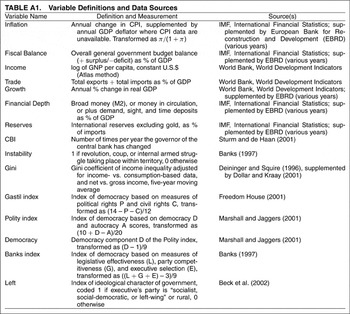
We consider several conditioning variables to be particularly important. We include the general consolidated government fiscal balance as a percentage of the GDP (Fiscal Balance), on the assumption that fiscal motives may drive inflation. We include the rate of annual GDP growth (Growth) to control for cyclical movements in the price level. We are also interested in controlling for the size of the financial sector, on the assumption that weaker financial sectors will prompt greater inflation.10
The use of seignorage revenues where private, voluntary markets for government securities are thin has been well documented in developing countries (Fry 1997). In weaker financial markets, individuals are less likely to have large cash holdings, savings, indexed pensions, and other instruments whose real value is prone to inflation-induced erosion. Thus it is that case that countries characterized by stronger, deeper financial markets are less prone to inflationary episodes due to both the presence of alternative sources of government finance, and equally importantly, because the “demand” for monetary stability is stronger in robust financial markets (Maxfield 1997).
One possible measure of this would be the outstanding claims on the private sector held by commercial banks. Unfortunately, this measure would not include commercial bank lending to the public or parastatal sector—a significant part of total bank credit in the transition economies, particularly during the high-inflation periods of the early 1990s. Another measure would be of total assets of the banking sector. This measure, however, is not available for most transition countries in our sample. Therefore, we use M2 as a percentage of GDP (
Financial Depth), which is a measure of outstanding banking-sector liabilities. This is an accepted measure of financial sector size and is widely available. Foreign reserves, as a percentage of imports (
Reserves), are included to control for currency flight and exchange rate management. We also include imports plus exports as a percentage of GDP (
Trade) to control for trade openness, and the log of per-capita GNP (
Income) to control for country wealth. An
Instability dummy is included, coded one if any revolution, coup, or armed conflict occurred within the borders of a country in a given year and zero otherwise. Finally, we include the lagged value of inflation,
Dt−1, to control for persistence in the dependent variable. All data sources are given in
Table A1 (see the Appendix);
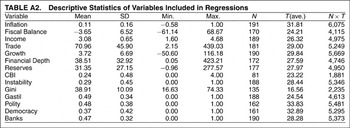
Table A2 contains descriptive statistics for all variables included in the regressions.
Benchmark Specification and Basic Results
Our first empirical model therefore takes the following autoregressive, interactive form:
where α, [phi], γ, βG, βP, and βGP are parameters to be estimated, and ε is a random disturbance, for i = 1,…, N countries, and t = 1,…, T years. We initially estimate equation (8) using ordinary least squares with panel-corrected standard errors (OLS-PCSE), where OLS estimates are used but where standard errors are adjusted for contemporaneous correlation as recommended by Beck and Katz (e.g., 1995, 1996, 2001). All estimations include a lagged dependent variable.
11 We also test for first-order serial correlation, i.e., that the error terms in equation (7) follow an AR(1) process
and report rho estimates. All estimations were performed using Stata 7.0.
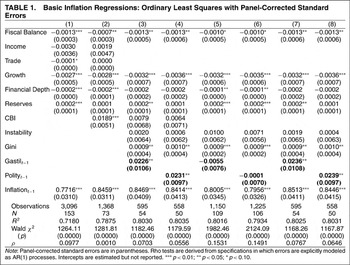
These basic regression results, excluding the interactive term, are reported in
Table 1. Regression (1) tests a basic economic model that considers inflation rates a result of fiscal policy, growth, financial sector depth, income levels, and economic openness. The fiscal, growth, trade, and financial depth terms all have the expected signs—surpluses, growth, greater trade openness, and larger financial sectors tend to be correlated with lower inflation levels.
In regression (2), we add a measure of central bank independence (CBI). Although analyses of OECD countries have generally found evidence supporting this view, empirical studies covering more countries have yielded little conclusive evidence of a robust connection across a range of countries, periods, and inflation rates, and the results have been considered highly sensitive to the sample and specification. Nevertheless, if CBI reduces the scope for discretion in monetary policy, then the inflationary bias induced by time-inconsistent monetary policies may also be limited. Thus we test whether our results are robust to the inclusion of CBI as a control variable. The familiar Cukierman index of legal independence, however, does not cover a sufficiently large number of countries over a consistent time series.12
Cukierman, Webb, and Neyapti (1992) find an inverse relationship between CBI and inflation, but their sample does not include postcommunist transition economies, and the CBI measures are separated by five-year gaps. More recently, comparable measures have been developed for 25 transition economies, and the evidence suggests that CBI is unrelated to inflation in the early stages of transition, i.e., when inflation is highest (Cukierman, Miller, and Neyapti 2002).
We rely, therefore, upon an expanded database of central bank governor turnover rates as a proxy for CBI taken from a recent study of developing countries (
Sturm and de Haan 2001) for two reasons. First, it is the most extensive measure of CBI currently available in panel format. Second, rather than measuring formal independence, it approximates the actual autonomy of the central bank governor—something not necessarily reflected in the legal index. Including
Central Bank Turnover in regression (2) cuts the sample size by over one-half (since advanced industrial and transition economies are no longer included) and removes the significance of the reserve and trade coefficients. The turnover rate of the central bank governor, however, is positively associated with inflation, confirming general findings about CBI in high-income countries.
13 We also used the “tenure” (in years) of the central bank governor as an alternative measure of CBI. The results were identical in all respects.
In regressions (3) through (8) we add the instability dummy as well as the Gini coefficient and alternate between our two measures of democracy. The trade and income measures have been removed (they are no longer significant; removing them does not alter the results in any way, and thus they are dropped from all subsequent estimations). Across all specifications, instability carries no significance. Inflation is associated, however, with income inequality, supporting claims in previous empirical work (Beetsma and Van Der Ploeg 1996). In regressions (3) and (4) both democracy measures are positively associated with inflation, also confirming earlier panel-data analyses. Central bank turnover, however, loses significance when these variables are added. Note that the sample size is further reduced, owing to the gaps in the data caused mainly by the unavailability of Gini data for several developing countries over the sample time period. In regressions (5) and (6) we remove central bank turnover, and the sample size doubles in each case. But in the larger sample, the democracy measures have lost their statistical significance. To ensure that these changes in the significance of the coefficients are not due to changes in the sample size, we reran estimations (5) and (6) with the same sample used in equations (3) and (4). The democracy measures are once again significantly positive—in columns (7) and (8)—suggesting that these results are sensitive to sampling. Rho tests throughout yield low estimates (0.001 to 0.153) and the use of an AR(1) process does not alter any results, suggesting that the lagged dependent variable captures most of the persistence in the dependent variable.
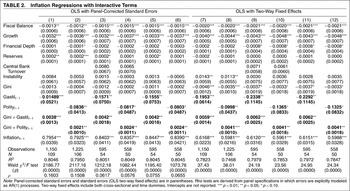
When the multiplicative terms are included in Table 2, the political variables become consistently significant. Regressions (1) and (2) use the full sample of available data. The measures of democracy are now significantly negative, while the coefficients on the interactive terms are significantly positive. As predicted, democratic regimes appear less likely to inflate than less competitive, more autocratic systems, but this effect is contingent upon the Gini coefficient: As the level of income inequality rises, the Gastil and Polity indices become positively associated with inflation. In regressions (3) and (4) we again add the central bank turnover term, which does not carry any significant sign. More importantly, the effects of the Gastil and Polity terms as well as the interactive terms are unchanged from the previous two estimations, and thus controlling for CBI does not influence our basic results. To ensure, again, that these results are robust to sampling, we rerun estimations (1) and (2) for the smaller sample and report the results in columns (5) and (6). The smaller sample size does not change the signs or the magnitudes of either the Gastil or Polity indices or their interactive terms.
To control for country-specific effects, we rerun all regressions (1) to (6) using OLS with fixed effects. We are also, however, interested in year-specific effects, since global inflation is generally perceived to have peaked in the 1980s. Thus we estimate the error term in equation (8) as
, including both time-invariant and cross-section invariant effects, in addition to the random disturbance. The results from these two-way fixed effects regressions are reported in columns (7) through (12). The linear and interactive effects of democracy both remain statistically significant, while the magnitudes of the coefficients actually increase by 19% to 67%. Moreover, the Gini coefficient is now negatively associated with inflation, indicating that high-inequality countries have lower inflation when time and country-specific intercepts are included.
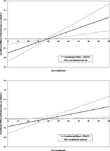
These conditional effects are depicted graphically in Figure 1, which plots the expected effect of the Gastil and Polity measures on inflation over a range of all possible Gini coefficients (though not the actual range, which is from 16.6 to 74.3).14
For illustrative purposes, upper and lower bounds for the 99% confidence interval are calculated from the variance–covariance matrix. In both cases, the conditional effects switch signs after some critical Gini value—39.6 in the case of the Gastil index, 40.0 in the case of the Polity index—above which the effect of these political measures on inflation becomes positive.
Sensitivity and Robustness
Alternative Measures of Democracy.
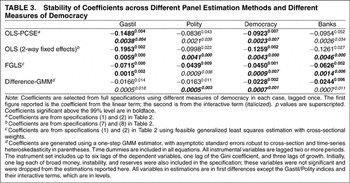
To test the robustness of our results to different measures of political democracy across different estimation techniques, we replaced the lagged Gastil/Polity terms in regressions (1) and (2) from Table 2 with two different alternatives, and reran these specifications using several different panel-data estimation methods. The first is the Democracy component of the Polity index, which ranges from zero to 10. The second is a measure of democracy taken from Banks (1997), using a composite of indicators of the effectiveness of the legislature vis-à-vis the executive, the competitiveness of the political nominating process, and freedom of group opposition (each of which are scored from one to three). The Democracy and Banks measures are both rescaled to yield indicators that range from zero to one.
In addition to the OLS-PCSE and two-way fixed effects models used in Table 2, we reran specifications (1) and (2) from Table 2 using feasible generalized least squares (FGLS) and a generalized method of moments (GMM) estimator. Table 3 shows selected results from these full regressions—specifically, the coefficients of the (linear) political variables and their interactions with the Gini coefficient. Gastil and Polity results are shown for comparison. All results are consistent with our previous findings: The linear coefficients are negative, and the interactive coefficients positive. With one exception, all coefficients are significant at 95% (the exception is significant at 90%). Of the 24 new coefficients generated, 19 are significant at the 99% level.
Endogeneity and Bias.
It has been argued that OLS estimates will generate inconsistent results in the presence of serial correlation in dynamic panels (Maddala 1997). The fixed-effects model, in addition, will generate biased estimates when applied to a dynamic panel, particularly in shorter time series.15
If the mean dependent variable and the mean error are correlated, demeaning the variables to eliminate country-specific effects (as the fixed-effects estimator does) introduces correlation between the demeaned, lagged dependent variable and the demeaned error term. Monte Carlo studies based on mean square error criteria generally show that the fixed effect model is better suited as T → 30 but that GMM estimators are preferable for T between 5 and 30 (Judson and Owen 1999). Average time series for the countries in our sample are generally less than 20 years. On problems of fixed effects models specific to political variables, see Green, Kim, and Yoon (2001) and Beck and Katz (2001).
have developed an alternative estimator, using a GMM technique that uses lagged values of the dependent and independent variables as valid instruments in a first-differenced equation, to develop a set of moment conditions that can be used to produce consistent results, even in smaller
T panels. An additional advantage of this GMM estimator is that it can remedy problems of reverse causality that may apply to several of our independent variables. Neither OLS-PCSE nor OLS with fixed effects deals satisfactorily with the potential problem of endogeneity. There is evidence, for example, that inflation can lead to low economic growth (
Barro 1995;
Bruno and Easterly 1998), financial disintermediation (
Boyd, Levine, and Smith 2001;
Khan, Senhadji, and Smith 2001), foreign reserve depletion (
Goldstein, Kaminsky, and Reinhart 2000), political instability (
Gasiorowski 1995), and inequality itself (
Easterly and Fischer 2001). The Arellano–Bond GMM estimator allows us to relax the assumption that economic growth, financial depth, reserves, instability, and inequality are strictly exogenous and treat these as endogenous variables.
To ensure that our results are not affected by these inconsistencies, we reformulate our empirical specification in accordance with the Arellano–Bond first-differenced GMM estimator.16
In an unrestricted Arellano–Bond estimator, one would use all available lags of the dependent variable lagged two periods or more as instruments. Instruments from earlier periods, however, become weaker in later periods when the sample is finite. A discussion of these techniques and the full set of results are given in the working-paper version of this paper, which is available upon request from the authors.
The results are reported in the last row in
Table 3. The coefficients confirm our general expectations from previous results. The democracy indices are negatively correlated with inflation, but this relationship is increasing in inequality. Overall, our GMM results support our governing hypothesis, that the relationship between democracy and inflation is contingent on income inequality, even if we control for the possible endogeneity of the independent variables.
Regional Effects.
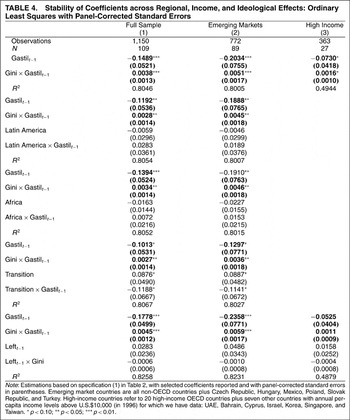
It is possible that the Gini coefficient is actually capturing a particular “regional effect”—for example, due to the possible coincidence of high inequality in Latin American and sub-Saharan African countries and low inequality in Transition economies—and that the effect of democracy on inflation, therefore, varies by particular region. To determine whether there is this sort of regional effect at work, we included three regional dummies and interacted the Gastil index with the regional dummy in separate regressions. Table 4 indicates that only the transition dummy is significant. In no case is the regional interaction term significant, however, indicating that the effect of democracy does not vary by region. Moreover, all of our previous results remain—the signs on the political term are negative, the signs on the political term interacted with Gini positive. The basic results are noted in the top panel of Table 4 for the purposes of comparison.
Income Effects.
We are also interested in whether the phenomenon we have described—that democracy increases inflation in high-inequality countries and decreases inflation in low-inequality countries—applies to all countries or whether the results are driven by emerging markets. To test country-income effects, we simply reran the basic regressions as well as the regressions with regional dummies and interactive terms only for non-OECD countries (“emerging” markets). We also reran the basic regressions restricting our sample to 20 high-income OECD countries plus seven non-OECD high-income countries. These results are in columns (2) and (3) in Table 4. The magnitudes of our basic coefficients increase when we constrain the sample to the emerging markets but decrease when applied to the high-income countries. In addition, the significance of our estimates falls to the 90% level from the 99% level. Finally, less than half of the variance is explained among the high-income observations. In short, it appears that our hypothesis has less explanatory force among the richer nations. This is to be expected—these countries have been consistently democratic for longer periods, and thus the marginal effects of democracy are likely to be smaller.
Populism vs. Democracy.
A possible critique of our analysis is that we have not drawn a sufficiently careful distinction between democratic regimes and populist regimes. To be sure, dictators are often subject to public pressures—a form of “quasi-participation” by the public. Although this criticism can be leveled at most empirical analyses of the effects of democracy, we take this criticism seriously, given the historical importance of populist systems in Latin America and other regions in which we are interested. It is, however, exceedingly difficult to distinguish a coherent “populist” ideology and, therefore, difficult to identify ex ante which political parties are populist and which are not (Dix 1985). We rely on the narrower definition of populism as referring to a set of policies aimed at the “disorganized underclasses,” involving redistributive measures (Stokes 2001). As such, populist programs are considered to overlap frequently those of socialist and left-leaning parties, particularly those that derive support from the urban and rural poor (Conniff 1999). To control for the presence of populist regimes, therefore, we use a Left dummy, taken from the Database of Political Institutions, coded one if the political party or faction of the chief executive is “defined as communist, socialist, social-democratic, or left-wing,” or if “rural issues [are] a key component of the party's platform, or if farmers are a key party constituency” (Beck et al. 2001). To see if the left dummy (lagged once) performs a similar function as the democracy measures, we interacted the left dummy with the Gini coefficient and reran the basic regressions from columns (1) and (2) in Table 2. The selected coefficients are presented in the bottom panel in Table 4. The inclusion of the left dummy does not alter our key results, nor is it by itself significant, either in the full sample or among the emerging markets. The inclusion of the left dummy, however, does weaken our results for the high-income countries.
Moderate, High, and Very High Inflation.
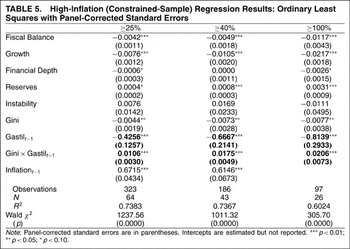
To test for sign-switching at extreme values of the dependent variable, finally, we constrain the sample to those country-year observations for which average annual inflation was greater than or equal to 25%, 40%, and 100%, plus three years after the last year of inflation above these thresholds. Because of the narrowness of the time scale for the ≥100% data (for which the average time series is less than four years), we do not include the lagged dependent variable in these specifications (rho tests revealed no substantial autocorrelation for this subsample). The results using OLS-PCSE are reported in Table 5.17
OLS results with two-way fixed effects were similar in all respects.
They show no sign-switching among either the political or the control variables. Moreover, the magnitudes of the coefficients for both the Gastil and the Polity indices and their interactive terms increase as we move from 25% to 40% to 100% thresholds, suggesting that the hypothesized relation applies with even greater force as the sample is constrained among the higher-inflation observations.
CONCLUSION
We have attempted to provide the outlines of a possible solution to one of the enduring puzzles in positive political economy, namely, the effect of regime type on inflation levels. In recent years the view that political participation, divided government, electoral competition, and political accountability will complicate matters of macroeconomic stability has been challenged by a view that supports the spread of democratic procedures as a means of challenging elites' private benefits from inflation. These approaches attribute inflationary demands to different key groups. Neither explanation, however, considers how certain prevailing conditions might shape preferences for inflation and define the political interactions by which monetary policies are made.
In a simple model we show that the effect of political regime on inflation is influenced by income inequality. Using a variety of panel-data estimation techniques, we found remarkably consistent and robust support for the claim that democracy and political competition affect inflation differently depending upon the level of income inequality. In countries with Gini coefficients generally below 40, democracy appears to help restrain inflationary pressures. Above that value, the effect reverses, and democracy and widespread political representation appear to generate inflation.
Our results explain the diverging experiences of Latin America during the debt crisis and of the postsocialist transition economies during the 1990s. In the Latin American cases, it is likely that higher levels of income inequality led to stronger pressures on government officials to use inflationary taxes to finance redistribution. Democratization and the spread of the electoral franchise in these countries, then, would have made price stability a more serious challenge. In the transition countries, in contrast, where 40–70 years of central planning had fashioned extremely equitable societies, governments that democratized did not feel pressures from the voting majority to use the inflation tax for increased redistribution. Indeed, the scenes of Latin American-style protests against stabilization programs did not materialize in the transition countries. In these countries, inflation spiraled not because of public pressures, but because of the private benefits elites obtained from channeling public resources to targeted groups—especially (often insolvent) enterprise borrowers—and democratization served as a check on these excesses.
Our analysis has identified some monetary disadvantages of democratic transition in high-inequality countries, perhaps leading to the troubling conclusion that democracy should be restricted in countries with high levels of income inequality in order to control inflation. There are, however, alternative implications of our analysis for institutional and policy design that may enable countries to maintain price stability while retaining the benefits of democratic rule. We mention two such implications here. First, our analysis suggests that redistribution in democratic societies with high levels of income inequality should reduce political pressures for inflation. Noninflationary redistributive programs—such as progressive taxation—that would not place fiscal burdens on governments would also ameliorate demands for inflationary financing by the poor.
Second, we found that, when controlling for regime type, the overall impact of central bank independence on inflation vanishes. While this may be a consequence of measurement difficulties, it nevertheless raises the possibility that insulated, autonomous central banks may not restrain the “passions” of populist politicians in democratic polities with high inequality. It is also likely that, in order to avoid becoming merely the clients of economic elites, central banks need to be insulated not only from popular pressures or from politicians, but also from the financial sector—normally thought of as the stalwart of price stability. We have seen, most prominently in the transition countries, several instances in which commercial banks benefited from central bank weakness, mainly because of the rents obtained from channeling centralized credits to borrowers. In either case, the influence of monetary institutions will be constrained by prevailing socioeconomic conditions and by the characteristics of political competition.






Comments
No Comments have been published for this article.