INTRODUCTION
Numerous parasites with complex life-cycles rely on trophic transmission to reach their definitive host (Poulin, Reference Poulin1998; Combes, Reference Combes2001). Some of these parasites have developed the ability to manipulate the behaviour of their intermediate hosts, increasing their susceptibility to predation and thus enhancing the probability of parasite transmission to the definitive host (see Moore, Reference Moore2002; Thomas et al. Reference Thomas, Adamo and Moore2005). This phenomenon is documented for a wide range of parasites, particularly larval helminths infecting arthropods or molluscs, for example, acanthocephalans (Bethel and Holmes, Reference Bethel and Holmes1973; Bakker et al. Reference Bakker, Mazzi and Zala1997), trematodes (Thomas and Poulin, Reference Poulin1998; Levri and Fisher, Reference Levri and Fisher2000), nematodes (Moore and Lasswell, Reference Moore and Lasswell1986), or cestodes (Poulin et al. Reference Poulin, Curtis and Rau1992; Pulkkinen et al. Reference Pulkkinen, Pasternak, Hasu and Valtonen2000). It is generally assumed that the alteration of host behaviour is of adaptive significance to the parasite (Poulin, Reference Poulin1995; Moore, Reference Moore2002; Thomas et al. Reference Thomas, Adamo and Moore2005). An alternative hypothesis is that the phenotypic modifications of the host are simply non-adaptive by-products (i.e., pathogenic effects) of parasitism, resulting from damage caused by the parasite or from host response to infection (Levri, Reference Levri1999; Poulin, Reference Poulin1995; Thomas et al. Reference Thomas, Adamo and Moore2005). The increased parasite transmission to the definitive host was found in a number of cases, either in natura or in controlled experiments (Moore, Reference Moore1983; Hoogenboom and Dijkstra, Reference Hoogenboom and Dijkstra1987; Lafferty and Morris, Reference Lafferty and Morris1996; Perrot-Minnot et al. Reference Perrot-Minnot, Kaldonski and Cézilly2007; Lagrue et al. Reference Lagrue, Kaldonski, Perrot-Minnot, Motreuil and Bollache2007). However, in numerous cases, laboratory experiments demonstrated behavioural modifications in parasitized intermediate hosts but did not measure the degree of trophic transmission to the definitive host (Poulin, Reference Poulin1995).
Cyathocephalus truncatus (Cestoda: Spathebothriidea) is a tapeworm that is widespread in Europe, using crustaceans, most often amphipods and usually Gammarus pulex, as intermediate hosts, and fishes as definitive hosts (Okaka, Reference Okaka1984). The larval stage requires approximately 10 weeks of development in the body cavity of the amphipod to reach the infective stage. Gammarids can live with these parasites for several months (Okaka, Reference Okaka1984), and the larva thus reaches a considerably larger size compared with that of the crustacean (Awachie, Reference Awachie1966; Okaka, Reference Okaka1984). Knudsen et al. (Reference Knudsen, Gabler, Kuris and Amundsen2001) showed that, in nature, Gammarus amphipods parasitized by the cestode were consumed approximately 8 times more than uninfected ones by Arctic charr (Salvelinus alpinus, one of the definitive hosts of C. truncatus). The authors thus suggested that this increased parasitic trophic transmission to the definitive host could be due to a modification of gammarid behaviour and/or appearance, caused by C. truncatus. However, this hypothesis has never been formally tested. Actually, while the infection by C. truncatus seems to have deleterious effects in fish host, its effects on its intermediate gammarid host remain poorly understood (Okaka, Reference Okaka1984 and references therein).
To test the hypothesis that behavioural changes are the cause for the increased trophic transmission of C. truncatus, the first aim of the present study was to examine the effects of C. truncatus on its intermediate host Gammarus pulex (Crustacea: Amphipoda) by comparing behaviours of infected versus uninfected gammarids. As a starting point, we chose to investigate traits already known to be modified by other trophically transmitted parasites infecting G. pulex, the acanthocephalans of the genus Pomphorhynchus. These parasites have the same intermediate and definitive hosts as C. truncatus, and they do change intermediate host behaviour in a way that increases trophic transmission (Perrot-Minnot et al. Reference Perrot-Minnot, Kaldonski and Cézilly2007; Lagrue et al. Reference Lagrue, Kaldonski, Perrot-Minnot, Motreuil and Bollache2007). Owing to the similar life-histories of these parasites, our prediction is that behavioural changes induced by C. truncatus could be close to those induced by Pomphorhynchus acanthocephalans in the same intermediate host, despite the limited relatedness of the parasites. The second aim of this study was to investigate whether the observed behavioural changes could be a side-effect of parasite-induced alterations of host fitness (Levri, Reference Levri1999; Franz and Kurtz, Reference Franz and Kurtz2002). We compared the oxygen consumption rate (which is a good index of metabolic activity; see Hervant et al. Reference Hervant, Mathieu, Barré, Simon and Pinon1997), the survival and a component of immunity in infected versus uninfected gammarids. For immunity, we compared levels of the hosts' phenoloxidase (PO) and prophenoloxidase (proPO) (Rigaud and Moret, Reference Rigaud and Moret2003). The pro-phenoloxidase cascade is a major component of the crustacean immune system, which is a general defence and non-self recognition system of arthropods, providing immunity against numerous pathogens (Nigam et al. Reference Nigam, Maudlin, Welburn and Ratcliffe1997; Söderhäll and Cerenius, Reference Söderhäll and Cerenius1998). We then investigated the correlations between some of these traits and the behavioural changes.
MATERIALS AND METHODS
Gammarus pulex were collected using a hand net, between September 2005 and June 2006 in a small tributary of the River Suzon, Burgundy, eastern France (N: 47°24,215′; E: 4°52,974′). For experimental purposes, parasitized individuals were actively sourced in the river; therefore, sampling did not reflect site prevalence. In this population, C. truncatus prevalence was low (usually less than 5%), but infected gammarids were easy to find, since the parasite is clearly visible through the cuticle of the host; due to the white colour and the large size of the worm, infected gammarids appeared white whereas uninfected ones were brown. To avoid confounding effects due to sex characteristics (such as size or physiological state due to reproduction), only males were included in this study.
In the laboratory, gammarids were maintained in well-aerated aquaria containing water at 15±1°C and leaf litter, using a 12 h:12 h light:dark cycle. At the end of the experiments, all individuals were killed with 70% alcohol and measured by linear dimensions (body height at the level of the 4th coxal plate basis, e.g. Bollache et al. Reference Bollache, Rigaud and Cézilly2002) using a stereoscopic microscope (Nikon SMZ 1500) employing Lucia G 4.81 software.
First experiment: behavioural and immunological measurements
Sixty-nine infected and 86 uninfected males were sampled from the field and were randomly used for 2 distinct experimental series. In the first series, reaction to light and activity were measured (with randomized order of presentation), and individuals were then tested for their immune defence. In a second series, reaction to light and activity were measured again, and the vertical distribution of the animals was also recorded (with randomized order of presentation).
To test the phototaxis of gammarids (a behaviour known to be modified by acanthocephalan parasites; Cézilly et al. Reference Cézilly, Grégoire and Bertin2000), the experiment was designed as described in Perrot-Minnot (Reference Perrot-Minnot2004). A single gammarid was introduced into a horizontal tube filled with 120 ml of aerated water (15±1°C), with a dark zone and a light zone of equal size, under a light intensity of 1300 lux. After a 5 min period of acclimatization, the position of the gammarid was recorded every 30 s during 5 min. At each observation, a score of ‘0’ was given if the individual was located in the dark area, whereas a score of ‘1’ was given if it resided in the illuminated area. At the end of each trial, summed scores ranged from ‘0’ (strongly photophobic) to ‘10’ (strongly photophilic).
In order to evaluate the influence of infection on the swimming activity of gammarids (a behaviour known to be modified by cestode parasites, e.g. Pulkkinen et al. Reference Pulkkinen, Pasternak, Hasu and Valtonen2000), we used the same experimental procedure and apparatus as used in the test for assessing the reaction to light, but the tubes were left transparent, and a line was drawn in the middle. A single gammarid was introduced into each tube. After an acclimatization period of 5 min, the number of times an individual crossed the median line within a period of 5 min was recorded.
Vertical distribution of gammarids in the water column (a behaviour known to be modified by some acanthocephalan species) was recorded following the method of Bauer et al. (Reference Bauer, Haine, Perrot-Minnot and Rigaud2005). A single gammarid was introduced in a vertical tube filled with 500 ml of aerated water at 15±1°C, where graduations were marked to define 5 levels of 5 cm height each. The light intensity was uniform within the cylinder. After 5 min of acclimatization, individual positions were recorded every 30 s in a time-interval of 5 min, and a score ranging from ‘1’ (bottom level) to ‘5’ (top level) was given. At the end of each experiment, the sum of scores ranged from ‘10’ (always at the bottom level) to ‘50’ (always at the top level).
The pro-phenoloxidase (proPO) cascade is involved in the melanization and encapsulation processes (Söderhäll and Cerenius, Reference Söderhäll and Cerenius1998; Sugumaran et al. Reference Sugumaran, Nellaiappan and Valivittan2000). The key catalysing enzyme, phenoloxidase (PO), is stored mainly in haemocytes as the inactive pro-enzyme proPO, which is rapidly activated upon infection. Hence, whilst the amount of naturally inactive and active enzymes together (proPO plus PO) in the haemolymph relate to the maintenance of the proPO system, the amount of naturally activated PO enzymes relate to its use. Immune assays were performed following a procedure adapted from Rigaud and Moret (Reference Rigaud and Moret2003). Haemolymph extracts were taken by wounding (with fine scissors) gammarids between the 7th and 8th dorsal segment. Two ml of a haemolymph droplet from the wound was collected into a sterile, pre-chilled glass capillary and flushed into a 0·5 ml microcentrifuge tube containing 18 μl of cold sodium cacodylate/CaCl2 buffer. All samples were frozen in liquid nitrogen and stored at −80°C. For each individual haemolymph extract, the activity of naturally activated phenoloxidase (PO) enzyme and the activity of the pro-enzymes (proPO), in addition to that of the PO (total activity), was measured using a spectrophotometric assay. PO activity was quantified without further activation, whilst total activity required the activation of the proPO into PO with chymotrypsin (Sigma C-7762). After thawing on ice, 5 μl of haemolymph extract were added to a microtitration plate well containing 20 μl of phosphate-buffered saline (PBS, pH 6·5) and either 140 μl of distilled water to measure PO activity, or 140 μl of chymotrypsin solution (0·07 mg/ml of distilled water) to measure total activity. Then 20 μl of L-Dopa solution (Sigma D-9628, 4 mg/ml) were added to each well. The reaction was allowed to proceed at 30°C in a spectrophotometric reader (Versamax, Molecular Devices) for 40 min. Readings were taken every 15 s at 490 nm and analysed using the software SOFT-Max®Pro. 4.0 (Molecular Devices). Enzyme activity was measured as the slope (Vmax value) of the reaction curve during the linear phase of the reaction, and adjusted to the activity of 1 μl of pure haemolymph.
Second experiment: measurement of oxygen consumption and ventilatory activity
For this experiment, a second sample of 26 infected and 26 uninfected males was used. Locomotive activity was measured, as in the first experiment (before the measurement of their respiration activity). Their oxygen consumption and ventilatory activity were measured using a modified Warburg constant volume system (Hervant et al. Reference Hervant, Mathieu, Barré, Simon and Pinon1997). In order to standardize their digestive metabolism (known to influence the oxygen consumption activity), all individuals were deprived of food for 48 h prior to the experiment. The Warburg reaction vials did not allow animal movement, such that the metabolic measurements were made without swimming expenditure. The vials were placed in a water bath and the entire respirometer system was kept in a temperature-controlled chamber at 14°C. The respirometers were not shaken, allowing the animals to respire without stress. After an acclimatization period (30 min), oxygen consumption was measured every 10 min during a period of 1 h. Ventilatory activity (number of pleopod beats/min) was evaluated visually in the Warburg reaction vials, without agitation. At the end of the experiment, all individuals were measured dried at 45°C for 24 h and weighed (±0·01 mg) on a balance (26ZSMA-FR, Precisa). Cestodes were dissected from infected gammarids and were weighed individually.
Third experiment: survival to starvation
We assessed the survival of individuals using a third sample of 41 parasitized and 49 unparasitized male gammarids. Each individual was placed in a separate small glass jar filled with 15 ml of water at 15±1°C. Gammarids were kept in the same water, without an oxygen supply and under food deprivation, in order to induce stress. Stressful conditions are known to be the most likely conditions in which differences in survival can be detected (e.g., Moret and Schmid-Hempel, Reference Moret and Schmid-Hempel2000). The jars were checked once a day during a period of 75 days. Dead individuals were measured, and, if the individual was parasitized, the total length of the parasite (fully extended in water) was also measured.
Statistics
Most of the data resulting from the behavioural measurements and the immune assays were not normally distributed and could not be transformed satisfactorily (Quinn and Keough, Reference Quinn and Keough2002). Consequently, these data were analysed using non-parametric statistical tests (Kruskal-Wallis or Wilcoxon tests). In the first experiment, data on activity met conditions of homoscedasticity, and were thus analysed using a mixed ANCOVA model which included infection status and experimental series as fixed factors, order of behavioural measurements as a random factor nested within experimental series, gammarid size as covariate, and the interaction between gammarid size and infection status. The oxygen consumption, ventilation and activity measurements in the second experiment all met conditions of homoscedasticity. These data were analysed using an ANCOVA, including gammarid dry mass as covariate, infection status as fixed factor and their interaction. The survival data from the third experiment were analysed using a Cox regression method, including gammarid size, parasite size and time as covariables. Correlations between the traits were investigated using Pearson or Spearman correlation tests, depending on whether they met homoscedasticity conditions or not, respectively. Multiple comparisons were corrected for using Bonferroni-correction. All tests were performed using the programs JMP version 5 (SAS Institute, Cary, USA) or SPSS version 11 (SPSS Inc., Chicago, USA).
RESULTS
Behavioural and immunological measurements
We found no difference in size between G. pulex males infected or uninfected by C. truncatus (t=0·5, d.f.=153, P=0·62).
Since the reaction to light was measured in 2 independent series (the first one where individuals were also tested for their immune defences, and the second one where vertical distribution was also investigated), a factor ‘experimental series’ was analysed. The gammarids' reaction to light was not significantly influenced by experimental series (Wilcoxon test, Z=−0·02; P=0·98), or by the order of behavioural experiments within each series (Z=0·36; P=0·72 and Z=−0·24; P=0·81, respectively).
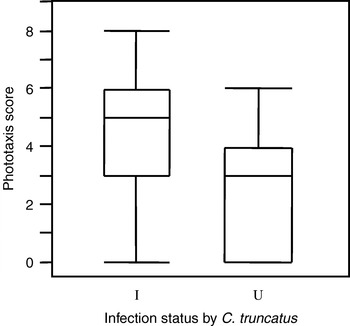
Infected G. pulex were found to be less photophobic than uninfected ones (Wilcoxon test, Z=5·43; P<0·0001; Fig. 1). We found no correlation between gammarid size and degree of phototactism, either in infected animals (ρ=0·17; P=0·16) or in uninfected ones (ρ=0·008; P=0·94). Finally, no correlation was found between parasite size and phototactism score (ρ=0·09; P=0·51; n=51). Therefore, only the infection status was found to significantly influence G. pulex reaction to light.
Phototaxis score of Gammarus pulex males according to their infection status by Cyathocephalus truncatus. I, infected individuals (n=69); U, uninfected individuals (n=86). Lines are medians, boxes are interquartile range, bars are interdecile range.

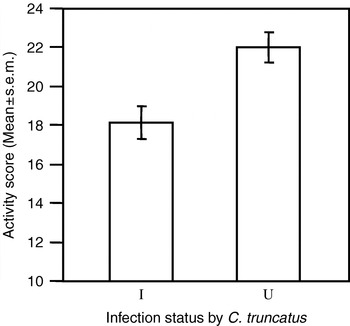
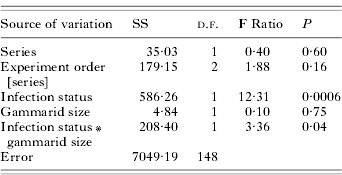
Since activity was measured in 2 independent series, a factor ‘experimental series’ was introduced in the mixed ANCOVA model. The analysis revealed no significant effect of the series or of the order of behavioural experiments. However, parasitized gammarids were significantly less active than uninfected ones (see Table 1 and Fig. 2). However, this parasitic effect was dependent on gammarid size, with large infected animals tending to be more active than smaller ones (see Status∗Size, Table 1). No correlation was found between activity score and parasite size (ρs=−0·06; P=0·66; n=51).
Activity score of Gammarus pulex males according to their infection status by Cyathocephalus truncatus. I, infected individuals (n=69); U, uninfected individuals (n=86).

Mixed ANCOVA testing the effect of series, experimental order (nested within series, random factor), infection status by Cyathocephalus truncatus and gammarid size on the swimming activity of Gammarus pulex
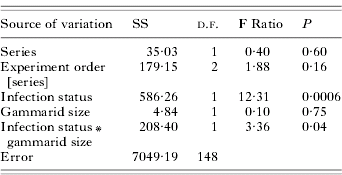
Global model: F6,148=3·46; P=0·003.
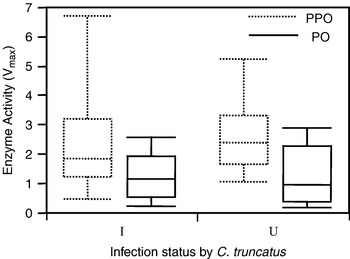
Total concentration of phenoloxydase enzyme (revealed by total activity) and that of active enzyme (PO activity) were similar in parasitized and unparasitized gammarids (Fig. 3; Wilcoxon test: Z=−1·25; P=0·21, and Z<0·00001; P=1, respectively) and these data did not correlate with the size of the gammarids (ρs=0·09; P=0·50; ρs=−0·08; P=0·54, respectively, n=58).
Enzyme activity (measured as Vmax, see text) for pro-phenoloxidase (PPO) and phenoloxidase (PO) in Gammarus pulex males, according to their infection status by Cyathocephalus truncatus. I, infected individuals (n=24); U, uninfected individuals (n=34). Lines are medians, boxes are interquartile range, bars are interdecile range.

The vertical distribution of G. pulex was not significantly different among behavioural experiments (Kruskal-Wallis, χ25=3·37; P=0·64). The infection status did not influence median location of individuals (Wilcoxon test, Z=−0·09; P=0·93, n=37 infected and 34 uninfected individuals), the majority of individuals being located consistently at the bottom of the water column during measurements. No correlation was found between vertical distribution score and G. pulex size (ρs=−0·13; P=0·29; n=71), or parasite size (ρs=0·05; P=0·81; n=22).
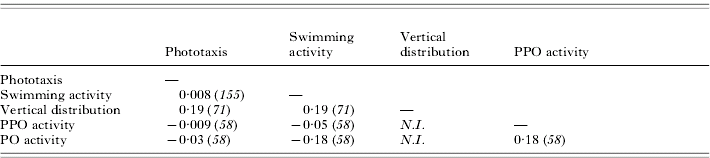
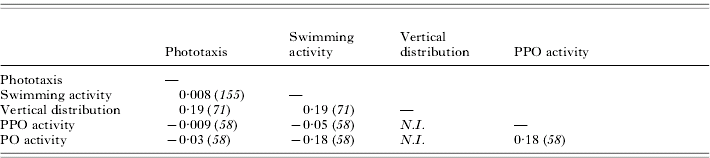
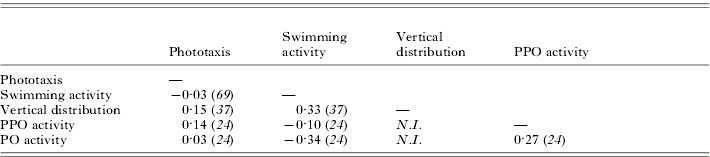
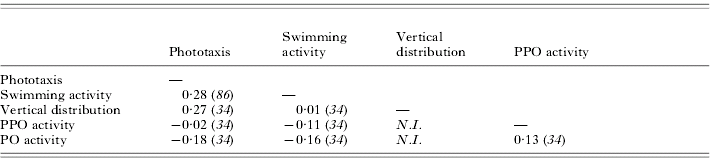
No significant correlation was apparent between the different phenotypic traits under investigation in this experiment. This was true when the analysis included data for all animals (infected and uninfected), and when uninfected and infected individuals were analysed separately (Table 2).
Non-parametric correlations between traits under investigation (values of Spearman's ρ). (A) All individuals grouped (infected by Cyathocephalus truncatus and uninfected); (B) animals infected by C. truncatus only; (C) uninfected animals only.
(Sample size is given in italics within parentheses. PPO: Pro-Phenoloxydase; PO: Phenoloxydase; N.I.: not investigated. None of these correlations was significant after Bonferroni's correction.)
A
B
C
Ventilation, oxygen consumption and activity
The dry mass of uninfected versus infected gammarids (excluding parasites) was significantly different (11·01 mg±0·34 and 8·29 mg±0·40, respectively, t=5·12, d.f.=50, P<0·0001). The mean dry mass of C. truncatus was 1·77 mg±0·12, representing from 10% to 32% of the gammarid dry mass. When added to the parasite mass, the dry mass of infected hosts was not significantly different from uninfected gammarids (t=−1·56, d.f.=50, P=0·12). These latter values (parasites+host for infected animals) were used as covariables in the following analyses.
The gammarids' activity was significantly influenced by both their dry mass and their infection status (ANCOVA global model: F3,48=11·56, P<0·0001). As for the first experiment, the activity of infected animals was significantly reduced compared with that of uninfected ones (F1,48=19·75, P<0·0001). There was no effect of dry mass per se (F1,48=0·29, P=0·59), but the interaction between dry mass and infection status was significant (F1,48=11·51, P=0·001). Activity was positively associated with gammarid mass in infected animals, but not in uninfected ones (results not shown).
The number of pleopod beats per min was similar between uninfected and infected animals (114·3±4·4 and 116·7±4·7, respectively) (global ANCOVA model including infection status and gammarid dry mass as factors: F3,48=0·06; P=0·98).
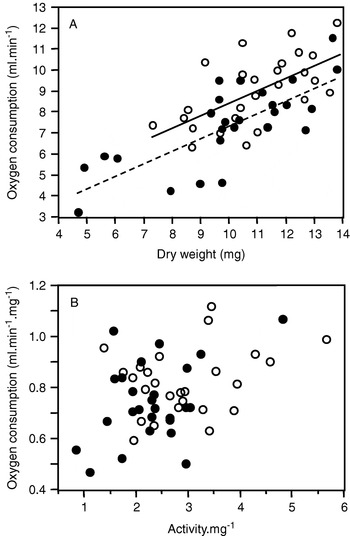
Oxygen consumption was influenced by infection status (F1,48=9·23, P=0·004) and by gammarid dry mass (F1,48=47·39, P<0·0001), but not by the interaction between these factors (F1,48=0·28, P=0·60; Global model: F3,48=22·23, P<0·0001). Therefore, at equivalent dry mass, G. pulex infected by C. truncatus consume less oxygen than uninfected individuals (Fig. 4A).
Oxygen consumption of Gammarus pulex males, according to their infection status by Cyathocephalus truncatus, and according to gammarid dry mass (A) and activity (B). Empty dots are uninfected individuals, black dots are infected individuals. In (B) both oxygen consumption and activity were corrected by gammarid dry mass.

To investigate the correlation between costs of oxygen consumption and activity, the data were corrected for dry mass. A positive and significant correlation was found when the 2 infective statuses were grouped (r=0·40; P=0·003, Fig. 4B). When the 2 infection statuses were separated, the correlation was significant for infected animals (r=0·42; P=0·03) but not for uninfected ones (r=0·28; P=0·16) (Fig. 4B).
Survival of starvation
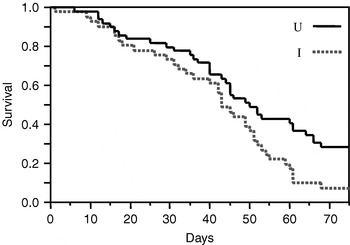
The best Cox regression model did not include gammarid and parasite size on their own or in interaction, suggesting that these parameters did not significantly influence survival (results not shown). Therefore, they were removed from the final analysis. The results of the Cox regression model showed that infected gammarids had a survival time to starvation reduced by a factor of 1·35 compared with uninfected individuals (Fig. 5, likelihood ratio χ2=5·53, P=0·018).
Survival pattern of Gammarus pulex males according to time and according to their infection status by Cyathocephalus trucatus. I, infected individuals (n=41); U, uninfected individuals (n=49).

DISCUSSION
G. pulex infected by C. truncatus were indifferent to light compared with the more photophobic, uninfected animals. However, both infected and uninfected gammarids preferred the bottom of the water column. These patterns of phototaxis and vertical distribution are similar to those induced in G. pulex by the acanthocephalans Pomphorhynchus laevis and P. tereticollis (Cézilly et al. Reference Cézilly, Grégoire and Bertin2000; Perrot-Minnot, Reference Perrot-Minnot2004); they do not induce a change in geotropism but do alter light taxis. Behavioural manipulations by acanthocephalans have been found to increase predation of infected amphipods by definitive hosts (e.g., Bethel and Holmes, Reference Bethel and Holmes1977; Bakker et al. Reference Bakker, Mazzi and Zala1997; Perrot-Minnot et al. Reference Perrot-Minnot, Kaldonski and Cézilly2007). Particularly in P. laevis, attraction to light makes the gammarids more prone to be found in the river current, where numerous predatory fish usually hunt (Lagrue et al. Reference Lagrue, Kaldonski, Perrot-Minnot, Motreuil and Bollache2007). Both P. laevis and C. truncatus use drift-hunting fish like trout as the definitive hosts, and are thus ecologically closely related. Therefore, we can reasonably propose that the change in phototaxis induced by C. truncatus in G. pulex partially explains the increase in predation rate observed by Knudsen et al. (Reference Knudsen, Gabler, Kuris and Amundsen2001).
C. truncatus infection was also linked to lowered swimming activity in G. pulex. While in some crustacean species infected by cestodes, a decreased activity may reduce escape behaviour and thus increase predation risk (Pulkkinen et al. Reference Pulkkinen, Pasternak, Hasu and Valtonen2000), in gammarids a decrease in swimming activity is known to relate to anti-predatory behaviour (e.g., Bollache et al. Reference Bollache, Kaldonski, Troussard, Lagrue and Rigaud2006 and references therein). Therefore, it is improbable that this behavioural alteration contributes to increased predation of infected intermediate hosts. Furthermore, the magnitude of this trait was correlated with that of the oxygen consumption in infected hosts, and thus, a decrease in these two traits probably reflects a pathogenic effect of the parasite.
Levels of immune defence were not affected by infection of G. pulex with C. truncatus. Contrasting results were obtained by Rigaud and Moret (Reference Rigaud and Moret2003), who found that P. laevis manipulated the level of immune defence in G. pulex, thus decreasing the capacity of its intermediate host to fight off parasites. This decrease in the level of immune defences has been interpreted as an active manipulation from the parasite, ensuring its survival probability in the intermediate host prior to transmission to the definitive host (Rigaud and Moret, Reference Rigaud and Moret2003). The present results suggest that infection by a macro-parasite is not systematically associated with a decrease in the degree of immune defence in G. pulex, and that the effects on immunity are likely to be parasite specific (see also Moret et al. Reference Moret, Bollache, Wattier and Rigaud2007 for another example). However, C. truncatus also has to cope with the immune system of its intermediate host; the mechanism of immune evasion used by this cestode might be distinct. Instead of actively immunosuppressing the intermediate host, C. truncatus may potentially evade the immune response via molecular mimicry (Damian, Reference Damian1964). However, the present investigation of the potential immune manipulation of G. pulex by C. truncatus was restricted to the ProPO system. Other immune pathways might be more relevant for gammarids to resist infection by the cestode that this one may suppress. The examination of several immune pathways in infected and uninfected gammarids by C. truncatus would help answer this specific question.
We found a negative effect of infection on the survival of individuals exposed to stress. Okaka (Reference Okaka1984) reported that parasitized individuals lived as long as non-infected ones, but this observation was not based on a formal survey under conditions of stress. The same author also observed that infected amphipods usually had smaller, fat bodies than non-infected individuals. Indeed, larval tapeworms depend on their host for nutritional requirements, which are obtained by absorption via their body surface. Therefore, the parasite may reduce the amount of nutritional reserve in the gammarid, which may explain the survival cost observed in our experiment. Also, the oxygen consumption was significantly decreased in parasitized individuals. Decreases in host respiration have also been reported for Gammarus infected by the acanthocephalan P. laevis (Rumpus and Kennedy, Reference Rumpus and Kennedy1974). Such alterations of host physiology are not surprising and have been discovered in other parasitic systems (e.g., Webb and Hurd, Reference Webb and Hurd1999). In the present study, oxygen consumption was correlated with swimming activity in infected animals, with both of these parameters being lowered by the infection. The alterations in host respiration and the decrease in swimming activity might reflect either the fact that infected gammarids adopt a strategy of ‘energy economy’ or a distinct pathogenic effect of C. truncatus. Such an effect may be due to the substantial size of the parasite relative to the gammarid (the cestode can account for a mean weight of 10% to 30% of the total dry mass of infected amphipods; Okaka, Reference Okaka1984; present study). It is also worth noting that the change in the photo-behaviour of the host by C. truncatus was not correlated with the alteration of activity. Thus, the modification of the gammarid reaction to light seems to be a behavioural manipulation by the parasite, independent of pathogenic effects of C. truncatus. These results are reminiscent of the phenotypic alterations induced by another cestode, Schistocephalus solidus, in one of its intermediate hosts, the three-spined stickleback. This trophically transmitted worm, which is considered as a ‘behavioural manipulator’ (Milinski, Reference Milinski1985), also alters several traits of host fitness, including swimming ability, oxygen consumption and survival (Arme and Owen, Reference Arme and Owen1967; Walkey and Meakins, Reference Walkey and Meakins1970; Barber and Svensson, Reference Barber and Svensson2003).
Various other tapeworms have been reported to induce changes in behaviour in their crustacean intermediate host, but the effects seem to be very diverse and sometimes act in opposing directions (Poulin et al. Reference Poulin, Curtis and Rau1992; Pasternak et al. Reference Pasternak, Huntingford and Crompton1995; Urdal et al. Reference Urdal, Tierney and Jakobsen1995; Pulkkinen et al. Reference Pulkkinen, Pasternak, Hasu and Valtonen2000). Furthermore, the intermediate hosts concerned were copepods and not amphipods. Therefore, it is difficult to draw a general conclusion regarding behavioural manipulation by cestodes from comparisons between our experiments and those described in the literature. On the contrary, it is interesting to note the similarity in the patterns of behavioural changes induced in G. pulex by the phylogenetically distant parasites C. truncatus and Pomphorhynchus acanthocephalans. It would be interesting to investigate whether this similarity between parasites from different phyla is also found at the functional level, as it is between two Pomphorhynchus species (Tain et al. Reference Tain, Perrot-Minnot and Cézilly2006), which would provide insight into the degree of evolutionary convergence between these two parasite groups.
N. F. was funded by a doctoral grant from the MENESR. We thank G. Bouët, M. Galipaud, and T. Tisin for help with collecting infected gammarids.