Rheumatic heart disease, although almost eradicated in well-resourced settings, has widespread and devastating effects in Africa.Reference Marijon, Mirabel, Celermajer and Jouven 1 , Reference Sims Sanyahumbi, Colquhoun, Wyber and Carapetis 2 Rheumatic heart disease is estimated to affect up to 32.9 million people worldwide and cause 275,100 deaths/year.Reference Mortality 3 Rheumatic heart disease is caused by cumulative exposure to acute rheumatic fever, which can result in severe cardiac valve damage.Reference Marijon, Mirabel, Celermajer and Jouven 1 World Heart Federation guidelines released in 2012 now provide consensus for rheumatic heart disease diagnosis by echocardiography.Reference Remenyi, Wilson and Steer 4 Echocardiography-based rheumatic heart disease screening programmes have been shown to be sensitive in detecting early disease.Reference Carapetis, Steer, Mulholland and Weber 5 , Reference Zachariah and Samnaliev 6 Early detection combined with effective secondary prevention has been shown to dramatically reduce morbidity and mortality.Reference Marijon, Mirabel, Celermajer and Jouven 1 , 7 The severe shortage of specialised healthcare providers in rheumatic heart disease endemic areas remains one of the major barriers to implementation of widespread echocardiographic screening.
Task shifting to clinical officers may be a strategy to move towards larger-scale screening for rheumatic heart disease. Task shifting is defined as the transfer of a task normally performed by a more highly trained heathcare worker to another with a different, usually lower, level of training. Task shifting has been shown to have a positive impact in low- and middle-income countries. This strategy has been recommended by the World Health Organization for low- and middle-income countries.Reference Some, Edwards and Reid 8 – 10
Rheumatic heart disease is associated with poverty. Malawi is one of the poorest countries in the world, with a gross national income per capita of $250. 11 There are 0.19 physicians per 1000 people in Malawi 12 and no in-country paediatric cardiologist. No in-country cardiac valve surgery exists, and therefore people with advanced rheumatic heart disease are generally left with substantial disability. Early identification of asymptomatic disease and enrolment in effective secondary prevention programmes can provide a cost-effective way to prevent morbidity and mortality from this disease.Reference Pelajo, Lopez-Benitez, Torres and de Oliveira 13 , Reference Karthikeyan, Zuhlke and Engel 14
Malawi has been found to have a high prevalence of both latent and advanced rheumatic heart disease. “Latent” rheumatic heart disease refers to echocardiographic evidence of rheumatic heart disease with no known history of acute rheumatic fever and no clinical symptoms. Our team found a latent rheumatic heart disease prevalence of 3.4% among asymptomatic school children who were screened.Reference Sims Sanyahumbi, Sable, Beaton and Chimalizeni 15 With respect to advanced rheumatic heart disease, one study showed that 34% of 3908 adult patients attending cardiac clinic in northern Malawi had rheumatic heart disease.Reference Soliman and Juma 16 In a paediatric cardiology clinic in southern Malawi, 22% of 250 children followed-up had rheumatic heart disease.Reference Kennedy and Miller 17 Thus, expanding the capacity to screen for rheumatic heart disease and enrol affected children in secondary prophylaxis programmes to receive monthly penicillin injections may have a great impact in reducing the sequaelae of this disease.
With so few physicians in Malawi, it is not feasible for rheumatic heart disease screening to be led by physicians. There is also nursing shortage in Malawi. Task shifting from physician-led to clinical officer-led rheumatic heart disease screening is a more sustainable option.
To date, all rheumatic heart disease screening performed in Malawi has been phyisician led.Reference Sims Sanyahumbi, Sable, Beaton and Chimalizeni 15 Given human resource limitations, task shifting from physician-led to clinical officer-led rheumatic heart disease screening may be a more sustainable option for widespread screening. Clinical officers are Malawian mid-level providers who provide most of the medical care in Malawi. The objective of our study was to evaluate whether clinical officers with no previous echocardiographic experience could be trained to accurately screen for rheumatic heart disease. We hypothesised that after completing training with lectures, rheumatic heart disease screening modules, and mentored attachments, clinical officers would have similar agreement in identifying rheumatic heart disease as a trained paediatric cardiologist.
Materials and methods
The Institutional Review Boards of Baylor College of Medicine, University of North Carolina, and Malawi National Health Sciences Research Committee approved the study. Before screening, the study team met with the administration of the participating school. Village chiefs, teachers, parents, and students were invited to a school-wide educational session on rheumatic heart disease and study procedures. All students aged 5–16 years were invited to take part in the study. All parents or guardians of participants were consented, and participating students aged 7 years or older documented assent.
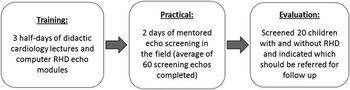
We evaluated the efficacy of clinical officer-led echocardiographic screening for rheumatic heart disease in Malawi, Africa (Fig 1). Our trainee group consisted of eight clinical officers who were in a bachelor’s degree programme for clinical officer paediatric specialty certification. These clinical officers previously completed 3 years of clinical officer school, and five clinical officers have been practising as clinical officers in Malawi for more than 5 years.
Study protocol flow chart.

Clinical officers first underwent basic cardiology and echocardiography training through three half-days of didactic lectures and computer-based training modules (WiRED International, http://www.wiredhealthresources.net/EchoProject/index.html). A paediatric cardiologist (A.S.) gave the lectures. The computer modules have been developed by experts in rheumatic heart disease and have been validated as effective training tools.Reference Beaton, Nascimento and Diamantino 18 – Reference Zeger and Liang 20 Training was provided at Kamuzu Central Hospital in Lilongwe, Malawi, where the clinical officers were based for their bachelor’s degree training. After completion of classroom training, each clinical officer spent 2 hours learning basic practical image acquisition skills on volunteer patients. This session was supervised by a paediatric cardiologist (A.S.).
The clinical officers attended mentored screening attachments with the study’s primary investigator (A.S.) to gain hands-on rheumatic heart disease screening training at a primary school in the Lilongwe school district. This school was chosen with the guidance of personnel from the Malawi Ministries of Health and Education. Each clinical officer completed 2 days of mentored hands-on training (6 hours each day) and completed at least 60 mentored focused screening echocardiograms.
Echocardiographic studies were obtained using a Philips CX50 (Best, Holland) portable echocardiography machine with an S5-1 transducer probe. Studies were carried out using an abbreviated rheumatic heart disease echo screening protocol. Studies utilised parasternal long-axis and apical four-chamber views with and without color Doppler with settings appropriate for World Heart Federation characterisation of rheumatic valve lesions.Reference Remenyi, Wilson and Steer 4 Additional parasternal short-axis and spectral Doppler loops were obtained in studies with concern for rheumatic heart disease. Negative studies generally consisted of eight loops, and suspected positive studies had an additional four to six loops. Recorded views included parasternal long-axis with and without color Doppler and apical four- and five-chamber views with and without color Doppler.Reference Remenyi, Wilson and Steer 4
With guidance from the primary investigator, the clinical officers diagnosed lesions on-site as to whether they would “refer” or “not refer”. Referral criteria included mitral regurgitation jet more than 1.5 cm, or any aortic regurgitation. We chose these referral criteria on the basis of a previous study that showed the combined criteria of mitral regurgitation >1.5 cm and any aortic regurgitation showed good specificity and sensitivity in identifying rheumatic heart disease from screening echocardiograms.Reference Lu, Sable and Ensing 21 Clinical officers were not asked to record short-axis or spectral Doppler views.
For the evaluation phase of the study, each clinical officer evaluated the same set of 20 children. These children were from a group that was previously screened for rheumatic heart disease.
Children had a screening echocardiogram performed by each clinical officer who was blinded to the diagnosis. The clinical officers performed the screening from start to finish, from positioning the child, performing the scan, and interpretation of results. They had an average of 10 minutes to complete each scan. After each scan, they completed an evaluation in which they indicated whether they would refer the child for cardiologist follow-up on the basis of above-mentioned criteria. The clinical officer results were compared with that of a trained paediatric cardiologist (A.S.). An echocardiogram was performed on each child by the cardiologist before the clinical officer-led screening echocardiograms were performed.
Agreement between clinical officers and cardiologist referral diagnoses as well as inter-clinical officer agreement were assessed using a κ statistic for each clinical officer–cardiologist and clinical officer–clinical officer pair. The mean κ statistic for all clinical officer–cardiologist pairs and all clinical officer–clinical officer pairs was estimated with a 95% confidence interval. κ Statistic was also used to compare clinical officer referrals to World Heart Federation Diagnoses. Sensitivity and specificity for whether the child had rheumatic heart disease by World Heart Federation criteria were estimated using a generalised linear mixed model with a random effect for clinical officer. Sensitivity and specificity using the 1.5-cm (referral) cut-off were also calculated. A marginal model using empirical (sandwich) estimators was used to model the correlated data.Reference Zeger and Liang 20
Results
A total of eight clinical officers completed the education, training, and evaluation phases of the study. None of the clinical officers had previous echocardiography experience; three of the clinical officers had some previous ultrasound experience, primarily with abdominal ultrasounds.
Of the 20 children that were evaluated, 12 had mitral regurgitation >1.5 cm, and eight of them did not have significant mitral or aortic regurgitation. Of the 20 children, 10 had borderline or definite rheumatic heart disease as defined by World Heart Federation standards, with mitral regurgitation >2 cm.
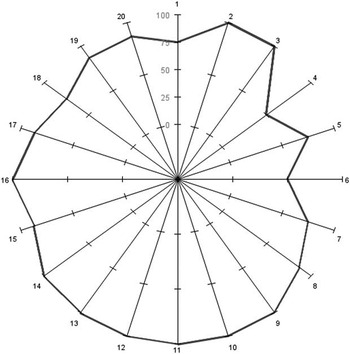
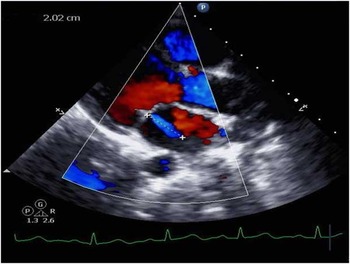
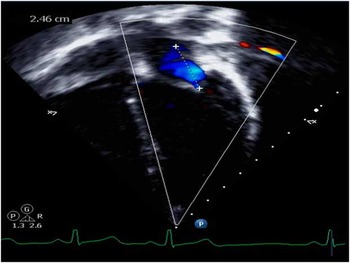
Clinical officers were instructed to “refer” if they found a mitral regurgitation jet that measured more than 1.5 cm. The clinical officers had high accuracy of correct diagnoses as to whether they would “refer” or “not refer” (Fig 2). The minimum number of correct responses was 16 (out of 20), and the maximum number of correct responses was 19. Only half of the clinical officers correctly diagnosed patients 4 and 6, and 75% of the clinical officers correctly diagnosed patients 1, 5, and 7. The remainder of the patients was correctly diagnosed by >87.5% of the clinical officers (Fig 2 and 3).
Percentage of clinical officers with correct referral response by patient.

Appropriate mitral regurgitation measurement.

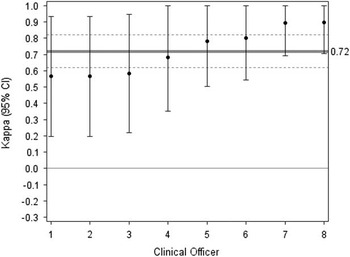
The overall mean κ estimate for agreement between clinical officer and cardiologist referral, using the 1.5-cm cut-off for length of mitral regurgitation, was 0.72 (95% confidence interval: 0.62, 0.82) (Fig 4), indicating, on average, substantial agreement. The minimum and maximum κs were 0.57 and 0.90. All κs were significantly greater than 0 (p⩽0.019). When comparing clinical officers with each other, the mean κ statistic was 0.56 (95% confidence interval: 0.48, 0.64), indicating moderate agreement. There was one clinical officer who was an outlier, and without this clinical officer, the κ improved to 0.63 (95% confidence interval: 0.53, 0.72).
Clinical officer referral agreement with cardiologist.

If we compare the clinical officers’ referrals to World Heart Federation diagnoses, using a 2-cm cut-off for mitral regurgitation length, the mean κ was 0.56 (95% confidence interval: 0.46 and 0.66), with minimum and maximum κ of 0.4 and 0.7, respectively. This indicates moderate agreement with World Heart Federation criteria. We do not, however, feel that this adequately demonstrates diagnostic accuracy as the clinical officers were asked to refer for mitral regurgitation lengths >1.5 cm.
Of the 12 children in the evaluation phase who had mitral regurgitation >1.5 cm, 10 of them met World Heart Federation criteria for either borderline or definite rheumatic heart disease with mitral regurgitation >2 cm. When comparing the clinical officers’ “referral” and “no referral” diagnoses with the actual World Heart Federation diagnoses of the patients evaluated, the clinical officers had a sensitivity of 0.91 (95% confidence interval: 0.86, 0.95) and a specificity of 0.65 (95% confidence interval: 0.57, 0.72) for rheumatic heart disease diagnoses by World Heart Federation criteria. They had a sensitivity of 0.92 (95% confidence interval: 0.86, 0.95) and specificity of 0.8 (95% confidence interval: 0.68, 0.88) for referral agreement using a cut-off of >1.5 cm for the mitral regurgitation jet length.
The most common reason for false-positive screens was measuring a jet that was not true mitral regurgitation – five measured closing volume, three measured mitral inflow, and three measured backflow during diastole (Table 1, Fig 5). The most common reason for a false-negative screen (missed referral) was an under-measured mitral regurgitation jet (five screens). Among patients who had to be referred but were not, upon review of recorded images, adequate images were obtained to make the referral, and they were not measured correctly by the clinical officer.
Inappropriate mitral regurgitation measurement (closing volume).

Reasons for incorrect referrals.

MR=mitral regurgitation; MV=mitral valve
Discussion
This study has demonstrated that following 5 days of training, clinical officers with no previous experience with echocardiography were able to screen and detect latent rheumatic heart disease with high sensitivity of 91% and acceptable specificity of 65% when compared with World Heart Federation Criteria diagnoses.
Echocardiographic screening studies have proven sensitive for early detection of rheumatic heart disease.Reference Sims Sanyahumbi, Sable, Beaton and Chimalizeni 15 , Reference Marijon, Ou and Celermajer 22 – Reference Engelman, Kado and Remenyi 25 Echocardiography has been shown to detect three to five times more rheumatic heart disease compared with clinical examination alone.Reference Marijon, Ou and Celermajer 22 , Reference Saxena, Ramakrishnan and Roy 26 , Reference Reeves, Kado and Brook 27 Early detection of rheumatic heart disease through echocardiographic screening may provide a way to identify children at the earliest stages of disease, when secondary prophylaxis has the greatest chance of preventing disease progression. It is also thought by some to be a cost-effective way to prevent advanced rheumatic heart disease.Reference Zachariah and Samnaliev 6 Secondary prevention consists of monthly benzathine penicllin G injections for those with rheumatic heart diseaseReference Marijon, Mirabel, Celermajer and Jouven 1 ; however, without echocardiographic screening, these children would be detected only after their valvular disease progresses to symptomatic disease.
The clinical significance and the expected progression or regression of latent rheumatic heart disease diagnosed through echocardiographic screening, as well as the specific cost implications, are as of yet unknown. Long-term follow-up studies are needed to determine the true value of echocardiographic screening for rheumatic heart disease.
Malawi is the poorest country to have evaluated task shifting of echocardiographic screening for rheumatic heart disease. This study used a shorter training period and, in general, particpants had less echocardiography experience compared with other studies.Reference Beaton, Nascimento and Diamantino 18 , Reference Lu, Sable and Ensing 21 , Reference Engelman, Kado and Remenyi 28
Rheumatic heart disease continues to cause devastation in Africa, and parts of Asia and Oceania. The global community is striving for a renewed strategy for rheumatic heart disease prevention. With the introduction of World Heart Federation guidelines for echo diagnosis of rheumatic heart disease, population-based screening for subclinical rheumatic heart disease is now possible. Training a workforce to identify early rheumatic heart disease could have global implications.
Ideally, referral for additional care should favour sensitivity to ensure all affected children are reached. Patients 4 and 6 were most commonly misdiagnosed (Fig 2). They both did not have mitral regurgitation measured as >1.5 cm, and thus were false-positive referrals. Half of the clinical officers in our study correctly said they would “not refer” patients 4 and 6. The other half indicated that they would refer the patients because they incorrectly measured the mitral regurgitation jet at the time of mitral valve closure (closing volume), instead of during systole. As this study was designed to have the clinical officers screen children for rheumatic heart disease, over-referring such as what would have been the case with patients 4 and 6 is not a substantive problem. Upon review of the evaluation studies for all participants, even if the referral was missed – as in patients 1, 5, and 7 – adequate images were obtained to make the diagnosis, indicating that the clinical officers had good image acquisition skills after only 2 training days in the field.
When we reviewed the false-negative referrals, the images acquired were adequate to make the diagnosis, but were not measured or interpreted correctly. As adequate images were obtained, future training should likely include more practice with interpretation and accurate measurements.
We compared the clinical officers’ referral results using our screening criteria for rheumatic heart disease diagnoses by World Heart Federation criteria. To make a diagnosis of rheumatic heart disease by World Heart Federation criteria, the mitral regurgitation jet must be measured as >2 cm, along with other supporting criteria. There was good sensitivity of 91% and average specificity of 65%. These results are consistent with a good screening test.
Our study did not ask clinical officers to make full rheumatic heart disease diagnoses, borderline or definite rheumatic heart disease, based on World Heart Federation criteria. When and if clinical officers are asked to screen children for rheumatic heart disease in the field, they will be referring children to a specialist for full diagnosis and follow-up plans, thus distinguishing between the World Heart Federation categories of definite and borderline was not thought to be clinically necessary for screening purposes.
We have shown that, after a short course of training, Malawian clinical officers had similar agreement in referring for rheumatic heart disease as a trained paediatric cardiologist. Our findings are consistent with a pilot study in Fiji in which two nurses demonstrated good sensitivity when asked to identify children needing follow-up for rheumatic heart disease.Reference Colquhoun, Carapetis and Kado 19 These nurses were trained for 3 weeks. In addition, another study showed that health workers trained in an 8-week course showed good sensitivity when screening for rheumatic heart disease.Reference Engelman, Kado and Remenyi 25 , Reference Engelman, Kado and Remenyi 28 A recent study from Brazil showed that professionals with previous echo experience had good sensitivity after 3 weeks of training.Reference Beaton, Nascimento and Diamantino 18 Our study, with three half-days of didactics and 2 days of field training, is the shortest course of training that has demonstrated successful results. As we used a set of standardised patients, our sample size was small. Evaluation through standardised patients such as ours may allow for more accurate assessment of the learner’s ability to screen the multiple-choice testing or in-field assessment such as what has been used in other studies.
We feel that our training protocol is not inferior compared with previous strategies. The main advantage of this protocol is that it takes less time. In addition, we trained healthcare workers who are not doctors or nurses. When asked to provide feedback, however, the clinical officers said that, although they performed well, that they do not feel confident to screen independently. Thus, a longer training protocol may improve the comfort level of trainees.
Further steps will include testing our training protocol with a larger sample size in a more “real-world” screening situation. We will also likely explore evaluating different groups of trainees such as Malawian radiographers/ultrasonographers.
The clinical officers trained through this study demonstrated substantial agreement with a paediatric cardiologist as demonstrated by a high κ statistic. Clinical officer screening with these criteria also proved to have good sensitivity and reasonable specificity in identifying latent rheumatic heart disease by World Heart Federation criteria.
Limitations
This study is a pilot study, as reflected by the small sample size and wide confidence intervals. In addition, the screening criteria that were taught to the clinical officers – mitral regurgitation jet >1.5 cm or any aortic regurgitation – even if executed perfectly – may miss children with rheumatic heart disease who solely have changes in the morphology of the mitral valve (borderline criteria A) or mitral valve stenosis without mitral regurgitation (definite criteria B). We feel that this may be an acceptable trade-off as the majority of children with rheumatic heart disease will have mitral regurgitation.
In addition, no cases of mitral stenosis or aortic valve pathology were seen in our evaluation cohort. In our previous study, we found that the overwhelming majority of children with latent rheumatic heart disease had mitral regurgitation (>92%), and therefore we felt that identification of mitral regurgitation was the most important screening skill for the clinical officers to attain.Reference Sims Sanyahumbi, Sable, Beaton and Chimalizeni 15
In addition, although continuous wave Doppler was available on our machine, and teaching its use to the clinical officers may have enabled them to make full diagnoses on the basis of World Heart Federation criteria, we chose to not include it in our criteria because of the short duration of training and the fact that none of the clinical officers had any previous echocardiography experience.
In conclusion, after a short course of intensive training including didactic lectures, computer modules, and hands-on training, clinical officers in Malawi were able to accurately screen for rheumatic heart disease using an abbreviated echo screening protocol. This supports clinical officer-led echocardiography screening for rheumatic heart disease as a feasible option for low-income countries with physician shortages.
Acknowledgements
The authors thank the Malawian study staff, the bright energetic clinical officers who participated in this study, as well as students and school officials at Kololo primary school in Lilongwe, Malawi.
Financial Support
This project was supported by a Baylor Pediatric Pilot Award.
Conflicts of Interest
None.
Ethical Standards
The authors assert that all procedures contributing to this work comply with the ethical standards of the relevant national guidelines on human experimentation and with the Helsinki Declaration of 1975, as revised in 2008, and has been approved by the institutional committees of Baylor College of Medicine (Houston, Texas, United States of America), University of North Carolina (Chapel Hill, North Carolina, United States of America), and Malawi National Health Sciences Research Committee (Lilongwe, Malawi).