The focal article (Mumby, Reference Mumby2019) outlines the critical theory perspective of the employee–employer relationship and applies it to “dynamics of workplace control and resistance.” Although there is plenty to unpack here, our perspective will focus on concerns we have with the underlying premises of critical theory and its application to the employer–employee relationship. We trust that other responses will provide relevant perspectives based on the industrial and organizational (I-O) psychology literature; we complement this by drawing from labor economics and economic history. Most pertinent to our perspective are theories of employment, surplus value, and the history of Marxist thought. From a labor economics perspective, employer–employee relationships are mutually beneficial. We take this perspective rather than critical theory’s for several reasons. First, labor economics can provide additional perspectives on ways that organizations create value in society. Second, the critical theory–based view of the employer–employee relationship ignores that employees also extract economic surplus from such relationships and withdraw if no surplus is gained.
Marx’s and critical theory’s view of the employer–employee relationship
Mumby (Reference Mumby2019) asserts that “issues of power, control, and resistance are endemic and defining features of ‘human behavior in organizations’” (p. 430) and that “from a critical perspective, the field of management—broadly construed—can be viewed as deploying increasingly sophisticated efforts to more efficiently extract surplus value from alienated, expropriated labor” (p. 430). To put this line of reasoning in perspective, we must examine its philosophical underpinnings—its origins in Marxist thought.
As Mumby (Reference Mumby2019) recalls, Marx viewed the employer–employee relationship as an insidious form of exploitation. This belief arose from Marx’s interest in the means of production and its driver: firm profits. His understanding of firm profits was derived from the labor theory of value (Marx, Reference Marx1865). This theory attempted to explain how organizations provide economic value in society. The theory, which dates prior but was matured by Ricardo (Reference Ricardo, Sraffa and Dobb1823), posits that the true value, or “natural price,” of a good is determined by the quantity of labor necessary to produce it. This theory is often not adequate in explaining the value of goods; for example, one can imagine a lucky child discovering a diamond on the beach, taking in a small fortune with little concerted effort. Despite developing it, Ricardo acknowledged its limitations, citing real-world examples that did not support the theory, stating, “I am not satisfied with the explanation I have given of the principles which regulate value” (Whitaker, Reference Whitaker1904, p. 42).
Marx, who did not use the name “labor theory of value” but instead “law of value,” tweaked and applied the theory in his critique of capitalism. He observed that wherever there were industry profits, the price of a good was greater than the costs of production. From this, he argued that the “socially necessary labor” required to produce a good constituted the true value of a good, and the profits enjoyed by the capitalist constituted surplus value. For example, if the firm could sell a product that took 6 hours to produce, but the capitalist made the laborer work 8 hours, then the difference of two hours would represent surplus value. This theory of exploitation has been very influential on critical theory, and it provides justification that the defining feature of the employer–employee relationship is the capitalist exploiting the worker for labor. After Marxist economic thought fell out of favor in university economics departments, scholars transitioned to applying similar ideas to philosophy and sociology or “other phenomena.”
Meanwhile, economists formulated more useful theories of value. For example, acknowledging the role of psychology in motivation, the subjective theory of value (Menger, Dingwall, & Hoselitz, Reference Menger, Dingwall and Hoselitz1994) explains that the value of a good or service is determined by an individual’s desire for the good or service. Thus, economic value emerges as an aggregation of individuals’ wants and needs. Recent neuroscience research has provided evidence that subjective value is represented and tracked in several areas of the brain (Kable & Glimcher, Reference Kable and Glimcher2007). Because “what is valuable” differs between economic actors, there can be relationships where both parties extract economic surplus, one of which we will outline in the next section. These win–win relationships are the fundamental building blocks of modern economic relationships yet are overlooked by critical theory.
The modern view of the employer–employee relationship
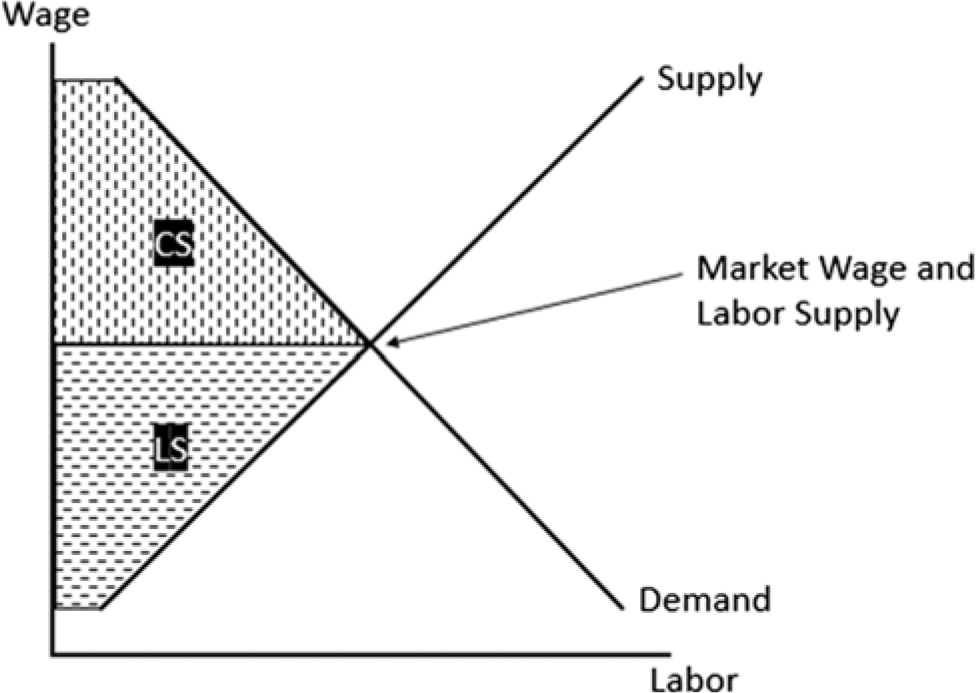
The neoclassical microeconomic model (Tarling, Reference Tarling, Durlauf and Blume1987) of the labor market explains the employer–employee relationship as one where, as Mumby (Reference Mumby2019) cites, the capitalist “…buys the use of the labourer’s labour power for a fixed period of time” (Harvey, Reference Harvey2018). This model of supply and demand (see Figure 1) demonstrates how labor is allocated in a market economy. This model is similar to other commodity markets, except the laborer is the supplier and the firm is the consumer. Because this relationship is voluntary on both sides, the worker provides more and more labor until the additional wage is not worth the time spent. Until then, the laborer benefits by receiving wages that are worth more to him or her than the time or effort invested. Thus, in sharp contrast to Marxian thought and critical theory, the laborer extracts surplus value from the capitalist. In Figure 1, the area CS represents the surplus extracted by the firm, and the area LS represents the surplus extracted by the laborer.
Figure 1.The neoclassical microeconomic model of the labor market.
Although economic value is usually discussed in monetary terms, labor surplus value could represent anything employees value: social relationships, opportunities for prosocial impact, opportunities to learn, and so forth. According to this model, employees who are not securing economic value from the relationship will end the relationship or simply provide less labor. This is in alignment with psychological theories of motivation that have been supported with empirical evidence. For example, equity theory (Adams, Reference Adams1965) asserts that individuals continuously evaluate whether resources are distributed fairly in a relationship—whether the benefits are worth the costs. Research testing equity theory has found that underpaid employees restore balance by reducing their effort on the job (Mowday, Reference Mowday, Steers and Porter1967), and that perceptions of equity are related to intent to stay with an employer (Berg, Reference Berg1991). Furthermore, Greenberg (Reference Greenberg1990) found evidence that underpaid employees are more likely to steal from their employer. Put simply, it is not in an organization’s interest to exploit employees, because surplus value is a precondition for the relationship on both sides.
Of course, there are situations in which firms exploit workers, but this is not the characterizing feature of the employee–employer relationship. In what is called a monopsony, firms have monopoly power (as buyers) in the labor market and are incentivized to keep wages below the competitive equilibrium (Kerr & Harcourt, Reference Kerr and Harcourt2002). Multiple fields, including labor economics and industrial-organizational economics, are in part dedicated to protecting workers from such situations. However, this is not accomplished by attempting to undermine the employer–employee relationship at its very core. Such efforts are counterproductive and antisocial because the relationship is inherently a win–win.
Conclusions
The discredited labor theory of value led Marx to conceptualize the employer–employee relationship as exploitative in nature. This view had a significant influence on critical theory’s conception of employer–employee relationships. However, a broader and more accurate understanding of labor markets recognizes that labor is not the only resource that creates economic value (which is subjective at the level of the individual), and that employees extract surplus value from the employer–employee relationship. In economic terms, work is good for both the capitalist and the laborer. Although there are certainly problems at work, the field of I-O psychology should continue to strive to improve the employer–employee relationship on both sides. This can take the form of solving problems of asymmetric information in employer–employee relationships, supporting the equity of such relationships, and addressing relevant problems posed by automation and the gig economy.




 You have Access
The focal article (Mumby, Reference Mumby2019) outlines the critical theory perspective of the employee–employer relationship and applies it to “dynamics of workplace control and resistance.” Although there is plenty to unpack here, our perspective will focus on concerns we have with the underlying premises of critical theory and its application to the employer–employee relationship. We trust that other responses will provide relevant perspectives based on the industrial and organizational (I-O) psychology literature; we complement this by drawing from labor economics and economic history. Most pertinent to our perspective are theories of employment, surplus value, and the history of Marxist thought. From a labor economics perspective, employer–employee relationships are mutually beneficial. We take this perspective rather than critical theory’s for several reasons. First, labor economics can provide additional perspectives on ways that organizations create value in society. Second, the critical theory–based view of the employer–employee relationship ignores that employees also extract economic surplus from such relationships and withdraw if no surplus is gained.
Marx’s and critical theory’s view of the employer–employee relationship
Mumby (Reference Mumby2019) asserts that “issues of power, control, and resistance are endemic and defining features of ‘human behavior in organizations’” (p. 430) and that “from a critical perspective, the field of management—broadly construed—can be viewed as deploying increasingly sophisticated efforts to more efficiently extract surplus value from alienated, expropriated labor” (p. 430). To put this line of reasoning in perspective, we must examine its philosophical underpinnings—its origins in Marxist thought.
As Mumby (Reference Mumby2019) recalls, Marx viewed the employer–employee relationship as an insidious form of exploitation. This belief arose from Marx’s interest in the means of production and its driver: firm profits. His understanding of firm profits was derived from the labor theory of value (Marx, Reference Marx1865). This theory attempted to explain how organizations provide economic value in society. The theory, which dates prior but was matured by Ricardo (Reference Ricardo, Sraffa and Dobb1823), posits that the true value, or “natural price,” of a good is determined by the quantity of labor necessary to produce it. This theory is often not adequate in explaining the value of goods; for example, one can imagine a lucky child discovering a diamond on the beach, taking in a small fortune with little concerted effort. Despite developing it, Ricardo acknowledged its limitations, citing real-world examples that did not support the theory, stating, “I am not satisfied with the explanation I have given of the principles which regulate value” (Whitaker, Reference Whitaker1904, p. 42).
Marx, who did not use the name “labor theory of value” but instead “law of value,” tweaked and applied the theory in his critique of capitalism. He observed that wherever there were industry profits, the price of a good was greater than the costs of production. From this, he argued that the “socially necessary labor” required to produce a good constituted the true value of a good, and the profits enjoyed by the capitalist constituted surplus value. For example, if the firm could sell a product that took 6 hours to produce, but the capitalist made the laborer work 8 hours, then the difference of two hours would represent surplus value. This theory of exploitation has been very influential on critical theory, and it provides justification that the defining feature of the employer–employee relationship is the capitalist exploiting the worker for labor. After Marxist economic thought fell out of favor in university economics departments, scholars transitioned to applying similar ideas to philosophy and sociology or “other phenomena.”
Meanwhile, economists formulated more useful theories of value. For example, acknowledging the role of psychology in motivation, the subjective theory of value (Menger, Dingwall, & Hoselitz, Reference Menger, Dingwall and Hoselitz1994) explains that the value of a good or service is determined by an individual’s desire for the good or service. Thus, economic value emerges as an aggregation of individuals’ wants and needs. Recent neuroscience research has provided evidence that subjective value is represented and tracked in several areas of the brain (Kable & Glimcher, Reference Kable and Glimcher2007). Because “what is valuable” differs between economic actors, there can be relationships where both parties extract economic surplus, one of which we will outline in the next section. These win–win relationships are the fundamental building blocks of modern economic relationships yet are overlooked by critical theory.
The modern view of the employer–employee relationship
The neoclassical microeconomic model (Tarling, Reference Tarling, Durlauf and Blume1987) of the labor market explains the employer–employee relationship as one where, as Mumby (Reference Mumby2019) cites, the capitalist “…buys the use of the labourer’s labour power for a fixed period of time” (Harvey, Reference Harvey2018). This model of supply and demand (see Figure 1) demonstrates how labor is allocated in a market economy. This model is similar to other commodity markets, except the laborer is the supplier and the firm is the consumer. Because this relationship is voluntary on both sides, the worker provides more and more labor until the additional wage is not worth the time spent. Until then, the laborer benefits by receiving wages that are worth more to him or her than the time or effort invested. Thus, in sharp contrast to Marxian thought and critical theory, the laborer extracts surplus value from the capitalist. In Figure 1, the area CS represents the surplus extracted by the firm, and the area LS represents the surplus extracted by the laborer.
The neoclassical microeconomic model of the labor market.
Although economic value is usually discussed in monetary terms, labor surplus value could represent anything employees value: social relationships, opportunities for prosocial impact, opportunities to learn, and so forth. According to this model, employees who are not securing economic value from the relationship will end the relationship or simply provide less labor. This is in alignment with psychological theories of motivation that have been supported with empirical evidence. For example, equity theory (Adams, Reference Adams1965) asserts that individuals continuously evaluate whether resources are distributed fairly in a relationship—whether the benefits are worth the costs. Research testing equity theory has found that underpaid employees restore balance by reducing their effort on the job (Mowday, Reference Mowday, Steers and Porter1967), and that perceptions of equity are related to intent to stay with an employer (Berg, Reference Berg1991). Furthermore, Greenberg (Reference Greenberg1990) found evidence that underpaid employees are more likely to steal from their employer. Put simply, it is not in an organization’s interest to exploit employees, because surplus value is a precondition for the relationship on both sides.
Of course, there are situations in which firms exploit workers, but this is not the characterizing feature of the employee–employer relationship. In what is called a monopsony, firms have monopoly power (as buyers) in the labor market and are incentivized to keep wages below the competitive equilibrium (Kerr & Harcourt, Reference Kerr and Harcourt2002). Multiple fields, including labor economics and industrial-organizational economics, are in part dedicated to protecting workers from such situations. However, this is not accomplished by attempting to undermine the employer–employee relationship at its very core. Such efforts are counterproductive and antisocial because the relationship is inherently a win–win.
Conclusions
The discredited labor theory of value led Marx to conceptualize the employer–employee relationship as exploitative in nature. This view had a significant influence on critical theory’s conception of employer–employee relationships. However, a broader and more accurate understanding of labor markets recognizes that labor is not the only resource that creates economic value (which is subjective at the level of the individual), and that employees extract surplus value from the employer–employee relationship. In economic terms, work is good for both the capitalist and the laborer. Although there are certainly problems at work, the field of I-O psychology should continue to strive to improve the employer–employee relationship on both sides. This can take the form of solving problems of asymmetric information in employer–employee relationships, supporting the equity of such relationships, and addressing relevant problems posed by automation and the gig economy.