INTRODUCTION
Although the family Mugilidae is composed of 25 valid genera based on the most recent revision proposed by Durand et al. (Reference Durand, Chen, Shen, Fu and Borsa2012a), species diversity is still debated (Durand et al., Reference Durand, Shen, Chen, Jamandre, Blel, Diop, Nirchio, Garcia de Leon, Whitfield, Chang and Borsa2012b). As a result of taxonomic uncertainties, the distribution and occurrence of Mugilidae remains largely unresolved. In Indian waters, mullet richness is not well-established because species inventories list seven to fifteen species (Fischer & Whitehead, Reference Fisher and Whitehead1974; Thomson, Reference Thomson1997). Among mugilid species mentioned in these inventories, the presence of Osteomugil perusii (Valenciennes, 1836) has not been well-established. Thomson (Reference Thomson1997) considered the species synonymous with O. cunnesius, Fischer & Bianchi (Reference Fischer and Bianchi1984) did not report its presence in the Indian Ocean, while Harrison & Senou (Reference Harrison, Senou, Carpenter and Niem1999), in their list of mullet species present in the western central Pacific, describe its distribution range as spanning from Africa to the Marianas Islands. Thus it is not clear whether O. perusii occurs in Indian waters and the present paper aims to provide the first report of this mugilid in Indian waters.
MATERIALS AND METHODS
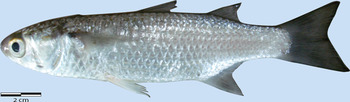
On 7 May 2012, 5 specimens of Osteomugil perusii were collected from the Vellar Estuary at Parangipettai (latitude 11°29′25.55″N, longitude 79°45′38.62″E), Tamil Nadu, south-east coast of India and 7 specimens on 12 January 2013 from the Cochin backwaters (latitude 9°58′08.41″N, longitude 76°14′40.78″E), Kochi, Kerala, south-west coast of India. In both locations specimens were caught by gillnet in shallow waters (1–1.5 m depth). Species identification was carried out according to the method of Harrison & Senou (Reference Harrison, Senou, Carpenter and Niem1999) since the recent taxonomic revision proposed by Durand et al. (Reference Durand, Chen, Shen, Fu and Borsa2012a) was entirely based on mitochondrial DNA sequences. Morphometric measurements were recorded according to the method of Thomson (Reference Thomson1954). All the morphometric measurements were recorded to the nearest 0.5 mm with fine draftsman dividers (Holden & Raitt, Reference Holden and Raitt1974). A total of 25 morphometric characters were recorded for 10 individuals of O. perusii including the voucher specimens deposited in the museum. Two specimens with damaged caudal fins were not considered for the study. Five entire specimens were deposited at the Marine Reference Museum at the Centre of Advanced Study in Marine Biology, Annamalai University under the Voucher numbers CASMB893–CASMB897 (Figure 1) for future reference. A small piece of muscle tissue was preserved in 95% ethanol for molecular analysis.
Osteomugil perusii Valenciennes, 1836, collected in the Vellar estuary (CASMB896), India.

Total DNA was extracted from the muscle tissues of O. perusii following the method of Sambrook et al. (Reference Sambrook, Fritsch and Maniatis1989). The mitochondrial gene, cytochrome oxidase I (COI) was amplified using universal primers: FishF1 + FishF2 and FishR1 (Ward et al., Reference Ward, Zemlak, Innes, Last and Hebert2005). Polymerase chain reaction (PCR) was carried out in 25 µl reaction volume containing 12.5 µl FastStart PCR MasterMix (Roche), 0.375 µl each primer (10 µM) and 1 µl of template DNA. The PCR conditions were followed by the initial preliminary denaturation at 92°C for 5 minutes followed by 35 cycles of strand denaturation at 92°C for 1 minute, 52°C for 45 seconds and primer extension at 72°C for 1.5 minutes, followed by final extension at 72°C for 5 minutes. Sequencing was done in the CEMEB sequencing platform of Montpellier, France. All nucleotide sequences obtained in the present study were deposited in GenBank under the accession numbers KF010474–KF010482. The sequences obtained from Indian O. perusii samples were compared to all sequences available in GenBank using BLAST. Intra-specific distance and nucleotidic divergence between species of the Osteomugil genus were estimated using the Kimura 2-parameter distance model of MEGA (version 4.0) package (Tamura et al., Reference Tamura, Dudley, Nei and Kumar2007).
RESULTS
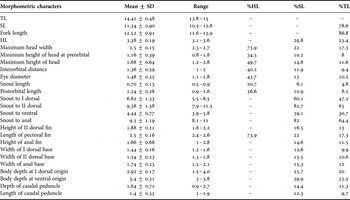
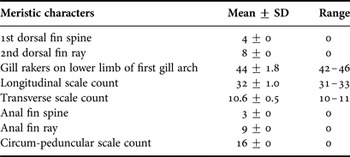
Osteomugil perusii is a small species with moderately robust body, adipose eyefold moderately developed. Body depth at first dorsal fin origin 24 to 30% standard length. Dorsally flattened head deeper than wide, snout short and blunt with 17 to 21% of total head length which confirmed the species identity. In addition the following taxonomic characters observed for the species strongly suggested that this species is O. perusii. Slender and weakly curved maxilla at the posterior tip, which is only just posteroventral to the corner of mouth and concealed partially or completely. Anteroventral edge of preorbital very weakly concave and serrate, not kinked; posteroventral tip narrow and not pointed. Gill rakers on lower limb of first gill arch 42 to 46. Origin of first dorsal fin midway between tip of the snout and base of caudal fin, or slightly nearer to the caudal fin base. Anal fin presents 3 spines and 9 soft rays, caudal fin is emarginated, pectoral fins are long, just reaching the level of origin of first dorsal fin or extending slightly beyond it; 22% of standard length; pectoral axillary scale present and moderately long. The meristic characters well coincided with ones of O. perusii species, i.e. 31 to 33 scales in longitudinal series, 10 to 11 scales in transverse rows, 16 scales in transverse series entirely around the caudal peduncle. Coloration of body was greenish dorsally; silvery flanks and abdomen; gold spot on operculum; fins dusky; dark spot at pectoral fin base. The morphometric and meristic measurements obtained for the specimens are given in Tables 1 & 2.
Morphometric characters of Osteomugil perusii: mean ± standard deviation, range and percentage of different body measurements in relation to head length (HL), standard length (SL) and total length (TL).

Meristic characters of Osteomugil perusii: mean ± standard deviation and range.

Cytochrome oxidase I sequence analysis showed a net mean divergence level of 1.1% within O. perusii from the Indo-West Pacific collected in Sri Lanka (JQ060640), Philippines (JQ060639), Taiwan (JQ060505) and New Caledonia (JQ060504) and 5% with other Osteomugil species: O. cunnesius (JQ060498 and JQ060496), O. engeli (JQ060500 and JQ060502), O. robustus (JQ060521), confirming the identity of the specimens.
DISCUSSION
The data on long-finned mullet from Indian waters are in accordance with the ranges of size, body proportions and meristic characteristics previously reported for this species (Senou, Reference Senou1988; Harrison & Senou, Reference Harrison, Senou, Carpenter and Niem1999). Osteomugil perusii can be easily distinguished from the other species of Osteomugil of the Indo-West Pacific, by the presence of 31–33 scales in a longitudinal series (v 37–43 in O. cunnesius and 37–41 in O. speigleri), 10–11 transverse scale rows between the origins of the first dorsal and pelvic fins (v 11–12 in O. speigleri) and by the emarginate caudal fin (it is forked in O. cunnesius and O. speigleri (Senou, Reference Senou1988)). The present report extends the current knowledge about the distribution of O. perusii and further investigations are needed to understand the distribution of long-finned mullet in other parts of the Indian coast. Absence of O. perusii in the Indian marine fish species checklist may be in part due to the difficulty to identify species belonging to the Mugilidae family, as well as to the poor monitoring of fish resources and the lack of experts in mugilid taxonomy. Moreover, many taxonomic characters undergo marked changes during early growth and the taxonomic identification of larval stages results to be complicated (Reddy, Reference Reddy1977). The highly conservative morphology of the Mugilidae species is the first cause of species misidentification or taxonomic debates. On the contrary, COI sequence analysis clearly separated O. perusii with other species of Osteomugil with 5% net mean divergence level and showed 1.1% divergence within the same species recorded from Sri Lanka, Taiwan and New Caledonia. In this context, the FishBol DNA barcoding program is a powerful and relevant approach to improve our knowledge about species richness and distribution range in the Mugilidae family. However, such information inferred from the COI barcode is relevant only if a precise molecular phylogenetic study is available, which is the case for this economic and ecologically important fish.
ACKNOWLEDGEMENTS
The first three authors are thankful to the Director of their Centre for their encouragement and authorities of the University for facilities. They are also thankful to the Centre for Marine Living Resources and Ecology (CMLRE) of the Ministry of Earth Science (MoES), Government of India, Kochi for the financial support. The immense help rendered by Mr K.P. Anil Kumar during sample collection is gratefully acknowledged. We also thank Mr David McKenzie for editing the English.