
Introduction
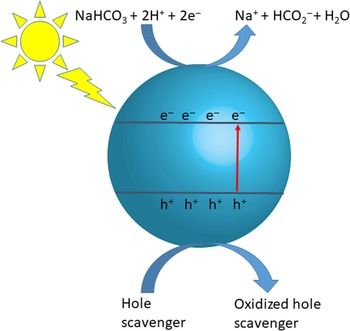
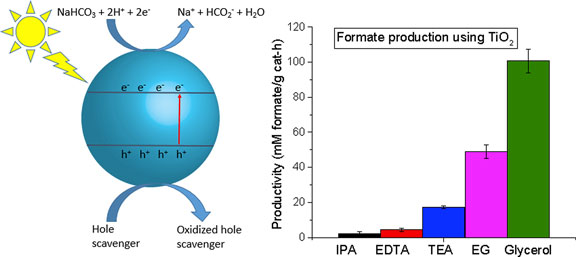
In semiconductor photocatalysis, the process is initiated by a photon of energy greater or equal to the band gap of the semiconductor. These photons excite valence band electrons (e−) of the semiconductor and create photogenerated e− and holes (h+) which migrate to the semiconductor surface to subsequently cause oxidation and reduction reactions. In our study, the excited e− react with bicarbonate to form the CO2•− radical anion, which undergoes further reduction to formate, an intermediate to methanol—a high-octane-number fuel. While semiconductor photocatalysis has been widely studied, one major drawback is the rapid e−/h+ recombination rate. In most cases, the e− and h+ recombine too rapidly for the semiconductor to be efficient.[Reference Houas, Lachheb, Ksibi, Elaloui, Guillard and Herrmann1] Prompt charge carrier recombination can be mitigated by the addition of a h+ scavenger, a sacrificial agent which undergoes oxidation in the photocatalytic process.[Reference Berr, Wagner, Fischbach, Vaneski, Schneider, Susha, Rogach, Jackel and Feldmann2] The h+ scavengers are important in photocatalytic reactions because they have been reported to enhance the photoactivity of TiO2.[Reference Kim and Choi3–Reference Murcia, Hidalgo, Navio, Vaiano, Ciambelli and Sannino7] The role of a h+ scavenger is to refill the photogenerated h+, thus reducing h+/e− recombination, and to prevent the interaction of h+ with precursors of the desired products.[Reference Mele, Annese, D'Accolti, De Riccardis, Fusco, Palmisano, Scarlino and Vasapollo8] Figure 1 shows a schematic representation of the oxidation and reduction processes on the surface of a photo-excited semiconductor, which also highlights the role of a h+ scavenger.
Schematic representation of photoreduction of HCO3− to formic acid on a semiconductor with a h+ scavenger.

The h+ scavengers used in previous studies include organic compounds such as methanol, ethanol, formic acid, acetic acid, triethanolamine (TEA), and disodium ethylenediamine tetraacetic acid (EDTA). One of the earlier studies on h+ scavengers started with Prairie et al. in 1993 as they investigated the effect of various organic compounds (EDTA, citric acid, salicylic acid, acetic acid, methanol, and ethanol) for the photoreduction of chromate.[Reference Kim and Choi3] Since then, other h+ scavengers such as sucrose, sodium sulfite, and sodium chloride have been used.[Reference Qin, Xin, Liu, Yin and Ma6, Reference Prairie, Evans, Stange and Martinez9–Reference Iguchi, Teramura, Hosokawa and Tanaka12] The novel idea of an inorganic h+ scavenger such as sodium sulfite has proven to be efficient for photocatalytic hydrogen generation with Pt-decorated CdS nanorods.[Reference Berr, Wagner, Fischbach, Vaneski, Schneider, Susha, Rogach, Jackel and Feldmann2] This comparative study revealed that sodium sulfite produced the largest amount of hydrogen and emphasized the important concept that the higher redox potential leads to faster h+ scavenging.
The aforementioned study prompted us to think about redox potential of h+ scavengers and consider SO32− because of its high redox potential at −1.5 eV [versus normal hydrogen electrode (NHE)]. Kaneco et al. used TiO2 and isopropanol as a h+ scavenger for reduction of high pressure CO2 to methane.[Reference Kaneco, Shimizu, Ohta and Mizuno13] In 2013, Valentin and colleagues conducted a density functional theory (DFT) comparison of five h+ scavengers adsorbed onto the TiO2 surface, and found that glycerol was the most efficient among tert-butanol, isopropanol, methanol, and formic acid.[Reference Di Valentin and Fittipaldi14] Valentin's work led toward our study of glycerol as a h+ scavenger due to its environmentally benign nature. In our publication, glycerol was proposed to be the most efficient h+ scavenger because of the number of primary hydrides available for reaction with photogenerated h+. Indeed, among glycerol, isopropanol, and ethylene glycol, glycerol proved to have the highest apparent quantum efficiency (AQE) of formate production from reduction of bicarbonate.[Reference Leonard, Pan and Heagy15–Reference Pan, Chowdhury, Premachandra, Olguin and Heagy17] After SO32−, TEA has the next highest oxidation potential at −1.2 eV, followed by EDTA at −0.45 eV. We have grouped these three h+ scavengers together due to the close proximity in their oxidation potentials and hypothesize that SO32− would be the most efficient at scavenging photo-generated h+ due to its highest oxidation potential. Previous studies have also found 2-propanol and glycerol as efficient h+ scavengers.[Reference Kaneco, Shimizu, Ohta and Mizuno13–Reference Pan, Chowdhury, Premachandra, Olguin and Heagy17] These results were highly promising since glycerol is derived from non-petroleum sources and can be synthesized biologically.[Reference Navarro, Sanchez-Sanchez, Alvarez-Galvan, del Valle and Fierro18, Reference Kait, Nurlaela and Dutta19] The second group of h+ scavengers include 2-propanol, ethylene glycol, and glycerol. These three species also have oxidation potentials in close proximity, and they have increasing number of hydroxy groups. Here we hypothesize that since glycerol possesses the most number of hydroxy groups, it has more potential sites available for oxidation, allowing the h+ scavenger to donate more e− to fill photo-generated h+. This report seeks to understand the effectiveness of these two groups of sacrificial h+ scavengers. We hypothesize that among the six h+ scavengers, sodium sulfite and glycerol would be the two most effective species for h+ scavenging.
Results and discussion
Cu2O and TiO2 were chosen because of their valence band and conduction band energies relative to the highest occupied molecular orbital (HOMO) energy of CO2 (online Supplementary Fig. S1).[Reference Chen and Wang20] As shown in the diagram, the conduction band of TiO2 lies below the HOMO of CO2 and may not be an obvious semiconductor to photochemically reduce CO2 or bicarbonate. However, experimental evidence from the literature and in this study demonstrates that TiO2 can successfully reduce CO2 to produce formate. Kaneco was one of the pioneers in the study of CO2 reduction to formate with TiO2 using a positive h+ scavenger.[Reference Kaneco, Kurimoto, Ohta, Mizuno and Saji21, Reference Kaneco, Kurimoto, Shimizu, Ohta and Mizuno22] As mentioned above, the superiority of glycerol as a h+ scavenger can be explained by the fact that glycerol possesses more primary OH groups, which leads to the improved C–H h+ scavenging reactivity. Glycerol has three hydroxyl groups and can be adsorbed more strongly on TiO2 or Cu2O in comparison to 2-propanol. Additionally, polyhydroxyls such as adsorbed glycerol appear to favor efficient hydride transfer to photo-generated h+ in TiO2 thereby suppressing the charge carrier recombination.[Reference Zhou, Song, Zhou, Wu, Wu, Liu and Han23]
Online Supplementary Fig. S2 presents the SEM images of Cu2O and TiO2, where the particles of Cu2O appear aggregated. Online Supplementary Fig. S3 shows the absorbance via diffuse reflectance spectroscopy (DRS) and the Kubelka–Munk treated plots of the semiconductors where the band gap energies of TiO2 and Cu2O appear at 3.2 and 2.0 eV, respectively. Cyclic voltammetry plots are illustrated in online Supplementary Fig. S4 and were used to further confirm the band gap energies, showing 1.88 and 3.4 eV for Cu2O and TiO2, respectively. Comparing these energies with literature values, diffuse reflectance seems to be the more precise method for band gap energy determination.
As indicated in online Supplementary Fig. S5, formate production from TiO2 and Cu2O in water is <2 ppm after 8 h, which demonstrates that e−/h+ recombination is too rapid for a semiconductor to be efficient, and that a h+ scavenger is necessary for photocatalytic reactions. Overall, TiO2 has been shown to be a more efficient photocatalyst than Cu2O with higher productivities and AQE in glycerol, ethylene glycol, and EDTA. In this study, our particular sample of TiO2 (online Supplementary Table S1) has a smaller size and larger surface area compared to Cu2O and is deemed the more efficient photocatalyst.
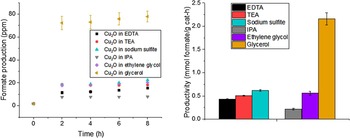
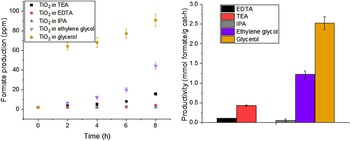
The six h+ scavengers were divided into two groups based on their oxidation potentials (sodium sulfite, TEA, and EDTA in one group; 2-propanol, ethylene glycol, and glycerol in another group). Formate production and productivity are shown in Figs. 2 and 3 and online Supplementary Table S2. Productivities for Cu2O in 2-propanol, ethylene glycol, and glycerol (Fig. 2) are 0.22, 0.56, and 2.16 mmol formate/g cat-h, respectively. Productivities for Cu2O in sodium sulfite, TEA, and EDTA (Fig. 2) are 0.62, 0.51, and 0.43 mmol formate/g cat-h, respectively. The same increasing productivity trend in 2-propanol, ethylene glycol, and glycerol (Fig. 3) is seen for TiO2, with even higher productivity at 1.22 and 2.52 mmol formate/g cat-h for ethylene glycol and glycerol, respectively. Productivities for TiO2 in TEA and EDTA (Fig. 3) are 0.43 and 0.11 mmol formate/g cat-h. No formate production was observed for TiO2 in sodium sulfite due to over-potential of the SO32− HOMO energy value relative to TiO2 valence band energy value. Formate production can also be quantified in terms of photon input and formate output. AQE, calculated by Eqs. (1) and (2) (online Supplementary Material, Experimental procedures), quantifies formate production in terms of photon input and formate output. Table I displays our key results, which show that for Cu2O, AQEs are 0.44%, 1.12%, and 4.32% in 2-propanol, ethylene glycol, and glycerol, respectively; and 1.24%, 1.01%, 0.86% in sodium sulfite, TEA, and EDTA, respectively. For TiO2, AQEs are 0.11%, 2.44%, and 5.04% in 2-propanol, ethylene glycol, and glycerol; and 0.87% and 0.22% in TEA and EDTA. It can be concluded that the formate production trend with TiO2 is: glycerol > ethylene glycol > 2-propanol, and TEA > EDTA. Presumably, due to the over-potential of SO32− in relation to TiO2, this system did not produce any formate. The formate production trend for Cu2O is: glycerol > ethylene glycol > 2-propanol, and SO32− > TEA > EDTA. Both trends are consistent with previous reports by Berr et al. and Leonard et al.[Reference Berr, Wagner, Fischbach, Vaneski, Schneider, Susha, Rogach, Jackel and Feldmann2, Reference Leonard, Pan and Heagy15–Reference Pan, Chowdhury, Premachandra, Olguin and Heagy17]
Formate production in ppm (left) and productivity (right) of Cu2O in sodium sulfite, TEA, EDTA, IPA, ethylene glycol, and glycerol.

Formate production in ppm (left) and productivity (right) of TiO2 in TEA, EDTA, IPA, ethylene glycol, and glycerol.

AQE (in %) for Cu2O and TiO2 in different h+ scavengersa.

a All reported values are from triplicate measurements. Dashed line (–) signifies no formate was produced.
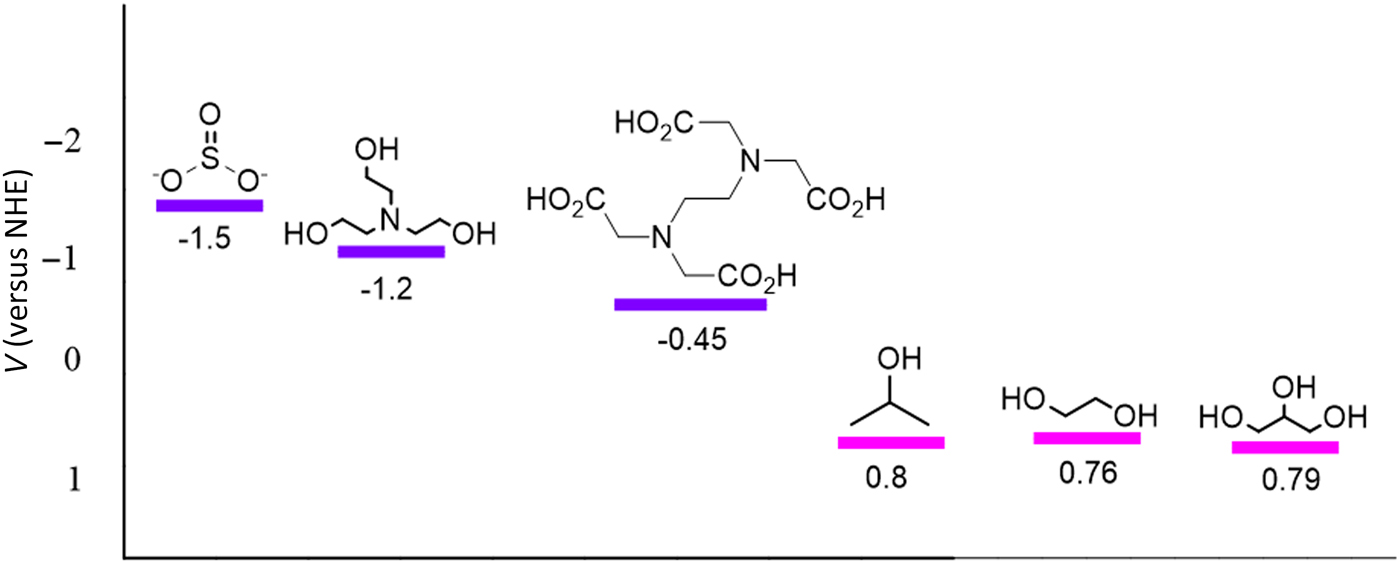
To explain the different efficiencies of the six h+ scavengers, one needs to examine their redox potentials. Figure 4 shows that SO32− has the highest oxidation potential, and therefore of the six h+ scavengers has the weakest bound e−. The oxidation potentials of SO32− is −1.5 versus NHE, followed by TEA at −1.2 versus NHE, and EDTA at −0.45 versus NHE.[Reference Berr, Wagner, Fischbach, Vaneski, Schneider, Susha, Rogach, Jackel and Feldmann2] Berr's work suggests that the increased oxidation potential has two benefits, and that the higher the oxidation potential, the more efficient the hydrogen production, and the increased stability of the nanorods. In the context of semiconductor photoreduction, oxidation potential can be a measure of how much energy the e− of the h+ scavengers gains by recombining with the photogenerated h+. Thus, the h+ scavenger with the largest oxidation potential is expected to possess the largest driving force,[Reference Berr, Wagner, Fischbach, Vaneski, Schneider, Susha, Rogach, Jackel and Feldmann2] thus rendering SO32− more efficient than TEA and EDTA. When the SO32− anion donates an e− to a h+ it is converted into SO3•−.
Oxidation potentials of the six h+ scavengers. Values for sulfite, TEA, and EDTA were obtained from Berr et al.[Reference Berr, Wagner, Fischbach, Vaneski, Schneider, Susha, Rogach, Jackel and Feldmann2]; values for 2-propanol, ethylene glycol, and glycerol were obtained from Leonard et al. and Moret et al.[Reference Leonard, Pan and Heagy15, Reference Moret, Dyson and Laurenczy27]
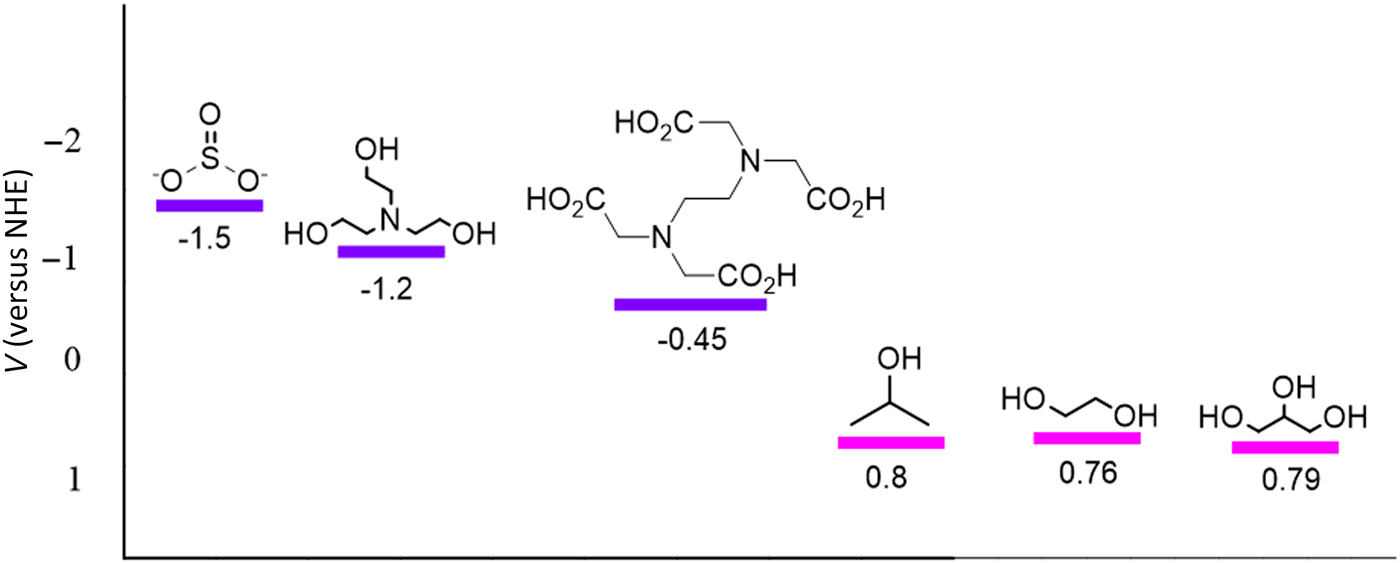
While the redox potentials of 2-propanol, ethylene glycol, and glycerol are similar (2-propanol 0.80 V, ethylene glycol 0.76 V, and glycerol 0.79 V[Reference Leonard, Pan and Heagy15–Reference Pan, Chowdhury, Premachandra, Olguin and Heagy17, Reference Shkrob and Sauer25]), glycerol was shown to be the most efficient h+ scavenger for the reaction. The difference in their h+ scavenging ability can be explained by the number of available hydroxyl groups. Such explanations imply a kinetic control compared to the thermodynamic positions of semiconductor conduction band. Glycerol contains one secondary and two primary alcohol groups, all of which are potential sites for oxidation that could enhance h+ scavenging activity. Dimitijevic et al. pointed out in their study that glycerol showed the highest rate of reaction with surface trapped h+.[Reference Dimitijevic, Shkrob, Gosztola and Rajh26] This is due to the abundance of hydroxyl groups on glycerol, which facilitates adsorption onto the particle surface. Since glycerol gives the best formate production next to ethylene glycol and 2-propanol, this lends support to our hypothesis that increasing the number of primary OH groups leads to improved C–H h+ scavenging activity. Lastly, Valentin et al. has confirmed in their computation study that glycerol is the best candidate among the organic compounds investigated as h+ scavengers.[Reference Di Valentin and Fittipaldi14]
Transient absorption spectroscopy (TAS) has been employed to study the charge carrier dynamics in a semiconductor photocatalysis system. Previous literature cites that photogenerated h+ remain on the surface of semiconductors on a timescale of tens of picoseconds and the h+ scavenger reduces the h+ on a timescale of 260 ps,[Reference Berr, Vaneski, Mauser, Fischbach, Susha, Rogach, Jackel and Feldmann24, Reference Dimitijevic, Shkrob, Gosztola and Rajh26] and that glycerol appears to scavenge most of the h+ formed on TiO2, however, around 10% of h+ remain un-scavenged even at high h+ scavenger concentration (>10%).[Reference Shkrob and Sauer25] These experiments demonstrate the efficiency and necessity of a h+ scavenger, and our work has demonstrated that green organic solvent glycerol is a superior h+ scavenging agent that can successfully suppress e−/h+ recombination in semiconductor photocatalysis, thus enhancing formate production. Future directions include the use of TAS to probe interband and molecular transitions, and to see how carriers are transferred between species. Transient photoreflectance spectroscopy (TPR) can be used to probe interfacial electric fields, and spectroelectrochemistry (SEC) can be used to monitor optical absorbance during electrochemical reactions. Solution-phase TAS entails the dynamics of charge transfer between the semiconductor and the redox system. Measurements of change in absorbance (ΔT/T) as a function of wavelength will provide information on decay characteristics of photogenerated h+. Furthermore, 2-D materials such as graphene oxide can prolong e−/h+ recombination because graphene has been shown to be an e− sink that can trap photogenerated charge carriers.
Conclusion
In conclusion, six h+ scavengers ranging in different oxidation potentials were tested in photocatalytic reaction of bicarbonate reduction to formate. Glycerol proved to be the most efficient h+ scavenger and this finding is significant because glycerol is an inexpensive solvent, abundant, and derived from plants. Using non-petroleum sources bodes well toward renewables and leads to less dependence on fossil fuels. This set of results addresses one of the major drawbacks in semiconductor photocatalysis because it investigates the topic of increasing the efficiency of the semiconductor by slowing e−/h+ recombination. Given the number of previous publications that utilize 2-propanol as their standard h+-scavenger solvent, this work suggests a new solvent such as glycerol should be considered for future AQE comparisons.
Supplementary material
The supplementary material for this article can be found at https://doi.org/10.1557/mrc.2018.177.