I. Introduction
If the news media are any guide to the truth, the environmental condition of the Earth has deteriorated over the past several decades to the point of imminent disaster. Proponents of man-made, or anthropogenic, global warming (AGW) maintain that an unprecedented, dangerous rise in the overall temperature of the Earth threatens us with imminent climatic catastrophe, and that the primary cause is emissions of carbon dioxide (CO2) and other gases into the atmosphere by the widespread use of fossil fuels. To prevent a global disaster, they claim, we must take vigorous political action immediately to reduce the burning of coal, natural gas, and oil. AGW activists assert that governments must enact strict limits to industrial development, massively increase global economic redistribution as penalties against the industrialized nations, and impose stringent penalties for noncompliance. Huge tax subsidies must be allocated for government-approved energy systems. All these measures are being promoted with the fervor of a moral crusade.
But, as Philip Stott, professor emeritus of biogeography at the University of London, reminds us: “What has been forgotten in all the discussion about global warming is a proper sense of history.”Footnote 1 Natural history provides abundant evidence that the Earth's climate, a manifestation of the largest, most complex, and longest-lasting natural system available for our study, has always been in flux. Changes in weather and climate result from millions of physical factors, including heat, water vapor, and solar rays, interacting in a chaotic web of physical, chemical, and thermal feedback systems. This has continued for billions of years. We have only begun to understand the Earth's climate system, and our computer models do not account for its complexity. The testimony of top-tier scientists makes it clear that there is no scientific consensus behind the AGW hypothesis. Their expert testimony, alongside the many dire predictions of global cooling and warming disasters that have oscillated over the past century, strongly suggests that climate catastrophe through AGW does not have a credible scientific foundation, and that the science of climate change is far from settled.
Among people who are in the position to create and enforce government policies, however, there is a consensus that human responsibility for global warming is a settled issue, and that the task now is to implement the laws required to atone for that responsibility. This political consensus is a dangerous thing, because the remedies being proposed to mitigate the AGW predictions are breathtaking in their scope and will have negative consequences for billions of people. This conclusion is not a matter of hypothetical computer modeling, conjecture, or percentages on a graph. The government actions being planned now are on a scale commensurate with socialist planned economies and would place the very heart of industrial society—the motive power that keeps its industry beating—under the control of a labyrinthine maze of all-powerful government bureaucracies. Should these proposals be adopted, the people of the industrialized nations will be subjected to controls over minutiae of daily life on a level previously thought intolerable. It behooves policy planners, scientists, and citizens alike to grasp the consequences of such policies, while they consider the shaky, disputed scientific grounds on which the calls for action are based.
Specific solutions to the complex scientific problems related to climate analysis and energy production cannot be provided by nonspecialists. But given the impetus for drastic political action advocated by the AGW supporters and the speed with which untested scientific hypotheses are being written into laws, nonscientists can—and must—judge the political plans attached to AGW. These plans can be evaluated independently of the AGW claims, in terms of their consequences for human beings. However, the awesome scale of the climate disasters being promised, and the energy with which those claims have been accepted, have deeply influenced the political debates. This leads to a question: Can a nonscientist form a rational conclusion about the validity of these scientific claims? Or is the scientific case for global disaster both so strong and so complex that he must accept the premise of AGW and agree to subordinate American industry and lives to the unlimited power of the federal Environmental Protection Agency—and the industry of the world to an international regime with breathtaking powers?
In evaluating the scientific claims, the principle to follow was stated by former NASA climate scientist Roy Spencer in his 2007 congressional testimony: “Given the extreme cost to humanity (especially the poor) that most economists claim will result from restricting or otherwise penalizing the use of fossil fuels, a guiding principle for accepting claims of catastrophic global warming should be: Extraordinary claims require extraordinary evidence.”Footnote 2 If the impending climate disaster is an apparition, then we should reject the premise that AGW is true. This would provide all the more reason to reject the political controls being proposed to counter it.
The purpose of this essay is to bring into focus two crucial aspects of this issue. The first is to present a basic outline of natural history as a historical context for the AGW claims, along with the evaluations of top-rank scientists who do not accept those claims. The second is to illuminate some of the regulatory proposals that these claims have engendered, as well as the economic, political, and moral meaning of these proposals. The specific focus here will be on the Advance Notice of Proposed Rulemaking released by the Environmental Protection Agency (EPA) on July 11, 2008, along with a brief summation of its background in American and international political action. This examination should assist nonscientists in forming judgments about whether claims of man-made global climate disaster are strong enough to warrant these radical, irreversible government actions.
In the end, this issue turns not on science or on economics, but on morality. Is it moral for human beings to thrive in a free, industrial society, or must they atone for this prosperity by sacrificing their liberty and their prosperity? Should we embrace and protect the scientific and political principles discovered in the Enlightenment, or should we reject those principles and turn back to the preindustrial Primitive under the rule of an omnipotent government?
II. Climate Change: The Deep History
Claims that the Earth is now undergoing an unprecedented rise in temperature—both in absolute terms and in the rate of increase—should be examined using precedents from the long-term history of the Earth.Footnote 3 At least seven major ice ages have occurred in the last billion years, when mile-deep ice sheets periodically advanced beyond polar areas and engulfed regions that were once warm, before melting in retreat. On a shorter timescale, some eleven glacial and interglacial periods have cycled during the past one million years. We are now living in a temporary interglacial warm period, the Holocene, that began with a relatively sudden rise in temperature about 11,000 years ago. We should expect the next glacial period to begin in the near future, meaning a few thousand years. These cyclical temperature changes have far surpassed the lesser variations since the dawn of industrial life.
What causes such variations? One of the central tenets of the AGW hypothesis is that high atmospheric concentrations of carbon dioxide (CO2) and other greenhouse gases have a direct effect on temperatures around the globe. The thermometer was not invented until the Renaissance, so scientists must study ancient temperatures and chemical concentrations indirectly, by gathering “proxy data” taken from fossils, tree rings, ice cores, coral reefs, peat bog cellulose, and other evidence. All of this requires highly technical scientific interpretation and is subject to new discoveries and complex methods of statistical analysis.
To cite one example of such a study, scientists from the University of New Mexico examined goethite (iron oxide) formations in Wisconsin. Their conclusions suggest that 440 mya (million years ago) “atmospheric CO2 was ∼16 times higher than today. However, this enhanced level of atmospheric CO2 does not seem to have been accompanied by unusually warm temperatures in the tropics, and in fact may have been contemporaneous with high-latitude continental glaciation on Gondwanaland [the southern super-continent].”Footnote 4 In the technical discussions that follow such studies, disagreements and controversies are energetic and often extend to basic issues and concepts. What does a hunk of rock in Wisconsin, a fossil shell in the tropics, or a piece of ice in Antarctica, say about the entire globe anyway? One thing is clear, however: figuring out the Earth's climate is a difficult, slow business. The science of this unsettled system is not settled, and scientists have little ability to make accurate predictions beyond the fact of change itself.
Using information derived from such proxy measurements, it is possible to reconstruct, at least roughly, temperature levels and CO2 concentrations going back into the Earth's deep history. Christopher Scotese, a geologist at the University of Texas at Arlington, used ancient evidence and computer models to determine average temperatures going back over 600 million years ago (mya).Footnote 5 Other scientists have worked to determine CO2 concentrations.Footnote 6 A basic outline of these CO2 and temperature reconstructions is as follows (values are rounded to the accuracy implied in the figures). Bear in mind that the average temperature today is about 59°F, and CO2 is about 350 to 380 parts per million (ppm):
• From 600 to 430 mya, CO2 was about 5,000 ppm; temperature was about 72°F. (One model has CO2 up to 7,000 ppm, another as lower than 5,000 ppm.)
• From 430 to 360 mya, CO2 fell below 1,500 ppm; temperatures shifted from 72°F to 54°F, then back up to 72°F.
• From 360 to 245 mya, CO2 fell to about 1,000 ppm; temperatures fell back to 54°F, then returned to 72°F, after a spike to 74°F.
• From 245 to 146 mya, CO2 held near 1,000 ppm; temperatures stayed near 72°F, until falling to about 60°F. (Other reconstructions show CO2 as rising to about 2,000 ppm about 200 mya, before falling again.)
• From 146 to 65 mya, CO2 decreased to 750 ppm or less; temperatures rose to 72°F.
• From 65 mya into the present, CO2 decreased to under 300 ppm. Temperatures were at 72°F—far higher than today—then fell to 54°F before beginning to rise.
Figure 1 illustrates these general trends. The heavy line shows average temperatures, the thin line shows a rough average of atmospheric CO2 concentrations:
Average carbon dioxide concentrations and temperatures, millions of years ago to the present.

Overall, the average temperature has moved up and down between 54°F and 72°F, while atmospheric CO2 concentrations dropped from about 5,000 to under 300 ppm. If AGW theory is correct, the Earth should have been blistering hot when CO2 was sixteen times higher than today, and temperatures should have fallen when CO2 levels moved below 1,000 ppm. Even if other factors mitigated extreme temperature changes, there should be some correlation between temperatures and CO2. The Earth's temperatures, however, varied independently of the CO2. The Earth's temperature was an average of 72°F—far higher than today—when CO2 was both 5,000 ppm and under 750 ppm.
R. Tim Patterson, professor of geology at Carleton University and director of the Ottawa-Carleton Geoscience Centre, wonders “whether Earth's climate record actually supports the assumption that CO2 is a major climate driver.”Footnote 7 He reminds us that during an ice age about 450 million years ago, carbon dioxide concentrations were about fifteen times higher than at present. He concludes that there is “no statistical correlation between the level of carbon dioxide in the atmosphere through the last 500 million years and the temperature record in this interval.”
Some scientists will dispute the precise figures here. Some will claim that CO2 levels 500 mya were merely eight times higher than today; others will claim they were twenty times higher. AGW supporters may attack this overview as simplistic, but one thing remains clear: overall, temperature and CO2 have not correlated as the AGW hypothesis requires. This strongly suggests that other natural factors, not atmospheric CO2 concentrations, were controlling the temperature changes.
III. Variations During the Past Five Hundred Thousand Years
A picture of the more immediate past is seen in reconstructions of temperatures and CO2 concentrations derived from Antarctic ice core samples collected at the Russian Vostok Research Station. The ice core reached down over 3,300 meters to reveal ice as old as 422,000 years. Scientists determine ancient temperatures by analyzing the ratio of heavier oxygen-18 to ordinary oxygen-16, and heavier deuterium-2 to ordinary hydrogen-1, in the ice. Over the 422,000 years, temperatures have varied nearly 22°F, from about 16°F below to 6°F above the temperatures of the past century.Footnote 8 Some scientists have noted that CO2 levels today “seem to have been unprecedented during the past 420,000 years.”Footnote 9 But the highest temperatures recorded in the ice core samples are about 6°F higher than today, at 128,357 and 323,482 years ago. If CO2 levels today are “unprecedented” and CO2 causes warming, then why are temperatures today lower than at several times in the Antarctic past?
Scientists working under the auspices of the Scripps Institution of Oceanography brought greater precision to their reading of the Vostok data. In the abstract of their published research, they wrote: “High-resolution records from Antarctic ice cores show that carbon dioxide concentrations increased by 80 to 100 parts per million by volume 600 ± 400 years after the warming of the last three deglaciations. Despite strongly decreasing temperatures, high carbon dioxide concentrations can be sustained for thousands of years during glaciations….”Footnote 10 Solar scientist Willie Soon of the Harvard-Smithsonian Center for Astrophysics agreed that “[a]tmospheric CO2 variations generally follow changes in temperature and other climatic variables rather than preceding them.”Footnote 11
The record shows that temperatures rose before CO 2concentrations rose. Patterson recognized that the time lag between rising or falling temperature and rising or falling CO2 is about 800 years. To illustrate the causal implications of this relationship, he draws an analogy with human history. If you think that climate is being driven by CO2, “then you probably would have no difficulty in accepting the idea that Winston Churchill was instrumental in the defeat of King Herold by Duke William of Orange at the Battle of Hastings in 1066.”Footnote 12
In his book An Inconvenient Truth, Al Gore ignores this time lag in order to create a false image of a frightening rise in temperature caused by CO2 emissions today.Footnote 13 He graphs CO2 and temperatures as rising and falling in parallel, thus depicting the “repeating correlation” that Patterson questioned: in Gore's graph, the two lines move in tandem, and the spike in CO2 to over 350 ppm today runs ominously off the graph. This is visually powerful—but is it accurate?
Gore's graph distorts the issue in two ways. First, it does not accommodate the earlier CO2 levels of up to 5,000 ppm, or sixteen times those of today. The graph presented in Figure 1 above has a higher vertical CO2 axis, and depicts today's CO2 variations in accurate proportion to earlier changes: as tiny waves at the bottom right-hand side of the graph. Gore also omits values on the temperature axis, an egregious omission that makes it impossible to quantify the scale of temperature variations. Second, Gore conflates correlation with causation. His parallel CO2 and temperature lines obscure the fact that large temperature rises preceded small CO2 rises by 500 to 1,500 years. Perhaps it is inconvenient for Gore to accept that the huge 22°F temperature changes in the Vostok ice core samples cannot be explained by the tiny—100 ppm—changes in CO2 that followed those temperature changes. Readers may properly conclude that Gore's CO2/temperature graph is a distortion of the historical record designed to elicit an emotional response for a political purpose.
In the words of Professor Bob Carter of the Marine Geophysical Laboratory at James Cook University in Australia, “Gore's circumstantial arguments are so weak that they are pathetic. It is simply incredible that they, and his film, are commanding public attention…. The man is an embarrassment to US science and its many fine practitioners, a lot of whom know (but feel unable to state publicly) that his propaganda crusade is mostly based on junk science.”Footnote 14
IV. Variations over the Past Thirty Centuries (1,000 b.c. to the Present)
During their early history, human beings emitted no industrial CO2, and were vulnerable to the vagaries of weather, disease, and famine. Natural disasters were blamed on supernatural beings and forces. Life was nasty, poor, brutish, and short. By 1,000 b.c., human beings had lived in settled communities for several thousand years. Following a cold period between about 800 and 400 b.c., temperatures in Europe rose from approximately 400 b.c. to a.d. 200, the Roman Warm Period. A cold period followed between ca. a.d. 200 and 900, during the European Dark Ages. The Medieval Warm Period (ca. 900–1350) was at least 2°F warmer than today. At this time, the English grew grapes and produced wine, European agriculture and cathedral architecture prospered, the precursors to modern universities were established, merchants were active over widening trade routes, and the Vikings settled Greenland before moving west into North America. No catastrophic climate events resulted from this 2°F warming of the planet.Footnote 15
Around 1450, the temperature in Europe plunged into the Little Ice Age (1450–1850).Footnote 16 England's Thames River froze during the winter, many crops failed in Europe, the Vikings abandoned Greenland to the snow and ice, and priests prayed for a halt to glaciers that threatened Alpine villages.Footnote 17 Research into British naval log books is slowly revealing more of the stormy character of the weather during this cold period.Footnote 18 When George Washington crossed the Delaware River on Christmas Eve 1776, he faced huge ice floes, which were confirmed in contemporary journals and diaries, and which an artist depicted seventy-five years later.Footnote 19 Had the people of Washington's day been eager to blame themselves for natural events, feverish cries of impending inundation with ice would have risen along with demands to curtail human action. Had governments at the time used their power to shut down artisans, laboratories, and merchants, there might have been no Industrial Revolution. As time passed, the Earth would have warmed or cooled by natural factors, but we today, bereft of industry, would be far less able to adapt to those natural cycles.
Things began to warm in the nineteenth century. From the mid 1800s to 1940, American industrialists built on the scientific revolution of the prior two centuries, within a political system that recognized their freedom to think and to act independently of the dogmas of church, crown, and community. For the first time, they produced coal- and oil-fired industries, electrical power plants, and mass quantities of consumer goods. Automobiles, telephones, radio, railroads, and ships shrank the continents and the oceans. These advancements exceeded anything in history, and demonstrate that the cause of human prosperity is not the Earth's climate. Atmospheric CO2 concentrations rose perhaps 16 ppm along with the temperatures, a welcome reversal of the Little Ice Age and a return to the earlier warm periods.
From 1940 to 1976, America and the free world built myriad fossil-fuel electric power plants, while high-rise buildings inscribed new skylines for cities, industrial manufacturing escalated, petroleum vehicles flooded America's new interstate highway system, and medicines became widely available. The human environment in the industrialized nations—the physical context in which we live—improved greatly over any other time in history. Life spans increased and infant mortality rates fell. The Earth's population soared to over four billion—an increase that correlates directly with higher emissions of CO2 by industrial activity—while temperatures dropped by about 0.45°F.
Surface thermometers used to construct a temperature record back to the 1850s show a warming trend for the three decades since 1979.Footnote 20 Scientists, however, have come to realize that the data from surface temperature monitoring stations have been skewed by the local heat effects of human activity. The temperature record has been distorted upward by the placement of the stations. The Lodi, California thermometer, for instance, is next to the parking lot of a fire station in a residential area—and, predictably, it has recorded a temperature rise of up to 4°F in the past forty years.Footnote 21 When California stations are statistically separated according to the populations of the counties in which they are located, it becomes clear that thermometers in counties with larger populations have recorded higher and steeper temperature increases.Footnote 22 Social, economic, and political factors have also distorted the global temperature record; when the Soviet Union collapsed, for instance, thousands of stations in Siberia were lost, which caused an upward shift in global temperature averages.Footnote 23
In 1999, a U.S. National Research Council panel, chaired by Tom Karl, director of the National Climatic Data Center, and including AGW proponent James Hansen of the Goddard Institute for Space Studies, issued a report that asked:
Are we making the measurements, collecting the data, and making it available in a way that both today's scientist, as well as tomorrow's, will be able to effectively increase our understanding of natural and human-induced climate change? The Panel on Climate Observing Systems Status would answer the latter question with an emphatic NO…. [T]hese systems require immediate action to reverse their decay and to redesign them.Footnote 24
Since 1979, satellites have allowed us to literally rise above the limitations of surface stations, to take systematic measurements across vast oceans and unpopulated land areas, and to draw data representative of the entire Earth. In 1989, NASA scientists Roy Spencer and John Christy developed the first global temperature data set from satellite microwave data.Footnote 25 Satellite data collection remains the most comprehensive and reliable global measurement method. According to the satellite record, from 1979 to 1996 temperatures varied by about .4°F, and in 1996 were at about the same level as in 1979. Prior to 2007, temperatures were at most “trending up at a modest 0.125° [Celsius] per decade” (about 0.22°F).Footnote 26 From 1998 (when El Niño caused a temperature spike of about 0.8°F) until 2007, temperatures have stayed flat or fallen. Temperatures decreased by 1.2°F during 2007 alone, the same amount that they may have increased from 1880 to 2000, despite the additional atmospheric CO2 from tremendous industrial growth during the twentieth century.
Patterson brings up vital questions about the CO2 global-warming hypothesis. In his own words, he asks:
If CO2 is of such critical importance to climate change why was there a large temperature rise prior to the early 1940s when 80 percent of the human produced carbon dioxide was produced after World War II? … When CO2 levels finally began to increase dramatically in the postwar years why was there a concomitant interval of about 30 years of cooling?
One would think that if CO2 had such critical control over climate that the relative abundance of CO2 in the atmosphere would be in lock step with global temperature. Many researchers realize the difficulties that are presented by trying to make CO2 the key factor in climate change…. In conclusion, the geologic record clearly shows us that there really is little correlation between CO2 levels and temperature.Footnote 27
To dramatize his claim that temperatures today are skyrocketing, Al Gore reproduced a version of the famous “hockey stick” temperature graph, which shows flat temperatures for the last 1,000 years, until a huge rise in the past century punctuates the page.Footnote 28 This graph was developed by Michael Mann and others, who used a complex software program to create a visual representation of temperature over time, using data from tree ring analyses back to 1,000 a.d., supplemented by other proxy data and the surface temperature record from the last two centuries. The result showed flat or declining temperatures up to about 1900, with a sharp upward shift from that point on. In one visual image, the Medieval Warm Period and the Little Ice Age were gone, and the 1990s became the warmest decade in 1,000 years. The graph was published in a peer-reviewed journal in 1998, the same year that Mann received his Ph.D. from Yale.Footnote 29 Mann was then assigned as a lead author for the United Nations Intergovernmental Panel on Climate Change (IPCC) Third Assessment Report of 2001; his graph was included in the 2001 Summary for Policymakers and was used to publicize claims of a coming climate crisis.Footnote 30
Ross McKitrick and Stephen McIntyre questioned the statistical methods used to create the graph. Neither one was a climate scientist—McIntyre was an economist at the University of Guelph, and McKitrick had years of experience analyzing data from the minerals industry—but each realized that the statistical methodology used to calculate the temperature data needed to be examined. After Mann released the software code used to create the graph, McKitrick and McIntyre found that they almost always got the same “hockey stick” shape when they fed data created by a random number generator into the software program.Footnote 31 This highlights the dependence of graphs, software analyses, and models on the statistical methodology used to calculate data. The graph was begging for a dedicated, focused analysis of the statistical methods used to create it.
Concerns about the graph—which, we must remember, was being used to support calls for political action on a global scale—led Representative Joe Barton, chair of the Energy and Commerce Committee in the U.S. House of Representatives, to enlist Edward Wegman and a team of statisticians to do a pro-bono assessment of the statistical methodology used to develop the graph.Footnote 32 Following that request, Representative Sherwood Boehlert, chair of the House Science Committee, requested that the National Academy of Sciences (NAS) look into the same issue. NAS released its report in June 2006; Wegman's team released its report in July. Wegman's team did not assess the data used; their concern was solely with the statistical methods used to interpret the data, an area in which they were world-class experts. Wegman's report in July 2006 stated:
It is not clear that Mann and associates realized the error in their methodology at the time of publication. Our re-creation supports the critique [by McKitrick and McIntyre] of the MBH98 methods [the 1998 article by Mann et al.].
In general, we found the writing in MBH98 and MBH99 [the 1998 and 1999 articles by Mann et al.] to be somewhat obscure and incomplete and the criticisms by MM03/05a/05b [the three critical articles by McKitrick and McIntyre] to be valid…. [T]he error may be easily overlooked by someone not trained in statistical methodology… .
The MBH98/99 work has been sufficiently politicized that this community can hardly reassess their public positions without losing credibility. Overall, our committee believes that the MBH99 assessment that the decade of the 1990s was likely the hottest decade of the millennium and that 1998 was likely the hottest year of the millennium cannot be supported by their analysis.Footnote 33
As to the NAS report, Geotimes reported: “The NAS committee … agreed with the Wegman report that it is difficult to quantify a single decade or year as hotter than others going back as far as 1,000 years, testified Gerald North, a climate scientist at Texas A&M University and chair of the NAS committee. However, North testified, ‘reservations about Mann et al's statistics should not undermine the fact that climate is warming’.”Footnote 34 Surely this means “should not undermine our conclusion” that the Earth is warming—for if it is a fact that the Earth is warming, no false conclusions could undermine the fact. But the graph was presented as evidence for the warming. Surely if the graph is invalid, we have reason to doubt the conclusions inferred from it.
The claim that “It is very likely that the 1990s was the warmest decade and 1998 the warmest year in the instrumental record since 1861” appeared in the IPCC Third Assessment Report above Mann's graph.Footnote 35 When such conclusions find their way into policy recommendations on an international scale with the speed with which this graph made it into the IPCC report, the laws that follow threaten to outstrip the uncertainty of the science behind the recommendations. Professor Thomas Crowley wrote, in his report to the subcommittee critical of the Wegman report, that “it is time to stop using Michael Mann as a whipping post and to start directing attention to the more important matters of whether anything should be done about global warming, and if so, what?”Footnote 36 But this blatant call for a focus on political action—which assumes the truth of global warming as a starting premise—makes it entirely proper to subject the “hockey stick” graph, its author, and the policy report that relied on it, to the strongest, most public scrutiny. Advocates of AGW who assert that nonscientists are not qualified to criticize the graph should cease asking nonscientists to accept the conclusions—and the coercive policy recommendations—that follow from it.
In the end, the graph that had been displayed authoritatively in the 2001 report of the United Nations' IPCC was omitted from the 2007 IPCC report. Despite the loss of this evidence, the political agenda of the IPCC has not changed, and as of this writing, Gore still relies on this graph to support his political agenda.
Politicians and political action aside, many scientists have come to recognize that the lack of correlation between CO2 and warming requires different explanations for temperature changes. Joel M. Kauffman, professor emeritus in the Department of Chemistry and Biochemistry, University of the Sciences in Philadelphia, has noted: “Claimed human-caused warming of the Earth to dangerous and unprecedented levels by human-related emissions of carbon dioxide is contradicted mainly by a non-correlation of carbon dioxide levels with warming.” What is the most plausible primary cause of the rise and fall in temperatures over history? Kauffman offers “plausible alternative causes,” including “variations in solar output and cosmic ray intensity.”Footnote 37 This direction of research has been followed by Henrik Svensmark and others.Footnote 38
The search for causes of temperature changes takes us off the planet to its primary source of energy, the sun, and its effects on water vapor, the most potent greenhouse gas. Boris Winterhalter has also drawn connections between solar phenomena and the Earth's climate: “The effect of solar winds on cosmic radiation has just recently been established and, furthermore, there seems to be a good correlation between cloudiness and variations in the intensity of cosmic radiation. Here we have a mechanism which is a far better explanation to variations in global climate than the attempts by IPCC to blame it all on anthropogenic input of greenhouse gases.”Footnote 39 It is no accident that the Little Ice Age reached its peak during the Maunder Minimum, when sunspot activity was nil (a.d. 1645–1715). Astronomer Ian Wilson and others have noted that two recent cool periods, the Dalton Minimum (1800–1820) and the Victorian Minimum (1880–1900), followed changes in solar activity, which suggests that we are about to begin two or three decades of cooling.Footnote 40 Work in this area is cutting-edge, and scientists are only beginning to understand the complex relationships between the brightness of the sun, cosmic rays, energy transfers, and the Earth's climate.
In summary, the last 500 million years of data reveal an energetic and immensely complex set of factors that constitute the Earth's climate. We do not understand it well enough either to posit a single cause of climate change or to create software programs to replicate it.Footnote 41 But we do know that we did not cause such changes a million years ago, and that should we pass out of existence tomorrow, the ice will eventually return.
V. The Controversy over Climate Change
Claims of imminent climate disaster today should be evaluated against similar cries in the past, as well as against the sober conclusions of scientists. From the story of Noah's Ark to the myth of Atlantis, human beings have periodically destroyed themselves in folklore, creating divine vengeance to fall upon them because of their sins, or positing inexplicable natural forces to wipe out their cities. In the ancient world, these stories were not invented out of whole cloth; the Mediterranean island of Thera did disappear into the sea after its volcano exploded, and the city of Sicyon in Greece is now underwater. Not long before, the Sahara was a savannah with crocodiles and huge fish in lakes, and the Nile River valley was a haven from “radical climatic changes” in surrounding areas.Footnote 42
The concern over so-called greenhouse gases began in 1827, when Jean-Baptiste Fourier considered the warming effect of certain gases in the atmosphere, and coined the phrase “greenhouse effect” by a metaphor with greenhouse glass.Footnote 43 Around 1860, John Tyndall suggested that a cause of the ice ages might be a decrease in atmospheric carbon dioxide levels. But it was chemist and physicist Svante Arrhenius who first speculated that CO2—called carbonic acid at the time—might affect surface temperatures.Footnote 44 One recent book uses Arrhenius to promote a political and economic program by citing Arrhenius's 1896 conclusion that doubling atmospheric CO2 would increase temperatures 9 to 11°F.Footnote 45 But as is usually the case, the book's author omits that by 1906 Arrhenius had recalculated his figures to about 25 percent of their original amounts: “a decrease in the concentration of carbonic acid by half or a doubling would be equivalent to changes of temperature of −1.5 C or +1.6 C [−3°F or +3°F] respectively.”Footnote 46 The science of atmospheric studies was born with a metaphor, and has proceeded with ongoing reexaminations, challenges, and corrections.
In the twentieth century, climate issues became the subject of pundits and politicians. Voices of doom wavered between premonitions of cold and heat, their prognostications ebbing and flowing like the natural cycles of the climate. The New York Times, September 18, 1924, ran the headline “[Arctic explorer Donald] MacMillan Reports Signs of a New Ice Age.” On March 27, 1933, the bogeyman was a heat wave: “America in Longest Warm Spell Since 1776; Temperature Line Records a New 25-Year Rise.” By May 21, 1975, the ice had returned: “Scientists Ponder Why World's Climate is Changing; A Major Cooling Widely Considered to be Inevitable”—inevitable, that is, until December 27, 2005, when “Past Hot Times Hold Few Reasons to Relax About New Warming.”Footnote 47 Talk of a new ice age has returned to the press in 2008, with meteorologists reporting that the winter was among the coldest on record. Gilles Langis, senior forecaster with the Canadian Ice Service, reported that arctic ice in places is 10 to 20 centimeters [4 to 8 inches] thicker than the previous year.Footnote 48
Those predicting environmental disasters today focus on particular issues in order to magnify the gravity of their general claims, and they push those issues until challenges make them untenable. Rhetorical skill and not logical argument has become the standard of success. One proponent of the AGW hypothesis, who seeks a foundation for political action, wrote in 2007 that “global warming will soon take its place as a primary driver of a wave of mass extinctions that will sweep the planet this century.” To support his desire for global economic redistribution, he predicts the imminent starvation and extinction of the polar bears in Canada's Hudson Bay.Footnote 49 But this prediction does not agree with global polar bear population figures, which have increased overall from about 5,000 in the 1960s to over 22,000 in 2007. The subpopulation on the west coast of Hudson Bay declined from 1,200 to 950 in the years 1987 to 2004, but it had increased from some 500 to 1,200 in the 1980s. People threatened by these dangerous carnivores shoot 300 to 500 every year, nearly fifty of them on the west coast of the Hudson Bay.Footnote 50 But the image of dead polar bears was an effective way to foment deep-seated fear of global catastrophe and to motivate political action.
Gore often uses a dramatic shot of a particular event to induce a more general fear of climate change and thus promote his political goals. He presents hurricanes and other storms as evidence for climate catastrophe, although even organizations that accept the truth of AGW, such as the Woods Hole Research Center, have concluded that “it is impossible to establish a direct causal link between greenhouse gas accumulation and individual, relatively short-term climatic events….”Footnote 51 Gore presents a photograph of a river in the Greenland ice, with the text: “These photos from Greenland illustrate some of the dramatic changes taking place on the ice there.”Footnote 52 But in 1953, arctic explorer R. H. Katz published a photo of just such a river in the ice on Greenland's Adolf Hoels Glacier. Katz also noted the ebb and flow of temperature levels: “We had expected to find a warmer climate, and the temperatures reported by Hgygaard and Mehren in 1931 had been much higher than on our trip.”Footnote 53 Nor does the New York Times avoid sensation; early in 2007, an article appeared about the discovery of land off western Greenland, so-called Warming Island, that was alleged to have been covered with ice for thousands of years, until unprecedented warming in the twenty-first century melted the ice.Footnote 54 But Ernst Hofer had published a book in 1957 showing this same area of Greenland devoid of ice.Footnote 55
The state of weather and climate predictions today is still unreliable enough for Science magazine to run an article on the subject in 2008, the abstract of which includes: “Of the dozens of forecasting techniques proffered by government, academic, and private-sector climatologists, all but two are virtually worthless, according to a new study.”Footnote 56 The situation becomes almost comical when one realizes that the supporters of AGW are claiming, in essence, that they are able to predict the weather for a thousand years into the future, and that this justifies their radical political plans.
The shifting sands of predictions make it all the more imperative to challenge one of the more strident claims made by AGW supporters, that the science is now “settled” by a scientific “consensus.”Footnote 57 A “consensus” does not establish truth—as Galileo knew—but the claim to a consensus itself is discredited when dissenters are recognized and polled. In a minority report issued on December 20, 2007, members of the U.S. Senate Environment and Public Works Committee reported that “[o]ver 400 prominent scientists from more than two dozen countries recently voiced significant objections to major aspects of the so-called ‘consensus’ on man-made global warming.”Footnote 58 Many of these scientists were expert reviewers for the UN IPCC—an Intergovernmental and not an Interscientific panel—which ignored their comments and critiques when they disagreed with the IPCC's political mission.
The scientists include IPCC 2007 expert reviewer Madhav Khandekar, a Canadian Ph.D. meteorologist with over forty-five years experience in climatology, meteorology, and oceanography. He wrote: “To my dismay, IPCC authors ignored all my comments and suggestions for major changes in the FOD (First Order Draft) and sent me the SOD (Second Order Draft) with essentially the same text as the FOD. None of the authors of the chapter bothered to directly communicate with me (or with other expert reviewers with whom I communicate on a regular basis) on many issues that were raised in my review. This is not an acceptable scientific review process.”
Also voicing his disagreement to the Senate committee is former IPCC expert reviewer and geochemist Tom V. Segalstad, professor and head of the Geological Museum at the University of Oslo. The theory that CO2 is a cause of global temperature change, he wrote, is “a search for a mythical CO2 sink to explain an immeasurable CO2 lifetime to fit a hypothetical CO2 computer model that purports to show that an impossible amount of fossil fuel burning is heating the atmosphere. It is all a fiction.”
Vincent Gray of New Zealand, an expert reviewer on drafts of the IPCC reports going back to 1990 and author of The Greenhouse Delusion: A Critique of “Climate Change 2001,” wrote for the Senate committee: “The [IPCC] ‘Summary for Policymakers’ might get a few readers, but the main purpose of the report is to provide a spurious scientific backup for the absurd claims of the worldwide environmentalist lobby that it has been established scientifically that increases in carbon dioxide are harmful to the climate. It just does not matter that this ain't so.”Footnote 59
The quantity of highly credentialed scientists critical of the AGW crisis has punctured the myth of a consensus.Footnote 60 Lawrence Solomon, a Canadian environmentalist and newspaper columnist, wanted to know whether any scientists disagreed with prevailing views of an imminent climate change crisis. To his surprise, he found many among the most respected names in their fields. They include Claude Allegre, a Ph.D. in physics from the University of Paris, former director of the French National Scientific Research Center, the Department of Earth Sciences at the University of Paris, and the Paris Institut de Physique du Globe. Allegre had written for twenty years about the dangers of global warming. But, given the mounting evidence, including the growing ice on Antarctica and the natural factors that explain Kilimanjaro's melting ice, he has now changed his position to: “The cause of climate change is unknown.” Solomon also discusses the cognitive disconnect between Al Gore's praise of Gore's own teacher Professor Roger Revelle, and Revelle's denial that global warming was a looming catastrophe.Footnote 61
One hundred scientists made their objections to the AGW hypothesis known in a letter to the UN Secretary General at the Bali Conference of December 2007.Footnote 62 Signers included William J. R. Alexander, professor emeritus in the Department of Civil and Biosystems Engineering at the University of Pretoria and a former member of the UN Scientific and Technical Committee on Natural Disasters, IPCC expert reviewer Richard S. Courtney, and Richard S. Lindzen, the Alfred P. Sloan Professor of Meteorology at the Massachusetts Institute of Technology, also an IPCC expert reviewer.
Ten years earlier, at the time of the Kyoto Conference in 1997,Footnote 63 over thirty thousand scientists and professionals in the physical science fields had signed the Oregon Petition, which stated:
There is no convincing scientific evidence that human release of carbon dioxide, methane, or other greenhouse gases is causing or will, in the foreseeable future, cause catastrophic heating of the Earth's atmosphere and disruption of the Earth's climate. Moreover, there is substantial scientific evidence that increases in atmospheric carbon dioxide produce many beneficial effects upon the natural plant and animal environments of the Earth.Footnote 64
The late Frederick Seitz, former president of the U.S. National Academy of Sciences, wrote a letter on behalf of the petition. Other signatories included Reid Bryson, senior scientist at the Center for Climatic Research, and emeritus professor of meteorology, geography, and environmental studies, University of Wisconsin, known as the “Father of American Climatology.”Footnote 65
Another signer, Tim Ball, professor of climatology and the first Canadian Ph.D. in climatology, wrote in a Cambridge Conference Network letter:
At no point in the geologic record is there any correlation between CO2 and temperature. The ice core record shows exactly the opposite, temperature changes before CO2. The 20th century record shows no correlation between human produced CO2 and climate. Since 1998 the world has cooled slightly while CO2 levels apparently continue to increase.Footnote 66
The list of the scientists who have suffered professionally for their unwillingness to follow the doctrine of man-made global warming hearkens back to the days when Church doctrine was the standard of truth.Footnote 67 Richard Lindzen has written that as far back as 1992, Senator Al Gore “ran two congressional hearings during which he tried to bully dissenting scientists, including myself, into changing our views and supporting climate alarmism.” Since then, scientists “who dissent from the alarmism have seen their grant funds disappear, their work derided, and themselves libeled as industry stooges, scientific hacks, or worse.”Footnote 68 Among those named by Lindzen are Henk Tennekes, dismissed as research director of the Royal Dutch Meteorological Society after questioning AGW, and Aksel Winn-Nielsen, former director of the United Nations World Meteorological Organization. Facing loss of funds was Danish astrophysicist Henrik Svensmark, who turned to the Carlsberg Foundation, a private foundation that ignored a senior government scientist's letter urging them to revoke funding to Svensmark. Svensmark won the Knud Hǿjgaard Anniversary Research Prize and the Energy-E2 Research Prize for his work on solar phenomena.Footnote 69
Contrary to claims that private funding biases scientific research, it is officials controlling government budgets who often put enormous pressures on organizations to support political positions. NASA is a case in point. On February 26, 1992, Senator Al Gore chaired a hearing of the Commerce Committee's Subcommittee on Science, Technology, and Space, which controls the budgets of NASA and other science agencies, such as the National Science Foundation. “With regard to the study of climate change,” said chairman Gore, “I think this is NASA's number one priority now, or ought to be. And I think it is our nation's number one scientific priority.”Footnote 70 Environmental activist and scientist James Hansen, always alert to budget issues, used his position as director of NASA's Goddard Space Studies Institute to turn Gore's political directive into NASA's official position. (Hansen later appeared with Al Gore to publicize Gore's movie, endorsed John Kerry for president, and received an award of $250,000 from a foundation started by Teresa Heinz Kerry—all while claiming “censorship” by the Bush administration as he made over 1,400 press appearances.)Footnote 71 Such political influence—and the immense size of government budgets—dwarf any pressure found in private funding.
In contrast to Hansen, scientists John Christy and Roy Spencer, who recognized that NASA put political limitations on what scientists could say, resigned from the organization. As Spencer put it in his 2007 congressional testimony, “Political influences on climate research have long pervaded the whole system. Both government funding managers and scientists realize that science programs, research funding, and careers depend upon global warming remaining a serious threat.”Footnote 72 Spencer reminded the committee that at their last hearing on this subject, Rick Piltz, director of the Climate Science Watch Government Accountability Project, had confirmed his organization's goal of political advocacy: “Climate Science Watch engages in investigation, communication, and reform advocacy aimed at holding public officials accountable for using climate research with integrity and effectiveness in addressing the challenge of global climate change.” According to its director, this organization evaluates scientific issues in terms of “reform advocacy”—political action—on behalf of climate change. Even groups not dependent upon government funding who take formal positions on AGW political action should be questioned; has their leadership acted after open debate with their membership, and are members who do not agree allowed to be heard? A demand for consensus is a political or religious act, not a scientific act. Spencer does not agree with NASA's AGW position, and having resigned, he may now say so.
We turn now to the specific political proposals being put forth to counter the coming onslaught of global warming—or is it cooling?—after a brief discussion of fossils fuels.
VI. The Importance of Fossil Fuels
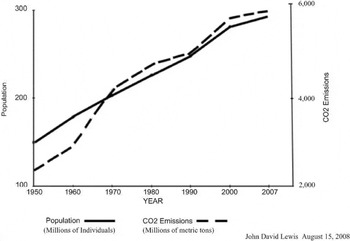
In setting the context for a discussion of political initiatives motivated by the AGW premise, it is important to recognize the irreplaceable value of fossil fuels. The rise of the United States as a prosperous nation was inextricably linked to the use of coal, oil, and natural gas. The population exploded over the past century, from under 76 million in 1900 to over 300 million today, accompanied by an unprecedented increase in prosperity and life span, as well as growing industrial emissions. A graph of CO2 emissions next to population makes this correlation clear (see figure 2).Footnote 73
United States population and CO2 emissions estimates, 1950–2007.

This correlation suggests that emissions are good, because life flourishes where industrial gases are emitted. Meanwhile, the lowest CO2 emissions in the world come from the poorest nations, who wish desperately to catch up. This makes the claim that “coal makes us sick, oil makes us sick, it's ruining our country, it's ruining our world” errant nonsense—why are we all not sick and dying?Footnote 74 But the graph does not say why CO2, population, and prosperity increased simultaneously. Is there a causal connection between CO2 emissions and prosperous population growth—or is this a coincidental correlation? Need we kill 60 percent of the population to achieve a 60 percent reduction in CO2 emissions? Or will reducing emissions to 1950 levels kill 60 percent of the population? What will be the consequences of coercive reductions in CO2 emissions?
CO2 emissions and material prosperity are two effects with the same material cause: industrial production. Industry has freed Americans from the ceaseless work of subsistence farming, created a plethora of new products, opened new vistas in technology for millions of people, and allowed city-dwelling Americans to visit remote natural areas. Industry also emits CO2 and other gases, by-products that, as technology stands today, cannot be drastically reduced without destroying the material cause of modern life, industry.
In the production of electricity, for example, there are no practical alternatives to fossil fuels today, except nuclear fission. Solar and wind have two inherent problems that limit them as primary sources of electricity. First, they are literally subject to the shifting winds and clouds of nature, and cannot provide the uninterrupted power that a stable electric grid requires. Second, the energy they gather is diffuse. There is a lot of it, but it is spread too wide and thin to be easily gathered.Footnote 75 They are, and will remain for the foreseeable future, adjuncts to primary power sources.
The Rancho Seco power plant in Sacramento demonstrates why. This 913 megawatt (mW) nuclear electrical generator was shut down in 1989 after years of environmental protests and rising costs. The Nuclear Regulatory Commission found “no significant impact” on the surrounding environment.Footnote 76 To close the plant, the operators wrote down hundreds of millions of dollars in loans, negotiated power guarantees from the Diablo Canyon Nuclear Power Plant (a dual-reactor with over 2,200 mW of capacity), and received millions of dollars in government subsidies to install solar arrays. The arrays now generate under 4 mW of solar electricity when the sun is shining, about 0.05 percent of the total power distributed by its operators.Footnote 77 The rest comes from a 50 mW natural gas burner at Rancho Seco, from other plants already on-line in California, and from out of state.Footnote 78 The appearance is a drastic turn to alternative energy—visibly manifested in acres of solar panels—but the reality is energy created by conventional means elsewhere. Unless large-scale battery systems can be created to handle the instability of solar and wind—a prospect that is highly speculative and will create its own hazardous materials—the only major, emissions-free source of electric power is nuclear plants.Footnote 79 One wonders where the United States will get its power, when California-style environmental laws—which allow no new oil drilling or construction of power plants either conventional or nuclear—become national laws.
Biofuels suffer from similar problems. In 2005, Congress passed the Renewable Fuels Standard mandate, renewed in 2008, which forced the fuel industry to mix ethanol into gasoline.Footnote 80 The Renewable Fuels Association—whose products could not be produced without federal coercion—promised that the act would generate $436 billion of household income nationally.Footnote 81 What has resulted so far? Food producers face huge losses or bankruptcy from the soaring cost of animal feed.Footnote 82 American gasoline prices rose to unprecedented levels in the summer of 2008, of which the ethanol mandates added some 14 to 19 cents per gallon in wholesale handling costs. Terminals have spent millions on special blenders and stainless steel piping, and where there are no special pipelines ethanol must be trucked in by diesel trucks. The lack of stability in the ethanol supply leaves terminals scrambling to meet their customers' needs while trying to obey the law.Footnote 83 Corn prices are unstable, and at times quadrupled during 2008. The search for agricultural land to grow corn has intensified. A study of ethanol production found that “costs of increased production are likely to exceed benefits by about three billion dollars annually in 2012 if current policies continue,” and that those policies are likely to increase greenhouse gas emissions overall.Footnote 84 Another study showed that the agricultural methods used to produce ethanol increased gas emissions appreciably.Footnote 85 In 2008, Texas petitioned the EPA to cut the mandates for a year, but because the EPA determined that “severe economic harm” had not been done (“severe” by what standard?), the EPA administrator denied the petition.Footnote 86 Such disjunctions between predictions of costs and the actual results should give us pause when other political schemes—such as American, European, or global cap-and-trade plans, which set limits on greenhouse gas emissions for industry, assign emissions allowances in the form of credits, and then allow the credits to be traded—are presented as if they will be economically beneficial.
So-called alternative energy sources—a misnomer, because they offer no meaningful alternative—also face another obstacle: the opposition of environmental activists and politicians. Senator Ted Kennedy opposed a wind energy project in Nantucket Sound, about which Robert F. Kennedy Jr. elaborated, “All of a sudden you're transferring an asset [meaning, areas of Nantucket sound] used by 5 million people into the hands of private industrial speculators.”Footnote 87 “Speculators” is an emotive word for “investors” who take financial risks in pursuit of profit—the worst villains in the minds of these politicians. Whether or not millions of people would benefit from the energy is irrelevant to Senator Kennedy's concern to maintain, at public expense, an area in which he may sail his yacht without seeing the sources of energy that make the yacht possible. Paul Watson, who was a cofounder of Greenpeace, and who as head of the Sea Shepherd Conservation Society advocates using force to promote his aims, wrote: “[T]his project is a threat to seabirds and as a marine wildlife conservation organization, we represent our clients, marine wildlife, and this Cape Wind project is not in their interest.”Footnote 88 Senator Kennedy fails to consider Watson's wider goal, which is to remove human influence, including yachts, entirely from all such areas.
Many people will be surprised to learn that environmentalists have filed lawsuits against wind generators and transmission lines across the United States, and have tried to block solar cells in the Mojave Desert.Footnote 89 In Valley County, Montana, a 500-megawatt, 20,000-acre wind farm was opposed by protesters who did not like the 400-foot turbines. The Sunrise Powerlink solar-energy project in California was opposed because it needs a 150-mile-long high-voltage transmission line from the Imperial Valley to San Diego.Footnote 90 In May 2008, the Bureau of Land Management stopped development of solar plants on 119 million acres of federal lands in Arizona, California, Colorado, Nevada, New Mexico, and Utah, pending environmental impact studies.Footnote 91 A group called the Alliance for Responsible Energy Policy, discussing the plans for arrays in the desert, argues that this portends the “permanent destruction of hundreds of thousands of acres of pristine public lands…. [This is] wilderness killing.” Protecting “pristine nature” here means ridding nature of any human presence—even a footprint in the desert.
As California governor Arnold Schwarzenegger put it, in a speech at Yale University:
[O]ur Department of Fish and Game is slowing approval of a solar facility in Victorville. It's because of an endangered squirrel, an endangered squirrel which has never been seen on that land where they're supposed to build the solar plants. But if such a squirrel were around, this is the kind of area that it would like, they say…. I don't know whether this is ironic or absurd. But, I mean, if we cannot put solar power plants in the Mojave desert, I don't know where the hell we can put it.Footnote 92
Even when they have not been blocked, solar, wind, and biofuel projects have gone nowhere without massive government subsidies. There is a reason why Home Depot sells gasoline electric generators, but does not sell home solar kits: solar is not cost-effective for anyone involved. Despite the fact that no alternative to coal, gas, oil, or nuclear has been found, NASA's James Hansen has called for the criminal trials of energy company CEOs, and for the bulldozing of coal power plants worldwide. To Hansen, coal trains are “death trains—no less gruesome than if they were boxcars headed to crematoria….”Footnote 93 Because nearly all political leaders have also accepted AGW as an unassailable truth, they too have set out to wish fossil fuels out of existence. Their proposals intend to force American industries to reduce their emissions below levels of fifty years ago, at the price of a staggering increase in federal power over the lives of individuals, and a catastrophic economic decline.
VII. A Dangerous Political Consensus
Over the past two decades, environmentalists and their supporters have connected the premise of anthropogenic global warming to wider social, political, and economic goals, and have mustered a variety of schemes to tie up industry in regulations and lawsuits, limit industrial activity, redistribute wealth from the developed to the undeveloped nations, and undermine the sovereignty of the Western nations. Across the globe, these plans have gained a moral force that has received strong institutional support in the European nations, including so-called cap-and-trade schemes in Europe and a major climate change law in the United Kingdom, as well as action by the United Nations. Within the United States, these movements have resulted in a series of actions that have empowered the Environmental Protection Agency to formulate, and to release for public comment, an outline of how greenhouse gas emissions would be regulated by federal power.
On July 11, 2008, the United States Environmental Protection Agency (EPA) released an Advance Notice of Proposed Rulemaking (ANPR) on the matter of global warming.Footnote 94 This request for public comment is based upon a 2007 U.S. Supreme Court ruling which held that CO2—a gas vital to the biological processes of plants and animals—is to be categorized within a range of pollutants as defined by the Clean Air Act (CAA).Footnote 95 Following this decision, in May of 2007, President Bush signed Executive Order 13432 requiring government agencies to cooperate with the EPA and to devise rules to deal with greenhouse gas emissions from automobiles and other internal combustion engines.Footnote 96 Additional pressure has come from both the House and the Senate to empower the EPA to pursue the broader goal of reducing emissions across the board.Footnote 97 The House Committee on Energy and Commerce, for instance, has produced a document outlining “potential mechanisms for limiting the cost and maximizing the efficiency of a mandatory, comprehensive climate change program to reduce greenhouse gas emissions by 60 to 80 percent by 2050.”Footnote 98
A brief summation of the sequence of events in the United States reveals pressure from all three branches of government that is leading to the implementation of federal regulations far beyond anything contemplated in American history. In October 1999, several states and private groups petitioned the EPA to use the CAA to regulate greenhouse gases. The EPA denied the petition, and the petitioners sued. After years of legal action, the Supreme Court ruled on behalf of the petitioners in Massachusetts v. EPA (2007), affirming the responsibility of the EPA to regulate those emissions, including CO2, should the EPA determine that they constitute an “endangerment” to public health. The Court ruled that “If EPA makes a finding of endangerment, the Clean Air Act requires the agency to regulate emissions of the deleterious pollutant from new motor vehicles.”Footnote 99 As reiterated in the ANPR, the Court also wrote: “Because greenhouse gases fit well within the Clean Air Act's capacious definition of air pollutant, we hold that EPA has the statutory authority to regulate the emission of such gases from new motor vehicles.”Footnote 100 In its opening sentences, the ANPR acknowledges:
This advance notice of proposed rulemaking (ANPR) presents information relevant to, and solicits public comment on, how to respond to the U.S. Supreme Court's decision in Massachusetts v. EPA. In that case, the Supreme Court ruled that the Clean Air Act (CAA or Act) authorizes regulation of greenhouse gases (GHGs) because they meet the definition of air pollutant under the Act.Footnote 101
Over the past years, the EPA and other agencies have implicitly if not explicitly accepted the “endangerment” criterion, given the EPA's acceptance of the conclusions of the UN IPCC and other political organizations that anthropogenic global warming (AGW) from greenhouse gases is “unequivocal.”Footnote 102 The Department of Energy, for instance, wrote in its comments in the ANPR:
The Department supports the actions taken by the United States to date to address global climate change and greenhouse gas emissions, and believes these efforts should be continued and expanded…. [However] The Department believes that an effective and workable approach to controlling GHG emissions and addressing global climate change should not simply consist of a unilateral and extraordinarily burdensome Clean Air Act regulatory program being layered on top of the U.S. economy… .Footnote 103
The EPA even cites a study to claim that certain Title VI provisions of the Clean Air Act “will have done more [by 2010] to mitigate climate change than the initial reduction target under the Kyoto Protocol, amounting to avoided emissions of 11 billion metric tons of CO2 equivalent per year, or a delay in climate impacts by about 10 years.”Footnote 104
Given the EPA's acceptance of the premise that man-made global warming is real and can be mitigated by government action to curb industrial emissions, EPA officials did not refuse to issue regulations on the grounds that CO2 is not an endangerment, but rather delayed the regulations on the grounds that the regulations would be ever-expanding, unilateral, economically destructive, and difficult if not impossible to implement. They argued, in essence, that these regulations would be devastating attacks on American freedom, although such language does not appear in the ANPR, and that the public should have an opportunity to offer input on these proposals. But such grounds were not recognized by the Court as valid reasons for EPA to avoid action. As stated in a January 2008 letter to the EPA administrator, signed by the attorneys general of seventeen states and the counsels of two municipalities, an “endangerment threshold” is the sole and sufficient justification to move forward with regulations:
In response to the Court's ruling, you repeatedly indicated that the agency would be moving forward with regulation under Section 202 and other provisions of the Clean Air Act. See e.g., Statement of Stephen L. Johnson, to House Select Committee on Energy Independence and Global Warming (June 8, 2007). In this manner, you acknowledged that the agency has concluded that the endangerment threshold has in fact been crossed.Footnote 105
Having accepted the basic premise that global man-made climate change is real and caused by human emissions of gases that include CO2, the question became one of how best to reduce these emissions. The debate has been narrowed to consider the methods of regulating CO2, and is no longer about whether to regulate it. The EPA and other agencies do not agree with the U.S. Supreme Court that the Clean Air Act is the right mechanism for the task. The ANPR begins with a clear warning that the assumption by the agency of the wide-ranging powers included in the CAA will lead to uncontrollable growth of the agency's power:
EPA's analyses leading up to this ANPR have increasingly raised questions of such importance that the scope of the agency's task has continued to expand. For instance, it has become clear that if EPA were to regulate greenhouse gas emissions from motor vehicles under the Clean Air Act, then regulation of smaller stationary sources that also emit GHGs—such as apartment buildings, large homes, schools, and hospitals—could also be triggered. One point is clear: the potential regulation of greenhouse gases under any portion of the Clean Air Act could result in an unprecedented expansion of EPA authority that would have a profound effect on virtually every sector of the economy and touch every household in the land.Footnote 106
Were the Bush administration obsessed with increasing executive power—as critics have often charged—this issue would have offered a golden opportunity to do so. But the opposite has been the case. It is the proponents of man-made global warming that are demanding an immediate, unilateral, and potentially limitless increase in executive power, while administration officials are asking for public deliberation and comment prior to assuming this power.
In a letter attached to the ANPR, Susan Dudley, Director of the Office of Information and Regulatory Affairs in the Office of Management and Budget, stressed the extent to which expanded EPA authority would reach down to local levels of American society. Meeting the standards for emissions reductions, for instance, “could require case-by-case EPA permitting” for “office and residential buildings, hotels, retail stores and other similarly-sized projects.” With regard to vehicles, “An effective mobile source emissions compliance and enforcement program is fundamental to ensuring that the environmental benefits of the emission standards are achieved.”Footnote 107 The EPA is here already contemplating a takeover of building permit authority and vehicle emissions testing, among other newly minted powers. Because the administration recognizes these dangers and has moved slowly before carving them into formal regulations, it is facing a barrage of criticism for not imposing these rules immediately and vigorously.
The ANPR provides details of the myriad ways in which the administrator of the EPA will be empowered to assert control over the daily life of every citizen. Perhaps the most ominous power will be over food production. Farm machinery, processing plants, and trucks would operate only with the permission of the EPA—even basic agriculture and the biological functioning of animals will not be exempt. The Department of Agriculture notes:
[M]any of the emissions are the result of natural biological processes that are as old as agriculture itself. For instance, technology does not currently exist to prevent the methane produced by enteric fermentation associated with the digestive processes in cows and the cultivation of rice crops; the nitrous oxide produced from the tillage of soils used to grow crops; and the carbon dioxide produced by soil and animal agricultural respiratory processes. The only means of controlling such emissions would be through limiting production, which would result in decreased food supply and radical changes in human diets. Footnote 108
The EPA will now have the unchecked power to ration food production, to approve its content, and to control its distribution. (How, one might ask, will we grow millions of acres of corn for ethanol, while rationing food production?)
The ANPR summarizes the EPA conclusions about the economic effects of using the CAA as a federal enforcement tool: “The effects of broad based, economy-wide regulation of GHGs under the CAA would have significant adverse effects on U.S. energy supplies, energy reliability, and energy security.” Electricity costs will rise 30 to 90 percent. The Energy Information Administration (EIA) analyzed legislation to reduce emissions 30 percent below 2005 levels by 2030 and 70 percent below 2005 levels by 2050. The EIA concluded that “achieving those emission targets would reduce manufacturing employment by 10 percent below currently projected levels in 2030…. [And it] would reduce the output of key energy-intensive manufacturing industries, such as food, paper, glass, cement, steel, and aluminum, by 10 percent and the output of non-energy-intensive manufacturing industries by nine percent below currently projected levels in 2030.”Footnote 109
The EPA then places these emissions-reduction targets into historical context, which strongly suggests that these estimates of economic and industrial losses are far too conservative:
To provide context, it is useful to note that a 60 percent reduction in U.S. emissions from 2000 levels would result in emissions levels that were last produced in the United States during the 1950s…. In 1950, the population in the United States was 151 million people—about half the current size—and the Gross Domestic Product was $293 billion.Footnote 110
It is helpful to note that government spending in 1950, at the federal, state, and local levels, was $70.3 billion (equivalent to about $561 billion in 2008 dollars). Today's far greater spending will remain a drain on productive activity as we try to regulate ourselves back to 1950.Footnote 111 Federal officials state explicitly that these proposals would create an unaccountable and economically totalitarian regime that would have negative effects on every American into future generations. “We are concerned that attempting to regulate greenhouse gases under the Clean Air Act will harm the U.S. economy…. [T]he U.S. economy would be subjected to a complex set of new regulations administered by a handful of people with little meaningful public debate and no ability to consider benefits, costs, risk tradeoffs and feasibility.”Footnote 112
But for proponents of anthropogenic global warming (AGW), the moral force attached to the task of cutting emissions reduces matters of economics and human well-being to irrelevance. In the end, economic prosperity and freedom have no bearing on the Supreme Court ruling in Massachusetts v. EPA, and the requirements for EPA action under the Clean Air Act. Thus, theory and practice have come together, in the form of impending federal regulations on a massive scale.
Given this political momentum, it is not surprising that Congress has also been active. The Lieberman-Warner Climate Security Act of 2007 and 2008 reveals the kind of cap-and-trade legislation that would meet the requirements of the ANPR—and the president—for open legislative action to achieve the goals of reducing greenhouse gases.Footnote 113 The bill would mandate the following cap-and-trade system for American industry:
• It would establish a Climate Registry, a bureaucracy to “collect high-quality greenhouse gas emission data” (Sec. 1102).
• It would require owners and operators of a “covered facility” to submit an “emission allowance” or offset credit for their emissions, with compliance determined by the EPA administrator, who shall “establish and distribute … emission allowances” and set the penalties for noncompliance (Sec. 1202). All natural gas emissions would be included (Sec. 1204).
• It would establish a Domestic Offset Program to “promulgate regulations authorizing the issuance and certification of offset allowances.” Project owners would need to “register emissions under the Federal Greenhouse Gas Registry” (Sec. 2402).
• It would establish a Carbon Market Efficiency Board to set the quantity of emission allowances, the period of paybacks for an allowance, the interest rate at which an emission allowance may be borrowed, etc. (Secs. 2602–2604).
• It would establish a Climate Change Credit Corporation, “a nonprofit corporation without stock” that “shall not be considered to be an agency or establishment of the Federal Government” (Sec. 4201).
The system is a cap-and-trade scheme: a statutory cap on total emissions of carbon dioxide, with the requirement that companies obtain permits for such emissions. Depending on where an industrial firm, farm, or building owner stands in the scheme, a business may obtain permits either directly from the EPA or by purchase from others who do not intend to use them. This buying and selling of government permissions will be managed by the ambiguous and contradictory Climate Change Credit Corporation, an establishment of the federal government that shall not be considered to be an establishment of the federal government (!). This doublethink passage is a redistribution scheme to transfer wealth from industrial producers to those who do not need to produce the gases—or anything else, if they can get enough money selling the government emissions credits. This attempt to cloak the scheme in the mantle of a “market” will obfuscate the political coercion that underlies the scheme. Experts in political “pull” will rise to assist businesses in gaining the permissions they need. Thus, the industry of the United States—including its food supply and transportation systems—will be placed under the control of the EPA, and harmonized with carbon-trading schemes coming on-line in Europe.Footnote 114 And when the scheme fails, the alleged “market” will take the blame.Footnote 115
The confusion that underlies the status of this bill—as of this writing, its sponsor is Barbara Boxer, it has been subject to a cloture vote, and it is apparently dead for the remainder of this administration—is akin to the confusion in its content. But it presents the basics of an American cap-and-trade system of a kind that could replace the Clean Air Act as the basis for EPA regulatory authority. We may expect that similar legislation will be brought forward in the coming years.
On an international level, the Kyoto Protocol is a similar redistribution scheme, described by one critic as comparable to “the sale of indulgences by the Mediaeval church.”Footnote 116 The protocol was adopted in December 1997 by the Third Conference of the Parties to the United Nations Framework Convention on Climate Change.Footnote 117 This agreement needed the kind of international sanction that could be created through promises of economic gain. Russia, for instance, joined because the 1990 Kyoto benchmark, which was locked in before Soviet industry collapsed, will allow Russia to partake of a huge number of emissions credits. China also hopes to collect huge cash payments based on hypothetical amounts of CO2 it might have produced. As of this moment, China exceeds the U.S. in total emissions, but its per-capita emissions remain lower. This provides a justification for its demand for $300 billion in economic transfers from the United States and the European nations to undeveloped nations, an amount that “might not be enough.”Footnote 118 With China and India exempt from the requirements to reduce emissions, the premise of carbon egalitarianism will be entrenched internationally, in the “buying” of credits from those who are either exempt from the caps or able to trade the credits they do not need. Money will flow from the industrialized nations to people in positions of power within nations that are not industrialized. Such schemes target the material cause of prosperity—industrial activity—as a cache of wealth to be drained and redistributed. While the United States and Europe work to implement these schemes, China and India will build power plants by the hundreds.
At the moment of this writing, the financial crisis of 2008 has put many of these enviro-socialist plans on hold. It appears that European cap-and-trade agreements, as well as the Lieberman-Warner Act, are dead, and that Kyoto is likely to pass away. But if motivations for such measures remain intact, we can predict that they will return. This is one prediction that has a causal basis: the connection between will and action. The American EPA proposals can be enacted by the EPA administrator's fiat. And on October 28, 2008, British Parliament passed the so-called Climate Change Act, which pledges to somehow cut CO2 emissions by 80 percent by 2050—even as the first snow fell on London in October since 1922.Footnote 119
Such proposals will neither create a new kind of power plant nor lower the Earth's temperature. But they will centralize political authority to an unprecedented extent, add to the coerced economic redistribution that is sapping the productive capital of industry, create special interest groups (or special interest groups of nations) to cash in on the permitting scheme, and irreversibly strengthen government control over every life on the planet. The result will be to raise prices everywhere, to precipitate an inescapable worldwide economic decline, and to reduce the energy security of nations who are precluded from using their coal because it might endanger the Earth.Footnote 120 Henceforth, we will all work not by right, but by permission. The scheme will pound a giant spike into the coffin of life, liberty, prosperity, and happiness for those who have actually achieved it.
VIII. Conclusion: Evaluating the Political and Moral Agenda
This basic examination of the Earth's climate history, including the history of failed environmentalist predictions and the opposing statements of top-rank scientists, has led to the conclusion that predictions of imminent climate disaster are specious, unproven, and ahistorical. No extraordinary evidence has been presented for the extraordinary claims; indeed, the claims run counter to historical evidence. Proponents of AGW, especially political figures, discuss AGW as if it were a fact no longer requiring proof, reject out of hand evidence to the contrary, and dismiss those who disagree as “flat-earthers,” “heretics,” or “deniers.” This makes AGW a dogma. There is no reason for freezing either our understanding or our laws on the basis of this dogma. Similar scares have come and gone. It is a good thing we did not draft laws to enforce the tenets of Limits to Growth by Donella Meadows in 1972 (which predicted economic collapse in terms reminiscent of Marx), or Paul Ehrlich's Population Bomb in 1968 (which reiterated the predictions of mass starvation first put forward by Thomas Malthus). What would the United States look like today, had Rachel Carson's Silent Spring appeared in 1940 instead of 1962, and become a motive for political action before millions of American backyards and trees were sprayed with DDT?
Americans today are largely unaware of the malaria that swept dozens of states up to the end of World War II. The Centers for Disease Control (CDC) in Atlanta was originally formed as a malaria control center. According to the CDC, malaria was endemic in the United States until the late 1940s. Energetic efforts to eliminate malaria by targeting mosquitoes through the spraying of DDT began in July 1947:
The program consisted primarily of DDT application to the interior surfaces of rural homes or entire premises in counties where malaria was reported to have been prevalent in recent years. By the end of 1949, over 4,650,000 house spray applications had been made. Total elimination of transmission was slowly achieved. By 1951, CDC gradually withdrew from active participation in the operational phases of the program and shifted its interest to surveillance, and in 1952, CDC participation in operations ceased altogether.Footnote 121
By 1949, malaria was effectively eliminated from the United States. Within two years of a spraying program, a major public health hazard had been eradicated, and malaria had been relegated to something that Americans today view as existing only in foreign lands. But had DDT been banned in 1947, Americans might still face malaria today—as it continues to ravage people in undeveloped nations who have not made their homes safe using DDT. The World Health Organization reports that a million people die of malaria every year, and that 20 percent of infant deaths in Africa are due to malaria.Footnote 122 Those deaths are the responsibility of the environmental movement. Yet the EPA has never reversed the decision of its administrator, William Ruckleshaus, to ban DDT in 1972. He did so on his singular authority, against the advice of J. Gordon Edwards, an entomologist and professor at San Jose State University, and despite the ruling of an administrative law judge that DDT was not a carcinogen.Footnote 123 But rather than reexamine the premises—and the flawed studies—that led to the action, further actions of the same stripe have followed.
There is no man-made threat to the natural climate, but the political climate is another story. The political program attached to anthropogenic global warming—now called “climate change” since we may not be warming at all—constitutes a clear and present danger: the imposition, by force of law, of irreversible federal economic controls on a scale never before seen in the industrialized world. These laws would strike to the heart of our capacity to thrive as productive beings, and would strip us of the ability to face the challenges of nature. This threat is all the more pressing given the strength of the impetus behind this movement and the open-endedness of the power it has granted to the EPA, should the agency wish to seize it. We are fast approaching the political tipping point beyond which freedom and prosperity will be unrecoverable.
The AGW premise has merged into a broader political, economic, educational, and even psychological program of enormous ambitions.Footnote 124 AGW is used as a rationalization for various socialist initiatives, including the subordination of property rights to political control, government takeover of industry, redistribution of wealth on national and global levels, and a mélange of laws to force people to act in “environmentally friendly” patterns (e.g., bans on incandescent light bulbs, showerhead flow restrictors, and garbage sorting laws). Economic support for such policies is based on the idea that economics as a discipline is concerned with the “allocation of scarce resources” and has nothing to do with producing material values. The economic doctrine of “externalities” purports to assign costs to businesses (e.g., a carbon tax, to pay for their alleged contribution to AGW); this adds an additional rationalization for redistribution schemes. Psychologists write books about how to change human behavior to fit the AGW dogma.Footnote 125 The focus on “saving the Earth” in public education has made environmental action a goal for many young people, who monitor their parents for compliance with recycling laws. AGW can be a lucrative career move for budding scientists who anticipate billions of dollars in government grants for environmental research that supports the AGW dogma. AGW is becoming a prerequisite to political success, and many politicians fear that opposition to environmental proposals will lose them the next election. As a result, political officials in the United States are now detailing the greatest expansion of federal power in three generations, and a chorus of voices is urging them to move faster.
But the biggest impetus behind the AGW premise is moral. Following the EPA's request for public comment, a spokeswoman for Greenpeace issued a statement that read, in part:
As “the world's biggest polluter”—a proclamation issued proudly by President Bush as he departed the G8 meeting yesterday—perpetuating inaction on the part of the U.S., whether it is at the federal level or abroad, is immoral.Footnote 126
In its attempt to discredit those who disagree by calling them “immoral,” Greenpeace makes clear that this is a clash of moral values. There is a profound moral difference between seeing nature as a value to be protected from man's defiling touch, and seeing nature as a value because it contains resources valuable to man. For the latter, the benefits that accrue to human beings are the basis for identifying a value in nature. Some aspects of nature (e.g., polar bears hunting human beings) are a threat and should be destroyed. But according to Greenpeace, the benefits or harms to human beings are irrelevant. To take time even to discuss the political and economic consequences of turning the country over to an autocratic federal agency is, they say, immoral. What does it matter what human beings think? The Earth is in danger, they cry, and that is enough to justify immediate, even dictatorial, action at any price. The moral claims made on behalf of the AGW premise—the connections to “social justice,” the apportionment of blame on the wealthy nations, the sympathy evinced by the sight of dead polar bears, and the idea that the Earth is held in stewardship by a collective under environmental leadership—give AGW the aura of a transcendent power that allows other concerns, including human well-being, to fade into insignificance.Footnote 127
Thus, the possibility of abundant energy is rejected by many leading environmentalists on principle. Paul Ehrlich—the first winner of the Heinz Award in the Environment—famously wrote: “Giving society cheap, abundant energy … would be the equivalent of giving an idiot child a machine gun.”Footnote 128 Amory Lovins—the fourth Heinz Award winner—opined that “it'd be a little short of disastrous for us to discover a source of clean, cheap, abundant energy because of what we would do with it. We ought to be looking for energy sources that are adequate for our needs, but that won't give us the excesses of concentrated energy with which we could do mischief to the Earth or to each other.”Footnote 129 The “mischief” includes industrial development, as well as the wealth it creates. The practical result is opposition to wind energy projects at sea and to solar panels in the desert.
Global warming was the one catastrophe able to motivate people to accept onerous economic restrictions that they would otherwise reject. But the rejection of the very idea of abundant energy reveals a deeper agenda: to criminalize productive achievement as such, to put the most productive individuals on trial, and to return us to a mythical Garden of Eden, where prosperity flowed causelessly like milk and honey because people wished it. This is nowhere better illustrated than in the efforts of many environmental groups to prevent the use of biotechnology in Africa, consigning millions of struggling farmers to slow starvation using antiquated agricultural practices. The Friends of the Earth are no friends of the farmers when they oppose genetically modified foods because they “may have the potential to grow” in areas that the environmentalists hold more dear than the lives of local farmers.Footnote 130
As the late Aaron Wildavsky, professor of political science at the University of California at Berkeley, put it:
Warming (and warming alone), through its primary antidote of withdrawing carbon from production and consumption, is capable of realizing the environmentalist's dream of an egalitarian society based on rejection of economic growth in favor of a smaller population's eating lower on the food chain, consuming a lot less, and sharing a much lower level of resources much more equally.Footnote 131
Under the premise of AGW, economic redistribution schemes have expanded in service to all of nature as embodied in “The Environment,” a divine entity to whom the industrialized nations are to pay reparations. The original meaning of “environment” was relational; it denoted an organism's surroundings, such as the environment of a person in an office building. This meaning has been discarded, because human life is no longer the point of reference for evaluating these surroundings. The new conception of “The Environment” constructs a transcendent entity with its own will, values, and plan of action. In such a pan-theological worldview, the deity becomes the source, standard, and recipient of moral actions; human laws must follow the environmental moral law and offer sacrifice to the deity. In practical application, “The Environment” now includes every organism on the face of the Earth, each with its own needs and even rights, except for man, whose needs and rights are forfeit if he comes into conflict with any other organism. Solar arrays in the desert must be stopped if a hypothetical squirrel might be threatened by human footprints, and human needs—especially private needs—are irrelevant. Greenpeace takes no cognizance of human values, needs, or consequences in its charge of immorality—as the Friends of the Earth do not care about starving farmers denied biotechnology, and the EPA does not care about people denied DDT and dying of malaria.
In this worldview, there is nothing neutral about the relationship between man and his environment: we are invaders, parasites, viruses. Paul Watson expressed this directly: “The planet's ecosystem is a collective living organism…. Humans are presently acting upon this body in the same manner as an invasive virus….”Footnote 132 Of course, many environmentalists may call him a “misguided idealist”—but what of Prince Phillip of England, who followed these “ideals” when he said: “If I could be reincarnated, I would return as a killer virus to lower human population levels.”Footnote 133 Or David Graber, a biologist with the U.S. National Park Service: “We are not interested in the utility of a particular species, or free-flowing river, or ecosystem, to mankind. They have intrinsic value—more value, to me—than another human body or a billion of them…. [S]ome of us can only hope for the right virus to come along.”Footnote 134 Or Maurice Strong, secretary general at the 1992 UN Conference on Environment and Development, who said: “Isn't the only hope for the planet that the industrialized civilizations collapse? Isn't it our responsibility to bring that about?”Footnote 135
If it is true that many environmentalists reject such statements, then why have they not repudiated the people who make them? Political leaders are writing laws with just as little concern for the human consequences of their actions. The AGW political movement is creating a self-fulfilling prophecy: it portends the collapse of capitalism, and then causes that collapse by destroying the foundations of capitalism in law and limited government. This is simply one more tie between the environmental and the Marxist movements, for the latter made the same claims and used the same methods to make certain they came true.
I have argued that natural history, the history of environmentalist predictions, and the statements of many scientists do not support the conclusion that man is destroying the Earth. I have further argued that the laws being proposed now are more than unnecessary: they will be positively destructive, automatically expanding, and irreversible. The integration of the AGW dogma with redistribution plans and the desire to exercise totalitarian economic control over industrial producers reveals the deep commitment of the movement's advocates to socialist programs. AGW dogma is a means to instill fear and guilt in the residents of industrialized nations, in order to gain their support for their own destruction. As one activist put it, “residents of industrialized nations are responsible for the vast majority of accumulated GHGs that cause climate-related harm.”Footnote 136 If those residents accept this assertion and do not defend the goodness of industrial activity and the liberty on which it is based, then they will witness the forced redistribution of their wealth on a global scale, and a deep decline in their standard of living.
But before following this road further, those residents should pay closer attention to history—to the history of the Earth, and to political history. No one knows what is going to happen to the Earth's climate in the future, except that it will change. We do know the consequences of placing America's economy under the control of an unchecked federal bureaucracy that is beholden to nature and not to man.