Introduction
The Centers for Medicare and Medicaid Services (CMS) require hospitals to report rates of central line-associated bloodstream infection (CLABSI), catheter-associated urinary tract infection (CAUTI), surgical site infection (SSI) after colon surgery and abdominal hysterectomy, hospital-onset methicillin-resistant Staphylococcus aureus (HO-MRSA) bacteremia, and hospital-onset Clostridioides difficile infection (HO-CDI) to the National Healthcare Safety Network (NHSN). Reference Page, Klompas and Chan1 The former four healthcare-associated infections (HAI) are determined by manual or partially automated review by infection preventionists while the latter two are laboratory-reportable events.
The current HAI reporting system is imperfect. First, the use of manual adjudication leads to discrepancies in data accuracy. Keller et al developed clinical vignettes to assess the accuracy of HAI identification; expert participants identified HAI correctly in only 61.1% of cases. Reference Keller, Linkin, Fishman and Lautenbach2 Second, HAI surveillance is time consuming with a reported 16.6 hours per week spent on CLABSI surveillance alone. Reference Rock, Thom and Harris3 Finally, CMS criteria fail to identify a substantial number of HAI. For example, only 14.5% of hospital-onset adult sepsis events are captured by NHSN Reference Page, Klompas and Chan1 and only 6 to 20% of HOB result in an NHSN-defined CLABSI. Reference Rock, Thom and Harris3–Reference Stack, Dbeibo, Fadel, Kelley, Sadowski and Beeler5
To improve the parity of reported HAI data, minimize the time dedicated to chart review by infection preventionists, and prevent the most HAI, the NHSN has developed a hospital-onset bacteremia (HOB) reporting module. HOB is a laboratory-reported HAI; risk-adjustment will be based on facility-level data. Reference Yu, Ye and Edwards6 Participating hospitals may voluntarily submit data beginning in 2025. Mandatory data collection is anticipated to follow in subsequent years. 7 It is postulated that HOB could replace certain metrics in NHSN. The goal of this study is to compare the proposed HOB metric with traditional CMS metrics for the identification and prognosis of HAI at a public safety net hospital.
Methods
Study design and population
This is a retrospective cohort of patients hospitalized between Jan 1, 2022, and Dec 31, 2023, at a 500-bed academic safety net hospital in Denver, CO. Patients over 18 years old with a positive blood culture on hospital day 4 or greater or a CMS-reportable HAI were eligible for inclusion; those with HO-CDI were excluded.
Definitions
Select CMS-reportable HAI events were defined as CLABSI, CAUTI, HO-MRSA bacteremia, and SSI after colon surgery and abdominal hysterectomy reported to NHSN. At least two infection preventionists adjudicated all infections. HOB was defined as a new bacteremia or fungemia on or after hospital day four. For recognized pathogens, a single positive blood culture was sufficient to meet the definition; two positive cultures within four calendar days were required for common commensal organisms. 8
Events were categorized into three mutually exclusive groups: “HOB-only” for HAI with bacteremia but not reportable to CMS; “CMS-only” for HAI reported to NHSN but not involving bacteremia; and “Overlap” for HAI meeting both CMS and HOB criteria. HAI were considered preventable if national prevention guidelines were available for the HAI.
Data collection
Data regarding CMS-reportable HAI events were exported from NHSN. For HOB, a list of positive blood cultures was obtained through the data warehouse for the institution and crossmatched to hospital admission dates. Variables were manually extracted from the electronic health record.
The source of HOB was determined by an infectious diseases physician using provider documentation, imaging studies, and laboratory tests; surveillance definitions were not used. If the clinical provider’s documentation suggested more than one possible source of HOB, a matching culture from a body site and clinical symptoms were used to determine the most likely source. If the clinical provider chose not to treat the positive blood culture, then it was classified as a contaminant. A second infectious diseases physician independently reviewed 10% of the cases to determine source of HOB; agreement was found in 93% of cases.
Statistical analysis
Descriptive statistics were used to analyze patient demographics and hospitalization characteristics. χ2 tests of independence were used to determine associations between categorical variables while differences in means t tests were used to test for associations between continuous variables and the outcomes of interest. Bivariate and multivariate analysis using logistic regression was performed on the primary outcome of mortality, testing for the effects of age, cohort inclusion, and the presence of multiple infections. Within the multivariate analysis, backwards selection modeling was used to limit to statistically significant effects. Data were analyzed using SAS Enterprise Guide, Version 8.3 for Windows (Copyright © 2025 SAS Institute Inc., Cary, NC, USA.). This study was approved by the Colorado Multiple Institutional Review Board.
Results
In the two-year study period, there were 150 HOB and 90 CMS events; 41 events met both criteria. Therefore, the three mutually exclusive categories included 109 HOB-only events (54.8%) in 97 patients, 49 CMS-only events (24.6%) in 49 patients, and 41 Overlap events (20.6%) in 39 patients.
Patients’ median age was 54.8 years (IQR 38.6, 65.9) and 79.5% were male. White patients comprised 67% of the population, and 14.6% of patients were Black; 35.7% identified as Hispanic, Latino, or of Spanish origin. These characteristics did not differ between the three groups. The 6-month mortality was similar between groups (27.6%) though the time from event to death was shorter in the HOB-only group than in the CMS-only and Overlap groups (median 8.5 vs 14.0 vs 10.6 days respectively, p = 0.017).
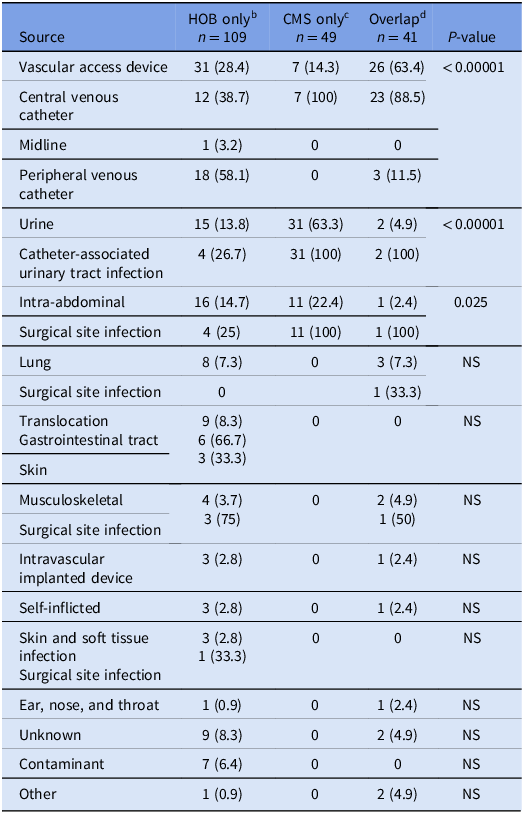
Infections of vascular access devices were the most common HAI (n = 64, 32.1%) with the majority in the Overlap group. Infections of the urinary tract were most common in the CMS-only group with few in the Overlap group (Table 1). In a multivariate analysis including multiple HAI events and age, older age was associated with increased mortality; for each one-year increase in age, mortality increased by 5% (OR 1.03–1.08, p < 0.0001).
Source of hospital-onset bacteremia and CMS-reportable hospital-acquired infection events, 2022–2023 a

a Note. These three categories are mutually exclusive
b HOB only: hospital-onset bacteremia; hospital-acquired infections that involved bacteremia and are not currently reported to the Centers for Medicare and Medicaid Services (CMS)
c CMS only: select hospital-acquired infections (HAI) that meet strict National Healthcare Safety Network definitions for central line-associated bloodstream infection, catheter-associated urinary tract infection, methicillin-resistant Staphylococcus aureus bacteremia, and surgical site infection after hysterectomy and colon surgeries and are reportable to CMS
d Overlap: HAI that involved bacteremia and were reported to CMS
Discussion
In this retrospective cohort study, CMS-only events were almost 50% less frequent than HOB-only events, suggesting that HOB is a more sensitive HAI metric than the current CMS-reported measures. Infections of vascular access devices were most common in the HOB-only and Overlap groups with 48% (31/64) of vascular access device infections not reportable to CMS. Over 60% of these were due to midlines or peripheral venous catheters, vascular access devices that are not tracked by CMS. This is in concordance with prior authors’ reports such as Dantes et al, who reported that 61% of HOB were due to vascular access devices, and Friedman et al, who reported that 52% of nosocomial bacteremia were due to intravascular devices. Reference Dantes, Rock and Milstone4,Reference Friedman, Kaye and Stout9 Based on our data, we anticipate that HOB would capture more vascular access device infection events and the same quantity of HO-MRSA bacteremia as the current CMS CLABSI and HO-MRSA bacteremia metrics. As prevention guidelines for both central and peripheral venous catheters are available, Reference Nickel, Gorski and Kleidon10,Reference Buetti, Marschall and Drees11 we believe that HOB could reasonably replace both the current CLABSI and HO-MRSA CMS metrics and potentially drive further reductions in HAI.
Urinary tract infection (UTI) and intra-abdominal infections were common causes of HOB, both representing approximately 14% of HOB-only cases. There were few Overlap events in either of these categories, suggesting that HOB identifies a different subset of both patients with UTI and with intra-abdominal infection than CMS measures. Specifically, many of the HOB UTI were in patients without a urinary catheter, and many of the HOB intra-abdominal infections were in those who did not have recent surgery. While there are well-defined prevention measures for CAUTI Reference Gould, Umscheid, Agarwal, Kuntz and Pegues12 and for SSI, Reference Berrios-Torres, Umscheid and Bratzler13 prevention measures for non-catheter-associated UTI in hospitalized patients and intra-abdominal infection not secondary to surgery are not defined. Prior authors have expressed concern about the adoption of HOB because a sizeable proportion of HOB events are not considered to be preventable. Reference Stack, Dbeibo, Fadel, Kelley, Sadowski and Beeler5,Reference Schrank, Sick-Samuels and Bleasdale14–Reference Leekha, Robinson and Jacob16 We concur with these prior authors; the substitution of HOB for the current CAUTI and SSI after colon surgery and hysterectomy may not result in improved patient outcomes until additional prevention strategies are identified.
Finally, this study found that all three groups of HAI events had similar six-month mortality (20 to 28%, P = 0.553). This is in concordance with prior authors who report 15–37% in-hospital mortality in patients with HOB. Reference Stack, Dbeibo, Fadel, Kelley, Sadowski and Beeler5,Reference Friedman, Kaye and Stout9,Reference Wisplinghoff, Bischoff, Tallent, Seifert, Wenzel and Edmond17,Reference Shorr, Tabak, Killian, Gupta, Liu and Kollef18 This study was not designed to determine if death was secondary to HAI or another cause. Nonetheless, this finding provides important prognostic information for patients with HAI events and highlights the critical importance of preventing these events in patients.
Strengths of this study include the manual evaluation of etiology of HOB infections and how it compares to CMS-reported measures. This study is limited by its single center design. Data from a larger set may have led to an ability to perform more multivariate comparisons.
In summary, HOB is an attractive alternative to CMS-reported measures as it can standardize and streamline HAI reporting. However, its ability to drive actionable decreases in patient harm is unclear.
Financial support
None.
Competing interests
All authors report no conflicts of interest relevant to this article.