Existing guidelines suggest that using the ratio of area under the concentration-time curve to minimal inhibitory concentration (AUC/MIC) to guide dosing for vancomycin significantly reduces vancomycin exposure and leads to improved treatment effectiveness and lower nephrotoxicity. Reference Rybak, Le and Lodise1 Such a strategy has been adopted in developed countries and has led to improvements in vancomycin therapeutic target attainment and to decreases in nephrotoxicity. Reference Meng, Wong and Huang2–Reference Neely, Kato and Youn4 AUC-guided dosing was recommended by a revised consensus guideline from the American Society of Health-System Pharmacists (ASHP), the Infectious Diseases Society of America (IDSA), the Pediatric Infectious Diseases Society (PIDS), and the Society of Infectious Diseases Pharmacists (SIDP) for suspected or definitive serious methicillin-resistant Staphylococcus aureus (MRSA) infections, patients at high risk for nephrotoxicity, patients with unstable renal function, and those receiving prolonged courses of therapy (ie, >3–5 days). Reference Rybak, Le and Lodise1
In Asia, data regarding the use of AUC-guided vancomycin dosing are limited to certain patent populations, including of pediatric, geriatric, and critically ill populations. Reference Suchartlikitwong, Anugulruengkitt and Wacharachaisurapol5–Reference Fukumori, Tsuji and Mizoguchi8 The hospital-wide use of AUC-guided vancomycin dosing has not been broadly implemented. Key barriers for routine implementation include the prescribing culture, lack of time, lack of knowledge on vancomycin therapeutic dose monitoring, poor communication among healthcare personnel, and poor coordination of the dose-monitoring process. Reference Chan, Baysari, Carland, Sandaradura, Moran and Day9,Reference Phillips, Wisdom, McKinnon, Woodman and Gordon10
In Thailand, data on the routine use of hospital-wide AUC/MIC guided vancomycin dosing strategies are limited. Reference Chattaweelarp, Changpradub, Punyawudho, Thunyaharn and Santimaleeworagun11,Reference Pongchaidecha, Changpradub and Bannalung12 Furthermore, the effectiveness of a multidisciplinary team (MT) with adherence of a vancomycin dosing protocol has not been well studied. To evaluate the feasibility of an AUC-based dosing protocol with MT support to improve the hospital-wide adherence to AUC-guided vancomycin dosing, we performed a quasi-experimental study at a tertiary care center in Thailand.
Methods
We conducted a quasi-experimental study among hospitalized patients who were admitted to Thammasat University Hospital, a 600-bed tertiary-care medical center in central Thailand. In this hospital, a standard antimicrobial stewardship program (ASP) was established in 2004 and consisted of ID physicians, clinical microbiologists, general hospital pharmacists, a hospital epidemiologist, an infection control specialist, and a computer system analyst. A vancomycin dosing protocol has been available since 2011 and is based on 2009 guidelines from ASHP, IDSA, and SIDP. Reference Rybak, Lomaestro and Rotschafer13 This protocol includes dose monitoring of vancomycin trough concentration (eg, appropriate vancomycin dosing, appropriate time to vancomycin concentration collections, adjusting vancomycin dosage base on optimal trough concentrations of 15–20 mg/L for serious MRSA infections, and avoiding trough concentrations of <10 mg/L or >20 mg/L). After physicians prescribed the first dose of vancomycin, vancomycin trough concentration and dosage adjustment were ordered based on physicians’ discretions. If an ID consultation was requested, the ID consultant was the person who ordered vancomycin. Although a hospital-wide vancomycin dosing protocol was in place, there was no enforcement regarding adherence to recommended vancomycin dosing, appropriate time to vancomycin concentration collections, and adjustment of vancomycin dosages base on optimal trough concentrations. For this reason, an MT was developed to monitor and reinforce adherence to vancomycin dosing protocol.
The study was divided into 2 periods: (1) the preintervention period (May–August 2020) when the vancomycin dosing protocol was applied in routine practice and (2) the postintervention period (October 2020–January 2021) when the implementation of an AUC-based dosing protocol with MT support was added into the existing hospital vancomycin dosing protocol. During the postintervention period, we integrated new recommendations on vancomycin dosing into a protocol featuring AUC-guided vancomycin dosing. Reference Rybak, Le and Lodise1 The MT consisted of infectious diseases (ID) specialists, a clinical pharmacist, and laboratory technicians. During the postintervention period, after physicians prescribe the first dose of vancomycin, the clinical pharmacist reviewed vancomycin dosage and notified the ID specialist to monitor adherence to the vancomycin dosing protocol for each prescription. This process included monitoring weight-based dosing of vancomycin and appropriate timing of vancomycin peak and trough concentrations collections within 72 hours after vancomycin initiation. A clinical pharmacist then performed the AUC/MIC calculation based on vancomycin concentrations and total vancomycin exposure per patient using online Bayesian software (Precise PK version 1.5.1.1.5.1, PrecisePK, San Diego, CA). After the AUC/MIC was calculated, the ID specialist contacted the treating physicians regarding the need for appropriate adjustment or continuation of current vancomycin dosage, as well as the need for the follow-up vancomycin concentrations via phone calls, chart notes, messages, or direct contact. If the treating physicians did not comply with vancomycin dosing protocol, the ID specialist directly communicated with treating physicians to explore the reasons for noncompliance with the protocol as well as further suggestions on appropriate vancomycin dosing based on specific situations. Daily discussion on the quality improvement of AUC-guided vancomycin dosing protocol was made by the team members via social media (LINE application, LINE Corporation, Korea). The protocol of vancomycin dosing during the postintervention period is summarized in Supplementary Material 1 (online).
Eligible patients included adults (aged ≥18 years) who were prescribed intravenous vancomycin therapy throughout the hospital for empirical therapy and targeted therapy for specific gram-positive pathogens. The patients for whom vancomycin therapy was stopped within 48 hours after initiation were excluded from the study. We alsop excluded patients with pre-existing stage 4–5 chronic kidney disease, 14 patients receiving renal replacement therapy (RRT) prior to vancomycin initiation, and patients currently on extracorporeal membrane oxygenation (ECMO). We also collected data for patient characteristics their underlying diseases, Charlson comorbidity index, baseline serum creatinine, follow-up serum creatinine on days 2–7 after vancomycin dose, hospital units, site of infection, and causative pathogens, concurrent nephrotoxicity agents as well as barriers to adherence to vancomycin dosing protocol. Acute kidney injury was defined, according to the Kidney Disease: Improving Global Outcomes (KDIGO) clinical practice guidelines, Reference Khwaja15 as any of the following: (1) increase in serum creatinine by ≥0.3 mg/dL within 48 hours, or (2) increase in serum creatinine to ≥1.5 times baseline within the prior 7 days, or (3) urine output volume <0.5 mL/kg/h for 6 hours. The MIC value was determined using the E-test method (MICEtest) (M.I.C.Evaluator Strip; Thermo Fisher Scientific, Basingstoke, UK).
The primary outcome included adherence of treating physicians to the vancomycin dosing protocol or the recommendation of the MT, which was classified as appropriate if vancomycin prescriptions met all of the following adherence criteria: (1) appropriate weight-based vancomycin dosing, (2) appropriate time of vancomycin concentration collections (peak and trough concentrations), and (3) appropriate adjustment or continuation of vancomycin dosage as recommended by the hospital vancomycin dosing protocol or by the MT. The vancomycin trough concentration (Ctrough) was defined as the serum vancomycin concentration obtained within 30 minutes prior to vancomycin next dose. The vancomycin peak concentration (Cpeak) was the serum vancomycin concentration obtained 1–2 hours after the completion of intravenous vancomycin dosage. The secondary outcomes included acute kidney injury events, vancomycin-related adverse events, length of hospital stay, and 30-day mortality rate. Based on a prior survey of the adherence rate to vancomycin dosing protocol in our hospital, the sample size needed to achieve statistical power of 80% to detect 25% improvement in adherence of treating physicians to the vancomycin dosing protocol was 240 total patients (120 patients per period).
The descriptive data are presented in number (percentage) and mean with standard deviation (SD) or median with interquartile range (IQR) depended on data distribution. Percentages were compared using χ Reference Meng, Wong and Huang2 tests or the Fisher exact test as appropriate, while the continuous data using the Mann-Whitney U test or the Student t test. Multivariable logistic regression analysis was performed to determine factors associated with adherence and 30-day mortality. The P value of <.05 was considered statistically significant. Statistical analyses were performed using SPSS Statistics software, version 26 (IBM, Armonk, NY). This study was approved by the institutional review board.
Results
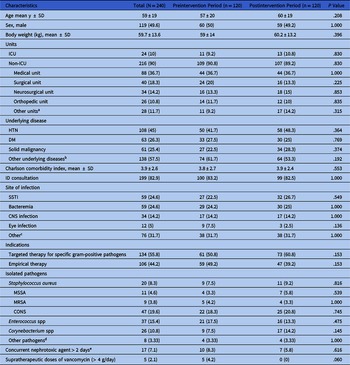
In total, 240 patients were included in the study: 120 in the preintervention period and 120 in the postintervention period. The mean age for the study population was 59±19 years; 119 participants were male (49.6%); and the mean body weight was 59.7±13.5 kg. Intravenous vancomycin was initiated in the critical care setting in 24 patients (10%), and 216 patients (90%) received vancomycin in a non–critical-care setting, including a medical unit (n = 88, 36.7%) and a general surgical unit (n = 40, 18.3%) (Table 1). The most common comorbidities were hypertension (n = 108, 45%) and diabetes mellitus (n = 63, 26.3%) (Table 1). The mean Charlson comorbidity index was 3.9±2.6. Vancomycin was used for empirical therapy in 106 patients (44.2%) and targeted therapy for specific gram-positive pathogens in 134 patients (55.8%). The most common infections leading to initiation of intravenous vancomycin therapy were bacteremia (n = 59, 24.6%) and skin and soft-tissue infections (n = 59, 24.6%), followed by infections of central nervous system (n = 34, 14.2%). The most common pathogens isolated were coagulase-negative staphylococci (n = 47, 19.6%), Enterococcus spp (n = 37, 15.4%), and Corynebacterium spp (n = 26, 10.8%). MRSA infections occurred in only 9 patients (3.8%). The median MICEtest for MRSA was 1 mg/L (interquartile range [IQR], 0.5–1 mg/L). Only 1 MRSA isolate had an MICEtest value of 2 mg/L. Also, 17 patients (7.1%) received concurrent nephrotoxicity agents for >2 days. Such agents included deoxycholate amphotericin B (n = 7, 2.9%), colistin (n = 6, 2.5%), aminoglycoside (n = 3, 1.3%), and trimethoprim-sulfamethoxazole (n = 3, 1.3%). Furthermore, 41 patients (17.1%) received concurrent piperacillin-tazobactam for >48 hours. Also, 21 patients (8.8%) had pre-existing stage 3 chronic kidney disease. Furthermore, 5 patients (2.1%) received a greater-than-maximum vancomycin dose of >4 g/day; all of these were in the preintervention group. The baseline characteristics of the study population in the pre- and postintervention periods are compared in Table 1.
Baseline Characteristics

Note. ICU, intensive care unit; HTN, hypertension; DM, diabetes mellitus; ID, infectious diseases; SSTI, skin and soft-tissue infection; CNS, central nervous system; S. aureus, S. aureus; MSSA, methicillin-susceptible S. aureus; MRSA, methicillin-resistant S. aureus; CONS, coagulase-negative staphylococci; N/A, not applicable.
a Other units included ophthalmic unit; ear, nose, and throat unit; and obstetrics and gynecology unit.
b Other underlying diseases included coronary artery disease, stage 3 chronic kidney disease, chronic liver disease, chronic lung disease, hematologic malignancy, history of cerebrovascular accident, autoimmune disease, and human immunodeficiency virus infection.
c Other site of infections included respiratory tract infection, bone and joint infection, intraabdominal infection, urinary tract infection, endovascular infection, and unknown site of infection.
d Other pathogens included Streptococci spp, Bacillus spp, and Rhodococcus kroppenstedtii.
e Concurrent nephrotoxic agents included deoxycholate amphotericin B, colistin, aminoglycoside, trimethoprim-sulfamethoxazole, angiotensin-converting enzyme inhibitors, nonsteroidal anti-inflammatory drugs, and diuretics.
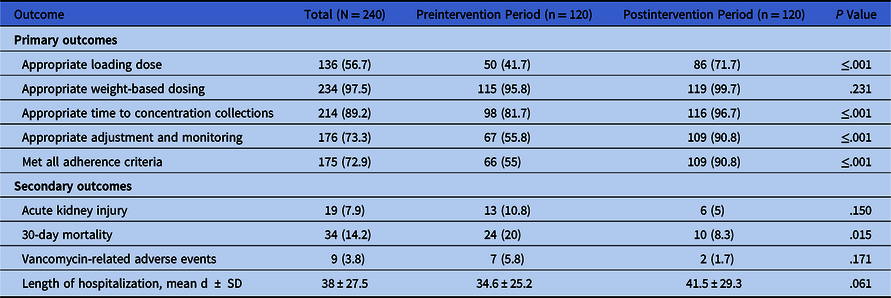
In the postintervention period, the adherence rate of vancomycin dosing protocol was significantly higher compared to the preintervention period (90.8% vs 55%; P ≤ .001). Overall, we detected no difference in adherence outcomes between patients in the intensive care unit (ICU) and non-ICU settings (70.8 vs 73.6%; P = .77). Barriers of adherence to the vancomycin dosing protocol in the postintervention period included a lack of knowledge about vancomycin therapeutic dose monitoring (7 of 11, 63.6%) and poor communication among healthcare personnel (4 of 11, 36.4%). Patients who received weight-based loading dose, met appropriate time to vancomycin concentration collections, and had appropriate dosage adjustment and monitoring were significantly higher in postintervention period: 71.7% vs 41.7% (P ≤ .001), 96.7% vs 81.7% (P ≤ .001), and 90.8% vs 55.8% (P ≤ .001), respectively (Table 2). Among the 240 patients include in this study, 19 patients (7.9%) developed acute kidney injury during vancomycin therapy. We detected a trend toward lower rate of acute kidney injury in the postintervention period compared to the preintervention period (5.0% vs 10.8%; P = .15). Overall, the 30-day mortality rate among the whole study cohort was 7.9% (34 of 240). We detected a statistically significant lower in the 30-day mortality rate during the postintervention period (8.3% vs 20%; P = .015). Vancomycin-related adverse events were found in 9 patients (9 of 240, 3.8%). Most were minor drug eruptions (7 of 240, 2.9%); 1 patient had red-man syndrome and 1 patient developed a drug reaction with eosinophilia and systemic symptoms (both patients were in the preintervention group). No instance of ototoxicity was reported in patients during the entire study period.
Primary and Secondary Outcomes

Note. SD, standard deviation.
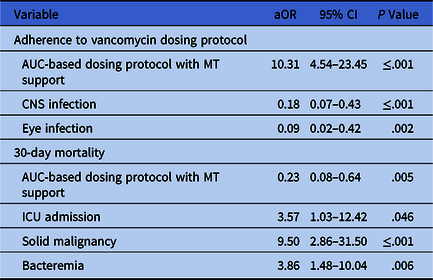
By multivariate logistic regression analysis of the adherence to the vancomycin dosing protocol, the factor predicting adherence to vancomycin dosing protocol included the AUC-based dosing protocol with MT support (adjusted odd ratio [aOR], 10.31; 95% CI, 4.54–23.45; P ≤ .001). In contrast, CNS infections (aOR, 0.18; 95% CI, 0.07–0.43; P ≤ .001) and eye infections (aOR, 0.09; 95% CI, 0.02–0.42; P = .002) were associated with lower adherence to the vancomycin dosing protocol. The factor associated with a lower rate of 30-day mortality was the AUC-based dosing protocol with MT support (aOR, 0.23; 95% CI, 0.08–0.64; P = .005), whereas admission to ICU (aOR, 3.57; 95% CI, 1.03–12.42; P = .046), solid malignancy (aOR, 9.50; 95% CI, 2.86–31.50; P ≤ .001), and diagnosis of bacteremia (aOR, 3.86; 95% CI, 1.48–10.04; P = .006) were associated with higher mortality (Table 3). We detected no statistically differences in other secondary outcomes including acute kidney injury, vancomycin-related adverse events and length of hospitalization (Table 2).
Multivariate Analysis of Factors Associated With Adherence to Vancomycin Dosing Protocol and 30-Day Mortality

Note. MT, multidisciplinary team; CNS, central nervous system; ICU, intensive care unit.
Discussion
This study contributes 4 notable findings. First, an AUC-based dosing protocol with MT support was feasible and highly effective to improve adherence to a vancomycin dosing protocol among ICU and non-ICU settings in an Asian hospital. Second, compliance with vancomycin dosing protocol featuring AUC-guided dose monitoring can lead to a reduction in overall mortality and a trend toward reduction in nephrotoxicity. Third, the AUC-based dosing protocol with MT support was effective in improving adherence on vancomycin dosing protocol among patients who receive vancomycin as empirical therapy or as targeted therapy for specific gram-positive pathogens. Lastly, this AUC-based dosing protocol with MT support was well accepted by treating physicians, as demonstrated by the high adherence rate to the vancomycin dosing protocol.
Strategies to improve vancomycin dosing protocol adherence have included education interventions, computer-assisted decision making in vancomycin prescriptions, pharmacist-driven vancomycin therapeutic dose monitoring program, and prospective review and feedback of vancomycin use. Reference Miloslavsky, Galler, Moawad, Actis, Cummings and El Saleeby16–Reference Faine, Mohr, Harland, Rolfes, Porter and Fuller22 However, these interventions were performed to improve vancomycin prescriptions in the era of using trough-guided vancomycin dosing. Limited data are available on effectiveness of AUC-based dosing protocol with MT support to improve AUC-guided vancomycin dosing protocols. To our knowledge, our study is the first to report the effectiveness of hospital-wide AUC-based dosing protocol with MT support to improve adherence to AUC-guided vancomycin dosing protocol in Asia. Notably, several factors, including CNS infections and eye infections, were associated with lower adherence to the vancomycin dosing protocol. Most noncompliance events occurred during the preintervention period and were associated with the combination of the lack of knowledge on vancomycin therapeutic dose monitoring and prescribing behaviors.
Barriers for nonadherence to vancomycin dosing protocols have included a lack of knowledge and clear communication on vancomycin dose-monitoring processes, a lack of a committed antimicrobial stewardship (ASP) team, physician prescribing behavior, and a lack of resources for dose calculation. Reference Chan, Baysari, Carland, Sandaradura, Moran and Day9,Reference Choi, Woo, Park and Lee23 In our study, the AUC-based dosing protocol with MT support improved adherence to the vancomycin dosing protocol was well accepted by physicians with only 9.17% nonadherence to the vancomycin dosing protocol. Significant barriers for adherence to vancomycin dosing protocol in our study included a lack of knowledge about vancomycin therapeutic dose monitoring and poor communication among healthcare personnel (eg, physicians, nurses, pharmacists, ID physicians) who are involved in vancomycin administration.
Previous data suggested that AUC-guided vancomycin dosing can lead to lower vancomycin exposure, leading to reductions in nephrotoxicity and other vancomycin-related adverse events (eg, drug eruptions, red man syndrome), improved resolution of signs and symptoms of infection, reduction in time to bacterial eradication, and decreased treatment failure and mortality. Reference Neely, Kato and Youn4,Reference Tsutsuura, Moriyama and Kojima24–Reference Lodise, Rosenkranz and Finnemeyer30 The treatment outcome measures of AUC-guided vancomycin dosing in previous studies included resolution of signs and symptoms, bacterial eradication, treatment failure, mortality, nephrotoxicity, and other vancomycin-related adverse events. Reference Ghosh, Chavada, Maley and van Hal25–Reference Lodise, Rosenkranz and Finnemeyer30 Our study confirmed that hospital-wide use of an AUC-based dosing protocol with MT support may lead to reduction in 30-day mortality and a trend toward reduction in nephrotoxicity and vancomycin-related adverse events. Notably, severity of illness, immunocompromised status, diagnosis of bacteremia and receive of concomitant nephrotoxicity agents remained important predictors for higher mortality.
Our study has several limitations. First, we used a quasi-experimental study design which may be subject to temporal changes in the patient population over time. However, the baseline characteristics of patients in the pre- and postintervention periods were comparable. Second, this was a single-center study, which may limit the generalizability of our findings. Third, we did not collect the impact of AUC-guided vancomycin dosing protocol on treatment outcomes specific for each gram-positive pathogen. Fourth, we used the E-test method for measuring MRSA MICs, which may have overestimated the true MIC. However, the number of MRSA infections in our study was small. Lastly, the small sample size in this study limited our power to detect changes in outcome results.
In conclusion, an AUC-based dosing protocol with MT strategy was effective to improve adherence to vancomycin dosing protocol in this middle-income country. This strategy can be readily applied without substantial barriers. Reduction in vancomycin exposure facilitated by this strategy may lead to reduction in nephrotoxicity and 30-day mortality. Additional studies to evaluate this strategy on various indications (eg, empirical versus targeted therapy for specific gram-positive pathogens), various outcomes including treatment outcomes on specific gram-positive pathogens, as well as cost-effectiveness of such strategy in Asia are needed.
Supplementary material
To view supplementary material for this article, please visit https://doi.org/10.1017/ice.2021.296
Acknowledgments
Financial support
No financial support was provided relevant to this article.
Conflicts of interest
All authors report no conflicts of interest relevant to this article.