Our story begins in a northern Algerian town called Tazoult. When Algeria was still a colony of the French, Tazoult was Lambèse, and when today's France was still a territory of the Roman Empire, it was Lambaesis. By a.d. 81, the town boasted a legionary camp,Footnote 1 and later Trajan made it the permanent base of the Third Legion Augusta.Footnote 2 It became a colonia between a.d. 197 and 252.
Lambaesis has been labelled ‘the military capital of the whole of Roman Africa’. Seen from the air, it looks the part. The town is laid out along a ‘military-style’ grid of perpendicular lines centred on the intersection of two main avenues.Footnote 3 Urban amenities included an amphitheatre, sanctuaries of Asklepios and Mithras,Footnote 4 and a water distribution system fed by one or two aqueducts built by the army.Footnote 5
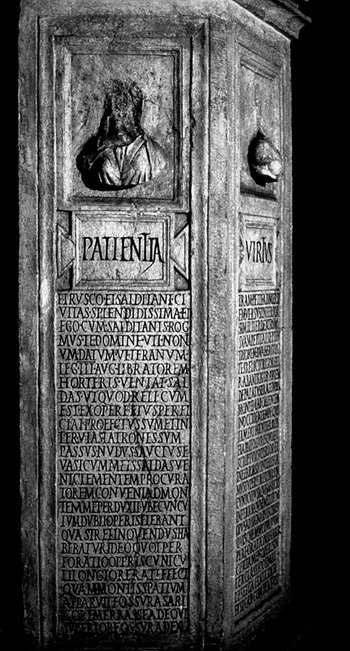
Lambaesis was rediscovered in the mid-nineteenth century by the French army, who had a camp in nearby Batna. According to reports, the French officers felt an immediate sense of affiliation with the place, and renamed the eastern gate to their encampment ‘Lambaesis gate’.Footnote 6 In October 1866, a servant of the local landowner Monsieur Médan discovered that a small stone column, which may have been re-used as part of a wall around 400 m east of the so-called Lambaesis Praetorium, was covered in writing.Footnote 7 By 1868, the column (more accurately, a cippus) had been excavated. According to Wilmanns, who transcribed the text for the Corpus Inscriptionum Latinarum, the cippus had originally been hexagonal,Footnote 8 but only three sides were now extant. Each side was headed by the relief of a now faceless woman, labelled with the name of a virtue inside a tabula ansata.Footnote 9
Starting from the left, the text says:
PATIENTIA … [Varius Clemens Valerio] Etrusco: ‘et Salditani civitas splendidissima et ego cum Salditanis rogamus te, domine, uti Nonium Datum, veteranum leg(ionis) III Aug(ustae), libratorem, horteris veniatFootnote 10 Saldas, ut quod relicum est ex opere eius perficiat.' Profectus sum et inter vias latrones sum passus; nudus saucius evasi cum meis; Saldas veni; Clementem procuratorem conveni. Ad montem me perduxit, ube cuniculum dubii operis flebant, quasi reliquendus habebatur, ideo quot perforatio operis cuniculi longior erat effect(a) quam montis spatium. Apparuit fossuras a rigorem errasse, adeo ut superior fossura dex/ [over to the second side] VIRTUS /tram petit ad meridiem versus, inferior similiter dextram suam petit ad septentrionem: duae ergo partes relicto rigore errabant. Rigor autem depalatus erat supra montem ab orientem in occidentem. Ne quis tamen legenti error fiat de fossuris, quot est scriptum ‘superior’ et ‘inferior’, sic intellegamus: superior est pars, qua cuniculus aquam recipit, inferior, qua emittit. Cum opus adsignar(em), ut scirent, quis quem modum suum perforationis haber(et), certamen operis inter classicos milites et gaesatesFootnote 11 dedi et sic ad compertusi/ [over to the third side] SPES /onem montis convenerun(t). Ergo ego, qui primus libram feceram, ductum atsignaveram, fieri institueram secundum formam, qu(a)m Petronio Celeri pro(curatori) dederam, opus effectum aqua missa dedicavit Varius Clemens proc(urator).
Modios V.Footnote 12
Ut lucidius labor meus circa duc(tum) hoc Saldense pareret, aliquas epistulas subieci.
Porci Vetustini ad Crispinum: ‘Benignissime, domine, fecisti et pro cetera humanitate ac benivolentia tua, quod misisti ad me Nonium Datum evocatum, uti tractare[m] cum eo de operibus, quae curanda suscepit. Et ideo, quamquam tempore urguerer et Caesarea festinarem, tamen Saldas excucurri et aquae ductum bene inchoatum, sed magni operis inspexi et quod absolvi sine curam Noni Dati non potest, qui it simul diligenter et fideliter tractavit. Et ideo rogaturus eram, concedere nobis, uti mensibus aliquis rei agendae immoraretur, nisi incidisset (in) infirmitatem contractam …’
ENDURANCE. COURAGE. HOPE. Varius Clemens to Valerius Etruscus: ‘Both the people of Saldae, a most splendid town, and I, together with the people of Saldae, beg you, o lord, to urge Nonius Datus, veteran of the third legion Augusta, surveyor, to come to Saldae, in order to complete what remains [to be completed] of his work.’ I left and on the way I suffered [the attack of] brigands; I escaped naked and wounded with my [men]; I came to Saldae; I met Clemens the procurator. He took me to the mountain, where they were crying over a tunnel, uncertain about the work, and thinking almost of abandoning it, because the tunnel excavation work had turned out to be longer than the width of the mountain. It became clear that the segments that had been dug departed from a straight line, to the point where the upper segment inclined to the right and was turned towards the south, [while] the lower one similarly inclined to its right towards the north: therefore both parts, having abandoned the straight line, were going astray. Now the straight line was marked off with stakes over the mountain from east to west. In order for the reader to make no mistake about the entry points, designated ‘upper’ and ‘lower’, let us understand it this way: upper is the part where the tunnel receives water, lower, where it discharges it. Having allocated the work so that they knew, everyone, what their portion of the excavation was, I set up a competition about the work between the navy men and the mercenaries and in this way they met in [the middle of] tunnelling through the mountain. Therefore I, who had first made the survey, had decided on the route of the aqueduct, had arranged for it to be done according to the plan which I had given the procurator Petronius Celer, completed the work. Having released the water, the procurator Varius Clemens dedicated the [aqueduct].
5 modii.
So that my labour about this aqueduct at Saldae is seen more clearly, I have placed some letters below. [Letter] of Porcius Vetustinus to Crispinus: ‘O most good-natured lord, in conformity with your humanity and benevolence, you sent me the reservist Nonius Datus, so I could deal with him about the works, which he undertook to take care of. And for this reason, although I was rushed for time and hurrying to Caesarea, nevertheless I made a detour to Saldae and inspected the aqueduct, [which was] definitely unfinished, but [a thing] of great achievement, and that cannot be completed without the supervision of Nonius Datus, who dealt with it both diligently and loyally. And for this reason I was going to ask that you grant us that he stays to do this thing a few months, if he does not fall ill …’
Photo of cippus of Nonius Datus. (By kind permission of Professor Klaus Grewe)

The events described in the inscription have been reconstructed by, among others, Brent Shaw and Jean-Pierre Laporte:Footnote 13 in the late 130s the commander of the Third Legion Augusta seconded Nonius Datus, a legionary with engineering expertise, to Petronius Celer,Footnote 14procurator Augusti in Mauretania Caesarensis (the neighbouring province), in order to help build an aqueduct in the town of Saldae. In a.d. 137 Nonius Datus, having surveyed the surrounding territory, gave Celer a forma, or plan, outlining the route of the aqueduct. Between a.d. 146 and 150, Q. Porcius Vetustinus,Footnote 15 who had succeeded Celer, appealed to the then military commander, L. Novius Crispinus,Footnote 16 to send Nonius back to Saldae, evidently because of problems with the construction. Again in the early 150s, the then procurator Augusti T. Varius Clemens asked M. Valerius Etruscus,Footnote 17 the legionary commander, to send Nonius to Saldae again, to complete the tunnel. The aqueduct was finally inaugurated in a.d. 152, 153, or shortly afterwards.
Saldae is today's Bejaïa (Bougie under the French), situated on the Mediterranean coast, and serving as a port for the agricultural production of the hinterland. Unlike Lambaesis, the site had been occupied since at least Punic times, but between 27 and 25 b.c. it was established by Augustus as a colonia for the Seventh Legion Immunis.Footnote 18 Thus, Saldae was not provided with an aqueduct until more than a hundred years after its Roman (re)foundation.Footnote 19
The Lambaesis inscription has attracted attention for a long time, and although its general contents are clear, a number of questions remain open. For instance, given that the modius was a unit of measurement for dry volumes, to what does ‘5 modii’ refer?Footnote 20 Again, if three sides are now destroyed, what are we missing? What completed the sextet of virtues? How did Nonius Datus' story really end? In this article, I will not so much attempt to resolve open questions, as review the various stories that have been told of the inscription. I will start with engineering tales — how the inscription has been used to write the history of Roman water supply systems. My second story will look at the cippus from a different angle — specifically, how through the centuries, aqueducts and infrastructures in general have been viewed and used as tools of empire. Finally, I will tease out one last account: Nonius Datus' own.
I THE ENGINEERING TALE
It is in its capacity as a source of information about Roman aqueducts in general, and ancient tunnels in particular, that Nonius Datus' inscription is most frequently cited.Footnote 21 Although probably not the most impressive from a purely technical point of view,Footnote 22 the tunnel of Saldae is the only case from antiquity where we have direct, detailed information from the person in charge of the works. Today's foremost ancient tunnel expert, Klaus Grewe, sees the inscription as the authentic voice of an ancient engineer,Footnote 23 speaking to us from the remote past.
The main question engineering tales are poised to answer is, how was the technical artefact made? In particular, how was the Saldae tunnel produced? The inscription does not provide a full answer to that. We know that there was a plan, but not what kind of plan — whether more or less geometrized, more or less plentiful in details of the actual construction. Datus does not specify whether the tunnel was cut into the rock, or dug out and built with bricks.Footnote 24 He does tell us that he rectified the mistake through depalatio, but in order to understand what that means, we have to look outside the inscription, at the collection of texts known as Corpus Agrimensorum Romanorum. Some of them illustrate a procedure referred to as cultellare, which was employed to solve the same problem, i.e. how to determine lengths on uneven ground, such as a path that goes over a mountain.Footnote 25
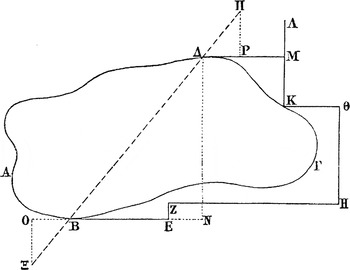
Despite the difference in terminology, the similarities in what is likely to have been the procedure hint at a connection between the Corpus and Datus' practice. Moreover, he characterizes the mistake made in digging the tunnel as a rigore errare, which echoes land-surveying terminology.Footnote 26 None of our extant Latin treatises, however, deals with the excavation of tunnels. The one extant solution to the problem is in Hero of Alexandria's Dioptra, written in the first century a.d.: ‘one wishes to dig through a mountain in a straight line, the mouths of the tunnel being given in the mountain.’Footnote 27 Hero instructs the reader to surround the irregular contour of the mountain with a circuit of straight lines, intersecting at right angles. All this is made possible by the dioptra, which allows the user to align points and create perpendiculars at will.
Diagram from Dioptra.

Once the surveyor has walked around the mountain from point Β, and reached the position at ΚΛ, Hero instructs him to look for the other ‘mouth’ of the tunnel, i.e. point Δ. ‘And I set the dioptra upon the line ΚΛ making sure that the ruler is always fixed on some point on the [line] ΚΛ, until the point Δ appears in a perpendicular position to the ruler.’Footnote 28 The point at which this happens is marked as N. Thanks to a system of triangulation that has been explained earlier (section 8), the dioptra allows the user/reader to calculate the length of ΔN and ΒN. Once these two crucial data are obtained, it is possible to determine the third side of the right-angled triangle ΒNΔ, i.e. ΒΔ, which is the tunnel itself. By ‘determine’ I mean not only that the length of the line ΒΔ is known, but also that its inclination, i.e. the size of the angles ΔΒN and ΒΔN, is known.Footnote 29
So we dig on the one hand from the [point] Β making the tunnel along a straight line, the [line] ΒΞ; on the other hand from the [point] Δ along the straight line ΔΠ. Then the remainder of the tunnel is produced by setting the ruler upon the line that we have found, the [line] ΞΒ, or upon the [line] ΠΔ, or also upon both parts. Producing the tunnel this way, the workers will meet each other.Footnote 30
Did Nonius Datus solve his tunnelling problem along lines similar to Hero's? According to Grewe, given the landscape conditions of any of the extant ancient tunnels, Hero's method is unfeasible in practice.Footnote 31 Despite his relative prestige as the kind of librator who would be put in charge of an aqueduct, we do not know whether Datus had read Hero or some Latin version of similar material, or even whether he was acquainted with any land-surveying texts at all.Footnote 32 Technical knowledge, including technical terminology, must have been, by and large, communicated and transmitted non-textually, that is, both orally and instrumentally. It is very likely that Datus and his helpers used simple triangulation and instruments such as the groma, the chorobates,Footnote 33 or a type of dioptra, without necessarily having what we would call a theory of them.
Several engineering tales have included an assessment of Datus' performance. He is seen both as an example of Roman efficiency, and of Roman inefficiency. Leveau reminds his readers that, while the tunnel at Saldae may seem extraordinary because of the survival of the inscription, ‘reality is probably much more banal’. He thinks that ‘the obstacle causing the delay was nothing of exceptional difficulty’.Footnote 34 Landels emphasizes the provincial setting of Datus' aqueduct, in contrast to the complex network described by Frontinus for the city of Rome, as a means of explaining why it was a ‘fiasco’, at least initially.Footnote 35 Laporte, despite thinking that Datus was hardly an exceptional engineer, praises the way he coped with a particularly inefficient workforce:
It is here that one sees the librator's true technical prowess: to go through some 250 metres of a tunnel which he knows to be too long and not in a straight line; to stop at one point and to decide to head in a precise direction; to do the same in the other tunnel, and to manage to finally rejoin the two parts. Here we have a little masterpiece of triangulation.Footnote 36
There is a whole rhetoric of difficulty in the history of engineering, which allocates merit in direct proportion to how intractable the initial situation was. Some historians see Datus in a positive light not so much because of the scale of the initial problem, or the brilliance of the eventual solution, but because he managed to dig himself out of a rather deep building-site hole.
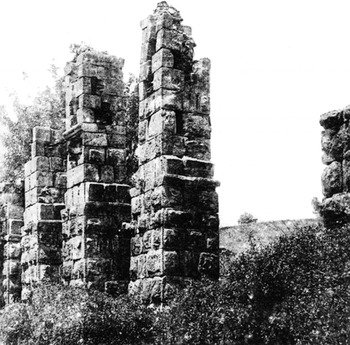
It has been estimated that the Saldae aqueduct, originating from springs at Toudja, measured overall between 25 and 26 km.Footnote 37 The tunnel, known as El Habel, has been estimated as being 86 m deep and around 428 m long, although some sources give a figure of 560 m. It apparently had a shaft near one of the entrances which may have served both as a ventilation conduit, and a way of ascertaining the depth once work had started.Footnote 38 The large size of the mountain could go some way towards explaining the workmen's mistake.Footnote 39 The aqueduct also included a bridge, of which several piers were still standing in modern times.
Remains of piers from the Saldae aqueduct (Mercier, op. cit. (n. 41)).

One of the piers held a plaque with the relief, probably apotropaic, of a double-winged phallus; another may have contained a dedicatory inscription. This need not have been about who built, or paid for, the aqueduct. Pre-Roman North African religion included various water divinities, and in Roman times dedications to the genius of an aqueduct were not infrequent.Footnote 40
One report by a captain of the French Génie described a system of reservoirs.Footnote 41 Other early observers noticed a gradual decrease in the diameter of the conduit pipes between the point of entry at Toudja and the point of exit at Bejaïa, as if not all water from the source had been planned to make its way into town. There may have been secondary conduits supplying water to the countryside, presumably for agricultural purposes.Footnote 42 Observing specific similarities between the piers of the Saldae aqueduct and those of the almost contemporary aqueduct at Cherchell, Leveau and Paillet have mooted the idea that Nonius Datus worked on the latter.Footnote 43
Clearly, the engineering tale is destined to remain open-ended. It could be told as a tale of technical triumph, or as a run-of-the-mill account of the laborious making of an average, even mediocre, provincial monument. Several assumptions are at work in either version of the story. Firstly, there is the notion that the information Datus provides, while in need of decodification, is, thanks to its very ‘technicality’, objective. The inscription has been approached as if it were, for all intents and purposes, a neutral account. Precisely by virtue of this supposed objectivity, the information it contains has been deemed applicable to objects other than the one it refers to. The Saldae aqueduct has become paradigmatic.
Corollary to the first is a second assumption: that there are, by and large, objects raw and simple — that we can tell the story of an aqueduct pretty much in independence of the human agency involved in it. Or rather, that the human agency involved in it is special, in that it is solely aimed at devising and solving technical problems. Representative of this approach is Donald Hill, who writes in his standard textbook: ‘[This is a] technical history of engineering — social and economic factors are referred to only when they can throw light upon engineering developments.’Footnote 44
Thirdly, and perhaps most pervasively, we encounter assumptions of continuity. Not only in the laws of physics, so that, centuries on, the material obstacles involved in tunnelling a mountain are still the same: there is also a fundamental continuity in human basic needs, which allows us to assess how well something works. A popular expression of this is Sprague de Camp's The Ancient Engineers. Within a general evolutionary framework, where (to paraphrase slightly) engineers are homo erectus's secret weapon in his struggle for survival, the author most famous for his science fiction writes: ‘Civilization, as we know it today, owes its existence to the engineers. […] The story of civilization is, in a sense, the story of engineering.’ Nonius Datus' inscription is recreated thus:
I found everybody sad and despondent. […] As always happens in these cases, the fault was attributed to me, the engineer, as though I had not taken all precautions to ensure the success of the work. What could I have done better?
De Camp thinks that ‘the answer to Datus’ question […] is, of course, “Stay on the job and don't wander off for four years at a stretch”’.Footnote 45 More recent scholarship reflects similar assumptions:
[S]ince the same physics governs natural phenomena then as now, computer reconstruction and ‘reverse engineering’ studies of ancient hydraulic structures offer the possibility of rediscovering the design intent behind archaeological remains. […] In this context, when selected engineering accomplishments of the ancient world are examined and shown to conform to a logical basis based on optimal use of skills and resources, then an ancient version of modern macroeconomic theory may emerge to demonstrate that application of basic, universal economic principles underlies their technical and administrative accomplishments. […] the passion involved in creation and recognition of hydraulic solutions can be shared across the centuries as perhaps only members of the brotherhood of engineers can understand.Footnote 46
Grewe also envisages engineers as a diachronic community, operating across time with different technologies, but joined in a similar struggle. This perceived continuity informs activities as diverse as those of the real-life or (increasingly) on-line communities devoted to the reconstruction of ancient technologies, and the academic field of experimental archaeology.Footnote 47
The professionals involved in experimental archaeology often claim that they aim to learn something from the process of reconstructing an ancient artefact through the exclusive use of techniques and materials available at the time.Footnote 48 On the other hand, the musings about the ancient ‘experience’ sometimes made by people engaged in experimental, or reconstruction, archaeology, often in the context of high media exposure, are extensively criticized from within the field.Footnote 49 In the latter case, the assumption that being surrounded by ancient things (or a close replica thereof) enables insights into the lived experience of the past, is attacked. In the former case, the assumption that making the same things (or a close replica thereof) enables insights into the past, is widely accepted. Precisely because basic human needs and the laws of physics do not change, the experience of making — the technician's experience — is seen as more essential, and thus ahistorical, than other types of experience.
II THE (POST-)IMPERIAL(IST) TALE
The second way of looking at the cippus focuses on the fact that Nonius Datus was a Roman military engineer, building a Roman water supply system in North Africa. It uses the inscription as a source for understanding infrastructures and technologies as manifestations, beneficial or sinister, of empire.
The political significance of water supply systems was, of course, not lost on the ancients themselves. Tacitus lists baths as one of the means of enslaving the unsuspecting Britons, and Frontinus triumphantly compares the aqueducts of Rome to the useless pyramids of Egypt.Footnote 50 On the other side of the imperial fence, defiant rabbis discuss Roman technologies in an exchange notoriously reminiscent of that scene from Monty Python's Life of Brian:
R. Judah, R. Jose and R. Simeon were sitting, and Judah, a son of proselytes, was sitting near them. R. Judah commenced [the discussion] by observing, ‘How fine are the works of this people! [the Romans, ndr] They have made streets, they have built bridges, they have erected baths.’ R. Jose was silent. R. Simeon b. Yohai answered and said, ‘All that they made they made for themselves; they built market-places to set harlots in them; baths to rejuvenate themselves; bridges to levy tolls for them.’Footnote 51
Such cynicism is patently absent from many later appraisals of Roman imperial technology. Voicing what appears to have been a majority view until well into the twentieth century, Edward Gibbon thought that:
[Aqueducts] deserve our peculiar attention. The boldness of the enterprise, the solidity of the execution, and the uses to which they were subservient, rank the aqueducts among the noblest monuments of Roman genius and power. […] The solitudes of Asia and Africa were once covered with flourishing cities, whose populousness, and even whose existence, was derived from such artificial supplies of a perennial stream of fresh water.Footnote 52
What did the Romans ever do for us? They gave us clean running water, even at the price of political subordination. Not only are there universal basic human needs — the hierarchy among them is also universal, and being abundantly hydrated trumps more abstract alternatives.
This contrast itself, however, depends on believing that aqueducts and other imperialist technologies were useful or indeed necessary, that they really were about ‘not just convenience, but salubriousness and even safety’.Footnote 53 Yet, as early as the Talmudic passage, it has been pointed out that the great majority of water carried by monumental urban aqueducts went to supply bath-houses. Were those useful, or ‘just’ a luxury?
In his preface to Leveau and Paillet's work on the aqueduct of Cherchell, Mounir Bouchenaki wrote:
[Leveau and Paillet] have presented, in conclusion, the aqueduct of Cherchell as a manifestation of urban luxury, highlighting in particular the waste of water and the display of domination of the countryside on the part of the city. Without wanting to underplay the contribution of the Roman architects' technical expertise to the buildings of ancient Africa, the debate on the civilizing role of Rome ought to be set in its true context. […] The merit of the present work is to have asked […] different questions, and to invite a re-examination of ancient archaeological remains within a de-colonised framework.Footnote 54
At the end of the same work, in their turn Leveau and Paillet inserted some revealing acknowledgements:
In the making of a book, the most difficult stage is often not putting the evidence together, or writing, but publication. The academic institutions from which we were hoping to receive support have showed disinterest in our work for economic reasons […], scientific reasons (a monograph which was too specialistic) and ideological reasons (underplaying Rome's ‘civilizing role’). […] For us, this work has not been the juxtaposition of accurate technical considerations and trendy ideas; it is the detailed study of a monument which has helped us become aware of the material reality of the exploitation of one society (rural and African) by another (urban and Roman), that is, of Roman colonial actuality.Footnote 55
Arguably, monumental aqueducts hardly met a real need. They were one among several water supply solutions available to the people of ancient North Africa, given their specific geographical, agricultural, and meteorological circumstances. Urban areas could, and often did, rely on cisterns and wells — Saldae did not have an aqueduct until long after it was made a colonia. As for agriculture, arguably many areas were adequately served by ‘old’ ‘native’ techniques such as zone-flooding and terrace agriculture.Footnote 56
In this light, Datus' story could be seen as a typical imperialist tale. As Shaw puts it:
Here are the themes of professionalism and bureaucratic planning: the role of the technical expert in army uniform, the official directives issued from above, planning on the part of a Roman colony and intervention by a provincial governor, all in the cause of providing a town with a supply of potable water. Nonius Datus' celebratory inscription is headed by the merits of the hero of the piece: Patientia, Virtus, Spes, three virtues of hard colonial endeavour if ever there were any.Footnote 57
The background image is a hostile and undomesticated landscape, both nature and people: remember that Datus and his men were attacked by brigands.Footnote 58 Remember also the ineffectual despair of the workers at the botched tunnels, and contrast it with the carefully constructed image of Datus' superior management skills.Footnote 59 The actual aqueduct, with its multi-span bridge and tunnel, could be seen as a deliberately Roman mark stamped on the territory, wild African nature and men subjugated and controlled by the efficiency and virtue of Roman experts.
But the (post-)imperialist tale is not universally endorsed. The issue of aqueducts and empire has been at the forefront of debate again, thanks to, among others, Andrew Wilson, who, in the general framework of a re-evaluation of the productivity of Roman economy, has shifted attention to the ways in which aqueducts can be described as ‘useful’, rather than ‘luxurious’. He emphasizes that aqueducts fed baths, but also more generally, through fountains for instance, provided increasing urban populations with access to water, thus playing a significant rôle in the growth of towns. Qualifying his earlier position, even Leveau had written in 1991:
An ancient aqueduct calls for a socio-economic rationale different from ours. It is not a question of denying either the utility of the aqueducts […] nor the connection between urban expansion and aqueduct building […]. No doubt the peasants did not look at the question of urban health through the same eyes as the municipal aediles.Footnote 60
In response to this, Wilson provides the evidence of North African aqueducts which had both exclusively rural, and rural and urban targets — for instance, a water basin near the source of the main aqueduct supplying Carthage must have been built for the rural population to use. Other aqueducts in the region had derivations or access points where water could be drawn, or where it was diverted to cultivated areas. Overall, Wilson indicates that the ‘binary opposition between utility and luxury appears too stark’ and that ‘the very utility of aqueducts increased their ideological impact’.Footnote 61
It appears that scholars in the debate about aqueducts and empire have been relying on different assumptions. Many of the advocates of a de-colonization of the history of Roman water supply systems, especially in the French-speaking world, are overtly political — their assumption is that there is continuity between old and new imperialisms, and this lends urgency and relevance to a political reading of ancient technologies.
Contributions such as Wilson's, on the other hand, avowedly steer clear of an excessive emphasis on ideology, laying claim to a new sort of economy-based neutrality. Thus, he emphasizes that, by fostering urbanization, and thus economic growth, aqueducts were useful. Yet, the key here, in my view, is not simply that aqueducts were useful, but that they were seen to be useful — not just that there was economic growth, but also that its effects were noticeable at the time.Footnote 62 Such a line of argument, albeit plausible, is not easy to substantiate. For a technical artefact to be not just useful, but be seen as useful, there has to be consensus, on the part of both makers/commissioners and users of the artefact, first, as to what the function of the artefact is, and second, that such function(s) are valuable and preferable to cheaper, less disruptive, more traditional alternatives. It may be more problematic to reach agreement on the first point than the second, especially in contexts where specific technical artefacts are ‘new’ and come ready-wrapped in a political package.
There is a second chapter to the (post-)imperialist tale.Footnote 63 Nonius Datus' cippus is no longer in Tazoult (which used to be Lambaesis):Footnote 64 it now stands in front of the council hall of Bejaïa — the town that used to be Saldae. How did it get there?
As we have seen, there was a French garrison at Batna. Nearby Lambèse (as it was) was chosen to host a military prison, built in 1851 exactly in a corner of the underlying Roman military camp, its walls utilising old Roman stone blocks as building material. As a result, the ancient graveyards were practically obliterated, to the dismay not only of contemporary scholars, but also of the military officers who had contributed to the initial excavations.Footnote 65 It is in this context that our cippus was first recovered.Footnote 66
The French authorities had what one could call an ambiguous attitude to North African antiquities. On the one hand, the French army in North Africa was in charge of much archaeological work: they were requested to draw archaeological maps, and to dig up Roman antiquities.Footnote 67 On the other hand, the distinction between valuable and dispensable antiquities was disputed, and control over the activities of individuals was difficult. Our sources report monuments destroyed or defaced, and the evidence for acts of vandalism on the part of French soldiers stretches to the 1960s.Footnote 68 Perhaps Datus struck a chord with the army. After its discovery, the cippus was kept in the Lambèse penitentiary.
Where it could have remained, if events in Bougie/Saldae had not taken another turn. As well as archaeological work, the French army in Algeria was in charge of building infrastructures, including aqueducts. For that purpose, they looked to Roman infrastructures as a kind of blueprint — something that had worked in the past and could work again.Footnote 69 The two tasks, archaeology and engineering, came together in Bougie after 1871. The French had recently suppressed a revolt in which the local population had been involved, and punished them by confiscating land and imposing restrictions on the use of the Toudja springs. In particular, the town of Bougie obtained one-fifth of the water at the expense of the local rural population. The French army engineers then planned a new aqueduct, which would follow the same itinerary as the Roman one and, in particular, would use the same tunnel. There were, of course, practical reasons for this: there are only so many ways of going from A, springs, to B, town. But we should also note that, by the time the Ponts-et-Chaussées were reconnoitring the aqueduct itinerary and the tunnel, the inscription was already known. In their own words, this was an opportunity to show, bypassing the Arabs, that the French were the direct and legitimate successors of the Roman Empire.Footnote 70
A new aqueduct was built between 1895 and 1896, at 21.6 km rather shorter than the Roman one.Footnote 71 There was controversy because it took water away from some local villages; also, not all observers were convinced that using the Roman tunnel was a good idea, both because of possible structural weakness, and for sanitary purposes.Footnote 72
In 1895 the local authorities at Bougie requested and obtained from the Cabinet and the Minister for Education and Fine Arts that the cippus be removed from Lambèse to Bougie. While still uncertain as to where exactly it was to be placed, both a letter by the sub-prefect at Bougie to the prefect in Constantine/Caesarea and a notice in a scholarly journal hint at possible motivations. According to the journal, the inscription ‘relate les difficultés éprouvées par les Romains dans l'exécution de leur enterprise’. After quoting the town's mayor to the effect that the cippus is a work of art, the letter comments: ‘il paraît juste et c'est presque un devoir pour nous de laisser se perpétuer un souvenir que les Romains eux-mêmes avaient jugé digne de livrer à la postérité.’Footnote 73 While the trials and tribulations of the ancient military engineer resonated with his modern counterparts, paying Nonius Datus his due tribute took some time. Difficulties in communication were compounded by the apparent reluctance of the head of the penitentiary at Lambèse to let go. A Monsieur Sarazin was sent personally to look for the cippus, and reported back in a telegram to the ministry thus: ‘Pierre trouvée penitencier. Directeur rien reçu. Opposition systématique pour transfert. Menace intervention ministère Intérieur. Instructions.’Footnote 74
The threat may have worked, because in 1896 the aqueduct was inaugurated, and the cippus, now situated in front of the town hall, was uncovered in a new format: the three missing sides had been restored and inscribed with the names of the sub-prefect, the city mayor, and the two military engineers responsible for the new aqueduct.Footnote 75 You could hardly find a more obvious example of what Dondin-Payre calls ‘the French appropriation of Roman works’.Footnote 76
III NONIUS DATUS' TALE
My last story is an attempt to find out what the cippus meant for Nonius Datus himself. What do we know about him? While the name Nonius could derive from any of several Roman proconsuls in Africa with that name between Julius Caesar's time and a.d. 92,Footnote 77 ‘Datus’ is characteristically North African. Names such as Datus or Donatus were frequent in the region and were probably the Latin version of the Punic Mattan, Methen and similar.Footnote 78 Through the second century, an increasing proportion of both soldiers and civilians living in Lambaesis had names that could indicate African origin. Even more clearly, epigraphic evidence from Lambaesis sometimes states the place of origin of soldiers of the Third Legion Augusta, and local recruitment appears significant, especially in the period between a.d. 115 and 235.Footnote 79
Whether he was a Romanized African or not, Datus does not represent himself primarily in terms of ‘ethnic’ identity, and, as Lassère points out with reference to the self-declaredly seminumidam and semigaetulum Apuleius, it is not certain that the ancients themselves always perceived names as making a strong cultural or political statement. We have epigraphic evidence for families of African origin whose children have sometimes African, sometimes entirely Roman names. In the second century a.d., at least some people of Italian descent gave their children ‘Punic’ names like Datus.Footnote 80
Nonius Datus introduces himself as a technical expert (a librator) and a soldier. That the two things are often found together is a well-known, but rarely explored fact.Footnote 81 The term librator probably indicated specialization in surveying uneven terrain.Footnote 82 Pliny the Younger asked Trajan to send him a librator ‘or an architect’, because he was planning to connect a lake near Nicomedia to the sea. Specifically, the librator was expected to ascertain the altitude of the lake, and to work out the details of the project. Pliny, moreover, indicates that he should be able to advise about the feasibility of an engineering project, taking into account factors such as (in his case) depth of the lake, volume of water flow, and counter-pressure from the sea towards the lake.Footnote 83
It seems likely that Datus learnt his craft through apprenticeship within the army. The Third Legion Augusta may have trained specialists in survey for the construction of water supply systems; we have at least one inscription referring to a discens libratorum (which could mean either trainee or teacher).Footnote 84 Again, whoever reads the words on the cippus is struck by the to-ing and fro-ing between procuratores and military commanders, and yet, if there were town authorities in Saldae involved in the project, their presence is erased: even the workforce appears to have been drawn from the military.Footnote 85
Indeed, of the three virtues, Patientia (the capacity to endure difficulties until one's task is completed) and Virtus (ability or efficacy, including the capacity to bring about a desired result) are extremely fitting for both a Roman soldier and an engineer.Footnote 86 As for Spes, imagine the instant of suspense before a catapult hits the target, or a pulley system lifts a huge column, or before the water finally rushes through the conduits and an aqueduct is inaugurated after years of work — perhaps hope is the quintessential virtue of an engineer. The three goddesses presiding over Datus hint at the strong moral dimension of both the technical and the military enterprise.
Again, notice how Datus combines technical knowledge, and what one could call management skills. He tells you that he knew both how to build an aqueduct, and how to manage people building an aqueduct. We find the idea that you cannot be a good technician unless you are a good manager elsewhere, for instance in Vitruvius,Footnote 87 and it is not unlike what is required of a good military officer, a job which calls for some specialized knowledge (formation, tactics — Roman soldiers were famously intensively trained), but also leadership qualities.
Thus, Nonius Datus introduces himself as an engineer and a soldier, a combination that made sense both in terms of the actual context for training and realization of large-scale technical works, and in terms of the values and ethos attached to them. Datus’ putative North African origin does not appear to have coloured his self-presentation as much as, in Shaw's words, his endorsement of the virtues of hard colonial endeavour.
But for whom exactly did Nonius Datus write? And what kind of a monument is the cippus — is it funerary? If so, it is unlike other clearly identified funerary material from Lambaesis. Is it a defence against charges of inefficiency? Or a votive to the gods for having finally completed the work?Footnote 88 The fact that we only have half of it stimulates, rather than hinders, the imagination, because there is no obvious beginning- or end-point. It is like one long strip of text, not organized in strict chronological order. If we start from Patientia, by the time we get to Spes we have a flashback. To adapt Valérie Huet's comments on Trajan's Column, time seems to be wrapped around Nonius Datus' monument, along with the story it tells.Footnote 89
Laporte and Shaw have commented on the inscription's tone of self-glorification. We know from various literary examples, especially in the so-called ‘technical’ literature, that the common strategy of self-glorification could be achieved in a number of ways.Footnote 90 Datus chose a specific one. It seems legitimate to assume that his way was comprehensible, and effective, for his intended audience, which, I believe, was the fellow inhabitants of Lambaesis, as much as military or civil authorities. The reader is struck by the abundance of details, not just about the chain of bureaucracy involved,Footnote 91 but also about the artefact itself. Take the clarification about which segment of the conduit is upper and which lower — all this, miles away from the actual thing. Who would want to know? Perhaps the people at Lambaesis were particularly attuned to this language, and grasped the significance of its combination of technical expertise and the workings of the imperial machinery, precisely because the great majority of people living in Lambaesis at the time were or had been soldiers, many of them with, or exposed to, some technical knowledge.
Non-textual learning such as Datus possessed, especially if it implied skilled manipulation of instruments, must have required the existence of an actual, not simply a virtual, community of experts, probably hierarchically arranged, and identified by its sharing of knowledge, knowledge practices, and the values associated with them. Concretely, there is evidence in the town of several possible libratores, a high number of mensores and an architect.Footnote 92 The importance of the army for Lambaesis' collective identity cannot be overstated: witness the numerous inscriptions relating to soldiers' associations.Footnote 93 A significant number of soldiers, or relatives on their behalf, indicate what their rôle in the army was through abbreviations.Footnote 94 To the extent to which the inscriptions were there to be seen or read, the existence of ‘code’ in the form of abbreviations again hints at the existence of a community, people ‘in the know’, for whom a specific rôle in the army would have been particularly meaningful.
The lettering of Nonius Datus' cippus is reminiscent of another document from Lambaesis: the so-called adlocutio inscription, a lengthy report of Hadrian's speeches to the troops on the occasion of his visit in a.d. 128. In modern reconstructions, the engraved adlocutio flanked a large-size single column, ultimately modelled after that of Trajan in Rome. Trajan may in fact have been mentioned in the speech.Footnote 95 In his address Hadrian praises the technical skill and orderliness in display tactics of the Third Legion Augusta; Nonius Datus' address to his fellow soldiers and veterans revolves around the same display of expertise and soldierly behaviour.
In one fragment, the emperor praises the troops for building a wall. Soldiers were customarily involved in the making of infrastructures: roads, bridges, probably the town itself, with its carefully laid out geometrical grid. Some of the pieces of the inscription specify what unit of the legion they are addressed to, but it is unclear whom Hadrian is talking to here.Footnote 96 He specifies that the wall is of the type that one would find built for semi-permanent winter quarters, yet the troops in question completed it in the same time it would have taken to erect a rampart made of turf (a much more manageable material). He even comments on the stones used: large, heavy and different from each other, so that careful matching of suitable stones of unequal size was necessary for construction. The troops also dug a trench, turning rough gravel into a smooth surface.Footnote 97
Wall and trench are represented here in terms of mastery over hard matter, and transformation of the asperities of the landscape. This echoes Nonius Datus' inscription, as well as other building inscriptions of the Third Legion Augusta.Footnote 98 In the adlocutio inscription, there is a deliberate emphasis on making things more difficult than they need to be: the wall is not only built, but built quickly. Not only quickly: it is also a semi-permanent type of wall, despite the ephemeral occasion. Even more than that, the stones used are the most impervious type of building material one could use for that wall — but the army's display for the emperor revolves precisely around such extreme technical feats, the building equivalent of racing while wearing full armour. The rhetoric of difficulty we saw deployed in the engineering tales is well in evidence here.
We could press the point further, and draw attention to the parallels between the dazzling techne of tactics — Arrian, author of a Taktike techne, was a close associate of Hadrian's, and may have been present at the training in LambaesisFootnote 99 — and the dazzling techne of aqueduct-building through wild landscapes. ‘Ex difficilibus difficillimum fecistis (you made something extremely difficult out of difficult things/circumstances)', addressed to the troops, might have been written equally of engineering feats, and of horse-riding in formation.Footnote 100
Thus, Lambaesis provided a suitable audience for the engineer's tale of difficulty overcome. Yet, it is not the most obvious location, miles away from the aqueduct. We might have expected Datus to set up the cippus in Saldae — indeed, that was the right place for it according to its nineteenth-century admirers. We have to keep in mind, however, that the finished aqueduct was dedicated by Varius Clemens — that means that his name, plus that of the emperor, and perhaps of the city notables, would have been on the main dedicatory inscription before Datus' own name, if that was there at all.Footnote 101 The cippus in Lambaesis, with its insistence on what he did, and the importance of his rôle, may have been a way for the engineer to claim authorship of his work, in circumstances where that authorship would otherwise be effectively denied to him. Thus, Nonius Datus' own tale, in a sense, restores the aqueduct to its maker.
IV CONCLUSIONS
Can we or should we privilege one story over the others? Is one of the tales more accurate, or plausible? I hope it is evident that I do not think we should merge the three strands into a unified, consistent discourse: I accept that we experience dissonance when the stories bounce off each other. I would like to advocate a pluralist history of ancient technology, which would compensate for the paucity of evidence by looking at what we have from more than one vantage point.Footnote 102
We need engineering tales in order not to lose sight of the materiality of our evidence — a technical artefact's function (what it is for) is arguably at least in part determined by its physical structure (the way it is made), not simply by the intentions and wishes of that artefact's user.Footnote 103 Physical structures have to be studied and understood. However, tales about ancient engineering would benefit from taking on more radically some of the challenges raised by the historiography of technology of other periods. The notions of technical efficiency and simplicity, or indeed even of basic human needs, have long been historicized. At the very least, we cannot take them for granted: technological choices are never obvious.Footnote 104
Moreover, engineering tales would benefit from the greater attention paid to what happens to artefacts after they are produced — in other words, to technologies-in-use — that we currently find both in archaeology and the history of technology of other periods.Footnote 105 The assumed continuities that help us understand and appreciate how a technical artefact was produced, should be made explicit and available for discussion, so that, alongside a recognition that some aspects of our material reality have not changed, we can gauge the impact of everything else that has.
Equally, we need imperialist, post-imperialist, and post-post-imperialist tales. They are about some of the principal uses of technology-in-use, and they keep ancient technology relevant for us today. None of the scholars involved in the debate about aqueducts denies that utility (however defined) and luxury (however defined) ultimately co-existed, but they appear to disagree as to which of the two should be considered the true function, which the idiosyncratic, secondary, epiphenomenal function, and how we can even ground that distinction in the evidence.Footnote 106 Unlike fields such as the study of religion, language, or funerary practices, where the more nuanced categories of ‘creolization’ or ‘hybridization’ are now current,Footnote 107 and despite the fact that the notion of ‘creole’ technologies is well-established in the history of imperial technologies of other periods,Footnote 108 when it comes to ancient large-scale technologies, it seems that we are still somewhat stuck between resistance and assimilation. Simmering underneath these discussions is, inescapably, a discourse about the advantages and disadvantages of empire, the political significance of which goes beyond the confines of academic discourse.Footnote 109
Finally, we need the engineers' own tales — we need to see more people alongside the artefacts. Tales of engineers restore a specific human dimension to the object: that of the makers. After all, the maker knows how the object came into being, and can, in principle, reproduce or maintain it. My underlying assumption in writing Nonius Datus' tale is that there is a good case to be made for the belief that the agency of the maker is distinctive and unlike the agency of other people involved with an artefact. As has been shown in particular for the history of early modern European science, bringing the invisible technician back into the light can change our picture of the technology, or indeed the material culture, of an entire period.Footnote 110
Secondly, reconstructing the technicians' tales adds to our growing understanding of technical knowledge and the way it was communicated and represented in antiquity. Technical literature has experienced a huge revival in the last few years.Footnote 111 We are a long way from Mommsen's dismissive:
without a doubt, Nonius Datus understood levelling (nivelliren) better than he did writing. His account is certainly perfectly clear, but clumsy, one moment rambling, the next overtly sentimental, as incidentally is not unusual for a country-fellow and contemporary of Apuleius. The account is not even free from bad grammatical howlers […] The patientia and virtus thus were by him, as by several of his later colleagues, hardly applied to the study of grammar.Footnote 112
Indeed, some features of Nonius Datus' self-presentation echo what we find in medical, military, and architectural treatises. But there are also differences: the authors and readers of the technical texts now being intensively analysed, were an élite. While Nonius Datus did not constitute the very bottom of the technical hierarchy (his crew were), he is still an exponent of what we could call a sub-élite in terms of wealth, connections and visibility. Thus, while acknowledging that he shares some characteristics with, say, Frontinus, it is also important to stress that he offers quite a different standpoint from the ‘upper-deck’ view.Footnote 113
Recent scholarship has been anxious to demonstrate that technical authors were fully conversant with the literary traditions of their time, and that they consciously presented themselves as participating in the same culture as their, usually élite, addressees. That has been a welcome counter-point to years of marginalization. What we risk losing sight of, however, are the ways in which Vitruvius, Hero and Galen were different from Cicero, Seneca or Plutarch. In their treatises, and even more in evidence such as Nonius Datus' message to the people of Lambaesis, we can identify a specific epistemology, with its corollary ethical and political facets, which is not reducible to an imitation or aspiration to ‘mainstream’ ‘high’ culture. This epistemology, and more generally this ethos, celebrate making things, including with one's hands, and achieving concrete results, despite difficultiesFootnote 114 — in fact, it parades and almost seeks out difficulties. It celebrates service to a patron, a general, the emperor, but also the leadership and authority which derive not from birth or wealth, but from work and ability. The ethos of the ancient technician is about identifying with what you do — more specifically with what you make — and, despite the clumsiness of expression that so horrified Mommsen, being proud of it.