I. INTRODUCTION
Semi-solid metal (SSM) process was pioneered by Flemings et al. at MIT in the 1970s. Since then, SSM process, including thixoforming and rheoforming, has been recognized as a promising technology to manufacture near net-shaped components with good mechanical properties. Reference Flemings1–Reference Fan3 Compared with thixoforming, rheoforming has exhibited obvious advantages and therefore received more and more attention in recent years. Reference Xiao, Luo, Wu, Li, Mao and Song4 Rheoforming involves the direct shaping of semi-solid slurry by die casting or squeeze casting. Since squeeze casting is a combination of casting and forging, the mold filling and solidification of semi-solid slurry is achieved under applied pressure during rheo-squeeze casting process. Therefore, rheo-squeeze casting process brings lower porosity and better integrity than rheo-die casting. Reference Lü, Wu, Dai, Lin and An5 Recent works have confirmed that rheo-squeeze casting is an effective way to improve the mechanical performance of several kinds of Al alloys. Reference Lü, Wu, Wan and An6–Reference Dai, Wu, Lü and Lin8
The quality of semi-solid slurry largely determines the rheological properties in the formation process as well as the final mechanical properties of shaped components. Therefore, the preparation of semi-solid slurry is especially important in rheoforming process. Till now, a number of processes have been developed to prepare high-quality semi-solid slurry, such as mechanical stirring, Reference Yim and Shin9 electromagnetic stirring, Reference Zhang, Li, Xie, Teng and Jin10 ultrasonic vibration, Reference Wu, Lü, An and Nakae11 etc. Gas induced semi-solid (GISS) process is a newly developed technique, in which the preparation of semi-solid slurry is carried out by applying Ar gas bubbling during the early stage of solidification. Reference Wannasin, Martinez and Flemings12 Compared with other processes, GISS seems to be more convenient, sufficient, and economic.
Until now, there is still no research work on the rheo-squeeze casting of Mg alloys. The current work attempts to apply rheo-squeeze casting combined with gas bubbling process to Mg alloys. AZ91 is the most widely used commercial cast Mg alloy. The addition of Ca to AZ91 alloy can improve the ignition resistance as well as its mechanical properties at elevated temperatures. The main obstacle to wide application of AZ91–Ca alloy is its poor mechanical properties at ambient temperature. Reference Qudong, Wenzhou, Xiaoqin, Yizhen, Wenjiang, Yanping and Xiaoping13,Reference Wu, Fan, Gao, Zhai and Zhu14 Based on the above analysis, it is indicated that rheo-squeeze casting combined with gas bubbling process may be an effective way to improve the mechanical properties of AZ91–Ca alloy at ambient temperature.
In this study, semi-solid slurry of a typical AZ91–2 wt% Ca (AZ91–2Ca) alloy was prepared by gas bubbling and subsequently shaped by direct squeeze casting process. The effect of pouring temperature on the microstructure of semi-solid slurry samples prepared by gas bubbling was investigated. The effect of pouring temperature on the microstructure and mechanical properties of rheo-squeeze casting AZ91–2Ca alloy samples was studied. The microstructure and mechanical properties of conventional squeeze casting AZ91–2Ca samples were also examined for comparison. The strengthening mechanism of rheo-squeeze casting AZ91–2Ca alloy was discussed based on the microstructure characterization. The formation mechanism of nondendritic primary α-Mg particles in AZ91–2Ca semi-solid slurry prepared by gas bubbling was also analyzed.
II. EXPERIMENTAL SECTION
Commercial AZ91D ingot and pure metal Ca (99.9%) were used to prepare AZ91–2Ca alloy in this study. The real chemical composition of AZ91–2Ca alloy used in this study was determined by an inductively coupled plasma analyzer (Plasma-400, Perkin Elmer Inc., Waltham, MA) and the result is presented in Table I. The liquidus temperature of this alloy is about 598.8 °C, which was calculated with a commercial thermodynamic database software package called Pandat. AZ91D ingot was melted in a stainless steel crucible in an electric resistance furnace. Ca was added into the melt at 700 °C and stirred for 3 min to achieve homogeneous chemical composition distribution. Then the melt of AZ91–2Ca alloy was held at 700 °C. A mixed gas atmosphere of SF6 (1 vol%) and CO2 (99 vol%) was used to protect the melt from severe oxidation during melting.
Real chemical composition of AZ91–2Ca alloy used in this study.

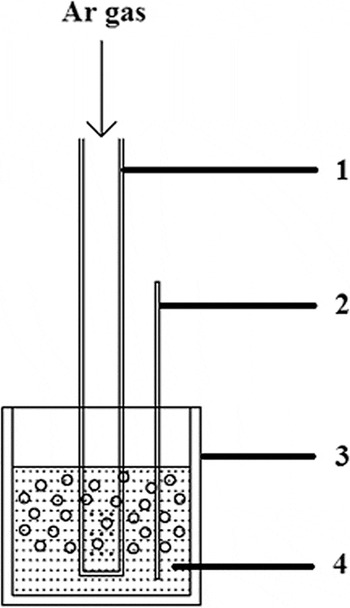
Figure 1 presents the schematic of the preparation of semi-solid slurry by gas bubbling. Each time, about 600 g melt of AZ91–2Ca alloy was transferred to a preheated metallic cup. A thermocouple was used to monitor the temperature of the melt in the metallic cup. When the melt was cooled down to 615 °C, a gas diffuser made of stainless steel was inserted into the melt and the flow rate of Ar gas was set at 6 L/min. When the melt reached the predetermined pouring temperature, i.e., 599, 596, 593, and 590 °C respectively, the diffuser was removed and some semi-solid slurry was immediately poured into a small copper mold to prepare semi-solid slurry samples with dimensions of Φ15 mm × 20 mm. The remaining semi-solid slurry was subsequently poured into the cylinder mold of a direct squeeze casting machine to prepare rheo-squeeze casting samples with dimensions of Φ55 mm × 80 mm. The pressure was applied to the semi-solid slurry within 5 s and held for 20 s. The level of applied pressure was set at 120 MPa. For comparison, conventional squeeze casting sample of AZ91–2Ca alloy without gas bubbling treatment was also prepared at pouring temperature of 700 °C and applied pressure of 120 MPa.
Schematic of the preparation of AZ91–2Ca semi-solid slurry by gas bubbling: (1) gas diffuser; (2) thermocouple; (3) metallic cup, and (4) melt.

The specimens for microstructure characterization of semi-solid slurry were cut from the bottom of AZ91–2Ca semi-solid slurry samples. The specimens for microstructure characterization and flat tensile samples for mechanical property test of rheo-squeeze casting and conventional squeeze casting AZ91–2Ca samples were cut from the bottom of the shaped samples using an electric-spark wire-cutting machine. The specimens for microstructure characterization were treated with standard metallographic procedures. The microstructure characterization was carried out using an optical microscope (OM, Axio observer A1, ZEISS, Oberkochen, Germany) and a scanning electron microscope (SEM, Quanta FEG 250, FEI, Hillsboro, OR). Primary α-Mg particles were analyzed by quantitative metallographic analysis software (Image-Pro Plus 6.0). The shape factor of a primary particle is defined as SF = 4πA/P 2, where A and P represent the area and perimeter of the primary particle, respectively. The gage dimensions of the tensile samples were 15 mm × 3.6 mm × 2 mm. The tensile testing was carried out using a universal material test machine with a crosshead speed of 1 mm/min at ambient temperature.
III. RESULTS AND DISCUSSION
A. Microstructure of AZ91–2Ca semi-solid slurry
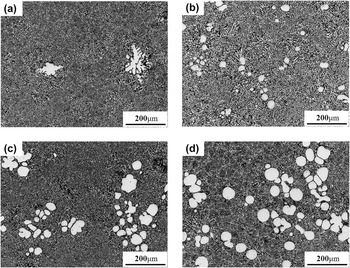
Figure 2 presents the microstructures of AZ91–2Ca semi-solid slurry samples prepared by gas bubbling at different pouring temperatures. As shown in Fig. 2, the microstructures of AZ91–2Ca semi-solid slurry samples showed typical semi-solid characteristics. The particles in bright color were primary α-Mg phase formed during gas bubbling process and the dark matrix was the residual melt solidified in the copper mold. It is observed that the change of pouring temperature showed a significant influence on the size and morphology of primary α-Mg phase formed in gas bubbling process. As shown in Fig. 2(a), although the pouring temperature (599 °C) was slightly above its liquidus, isolated α-Mg dendrites were still observed in semi-solid slurry sample. However, when the pouring temperature decreased to 596 °C, shown in Fig. 2(b), coarse α-Mg dendrites almost disappeared and primary α-Mg particles turned to be nondendritic and well dispersed in the matrix. Further decreasing the pouring temperature to 593 and 590 °C, primary α-Mg particles mostly preserved their spherical morphology and the size of nondendritic primary α-Mg particles coarsened gradually.
Microstructures of AZ91–2Ca semi-solid slurry prepared by gas bubbling at different pouring temperatures: (a) 599 °C; (b) 596 °C; (c) 593 °C, and (d) 590 °C.

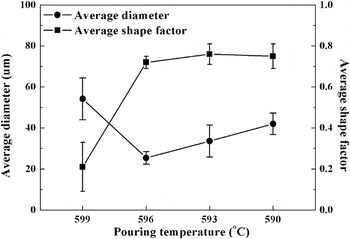
Figure 3 shows the effect of pouring temperature on size and roundness of primary α-Mg particles in AZ91–2Ca semi-solid slurry samples prepared by gas bubbling. The quantitative analysis results are in accordance with the microstructure observation above. With the decrease of pouring temperature from 599 to 590 °C, the average diameter of primary α-Mg particles first decreased dramatically from 54.2 to 25.4 μm and then gradually increased to 42.0 μm. Meanwhile, the average shape factor first increased remarkably from 0.21 to 0.72 and then maintained at a relatively high level. As the average cooling rate during gas bubbling treatment was calculated to be about 0.80 °C/s, it is concluded that fine semi-solid slurry of AZ91–2Ca alloy could be prepared by gas bubbling process within 30 s, with primary α-Mg particles having an average diameter of less than 50 μm and average shape factor higher than 0.7. The efficient preparation of semi-solid slurry is especially valuable to Mg alloys, since the shortening of processing time can effectively inhibit severe oxidation of Mg alloy melt during the preparation of semi-solid slurry.
Effect of pouring temperature on size and roundness of primary α-Mg particles in AZ91–2Ca semi-solid slurry samples prepared by gas bubbling.

In the early stage of solidification, the solid fraction in semi-solid slurry increases significantly. In this study, when the pouring temperature decreased from 599 to 590 °C, the solid fraction in AZ91–2Ca semi-solid slurry increased from 0.029 to 0.180. The increase of solid fraction greatly influences the size and morphology of primary particles, as well as the rheological properties of semi-solid slurry and final mechanical properties of the cast samples. In most rheoforming processes, the solid fraction is limited to less than 0.2. Therefore, the lowest pouring temperature was set as 590 °C in this study.
The existence of coarse and dendritic primary particles in sample quenched above liquidus temperature [presented in Fig. 2(a)] was also observed in previous GISS research studies. Reference Canyook, Petsut, Wisutmethangoon, Flemings and Wannasin15 When the cold diffuser was inserted into the melt, dendrites could form immediately around the diffuser due to sudden cooling. At the beginning of gas bubbling, since the temperature of the melt was still above its liquidus, the firstly formed dendrites would gradually remelt and disappear. The remelting process might be interrupted when quenched into the copper mold and resulted in the presence of unmelted dendrites.
In previous studies, it was suggested that the fragmentation of dendrites was responsible for the formation of nondendritic primary particles in GISS process. Reference Canyook, Petsut, Wisutmethangoon, Flemings and Wannasin15,Reference Canyook, Wannasin, Wisuthmethangkul and Flemings16 However, in view of the morphology evolution of primary α-Mg particles shown in Fig. 2, it is reasonable to conclude that most of the primary α-Mg particles were more likely to nucleate and grow into spherical particles directly in the melt during gas bubbling process. As shown in Fig. 2(b), primary α-Mg particles were already circular at the initial stage, indicating that these particles were not broken dendrites. As the temperature of Ar gas was always lower than the melt, effective localized chilling could be achieved near the diffuser during gas bubbling. Heterogeneous nucleation was likely to occur in the undercooled regions and the nuclei could distribute uniformly in the melt driven by the gas flow. Also due to the presence of continuous gas bubbling, forced stirring was achieved and homogeneous temperature and concentration field was created in the bulk melt, which had a favorable influence on the nondendritic growth of primary α-Mg particles. Reference Fan and Liu17,Reference Fan, Liu and Hitchcock18
B. Microstructure and mechanical properties of rheo-squeeze casting AZ91–2Ca alloy
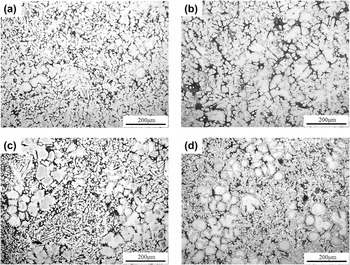
Figure 4 presents the microstructures of rheo-squeeze casting AZ91–2Ca alloy samples prepared by gas bubbling process at different pouring temperatures. It is observed that the semi-solid characteristic of AZ91–2Ca semi-solid slurry was preserved in the rheo-squeeze casting samples. The microstructures of rheo-squeeze casting AZ91–2Ca alloy samples definitely consisted of coarse nondendritic primary α-Mg particles, well-refined α-Mg dendrites, and secondary phases. In comparison with the microstructures of AZ91–2Ca semi-solid slurry samples shown in Fig. 2, primary α-Mg particles coarsened significantly in rheo-squeeze casting samples, since these particles went through further growth during the transfer of semi-solid slurry and subsequent squeeze casting process. With the decrease of pouring temperature, the volume fraction of primary α-Mg particles also increased continuously. Due to the increase of the solid fraction, large primary α-Mg particles tended to aggregate together in rheo-squeeze casting AZ91–2Ca alloy samples.
Microstructures of rheo-squeeze casting AZ91–2Ca alloy samples prepared by gas bubbling process at different pouring temperatures: (a) 599 °C; (b) 596 °C; (c) 593 °C, and (d) 590 °C.

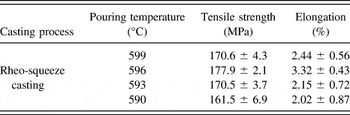
The mechanical properties of the rheo-squeeze casting AZ91–2Ca alloy samples prepared by gas bubbling at different pouring temperatures are illustrated in Table II. As presented in Table II, with the decrease of pouring temperature from 599 to 590 °C, both tensile strength and elongation first increased and then decreased. The best mechanical properties of rheo-squeeze casting AZ91–2Ca alloy was achieved at the pouring temperature of 596 °C, in which tensile strength and elongation were 177.9 MPa and 3.32%, respectively.
Mechanical properties of rheo-squeeze casting AZ91–2Ca alloy samples prepared by gas bubbling at different pouring temperatures.

It is observed that, with the decrease of pouring temperature, the change rule of mechanical properties of rheo-squeeze casting AZ91–2Ca alloy samples was the same to the change rule of quality of AZ91–2Ca semi-solid slurry samples presented in Fig. 3. More specifically, semi-solid slurry prepared at pouring temperature of 596 °C possessed the best combination of size and roundness of primary α-Mg particles. Meanwhile, rheo-squeeze casting AZ91–2Ca alloy prepared at pouring temperature of 596 °C exhibited the peak mechanical properties. These results confirm that the improvement in the quality of semi-solid slurry is beneficial to the mechanical properties of rheo-squeeze casting samples.
It is interesting to note that the slight change of pouring temperature obviously influenced the mechanical properties of rheo-squeeze casting AZ91–2Ca alloy, especially in its elongation. A similar phenomenon was also reported by Wu et al. in the rheo-die casting of A356 Al alloy made with indirect ultrasonic vibration process. Reference Wu, Lü, An and Nakae11 They attributed to the relatively poor mechanical properties at high pouring temperature to the existence of dendrites and large gas pores while the poor mechanical properties at low pouring temperature was due to the increased oxidation of melt surface. In this study, the relatively low ductility of rheo-squeeze casting AZ91–2Ca sample at pouring temperature of 599 °C was also due to the coarse dendrites occurred occasionally in the rheo-squeeze casting sample. However, when considering the condition of low pouring temperature, besides the risk of oxidation, the significant increase of solid fraction should also be taken into consideration. In the initial solidification stage of AZ91–2Ca alloy, the solid fraction in semi-solid slurry changed greatly, which promoted the continuous coarsening and possible aggregation of primary α-Mg particles. The existence of large aggregated primary α-Mg particles in rheo-squeeze casting AZ91–2Ca alloy samples could easily lead to stress concentration during tensile deformation and result in poor ductility.
C. Comparison between rheo-squeeze casting and conventional squeeze casting
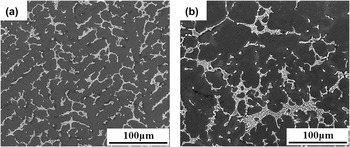
The microstructures of conventional squeeze casting and rheo-squeeze casting AZ91–2Ca alloy samples observed by OM are presented in Fig. 5. As shown in Fig. 5, it is clear that there is obvious difference in α-Mg phase between the samples of AZ91–2Ca alloy prepared by conventional squeeze casting and rheo-squeeze casting, respectively. As can be seen in Fig. 5(a), only well-developed dendritic α-Mg phase with dimension of several hundred micrometers can be observed in conventional squeeze casting AZ91–2Ca alloy. However, due to its unique solidification process, there are two kinds of α-Mg phase with different morphologies present in the microstructure of rheo-squeeze casting AZ91–2Ca alloy, i.e., coarse nondendritic primary α-Mg phase and fine dendritic α-Mg phase in solidified residual melt, as shown in Fig. 5(b).
Optical microstructures of (a) conventional squeeze casting and (b) rheo-squeeze casting AZ91–2Ca alloy samples.

SEM observation presented in Fig. 6 further proved that the size and distribution of second phases in AZ91–2Ca alloy were also influenced greatly by the different casting processes. According to previous literature, there are two kinds of second phases in the as-cast AZ91–2Ca alloy, i.e., β-Mg17Al12 phase and Al2Ca phase. Reference Liang, Chen, Blandin, Suery and Han19 As shown in Fig. 6, the irregular-shaped phase in gray color is β-Mg17Al12 phase and the lamellar phase in bright color is Al2Ca phase. As can be seen in Fig. 6(a), in conventional squeeze casting AZ91–2Ca sample, since α-Mg phase grew into well-developed dendrites during solidification, second phases mainly formed in the interdendritic regions and their growth was restricted. Therefore, most of the second phases were separated and homogeneously distributed. However, in rheo-squeeze casting AZ91–2Ca sample, shown in Fig. 6(b), the distribution of second phases was not uniform. The aggregation of second phases was observed in the region of solidified residual melt and lamellar Al2Ca phase tended to be coarse and connected.
SEM images of microstructures of (a) conventional squeeze casting and (b) rheo-squeeze casting AZ91–2Ca alloy samples.

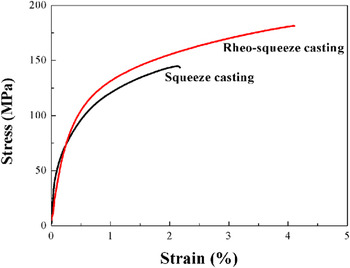
Table III presents the mechanical properties of the conventional squeeze casting AZ91–2Ca alloy sample prepared in this study. For more direct observation, the typical tensile stress–strain curves of the conventional squeeze casting and rheo-squeeze casting AZ91–2Ca alloy samples are also presented in Fig. 7. As presented in Tables II and III, all the rheo-squeeze casting samples in this study showed better mechanical properties than conventional squeeze casting sample, in both tensile strength and ductility. The best mechanical properties of rheo-squeeze casting AZ91–2Ca alloy sample achieved at pouring temperature of 596 °C exhibited an increase of 23.9 and 79.4% in tensile strength and elongation, respectively, than those of conventional squeeze casting AZ91–2Ca alloy sample.
Mechanical properties of conventional squeeze casting AZ91–2Ca alloy sample prepared at pouring temperature of 700 °C and applied pressure of 120 MPa.

Typical tensile stress–strain curves of conventional squeeze casting and rheo-squeeze casting AZ91–2Ca alloy samples.

It is generally believed that the improvement of mechanical properties in rheoforming is mainly attributed to the refinement and spheroidization of primary phase. Reference Guo, Zhang, Hu, Ding and Liu20 In this study, the refinement in the as-cast microstructure of rheo-squeeze casting AZ91–2Ca alloy actually consisted of two parts, i.e., the refinement and spheroidization of primary α-Mg particles occurred during the gas bubbling process and the refinement of α-Mg particles in the residual melt induced by high cooling rate and applied pressure during the subsequent squeeze casting process. In conventional squeeze casting process, the melt of AZ91–2Ca alloy was poured into the mold at 700 °C, which was about 100 °C higher than its liquidus. Although the application of pressure could also promote grain refinement in conventional squeeze casting, the refining effect was not as significant as rheo-squeeze casting. Therefore, rheo-squeeze casting possesses significant advantages in refinement strengthening over conventional squeeze casting.
The size, morphology, and distribution of second phases also play an important role in the mechanical performance of cast alloys. Compared with the evolution of primary phase, the effect of rheoforming process on second phases received less attention till now. It was reported that, compared with conventional squeeze casting, rheo-squeeze casting process could promote the uniform distribution of eutectic Si particles in A356 Al alloy and therefore further improve the mechanical properties of rheo-squeeze casting A356 alloy sample. Reference Lü, Wu, Dai, Lin and An5 In contrast, in this study, second phases in rheo-squeeze casting AZ91–2Ca alloy tended to aggregate and coarsen, which led to the formation of connected network-like Al2Ca phase. The significant difference in the distribution of second phases between rheo-squeeze casting A356 Al alloy and AZ91–2Ca Mg alloy is due to their different metallurgical characteristics. Reference Kleiner, Ogris, Beffort and Uggowitzer21 A356 alloy is a typical hypoeutectic Al–Si alloy containing about 50% eutectic and the eutectic Si can be modified by addition of approximately 300 ppm Sr. Reference Nafisi and Ghomashchi22 As a result, the as-cast microstructure of rheo-squeeze casting A356 alloy consists of about 50% Al particles and about 50% eutectic which contains fine dispersed Si particles. However, the eutectic fraction in AZ91–2Ca alloy is much lower than that in A356 alloy. The quantitative analysis results confirmed that the eutectic fraction in AZ91–2Ca alloy was only in the range of 12–14%. In thick-walled parts like the cylinder in this study, solidification continued on the already existed primary α-Mg particles and the residual melt got enriched with the alloying elements, including Al, Zn, and Ca. The enrichment of alloying elements in the residual melt facilitated the formation and aggregation of coarse lamellar Al2Ca phase. Since Al2Ca phase is brittle and easily broken during deformation, the aggregation and coarsening of Al2Ca phase was obviously harmful to the final mechanical properties of rheo-squeeze casting AZ91–2Ca alloy. Reference Wu, Fan, Gao, Zhai and Zhu14
In summary, it can be concluded that the effect of rheo-squeeze casting on the microstructure of AZ91–2Ca alloy was significant but its effect on mechanical properties was sophisticated. The refinement of α-Mg phase definitely had a positive function on the mechanical properties of rheo-squeeze casting AZ91–2Ca alloy while the aggregation and coarsening of lamellar Al2Ca phase had a negative function. The final mechanical performance of rheo-squeeze casting AZ91–2Ca alloy proved that the refinement strengthening effect was only partially offset by the negative effect of second phases. To fully display the advantages of rheo-squeeze casting, it is necessary to explore effective approaches to develop the morphology in rheo-squeeze casting AZ91–2Ca alloy and distribution of Al2Ca phase in the next step, such as chemical modification and heat treatment.
IV. CONCLUSIONS
In the present work, semi-solid slurry of AZ91–2Ca alloy was prepared by gas bubbling and shaped by rheo-squeeze casting process successfully. The main conclusions are listed as follows:
-
(1) With the decrease of pouring temperature, the size of primary α-Mg particles first decreased dramatically and then gradually increased. The average shape factor first increased remarkably and then maintained at a relatively high level. Fine semi-solid slurry of AZ91–2Ca alloy could be prepared by gas bubbling within 30 s, with primary particles having an average diameter of less than 50 μm and average shape factor higher than 0.7.
-
(2) Compared with semi-solid slurry samples, primary α-Mg particles in rheo-squeeze casting AZ91–2Ca alloy samples coarsened significantly. With the decrease of pouring temperature from 599 to 590 °C, both tensile strength and elongation of rheo-squeeze casting AZ91–2Ca alloy first increased and then decreased. The best mechanical properties were achieved at the pouring temperature of 596 °C, in which tensile strength and elongation were 177.9 MPa and 3.32%, respectively.
-
(3) Compared with conventional squeeze casting sample, the significant improvement in mechanical properties of rheo-squeeze casting AZ91–2Ca alloy samples was mainly attributed to the refinement in the as-cast microstructure, including the refinement and spheroidization of primary α-Mg particles occurred during the gas bubbling process and the refinement in the residual melt induced by high cooling rate and applied pressure during the subsequent squeeze casting process.
ACKNOWLEDGMENTS
This work was financially supported by Science Research Fund for the Doctoral Program of Higher Education of China (Nos. 20120073120011 and 20130073110052), National Natural Science Foundation of China (No. 51275295), and Shanghai Yang-Fan Program (No. 14YF1402000).