The rural sector, in which the vast majority of economic activity took place in early modern Europe, is widely viewed as financially comatose. Many scholars accept Aleksander V. Chayanov's view that in peasant societies “capital” and “interest” are not comprehensible concepts and “cannot even be defined quantitatively.”Footnote 1 Others portray preindustrial rural people as being forced into borrowing only as a last resort, and then mainly to overcome consumption crises, not invest in production.Footnote 2 Most accounts tacitly assume that financial activity was limited largely to bankers and merchants, or to trading economies such as Holland and England, where modern financial instruments were emerging.Footnote 3 Outside such precocious commercial enclaves, borrowing was nonproductive, investment was negligible, and people saved through hoarding rather than financial assets. The minimal financial activity that occurred was dominated by monopolistic local moneylenders and personalized credit relationships until the nineteenth century.Footnote 4 Country dwellers in the “less- developed” interior of early modern Europe, according to this account, were either unwilling or unable to participate in financial activity.
This article questions these widely held assumptions. Our alternative theory is that most people wish to smooth their consumption over time by borrowing, finance profitable investments that cannot be funded from current resources, bridge episodes of low liquidity, find productive uses for savings by lending, and spread risks by holding wealth in diverse forms including financial assets. If these motivations are general, one would expect to observe borrowing and lending in some form in every economy. The interesting question is: what form does this credit take in different places and times? One context that has been almost wholly neglected is the countryside of early modern central Europe. Although market-oriented in many ways, central Europe followed a much more gradual growth trajectory than the precocious North Atlantic economies, and its financial sector is often portrayed as virtually nonexistent until the celebrated German banking system emerged in the nineteenth century.Footnote 5
We focus here on debt in a small, rural community in the Black Forest, remote from urban centers, whose inhabitants earned their livings from neither long-distance commerce nor international finance, but rather those small-scale activities—farming, crafts, proto-industrial work, local services, and day laboring—which generated the vast majority of European output before industrialization. We exploit a unique data set of inventories recording all assets—and liabilities—at marriage, remarriage, widowhood, and death, covering a large majority of adults across the seventeenth century.
In line with the standard economic model of intertemporal allocation, we define debt to be the sum total of all liabilities which individuals are contractually obliged to fulfill.Footnote 6 Our justification for adopting this definition is that we expect individuals, when deciding whether to incur a liability, not to distinguish between different types of liability—between tradable and nontradable ones, or between liabilities that may be linked to other transactions and those that are not. Consistent with this reasoning, we assume that individuals, when they incur debts, consider their solvency (i.e., their ability to meet all their contractual obligations), not their liquidity (i.e., whether they can quickly raise funds to meet obligations). That is, in making decisions about how much debt to incur, we assume that people take into account all their other obligations. It is this sum total of all obligations of an individual or household that these early modern German rural inventories record and that this article analyzes.
The borrowing recorded in these inventories reveals clear similarities between the “less-developed” interior of the continent and the faster-growing northwest European economies in the early modern period—but also striking differences. Counter to traditional historiography, financial dealings in early modern Europe were not restricted to the urban, mercantile, or industrial sectors of commercialized Holland, Flanders, England, or France, but were vigorously practiced even in remote rural areas such as the Black Forest. Credit relationships were not limited either to the elite or to the destitute, but extended across all demographic groups and socioeconomic strata. Borrowing was not primarily an indicator of crisis or poverty but instead a strategy deployed by a wide cross-section of rural society to smooth consumption, make investments, and diversify risks. Yet this lively borrowing activity also manifests interesting contrasts with some more sophisticated early modern financial sectors, differences that can be traced to both institutional and economic characteristics of this central European society.
THE MICRO-STUDY
The context in which we analyze rural borrowing is the south German territory of Württemberg, specifically the locality of Wildberg, located in the Nagold Valley of the northern Black Forest.Footnote 7 Although legally a town, Wildberg was a small settlement whose inhabitants lived from farming alongside crafts, proto-industry, and local services. With fewer than 1,000 inhabitants in 1600, its population rose to around 1,650 before the Imperial invasion of 1634. From then to the end of the Thirty Years War in 1648, its population hovered around 1,000 inhabitants, and although it gradually recovered to about 1,400 by the mid-1670s, renewed war with France in the 1680s and 1690s reduced its size to some 1,200 inhabitants in 1700.Footnote 8 Proto-industrial textile production made inroads after about 1580. By the 1630s about 40 percent of Wildberg households engaged in export-oriented worsted-weaving and spinning had become a mainstay of its female inhabitants. In a parallel development, the percentage of Wildberg taxpayers owning land (other than cottage gardens) declined from 70 percent in 1565 to 50 percent in 1614 and 1629, but the proportion then recovered to 60 percent during the rest of century.Footnote 9 Early modern Wildberg was thus a small, rural community where most households combined small-scale farming with other occupations.Footnote 10
Most secondary- and tertiary-sector occupations in Württemberg, including the weaving, dyeing, and exporting of proto-industrial worsteds, were controlled by rural-urban guilds, which until the nineteenth century maintained entry barriers, fixed wages and prices, and excluded women, migrants, Jews, laborers, and many others. The courts, councils, assemblies, and officials of Württemberg's powerful local communities closely monitored and administered settlement, marriage, migration, inheritance, consumption, prices, wages, land transactions—and financial dealings. The Württemberg state also regulated factor and product markets in symbiosis with local communities and occupational corporations.Footnote 11
This institutional context influenced financial dealings in a number of ways. For one thing, state and communities provided a comprehensive framework for recording debt contracts and enforcing repayment within rural settlements, across administrative districts, and even beyond the national borders.Footnote 12 The first judicial instance at which defaulting debtors could be pursued was the local community court, at which the “social capital” of information and sanctions inside Württemberg communities could be mobilized.Footnote 13 At the next level of jurisdiction, debt contracts were enforced by the district court, manned by town council members and chaired by the district governor (a princely bureaucrat). Princely officials also pursued debtors by writing to officials in other districts and even beyond the borders of Württemberg.Footnote 14
Württemberg's institutions were unusually strict in that ordinary people had to secure permission from their community to borrow small sums, and from the state for larger ones.Footnote 15 The powerful community courts had (and enforced) the right to veto ratification (Fertigung) for debts secured by real property.Footnote 16 To give a personal bond (Gültbrief) one had to get permission from the communal court and district bureaucrats. Additionally, all loans above a certain size (25 Gulden (fl) in 1621, 100 fl by 1781) required a princely permit.Footnote 17 More sophisticated debt instruments, such as bills of exchange (Wechselbriefe), were legally reserved for merchants and members of the princely court. Ordinary people who wanted to use such financial instruments had to seek a costly government permit, and inevitably many preferred to engage in less formal types of borrowing.Footnote 18
Like many other places, Württemberg had usury laws. The state fixed a legal interest rate ceiling of 5 percent per annum and prohibited lending practices that circumvented this ceiling.Footnote 19 Community courts were forbidden to ratify or enforce loans with an explicit or implicit interest above 5 percent.Footnote 20 Studies of Württemberg credit markets from the sixteenth through to the mid-nineteenth century find thoroughgoing compliance with the 5 percent ceiling in formally recorded or enforced debts.Footnote 21 This rate ceiling clearly created excess demand for loans, as shown by borrowers’ eagerness to borrow at higher rates in the black market.Footnote 22 Furthermore, interest rate ceilings meant that marginal borrowers, especially women and the poor, were either excluded from credit altogether, or could only obtain loans in the informal sector at illegally high rates and without the benefits of legal protection.Footnote 23
Our data on borrowing were generated by a further component of the Württemberg institutional framework, its inheritance rules. Under this strictly partible system, spouses retained rights over property brought into marriage, and daughters inherited equally with sons. To facilitate the community-based administration of this system, from 1551 onwards the government mandated that communal officials called Inventierer (inventory makers) record people's possessions at death in two forms—“contingent inheritance inventories” (Eventualteilungen), drawn up for a couple when one spouse died, at which inheritance shares were recorded but not actually allocated among heirs; and “actual inheritance inventories” (Realteilungen), drawn up for widowed (and a few never-married) persons, at which inheritance shares were actually distributed. From 1610 onwards the government also mandated inventories at marriage and remarriage (Beibringungsinventare).
A person or couple was not legally obliged to be inventoried by communal officials if they possessed a special legal status, left a written will, agreed to marital community of property, got the district court's approval, drew up a private inventory, had only one heir, or obtained agreement from all their heirs—although such people could be inventoried, since these rules were just treated as guidelines. Administrative breakdown, corruption, and negligence could also prevent inventorying.Footnote 24 Nonetheless, a substantial and growing proportion of marriages and deaths in early modern Württemberg generated inventories.Footnote 25
To test for representativeness, we linked all surviving Wildberg marriage and death inventories for 1602–1700 with 12 tax registers covering the period 1599–1705. Tax registers recorded all autonomous economic units—i.e., those pursuing independent livelihoods—including women, solitaries, and persons with zero taxable assets (i.e., no real estate).Footnote 26 As early as 1614 over one-third of Wildberg's male taxpayers could be linked definitively with at least one inventory, rising to over 40 percent by 1629, over 50 percent by 1639, over 67 percent by 1661, and over 80 percent by 1695. Even among female taxpayers, 23 percent could be linked with at least one inventory by 1614, rising to 44 percent by 1629, and over 75 percent by 1695. Although the wealth of inventoried taxpayers was on average higher than that of non-inventoried ones, the difference was not always statistically significant, and each cross-section included inventoried taxpayers with zero taxable wealth.Footnote 27 Württemberg inventories were neither universal nor perfectly representative, but they encompass most people with the autonomy needed to take out loans, and include both women and the landless.Footnote 28 Moreover, because they record both formal and informal liabilities, their coverage is far superior to any other available data source on early modern rural borrowing.
A Württemberg inventory began by recording locality, date, and personal details for inventoried individuals, plus current and former spouses, parents, offspring, and other heirs. A second section listed real estate, subdivided into buildings, gardens, arable fields, pastures, woods, and fishing waters. A third recorded all moveable goods down to those worth only one Heller (the smallest currency unit), including cash, jewelry, silver, men's clothing, women's clothing, books, bedding, household linen, household vessels, furniture, general household goods, farm and craft tools, business wares, animals, food and grain stores.Footnote 29 A fourth section recorded unpaid debts (Passiva) and financial assets (Aktiva). The final section produced an accounting of the net assets of a person or couple, allocated inheritance shares, and recorded participants’ signatures.
Württemberg inventories were supposed to record monetary values for all items, although early ones did not always do so. Although historians have sometimes claimed that inventories were based on a standardized set of prices, there are strong reasons to believe that in Württemberg they recorded actual prices. For one thing, inventory makers were not casual amateurs but specially appointed community officials (Inventierer) assisted by professional clerks, an important part of whose training consisted in learning how to draw up inventories carefully so as to avoid inheritance conflicts. Inventory makers even sometimes asked women to assist them in valuing gender-specific items.Footnote 30 Furthermore, certain items in the inventories themselves were explicitly described as having been paid for by the bride or groom personally and prices for the same item type in the same inventory varied with quality.Footnote 31 Finally, inheritance shares were legally allocated and debts were legally paid according to inventory valuations, a practice to which heirs, creditors, and law courts would hardly have consented had the valuations not been accurate. Prices of all items in an inventory would have had to be “wrong” to precisely the same degree in order to satisfy sharp-eyed heirs and creditors. It was surely more straightforward for inventory makers simply to use the prices paid for these items on the market, which the evidence suggests they did.
CHARACTERISTICS OF DEBTS
The number and value of debts listed in the inventories for seventeenth-century Wildberg already cast doubt on any simple view that premodern central European rural economies were financially torpid. The surviving marriage and death inventories for this locality between 1602 and 1700 list a total of 8,206 separate debts, approximately 4 debts per inventoried person.Footnote 32 The total value of borrowing was nontrivial relative to assets: in the 1,182 lists for individuals recording monetary values for all items, the value of debts amounted to 11.5 percent of the value of total possessions; in the 638 lists for couples, debts amounted to 13.4 percent of the value of total possessions. The average size of a single debt in an individual inventory was 13.6 inflation-adjusted Gulden (fl), in a couple inventory 14.3 fl; this was nearly two times the annual cash wage of an average male servant in seventeenth-century Wildberg and over four times that of a female servant.Footnote 33
Borrowing was thus quantitatively important among ordinary people in this rural economy. But what were its characteristics? What light do these 8,206 debts shed on premodern rural finance?
Why Did People Borrow?
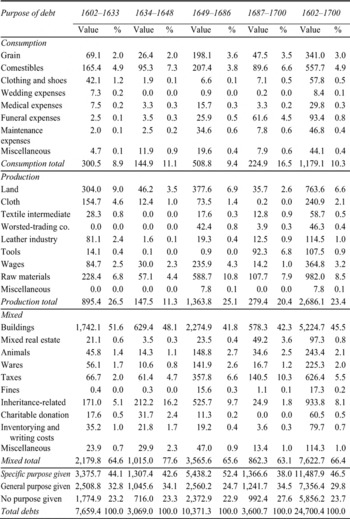
We begin by investigating the widely held assumption that premodern country dwellers borrowed mainly to survive food crises,Footnote 34 engage in conspicuous consumption,Footnote 35 or for other nonproductive purposes.Footnote 36 To find out why people actually borrowed in seventeenth-century Wildberg, Table 1 categorizes the recorded purposes of the 8,180 inventoried debts with known values.Footnote 37 Not all inventoried debts had specific purposes recorded. About 30 percent of debts by value were described only in general terms (capital sum, interest payments, installments, etc.), in which capital sums made up two-thirds of the category. Another approximately 24 percent of debts by value were described only in terms of the creditor, in which debts to private persons comprised over two-thirds of the category.
VALUE OF DEBTS BY PURPOSE, WILDBERG, 1602–1700

Notes:
Values measured in inflation-adjusted Gulden (fl); index year 1565. Includes only those debts for which values were recorded (n = 8,180). Columns do not always add up to 100 percent because of rounding.
Sources:
HStAS, A573, Bü. 4798–4802, 4804, 4806–4808, 4814 (Abschriften); Bü. 4870–4871, 4874, 4876–4892, 4895–4897, and 4901–4947 (Originale) (1602–1700).
But 46.5 percent of inventoried debts by value—an unusually high proportion—recorded a clear, specific purpose.Footnote 38 Although this subset of debts may be unrepresentative, the fact that virtually all conceivable purposes for borrowing appear suggests that none was systematically ignored. Table 1 categorizes these into consumption, production, and “mixed” purposes. Production and consumption were closely linked in early modern households, of course, so many debts—such as those for buildings (used for both residence and work) and animals (producers of food, draft power, and industrial materials)—had to be categorized as “mixed.”
The most salient class of “mixed” debts were for buildings, though these declined from about 50 percent of specific-purpose debts before mid-century to about 42 percent thereafter. A second important class of “mixed” debts were for inheritance claims, which made up 8 percent across the century, though much higher percentages during the Thirty Years War, probably as fallout from high wartime mortality. Taxes comprised a third notable “mixed” purpose, rising significantly from only 2 percent of specific-purpose loans before 1634 to over 10 percent after 1687. Although indebtedness caused by tax demands had a long tradition in Germany, these findings for Wildberg suggest that the accelerating state growth of the seventeenth century swelled private borrowing.Footnote 39
Was it true that people borrowed mainly for consumption—either to stave off starvation or to purchase luxuries beyond their means—and hence that most borrowing was for nonproductive purposes? The answer is no. Production debts comprised 23 percent of debts by value, compared to only 10 percent for consumption debts. Only in the worst wartime period (1634–1648) did consumption and production account for nearly equal proportions (10 and 11 percent, respectively)—interestingly, consumption debt did not increase, it was just that production-related debt declined. By contrast, in peacetime (1602–1633, 1649–1686) production debts were nearly three times as high as consumption debts. The share of consumption debts only rose after 1687, and even then remained lower than production debts. The same low proportion of consumption debts emerges from several other German debt studies,Footnote 40 but contrasts intriguingly with the primacy of consumption loans in probate accounts in seventeenth-century England, notoriously one of the cradles of the early modern Consumer Revolution.Footnote 41 People in early modern Wildberg did borrow to bridge consumption gaps, but they borrowed much more to invest in their own productive capacities.
Breaking down production borrowing between economic sectors yields just over one-third for agricultural purposes and just under two-thirds for industrial ones.Footnote 42 This finding is consistent with the proto-industrial specialization of Wildberg and the low agricultural productivity growth in Württemberg as a whole before c.1850.Footnote 43 It is also mirrored in a mainly agricultural Württemberg village in the mid-nineteenth century, where craftsmen were disproportionately represented among debtors.Footnote 44 But it contrasts intriguingly with the importance of agriculture-related loans in early modern Flanders, Holland, and England, whose Agricultural Revolutions were by this time in full swing.Footnote 45
When it came to consumption, did people borrow for luxury or display, the objection so often leveled at peasant borrowing by premodern elites?Footnote 46 Again the answer is no. The largest tranche was for grain and comestibles, which made up four-fifths of consumption-related borrowing by value. Some grain may have been purchased as seed, which would make it production-related, but even with the relatively low Württemberg yield ratio of 5:1, most grain was for consumption.Footnote 47 People did not borrow to buy grain because they were too improvident to store food, since most inventories in Wildberg (and other Württemberg villages) record stocks of grain and comestibles.Footnote 48 Grain debts more probably arose, therefore, from temporary cash-flow problems. By comparison, debts for luxury and display—the “unnecessary” clothing, wedding celebrations, and funeral ceremonies castigated in seventeenth-century Württemberg sumptuary ordinances—made up only 2 percent of the value of all debts for known purposes, providing no evidence of any early modern Consumer Revolution fuelled by expanding credit. This is consistent with studies emphasizing the institutional and economic constraints on consumption by ordinary Württemberg people, and dating the spread of consumer luxuries only to the later eighteenth or early nineteenth centuries.Footnote 49

Were Debts Formally Documented?
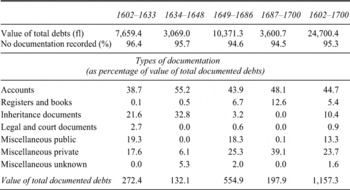
But does all this borrowing in rural Württemberg testify to highly developed, formal credit markets of the sort described for early modern France, England, or the Low Countries? Debt documentation is one indicator of more formal credit markets in which borrowing is more often intermediated, repayment is more easily enforced, and financial instruments are negotiable.Footnote 50 By this measure, as Table 2 shows, seventeenth-century Wildberg borrowing was not highly formal, with only 4.7 percent of inventoried debts by value (2.6 percent by number) making any mention of documentation.Footnote 51 This is very low compared to other European economies in the same period. In early modern rural Flanders, for instance, three-quarters of debts in probate inventories were documented as bonds or annuities,Footnote 52 and in early modern Kent, over one-quarter of debts in probate accounts were documented.Footnote 53
This is not to say that documentation was wholly unavailable in early modern Württemberg. The few Wildberg debts that did mention documentation show the use of various types of account, register, inheritance record, legal court record, and miscellaneous documents ranging from the informal “Zettel” (slip of paper) to the formal “Urkunde” (debt certificate), “Gült” or “Obligation” (bond), or “Kontrakt” (contract).
But closer analysis shows an intriguing pattern. Most of these documents were not specific to the credit market. Rather, they had been generated for other purposes, often by state or community offices. Thus over 44 percent of all debts mentioning documentation were supported by “accounts,” over one-third of those being from state and community offices, the remainder from shopkeepers and craftsmen. A second major tranche (over 13 percent of debts mentioning documentation) was supported by other miscellaneous public documents—extracts, letters, lists, and specifications. A third tranche (over 10 percent of debts mentioning documentation) referred to the public administration of the inheritance system, particularly inventories and inheritance divisions. A fourth tranche (over 5 percent) referred to “registers,” mainly those of state and community offices. Only the 24 percent of documented debts in the “miscellaneous private” category—less than 1 percent of total debts by value—were supported by any of the debt-specific instruments associated with the expansion of private finance in some other early modern European economies—annuities, bonds, debentures, deeds, letters of exchange, and so on.Footnote 54
In this respect, seventeenth-century Württemberg differed from early modern France or the post-French Revolution Rhineland, where debts were documented in notarial registers.Footnote 55 Württemberg also differed from early modern Flanders, where village clerks earned freelance fees by writing up private debt contracts and peasants used non-documented IOUs only for small loans.Footnote 56 Württemberg differed from early modern Holland, too, where village debts consisted heavily of documented annuities.Footnote 57 And Württemberg differed from England, where although oral debts existed, by the seventeenth century much borrowing was supported using sophisticated, credit-specific documentation.Footnote 58 Nor is there any evidence for early modern Wildberg of the negotiable debt instruments emerging in the northwest European economies in this period.
Institutional features probably contributed to this relative paucity of credit market-specific documentation.Footnote 59 As mentioned earlier, formalization would have required obtaining communal or state authorization to borrow, which might well be denied. Furthermore, no one was allowed to borrow on a bond without approval from his community court for small sums and from the princely government for larger ones.Footnote 60 Only merchants and other high-status persons could use bills of exchange, while “craftsmen and other ordinary citizens and farmers” had to get special state permits.Footnote 61 Permits were expensive, as were formal debt certificates, for which community and state officials demanded high fees.Footnote 62
A further contributory factor may have been that the comprehensive public record keeping in early modern Württemberg reduced incentives to develop the sophisticated private debt instruments of England or the Low Countries, or the quasi-private notarial instruments of France and the French-influenced Rhineland. The Württemberg government required debt documentation to be written up only by official public clerks (Amtsschreiber) and certified only by princely or communal officials.Footnote 63 When foreign notaries began to operate in Württemberg in the 1790s, the government passed legislation restricting their activities.Footnote 64 Communal and state officials may have played the debt recording and brokerage role in early modern Germany and SwitzerlandFootnote 65 that notaries played in France,Footnote 66 county attorneys in England,Footnote 67 or village clerks in Flanders.Footnote 68
Was Borrowing Personalized?
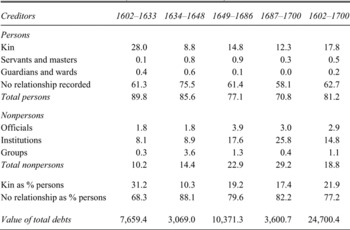
A rather different indicator of the formality of credit markets is the extent to which borrowing extends beyond the boundaries of family and community, and here Wildberg looks more formal—or at least not personalized. Table 3 categorizes the creditors from whom Wildberg inhabitants had borrowed into persons, officials, institutions (guilds, religious foundations), and groups (children under guardianship, sets of heirs).
Contrary to the assumption that premodern rural borrowing was highly personalized, nearly 19 percent of Wildberg debts by value were owed to nonpersonal creditors (mostly institutions and officials), rising from 11 percent in the first half of the century to nearly 23 percent 1649–1686, and over 29 percent after 1687. The proportion of “impersonal” debts in this economy was thus nontrivial and rising. However, this was not because the growth of the market was encouraging exchange with strangers but rather because the growth of the state was swelling fiscal demands and borrowing from public institutions.

Only about 81 percent of debts by value in seventeenth-century Wildberg were owed to creditors who were persons, and only about 18 percent were owed to persons recorded as being related to borrowers through kinship, employment, or guardianship. Table 3 shows that this proportion varied from one period to another, but showed no clear trend across the century, with the highest share of “personalized” borrowing in the 1602–1633 period but the lowest proportion in the 1634–1648 period, and intermediate proportions after mid-century. Of course, these fluctuations may merely result from unsystematic recording. But insofar as they reflect economic practice, they cast doubt on two widely held views. First, borrowing was not predominantly personalized, since less than one-fifth of borrowing in Wildberg occurred between persons with recorded relationships. And second, borrowing was not becoming more impersonal over time, since both the highest and the lowest proportions of personalized borrowing occurred in the first half of the seventeenth century. Furthermore, Andreas Maisch's study of another Württemberg rural community in the eighteenth century found 13–16 percent of inventoried borrowing among kin, almost identical to the proportion in post-1650 Wildberg.Footnote 69

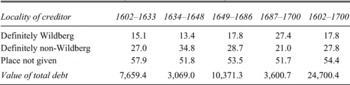
Impersonality is also reflected in the degree to which borrowing extends beyond the local community.Footnote 70Table 4 shows that less than 18 percent of Wildberg borrowing by value took place inside the community. Borrowing that definitely occurred within the community actually rose over time, from 13–15 percent before 1649 to 17–27 percent in the second half of the century. Even assuming that all borrowing with unrecorded locality was actually within Wildberg shows the highest proportion (79 percent) in the post-1687 period. These findings are consistent with the high proportions of intracommunal borrowing found in nineteenth-century Württemberg villages by both Maisch and Anne Mauch, based on different documentary sources, suggesting that they reflect economic practice rather than recording conventions.Footnote 71
Borrowing in rural Württemberg was thus not predominantly personalized. But nor did it become more impersonal as the early modern period passed. On the contrary, borrowing between relatives fluctuated unsystematically across the seventeenth century in Wildberg, and literature on other localities suggests that it remained at similar levels well into the eighteenth century. Borrowing within the community actually increased in Wildberg across the seventeenth century, and literature on other localities shows it remaining high into the nineteenth century. Personalized borrowing in this economy was thus not the dominant pattern; but nor is there any evidence of depersonalization across the early modern period.
THE PREVALENCE OF BORROWING
But who was it who engaged in all this borrowing? Seventeenth-century Wildberg marriage inventories show that both brides and grooms were involved in borrowing and lending: over one-quarter of individuals had outstanding debts at marriage, nearly one-third had financial assets, and more than one-sixth were both debtors and creditors.Footnote 72 At death, both men and women were even more heavily involved in borrowing and lending than at marriage: 88 percent had debts, 81 percent had financial assets, and 71 percent had both.Footnote 73 Borrowing and lending were also widespread among couples: at marriage, just under half had debts, half had financial assets, and a third had both; by the time one spouse died, 94 percent of couples had debts, 78 percent had financial assets, and 74 percent had both.Footnote 74
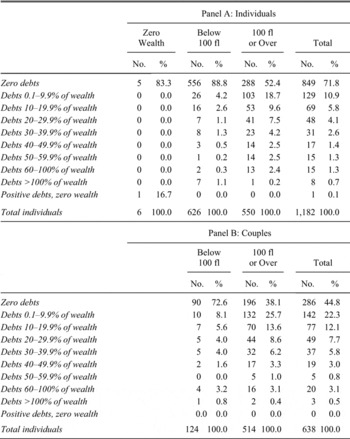
Borrowing also extended across society. As Table 5 shows, at least some members of every wealth stratum owed some money.Footnote 75 But less than 1 percent of individuals or couples borrowed sums in excess of their total wealth. Only 2.1 percent of individuals and 3.6 percent of couples even violated the contemporary rule of thumb that one should not borrow sums exceeding three-fifths of the value of the collateral one could provide.Footnote 76
Counter to the stereotype that only destitute people borrowed, in Wildberg debt was significantly lower among the poor than the rich.Footnote 77 Among individuals, as Table 5 shows, less than 12 percent of those with under 100 fl total wealth had unpaid debts in their inventories, compared to 47 percent of those with over 100 fl. Among couples, the corresponding figures were 27 percent and 62 percent.
The degree of indebtedness also varied significantly and positively with wealth.Footnote 78 Thus only 7 percent of individuals with assets under 100 fl owed more than 10 percent of their wealth, compared to 29 percent of individuals with wealth over 100 fl; the corresponding figures for couples were 19 percent and 36 percent. Such findings casts doubt on premodern elites’ view that an ignorant, uncommercialized, and irrational rural population did not know how to calibrate its borrowing to its economic means. Further doubts are raised by comparing borrowing to real estate and moveable goods.Footnote 79 In seventeenth-century Wildberg, fewer than 10 percent of individuals and fewer than 14 percent of couples had borrowed sums exceeding the value of their real estate—and, as the inventories themselves show, real estate was not the only kind of asset people owned. Indeed, “excessive” borrowing was lower here than in rural England at the same period. Whereas in Wildberg, 6.6 percent of individuals and 7.2 percent of couples had borrowed sums worth more than the value of their moveable goods (including financial assets), the corresponding figure for early modern Yorkshire was significantly higher, at 15.7 percent.Footnote 80 The credit market in seventeenth-century Württemberg was thus accessible to those without real estate, and even to a few people without any assets at all, but credit was severely rationed.Footnote 81
INDEBTEDNESS BY ECONOMIC STRATUM, MARRIAGE AND DEATH INVENTORIES WITH COMPLETE VALUES, WILDBERG, 1602–1700

WHAT WERE THE CHARACTERISTICS OF EARLY MODERN BORROWERS?
In this less-developed economy everyone borrowed: women and men; the unmarried, the married, and the widowed; those entering marriage, those losing a spouse, and those leaving life; those with no assets and those with many. But what characteristics were associated with high levels of debt?
We do not know all possible influences on borrowing. But for 1,182 individuals and 638 couples inventoried at marriage or death in Wildberg between 1602 and 1700, we have information about the sums they had borrowed, the value of their possessions, and a number of their personal characteristics, derived either from inventories or from tax registers, censuses, and parish registers.Footnote 82
We hypothesized that people borrowed to smooth their consumption, finance profitable investments, and diversify their wealth, but that their ability to do so was affected by their personal characteristics. To explore borrowers’ characteristics systematically, we estimated a regression in which the dependent variable was the inflation-adjusted value of the debts recorded in an inventory. We used a Tobit model because the dependent variable was left-censored (74 percent of individuals and 45 percent of couples for whom values of all items were recorded had no liabilities).
To test the hypothesis that borrowing was influenced by personal characteristics, we included as independent variables sex and marital status (for individuals only) and (for both individuals and couples) occupation, migration status, life-cycle juncture of inventorying (marriage or death), number of living offspring, and number of non-offspring heirs.
To explore the hypothesis that people chose the amount they borrowed in combination with allocating their wealth among different asset types, a second set of independent variables consisted of the value of the individual's (or couple's) buildings, land, animals, cash, silver, financial assets, personal items (clothing, weapons, jewelry, etc.), and durable and nondurable household items. All values were indexed for inflation. Since our hypothesis is that these wealth variables were chosen together with the amount of borrowing, the regression results must of course be interpreted as multivariate correlations rather than unidirectional causal effects.
To investigate whether the association between borrowing and assets differed according to sex, marital status, or inventory type, we included interaction terms between those three binary variables and all the asset variables.
Since influences on borrowing might change over time, as with the recurrent surges of early modern central European warfare, we included “date” as an independent variable. In our specification, the effect of date on borrowing was allowed to differ between four periods, with breakpoints reflecting the major caesura of seventeenth-century Württemberg history, at 1634 (Imperial invasion of the territory), 1648 (Peace of Westphalia), and 1687 (French invasion).
We also postulated that borrowing might be affected by a person's age. Our family reconstitution yielded ages for 74.7 percent of inventoried individuals and for both spouses in 58.2 percent of inventoried couples. This revealed that the inventories covered the entire spectrum of adult ages, from 17 to 76 years for marriage inventories and from 23 to 87 years for death inventories.Footnote 83 Controlling for age in this data subset enabled us both to address the criticism frequently leveled at inventory studies—that they reflect the decisions only of older persons close to death—and to explore the life-cycle of borrowing in this economy.
We therefore began by estimating the regression for the data subset for which age was known. For the 75 percent of individuals for which age was known, age had no statistically significant effect on borrowing, enabling us to drop age as an independent variable for individuals.Footnote 84 For the 58 percent of couples whose ages were known, by contrast, both husband's and wife's age did significantly affect borrowing. The coefficient on age itself was positive while the coefficient on the square of age was negative, indicating an inverted U-shaped relationship, and implying that borrowing peaked at 39.8 years for men and 49.8 years for women.
This age profile contrasts with the U-shape assumed for modern economies, but is understandable in terms of the early modern economic life cycle. Formal human capital investment in youth was low: in early modern Württemberg, schooling was compulsory but ended at age 14; females typically received no further formal training because guilds excluded them; many males followed apprenticeship and journeymanship but completed these before first marrying, which occurred on average at age 26 for both sexes in seventeenth-century Wildberg.Footnote 85 In old age, retirement was rare, implying relatively low “dissaving” until one's final illness. One would therefore expect borrowing to be highest in middle life, when couples were operating agricultural and proto-industrial businesses with high demand for production loans. However, it seems likely that there was some mismatch between the phase of peak mid-life demand (between the ages of 26 and 40, the 15-year period after first marriage when couples were typically setting up shop and supporting dependent children) and the phase of peak access to supply (after age 40, when offspring were productive, businesses had become established, and households enjoyed peak credibility vis-à-vis creditors). The regression findings showing peak borrowing between the ages of 40 and 50 suggest that supply considerations predominated, which is consistent with the credit rationing discussed earlier. Overall, however, a mid-life peak in borrowing made sense for couples in the early modern economy, although it differs from the U-shaped age profile in modern economies.Footnote 86
Having established this age profile, we formally explored the statistical effects of dropping age from the model since the data subset with known ages excluded 42 percent of observations and might differ systematically from the wider data set (for instance, by excluding more migrants). Formal tests demonstrated that for the data subset for which ages were known, excluding age did not significantly influence the estimates of the other variables. A second set of formal tests showed no significant difference in the estimated coefficients on almost all the non-age variables between the model for the entire sample excluding the age variables and the model for the data subset with known ages. These tests justified estimating the regression for the full data set excluding ages.
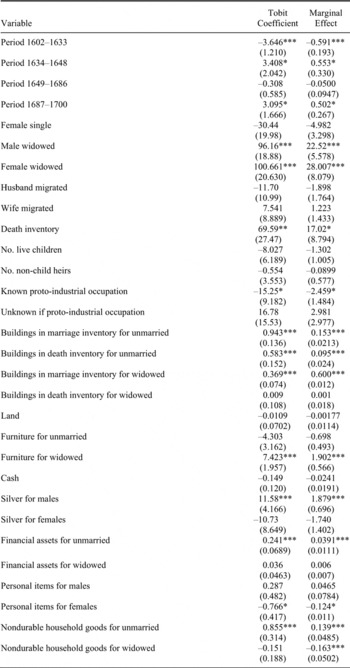
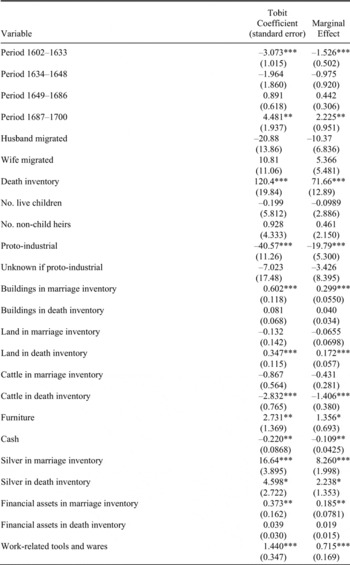
Beginning by estimating the most general model including all independent variables and interaction terms described above, we then excluded a number of variables whose coefficients did not differ significantly different from zero, although we retained some variables whose lack of significance was of analytical interest. The resulting Tobit models are reported in Table 6 (for individuals) and Table 7 (for couples).
TOBIT MODEL OF VALUE OF INDIVIDUALS’ BORROWING, WILDBERG, 1602–1700

∗ significant at the 0.10 level.
∗∗ significant at the 0.05 level.
∗∗∗ significant at the 0.01 level.
Notes:
N = 1,182. Robust standard errors in parentheses. Marginal effect is effect on mean value of dependent variable, assessed at sample mean of all other variables, conditional on dependent variable being positive or zero. Occupations: omitted category is “Known non-proto-industrial occupation.”
Beginning with the analytically interesting variables that failed to manifest the expected link with debt, the regressions showed that migration status was not associated with borrowing. At least in early modern Wildberg, there is no indication that nonlocals who were potentially less integrated into local personalized lending networks borrowed less. Nor was debt linked with numbers of surviving children or heirs, providing no support for the idea that individuals or couples substituted offspring or other kin for financial borrowing.
But a core set of variables showed significant links with borrowing for both individuals and couples: date, proto-industry, inventory type, and value of buildings, financial assets, furniture, and silver. Individual debt was also significantly linked with sex, marital status, land, personal possessions, and nondurable household goods, while couples’ borrowing was significantly linked with stocks of cattle, cash, and work-related tools.
Borrowing changed significantly across the seventeenth century for both individuals and couples. From 1602 to 1634 borrowing fell substantially with each year that passed. It then stalled, with no significant change throughout the entire wartime period (1634–1648) and postwar recovery (1649–1687), before rising again with every year that passed from 1687 to 1700, albeit with borderline significance for individuals. This region of rural central Europe thus fails to show anything like the seventeenth-century expansion of credit described for North Atlantic economies such as England, France, or the Low Countries. That this long financial stagnation may have been linked to the catastrophic economic fallout of the Thirty Years War and the agonizingly slow postwar recovery is supported by micro-studies documenting how the Thirty Years War reduced savings, depressed collateral values, and strangled credit markets in rural Germany.Footnote 87
TOBIT MODEL OF VALUE OF COUPLES’ BORROWING, WILDBERG, 1602–1700

Notes:
N = 638. Otherwise, see the notes for Table 6.
Early modern Wildberg also casts doubt on a second widely held view based primarily on northwest European evidence—that proto-industry intensified rural involvement in credit.Footnote 88 Proto-industrial worsted-weaving was the single most important livelihood in seventeenth-century Wildberg, but it involved less borrowing than average.Footnote 89 Weaving couples had 19.8 fl lower debts than non-weavers, a substantial effect given mean total borrowing of 61 fl, though the effect for individuals was smaller and less significant. Admittedly proto-industrial weavers were significantly poorer than non-weavers, but this cannot explain their lower borrowing since the regressions control for wealth. The pervasive involvement in credit markets in this early modern German society was not driven by some putative commercial precocity among proto-industrial workers—indeed, rather the opposite. The roots of financial activity must be sought elsewhere in this rural economy.
Our earlier findings on the age profile of borrowing are confirmed by the significant link between debt and the life-cycle juncture of the inventory. Borrowing was higher at death (of oneself or one's spouse) than at marriage by 17 fl for individuals (a large difference, given mean individual liabilities of 24 fl) and 71 fl for couples (also striking, given mean couple debts of 61 fl). One contributory factor may have been that decrepitude of a recently deceased individual or spouse swelled the debts in death inventories, although the value of medical and funeral debts in Table 1 is low.Footnote 90 Arguably more important was the early modern economic life cycle already discussed, in which newly married people had not yet amassed wealth and reputation needed to access credit, whereas someone closer to death enjoyed an established position that facilitated borrowing, especially where credit was rationed as in early modern Württemberg.Footnote 91
Life-cycle juncture also influenced how liabilities interacted with assets. Buildings, for instance, were positively associated with borrowing at marriage for both individuals and couples, but at death this was only true for unmarried individuals, not for widows or couples. Silver, too, was positively associated with borrowing for individual males and for couples at marriage, but at death the link for couples had disappeared.Footnote 92 Financial assets, likewise, were positively associated with borrowing for couples at marriage but not at death. These findings show that these core asset types were positively linked with debts for almost all demographic groups, but that although borrowing rose between marriage and death, the link with assets weakened—a result consistent with the argument proposed earlier, concerning the importance of established position and reputation.
Above all, however, the consistently positive link between the value of assets and the value of debts hammers home the fact that borrowing in this early modern economy was not associated with poverty or distress. Rather, it was linked to ownership of the single largest and most important piece of real property (a house and its appurtenances), with precious metals, with financial assets, and with large amounts of valuable furniture (the most durable of household moveables). It seems likely that these very pronounced and consistent links arose from the fact that these asset categories provided collateral to support higher borrowing. Collateral plays a role in most credit markets, but studies of modern developing economies show it to be particularly important for access to credit where, as in Württemberg, legislation prohibits interest rates from being adjusted to reflect the risks of lending.Footnote 93
In this context, it might seem odd that land, which could also be used as collateral, was not consistently associated with higher borrowing—it showed a positive link for couples at death but not otherwise. In the Wildberg context, however, this is not so surprising. Although most Wildberg citizens owned some land, few of them relied on it wholly for their livelihood, whereas almost all needed a building for their secondary- or tertiary-sector by-employment.Footnote 94 On average, individuals owned 46 fl worth of buildings but only 35 fl worth of land; couples owned 120 fl worth of buildings but only 84 fl worth of land. Furthermore, by far the most common type of inventoried building was a Behausung (abode, dwelling), which often included a garden and agricultural infrastructure (barns, stables, sheds, manure racks, etc.). In Wildberg, therefore, buildings typically included some land and exceeded pure land in value, so their greater importance as collateral is hardly surprising. For a locality more dependent on full-time farming, pure land ownership might well play the role that possession of a Behausung did in proto-industrial Wildberg.
The regression findings also show a significant negative link between borrowing and liquid assets—particularly cash (more significant for individuals) and cattle (more important for couples, especially at death). These results mirror findings for economies as diverse as medieval Nürnberg,Footnote 95 sixteenth-century Württemberg,Footnote 96 and early modern England,Footnote 97 where cattle and cash also substituted for borrowing. Thus one function of borrowing in the premodern rural economy was to enable those temporarily short of liquid resources—whether cash or cattle—to smooth consumption and make profitable investments which could not be funded from current assets. This is consistent with the idea that people borrowed to solve cash-flow problems, not because they were fundamentally lacking in assets.
Finally, the effects of gender and marital status on borrowing confirm and intensify the emerging pattern whereby borrowing in this early modern rural economy was associated not with poverty and disadvantage but with more substantial socioeconomic status. Debts were significantly and substantially higher among males than females and among widows than unmarried people. Although spinsters were not totally excluded from the credit market—about 7 percent of them entered marriage with debts—their borrowing was significantly lower than that of bachelors, widows, or widowers. Bachelors in turn had significantly and substantially lower borrowing than widowers—or, indeed, widows. Interestingly, borrowing was more significantly linked with marital status than with gender, as shown by the fact that borrowing did not differ significantly between widowers and widows.
These findings are fully consistent with our rich evidence on the institutional disadvantages suffered by females and unmarried persons in the premodern Württemberg economy.Footnote 98 Females were subject to gender guardianship which hindered them from transacting as independent legal agents.Footnote 99 They were excluded by guilds and other occupational associations from most craft, proto-industrial, commercial and professional occupations.Footnote 100 Despite their equal inheritance rights under the Württemberg partible inheritance system, other institutions caused women's property rights to be less secure than men's.Footnote 101 And females lacked any voice in the powerful community councils that regulated most factor and product markets in rural Württemberg.Footnote 102 All these disadvantages made women poorer and riskier borrowers, deterring lenders. Marital status was also associated with noticeable economic disadvantages in premodern Württemberg, particularly community and guild rules preventing never-married persons from practicing most occupations independently.Footnote 103 Both sets of institutional disadvantages coincided for unmarried females who, when they sought to conduct a livelihood independently outside a household headed by a male relative or master, were pejoratively dubbed Eigenbrötlerinnen (literally, “own-breaders”) and persecuted at the discretion of communal, guild, ecclesiastical, and governmental authorities.Footnote 104 Lower borrowing by females and the unmarried—and lower willingness to lend to them—was rational, given these severe institutional and economic restrictions. The pronounced positive effects of male gender and ever-married status on the value of one's debts provide further confirmation that in this premodern rural economy borrowing was associated with a higher, not a lower, socioeconomic position.
CONCLUSION
What can we conclude from these findings about financial activity in the “less-developed” rural interior of early modern Europe? Württemberg was a relatively undynamic economy compared to Flanders, Holland, England, or many parts of France in the early modern period.Footnote 105 Nonetheless, borrowing was widespread, even in a remote rural community such as Wildberg. Debtors included women and men, poor people and rich ones, young adults and the elderly, those about to marry and those about to die, and persons of all marital statuses. Although few lifelong celibates were inventoried, those who were recorded had all borrowed money, indicating that at least some even of this disadvantaged group had access to credit.Footnote 106 Almost everyone was able to borrow, and could to some extent smooth consumption, finance investments, and diversify risks. In so doing, they enabled other rural people to hold their savings in financial form and diversify their investments.Footnote 107 Württemberg thus resembles many other medieval and early modern European rural societies,Footnote 108 but contrasts sharply with portrayals of modern less-developed economies in which people—especially in rural areas—are constrained to consume what they themselves produce and can only expand production using their own hoarded savings.Footnote 109
Credit markets in seventeenth century Württemberg were also quite variegated. Borrowing was not conducted purely on the basis of personalized relationships, but encompassed a wide range of sources—the state, the community, the church, charitable foundations, hospitals, guilds, and groups of heirs and children in guardianship. Most strikingly, individuals borrowed from each other—a testimony to the savings potential of rural people, even in a relatively slow-growing economy such as this one.
The individuals able and willing to provide credit in early modern Wildberg were also variegated, with the vast majority consisting not of family members or other close associates, but people with whom the borrower had no recorded relationship other than the borrowing itself. Well over one-quarter of borrowing by value was undertaken with creditors outside the local community. Nor does early modern Wildberg show any sign of being dominated by a Dorfkönig (village king) who monopolized local lending: rural Württemberg was teeming with a diversity of lenders, even the largest of whom did not monopolize supply.Footnote 110 This was not the type of rural economy in which borrowing takes place only through highly personalized relationships or where lending is monopolized by a dominant village moneylender who can charge ruinously high interest rates and keep peasants in “debt peonage” because he has no competitors.Footnote 111
Within this reasonably diversified Württemberg credit market, people behaved in ways consistent with the basic economic hypotheses with which this article began. Debt was not an indicator of distress or crisis, but rather was higher for the owners of buildings, silver, and other durable and valuable assets, for males, for those who had achieved the married state, for substantial couples in middle life, and for other relatively well-off groups such as those in non-proto-industrial occupations. Associated as it was with economic substance rather than impoverishment, borrowing rarely meant economic ruin or even the “overindebtedness” criticized by medieval and early modern elites and lamented by some modern historians.Footnote 112
The positive economic role played by borrowing is confirmed by the composition of inventoried debts. Borrowing made it possible to smooth consumption over time, funding necessities and enabling minor discretionary spending on clothing, medical care, weddings, and funerals, although there is no sign that it financed a rural Consumer Revolution. Borrowing also enabled people to smooth payment of the rising burden of taxes extorted by the expanding early modern state. But above all, borrowing facilitated profitable investments, enabling farmers to purchase land and animals, employers to pay servants and laborers, and rural artisans to finance the delay between buying inputs and selling industrial goods. In short, credit markets made markets in land, labor, and output work better. The ubiquitous borrowing we observe in seventeenth-century Wildberg played a positive role in enabling people to survive as well as they did.
But credit in early modern Württemberg also—unsurprisingly—had a darker side. For one thing, access to the credit market—like all economic dealings in rural Württemberg—was supervised and regulated to an extraordinary degree, and formal borrowing was not possible without the favor of one's communal council and the local state officials. Secondly—and possibly partly as a consequence of this strong communal and governmental surveillance—borrowing was associated with substantial socioeconomic status to a very pronounced degree. This meant that if you were female, never-married, very young, very old, propertiless, or proto-industrial, it could be difficult to obtain credit.Footnote 113 The 5 percent interest rate ceiling enforced by the Württemberg state was significantly lower than legal ceilings (or actual interest rates charged) in seventeenth-century England, Flanders, or Holland, and was probably inappropriately low for the Württemberg economy in the seventeenth century, as shown by the evidence that poor borrowers sought to borrow in the black market at implicit interest rates that violated the rate ceiling.Footnote 114 As in modern developing economies, the low interest rate ceiling in early modern Württemberg probably rationed credit to higher-risk borrowers such as women, young adults, the elderly, the poor, and the propertiless, pushing them into the informal sector where they were exposed to greater exploitation.Footnote 115
Nor does the credit market in early modern Württemberg appear to have been as extensive or variegated as that of many North Atlantic economies or to show any sign of becoming more impersonal, intermediated, or formal over the seventeenth century. In the early modern Netherlands, for instance, inventories even of poor families record borrowing from pawnshops and in the formal credit markets of the public debt, financial mechanisms never mentioned in inventories for early modern Wildberg.Footnote 116 During a century in which English, Dutch, Flemish, and French credit markets enjoyed a growing impersonality and sophistication which extended into the countryside, in Wildberg the proportion of extra-familial or extra-communal borrowing did not observably increase.
Finally, the debts recorded in Wildberg inventories do not manifest the degree or sophistication of documentary support observed in England, France, Flanders, or Holland at the same period. Most forms of debt documentation mentioned for these ordinary German artisans and farmers were generated by bureaucratic accounts, official registers, or public administration of the inheritance system. Inventories recorded hardly any credit market-specific documents hinting at formal or negotiable financial instruments. This is not surprising, given Württemberg legislation requiring ordinary people to obtain communal or state permission before borrowing money even on bonds, let alone on more sophisticated credit instruments. Whether the institutional arrangements observed in this early modern German economy offered mechanisms for smoothing economic decisions and managing risks that (despite their differences) were as effective as those in the North Atlantic economies, or whether these differences alternatively contributed to slower German growth and development, constitutes a challenge for future comparative research.