1. Introduction
It is well known that the mantle is heterogeneous in composition and encompasses several end-members in terms of Sr, Nd and Pb isotopes (e.g. White, Reference White1985; Zindler & Hart, Reference Zindler and Hart1986). In active continental margin, fluid or melt released from subducted sediments or seawater-altered oceanic crust could significantly modify the lithospheric mantle and participate in the generation of subduction-related magma (e.g. McCulloch et al. Reference McCulloch, Jaques, Nelson and Lewis1983; Vroon et al. Reference Vroon, Bergen, Klaver and White1995; Bailey, Reference Bailey1996; Plank & Langmuir, Reference Plank and Langmuir1998; Elliott, Reference Elliott and Eiler2003; Bouvier, Métrich & Deloule, Reference Bouvier, Métrich and Deloule2008). Consequently, the mantle in a subduction setting is dominated by three end-members: depleted mantle (DM) with low 87Sr/86Sr and high 143Nd/144Nd ratios; enriched mantle 1 (EM1) with low 87Sr/86Sr and low 143Nd/144Nd ratios; and enriched mantle 2 (EM2) with high 87Sr/86Sr and low143Nd/144Nd ratios. Accordingly, the subduction-related igneous rocks have highly varied Sr–Nd isotopic compositions and usually show a DM–EM1 or a DM–EM2 trend on a Sr–Nd isotope variation diagram (e.g. Kelemen, Hanghøj & Greene, Reference Kelemen, Hanghøj, Greene, Rudnick, Holland and Turekian2003).
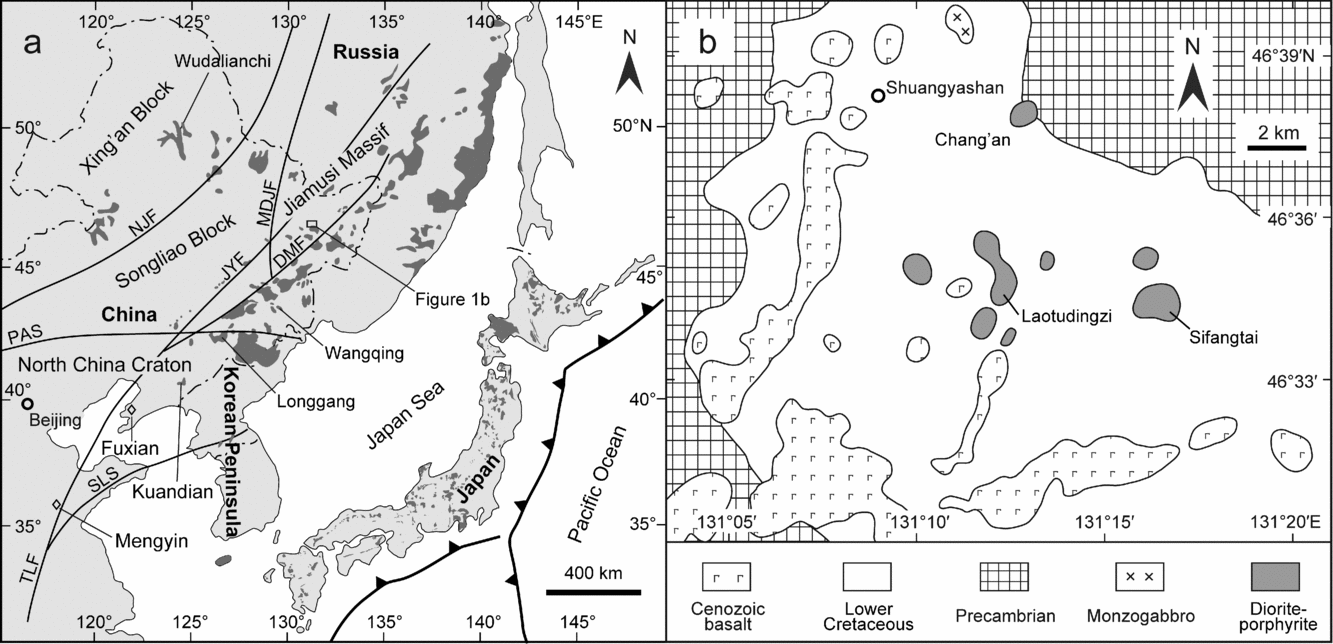
Northeast China (Fig. 1a) on the eastern Eurasian continent has long been an active continental margin since Early Mesozoic time (e.g. Wang & Mo, Reference Wang and Mo1995; Maruyama et al. Reference Maruyama, Isozaki, Kimura and Terabayashi1997), characterized by large volumes of Mesozoic–Cenozoic igneous rocks (e.g. Liu, Han & Fyfe, Reference Liu, Han and Fyfe2001; Wu et al. Reference Wu, Lin, Wilde, Zhang and Yang2005a, Reference Wu, Sun, Ge, Zhang, Grant, Wilde and Jahn2011). Previous Sr–Nd isotope studies on these igneous rocks have clearly recognized the DM end-member, as represented by the peridotite xenoliths from Wangqing (e.g. Xu et al. Reference Xu, Menzies, Vroon, Mercier and Lin1998) and the EM1 end-member defined by the Cenozoic basalts from Wudalianchi (e.g. Basu et al. Reference Basu, Wang, Huang, Xie and Tatsumoto1991; Zhang et al. Reference Zhang, Suddaby, Thompson, Thirlwall and Menzies1995; Fan, Sui & Liu, Reference Fan, Sui and Liu2001; Zou et al. Reference Zou, Reid, Liu, Yao, Xu and Fan2003). In addition, many peridotite xenoliths and Cenozoic basalts from Northeast China have higher 87Sr/86Sr ratios than EM1, indicating the possible presence of EM2, and its formation may be related to the subduction of the palaeo-Pacific and Pacific plates beneath the eastern Eurasian continent (Basu et al. Reference Basu, Wang, Huang, Xie and Tatsumoto1991; Tatsumoto et al. Reference Tatsumoto, Basu, Huang, Wang and Xie1992; Xu et al. Reference Xu, Menzies, Vroon, Mercier and Lin1998; Chen, Hsu & Ho, Reference Chen, Hsu and Ho2003; Choi et al. Reference Choi, Mukasa, Kwon and Andronikov2006). However, the location and the Sr–Nd isotopic characteristics of EM2 have been poorly constrained. In this study, we report the Sr–Nd isotopic compositions of the Late Cretaceous Shuangyashan suite, comprising a monzogabbro and diorite–porphyrite stocks and their hornblendite enclaves; convincingly demonstrate the presence of EM2 in Northeast China; delimit the Sr–Nd isotopic compositions of EM2; and discuss the relationship between EM2 and cycling of the subducted continental material.
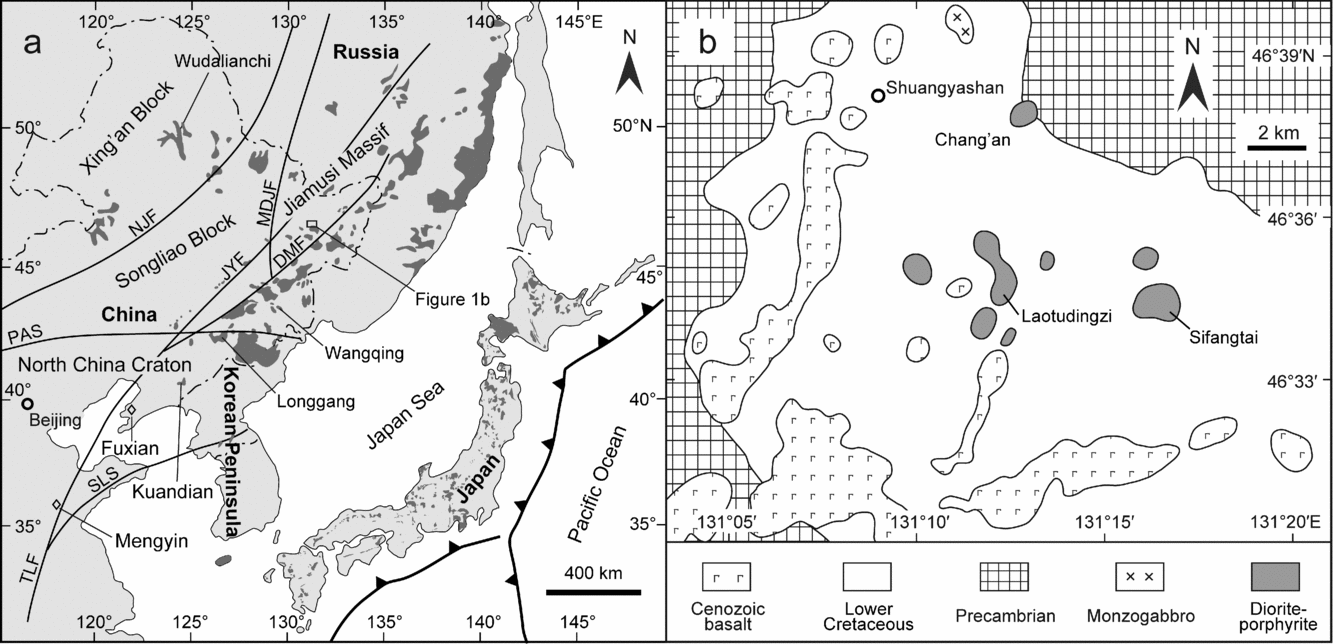
(a) Simplified map showing the major units, faults and distribution of Cenozoic basalts (dark grey areas) in Northeast Eurasia and the approximate location of (b). Diamonds show the locations of Fuxian and Mengyin peridotite xenoliths from the eastern North China Craton. DMF – Dunmi Fault, JYF – Jiayi Fault, MDJF – Mudanjiang Fault, NJF – Nenjiang Fault, PAS – palaeo-Asian Suture, SLS – Sulu Suture, TLF – Tanlu Fault. (b) Sketch map showing the locations of the monzogabbro and hornblendite enclave-bearing diorite–porphyrite stocks in the Shuangyashan coal basin.
2. Geological setting
Northeast China comprises several blocks, including the Palaeozoic Xing'an Block, Songliao Block and the Precambrian Jiamusi Massif from west to east (Fig. 1a). The evolution of Northeast China has involved the palaeo-Asian Ocean from Late Palaeozoic to Early Mesozoic time and the Mongol-Okhotsk Ocean from Early Mesozoic to Late Mesozoic time, followed by the subduction of the palaeo-Pacific and Pacific plates from Early Mesozoic time (e.g. Wang & Mo, Reference Wang and Mo1995; Zhao et al. Reference Zhao, Peng, Dang and Zhang1996; Li et al. Reference Li, Zhang, Yang, Li, Sun, Zhu and Wang2009; Wu et al. Reference Wu, Sun, Ge, Zhang, Grant, Wilde and Jahn2011). The long history has been accompanied by widespread development of voluminous Late Palaeozoic and Mesozoic plutons (e.g. Wu et al. Reference Wu, Jahn, Wilde and Sun2000, Reference Wu, Lin, Wilde, Zhang and Yang2005a, Reference Wu, Sun, Ge, Zhang, Grant, Wilde and Jahn2011; Zhang et al. Reference Zhang, Wu, Wilde, Zhai, Lu and Sun2004; Xu et al. Reference Xu, Pei, Gao, Yang and Bu2008) and Cenozoic basalts (e.g. Hsu & Chen, Reference Hsu and Chen1998; Liu, Han & Fyfe, Reference Liu, Han and Fyfe2001; Zhang et al. Reference Zhang, Feng, Li, Li, Xin, Li and Wang2002; Chen et al. Reference Chen, Zhang, Graham, Su and Deng2007; Fig. 1a).
Since Early Cretaceous time, the eastern part of Northeast China had been an active continental margin (e.g. Meng & Zhou, Reference Meng and Zhou1996; Maruyama et al. Reference Maruyama, Isozaki, Kimura and Terabayashi1997; Taira, Reference Taira2001) before the opening of the Sea of Japan in Miocene time (Otofuji & Matsuda, Reference Otofuji and Matsuda1983, Reference Otofuji and Matsuda1984; Horikoshi, Reference Horikoshi1990; Jolivet, Tamaki & Fournier, Reference Jolivet, Tamaki and Fournier1994) and in a back-arc setting after the opening of the Sea of Japan (e.g. Wang & Mo, Reference Wang and Mo1995; Liu, Han & Fyfe, Reference Liu, Han and Fyfe2001), during which a few Cretaceous coal basins occur in the eastern part of Northeast China, including the Shuangyashan coal basin on the Jiamusi Massif (HBGMR, 1993). The Shuangyashan basin is underlain by the Precambrian Mashan complex, which consists of amphibole schist and gneiss and underwent Middle to Late Cambrian metamorphism (e.g. Song et al. Reference Song, Li, Niu and Xu1997; Li et al. Reference Li, Niu, Song, Xu, Zhang and Zhao1999; Wilde, Zhang & Wu, Reference Wilde, Zhang and Wu2000). The metamorphic basement is unconformably covered by the Lower Cretaceous coal-bearing Chengzihe and Muling formations, which are dominated by sandstone, mudstone and minor tuff, with abundant coal beds (HBGMR, 1993). These coal-bearing sequences are unconformably overlain by the Miocene basalts (Fig. 1b).
In the Shuangyashan basin, the Lower Cretaceous coal-bearing sequences (HBGMR, 1993) are intruded by a suite of Late Cretaceous intrusions, including one monzogabbro and eight diorite–porphyrite stocks. These intrusions are small in size (0.4–5 km2). The monzogabbro is coeval with the diorite–porphyrites (HBGMR, 1993), and its zircon SHRIMP U–Pb age is 98 ± 2 Ma (Zhang et al. Reference Zhang, Han, Zhu, Xu, Chen and Song2009). All the diorite–porphyrite stocks contain variable numbers of cumulate hornblendite enclaves, but large-size enclaves are only present in the Sifangtai intrusion.
Petrologically, the monzogabbro is massive and holocrystalline, showing a typical poikilitic texture (Zhang et al. Reference Zhang, Han, Zhu, Xu, Chen and Song2009). Olivine, clinopyroxene, orthopyroxene, plagioclase, biotite and ilmenite are chadacrysts, while K-feldspar is oikocryst. The diorite–porphyrites are massive and have a porphyritic texture (Zhang et al. Reference Zhang, Han, Wei and Shu2011). The matrix is composed of very fine-grained anhedral plagioclase and amphibole, and the phenocrysts comprise fine- to medium-grained plagioclase. Medium- to coarse-grained amphibole is also present in the diorite–porphyrites. It is pargasitic in composition, similar to that in the cumulate hornblendite enclaves, and often has embayed rims. This mineral is supposed to be a xenocryst derived from fragmented cumulate hornblendites (Zhang et al. Reference Zhang, Han, Wei and Shu2011). The hornblendite enclaves show a typical cumulate texture: pargasitic amphibole and minor clinopyroxene are cumulus, whereas anorthitic plagioclase (An > 85 mol.%) is intercumulus. Rare biotite and ilmenite are present in the enclaves. Based on their mineralogy and element geochemistry, the enclaves are proposed to be derived from layered cumulate hornblendites in the crust–mantle transition zone, which may have crystallized from hydrous basaltic magma (Zhang et al. Reference Zhang, Han, Wei and Shu2011).
3. Samples and analytical methods
Most samples were collected from quarries and three (07LTDZ02, 07LTDZ04 and 07LTDZ06) were from a prospecting trench. Diorite–porphyrite and hornblendite enclave samples were mainly collected from the Sifangtai, Laotudingzi and Chang'an intrusions.
In this study, 9 samples were analysed for major oxide content and 16 for trace element concentration. Twenty-two whole-rock samples as well as K-feldspar and clinopyroxene separates from two monzogabbro samples (05SYS1 and 05SYS2) were analysed for Sr–Nd isotopic compositions. In particular, in the powder preparation for the diorite–porphyrite samples, amphibole xenocrysts were carefully removed.
Major oxide contents of whole-rock samples were determined by X-ray fluorescence (XRF) (ARL ADVANTXP+) on fused glass discs at the Ministry of Education Key Laboratory of Orogenic Belts and Crustal Evolution, Peking University in Beijing. USGS standard BCR-2 and Chinese national standard GSR-3 were used to monitor the analytical process.
Trace element concentration analyses were performed at the State Key Laboratory of Continental Dynamics, Northwest University in Xi'an, China. Samples were dissolved in acid and their trace element concentrations were measured by inductively coupled plasma mass spectrometry (ICP-MS) (Elan 6100 DRC). International standard samples BHVO-1 and AVG-1 were used to monitor the analytical process. The precision is better than 5%. The accuracy, indicated by relative difference between measured and recommended values, is better than 2% for most of the trace elements. The analytical procedure was detailed by Rudnick et al. (Reference Rudnick, Gao, Ling, Liu and McDonough2004).
Sr–Nd isotopic analyses were done at the Isotopic Laboratory of the Institute of Geology and Geophysics, Chinese Academic of Science, Beijing. Sr and Nd were separated using a routine two-column ion exchange technique: one column for separation of light rare earth elements (LREEs) (1 × 8 cm, packed with Bio-Rad AG50×8, 200–400 mesh resin), and the other for purification of Nd (0.6 × 7 cm) was packed with Kel-F Teflon powder coated with an exchange medium of HDEHP. Procedural blanks were < 500 pg for Sr and < 100 pg for Nd. Sr and Nd isotopic analyses were performed on a Finnigan MAT-262 multi-collector mass spectrometer in static mode for Sr and in dynamic mode for Nd. During Sr–Nd isotopic analyses, NBS-987 Sr and JNdi Nd standards yielded 87Sr/86Sr = 0.710244 ± 0.000008 (n = 12) and 143Nd/144Nd = 0.512119 ± 0.000005 (n = 11), respectively, and BCR-2 gave 87Sr/86Sr = 0.705012 ± 0.000016 (n = 5) and 143Nd/144Nd = 0.512645 ± 0.000016 (n = 5). The measured 87Sr/86Sr and 143Nd/144Nd ratios were normalized to 86Sr/88Sr = 0.1194 and 146Nd/144Nd = 0.7219, respectively. The analytical procedures for Sr–Nd isotopes are the same as those described by Wu et al. (Reference Wu, Yang, Wilde and Zhang2005b).
4. Results
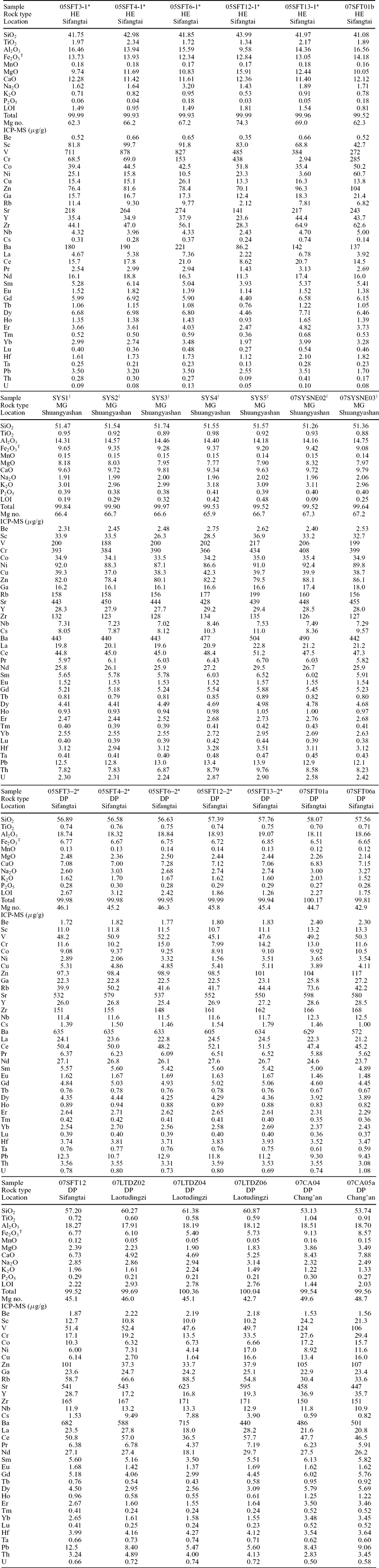
Only one hornblendite enclave has been analysed for major oxide contents and trace element concentrations in this study (Table 1). It shows similar geochemistry to the Group 2 enclaves as reported in Zhang et al. (Reference Zhang, Han, Wei and Shu2011). Three of eight diorite–porphyrite samples are from the Sifangtai intrusion and their major oxide contents and trace element concentrations are in good accordance with those previously reported by Zhang et al. (Reference Zhang, Han, Wei and Shu2011). Only trace element concentrations and Sr–Nd isotopic compositions of the monzogabbro are analysed in this study, and their major oxide contents were recently reported by Zhang et al. (Reference Zhang, Han, Zhu, Xu, Chen and Song2009). All the data presented in this study and earlier papers (Zhang et al. Reference Zhang, Han, Zhu, Xu, Chen and Song2009, Reference Zhang, Han, Wei and Shu2011) are combined together to characterize the Shuangyashan suite in the following sections.
Major oxide and trace element concentrations of Shuangyashan hornblendite enclaves, monzogabbro and diorite–porphyrites
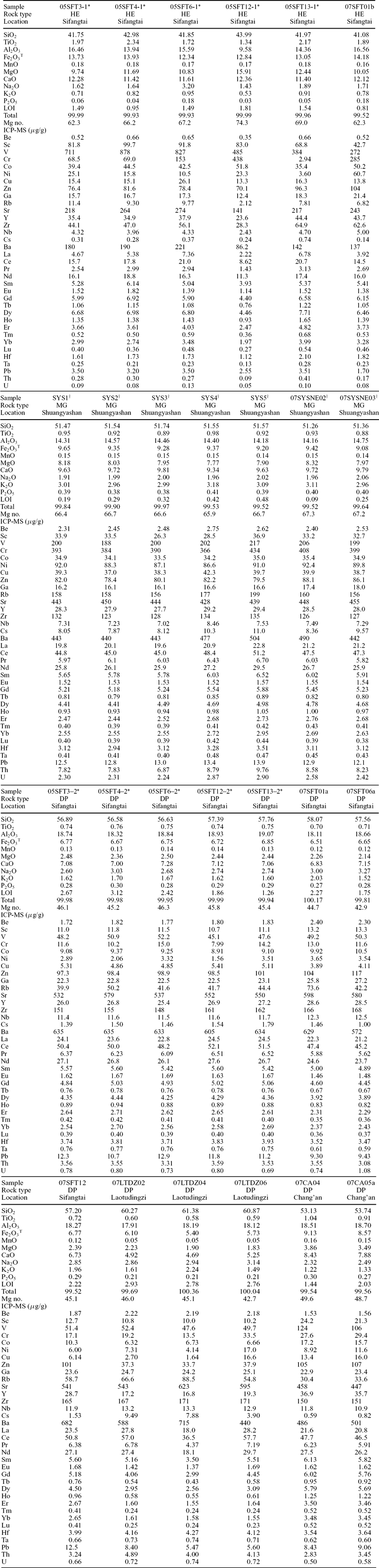
Mg no. = 100 × Mg/(Mg + Fe2+); Abbreviations: HE – hornblendite enclave; MG – monzogabbro; DP – diorite–porphyrite.
* Major oxides and trace element data from Zhang et al. (Reference Zhang, Han, Wei and Shu2011).
† Major oxides data of the monzogabbro from Zhang et al. (Reference Zhang, Han, Zhu, Xu, Chen and Song2009).
4.a. Major oxides
The hornblendite enclaves (Table 1) are characterized by low SiO2 (41.08–43.99 wt%) and high MgO (9.74–15.91 wt%), CaO (11.40–12.36 wt%) and TiO2 (1.34–2.34 wt%). Total alkali contents (Na2O + K2O) and Mg no. (= 100 × Mg/(Mg + Fe2+)) of the hornblendite enclaves vary in the range of 1.96–4.15 wt% and 62.3–74.3, respectively.
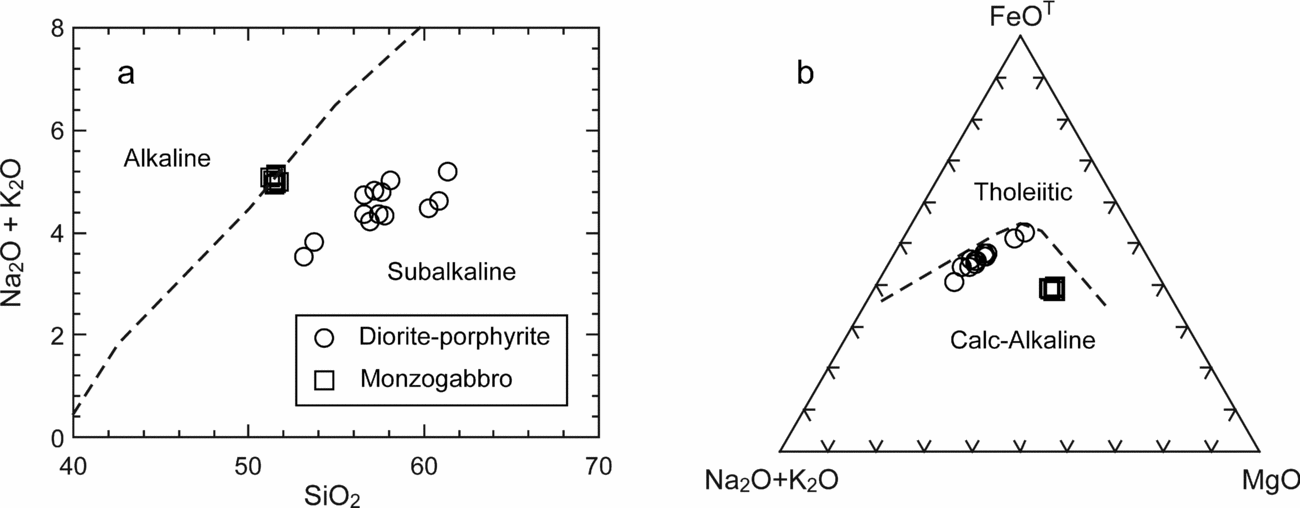
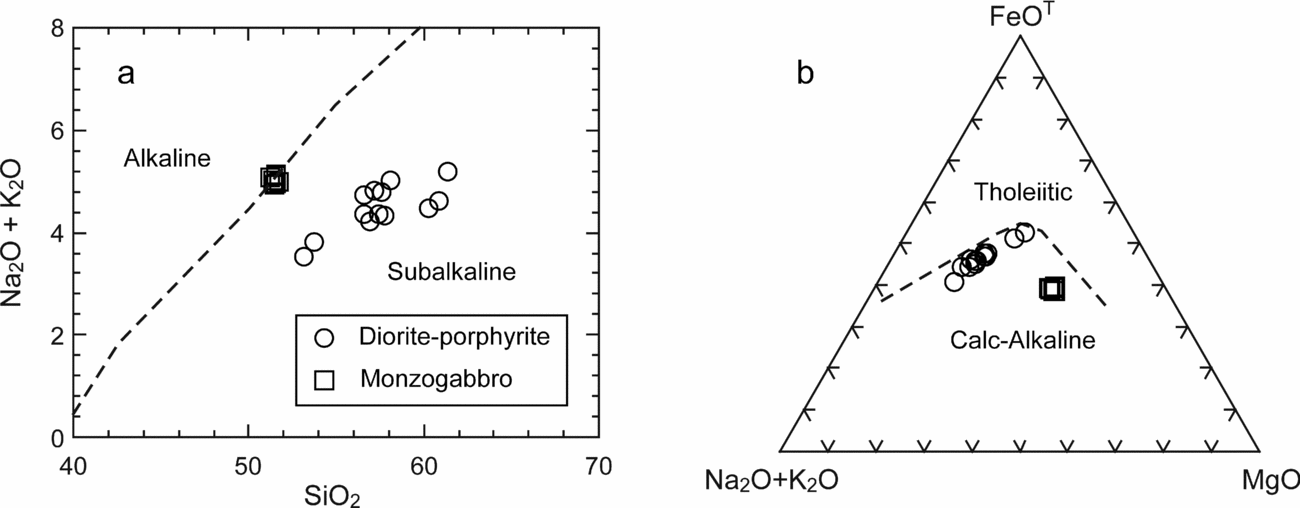
The monzogabbro and diorite–porphyrites are subalkaline (Fig. 2a) and calc-alkaline (Fig. 2b). The monzogabbro shows narrow variations in major oxide contents (SiO2 = 51.26–51.74 wt%, Al2O3 = 14.16–14.75 wt%, Na2O = 1.91–2.06 wt%, K2O = 2.96–3.18 wt%, MgO = 7.77–8.32 wt%) and high Mg no. (65.9–67.3) and total alkali contents (4.92–5.14 wt%) (Table 1). The diorite–porphyrites have higher SiO2 (53.13–61.38 wt%) and Al2O3 (17.91–19.07 wt%) and lower MgO (1.83–3.86 wt%), Fe2O3T (5.40–9.13 wt%) and Mg no. (42.7–49.6) than the monzogabbro, and their CaO, Na2O and K2O and total alkali contents vary in the ranges of 4.69–8.43 wt%, 2.32–3.27 wt%, 1.22–2.24 wt% and 3.54–5.18 wt%, respectively. Among the three diorite–porphyrite intrusions, the Chang'an intrusion has the highest MgO (3.49–3.86 wt%), Fe2O3T (8.57–9.13 wt%), TiO2 (0.91–1.04 wt%), CaO (7.88–8.43 wt%) and Mg no. (48.7–49.6) and the lowest SiO2 (53.13–53.74 wt%), Na2O (2.32–2.49 wt%) and K2O (1.22–1.33 wt%), whereas the Laotudingzi intrusion has the highest SiO2 (60.27–61.38 wt%) and the lowest TiO2 (0.58–0.60 wt%), Fe2O3T (5.40–6.10 wt%) and CaO (4.69–5.25 wt%) contents.
(Na2O + K2O)–SiO2 (a) and (Na2O + K2O)–FeOT–MgO (b) diagrams for the monzogabbro and diorite–porphyrites of the Shuangyashan suite, showing that the monzogabbro and diorite–porphyrites are calc-alkaline rocks. Data from Table 1 and Zhang et al. (Reference Zhang, Han, Zhu, Xu, Chen and Song2009, Reference Zhang, Han, Wei and Shu2011). Boundary between tholeiitic and calc-alkaline is from Irvine & Baragar (Reference Irvine and Baragar1971).
4.b. Trace elements
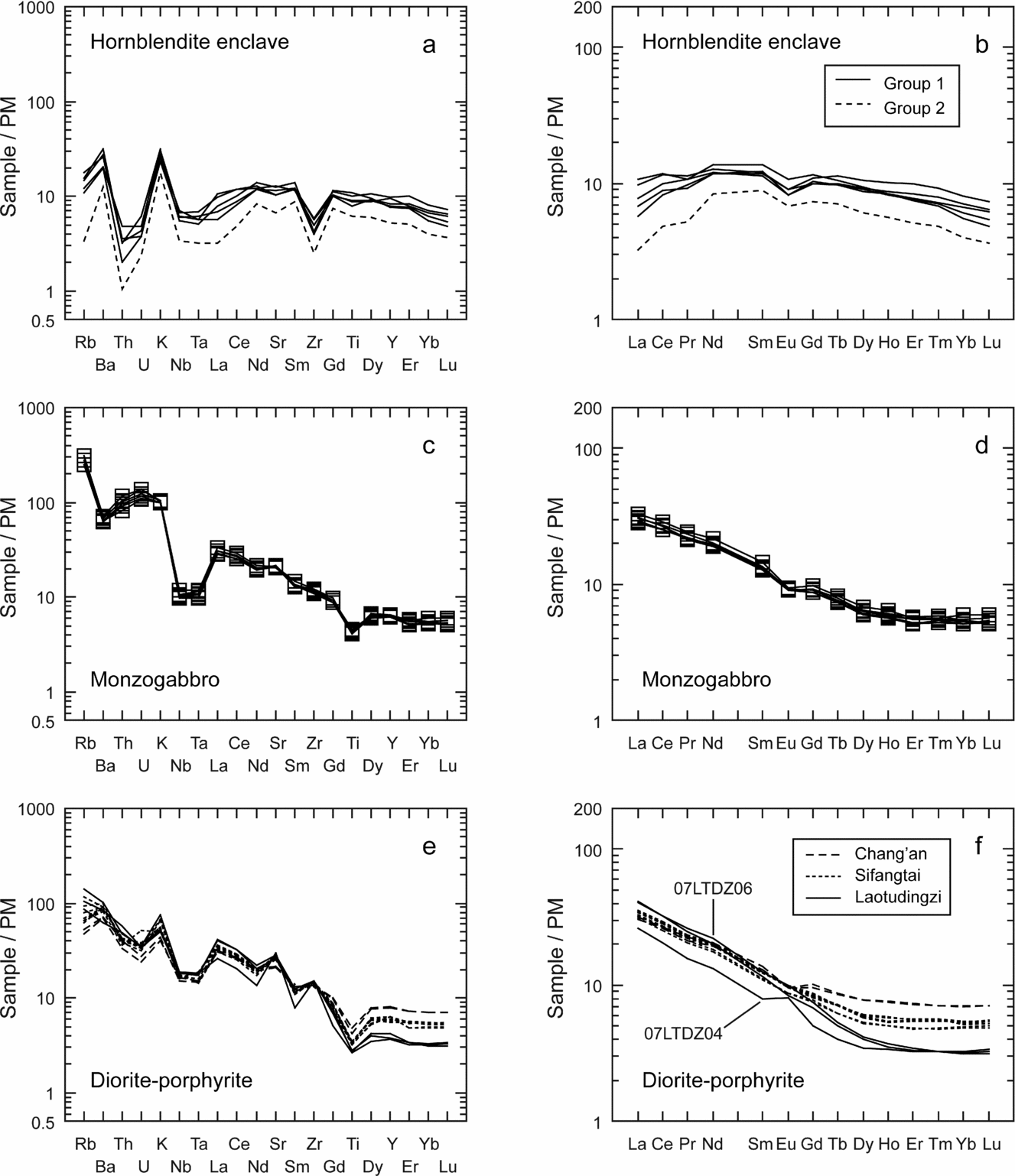
The hornblendite enclaves exhibit weak Nb and Ta negative anomalies, consistent U, Zr and Hf negative anomalies, and Ba and K positive anomalies (Fig. 3a). The enclaves show convex primitive mantle-normalized REE patterns (Fig. 3b), with weak Eu negative anomalies ((Eu/*Eu)N = 0.73–0.85) and no obvious REE fractionations ((La/Yb)N = 0.81–1.52).
Primitive mantle (PM) normalized trace element and REE patterns of the hornblendite enclaves (a & b), monzogabbro (c & d), and diorite–porphyrite (e & f). Data from Table 1 and Zhang et al. (Reference Zhang, Han, Wei and Shu2011). Normalization values are from Sun & McDonough (Reference Sun, McDonough, Saunders and Norry1989).

The monzogabbro shows little variation in trace element concentrations (Table 1). It is characterized by enriched large-ion lithophile elements (LILEs) with respect to high-field-strength elements (HFSEs), with striking Nb, Ta and Ti negative anomalies and a weak Rb positive anomaly (Fig. 3c). The monzogabbro has Nb/U, Ce/Pb, Zr/Nb, Ba/Th, Th/La and Ba/La ratios of 2.60–3.18, 3.46–3.91, 15.8–18.2, 51.6–64.5, 0.35–0.43 and 20.8–23.1, and shows enriched light rare earth elements (LREEs) with respect to heavy rare earth elements (HREEs), with (La/Yb)N = 5.51–5.78 (Fig. 3d) and (Eu/*Eu)N = 0.78–0.86.
The diorite–porphyrites are generally characterized by enriched LILEs relative to HFSEs, with Nb, Ta and Ti negative anomalies as well as a slight Sr positive anomaly (Fig. 3e). Except for 07LTDZ04, other diorite–porphyrite samples show similar LILE, LREE and HFSE but different HREE concentrations (Fig. 3e, f). The Chang'an intrusion has the highest HREE concentrations and the lowest REE fractionation ((La/Yb)N = 4.33–4.45), whereas the Laotudingzi intrusion has the lowest HREE concentrations and the highest REE fractionation ((La/Yb)N = 8.18–13.06). Two samples (07LTDZ04 and 07LTDZ06) from the Laotudingzi intrusion have slight Eu positive anomalies ((Eu/*Eu)N = 1.30 and 1.05, respectively), samples from the Chang'an intrusion exhibit weak Eu negative anomalies ((Eu/*Eu)N = 0.82–0.86) and those from the Sifangtai intrusion show negligible Eu negative anomalies ((Eu/*Eu)N = 0.93–1.00). Generally, the three diorite–porphyrite intrusions have Nb/U and Ce/Pb ratios of 11.6–23.6 and 3.74–10.3.
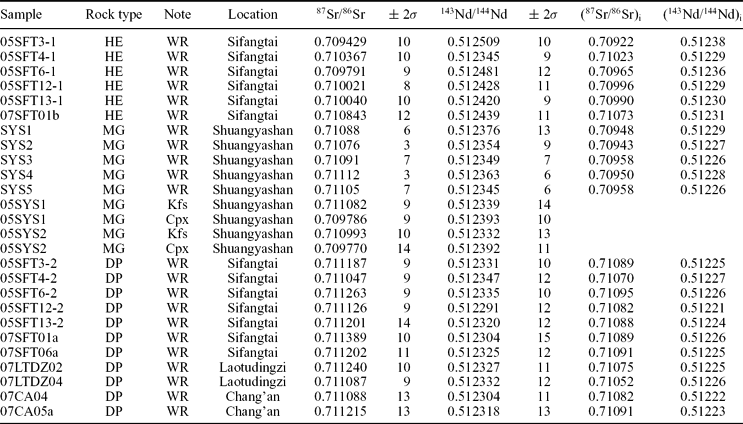
4.c. Sr–Nd isotopes
All the samples are characterized by high 87Sr/86Sr and low 143Nd/144Nd ratios (Table 2). In particular, the K-feldspar and clinopyroxene separates from the monzogabbro have the same Sr–Nd isotopic compositions as the whole-rock samples (Table 2). Samples from the three diorite–porphyrite intrusions show consistent Sr–Nd isotopic compositions (Table 2). After age correction, the monzogabbro and diorite–porphyrites have the same initial 143Nd/144Nd ratios at 98 Ma: 0.51226–0.51229 for the monzogabbro and 0.51221–0.51227 for the diorite–porphyrites, respectively. However, the diorite–porphyrites have slightly higher initial87Sr/86Sr ratios (0.71052–0.71095) than the monzogabbro (0.70943–0.70958). Comparatively, the hornblendite enclaves display relatively large variations in their initial 87Sr/86Sr and 143Nd/144Nd ratios: 0.70922–0.71073 and 0.51229–0.51238, respectively, covering the ranges of initial 87Sr/86Sr and 143Nd/144Nd ratios of the monzogabbro and diorite–porphyrites.
Sr–Nd isotope analysis results for Shuangyashan hornblendite enclaves, monzogabbro, diorite–porphyrites and separates of K-feldspar and clinopyroxene from the monzogabbro
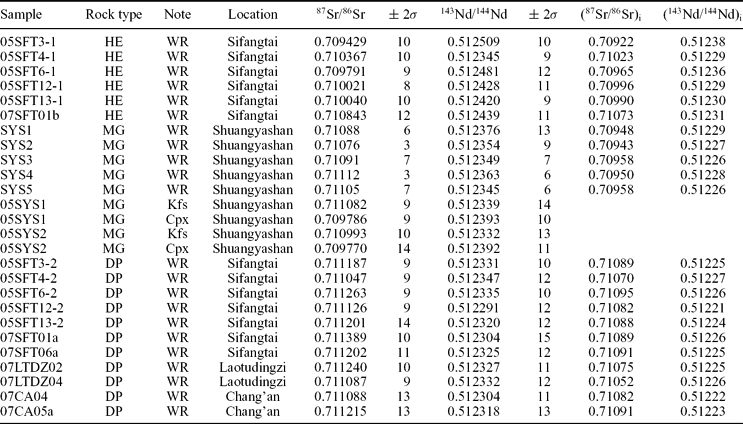
In initial 87Sr/86Sr and 143Nd/144Nd calculation, 87Rb/86Sr and 147Sm/144Nd values were calculated from Rb, Sr, Sm and Nd concentrations of whole-rock samples measured by ICP-MS as reported in Table 1 and Zhang et al. (Reference Zhang, Han, Wei and Shu2011). Abbreviations: HE – hornblendite enclave; MG – monzogabbro; DP – diorite–porphyrite; WR – whole rock; Kfs – K-feldspar; Cpx – clinopyroxene.
5. Discussion
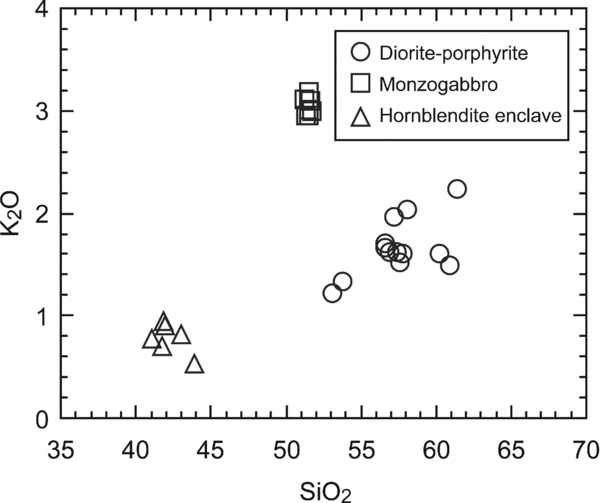
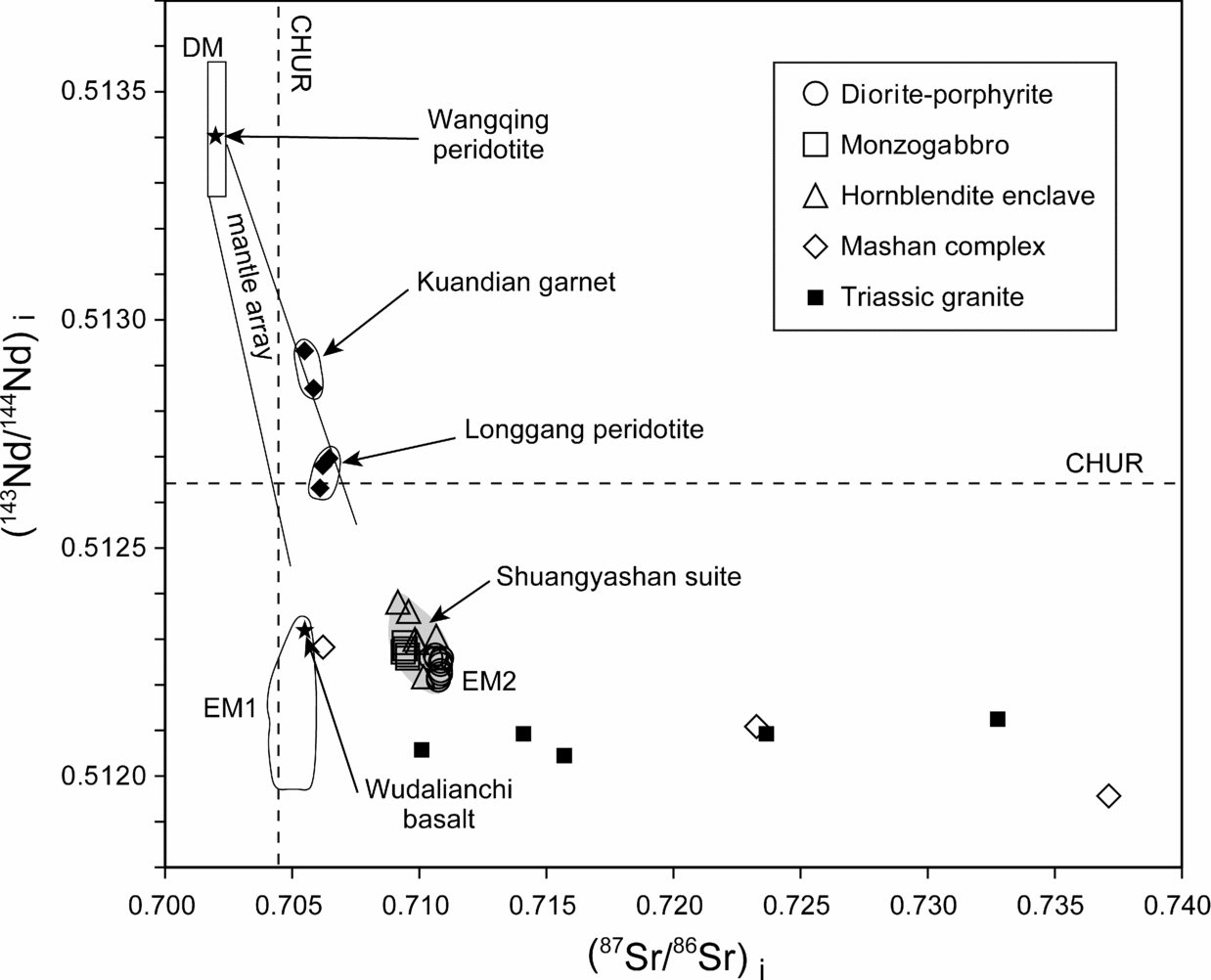
Although the Shuangyashan suite comprises three different types of rocks, these rocks are commonly characterized by high initial 87Sr/86Sr and low initial 143Nd/144Nd ratios (Table 2), and they do not show a common evolution trend (Fig. 4), indicating that they may have crystallized from different parental magmas or been affected by crustal contamination and post-magmatic processes.
K2O–SiO2 diagram showing that the monzogabbro, diorite–porphyrites and hornblendite enclaves of the Shuangyashan suite may have crystallized from different parental magma. Data from Table 1 and Zhang et al. (Reference Zhang, Han, Zhu, Xu, Chen and Song2009, Reference Zhang, Han, Wei and Shu2011).

5.a. Evaluation of crustal contamination and post-magmatic processes
It is known that crustal contamination and post-magmatic processes may have resulted in great geochemical and isotopic differences between igneous rocks and their parental magmas (e.g. Glazner & Farmer, Reference Glazner and Farmer1992; Foland, Gibb & Henderson, Reference Foland, Gibb and Henderson2000; Barry, Saunders & Kempton, Reference Barry, Saunders and Kempton2003; Katzir et al. Reference Katzir, Litvinovsky, Jahn, Eyal, Zanvilevich, Valley, Vapnik, Beeri and Spicuzza2007). Hence, it is very important to evaluate whether the monzogabbro and diorite–porphyrites have been affected by crustal contamination and post-magmatic processes.
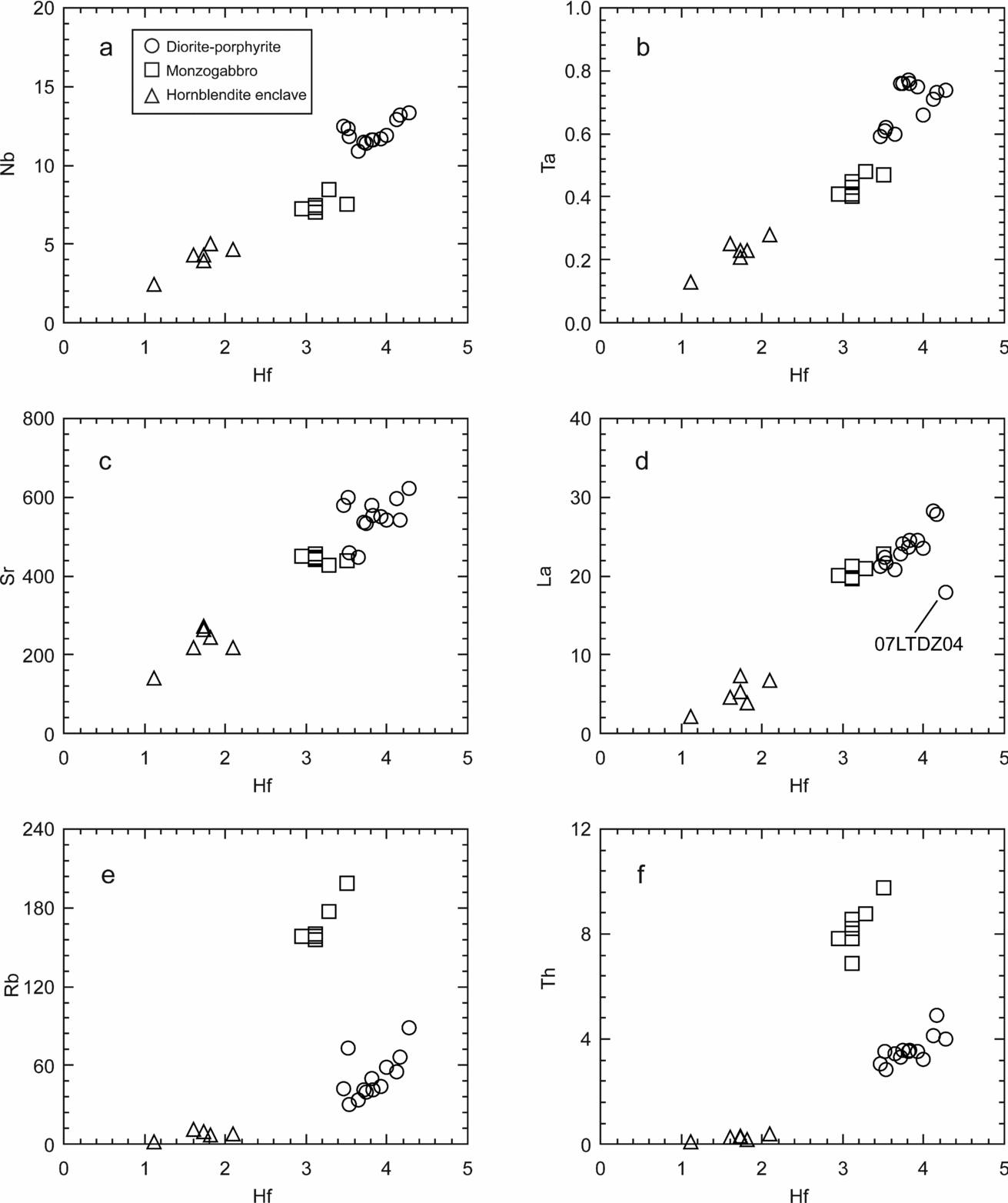
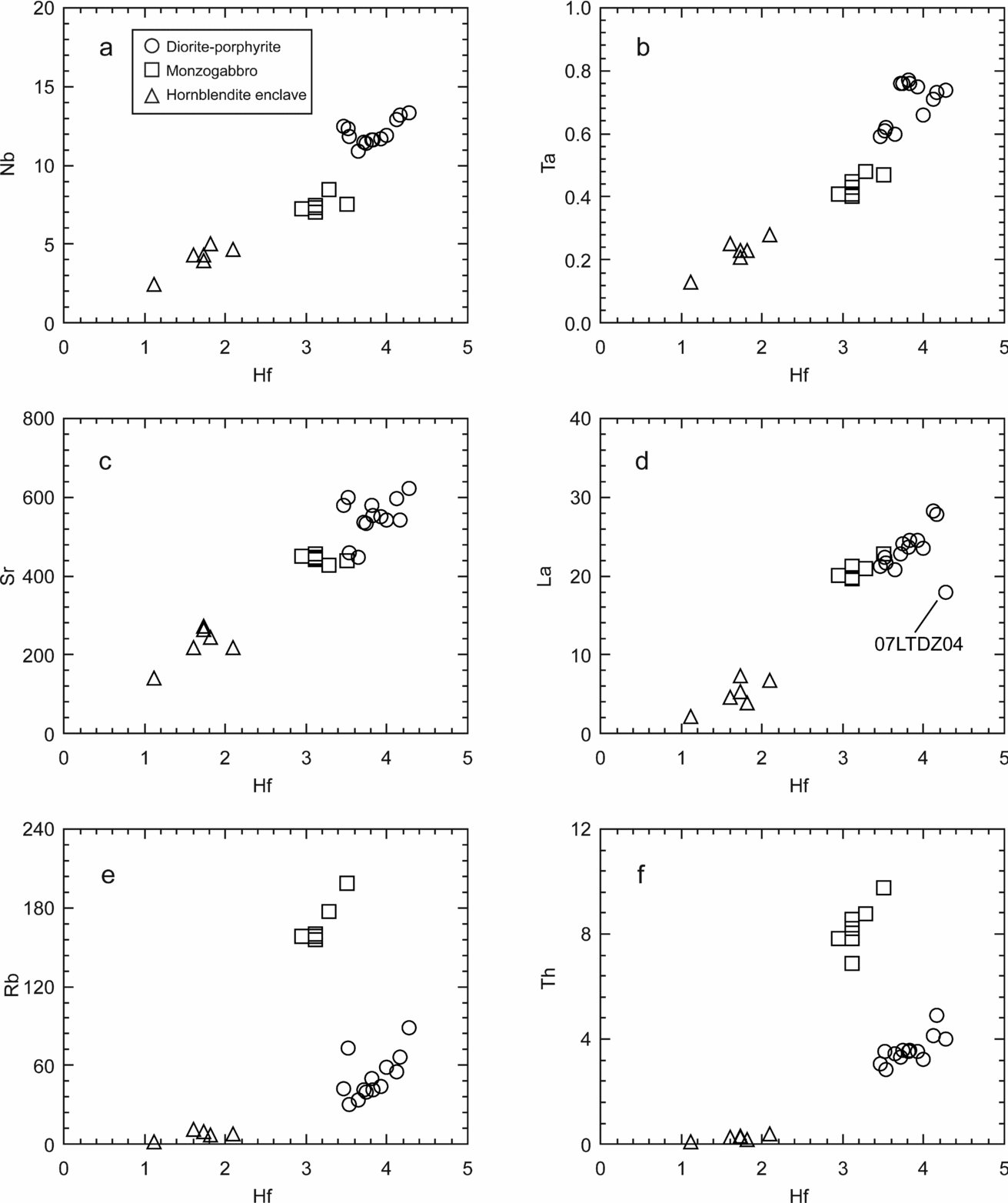
As mentioned in Section 3, all the samples were collected from a prospecting trench and quarries. They are very fresh and have no features of post-magmatic alteration in thin-section. In trace elements, highly incompatible elements such as Rb and Th are commonly mobile and compatible elements such as Hf are immobile during surface processes (e.g. Ward, McArthur & Walsh, Reference Ward, McArthur and Walsh1992; Le Roex, Bell & Davis, Reference Le Roex, Bell and Davis2003; Xu et al. Reference Xu, Ma, Frey, Feigenson and Liu2005; Kumar, Reddy & Leelannandam, Reference Kumar, Reddy and Leelannandam2006). Consequently, incompatible elements may vary greatly, compared to compatible elements, during post-magmatic processes. For the Shuangyashan suite, most elements have similar and consistent correlations with Hf, except for La in sample 07LTDZ04 (Fig. 5a–d), but Rb and Th show very different correlations with Hf in individual rock types (Fig. 5e, f). The differences in Rb and Th concentrations between different rock types cannot be simply attributed to the effects of post-magmatic processes, because increasing or decreasing Rb concentrations in rocks during post-magmatic processes will enlarge or reduce the present 87Sr/86Sr ratios and this may lead to largely varied initial 87Sr/86Sr ratios. However, the monzogabbro and diorite–porphyrites show limited variations in their Sr–Nd isotopic compositions, especially in the initial 87Sr/86Sr ratios (Table 2), respectively. This indicates that post-magmatic processes have had little effect on the Shuangyashan suite.
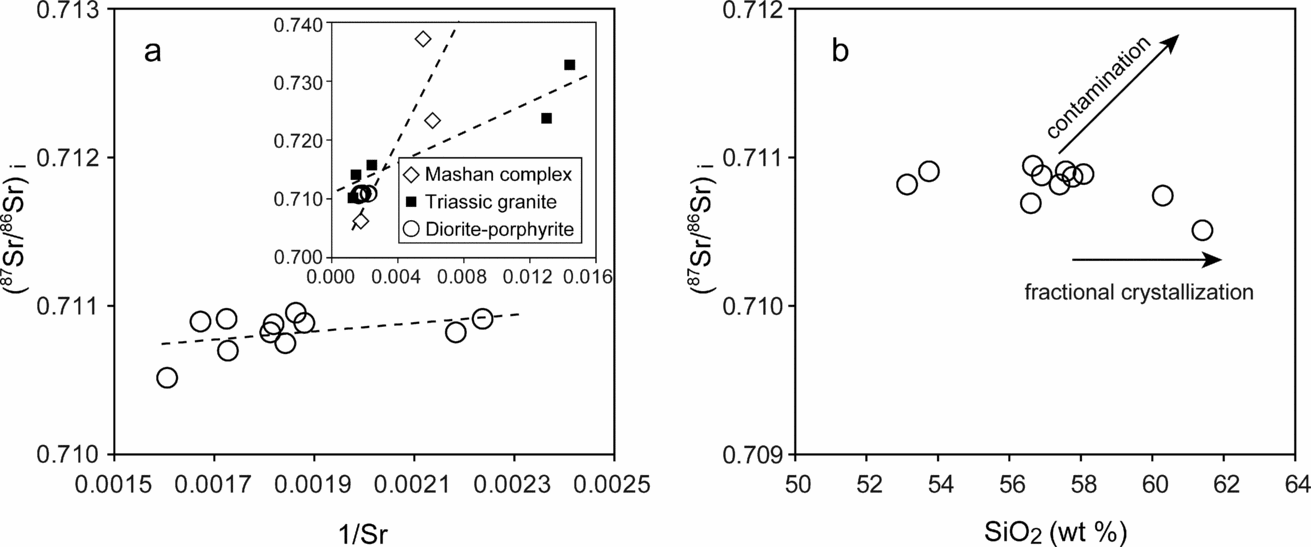
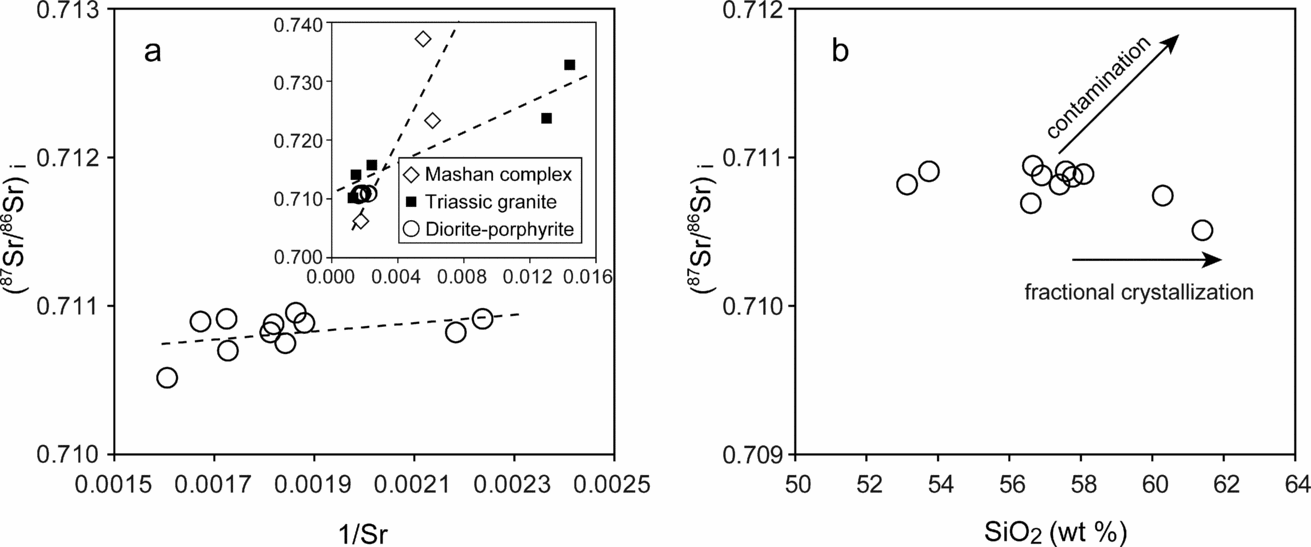
Possibly, crustal contamination is another mechanism contributing to the high Sr and low Nd isotopic characteristics of the Shuangyashan suite. In this aspect, the Cretaceous cover and basement rocks of the Shuangyashan basin as well as Triassic plutons that intrude the Jiamusi Massif must be taken into consideration. Unfortunately, there are no available Sr–Nd isotopic data for the Cretaceous country rocks of the Shuangyashan suite. Three samples from the Mashan complex, which may represent the basement rocks of the Shuangyashan basin, have greatly varied Sr–Nd isotopic compositions at 100 Ma: 87Sr/86Sr = 0.70621 and 143Nd/144Nd = 0.51228 for garnet-bearing granite, 87Sr/86Sr = 0.72326 and 143Nd/144Nd = 0.51210 for adamellite, and 87Sr/86Sr = 0.73712 and 143Nd/144Nd = 0.51195 for granulite (Wu et al. Reference Wu, Jahn, Wilde and Sun2000). In addition, the Triassic granites that are intruded into the Jiamusi Massif have 87Sr/86Sr and 143Nd/144Nd ratios of 0.71010–0.73273 and 0.51204–0.51212 at 100 Ma (Wu et al. Reference Wu, Jahn, Wilde and Sun2000). Except for the garnet-bearing granite, which has an initial 87Sr/86Sr ratio significantly lower than, and an initial 143Nd/144Nd ratio similar to, the Shuangyashan suite, the other rocks have lower initial 143Nd/144Nd ratios than the Shuangyashan suite and their initial 87Sr/86Sr ratios vary greatly. Importantly, the basement rocks and Triassic granite plutons show very different trends from the diorite–porphyrites whose initial 87Sr/86Sr ratios show no changes with Sr concentrations, unlike the basement rocks and Triassic granite plutons (Fig. 6a). It seems that these rocks might have been involved in the Shuangyashan suite.
Selected trace elements versus Hf diagrams for the Shuangyashan suite. Data from Table 1 and Zhang et al. (Reference Zhang, Han, Wei and Shu2011). The Shuangyashan suite seems to show a differentiation trend (a–d) but different trends in highly incompatible elements Rb and Th (e & f), indicating that surface processes have no effect on the rocks and there is no evolutionary relationship between different types of rocks.
(87Sr/86Sr)i–1/Sr (a) and (87Sr/86Sr)i–SiO2 (b) diagrams showing that the diorite–porphyrites show no obvious changes in the initial 87Sr/86Sr ratios as Sr and SiO2 contents increase, suggesting a predominant fractional crystallization rather than crustal contamination. It is noted that the diorite–porphyrites show a very different trend from the Precambrian Mashan complex and Triassic granites (Wu et al. Reference Wu, Jahn, Wilde and Sun2000) as shown in the inset of (a).
However, the monzogabbro has a low and narrow range of SiO2 contents (51.26–51.74 wt%) and high Mg no. (65.9–67.3). This, combined with its mineralogy (Zhang et al. Reference Zhang, Han, Zhu, Xu, Chen and Song2009), indicates that it may have crystallized from basaltic magma. In this case, any crustal contamination must have occurred during magma ascent. The monzogabbro shows little variation in major oxides and trace elements (Table 1; Figs 2, 3c, d), and its K-feldspar oikocryst and clinopyroxene chadacryst separates have the same 87Sr/86Sr and 143Nd/144Nd ratios as whole-rock samples (Table 2), suggesting that the monzogabbro is geochemically homogeneous, with little contribution from either upper crust material (SiO2 = 66.6 wt%, Sr = 320 ppm, Rudnick & Gao, Reference Rudnick, Gao, Rudnick, Holland and Turekian2003) or the basement rocks and Triassic granites of the Jiamusi Massif.
Texture, mineralogy (pargasitic amphibole, anorthitic plagioclase (An > 85 mol.%) and minor clinopyroxene) and elemental geochemistry (low SiO2 = 41.08–43.99 wt% and high Mg no. = 62.3–74.3) of the hornblendite enclaves suggest that they were derived from layered cumulate hornblendites crystallized from hydrous basaltic magma with Mg no. > 63 in the crust–mantle transition zone (Zhang et al. Reference Zhang, Han, Wei and Shu2011). The hornblendite enclaves have initial 87Sr/86Sr and 143Nd/144Nd ratios indistinguishable from those of the monzogabbro (Table 2). They do not show any evidence for crustal contamination.
If the hornblendite enclaves were derived from the crust–mantle transition zone (Zhang et al. Reference Zhang, Han, Wei and Shu2011), the enclave-bearing diorite–porphyrites must have had an origin at least in the crust–mantle transition zone or even in the mantle. In any case, the high SiO2 contents (53.13–61.38 wt%) and low Mg no. (42.7–49.6) of the diorite–porphyrite may have resulted from low-degree partial melting of the mantle, fractional crystallization of mantle-derived magma or involvement of more crustal material. The diorite–porphyrites generally have slightly higher initial 87Sr/86Sr ratios (0.7105–0.7110) than the monzogabbro (0.7094–0.7096) and the hornblendite enclaves (0.7092–0.7107), but all of them have indistinguishable initial 143Nd/144Nd ratios of 0.51221–0.51238 (Table 2). This implies that the Mashan complex and Triassic granitic plutons may have contributed negligible contamination to the diorite–porphyrites. On the other hand, the diorite–porphyrites show no evident change in the initial 87Sr/86Sr ratios with increasing SiO2 contents (Fig. 6b), suggesting a predominant fractional crystallization for the diorite–porphyrites (Figs 2, 6). This is supported by of the relationship between the initial 87Sr/86Sr ratios and 1/Sr (Fig. 6a). Among the diorite–porphyrite intrusions, the Chang'an and the Laotudingzi may have crystallized from the least- and most-evolved magmas, respectively. The former has the lowest SiO2 and the highest Fe2O3T, CaO and Mg no., with weaker REE fractionation ((La/Yb)N = 4.33–4.45), while the latter has the highest SiO2 and the lowest Fe2O3Tand CaO, with stronger REE fractionation ((La/Yb)N = 8.18–13.06).
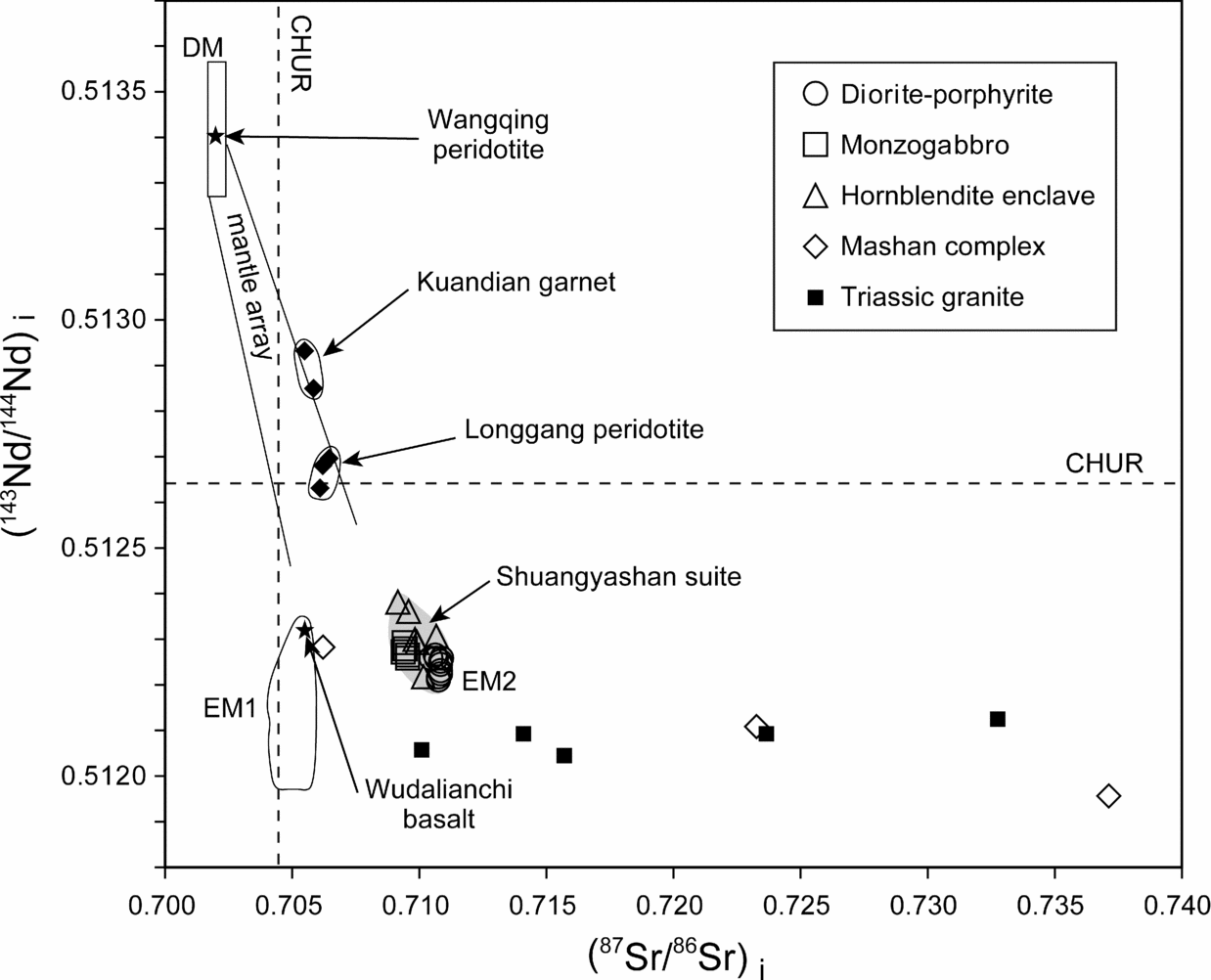
The diorite–porphyrites are coeval with the monzogabbro (HBGMR, 1993) and they show similar Sr–Nd isotopic compositions to the monzogabbro and the hornblendite enclaves. Particularly, the hornblendite enclaves completely plot over the Sr–Nd isotopic compositions of the monzogabbro and diorite–porphyrites (Fig. 7), indicating that their Sr–Nd isotopic characteristics may have been inherited from a common source rather than contributed from crustal contamination. This common source for the Shuangyashan suite may be in the mantle, as constrained by the origin of the monzogabbro and hornblendite enclaves.
The Shuangyashan suite has distinct initial 87Sr/86Sr and 143Nd/144Nd ratios in comparison with the most depleted clinopyroxene separate from a Wangqing peridotite xenolith with 87Sr/86Sr = 0.7022 and 143Nd/144Nd = 0.5134 (Xu et al. Reference Xu, Menzies, Vroon, Mercier and Lin1998), and the most enriched Wudalianchi basalt with Sr–Nd isotopic compositions of 87Sr/86Sr = 0.7055 and 143Nd/144Nd = 0.5123 (Zhang et al. Reference Zhang, Suddaby, Thompson, Thirlwall and Menzies1995) in Northeast China. Three Longgang peridotite xenoliths (Hsu, Chen & Ho, Reference Hsu, Chen and Ho2000) and Kuandian garnet megacrysts (Tatsumoto et al. Reference Tatsumoto, Basu, Huang, Wang and Xie1992) with enriched Sr–Nd isotopic compositions are plotted near the DM–EM2 trend. The DM and EM1 ranges and mantle array lines are based on figure 6 in Zindler & Hart (Reference Zindler and Hart1986). CHUR – chondritic uniform reservoir.
5.b. Lithospheric mantle origin for EM2
Mantle-derived magma may originate from the asthenosphere (e.g. Arndt & Christensen, Reference Arndt and Christensen1992; Pearson & Nowell, Reference Pearson and Nowell2002; Pearson, Canil & Shirey, Reference Pearson, Canil, Shirey, Carlson, Holland and Turekian2003) or the lithosphere (e.g. Zhang et al. Reference Zhang, Menzies, Suddaby and Thirlwall1991; Verma, Reference Verma2000; Ersoy, Helvaci & Palmer, Reference Ersoy, Helvaci and Palmer2010). The asthenospheric magma may interact with the overlying lithospheric mantle during its upward transportation (Ellam & Cox, Reference Ellam and Cox1991; Xu et al. Reference Xu, Ma, Frey, Feigenson and Liu2005). In this case, the asthenospheric magma could be modified by the lithospheric mantle and show some lithospheric mantle affinity (Ellam & Cox, Reference Ellam and Cox1991; Xu et al. Reference Xu, Ma, Frey, Feigenson and Liu2005). Similarly, the lithospheric mantle could be refertilized by the asthenospheric magma and shows some geochemical features of the asthenosphere (e.g. Saal et al. Reference Saal, Takazawa, Frey, Shimizu and Hart2001; Le Roux et al. Reference Le Roux, Bodinier, Tommasi, Alard, Dautria, Vauchez and Riches2007; Ersoy, Helvaci & Palmer, Reference Ersoy, Helvaci and Palmer2010; van Acken et al. Reference Van Acken, Becker, Hammerschmidt, Walker and Wombacher2010).
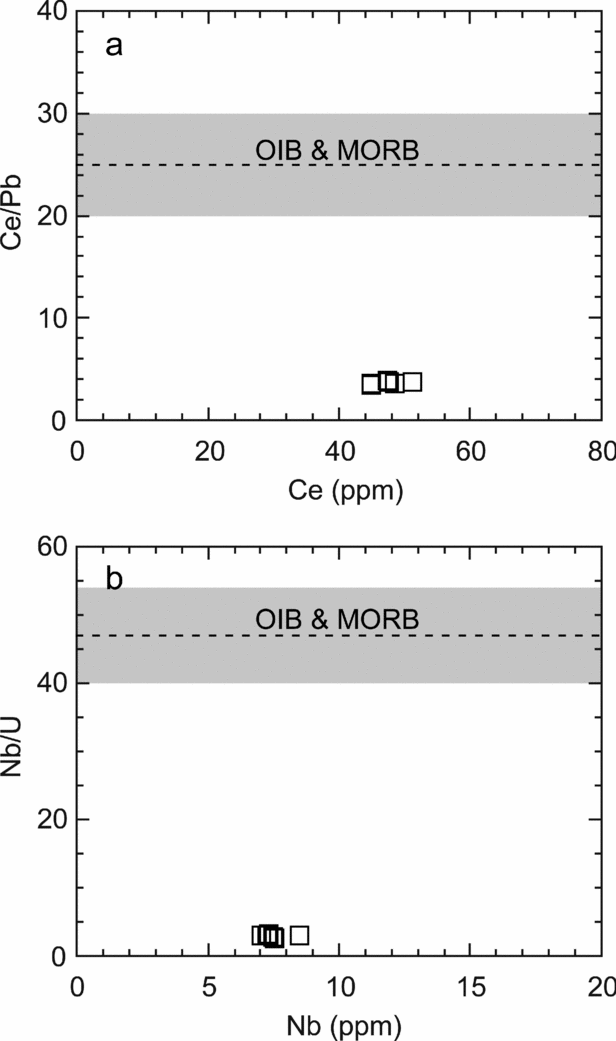
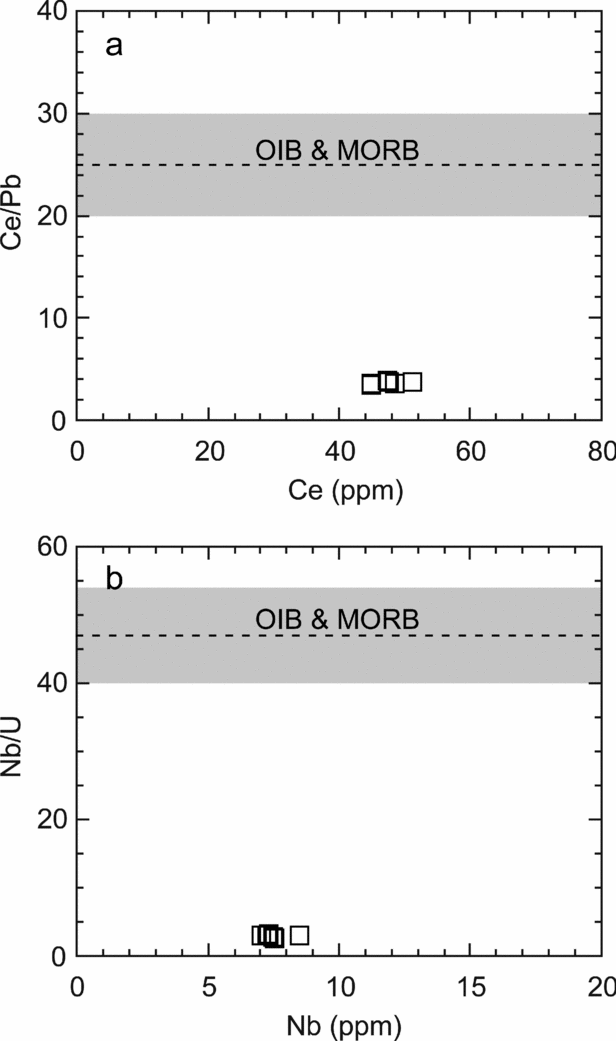
Oceanic basalts (ocean island basalt (OIB) and mid-ocean ridge basalt (MORB)) may be derived from asthenospheric mantle and have little interaction with the lithospheric mantle during their upward transportation so that they show asthenospheric geochemical affinity, and some element ratios such as Ce/Pb and Nb/U can be used to detect their source regions (e.g. Pearce, Harris & Tindle, Reference Pearce, Harris and Tindle1984; Hofmann et al. Reference Hofmann, Jochum, Seufert and White1986; Hofmann, Reference Hofmann1988; Zou et al. Reference Zou, Reid, Liu, Yao, Xu and Fan2003; Xu et al. Reference Xu, Ma, Frey, Feigenson and Liu2005). It is generally accepted that the average Ce/Pb and Nb/U ratios for oceanic basalts (OIB and MORB) are 25 ± 5 and 47 ± 7, respectively (Hofmann et al. Reference Hofmann, Jochum, Seufert and White1986). For the Shuangyashan suite, trace element ratios of the diorite–porphyrites may have been largely modified owing to significant fractional crystallization (Fig. 6) and thus they cannot be used to identify the origin for mantle-derived magma. The Ce/Pb and Nb/U ratios of the monzogabbro are 3.46–3.91 and 2.60–3.18, respectively, significantly lower than those of oceanic basalts (Fig. 8a, b). In addition, other element ratios such as Zr/Nb (15.8–18.2), Ba/Th (51.6–64.5), Th/La (0.35–0.43) and Ba/La (20.8–23.1) of the monzogabbro are very different from those of oceanic basalts but similar to continental crust (Weaver, Reference Weaver1991). It seems that the monzogabbro does not have asthenospheric mantle affinity, or its parental magma is derived from the asthenosphere but involves continental material. If its mineralogy and tectonic setting are taken into consideration, the monzogabbro, together with the diorite–porphyrites and their hornblendite enclaves, is more possibly derived from the lithospheric mantle.
Ce/Pb–Ce (a) and Nb/U–Nb (b) diagrams for the monzogabbro, showing its parental magma is impossibly derived from the asthenosphere. The average Ce/Pb and Nb/U ratios in OIB and MORB are after Hofmann et al. (Reference Hofmann, Jochum, Seufert and White1986).
It is generally accepted that the upper mantle is composed of upper spinel- and lower garnet-facies peridotite, and the spinel–garnet facies transition occurs at ~ 75 km (McKenzie & O'Nions, Reference McKenzie and O'nions1991). Geophysical studies have revealed that the present lithosphere–asthenosphere boundary below the Jiamusi Massif lies at about ~ 80–100 km (An & Shi, Reference An and Shi2006; Liu et al. Reference Liu, Zhang, Han and Tang2006; Zhang et al. Reference Zhang, Yang, Wu and Liu2006), suggesting the presence of garnet peridotite in the lower lithospheric mantle and underlying asthenosphere. Because HREEs are highly compatible and LREEs are incompatible in garnet (e.g. Shimizu & Kushiro, Reference Shimizu and Kushiro1975; van Westrenen, Blundy & Wood, Reference Van Westrenen, Blundy and Wood1999), partial melt of garnet peridotite may be characterized by high REE fractionation, and its (La/Yb)N will decrease with increasing partial melting of garnet peridotite: (La/Yb)N = 10 at 20% partial melting and (La/Yb)N = 50 at 5% partial melting (Kelemen, Yogodzinski & Scholl, Reference Kelemen, Yogodzinski, Scholl and Eiler2003). In the Shuangyashan suite, the monzogabbro shows moderate REE fractionation: (La/Yb)N = 5.51–5.78 (Fig. 3d). Petrography and high Mg no. of the monzogabbro suggest that only minor fractional crystallization of olivine and clinopyroxene occurred in the parental magma (Zhang et al. Reference Zhang, Han, Zhu, Xu, Chen and Song2009). Combined with the partition coefficients (e.g. Shimizu, Sangen & Masuda, Reference Shimizu, Sangen and Masuda1982; Jones & Layne, Reference Jones and Layne1997; Blundy & Dalton, Reference Blundy and Dalton2000; Bedard, Reference Bedard2005), the fractional crystallization of olivine and clinopyroxene will lead to rising (La/Yb)N of the residual melt. This implies that the parental magma of the monzogabbro should have very low (La/Yb)N. If it was derived from the asthenosphere or lower lithospheric mantle, much more than 20% partial melting is required and this seems impossible.
Alternatively, the parental magma of the monzogabbro was derived from partial melting of the spinel peridotite in the upper lithospheric mantle. If so, the lithospheric mantle must be characterized by enriched geochemical features. In fact, some peridotite xenoliths from Longgang (87Sr/86Sr = 0.7060–0.7064, 143Nd/144Nd = 0.51263–0.51269; Hsu, Chen & Ho, Reference Hsu, Chen and Ho2000) and mantle-derived garnet megacrysts from Kuandian (87Sr/86Sr = 0.7055–0.7058, 143Nd/144Nd = 0.51285–0.51293; Tatsumoto et al. Reference Tatsumoto, Basu, Huang, Wang and Xie1992) (Fig. 1a) show more enriched Sr–Nd isotopic features than FOcal ZOne (FOZO) mantle and DM and significantly deviate from the DM–EM1 trend and are closer to the DM–EM2 trend (Fig. 7), implying that the enriched lithospheric mantle is probably present in Northeast China. Enriched lithospheric mantle with extremely variable 87Sr/86Sr (0.7025–0.7224) and 143Nd/144Nd (0.5094–0.5174) ratios is also present beneath the Siberian Craton (Pearson et al. Reference Pearson, Shirey, Carlson, Boyd, Pokhilenko and Shimizu1995). Similarly, the Fuxian and Mengyin peridotite xenoliths from the eastern North China Craton (Fig. 1a) also show extremely variable initial 87Sr/86Sr (0.7030–0.7196) and 143Nd/144Nd (0.5120–0.5125) ratios (Zhang et al. Reference Zhang, Goldstein, Zhou, Sun, Zheng and Cai2008). Both of the examples imply the presence of enriched lithospheric mantle beneath the continents.
The Shuangyashan suite is mainly characterized by high 87Sr/86Sr and low 143Nd/144Nd ratios, being consistent with the Sr–Nd isotopic geochemistry of EM2. This, combined with the published data, suggests that EM2, in addition to DM, FOZO and EM1, is also present in the lithospheric mantle beneath Northeast China.
5.c. Genesis of EM2
The enriched signatures of the lithospheric mantle could have resulted from metasomatism by enriched fluids or melts (Ikeda, Nagao & Kagami, Reference Ikeda, Nagao and Kagami2001; Xu et al. Reference Xu, Menzies, Thirlwall, Huang, Liu and Chen2003; Senda, Tanaka & Suzuki, Reference Senda, Tanaka and Suzuki2007; Scambelluri, van Roermund & Pettke, Reference Scambelluri, van Roermund and Pettke2010), and the formation of EM2 is usually attributed to the involvement of recycled continental materials in the mantle (e.g. Saunders et al. Reference Saunders, Norry and Tarney1988; Jackson et al. Reference Jackson, Hart, Koppers, Staudigel, Konter, Blusztajn, Kurz and Russell2007; Willbold & Stracke, Reference Willbold and Stracke2010). In a subduction setting, continent-derived trench sediments are easy to recycle into the mantle as the oceanic slab is being subducted. Particularly, seawater-altered oceanic crust and/or subducted sediments may release enriched fluids or generate enriched melts (e.g. McCulloch et al. Reference McCulloch, Jaques, Nelson and Lewis1983; Hergt et al. Reference Hergt, Chappell, McCulloch, McDougall and Chivas1989; Elliott, Reference Elliott and Eiler2003; Jackson et al. Reference Jackson, Hart, Koppers, Staudigel, Konter, Blusztajn, Kurz and Russell2007). Usually, seawater has a higher 87Sr/86Sr ratio than oceanic crust (Veizer et al. Reference Veizer, Ala, Azmy, Bruckschen, Buhl, Bruhn, Carden, Diener, Ebneth, Godderis, Jasper, Korte, Pawellek, Podlaha and Strauss1999; Prokoph, Shields & Veizer, Reference Prokoph, Shields and Veizer2008), and consequently seawater-altered oceanic crust may have significantly increased 87Sr/86Sr ratios (e.g. Hart et al. Reference Hart, Blusztajn, Dick, Meyer and Muehlenbachs1999; Elliott, Reference Elliott and Eiler2003). However, the 87Sr/86Sr ratio of the Cretaceous seawater was below 0.7084 (Veizer et al. Reference Veizer, Ala, Azmy, Bruckschen, Buhl, Bruhn, Carden, Diener, Ebneth, Godderis, Jasper, Korte, Pawellek, Podlaha and Strauss1999; Prokoph, Shields & Veizer, Reference Prokoph, Shields and Veizer2008), much lower than the initial 87Sr/86Sr ratios of the Shuangyashan suite. Therefore, the Sr–Nd isotopic signatures of the parental magma and the mantle source for the Shuangyashan suite cannot be simply attributed to contributions from seawater-altered oceanic crust. Alternatively, subducted sediments may be responsible for the EM2 isotopic signatures of the parental magmas for the Shuangyashan suite and their mantle source.
Generally, the Sr–Nd isotopic compositions of subducted sediments exhibit a great variation (Plank & Langmuir, Reference Plank and Langmuir1998). Generally, continent-derived sediments have high 87Sr/86Sr and low 143Nd/144Nd ratios; the incorporation of subducted sediments in magma generation could greatly elevate the 87Sr/86Sr ratios of the arc magma and lower the 143Nd/144Nd ratios (e.g. Lin, Reference Lin1992; Bailey, Reference Bailey1996; Plank & Langmuir, Reference Plank and Langmuir1998). This is in agreement with the observation that subducted sediments from continental arcs have higher 87Sr/86Sr ratios than those from island arcs (Plank & Langmuir, Reference Plank and Langmuir1998). Consequently, subduction-related igneous rocks may have greater or lesser EM2 signatures (e.g. McCulloch et al. Reference McCulloch, Jaques, Nelson and Lewis1983; Hergt et al. Reference Hergt, Chappell, McCulloch, McDougall and Chivas1989; Vroon et al. Reference Vroon, Bergen, Klaver and White1995; Bouvier, Métrich & Deloule, Reference Bouvier, Métrich and Deloule2008) and probably show a DM–EM2 trend (Hergt et al. Reference Hergt, Chappell, McCulloch, McDougall and Chivas1989; Kelemen, Hanghøj & Greene, Reference Kelemen, Hanghøj, Greene, Rudnick, Holland and Turekian2003; Jackson et al. Reference Jackson, Hart, Koppers, Staudigel, Konter, Blusztajn, Kurz and Russell2007). Evidently, subducted sediments dominated by continental material may have resulted in igneous rocks with EM2 signatures by participating in the generation of magma (Jackson et al. Reference Jackson, Hart, Koppers, Staudigel, Konter, Blusztajn, Kurz and Russell2007; Willbold & Stracke, Reference Willbold and Stracke2010). The Sr–Nd isotopic and trace element geochemistry of the Shuangyashan suite clearly suggests that recycled continental material may have played an important role in the formation of EM2 in the lithosphere.
Tectonically, a continental arc occurred along the eastern edge of the Eurasian continent before the Japanese islands were rifted away from the Eurasian continent during Early Miocene time (e.g. Jolivet, Tamaki & Fournier, Reference Jolivet, Tamaki and Fournier1994; Wang & Mo, Reference Wang and Mo1995; Maruyama et al. Reference Maruyama, Isozaki, Kimura and Terabayashi1997). The detritus derived from erosion of the continental arc might have been transported into the trench and moved together with the subducting oceanic slab into the mantle, and finally participated in the generation of subduction-related magma at depth. The rising magma may have contained plenty of fluids; its interaction with the overlying lithospheric mantle may finally have given rise to significantly increased 87Sr/86Sr and decreased 143Nd/144Nd ratios as well as enrichment of LILEs and HFSEs in the lithospheric mantle. Afterwards, partial melts of the enriched lithospheric mantle may have ascended into the crust–mantle transition zone to form the layered cumulate hornblendites. Subsequently, some batches of melts may have captured fragments of the layered cumulate hornblendites and carried them into the upper crust to form the enclave-bearing diorite–porphyrites, and others may have directly ascended into the upper crust to form the monzogabbro. Therefore, the Shuangyashan suite may be representative of EM2 in the lithospheric mantle of Northeast China.
6. Conclusions
The Shuangyashan suite from Northeast China includes a monzogabbro and diorite–porphyrites and their cumulate hornblendite enclaves. Different types of rocks originated from a common source in the lithospheric mantle, and petrology and geochemistry indicate that post-magmatic processes and crustal contamination may have played a negligible role in the Sr–Nd isotopic compositions of the Shuangyashan suite. The Shuangyashan suite is characterized by high initial 87Sr/86Sr (0.70922–0.71095) and low 143Nd/144Nd ratios (0.51221–0.51238) at 98 Ma, suggesting the presence of EM2 in the lithospheric mantle beneath Northeast China. The formation of EM2 in the lithospheric mantle may be related to the participation of recycled continental material in arc magma generation and the interaction between rising magma and the overlying lithospheric mantle in a subduction setting.
Acknowledgements
Mark B. Allen and another anonymous reviewer are greatly thanked for their helpful and constructive comments and suggestions, which have greatly helped us to improve our presentation and discussion. We are grateful to Xiao-ming Liu, Ye Liu and Chao-feng Li for their help in chemical and isotopic analyses. This work was financially supported by China Geological Survey (Grant No. 1212010050502) and President's Foundation for Undergraduate Research of Peking University.