Introduction
Prolonged treatment with antipsychotic medication (AM) is widely considered as the standard care in patients with schizophrenia (Buchanan et al. Reference Buchanan, Kreyenbuhl, Kelly, Noel, Boggs, Fischer, Himelhoch, Fang, Peterson, Aquino and Keller2010). From the patients’ perspective, the wish to lead a normal life and to cope with occurring symptoms is the main reason for taking AM (Moritz et al. Reference Moritz, Hünsche and Lincoln2014). Indeed, AM has been shown to be effective in reducing symptoms, increasing short-term functioning, and preventing relapse (Leucht et al. Reference Leucht, Abraham and Kissling1999, Reference Leucht, Engel and Davis2009, Reference Leucht, Tardy, Komossa, Heres, Kissling, Salanti and Davis2012). However, overall effect sizes are moderate at the most (Leucht et al. Reference Leucht, Engel and Davis2009) and up to 74% of the patients do not take their medication as prescribed (Lacro et al. Reference Lacro, Dunn, Dolder, Leckband and Jeste2002; Lieberman et al. Reference Lieberman, Stroup, McEvoy, Schwartz, Rosenheck, Perkins, Keefe, Davis, Davis, Lebowitz, Severe and Hsiao2005). Although predictors and consequences of incomplete medication adherence have been widely studied (e.g. Lacro et al. Reference Lacro, Dunn, Dolder, Leckband and Jeste2002; Ascher-Svanum et al. Reference Ascher-Svanum, Faries, Zhu, Ernst, Swartz and Swanson2006; Wiesjahn et al. Reference Wiesjahn, Jung, Lamster, Rief and Lincoln2014), comparatively little is known about patients who do not take AM at all or have long medication-free periods. This is surprising as complete non-adherence is not a rare phenomenon. For example, in an international study combining World Health Organization surveys, Harrison et al. (Reference Harrison, Hopper, Craig, Laska, Siegel, Wanderling, Dube, Ganev, Giel, an der Heiden, Holmberg, Janca, Lee, Leòn, Malhotra, Marsella, Nakane, Sartorius, Shen, Skoda, Thara, Tsirkin, Varma, Walsh and Wiersma2001) identified an average of 26% of the patients with psychosis as not to have been taking AM at all for at least 2 years.
In a prospectively designed investigation of all patients admitted to two Chicago hospitals with a first or second episode of schizophrenia or schizo-affective disorder, Harrow et al. (Reference Harrow, Jobe and Faull2012) found that about 35% of the patients initially treated with AM terminated medication intake within 2 years and stayed off medication for the following 18 years. Interestingly, this self-selected group had significantly higher levels of general and social functioning, lower levels of symptoms, and more periods of recovery than the continuously medicated sample at all follow-up assessments (after 4.5, 7.5, 10, 15 and 20 years) although the groups did not differ significantly in these variables at baseline. It needs noting, though, that the non-medicated group showed better early pre-morbid developmental achievements related to work, education, marital status (among others) and better prognostic factors, such as acute onset or precipitating stress at index hospitalization (Harrow & Jobe, Reference Harrow and Jobe2007; Harrow et al. Reference Harrow, Jobe and Faull2012). Thus, these factors might be predictors for being successfully off medication in the long run. In line with the Chicago study, Moilanen et al. (Reference Moilanen, Haapea, Miettunen, Jääskeläinen, Veijola, Isohanni and Koponen2013) identified 34% of the patients with schizophrenia spectrum disorders of the Northern Finland 1966 birth cohort sample as being non-medicated. All of these non-medicated participants had been hospitalized at least once and the majority had withdrawn from AM more than 1 year ago. Compared with the remaining medicated sample, these patients revealed lower symptom scores, better functioning, were less often in a disability pension, and had spent less time in psychiatric hospitals.
These studies indicate that there are patients who do not take AM in order to reduce symptoms, but nevertheless do not seem to be fairing worse in the long run than those who take AM. This raises the question, among many others, whether this group of patients compensates for the absence of medication by increasing their use of other potentially helpful strategies. In an exploratory interview trial, McNally & Goldberg (Reference McNally and Goldberg1997) found social support strategies, such as calling a friend, behavioural distraction, professional help and cognitive strategies to be widely used coping strategies of patients with schizophrenia. However, little is known about which coping strategies are used by non-medicated individuals. It seems intuitive to assume that they might draw more strongly on social support, a factor known to predict better clinical and functional outcomes (Erickson et al. Reference Erickson, Beiser and Iacono1998; Norman et al. Reference Norman, Malla, Manchanda, Harricharan, Takhar and Northcott2005) or use other coping strategies in a more effective manner. This assumption is underpinned by the results of Torgalsboern (Reference Torgalsboern2012) who found a positive correlation between the level of functioning and greater resilience, which can be defined as the ability to cope successfully with stress (Connor & Davidson, Reference Connor and Davidson2003), in non-medicated patients with schizophrenia.
In the present study we thus compared sociodemographic and clinical variables, as well as social support, and coping behaviour in non-medicated and medicated persons with schizophrenia spectrum disorders. Following the results of the Chicago (Harrow et al. Reference Harrow, Jobe and Faull2012) and the Northern Finland (Moilanen et al. Reference Moilanen, Haapea, Miettunen, Jääskeläinen, Veijola, Isohanni and Koponen2013) studies, we expected that individuals not taking AM would show lower symptom severity and better functioning than those on medication. Furthermore, based on the assumption that non-medicated individuals compensate for the absence of medication by using other coping strategies and draw more strongly on social support as a way of coping, we expected them to show a wider range of coping strategies than patients who take medication, to be more satisfied with the effect of these strategies and to receive more social support.
As an additional research question, we aimed to explore on a qualitative level which types of coping strategies participants use and whether non-medicated and medicated individuals differ in the types of strategies employed.
Method
Participants and study setting
The study took place at the Philipps University of Marburg and the University of Hamburg, Germany. Participants were recruited via advertisements in local newspapers and bulletin boards in public spaces as well as on non-profit Internet platforms on psychotic disorders in the German language (http://www.kompetenznetz-schizophrenie.info/forum/; http://www.schizophrenie-netz.info/forum/). The study was also promoted in the out-patient clinic of the University of Marburg and in the Psychosis Out-patient Clinic of the Psychiatric Hospital of the University of Hamburg.
The trial was approved by the Ethical Committee of the Department of Psychology of the University of Marburg (AZ 2011–22k). Informed consent was obtained from all participants or their legal guardian. Inclusion criteria were: (1) having a schizophrenia spectrum psychotic disorder (schizophrenia, schizo-affective disorder, delusional disorder, psychotic disorder not otherwise specified) confirmed by the Structured Clinical Interview for DSM-IV (SCID; Wittchen et al. Reference Wittchen, Zaudig and Fydrich1997); (2) not taking AM for at least 3 months (non-medicated sample) or taking AM for at least 3 months (medicated sample); (3) age between 18 and 70 years; (4) sufficient German language skills to communicate with the interviewer.
Measures
We generated a semi-structured interview to assess diagnosis, previous and current symptoms, subjective evaluation of symptoms, history of mental disorder, experiences with medication, experiences with the psychiatric health care system, and coping strategies. In addition, we assessed insight, illness beliefs, reasons for taking or not taking medication, and the relationship with the treating physician, which will be reported elsewhere. Each topic was explored by open-ended questions and the answers were rated by the interviewer on four- or five-point rating scales (e.g. ‘Do you have specific strategies for coping with symptoms?’; ‘On the whole, are your coping strategies working sufficiently well? Rating scale: 1 = no; 2 = rather no; 3 = rather yes; 4 = yes’). The complete interview can be retrieved from the corresponding author (T.M.L). In order to increase the validity of the interview ratings, all interviews were rated again by a student assistant trained in rating the interview scales and blind to the hypotheses. Blinding on group membership was not possible as this was explicit in the interview. The analyses are based on a consent rating between interviewer and second rater.
The presence of psychotic disorder was assessed using the SCID (Wittchen et al. Reference Wittchen, Zaudig and Fydrich1997), sections B and C, which were integrated into the interview.
Psychotic symptoms and symptom-related distress were assessed using the German version of the Community Assessment of Psychotic Experiences (CAPE; Konings et al. Reference Konings, Bak, Hanssen, van Os and Krabbendam2006). This self-rating instrument consists of 42 items on the three dimensions of positive symptoms, negative symptoms and depression. Symptoms are rated with regard to frequency of occurrence and related distress. The German version has demonstrated good internal consistencies (α = 0.84–0.91; Lincoln et al. Reference Lincoln, Peter, Schäfer and Moritz2009).
We used the DSM Axis V Global Assessment of Functioning Scale (GAF) as a global measure of social, psychological and occupational functioning (Sass et al. Reference Sass, Wittchen, Zaudig and Houben2003), which has been shown to be valid for assessing global functioning in patients with schizophrenia (Schwartz, Reference Schwartz2007).
Social functioning was assessed with the Role Functioning Scale (RFS; Goodman et al. Reference Goodman, Sewell, Cooley and Leavitt1993), which has demonstrated good criterion validity and retest reliability (0.85–0.92 within a 1-year period). Ratings are based on a semi-structured interview. We used an adapted version of the RFS with anchoring points ranging from 1 to 12 (Lincoln et al. Reference Lincoln, Ziegler, Mehl, Kesting, Lüllmann, Westermann and Rief2012), referring to the last 7 days and combined the subscales ‘immediate social network relationships’ and ‘extended social network relationship’ to a composite score.
Perceived social support was assessed using the short version of the Social Support Questionnaire (Fydrich et al. Reference Fydrich, Sommer, Tydecks and Brähler2009). This 14-item instrument has demonstrated excellent internal consistency (α = 0.94; Fydrich et al. Reference Fydrich, Sommer, Tydecks and Brähler2009).
Procedure
Participants contacted the authors by telephone. After a brief telephone screening, participants were invited for the interview session. They provided informed consent and completed a demographic questionnaire, followed by the interview and the remaining questionnaires. Three interviewers were involved in the study (E.J., M.W., H.W.). All interviews were video- or audiotaped. The complete assessment took about 2 h. Participants received 15 Euros for their participation.
Analyses
Data were analysed using SPSS version 21.0.0 (USA). We tested the distribution of the variables separately for the non-medicated and medicated groups. As several variables were not normally distributed according to the Kolmogorov–Smirnov test, we used parametric as well as non-parametric procedures. In order to avoid inflation of type 1 error, we applied Bonferroni corrections. For non-parametric tests r is reported as effect size (0.1 = small; 0.3 = medium; 0.5 = large; Field, Reference Field2009). For parametric tests we reported Cohen's d (0.2 = small; 0.5 = medium; 0.8 = large; Cohen, Reference Cohen1992).
Additionally, we used qualitative methods to analyse coping strategies. Two authors (E.J., M.W.) went through the list of reported strategies independently and identified categories of strategies. In the next step, the identified categories were compared and discussed until consensus on categories was reached. One author coded the strategies according to the final set of categories.
Results
Sample characteristics
In total, 51 participants were recruited, 47% in Marburg, 53% in Hamburg. About half of the participants had been invited to participate by their therapist (51%), 45% responded to the advertisement, and two participants were referred by a friend. Three participants were excluded from the analyses because they did not meet the criteria for a schizophrenia spectrum disorder, although they reported subclinical delusions or hallucinations.
Of the remaining 48 participants, 33 participants (69%) fulfilled DSM-IV criteria for schizophrenia, 10 (21%) for schizo-affective disorder, and five (10%) for delusional disorder.
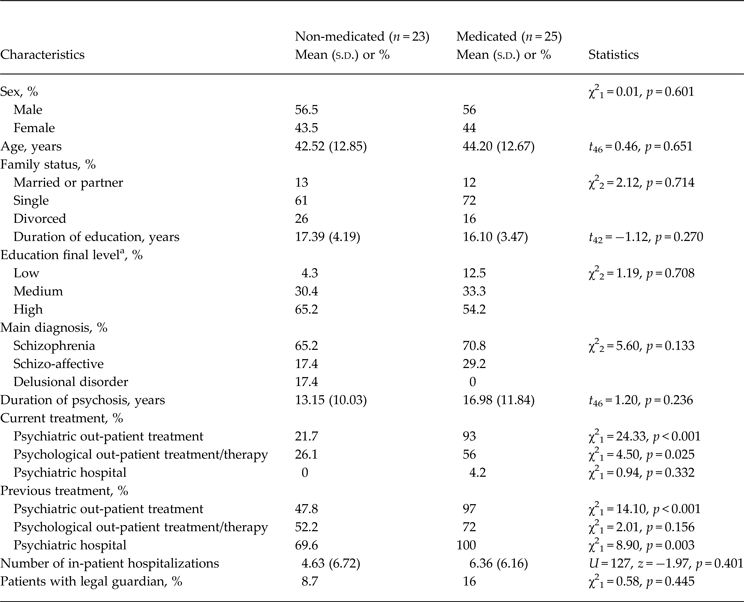
A total of 23 participants had not taken AM for at least 3 months; 25 were taking AM. The mean age of participants was 43.40 (s.d. = 12.65) years; 44% were female. The mean duration of disorder was 15.14 (s.d. = 11.06) years. The groups did not differ significantly in sex, age, family status, educational level, diagnosis or duration of psychosis (see Table 1). Medicated participants were more likely to be in psychiatric (93% v. 21%; p < 0.001) and psychological out-patient treatment (56% v. 26%; p = 0.025). Also, in the medicated sample more participants had previously been in psychiatric out-patient and in-patient treatment (97% v. 48% and 100% v. 70%, respectively; p < 0.001).
Sociodemographic and clinical characteristics for non-medicated and medicated participants
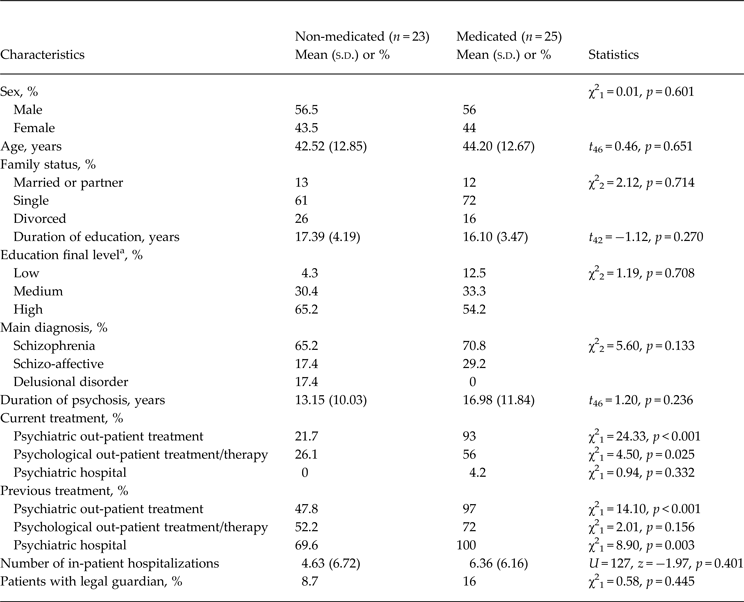
s.d., Standard deviation.
a Low = Hauptschule (general secondary school); medium = Realschule (intermediate secondary school); high = Abitur (A-level or high school equivalent).
Of the non-medicated participants, 78% had previously taken AM. Three of these participants had withdrawn within the last year, four had been off medication for 1–5 years, four for 5–10 years and five had withdrawn more than 10 years ago. About half of these participants (55%) reported that discontinuation of AM had been in agreement with their treating physician. On average, these participants had been on medication for 30.8 (s.d. = 36.2) months, ranging from 1 week to 9 years, and had discontinued AM on average 8 years ago (mean = 93.7 months, s.d. = 101.4, range = 3–336 months). Five participants (22%) had never taken AM. Two of them had been offered AM but refused; three had never seen a psychiatrist and had never been offered AM.
Psychopathology, general functioning and distress
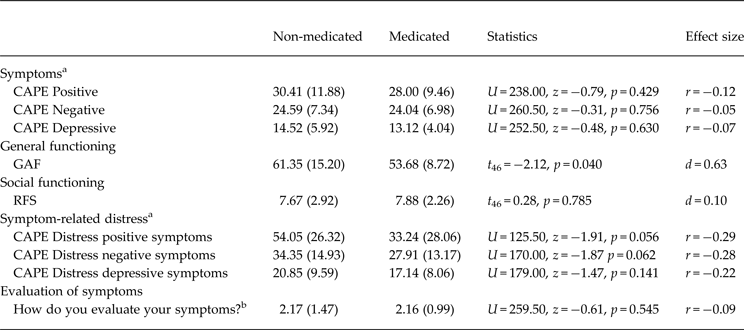
As can be seen in Table 2, the groups did not differ significantly in positive symptoms, negative symptoms, or symptoms of depression. Non-medicated participants had significantly higher levels of general functioning (GAF) than medicated participants (p = 0.04; d = −0.63). There were no significant differences in the level of social functioning, symptom-related distress, or evaluation of symptom experiences. In both groups, the majority of participants reported to perceive the symptoms as being ‘rather distressing’ or ‘distressing’, with a tendency towards more perceived distress in non-medicated participants.
Symptom severity, level of functioning, symptom-related distress, and subjective evaluation of symptoms in non-medicated and medicated participants

Data are given as mean (standard deviation).
CAPE, Community Assessment of Psychotic Symptoms (higher scores indicate more severe symptoms and distress); GAF, Global Assessment of Functioning Scale (higher scores indicate better functioning); RFS, Role Functioning Scale (higher scores indicate better functioning).
a Bonferroni corrected level of significance: p < 0.017. We applied Bonferroni corrections within blocks of analysis.
b ‘How do you evaluate your symptoms? As being “negative” (1), “rather negative” (2), “neutral” (3), “rather positive” (4), or “positive”?’.
Social support and coping strategies
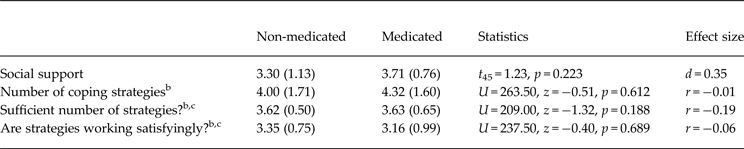
The groups did not differ significantly in the level of perceived social support (p = 0.22; d = 0.35; see Table 3).
Group comparisons on social support, number and evaluation of coping strategiesa
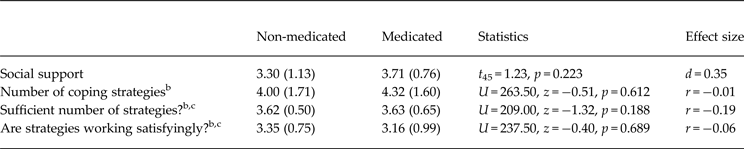
Data are given as mean (standard deviation).
a Higher scores indicate more perceived social support and higher satisfaction with strategies.
b Bonferroni corrected level of significance: p < 0.017.
c Rating scale ranging from 1 = no; 2 = rather no; to 3 = rather yes; 4 = yes.
Except for one, all participants reported using at least one coping strategy, with a mean of 4.17 (s.d. = 1.64) strategies. The groups did not differ significantly in the number of reported coping strategies or in their satisfaction with the quantity and effectiveness of these strategies (see Table 3). In both groups the majority of participants (>70%) were ‘rather satisfied’ or ‘satisfied’ with the number of strategies and the way they worked.
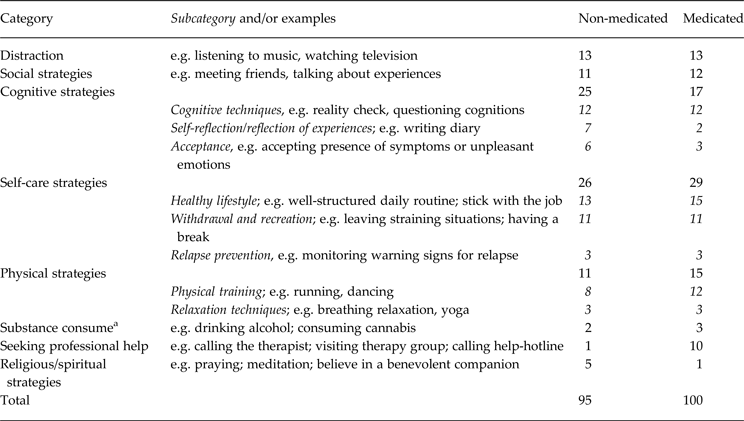
As can be seen in Table 4, the qualitative analysis revealed eight categories of coping strategies. Participants in both groups reported using general self-care strategies most frequently, followed by cognitive strategies, distraction, social and physical strategies (11–15 times). Substance strategies (excluding medication use) and religious or spiritual practice were rarely reported. Medicated participants reported professional help strategies (n = 10) significantly more often than non-medicated participants (n = 1, χ2 1 = 8.62, p = 0.005). With this exception, distribution of reported strategies was comparable across the groups (see Table 4).
Frequencies of reported categories of coping strategies in non-medicated and medicated participants
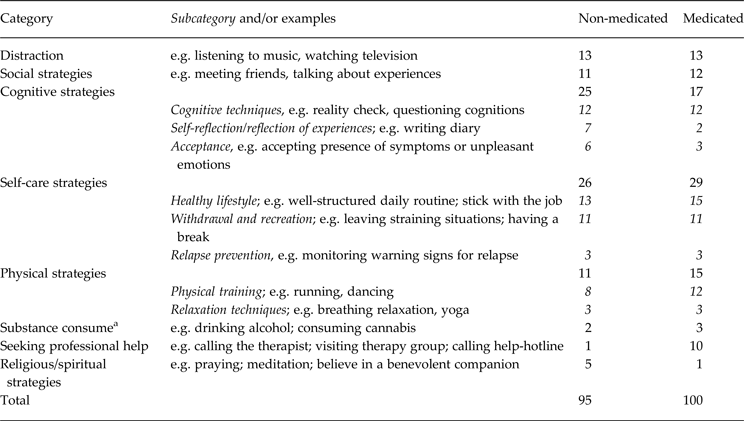
a Excluding use of medication (e.g. adapting dosage of antipsychotic medication, using additional medication, using homeopathic medication) which was reported seven times in the medicated group and once in the non-medicated group.
We found significant positive bivariate correlations between satisfaction with the quantity and effectiveness of strategies and the level of general functioning (r = 0.39, p = 0.008 and r = 0.36, p = 0.015). The satisfaction with the quantity of strategies was also significantly associated with social functioning (r = 0.33, p = 0.024). However, there were no significant relationships between the numbers of reported coping strategies and levels of general (r = 0.14, p = 0.138) or social functioning (r = 0.07, p = 0.351).
Subgroup analyses of non-medicated participants
Never taken AM v. previously medicated
Those participants who had never taken AM (n = 5) had significantly lower depression scores (median= 10.00) than those who had been medicated in the past (n = 18) (median = 15.47, U = 14.00, z = −2.25, p = 0.025). The groups did not differ significantly in psychotic positive or negative symptoms, general or social functioning, social support or number of coping strategies.
Withdrawn from medication in agreement with physician v. without physician
There were no significant differences between those who had withdrawn from medication in agreement with the treating physician (n = 10) and those who had withdrawn without a physician (n = 8) concerning the number of previous hospitalizations, symptom severity, functioning, social support, or number of coping strategies (all p > 0.05).
Time off medication in relation to duration of disorder
A longer duration of being non-medicated (in relation to the duration of the disorder) was significantly associated with higher general functioning (r = 0.53, p = 0.023). No other significant associations were found.
Discussion
In corroboration of previous findings (e.g. Harrow & Jobe, Reference Harrow and Jobe2007; Harrow et al. Reference Harrow, Jobe and Faull2012; Moilanen et al. Reference Moilanen, Haapea, Miettunen, Jääskeläinen, Veijola, Isohanni and Koponen2013), non-medicated participants revealed a higher level of general functioning than the medicated individuals. Moreover, we found that the longer a participant had been off medication (in relation to the duration of disorder), the higher his or her level of general functioning was. This is in line with the notion that not taking AM is more likely to show advantages over a longer time course than on a short-term basis (Whitaker, Reference Whitaker2004; Harrow & Jobe, Reference Harrow and Jobe2013).
Interestingly, however, despite their somewhat higher levels of functioning, the non-medicated participants revealed similar symptom severity and a tendency towards more symptom distress. Although the finding that the participants who chose to discontinue medication are not more symptomatic than those who continue taking AM seems to imply that these patients are more capable of coping effectively with their symptoms, this hypothesis was not supported by our data that showed a comparable quantity and similar types of strategies between the groups.
The mean number of reported coping strategies was comparable with previous findings (Phillips et al. Reference Phillips, Francey, Edwards and McMurray2009), as were the types of strategies (Lee et al. Reference Lee, Lieh-Mak, Yu and Spinks1993; Rückl et al. Reference Rückl, Büche, Gentner, Heyne, Von Bock, Barthel, Vedder, Bürgy and Kronmüller2012). One exception was the use of professional help, which was – unsurprisingly – more often reported in the medicated sample. Furthermore, the majority in both groups was satisfied with the number and perceived effectiveness of coping strategies, and the extent of satisfaction was associated with better functioning. Due to the cross-sectional design of the study it remains unclear whether the higher level of functioning is a result of better coping or if greater satisfaction with coping is due to the more satisfying level of functioning. Moreover, self-efficacy might moderate or mediate the association between coping and outcome. It seems likely that persons with a schizophrenia spectrum disorder need confidence in their ability to cope with their symptoms for making the decision to withdraw from medication. Thus, non-medicated individuals might have higher self-efficacy beliefs. However, this remains speculative and warrants further research.
Some previous studies have indicated that higher functioning in non-medicated individuals with psychosis is associated with a better pre-morbid development or milder forms of psychosis (Harrow & Jobe, Reference Harrow and Jobe2007; Moilanen et al. Reference Moilanen, Haapea, Miettunen, Jääskeläinen, Veijola, Isohanni and Koponen2013). Sociodemographic and clinical data in our study do not support this assumption, as the groups did not differ in regard to their levels of education, duration of psychosis, number of previous hospitalizations, or psychotic diagnoses. Merely the finding that those who had never taken AM had lower depression scores than those who had previously taken AM points to a possible predictor for successfully being off medication in the long run. However, a number of possibly relevant factors (e.g. family history, neurobiological markers) that might explain higher functioning in non-medicated individuals were not assessed in this study due to its focus on coping and the cross-sectional design limit the study's validity in regard to explaining predictors of outcome.
Taking into account the common side effects of AM such as sedation or akinesia (e.g. ‘feeling slowed down’; ‘feeling like a zombie’; Weiden & Miller, Reference Weiden and Miller2001), an alternative explanation for higher functioning in non-medicated participants is that medication itself impairs functioning in those individuals who experience these restraining side effects (see Lewander, Reference Lewander1994 for a discussion of the neuroleptic deficit syndrome). However, reverse causation (individuals with poorer functioning and higher symptom level consequentially stay on medication) is also possible.
The treatment recommendation in current consensus guidelines for patients with first episode of schizophrenia is an initial treatment with AM for 1–2 years (Buchanan et al. Reference Buchanan, Kreyenbuhl, Kelly, Noel, Boggs, Fischer, Himelhoch, Fang, Peterson, Aquino and Keller2010; Barnes & Schizophrenia Consensus Group of British Association for Psychopharmacology, Reference Barnes2011). However, in clinical praxis AM is commonly prolonged for many years (Harrow & Jobe, Reference Harrow and Jobe2007), which also becomes apparent in our sample, as medicated participants had been taking AM for 6.5 years on average, ranging from 3 months to 21 years. Together with the results of longitudinal trials that find better long-term outcomes in non-medicated compared with medicated patients (Harrow et al. Reference Harrow, Jobe and Faull2012; Moilanen et al. Reference Moilanen, Haapea, Miettunen, Jääskeläinen, Veijola, Isohanni and Koponen2013) and the findings on the severe risks of long-term use of AM (e.g. Newcomer & Haupt, Reference Newcomer and Haupt2006; Newcomer, Reference Newcomer2007; Daumit et al. Reference Daumit, Goff, Meyer, Davis, Nasrallah, McEvoy, Rosenheck, Davis, Hsiao, Stroup and Lieberman2008; Ray et al. Reference Ray, Chung, Murray, Hall and Stein2009; Ho et al. Reference Ho, Andreasen, Ziebell, Pierson and Magnotta2011), findings that show that patients who discontinue medication are doing equally well or better stress the necessity to be more courageous when it comes to discontinuing medication after a first acute phase. This conclusion is also clearly underpinned by the result of Wunderink et al. (Reference Wunderink, Nieboer, Wiersma, Sytema and Nienhuis2013) who found better long-term recovery rates in a group of first-episode patients with early dose reduction compared with a maintenance group after a 7 year follow-up.
Interestingly, subgroup analysis of our data revealed that participants who had withdrawn from AM on their own did not differ from those who had withdrawn in agreement with the treating physician with regards to symptom severity, functioning or numbers of hospitalizations. This is surprising, as sudden withdrawal from AM has generally been found to be associated with increased risk of relapse (Viguera et al. Reference Viguera, Baldessarini, Hegarty, van Kammen and Tohen1997). Our results indicate that there are patients who are able to withdraw responsibly and successfully from medication on their own. However, given the small numbers involved in the subgroup analyses, this finding warrants replication before drawing firm conclusions.
Limitations
Our sample size was small, which limited the power of our analyses and the generalizability of our results. Further, a selection effect for the complete sample has to be considered. It can be assumed that individuals with better coping capabilities and functioning were motivated to participate, as the 2 h assessment might have been too demanding for those with lower functioning. This might be the case for the unmedicated sample, in particular, of which a larger number was recruited by adverts rather than via out-patient facilities. Another limitation is the cross-sectional design. Randomized controlled longitudinal studies are needed to identify predictors for being successfully off medication in the long run. For clinical praxis, this would be a relevant progress and a step towards evidence-based individual decision making. This study only assessed spontaneously reported coping strategies, which might have underestimated the number of actually used coping strategies. Ambulatory assessment of symptoms and coping would allow more exact evaluation of coping and perceived effectiveness (Fahrenberg et al. Reference Fahrenberg, Myrtek, Pawlik and Perrez2007). A further limitation is that raters were not blind to groups, and interviewers were not blind to the hypothesis, which includes the risk of bias. However, the second rater was blind to the hypothesis and aims of the study and all analyses are based on the consensus ratings between the first and second raters, thus minimizing risk of bias. Furthermore, a substantial part of the analysed variables is based on self-ratings and is thus unlikely to be affected by possible rater bias.
Conclusions
In line with previous results our data indicate that for a subgroup of individuals with schizophrenia spectrum disorders it is possible to function well without AM. However, this does not seem to be explicable by more effective coping. Nevertheless, our results point to the availability of successful coping strategies in both non-medicated and medicated individuals with schizophrenia spectrum disorders and demonstrate that coping is associated with better functioning. Thus, clinicians and counsellors working with individuals with schizophrenia spectrum disorders are well-advised to explore and help to improving coping capabilities in order to increase resilience and functioning. In the light of severe side effects of long-term treatment with AM more research on predictors for successfully being off medication in the long run is needed in order to enable individual evidence-based counselling and to provide a basis for an informed and shared decision on treatment.
Acknowledgements
This study was supported by the Psychotherapie-Ambulanz Marburg by doctoral scholarships for E.J. and M.W. We would like to thank the Sozialpsychiatrische Psychosen-Ambulanz and the Psychose-Seminar of the UKE Hamburg, the Psychotherapie-Ambulanz Marburg, as well as all participants. We also thank our student research assistant André Dahlinger for consensus ratings.
Declaration of Interest
None.