INTRODUCTION
Promoting the physical, psychological, and social well-being of patients is an important goal of public health. Within that broad scope, there has been an increasing emphasis on enhancing quality end-of-life (EoL) care (Waldrop & Meeker, Reference Waldrop and Meeker2014). Hospice care is recognized as one of the key mechanisms employed to achieve this goal (Colón & Lyke, Reference Colón and Lyke2013; Waldrop & Meeker, Reference Waldrop and Meeker2014). The positive outcomes of hospice services are well documented. To name a few, hospice care improves self-management of illness, enhances life satisfaction, reduces burdens on family members, and lowers healthcare costs (Casarett et al., Reference Casarett, Hirschman and Crowley2003; Chastek et al., Reference Chastek, Harley and Kallich2012; Holley et al., Reference Holley, Gorawara-Bhat and Dale2009).
Utilization of hospice services has steadily increased, as 1.6–1.7 million patients received hospice care in 2015 compared to 1.5 million in 2014 (National Hospice and Palliative Care Organization, 2015). Alongside the growing number of persons using hospice care services, racial/ethnic disparities in hospice utilization still exist. As compared to whites, Latinos/Hispanics are less likely to utilize hospice care—only about 7% of hospice patients are Latino or of Hispanic origin (Colón & Lyke, Reference Colón and Lyke2013; National Hospice and Palliative Care Organization, 2015). For many of this group, a decision about hospice use is often made during a medical crisis (Gelfand et al., Reference Gelfand, Balcazar and Parzuchowski2004), and hospice referrals are made late (Schockett et al., Reference Schockett, Teno and Miller2005). Hospice use is also markedly different by geographic region—for example, residents in rural regions have limited access to hospice services when compared to their urban counterparts (Campbell et al., Reference Campbell, Merwin and Yan2009; Virnig et al., Reference Virnig, Ma and Hartman2006; Reference Virnig, Moscovice and Durham2004). Accessing hospice needs for rural residents is challenging due to distant locations and limited health-related resources (Lackan et al., Reference Lackan, Ostir and Freeman2004; Lynch, Reference Lynch2013; Virnig et al., Reference Virnig, Ma and Hartman2006; Reference Virnig, Moscovice and Durham2004). Virnig and colleagues (Reference Virnig, Ma and Hartman2006) found that in-home hospice services are not accessible in many rural areas. They also showed that hospice use among Medicare beneficiaries significantly differs by geographic location, with a lower incidence of hospice use in rural regions as compared to nonrural regions (Virnig et al., Reference Virnig, Moscovice and Durham2004).
The factors that influence intention to use hospice services or actual use among Latinos include personal, social, and cultural aspects—for example, lack of knowledge about hospice care (Carrion et al., Reference Carrion, Cagle and Van Dussen2015; Gelfand et al., Reference Gelfand, Balcazar and Parzuchowski2004; Selsky et al., Reference Selsky, Kreling and Luta2012); acculturation; language barriers (Born et al., Reference Born, Greiner and Sylvia2004; Gelfand et al., Reference Gelfand, Balcazar and Parzuchowski2004); and cultural norms and values about EoL care and decision making (Born et al., Reference Born, Greiner and Sylvia2004; Colón, Reference Colón2005; Kreling et al., Reference Kreling, Selsky and Perret-Gentil2010). Family-oriented caregiving is common in Latino families, and it also plays an important role in EoL decision making among Latinos (Cruz-Oliver et al., Reference Cruz-Oliver, Talamantes and Sanchez-Reilly2014; Smith et al., Reference Smith, Sudore and Pérez-Stable2009). While Western society focuses on autonomy, Latino culture values a collective decision-making process that emphasizes family inputs and participation in EoL care (Kreling et al., Reference Kreling, Selsky and Perret-Gentil2010; Smith et al., Reference Smith, Sudore and Pérez-Stable2009).
Despite the importance of the cultural aspects of EoL care, only a few studies have been conducted with family caregivers of Latino patients about their willingness to use hospice care, and the majority of them had a qualitative focus (Born et al., Reference Born, Greiner and Sylvia2004; Carrion, Reference Carrion2010; Gelfand et al., Reference Gelfand, Balcazar and Parzuchowski2004; Kreling et al., Reference Kreling, Selsky and Perret-Gentil2010). These studies contributed to our knowledge of a cultural framework within which the family caregivers' needs, their concerns, and the barriers to utilizing hospice care should be understood. However, the factors contributing to our understanding of the prevalence and willingness of families to use hospice care are not well known. This is particularly true for caregivers of patients in the rural United States (U.S.)–Mexico border region, an area that is geographically and culturally unique and where there are limited EoL care resources. Residents of a border region often maintain strong cultural ties to their family of origin on both sides of the border. Hence, the preference for hospice care and the perspectives on EoL decision making in this population would also be unique and should be addressed with regard to a certain geocultural perspective. The objectives of the present exploratory study were to: (1) explore the prevalence of willingness to use hospice services, and (2) identify the factors contributing to that willingness among family caregivers of Latino patients in the rural U.S.–Mexico border region.
METHOD
Design and Setting
Our study involved a secondary analysis of existing data collected for a hospice needs assessment conducted by a home healthcare agency in the U.S.–Mexico border region of Southern California. We analyzed data from 189 caregivers of Latino patients who were enrolled in a home healthcare program.
Sampling and Procedure
A convenience sampling method was employed. The agency staff contacted the family caregiver to assess if he/she was interested in participating in a survey during a home visit with the patient. A total of 243 caregivers were approached, 20 of whom refused to participate (e.g., busy schedule, out of town, visiting the patient hospitalized during the study period). Among 223 eligible participants, 13 did not show up at the scheduled home visit. Of those 210 participants who completed the survey, 21 with non-Latino patients were excluded, resulting in 189 caregivers of Latino patients for analysis. Our study was approved by the institutional review board at San Diego State University.
Data Collection
The data were obtained from patients' medical charts and during in-person interviews with family caregivers. A face-to-face interview was conducted by bilingual staff members employing a structured questionnaire, in either English or Spanish according to patient preference. The interviews were completed at the patient's home and took place between November of 2014 and August of 2015. Each interview lasted ~30 minutes. Patients' sociodemographic and health-related information were obtained from their medical charts.
Measures
Survey questions were adapted from the questionnaire employed by Ludke and Smucker (Reference Ludke and Smucker2007) and explored knowledge about and intentions to use hospice care services among Latino immigrants. The dependent variable for our study was willingness to use hospice care, and the independent variables included familiarity with hospice care, EoL care preference, comfort with EoL discussions, trust in physicians, attitudes about hospice care, and caregivers' and patients' sociodemographic and health-related variables.
Willingness to Use Hospice Care
After assessing familiarity with hospice care, participants were provided with an explanation of the concept of hospice and asked, “If your loved one was near the end of life because of a terminal illness, would you consider using hospice care for that loved one?” The response categories ranged from 1 (definitely no) to 4 (definitely yes), and the first two categories were collapsed into “no” and the latter two into “yes.”
EoL Care Preference
EoL care preference was assessed by asking participants whether they wanted the patient to be alive as long as possible even if he/she needed to depend on life supports. Participants' responses ranged from 1 (definitely no) to 4 (definitely yes) and were dichotomized into no/yes.
Comfort with EoL Discussions
Comfort with EoL discussions was measured by asking participants, “How comfortable are you with discussing the types of treatments your loved one [the patient] wants during the end-of-life stage (for example, whether he/she wants to prolong his/her life with life supports)?” The response categories ranged from 1 (very uncomfortable) to 4 (very comfortable), and the first two categories were collapsed into “uncomfortable” and the latter two into “comfortable.”
Trust in Physicians
Trust in physicians was assessed by asking participates if they trusted the doctor who was treating their loved one to make the right decisions about his/her healthcare if he/she were to get very sick. Participants' responses of 1 (definitely no) to 4 (definitely yes) were dichotomized into no/yes.
Attitudes about Hospice Care
Attitudes about hospice care were measured by two items: (1) receiving hospice care services means giving up on life, and (2) hospice is offered when nothing else can be done (Manu et al., Reference Manu, Mack-Biggs and Vitale2013). Responses were scored on a scale from 1 (strongly disagree) to 5 (strongly agree).
Familiarity with Hospice Care
Familiarity with hospice care was measured by asking participants how familiar they were with hospice care. The response categories ranged from 1 (not familiar) to 4 (very familiar), and the first two categories were collapsed into “not familiar” and the latter two into “familiar.”
Sociodemographic Variables
Caregivers' sociodemographic variables included age; gender (0 = female, 1 = male); education (1 = less than high school to 4 = college graduate); income (1 = $0–14,999 to 4 = $45,000 and above); marital status (0 = not married, 1 = married); and religion (2 = Catholic, 1 = non-Catholic-related religion, 0 = atheist). Patients' sociodemographic variables included age, gender, and marital status. Health-related variables included the number of chronic diseases and activities of daily living (ADL). Information on chronic diseases—both physical (e.g., heart disease, lung disease, diabetes) and mental (e.g., anxiety, depression) issues—were obtained from patients' records provided by physicians upon their referral for home care services at the study site. The ADL scores were summed on six functional areas: dressing upper, dressing lower, bathing, toilet transferring, transferring, and ambulation. The ADL total score could range from 0 to 27, with a higher score indicating greater impairment in ADL functioning.
Data Analysis
The sociodemographic and health-related characteristics of caregivers and patients were summarized by descriptive statistics. Bivariate tests (t and chi-square tests) were performed to compare the means and distributions of the study variables by the status (yes/no) of willingness to use hospice care services. Hierarchical logistic regression analysis was conducted to predict the outcome variable of willingness to use hospice care, with potential predictors entered into the models in a stepwise fashion. In the first step (Model 1), willingness to use hospice care was regressed on caregivers' and patients' sociodemographic variables. In the second step (Model 2), patients' health-related variables (number of chronic illness and ADL total score) were entered, followed by EoL care preference, comfort with EoL discussion, trust in physicians, and familiarity with hospice care at the third step (Model 3). Attitudes about hospice care were introduced during the final step (Model 4).
RESULTS
Sociodemographic and Health-Related Characteristics of the Sample
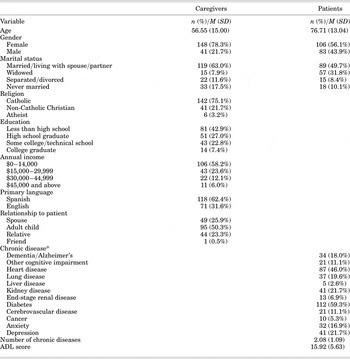
Table 1 presents the descriptive statistics for the sociodemographic and health-related variables. The mean age of caregivers was 56.5 years. The majority were female (78.3%) and reported being Catholic (75.1%). About two-thirds (63%) were married or living with a spouse/partner. About 43% had attained less than a high school education, and 27% were high school graduates. More than half of caregivers (58.2%) had an annual income less than $15,000, followed by 23.6% between $15,000 and 29,000. In terms of relationship to the patient, about half (50.3%) were an adult child and about 26% a spouse/partner.
Sociodemographic and health-related characteristics (N = 189)

* Note that participants could report more than one chronic disease.
The mean age of patients was 76.7 years. More than half (56.1%) were female, and almost half (49.7%) were married or living with a spouse/partner. In regard to chronic illness, more than half (59.3%) had diabetes, followed by heart (46%), kidney (21.7%), and lung (19.6%) disease. On average, patients reported two chronic problems (M = 2.08, SD = 1.09) and moderate difficulties with ADL (M = 15.92, SD = 5.63). In addition, about 22% reported depression and 16.9% anxiety.
EoL Care-Related Variables
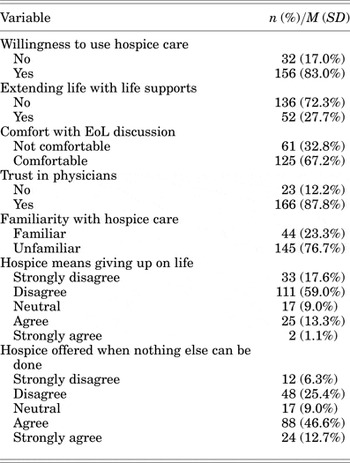
The descriptive statistics for the EoL care-related variables are reported in Table 2. The majority of caregivers (83%) were willing to utilize hospice care services for their loved ones. More than two-thirds (72.3%) of caregivers did not want their loved one to extend life with artificial treatments. About two-thirds (67.2%) reported that they felt comfortable with discussing EoL care options, and the majority (87.8%) trusted the doctor treating their loved one to make the right decisions about his/her healthcare if he/she were to get very sick. The majority (76.7%) reported that they were not familiar with hospice care. In terms of attitudes about EoL care, more than half (59.3%) agreed or strongly agreed that hospice is offered when nothing else can be done. The majority (76.6%) disagreed or strongly disagreed that receiving hospice care means giving up on life. Bivariate tests indicated that these EoL care-related variables were not significantly associated with the willingness to use hospice care (yes/no), except for the belief that hospice care means giving up on life. Those caregivers who did not consider hospice care as giving up on life were more likely to prefer using hospice services (χ2(4) = 11.92, p < 0.05).
End-of-life (EoL) care-related variables (N = 189)

Predictors of Willingness to Use Hospice Care
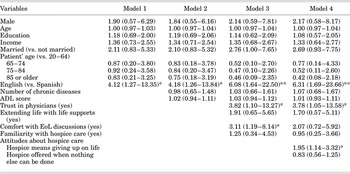
Table 3 presents the results of hierarchical logistic regression, including an estimated odds ratio (OR) and its 95% confidence interval (CI 95%) for each predictor, as well as model fit statistics. In Model 1, only language (OR = 4.12, CI 95% = 1.27–13.35) significantly predicted caregiver willingness to use hospice care. Those whose primary language was English were about four times more likely to prefer hospice care for a loved one. In Model 2, the addition of health-related variables (number of chronic illness and ADL total score) did not make a significant contribution to predicting caregiver willingness. Among the variables added in Model 3 (trust in physicians, preference for EoL care, comfort with EoL discussions, and familiarity with hospice care), only trust in physicians was a significant predictor (OR = 3.82, CI 95% = 1.10–13.27). Caregivers who trusted that physicians would make the best EoL decisions were about four times more likely to use hospice care services compared to those who did not.
Predictors for willingness to use hospice care

Note. Odds ratio (95% confidence interval). Attitudes toward hospice care were reverse coded.
*p < 0.05, **p < 0.01.
Model fit:
Model 1: −2 × log likelihood = 145.42; χ2(9) = 15.31, p = 0.83; Nagelkerke R 2 = 0.14.
Model 2: −2 × log likelihood = 145.13; χ2(11) = 15.60, p = 0.16; Nagelkerke R 2 = 0.14.
Model 3: −2 × log likelihood = 134.89; χ2(15) = 25.84, p = 0.40; Nagelkerke R 2 = 0.23.
Model 4: −2 × log likelihood = 129.40; χ2(17) = 32.33, p = 0.01; Nagelkerke R 2 = 0.27.
When attitudes about hospice care were introduced into the prediction (Model 4), the belief that hospice care basically amounts to giving up on life (OR = 1.95, CI 95% = 1.14–3.32) significantly predicted willingness to use hospice care. Caregivers who believed that hospice care means giving up on life were less likely to prefer hospice care compared to those who did not. The odds of willingness to use hospice services decreased by 95% per one scale-point increase (e.g., from “neutral” to “agree,” or “agree” to “strongly agree”). In this final model, language and trust in physicians still retained significance in terms of predicting willingness.
DISCUSSION
In response to the need for culturally competent practice in EoL care, our study explored the willingness to use hospice care among family caregivers of Latino patients. We found that the majority of caregivers (83%) were willing to utilize hospice services for their loved ones at the end of life. Although similar rates of willingness to use hospice care were reported in previous studies (Colón, Reference Colón2012; Colón & Lyke, Reference Colón and Lyke2013; Park et al., Reference Park, Jang and Ko2015), our finding is contradictory to Selsky et al. (Reference Selsky, Kreling and Luta2012), who showed that only 35% of Latino participants had an intention to use hospice care services. This discrepancy may be due to the current status of our participants as a caregiver and the distress they may have experienced while caregiving. While less than a third of the participants in the study by Selsky and colleagues (Reference Selsky, Kreling and Luta2012) had experience as a caregiver, all participants in our study were currently involved in caregiving for loved ones who were in a need of skilled nursing. Further, these patients had multiple chronic diseases and mental health issues, including cognitive impairments (e.g., dementia, Alzheimer's disease), depression, and anxiety (see Table 1), which may have imposed a burden on our participants in meeting patients' needs. Thus, our participants were perhaps more willing to use or even seek hospice services. This suggests that it is important for hospice practitioners to assess both patients’ and caregivers’ needs and tailor their services to meet the needs, including EoL decision making, psychological services, and symptom management.
Our study also found that the caregivers' primary language, their trust in physicians to make the best decisions, and the belief that hospice care means giving up on life significantly accounted for their willingness to consider using hospice care. Caregivers whose primary language was English were at least four times more likely to consider using hospice care services for their loved ones than those whose primary language was Spanish. Park and colleagues (Reference Park, Jang and Ko2015) also showed in a U.S. study that willingness to use hospice care increased about threefold with English proficiency among non-Cuban Hispanics. This suggests that people with language proficiency may have better access to healthcare information. A study by Carrion (Reference Carrion2010) found that language barriers impeded the ability of Latinos to obtain information or access hospice care. Our follow-up analysis revealed that caregivers who primarily spoke English reported being more familiar with hospice care services compared to those who primarily spoke Spanish (p = 0.05, marginally significant).
Trust in physicians to make the best EoL decisions was also found to increase willingness to use hospice care. It has been well documented that trust in healthcare professionals or healthcare systems plays an important role in the EoL decision-making process (Johnson et al., Reference Johnson, Kuchibhatla and Tulsky2008). A paternalistic approach to decision making is not uncommon among Latinos, and they are more likely to prefer physician-directed decision making than are whites (Levinson et al., Reference Levinson, Kao and Kuby2005). Therefore, when recommended by a trusted physician, it is not surprising for caregivers of Latino patients to consider hospice care. The preference of this ethnic group to delegate decisions about EoL treatment to physicians might be multifaceted, involving cultural traditions and values, literacy and language barriers, and other structural barriers. It will be important for clinicians to explore such social and cultural aspects when assisting patients and family members in the EoL decision-making process.
With regard to attitudes about hospice care, caregivers who believed that using hospice care means giving up on life were about half as likely to use hospice services than their counterparts. Latino caregivers often deny the fact of their loved one's impending death and shield them from being informed of his/her terminal illness due to a fear of potential harmful effects for the patient (Kreling et al., Reference Kreling, Selsky and Perret-Gentil2010). Instead, caregivers consider providing hope and encouragement to the patient as an important role to be played by the hospice staff (Gelfand et al., Reference Gelfand, Balcazar and Parzuchowski2004). This highlights the importance of assessing Latino caregivers' understanding about the functions and goals of hospice services. Given that the definition of hospicio in Spanish refers to an orphanage or a place for poor people, Latino caregivers and patients may misunderstand and believe that a hospice would provide substandard or inadequate treatment (Cruz-Oliver et al., Reference Cruz-Oliver, Talamantes and Sanchez-Reilly2014; Kreling et al., Reference Kreling, Selsky and Perret-Gentil2010). In our study, caregivers who were unfamiliar with hospice care were more likely to believe that receiving hospice care means giving up on life (χ2(4) = 16.44, p < 0.01). Thus, it is necessary for healthcare professionals to explore the family's EoL care preferences and its concordance with the patient's wishes, and discuss their needs and concerns about making an EoL decision. Healthcare professionals then need to provide a culturally appropriate intervention that would assist individuals in understanding the purpose and goals of hospice care as “preparing for what is to come.” Highlighting the strength-oriented aspects of EoL care (i.e., eliciting individuals' strengths, values, and goals and enhancing interpersonal relationship with family and friends) would further minimize any misconceptions about hospice care among Latino patients and their families.
LIMITATIONS OF THE STUDY
To our knowledge, this study is the first to examine willingness to use hospice care services among family caregivers of patients in the U.S.–Mexico border region. Despite its potential contribution to expanding our understanding about the prevalence and predictors of this willingness, our study has several weaknesses that should be addressed. First, the study design and sampling method we employed may limit the generalizability of our findings. The study analyzed a relatively small and convenient sample from a single site. Also, the patients were all Medicare recipients, and a family's willingness to use hospice care services might vary according to the patient's insurance status. To enhance generalizability, a future study needs to target multiple sites and a sufficiently large number of individuals sampled using a rigorous method (e.g., stratified cluster random sampling). Second, most of the study variables were measured by a single item, which might provide limited information or a partial picture about the constructs of interest. Hence, it would be beneficial for a future study to develop and utilize psychometrically validated measures of variables. Another limitation is the lack of considering caregiving-related variables. For example, caregivers of patients with severe illness experience burdens with various aspects (e.g., emotional, physical, economical) (Rabow et al., Reference Rabow, Hauser and Adams2004), and the intensity of the caregiving burden is significantly related to hospice use (Karikari-Martin et al., Reference Karikari-Martin, McCann and Hebert2012). Thus, a future study assessing caregiving-related variables and their associations with willingness to use hospice care would be beneficial.
CONCLUSIONS
Our study investigated the prevalence and factors contributing to willingness to use hospice care services among caregivers of Latino patients. Despite the relatively low level of familiarity with hospice care, the majority would consider using hospice care for their loved ones. Caregiver willingness was influenced by such culturally related factors as language, beliefs about hospice services, and trust in physicians regarding EoL decision making. Speaking English as a primary language may increase information access. Cultural notions about hospice care need to be examined, because those with a negative perspective on hospice care are less likely to utilize hospice services. In addition, our finding that trust in physicians positively impacts willingness to use hospice care services highlights the importance of healthcare professionals' engagement in EoL care planning with patients and their families.
ACKNOWLEDGMENTS
We would like to thank the caregivers for their participation and the staff members at AccentCare for their support.