Hypertrophic cardiomyopathy is a heterogeneous condition defined by the presence of left ventricular hypertrophy in the absence of congenital heart disease or abnormal loading conditions sufficient to cause the observed degree of hypertrophy; this disease diversity of the disease is most apparent in childhood.Reference Elliott, Andersson and Arbustini 1
Hypertrophic cardiomyopathy is the most frequently encountered genetic cardiac disease,Reference Maron 2 , Reference Maron, Towbin and Thiene 3 with a prevalence of 1:500 in the general population.Reference Maron 2 Recent studies on children suggest a lower incidence for disease onset during childhood, with a rate of three to five cases per 1 million children.Reference Melacini, Basso and Angelini 4
The clinical presentation and natural history is particularly heterogeneous, ranging from benign asymptomatic forms to more malignant expressions that may result in premature death through several pathways.Reference Elliott, Andersson and Arbustini 1 , Reference Maron 2 , Reference Spirito, Bellone, Harris, Bernabo, Bruzzi and Maron 5 Previous studies have reported that children with hypertrophic cardiomyopathy have up to a 6% annual mortality rate,Reference Ostman-Smith, Wettrell and Riesenfeld 6 although more recent data suggest that the mortality rate is closer to 1%.Reference Nugent, Daubeney and Chondros 7 , Reference Colan, Lipshultz and Lowe 8
Sudden cardiac death is often and typically associated with sports or vigorous exertion.Reference Elliott, Andersson and Arbustini 1 However, in a minority of children with hypertrophic cardiomyopathy, progressive cardiac failure may be the cause of non-sudden death.Reference Melacini, Basso and Angelini 4 Risk factors for sudden cardiac death have been identified in large cohorts of adult patients with hypertrophic cardiomyopathy.Reference Maron, McKenna and Danielson 9 , Reference Nasermoaddeli, Miura and Matsumori 10 Although several studies have attempted to risk-stratify children with hypertrophic cardiomyopathy by identifying clinical and laboratory risk factors,Reference Colan, Lipshultz and Lowe 8 , Reference Maron, McKenna and Danielson 9 , Reference Monserrat, Elliott, Gimeno, Sharma, Penas-Lado and McKenna 11 , Reference Ostman-Smith, Wettrell, Keeton, Riesenfeld, Holmgren and Ergander 12 most have not been validated.Reference Harris, Spirito and Maron 13 In addition, Egyptian children may differ from Western and Asian patients in the pattern of hypertrophy distribution, clinical manifestations, and risk factors. Our study aimed to report the clinical characteristics and outcomes of Egyptian children with hypertrophic cardiomyopathy over a period of 7 years and determine whether the reported adult risk factors for sudden cardiac death are predictive of the outcome in these affected children.
Patients and methods
This present retrospective study reviewed the clinical data of 128 hypertrophic cardiomyopathy children out of 620 patients with all types of cardiomyopathies – dilated cardiomyopathy, hypertrophic cardiomyopathy, and restrictive cardiomyopathy – who were visiting the cardiomyopathy clinic of the Department of Pediatrics, Faculty of Medicine, Cairo University Children Hospital, which is a tertiary referral centre for children, over a period of 7 years, that is, between June, 2004 and June, 2011.
The inclusion criteria were age ≤14 years at the time of diagnosis and echocardiographic evidence of either concentric left ventricular hypertrophy or asymmetric septal hypertrophy – with a median septal thickness 1.4 times that of the posterior wall, which is defined as a diastolic septal thickness or left ventricular diastolic wall thickness Z-score >2 and a wall thickness >2 SD above the normal population mean for body surface area,Reference Grenier, Osganian and Cox 14 in the absence of a defined haemodynamic cause such as hypertension, congenital heart disease, or exposure to drugs known to cause cardiac hypertrophy. The study was approved by the ethical committee at Cairo University.
The collected data included demographic features and all information relevant to the cardiomyopathy, including personal history – age, sex, and symptoms – family history, past history – history of prior cardiac arrest or syncope, and physical examination. Every patient was also subjected to standard 12-lead electrocardiograph and Holter monitoring.
The echocardiographic examination included two-dimensional, Doppler, and M-mode echocardiography performed at rest using standard methods. In addition, the left ventricular posterior wall and septal echocardiographic parameters and degree of left ventricular outflow tract obstruction were determined. Left ventricular outflow tract obstruction or right ventricular outflow tract obstruction was defined as a peak resting gradient ≥16 mmHg with a peak velocity ≥2 m/second. Aortic and mitral regurges were reported as normal or mild, moderate, and severe. All studies were interpreted by the same paediatric cardiologist. The outcomes of the patients were also reported.
Statistical methods
Body surface area was calculated from height and weight. A Z-score is a statistical measurement of a score's relationship to the mean value of a group of scores. A Z-score of 0 implies that the score is the same as the mean. A Z-score can also be positive or negative, indicating whether it is above or below the mean and by how many standard deviations. The left ventricular end-diastolic dimension, free wall thickness, and septal thickness were expressed as Z-scores relative to the distribution of these measurements versus body surface area in normal childrenReference Sluysmans and Colan 15 . Fractional shortening was expressed as a Z-score relative to age.Reference Carvalho, Diógenes, Jucá, Carvalho, Carvalho and Paes Júnior 22
Statistical Package of Social Science program version 9.0 was used for analysis of data. Data were summarised as mean, standard deviation, and percentage. The t-test was used for analysis of two quantitative variables. Categorical variables were described as numbers and percentages. The non-parametric Mann–Whitney U-test was used when the variables were not symmetrically distributed. The χ 2-test was used for analysis of qualitative data. Logistic regression analysis was used for the detection of risk factors of death. Kaplan–Meier survival curves were also generated for analysis. Individual Z-score measurements were run in Kaplan–Meier survival analysis to determine a statistically significant Z-score. A p-value was considered significant if it was ≤0.05.
Results
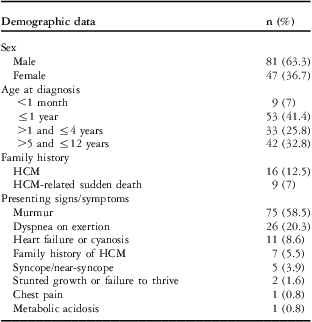
Over a period of 7 years 142 patients were diagnosed with hypertrophic cardiomyopathy, of whom 128 patients met the inclusion criteria for hypertrophic cardiomyopathy. Clinical characteristics of the patient population are listed in Table 1. The patients had an average age of 5.9 ± 3.4 years with a range of 7 days–14 years. Among the patients, 81 (63.3%) were boys and 47 (36.7%) were girls.
Demographic features of the studied patients.

HCM = hypertrophic cardiomyopathy
The different aetiologies of hypertrophic cardiomyopathy patients – as suspected clinically and from the available diagnostic tools – were idiopathic hypertrophic cardiomyopathy, accounting for 77.3% of the cases (n = 99); inborn errors of metabolism, 15.6% (n = 20); malformation syndromes, 5.4% (n = 7); and neuromuscular disorders, 1.5% (n = 2). Congestive cardiac failure at diagnosis was the main presentation in non-idiopathic hypertrophic cardiomyopathy patients, 11 out of 29 patients (37.9%).
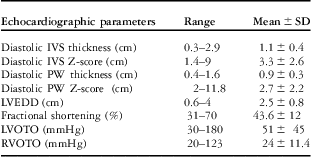
The echocardiographic data are presented in Table 2. Asymmetrical septal hypertrophy of interventricular septal wall, with a median septal thickness 1.4 times that of the posterior wall, was recorded in 85 patients (66.5%). Concentric hypertrophy was present in 43 patients (33.5%). Right ventricular hypertrophy was reported in 15 patients: nine patients had mild hypertrophy and six had moderate-to-severe hypertrophy. Mitral regurge was reported in 60 patients (46.9%), whereas aortic regurge was reported in 25 patients (19.5%).
Echocardiographic parameters of the studied patients.

IVS = inter-ventricular septum; LVEDD = left ventricular end-diastolic dimension; LVOTO = left ventricular outflow tract obstruction; PW = posterior wall; RVOTO = right ventricular outflow tract obstruction; SD = standard deviation
Outcome
During the follow-up period, 37 patients (28.9%) remained asymptomatic, three patients developed dilated cardiomyopathy, and the remaining 88 patients complained of chest pain, fatigue, dyspnoea on exertion, and palpitations.
Cryoablation was performed in two patients: one patient died intra-operatively and the second developed a cardiac block with pacemaker implantation. Surgical myotomy–myectomy resection of left ventricular outflow tract with and without a patch to enlarge it was performed in eight patients: three of them died and the other three required pacemakers. Of these eight patients, five were operated upon by an internationally recognised surgeon aiming to train our surgical team, one patient was operated upon in France, and the remaining two patients were operated upon by our surgeons after the training.
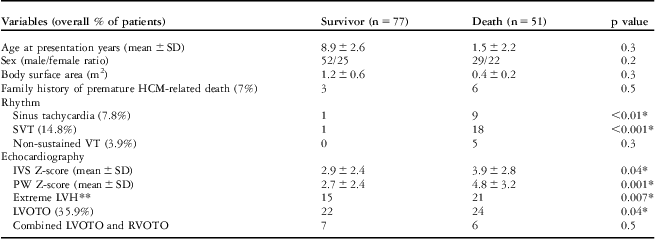
Of the 128 patients, 51 died during the period of the study: 29 (56.9%) boys and 22 (43.1%) girls. Of them, 36 (70.5%) were diagnosed before the age of 1 year. The frequency of the reported risk factors for death is summarised in Table 3. A total of 34 patients (66.6%) died of sudden cardiac death.
Prevalence of different risk factors of death.

HCM = hypertrophic cardiomyopathy; IVS = inter-ventricular septum; LVH = left ventricular hypertrophy; LVOTO = left ventricular outflow tract obstruction; PW = posterior wall; RVOTO = right ventricular outflow tract obstruction; SD = standard deviation; SVT = supraventricular tachycardia; VT = ventricular tachycardia
*p < 0.05
**Patients with Z-score >6 for IVS and/or PW thickness
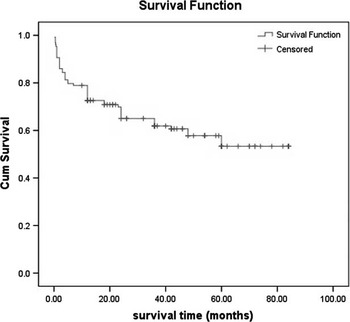
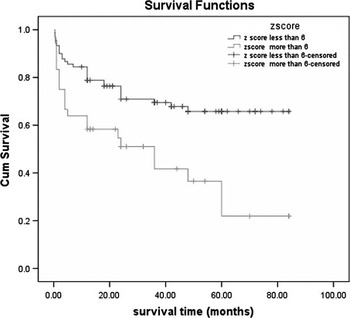
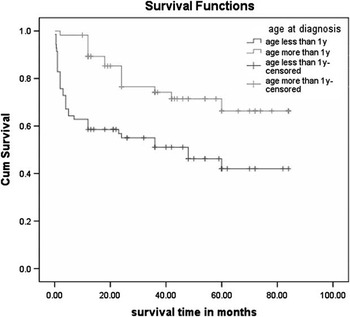
On applying the Kaplan–Meier survival analysis, it was seen that the mean survival was 53.4 months (95% CI, 46.9–59.8). The 1-year, 3-year, and 7-year survival rates were 73%, 62%, and 53.3%, respectively (Fig 1). The survival was significantly lower in patients with an extreme left ventricular hypertrophy, that is, a Z-score >6 for interventricular spectrum and/or posterior wall thickness (p = 0.001) (Fig 2). Patients presenting at >1 year of age had significantly better survival than those presenting at ≤1 year of age (mean survival 64.7 month versus 43.7 month; p = 0.001) (Fig 3).
Kaplan–Meier survival analysis for the cumulative survival over the study period.

Kaplan–Meier survival analysis for left ventricular wall thickness.

Kaplan–Meier survival analysis for patients presenting at age >1 year and at age of ≤1 year with a left ventricular wall thickness.

In the univariate analysis, sinus tachycardia (p = 0.01), supraventricular tachycardia (p = 0.001), the mean interventricular septal wall Z-score (p = 0.04), the mean posterior wall Z-score (p = 0.001), extreme left ventricular hypertrophy (p = 0.007), and left ventricular outflow tract obstruction (p = 0.04) were significant mortality-related risk factors (Table 3).
The multivariate analysis of the significant variables described above showed that extreme left ventricular hypertrophy (OR 1.08; 95% CI, 1.32–6.57; p = 0.008), the mean interventricular septal wall Z-score (OR 1; 95% CI, 1.1–6.9; p = 0.03), sinus tachycardia (OR 4; 95% CI, 6.4–478.4; p = 0.001), and supraventricular tachycardia (OR 4.7; 95% CI, 13.5–910.1; p = 0.007) were independent risk factors for prediction of death in patients with hypertrophic cardiomyopathy.
Discussion
After 50 years of recognition and study of hypertrophic cardiomyopathy disease, it is evident that hypertrophic cardiomyopathy is a particularly heterogeneous and unpredictable disease with respect to its clinical expression and natural history.Reference Maron 2 , Reference Maron, McKenna and Danielson 9 In our study on 128 hypertrophic cardiomyopathy children, it was seen that the most common reason for diagnostic echocardiography was the accidental detection of cardiac murmur (58.5%), dyspnoea on exertion (20.3%), cardiac failure (8.6%), and family history of hypertrophic cardiomyopathy (5.5%). This is in accordance with the results of many previously published reports.Reference Maron, Tajik and Ruttenberg 16 – Reference Decker, Rossano and Smith 18 Early occurrence of cyanosis and cardiac failure was a bad predictor of the outcome.Reference Colan, Lipshultz and Lowe 8 , Reference Maron 19 , Reference Maron and Spirito 20
In this study, we found one patient with a rare combination of severe hypertrophic cardiomyopathy, no left ventricular outflow tract obstruction, tricuspid atresia, rudimentary right ventricle, a small pulmonary artery arising anteriorly from the right ventricle with a dual supply from patent ductus arteriosus and forward flow from right ventricle, dilated coronary arteries, and evidence of coronary steel into the right ventricle. The patient died shortly after the diagnosis and no post-mortem autopsy was performed. Hypertrophic cardiomyopathy was reported before in association with Fallot Tetralogy in two patientsReference Lewin, Towbin, Thapar, Dreyer and Feltes 21 : tetralogy of Fallot with both right and left ventricular hypertrophy but absence of other forms of congenital cyanotic heart diseases.Reference Carvalho, Diógenes, Jucá, Carvalho, Carvalho and Paes Júnior 22 , Reference Will, Serrian and Dawson 23
Previously thought to be a rare disorder, hypertrophic cardiomyopathy is now believed to occur with an incidence of one in 500 in the general population and remains the most common cause of sudden death in children and young adults <35 years of age.Reference Nishimura and Holmes 24 In the present study, the mean survival was 53.4 months (95% CI, 46.9–59.8). The 1-year, 3-year, and 7-year survival rates were 73%, 62%, and 53.3%, respectively, with an annual mortality rate of 5.7%.
These results are in accordance with those of previously reported studies on children with idiopathic hypertrophic cardiomyopathy in which the annual mortality rate was 3–8%Reference McKenna 25 , Reference Yetman, Hamilton, Benson and McCrindle 26 . More recently, two large series showed a much lower annual mortality rate of 1–1.5%.Reference Nugent, Daubeney and Chondros 7 , Reference Colan, Lipshultz and Lowe 8 Our higher mortality rate may be explained by the inclusion of metabolic cases of hypertrophic cardiomyopathy with poor prognosis, late diagnosis of hypertrophic cardiomyopathy patients after development of complications, non-compliance to medical treatment, negligence of follow-up, and the small number of surgically corrected patients, because of long waiting lists for surgery as a result of limited number of expert surgeons and the high cost of defibrillators.
Several prior reports have indicated that hypertrophic cardiomyopathy presenting in infancy carries a worse prognosis than in older age groups; however, the reported mortality rates have varied dramatically from 0% to 89%.Reference Maron 19 , Reference Moran and Colan 27 These disparities likely are due to the fact that small series fail to reflect the wide variation in cause-specific survival.Reference Colan, Lipshultz and Lowe 8 In our study, the prognosis for children with hypertrophic cardiomyopathy was worse in those presenting before 1 year of age; the survival rate was 48.6% compared with 73.7% in those presenting after 1 year of age. This was in accordance with the results of a large epidemiological series of 855 children in which the survival rate was significantly higher in children who presented after 1 year of age (99%) compared with those presenting before the age of 1 year (85%).Reference Colan, Lipshultz and Lowe 8
Prognostic factors
Predicting which patients with hypertrophic cardiomyopathy are at greatest risk of sudden cardiac death has been the major focus of investigations on adults and children. The risk factors in adult studies are well described.Reference Decker, Rossano and Smith 18 Studies have been inconsistent in children, who may reflect the varying aetiologies of hypertrophic cardiomyopathy.Reference Nugent, Daubeney and Chondros 7 , Reference Colan, Lipshultz and Lowe 8 , Reference Monserrat, Elliott, Gimeno, Sharma, Penas-Lado and McKenna 11 , Reference McMahon, Nagueh and Pignatelli 28 In this study, sudden cardiac death was more common than non-sudden cardiac death in children. On applying the known adult risk factors, the univariate analysis revealed that sinus tachycardia, supraventricular tachycardia, the mean interventricular septal wall Z-score, the mean posterior wall Z-score, extreme left ventricular hypertrophy, and left ventricular outflow tract obstruction were significant mortality-related risk factors. On multivariate analysis; extreme left ventricular hypertrophy, the mean interventricular septal wall Z-score, sinus tachycardia, and supraventricular tachycardia were independent risk factors of death in patients with hypertrophic cardiomyopathy.
This study showed that extreme left ventricular hypertrophy (Z-score >6) was a risk factor of premature death. Extreme left ventricular hypertrophy, which is defined in adult studies as an absolute left ventricular wall thickness of 30 mm, was seen to be an adult risk factor of death.Reference Maron, McKenna and Danielson 9 A direct relationship between left ventricle wall thickness and the risk of sudden death or cardiac failure-related death has been reported in patients with hypertrophic cardiomyopathy.Reference Spirito, Bellone, Harris, Bernabo, Bruzzi and Maron 5 Olivotto et al proposed that the presence of left ventricular hypertrophy might be a potential risk factor for sudden death only in patients diagnosed with hypertrophic cardiomyopathy at a very young age.Reference Olivotto, Gistri and Petrone 29
Absolute values in children are not as useful because of the changing body surface area. This is in agreement with the results of Decker et al, whose study was the first to show a significant association between the left ventricular wall thickness indexed to body surface area, defined as a Z-score >6, and premature death or transplantation in children with isolated hypertrophic cardiomyopathy.Reference Decker, Rossano and Smith 18 Our data disagreed with the results of Nasermoaddeli et al, who found that left ventricle wall thickness did not show a significant relationship with prognosis in elderly patients.Reference Nasermoaddeli, Miura and Matsumori 10 This may be explained by studying different age groups of patients.
In this study, sinus tachycardia and supraventricular tachycardia were significant predictors of death. Hypertrophic cardiomyopathy was seen to be associated with arrhythmia-related consequences, particularly sudden death. Ventricular tachyarrhythmias on Holter electrocardiograph have been reported as markers for sudden death in highly selected hypertrophic cardiomyopathy populations.Reference Adabag, Casey, Kuskowski, Zenovich and Maron 30 The triggers for potentially lethal ventricular tachyarrhythmias are poorly understood, although sinus tachycardia has been identified as an initiating rhythm in some cases, suggesting that a high sympathetic drive can be proarrhythmic and may provide a possible clue to the mechanisms of sudden death in athletes with hypertrophic cardiomyopathy.Reference Cha, Gersh and Maron 31 The inability to place defibrillators in time was mainly because of its very high cost and the incredible bureaucracy faced to obtain a government-sponsored device.
Study limitations
This study was a retrospective survival analysis, the limitations of which are mainly that it was restricted to a single institution, a tertiary centre, and the number of patients who underwent catheterisation was not enough for statistical analysis. Moreover, exercise testing could not be achieved because of the young age of the patients in this study. Long waiting lists for surgery affected the end number of patients who underwent surgical intervention. Finally, some missing data in the records and follow-up sheets limited a thorough analysis of all parameters.
Conclusion
At our Egyptian tertiary care centre, hypertrophic cardiomyopathy had a relatively worse prognosis than what has been reported in Western and Asian series. Infants had a worse outcome than children presenting after the age of 1 year. A poor prognosis in childhood hypertrophic cardiomyopathy was predicted by the presence of an extreme left ventricular hypertrophy.
Acknowledgements
The operative procedures were performed by our surgical team including Sir Magdi Yacoub, who trained the surgical team to manage hypertrophic cardiomyopathy patients in Egypt.