INTRODUCTION
More than 800 million people worldwide depend on forests for food, fuel and income (TEEB 2010). Traditional woodfuels, including firewood and charcoal, account for 55% of harvested wood (FAO 2013). Between 27% and 34% of pan-tropical traditional woodfuels are harvested unsustainably (Bailis et al. Reference Bailis, Drigo, Ghilardi and Masera2015). Forest protection necessitates restrictions on non-timber forest product (NTFP) extraction, with resulting welfare implications for local communities and trade-offs between conservation and human wellbeing (Schelhas & Pfeffer Reference Schelhas and Pfeffer2009; McShane et al. Reference McShane, Hirsch, Trung, Songorwa, Kinzig, Monteferri, Mutekanga, Thang, Dammert and Pulgar-Vidal2011; Hosonuma et al. Reference Hosonuma, Herold, De Sy, De Fries, Brockhaus, Verchot, Angelsen and Romijn2012).
Economic valuation of the total value of forests at multiple scales can improve understanding of these trade-offs, enabling calculation of the cost–benefit ratio of protection at both global and local levels (Naidoo & Ricketts Reference Naidoo and Ricketts2006). Appreciating the economic contribution of NTFPs to wellbeing is essential if compensation is to be provided for restricted extraction, such as through payments for ecosystem services (PES) initiatives (Wunder Reference Wunder2013). However, wellbeing is multifaceted, and may be defined as “a state of being with others, which arises where human needs are met, where one can act meaningfully to pursue one's goals, and where one can enjoy a satisfactory quality of life” (McGregor Reference McGregor2008). There is growing consensus that evaluating the impacts of conservation interventions on wellbeing should include both objective and subjective components of people's lives (Agarwala et al. Reference Agarwala, Atkinson, Fry, Homewood, Mourato, Rowcliffe, Wallace and Milner-Gulland2014; Woodhouse et al. Reference Woodhouse, Homewood, Beauchamp, Clements, McCabe, Wilkie and Milner-Gulland2015; Lange et al. Reference Lange, Woodhouse and Milner-Gulland2016). Here, we present a novel approach to the assessment of forest protection trade-offs that incorporates these linked material- and perception-based indicators of wellbeing by comparing perceived need for firewood with actual usage.
Examination of forest protection trade-offs must also incorporate concerns regarding leakage, when the benefit of protecting one forest area is negated by the displacement of resource extraction elsewhere (Ewers & Rodrigues Reference Ewers and Rodrigues2008). Robinson and Kajembe (Reference Robinson and Kajembe2009) identify four possible effects of forest access restrictions at the village level: (1) villagers displace extraction elsewhere (leakage); (2) villagers replace extraction with increased purchase from markets, potentially intensifying pressure on other forests supplying those markets; (3) villagers reduce extraction quantities, with potentially negative welfare impacts; and (4) villagers cultivate more resources on their own or village land. In addition to these, we identify two further possible effects, whereby: (5) villagers do not comply with management and continue extraction activities; and (6) in the case of extraction for fuel, villagers switch to alternatives where available (e.g. gas). To predict these effects and inform management decisions, spatial–temporal models of NTFP use help to define a landscape that does not solely account for ecological characteristics, but includes interactions between these and socioeconomic conditions (Robinson et al. Reference Robinson, Albers and Williams2011). Models indicate that if labour and resource markets function efficiently, then extraction restrictions will not lead to leakage; however, imperfect and costly markets will lead to displacement of activities into unprotected areas (Robinson et al. Reference Robinson, Albers and Williams2011; Albers & Robinson Reference Albers and Robinson2013).
In this paper, we present a novel method for examining the impact of protected status on wellbeing and the implications for leakage. We do this by analysing household ability to meet NTFP needs in the vicinity of forests of mixed protected status in rural Tanzania. NTFPs, such as firewood and charcoal, account for over 90% of total energy consumption in Tanzania (Felix & Gheewala Reference Felix and Gheewala2011). Fuel-efficient stoves can increase cooking efficiency by 30–75%, and a range of development efforts promote the use of such stoves in Tanzania (Jetter & Kariher Reference Jetter and Kariher2009; Still et al. Reference Still, MacCarty, Ogle, Bond and Bryden2011). However, on average, the population of Tanzania and its largest city Dar es Salaam has increased annually by 2.7% and 5.6% respectively between 2002 and 2012 (NBS 2013). Such population growth is predicted to increase pressure on forest resources, acting as a major driver of forest degradation (Hosier et al. Reference Hosier, Mwandosya and Luhanga1993; Felix & Gheewala Reference Felix and Gheewala2011).
Tanzania is now piloting methods for policies aimed at reducing emissions from deforestation and degradation (REDD+) linked to its existing participatory forest management (PFM) programme (Burgess et al. Reference Burgess, Bahane, Clairs, Danielsen, Dalsgaard, Funder, Hagelberg, Harrison, Haule, Kabalimu, Kilahama, Kilawe, Lewis, Lovett, Lyatuu, Marshall, Meshack, Miles, Milledge, Munishi, Nashanda, Shirima, Swetnam, Willcock, Williams and Zahabu2010). Early lessons from REDD+ pilot projects indicate that new challenges have emerged, with trade-offs arising between long-term protection and short-term needs, as well as concerns for leakage (Blomley et al. Reference Blomley, Edwards, Kingazi, Lukumbuzya, Mäkelä and Vesa2016). With high dependence on firewood for energy in our study villages, we compare household perceived need for firewood with actual consumption in order to provide a simple metric of ability to meet firewood needs (henceforth: firewood sufficiency). The effect of household variables and forest protection status on firewood sufficiency is analysed, and the implications for wellbeing and leakage in this landscape of forests with mixed protection status is assessed.
METHODS
Study area
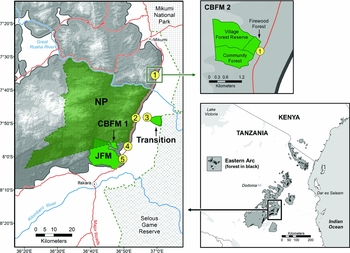
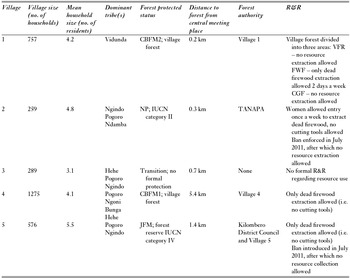
Data were collected in five forest-adjacent villages in the Kilombero and Kilosa districts (Morogoro region; Fig. 1), neighbouring the biodiversity-rich Eastern Arc Mountains (Burgess et al. Reference Burgess, Butynski, Cordeiro, Doggart, Fjeldså, Howell, Kilahama, Loader, Lovett, Mbilinyi, Menegon, Moyer, Nashanda, Perkin, Rovero, Stanley and Stuart2007). Villages were selected to maximize variation in protected status whilst minimizing geographic spread so as to avoid high variation in ecological and social factors. To preserve household anonymity, villages were identified by number and adjacent forests by their protection status: one forest a national park (NP), one forest under joint forest management (JFM), two forests under community-based forest management (CBFM; CBFM1 and CBFM2) and the remaining forest in under management transition (transition forest; Table 1).
Location of the five study villages and adjacent forests. Adapted using data on Eastern Arc Mountain boundaries and forests from Platts et al. (Reference Platts, Burgess, Gereau, Lovett, Marshall, McClean, Pellikka, Swetnam and Marchant2011), Protected Area boundaries from UNEP-WCMC (2010), transition forest and Selous Game Reserve boundaries with the assistance of the Udzungwa Forest Project and Village 1 forest boundaries from WWF (2006). Data on spatial infrastructure provided with the assistance of the Valuing the Arc project (http://www.valuingthearc.org).

Description of study villages and adjacent forests. NP = national park; CBFM = community-based forest management; IUCN = International Union for Conservation of Nature; JFM = joint forest management; TANAPA = Tanzania National Park Authority; R&R = rules and regulations (defined through interview with forest authority representatives); VFR = village forest reserve; FWF = firewood forest; CGF = community group forest.

One year prior to NP gazzettement in 1992, the World Wide Fund for Nature (WWF) and the Tanzanian National Park Authority (TANAPA) began a 10 year project promoting tree nurseries and fuel-efficient stoves in villages on the eastern border of the park, to reduce dependence on the forest (Harrison Reference Harrison2006). During this time, TANAPA allowed villagers weekly entry to extract dead firewood. This concession continued until June 2011, when it was banned given concerns for the impact on biodiversity (Rovero et al. Reference Rovero, Nyundo and Kitegile2008). All five study villages exist in this area east of the NP. Agriculture is the predominant livelihood activity in these districts, and pressure on resources is high (Gorenflo & Orland Reference Gorenflo and Orland2013).
Data collection
Between March and December 2011, 500 household questionnaires were administered across study villages in order to gauge NTFP use and household-level socioeconomic and demographic variables. In each village, focus groups were used to jointly identify village-specific wealth indicators, such as asset ownership, and households were assigned to either a high-income or low-income wealth category with the assistance of village councils. Total village household lists were then stratified by sub-village and wealth (after Lund et al. Reference Lund, Larsen, Chhetri, Rayamajhi, Nielsen, Olsen, Uberhuaga, Puri and Córdova2008), and random number generation was used to select 100 household heads/village as respondents. This number of questionnaires was chosen to maximize variability in responses whilst maintaining a logistically viable sample size.
Questionnaires were administered by enumerators local to each village in the wet (May–June) and dry (November) season to capture seasonal variation in NTFP use. The geographic coordinates of all 500 households were recorded. Multiple questions relating to NTFP use were asked to facilitate triangulation of data. Households were asked to identify their major source of cooking energy, how this was obtained and the monthly quantity consumed. Households were asked to identify all nearby forests, whether they extracted from that forest and products extracted. Households were also asked to recall their NTFP use each month in that season. Specifically, for each product, households were asked to recall the quantity extracted per month, the frequency of extractions and the extraction location. Households were also asked to recall the quantities purchased, sold and consumed per month. Finally, households were asked the perceived quantity needed per month. The aim of this data collection method was to compare like-for-like quantities, rather than econometric valuation. Rapid assessment methods, such as those employed here, have been shown to have good congruence with more detailed assessment in comparison with interview-based methods (Jones et al. Reference Jones, Andriamarovololona, Hockley, Gibbons and Milner-Gulland2008).
Data analysis
NTFP utilization and protected area compliance
Households were coded into those that either solely extracted NTFPs, solely bought NTFPs or both extracted and bought NTFPs. Extraction location for each product was coded by the forest protection status (NP, CBFM1, CBFM2, JFM or transition) or household agricultural fields or private woodlot (Fields/Private) or purchase (Buy). The percentage of households extracting each NTFP was calculated by extraction location. Compliance with management rules and regulations was inferred through reporting of number of NTFPs extracted, being firewood only or multiple products. This measure of compliance is susceptible to under-reporting, as despite best efforts to elicit truthful answers through data triangulation and use of local enumerators, some households may have under-reported their NTFP use, or indicated extracting from non-forest areas for fear of repercussions.
Firewood sufficiency
The mean quantities of firewood extracted, bought, sold, consumed and needed per household were calculated across both wet and dry seasons to provide average monthly rates (bundles/month). Reported household firewood consumption was cross-validated via calculation of quantities extracted, bought and sold. Household firewood sufficiency was calculated by deducting household perceived mean quantity of firewood needed/month from mean quantity consumed/month. This method builds on other household-scale approaches to define firewood sufficiency by going beyond a purely qualitative understanding (Dovie et al. Reference Dovie, Witkowski and Shackleton2004). Whilst moving towards a more rigorous quantitative approach, the method explicitly retains a subjective component that is common to recent definitions of wellbeing by allowing respondents to estimate their own need (Agarwala et al. Reference Agarwala, Atkinson, Fry, Homewood, Mourato, Rowcliffe, Wallace and Milner-Gulland2014; Milner-Gulland et al. Reference Milner-Gulland, McGregor, Agarwala, Atkinson, Bevan, Clements, Daw, Homewood, Kumpel, Lewis and Mourato2014). Negative sufficiency indicated a deficit in household firewood needs, zero values indicated that needs were met and positive values indicated a surplus of firewood. Households were then grouped by extraction location, and one-way analysis of variance and Tukey post hoc tests used to compare differences in mean household firewood sufficiency between extraction locations.
Between the wet and dry season surveys, the aforementioned firewood collection ban commenced in the NP and also JFM. If households indicated a switch in extraction location from either NP or JFM between surveys, the difference between mean wet season firewood sufficiency and mean dry season firewood sufficiency was tested using Student's t-tests. All statistical analyses were carried out using R (version 3.0.0; http://cran.r-project.org).
Determinants of firewood sufficiency
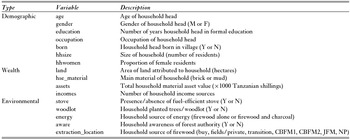
Further analysis was carried out to determine what factors might predict household firewood need, consumption and sufficiency independently. A broad set of 16 household-level demographic, wealth and environmental predictor variables were chosen based on previous investigations into NTFP consumption correlates (e.g. Foerster et al. Reference Foerster, Wilkie, Morelli, Demmer, Starkey, Telfer, Steil and Lewbel2012; Table 2). All variables were coded from household questionnaire data. Dependence on NTFPs for energy was represented by whether households used firewood alone as their major energy source or in combination with charcoal. Previous analysis found variation in household awareness of each forest management authority in this study sample, with clear awareness of NP status, yet no awareness of JFM and low engagement in PFM (Latham Reference Latham2013). Given this, awareness was also included as a binary variable in all models.
Description of household predictor variables (1 Tanzanian shilling was equal to mean 0.000635 US dollars during the period of data collection [March–December 2011]). M = Male; F = Female; Y = Yes; N = No; NP = national park; CBFM = community-based forest management; JFM = joint forest management.

Covariation between-predictor variables were assessed using Pearson correlation and variance inflation factors (VIFs), and all variables were retained (Pearson p ≤ 0.7 and/or VIF ≤ 5) (Zuur et al. Reference Zuur, Ieno and Elphick2010). Variables with uneven spread (occupation, 98% farmer) were excluded from models. Before modelling, variables with a strong skew were transformed as follows: age, hhsize (i.e. household size), assets (square root), land (cube root) and response variables firewood need, firewood consumption (log10) and firewood sufficiency (cube root).
Generalized linear models (GLMs) with a Gaussian error function were used to investigate the influence of the same predictor variables on: (1) firewood need; (2) firewood consumption; and (3) firewood sufficiency. Spline correlograms (ncf package; Bjornstad Reference Bjornstad2012) were used to test for spatial autocorrelation, as observations of households facing equivalent socioeconomic and environmental factors might not be independent. Significant spatial autocorrelation was present at short lag distances of 3 km, 4 km and 4 km for need, consumption and sufficiency data, respectively. With only five villages sampled, it was not appropriate to include village as a random factor using generalised linear mixed models (e.g. Crawley Reference Crawley2002). However, spline correlograms of the Pearson residuals suggested spatial correlation was successfully accommodated by each GLM through the inclusion of the extraction_location variable.
Minimum adequate models were obtained using backwards–forwards selection based on the Akaike information criterion (Murtaugh Reference Murtaugh2009). Some levels within the categorical variable extraction_location did not contribute to final models, and so seven independent binary variables (‘True’ or ‘False’) were created (‘Buy’, ‘Fields/Private’, ‘Transition’, ‘CBFM1’, ‘CBFM2’, ‘JFM’ and ‘NP’), and backwards–forwards selection was repeated. Final models were validated through observation of residual spread. Analyses of deviance were used to test the probability that the amount of deviance explained was not significantly reduced from the full (unreduced) model (p[D]) (Zuur et al. Reference Zuur, Ieno and Elphick2010). The probability that the slope estimate of each variable was significantly different from zero was determined, based on a t distribution (Quinn & Keough Reference Quinn and Keough2002). The false discovery rate (Benjamini & Hochberg Reference Benjamini and Hochberg1995) correction of α values for repetitive testing was employed on slope estimates for each model in turn, resulting in 95% significance α cut-offs of 0.05, 0.039 and 0.025 for need, consumption and sufficiency models, respectively.
RESULTS
NTFP utilization and protected area compliance
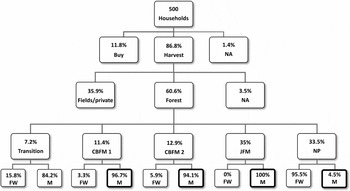
All households were dependent on NTFPs as their main source of energy; 48% stated use of both firewood and charcoal, 47% stated use of firewood only and 5% stated use of charcoal only. Of the 500 households surveyed, 434 (86.8%) indicated extracting NTFPs, of which 166 (38.2%) households supplemented with additional purchases, and 59 households (11.8%) only purchased NTFPs (1.4% unanswered; Fig. 2). Over half of households extracting NTFPs obtained these from a forest (n = 263; 60.6%); of which 60.8% (32% of the total sample) were non-compliant with forest management by indicating extraction of more than just dead firewood. The remainder of households extracting NTFPs did so from agricultural fields or private woodlots (n = 156; 35.9%; 3.5% unanswered).
Schematic representation of non-timber forest product use by all households, including extraction location. Bold boxes = non-compliant resource extraction according to the rules and regulations defined in Table 1.

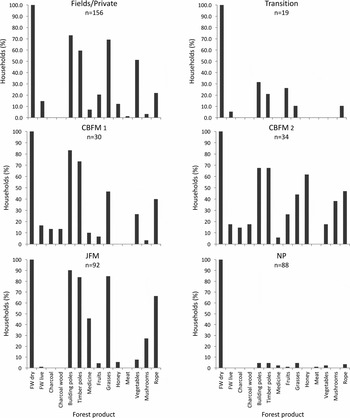
Households indicated extracting multiple NTFPs from the PFM forests (JFM, CBFM1 and CBFM2; Fig. 3). All households using these forests, except for one using the CBFM1 forest and two using the CBFM2 forest, indicated non-compliance with the rules and regulations. Households using the transition forest stated similar extraction of NTFPs, although given that this forest was not formally protected, this type of use could not be categorised for compliance. Of the households extracting from the NP, 95.5% stated extraction of firewood only before the ban was implemented, in line with management.
Percentages of households extracting each non-timber forest product by extraction location (n = number of households).

Firewood sufficiency
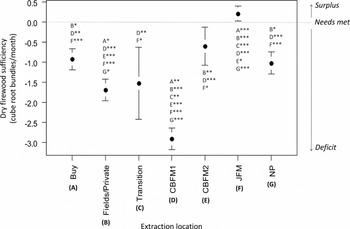
Household perceived firewood sufficiency varied from –99.0 to +40.0 bundles/month, with a mean household sufficiency of –6.43 (±12.71) bundles/month across all villages. Sufficiency varied significantly between extraction locations (Fig. 4). Households with very low sufficiency (less than –10 bundles/month, n = 82) all reported modest consumption quantities based on the sample average, yet excessively high perceived need for firewood. The opposite was true for households with very high sufficiency (greater than +10 bundles/month, n=5), which reported similarly modest quantities of firewood needed yet consumed exceedingly high quantities. Households extracting from JFM had the highest mean sufficiency (0.21 ± 0.83 bundles/month), indicating that household firewood needs were on average met. Households extracting from all other locations had negative mean sufficiency values, indicating an inability to meet firewood needs, with the lowest mean sufficiency in households extracting from CBFM1 (–2.9 ± 0.65 bundles/month). Households extracting from fields or private areas had significantly lower sufficiency values than households extracting from all forests except for the transition forest and CBFM1, suggesting a difficulty in meeting needs when extracting from outside forested areas.
Mean household monthly firewood sufficiency, and 95% confidence intervals, based on the t distribution by extraction location in order of increasing protection status. Letters indicate significant differences in sufficiency between associated extraction locations based on one-way analysis of variance and subsequent Tukey's honest significant differences (***p < 0.001, **p < 0.01, *p < 0.05). NP = national park; CBFM = community-based forest management; JFM = joint forest management.

All households extracting firewood from the NP in the wet season indicated a switch in extraction location to fields or private areas after the ban was enforced between surveys. Despite this, no significant difference in firewood sufficiency was found between seasons (mean wet season = –2.49 ± 4.65 bundles/month, mean dry season = –2.84 ± 6.54 bundles/month, t = 0.30, p = 0.78), although any long-term impacts of the ban might not be reflected within the short timeframe of the study. No such switch was reported by households extracting from JFM in the dry season.
Determinants of firewood need, consumption and sufficiency
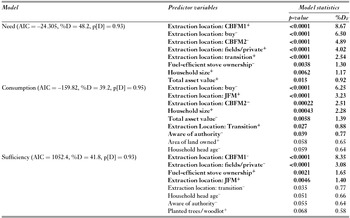
Extraction location and household demographic, wealth and environmental variables best predicted firewood need, consumption and sufficiency (Table 3). Household perceived need for and consumption of firewood were significantly reduced if sourced from markets or extracted from CBFM2. Households extracting from fields or private areas, the transition forest and CBFM1 had significantly higher perceived needs for firewood. Indeed, sufficiency values of households extracting from field or private areas and CBFM1 were significantly lower yet not retained in the consumption model, signifying that this increased need was not met by quantities consumed from these areas. Households extracting from JFM consumed significantly more firewood and were significantly more capable of meeting firewood needs.
Linear regression models based on backward–forward selection using the Akaike information criterion (AIC) of household firewood: (1) need, (2) consumption (log10 bundles/month) and (3) sufficiency (cube root bundles/month) versus demographic, wealth and environmental predictor variables. Statistics include the probability of deviation from a slope of zero (p), direction of the trend (positive [+], negative [–]), the percentage deviance explained by each variable (%D V), the AIC, the percentage deviance explained by the model (%D) and the probability of decreased deviance explained from the full model (p[D]), following analysis of deviance. Bold type indicates significant variables following false discovery rate (FDR) correction for repetitive testing (‘Need’ α FDR = 0.05, ‘Consumption’ α FDR = 0.039, ‘Sufficiency’ α FDR = 0.025). CBFM = community-based forest management; JFM = joint forest management.

Larger households had significantly increased perceived needs for and consumed more firewood, while those with more valuable assets perceived a greater need for but consumed less firewood (Table 4). Households owning a fuel-efficient stove had significantly improved ability to meet firewood needs, with significantly lower perceived needs for firewood, although consumption quantities were unchanged. Household awareness of the forest’s management authority significantly reduced firewood consumed, indicating a positive relationship between awareness of protection status and compliance with management.
Demographic, wealth and environmental variables that best predicted household firewood need, consumption and sufficiency based on linear regression models. Arrows indicate the direction of the relationship between explanatory and response variables (see Table 3 for model details). CBFM = community-based forest management; JFM = joint forest management; NA: variable was not retained in the minimum adequate model after backward–forward Akaike information criterion selection. aSignificant relationship following false discovery rate correction; bnon-significant relationships (p > α FDR).

DISCUSSION
Household NTFP extraction provides a general indication of low compliance with forest protection in the study area, with the exception of households extracting from the NP. Awareness of NP status was high, and this is reflected by most households extracting firewood only from this forest and the stated switch in extraction location post-ban. The mean deficit in firewood sufficiency of households extracting from the NP also reflects compliance, as the restrictions in place limit the quantities that households can extract regardless of their perceived need. The opposite is true for households extracting from JFM, as no households were aware of JFM status and the findings reflect non-compliant NTFP extraction and no switch in extraction location post-ban. Households extracting from JFM were significantly more likely to meet their resource needs, indicating that household extraction was unrestricted by management and use of this forest was as required. Findings indicate support for previous research that found compliance increased with awareness of the forest rules and regulations in Uganda (Nkonya et al. Reference Nkonya, Pender and Kato2008). However, a direct relationship between awareness and compliance cannot be inferred here, and compliance will be influenced by numerous factors, such as the status and enforcement of protection in each area (e.g. Rovero Reference Rovero2007).
Households extracting from CBFM1 and CBFM2 also indicated low compliance, given the high reporting of extracting more than firewood. Unlike JFM households, the majority of CBFM households were aware of these forests’ community-based authorities; however, very few were actively engaged in management. Interestingly, perceived need for and consumption of firewood were significantly reduced in households extracting from CBFM2. This may indicate some level of success of community-led management in this village, with households being more conscious of firewood quantities consumed. Conversely, households extracting from CBFM1 were significantly less likely to meet their firewood needs. The condition of CBFM1 or its distance from the village may have limited the perceived ability of this forest to supply household needs (e.g. Robinson et al. Reference Robinson, Williams and Albers2002). Indeed, most households in the CBFM1 village reported extraction from the NP, stating that access was easier due to distance and firewood extraction being permitted before the ban. However, further investigation is required in order to deduce the reasons for the observed differences in sufficiency between the two CBFM forests. This would necessitate obtaining information relating to the ecological conditions of each forest, as well as quantitative and qualitative assessment of management effectiveness.
Determinants of firewood utilization
NTFP dependence has previously been associated with low wealth (Adhikari et al. Reference Adhikari, Di Falco and Lovett2004). Interestingly, we found that increased assets resulted in higher perceived need for firewood, whilst actual consumption decreased, perhaps due to a switch to alternative, non-forest sources of energy. Decreased consumption was also observed in households solely purchasing firewood. These households also indicated a lower perceived need for firewood, perhaps reflecting the influence of a financial transaction on perceived firewood need as opposed to extracting the resource at no monetary cost. Nevertheless, the findings suggest that perceived firewood need and sufficiency are indeed influenced by subjective characteristics of wellbeing not directly linked to objective fuel requirements; exemplified here by wealthier households aspiring towards greater fuel use than they in fact consumed each month. This highlights the value of our methodology, which explicitly incorporates subjective components of wellbeing, firstly by allowing respondents to define their own perceived needs and secondly by comparing these perceptions with actual consumption. The excessive firewood deficits and surfeits observed in some households illustrates the degree to which these perceptions can be exaggerated, warranting further examination into the factors influencing both the need for NTFPs and their actual use. For example, the higher perceived need for firewood among households extracting from certain sources might reflect the difficulty in obtaining fuel from those areas, with this increased difficulty creating the sense that more is needed than would actually be used.
Our observed relationship between firewood sufficiency and fuel-efficient stove use presumably resulted from a perception of improved fuel efficiency within these households. It could be argued that households owning stoves might be more engaged in sustainability discussions in the area (e.g. Harrison Reference Harrison2006), and that stove ownership alone has improved perceived wellbeing whilst actual consumption remains unchanged. It has been recommended that policies to conserve tropical forests be implemented in parallel with projects aimed at enhancing fuel efficiency, such as through the use of modified stoves (Fisher et al. Reference Fisher, Lewis, Burgess, Malimbwi, Munishi, Swetnam, Turner, Willcock and Balmford2011). However, our findings indicate that the actual efficiency savings of stoves need careful examination if any perceived benefits are to be realized in practise (e.g. Bailis et al. Reference Bailis, Drigo, Ghilardi and Masera2015; Hanna et al. Reference Hanna, Duflo and Greenstone2016). Such examination would benefit future efforts to enhance more sustainable fuel use in the area. In addition, improving local awareness of forest protection status and methods in agroforestry is recommended, given the positive relationship that is indicated between awareness and compliance and the observed decrease in sufficiency when firewood is extracted from agricultural areas.
Implications for leakage and wellbeing
The difficulty of the non-forest firewood sources to meet household needs presents long-term concerns for leakage. This is especially significant in this area given the firewood ban and the observed non-compliance within less well-protected forests such as JFM or the transition forest. The specific challenges impeding households’ ability to meet resource needs outside of forest areas need to be measured; however, land availability for tree planting and alternative energy opportunities in the area are limited (Gorenflo & Orland Reference Gorenflo and Orland2013; pers. obs.). Considering the six effects of resource access restriction previously outlined, the potential for either displacement, reduction or non-compliance are most significant. This has serious implications for either long-term forest protection in the area given leakage or non-compliance, or detrimental effects on local welfare through an inability to meet fuel and food demands. This welfare impact is significant given that the restricted NTFP access in Tanzania is likely to most significantly impact the poorest (Schaafsma et al. Reference Schaafsma, Morse-Jones, Posen, Swetnam, Balmford, Bateman, Burgess, Chamshama, Fisher, Freeman, Geofrey, Green, Hepelwa, Hernández-Sirvent, Hess, Kajembe, Kayharara, Kilonzo, Kulindwa, Lund, Madoffe, Mbwambo, Meilby, Ngaga, Theilade, Treue, van Beukering, Vyamana and Turner2014), while the potential for leakage presents concerns for the area's important biodiversity (Burgess et al. Reference Burgess, Butynski, Cordeiro, Doggart, Fjeldså, Howell, Kilahama, Loader, Lovett, Mbilinyi, Menegon, Moyer, Nashanda, Perkin, Rovero, Stanley and Stuart2007). Such outcomes are especially significant in areas containing forests of mixed protection status. The presence of multiple independent forest authorities creates potential for locally based management decisions that might not take the larger socioecological landscape into consideration. With local objective and subjective dependence on NTFPs unaddressed, such decisions can have serious implications for forest protection or human wellbeing within the landscape. Within our study area, long-term monitoring of household NTFP utilization is needed in order to assess the impact of the firewood ban on both household welfare and leakage, given the proximity of other less well-protected forests. Indeed, considerable leakage of NTFP extraction activities into more distant forests has been observed after PFM implementation in Tanzania (Robinson & Lokina Reference Robinson and Lokina2011). Therefore, these findings lend empirical support to the growing theory relating to the need for a landscape planning approach to forest conservation policies (Robinson et al. Reference Robinson, Albers and Williams2011).
Wider implications
Understanding and addressing the issue of leakage is particularly important for PES and REDD+ if carbon benefits are to be meaningful and permanent. REDD+ in particular is expected to provide poverty alleviation and biodiversity conservation benefits in addition to climate change mitigation. Thus, local welfare costs of restricted NTFP use ought to be assessed alongside the global benefit of addressing climate change. Such spatial ecosystem valuation can help evaluate the trade-offs between local and international communities in order to inform policy (e.g. Schaafsma et al. Reference Schaafsma, Morse-Jones, Posen, Swetnam, Balmford, Bateman, Burgess, Chamshama, Fisher, Green, Hepelwa, Hernández-Sirvent, Kajembe, Kulindwa, Lund, Mbwambo, Meilby, Ngaga, Theilade, Treue, Vyamana and Turner2012). In addition, carbon accounting at the national level will need to include the potential offsetting of emissions due to displaced NTFP extraction activities (Robinson et al. Reference Robinson, Albers, Meshack and Lokina2013). Fisher et al. (Reference Fisher, Lewis, Burgess, Malimbwi, Munishi, Swetnam, Turner, Willcock and Balmford2011) estimate that the implementation costs of measures to alleviate forest dependency, such as raising agricultural yields and increasing stove use, remain feasible within REDD+ policies, despite exceeding the opportunity costs of carbon conservation. However, household energy needs will still need to be met, despite compensation through PES or REDD+, and the source of this energy will need to be considered at multiple scales and by multiple forest authorities.
ACKNOWLEDGEMENTS
This study was conceived by JEL, who collected and analysed field data and also prepared the manuscript with extensive input from RL, SMS and ARM. We thank Steve Cinderby at Stockholm Environment Institute, York, for assistance with preparation of the methods and data handling. The authors thank the village councils and villagers for allowing research to be conducted within all five villages and also thank all relevant forest officials. The authors also thank Mohamed A. Kambi for research assistance in the field, and the enumerators Ladislaus Mkatihela, Shafii Rashidi, Katenga Henry, Joseph Damiani Nyambi and Hassan Pamuhi. The authors thank Phil Platts for assistance with cartography and the Udzungwa Forest Project for field logistical support. The authors also thank the four anonymous reviewers for their constructive comments, which significantly improved this manuscript.
CONFLICT OF INTERESTS
None.
FINANCIAL SUPPORT
Research was carried out with funding from the Economic and Social Research Council (ESRC) with the permission of the Tanzania Commission for Science and Technology (COSTECH permit number 2011-60-NA-2010-205).
ETHICAL STANDARDS
Ethical approval was received from the University of York Environment Department Ethics Committee. The authors assert that all procedures contributing to this work comply with the ethical standards of the relevant national and institutional committees on human experimentation and with the Helsinki Declaration of 1975, as revised in 2008.