The 2014 Ebola outbreak was extremely challenging for healthcare workers (HCWs) worldwide. Treating patients was demanding, and limiting disease transmission proved to be difficult. Between January 2014 and March 2015, 815 healthcare workers in Sierra Leone, Liberia, and Guinea became infected with Ebola. 1 Between August and December 2015, 27 Ebola patients were treated in the United States and Europe. Of these 27 patients, 24 were evacuated from Africa and 22 were HCWs. In addition, 3 HCWs became infected with Ebola without having been to Africa by caring for these 24 evacuated Ebola patients. Therefore, the ratio between patients managed outside Africa and infected HCWs was only 8:1.Reference Uyeki, Mehta and Davey 2 Such a high infection risk underlines the importance of adequate patient isolation.
Not only Ebola but also other highly contagious diseases such as avian influenza, Middle East respiratory syndrome (MERS), severe acute respiratory syndrome (SARS), or pulmonary tuberculosis may require a near-perfect patient isolation to protect HCWs.
Different approaches to preventing transmission are used when dealing with patients with highly contagious infections. The HCW has to wear extensive personal protective equipment (PPE), usually consisting of protective suits, head covers, and respirator systems with air filtration. However, this equipment is cumbersome and may negatively affect medical performance.Reference Flaishon, Sotman, Ben-Abraham, Rudick, Varssano and Weinbroum 3 – Reference Schröder, Zoremba and Rossaint 6
Alternatively, and especially recommended for air medical transportation, airtight containment units, such as a portable isolation unit (PIU), may be used to isolate patients. 7 , Reference Christopher and Eitzen 8 In 2015, the Swiss Air Medical Rescue Services (REGA) evacuated a British HCW from Sierra Leone to London using such a PIU after she became infected with Ebola following a protocol breach while doffing her PPE.Reference Farmer 9
The negative influence of PPE on the performance of medical personnel is known, but no data are available on the effect of PIUs on carrying out emergency medical procedures.
To care for isolated patients, the execution of medical procedures, especially time-sensitive tasks like airway management, must be possible with as little disruption as possible. Emergency airway management procedures are standardized, and success is readily defined as the ability to ventilate the lungs. Such scenarios can be realistically simulated in mannequins. Therefore, we used airway management as a surrogate outcome parameter to determine the influence of PIUs, PPE, and standard protection measures on medical procedures.
Specifically, the purpose of this randomized controlled mannequin study was to find out how long each individual airway management procedure would take (ie, the primary outcome). In addition, we wanted to gain insight in subjective ratings of difficulties experienced when performing medical emergency tasks in such settings.
MATERIALS AND METHODS
Study Design and Setting
To evaluate the impact of patient isolation on airway management, we invited 30 anesthesiologists working in the local ground or helicopter-based emergency medical services (HEMS) to participate in this randomized controlled mannequin trial, conducted at Bern University Hospital, Bern Switzerland.
The study was reviewed by the Cantonal Ethics Committee (KEK) Bern (no. Req_2016_00106, 18.03.2016). After signing informed consent, participants performed airway management on mannequins, using 6 different procedures in 3 different settings representing different techniques of patient isolation.
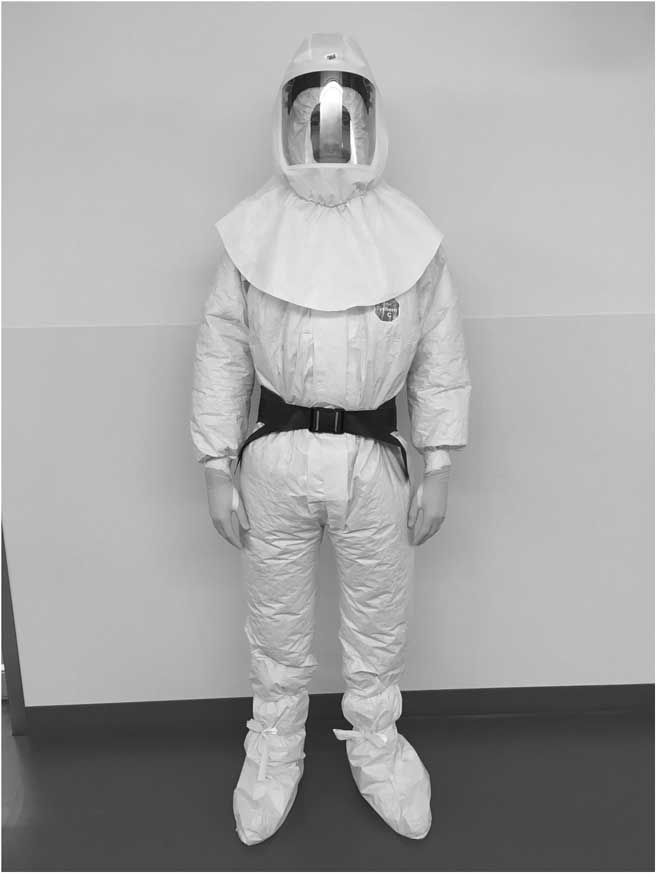
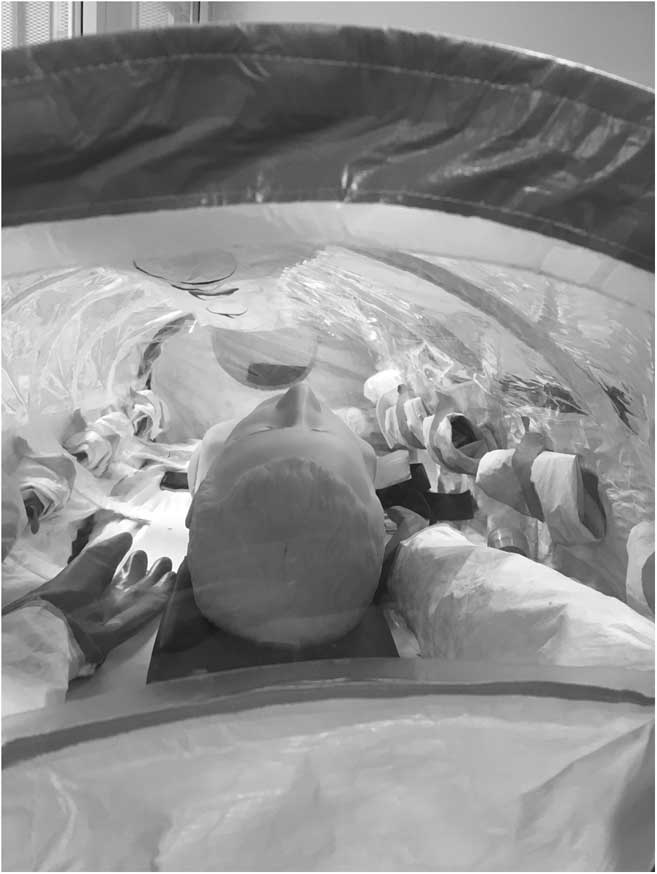
The order of the 6 airway management procedures as well as the order of the isolation setting was randomized. All participants were familiar with the 6 airway-management techniques before the study onset, and 3 different settings were used. (1) In one setting, a standard setting with exam gloves (cosaLine Nitril Comfort, Cosanum, Oxford, UK) was used. (2) In another setting, participants wore personal protective equipment (PPE). According to hospital standards, we used level C personal protective equipment consisting of 2 pairs of gloves (Biogel Indicator Underglove, Mölnlycke Health Care, Schlieren, Switzerland; Sempermed supreme surgical gloves sterile, Vienna, Austria), chemical protective clothing (Tychem C with socks, DuPont, Wilmington, DE USA), a hard hat (Versaflo S-605-10, 3M, Maplewood, MN USA), and a powered air purifying respirator (PAPR; Jupiter Powered Air Turbo Unit, 3M, St. Paul, MN) (Figure 1). (3) In a third setting, the mannequin was isolated in a PIU, (VenIONPIU portable isolation unit, TB-Safety, Frick, Switzerland) was used by REGA (Figure 2).Reference Farmer 9 , Reference Albrecht, Kunz and Voelckel 10 The VenIONPIU is a temporary, single-use isolation chamber that prevents cross contamination from patient to HCW. Built-in one-size gloves on both sides and at the head of the chamber enable HCWs to access the chamber.
Personal protective equipment (PPE).

Mannequin isolated in portable isolation unit (PIU).

Airway management was performed on 3 identical Laerdal airway management trainers (Laerdal, Stavanger, Norway). Participants ventilated mannequins using a facemask before commencing with the airway management technique corresponding to the randomized order. Successful airway management was defined as visible thorax excursion. We stressed the importance of measuring time to ventilation. One attempt per device in each setting was allowed, and an attempt was defined as unsuccessful when participants decided to abort the procedure, when esophageal intubation occurred, or when an attempt took longer than 240 seconds. All airway devices were prepared and assembled before the start of the time measurements.
Selection of Participants
We included only certified Swiss emergency physicians employed at the Department of Anesthesiology and Pain Therapy of Bern University Hospital who also worked for the local helicopter-based emergency medical service or the local ground emergency medical service (ambulance service). All participants were practicing anesthesiologists and were trained in basic and advanced airway management and were familiar with all devices used in this study. Participants were not specifically trained beforehand to perform airway management in the isolation setting. This condition reflects the clinical reality that, due to large numbers of anesthesia providers and small numbers of isolated patients, providers may have limited familiarity with isolation equipment.
Methods and Measurements
We compared the use of 6 different airway management techniques in each of the 3 settings and tested the standard laryngoscope, 2 supraglottic airway devices, 2 optical devices, and a cricothyrotomy set. Tracheal tubes of inner diameter 7.0 mm were used with all intubation techniques. The following devices were used: (1) Macintosh blade for direct laryngoscopy, (2) Airtraq SP supraglottic video-laryngoscope (Teleflex, Wayne, PA USA), (3) i-gel supraglottic airway device (Intersurgical, Wokingham, UK), (4) LMA Fastrach supraglottic airway device (Teleflex), (5) Ambu fiberoptic aScope (Ambu, Copenhagen, Denmark), and (6) Melker emergency cricothyrotomy catheter set (Seldinger) (Cook Group, Bloomington, IN USA). The cricothyrotomy was performed on a simplified model as described by Varaday et al.Reference Varaday, Yentis and Clarke 11 The model’s “skin” and its “cricothyroid membrane” were renewed after each attempt.
The primary outcome was the time in seconds from stopping bag-mask ventilation until the first visible effective ventilation of the mannequin, measured by study personnel not otherwise participating in the study.
One secondary outcome was the subjective rating of difficulty when handling a device: After each device use, participants rated the level of difficulty on a 100-mm visual analogue scale (VAS), 0 representing “very easy” and 100 representing “extremely difficult.” After completing all 3 settings, participants rated the overall level of difficulty for each setting in the same way. Another secondary outcome was the percentage of attempts that led to successful ventilation in <60 seconds.Reference Farmery and Roe 12
Data Analysis
Assumptions for our sample size calculation were based on the results obtained in a study by Wang et al.Reference Wang, Chaou, Tseng and Lin 4 Assuming a standard deviation (SD) of <20 seconds, 16 participants were required to detect a difference of 15 seconds with a power of 80% and an α error of 5%. We included 30 participants to compensate for dropouts.
The Shapiro-Wilk test was used to check the results for normal distribution. Non-normally distributed data were analyzed using a generalized Friedman test (Skillings-Mack test) to find differences in time-to-ventilate and subjective ratings of difficulties. The Wilcoxon matched-pairs signed-rank test was used to compare 2 settings at a time with a Bonferroni correction factor for multiple comparisons: PIU vs standard, PIU vs PPE, and PPE vs standard. As a sensitivity analysis, data were also included in a mixed-model analysis to discover differences in time-to-ventilate across the 3 settings for each device.
For the analysis of the subjective ratings of difficulty, all data were used regardless of success or failure.
All data were analyzed using Stata version 14.0 software (StataCorp, College Station, TX USA). Results are presented as median with interquartile range for nonparametric data or mean and SD for parametric data. Success rates are presented as percentages. A probability of P<.05 was considered significant.
RESULTS
In total, 18 attending anesthesiologists (mean age±SD, 43±7.6 years; 22% female) and 12 residents (mean age±SD, 40±7.7 years; 8% female) participated in the study. Together, they performed 6 emergency airway management procedures in each of the 3 settings, for a total of 540 attempts to establish a patent airway. Of these 540 attempts, 32 (5.9%) were unsuccessful: 18 because participants aborted, 10 because of esophageal intubation, and 4 because the time limit of 240 seconds was exceeded.
Table 1 provides the times-to-ventilation (the primary outcome) and the overall success rates for each device in each setting. Comparing the different isolation scenarios, the generalized Friedman test revealed that time-to-ventilation differed significantly across the 3 settings (P<.01). No significant difference in time-to-ventilation was found between the standard and PPE settings, but times-to-ventilation were significantly longer in the PIU setting.
Success Rates and Times to Ventilate in Airway Management Devices

NOTE. IQR, interquartile range; PPE, personal protective equipment; PIU, portable isolation unit.
a Ventilation<60 sec (successful attempts<60 sec / successful attempts).
b Success rate=(successful attempts)/(total no. of attempts).
c Significantly different from PPE and standard setting (Wilcoxon matched pairs signed-rank test P<.02, Bonferroni correction factor).
d Significantly different from PPE and standard setting (2-sample test of proportions, P<.05).
Comparing the different airway management devices, placement of supraglottic airway devices was fastest, followed by direct laryngoscopy, whereas cricothyrotomy and the fiberoptic scope took longest to secure ventilation in all settings. When using the fiberoptic scope in the PIU, time-to-ventilate was >3 times longer than in the standard setting (170 vs 44 seconds). Cricothyrotomy took ~1.5 times longer in the PIU than within the standard setting (78 vs 52 seconds).
Overall, 409 airway management attempts (76%) were successful in <60 seconds (overall median time-to-ventilate, 26 seconds; range, 12–51 seconds), with marked differences between the settings (86% and 85% attempts were successful in the standard and PPE setting, respectively, while only 69% attempts succeeded within 60 seconds using the PIU; P<.01). In the standard setting, 86% of attempts to ventilate were successful in <60 seconds (median time, 23 seconds; range, 11–45 seconds). In the PPE setting, this was the case in 85% of attempts (median time, 25 seconds; range, 11–48 seconds). However, only 69% of attempts were completed in <60 seconds in the PIU setting (median time, 38 seconds; IQR range, 15–72 seconds) (Table 1).
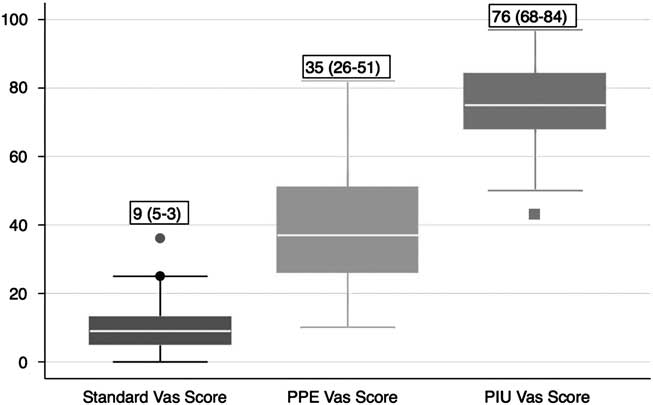
The subjective ratings of difficulty for the 3 settings were very different between each setting (P<.01), and for any of the airway devices, difficulty ratings were significantly higher in the PIU setting (P<.01) (Table 2 and Figure 3). Of the airway management techniques, the fiberoptic scope was rated the most difficult (VAS, 98; range, 87–100), followed by the Airtraq video laryngoscope (VAS, 69; range, 48–75). The supraglottic airway devices were rated easiest in all 3 settings. There were no differences in significances when using a mixed model instead of the generalized Friedman test or the Wilcoxon test. We found no significant differences in the time-to-ventilate or in the subjective levels of difficulty when comparing attending anesthesiologists with residents.
Overall subjective rating of difficulty. Numbers shown are the median value and the interquartile range (IQR).

Subjective Rating of Difficulty per Setting and Airway Management Device

NOTE. IQR, interquartile range; PPE, personal protective equipment; PIU, portable isolation unit; VAS, visual analogue scale.
a Subjective level of difficulty (0–100 mm VAS), median (IQR).
b Significantly different from the other two settings (Wilcoxon matched pairs signed-rank test P<.01, Bonferroni correction factor).
DISCUSSION
In this randomized controlled study of the effect of different isolation settings on airway management on mannequins in a simulated setting, we found marked differences in time-to-ventilate between a portable isolation unit (which surrounds the patient) and wearing PPE (surrounding the anesthesiologist). We found no statistically significant differences, however, in time-to-ventilate intervals between standard protective measures and PPE; thus, we could not confirm that wearing PPE affects the time needed to establish a protocol airway as previously described elsewhere.Reference Flaishon, Sotman, Ben-Abraham, Rudick, Varssano and Weinbroum 3 , Reference Castle, Owen, Hann, Clark, Reeves and Gurney 13
Although wearing PPE only minimally affected time-to-ventilation when compared to a standard setting, it was perceived as significantly more difficult. The main complaints expressed in comments by the participants while wearing the equipment were discomfort, heat, perspiration and, especially for participants wearing glasses, discomfort and interference caused by the head cover. Working with and handling of the protective equipment itself is difficult, and the risk of cross-contamination is significant, especially during removal. In a simulation study, Tomas et al described that during removal of PPE, contamination of HCW skin or clothing occurred in 46% of cases.Reference Tomas, Kundrapu and Thota 14 , Reference Ortega, Bhadelia and Obanor 15
The use of a PIU substantially reduces this risk of contamination because the patient is completely isolated from the environment, regardless of how many HCWs are caring for the patient at the same time. The main complaints when using the PIU in our study were the standardized one-sized gloves (often either too big or too small) and decreased and limited visibility through the plastic shield.
In this study, we tried to determine whether and how severely these limitations affect the performance of emergency medical procedures such as airway management. We saw substantially longer time intervals to achieve proper ventilation, significantly higher ratings regarding subjective difficulty, and reduced overall success rates with the PIU. Specifically, airway management with the fiberoptic scope took much longer than with other isolation scenarios and had a failure rate of 60%. Therefore, we do not recommend the use of fiberoptic scopes in a PIU.
Performing cricothyrotomy in the PIU took >1 minute (median, 78 seconds) and significantly longer than with the other 2 settings. Published studies showed similar time requirements for successful cricothyrotomy; in contrast, expert opinion states that successful cricothyrotomy can be achieved in 40 seconds or less in a cannot-ventilate, cannot-intubate situation.Reference Chan, Vilke, Bramwell, Davis, Hamilton and Rosen 16 – Reference Wong, Prabhu, Coloma, Imasogie and Chung 18 Interestingly, participants in our study required >40 seconds to perform cricothyrotomy in any of the 3 settings. A possible reason for this is the difference in techniques (Seldinger vs surgical) and that, different from the cited articles, our endpoint included connecting a ventilation bag and then administering a first breath.Reference Asai 19 Apparently, the feasibility of this last option to secure oxygenation in a cannot-ventilate, cannot-intubate situation is limited in a PIU compared to when an HCW has direct contact with the patient.
Excluding the fiberoptic scope and cricothyrotomy from the initial analysis, the success rates for successful intubation in <60 seconds in the PIU scenario changed considerably from the initial 69% to 90%. Thus, with the exception of those 2 techniques, airway management in a PIU is possible within clinically acceptable times.
The most reliable devices in both the PPE and PIU settings were supraglottic airway devices, as the average time-to-ventilation was only ~14 seconds. These times were even shorter in the standard setting (difference of ~5 seconds), but this finding is of doubtful clinical relevance. Our findings suggest that supraglottic devices are a suitable option in the PIU setting. The marked differences in times between the groups might be of clinical relevance when securing the airway. In the PIU setting, we would refrain from using fiberoptic scopes, even if airway management is expected to be difficult. Direct laryngoscopy may be attempted by sufficiently trained personnel; however, supraglottic airway devices should be readily available and are likely to produce high success rates within seconds.
The mannequin design of this study limits generalization; results may or may not be translatable into clinical practice. Notably, the texture of the human oropharynx is hard to recreate in mannequins. Moreover, mannequins are unable to mimic the difficulties surrounding airway management in the presence of secretions or blood in the airway. However, creating a real-life scenario is difficult due to ethical considerations, and our results provide insight into the objective feasibility and subjective impression of the difficulty surrounding the different protective measures and their influence on emergency airway maneuvers.
In summary, this randomized controlled mannequin study demonstrates the feasibility of performing airway management while wearing PPE, even if participants rated the procedure more difficult than under normal circumstances. Furthermore, we showed that, with the exception of fiberoptic intubation and cricothyrotomy, emergency airway management is quickly achievable, even in a PIU. Supraglottic airway devices remain highly recommendable if airway management is needed during transport of a contagious patient in such an isolation device.
ACKNOWLEDGMENTS
Financial support: The study was funded solely through an institutional research grant from the Department of Anesthesiology and Pain Medicine, Inselspital, Bern University Hospital, University of Bern, Bern, Switzerland.
Potential conflicts of interest: All authors report no conflicts of interest relevant to this article.