Introduction
Cognitive impairment is a core feature of schizophrenia and affects most cognitive domains (Heinrichs & Zakzanis, Reference Heinrichs and Zakzanis1998; Mesholam-Gately, Giuliano, Goff, Faraone, & Seidman, Reference Mesholam-Gately, Giuliano, Goff, Faraone and Seidman2009). Deficits appeared even before the onset of schizophrenia (Meier et al., Reference Meier, Caspi, Reichenberg, Keefe, Fisher, Harrington and Moffitt2014) and patients’ decline in later life is strongly related to their functional competencies (Harvey, Parrella, White, Mohs, & Davis, Reference Harvey, Parrella, White, Mohs and Davis1999; Kalache et al., Reference Kalache, Mulsant, Davies, Liu, Voineskos, Butters and Rajji2015). An important issue in the study of schizophrenia is that both executive functions (EFs) (Reichenberg & Harvey, Reference Reichenberg and Harvey2007) and processing speed (PS) (Dickinson, Ramsey, & Gold, Reference Dickinson, Ramsey and Gold2007) are impaired and that these deficits may affect other cognitive abilities. However, despite the increase in schizophrenia patients’ life expectancy (Cohen et al., Reference Cohen, Vahia, Reyes, Diwan, Bankole, Palekar and Ramirez2008; Lee et al., Reference Lee, Liu, Tu, Palmer, Eyler and Jeste2018), the course of cognitive impairment in late adulthood remains unclear owing to the lack of studies that investigate this particular issue (Herold, Schmid, Lässer, Seidl, & Schröder, Reference Herold, Schmid, Lässer, Seidl and Schröder2017; Rajji & Mulsant, Reference Rajji and Mulsant2008), and because normal aging is also associated with cognitive decline (Cona, Arcara, Amodio, Schiff, & Bisiacchi, Reference Cona, Arcara, Amodio, Schiff and Bisiacchi2013; Verhaeghen & Cerella, Reference Verhaeghen and Cerella2002). However, knowledge is crucial for adapting treatments and cognitive remediation to older schizophrenia patients. Given that remediation programs are currently better suited to younger patients, they need to be adapted to the specificity of older patients (Wykes et al., Reference Wykes, Reeder, Landau, Matthiasson, Haworth and Hutchinson2009).
EFs allow adapting behavior to diverse situations (e.g. creating a plan, initiating its execution, persevering until completion). They also mediate our ability to organize our thoughts in a targeted manner (Jurado & Rosselli, Reference Jurado and Rosselli2007). In other words, they are regarded as higher-order cognitive processes supporting other areas of cognition and thus are widely used in everyday life. Although executive functioning covers broad concepts, the importance of considering some specific EFs is now well established. The common distinction proposed identifies three specific EFs, namely shifting, updating and inhibition (Miyake et al., Reference Miyake, Friedman, Emerson, Witzki, Howerter and Wager2000). Subsequently, Fisk and Sharp (Reference Fisk and Sharp2004) identified a fourth function, referred to as ‘access’, which reflects the efficiency of access to long-term memory and may be assessed with word fluency tests.
Executive deficits in schizophrenia are well established (Fioravanti, Bianchi, & Cinti, Reference Fioravanti, Bianchi and Cinti2012). A more fine-grained analysis of these deficits revealed impairments in shifting, updating and inhibition (Chan, Chen, & Law, Reference Chan, Chen and Law2006; Donohoe, Corvin, & Robertson, Reference Donohoe, Corvin and Robertson2006; Rabanea-Souza et al., Reference Rabanea-Souza, Akiba, Berberian, Bressan, Dias and Lacerda2016; Raffard & Bayard, Reference Raffard and Bayard2012; Wongupparaj, Kumari, & Morris, Reference Wongupparaj, Kumari and Morris2015) as well as access (Rossell, Reference Rossell2006), even though there were some discrepancies concerning inhibition (Chan et al., Reference Chan, Huang, Guo, Cao, Hong and Gao2010; Laurenson et al., Reference Laurenson, Gorwood, Orsat, Lhuillier, Le Gall and Richard-Devantoy2015; Thuaire et al., Reference Thuaire, Rondepierre, Bacon, Vallet, Jalenques and Izaute2020; Westerhausen, Kompus, & Hugdahl, Reference Westerhausen, Kompus and Hugdahl2011). Importantly, insofar as EFs are strongly linked to everyday life skills (McClure et al., Reference McClure, Bowie, Patterson, Heaton, Weaver, Anderson and Harvey2007) and quality of life (Tolman & Kurtz, Reference Tolman and Kurtz2012) in schizophrenia, they are an important target area for cognitive remediation (Penadés et al., Reference Penadés, Catalán, Puig, Masana, Pujol, Navarro and Gastó2010).
Nevertheless, it remains unclear whether executive impairment in schizophrenia comes from an executive impairment per se or from low-order processes instead. Contrary to executive functioning, which is thought to be uniquely human (Luria, Reference Luria1966) or at least specific to the most intelligent species, lower-order processes are less evolved as cognitive functions. Those such as PS are implicated in almost every cognitive process. Thus, complex operations need to process simple operations quickly in order to keep their product available (Salthouse, Reference Salthouse1996). Consequently, PS and EFs share some mutual variance (Albinet, Boucard, Bouquet, & Audiffren, Reference Albinet, Boucard, Bouquet and Audiffren2012) but tap into different processes. Indeed, some authors suggested that PS is the most important deficit in patients (Dickinson et al., Reference Dickinson, Ramsey and Gold2007) and may mediate EFs impairments (Rodríguez-sánchez, Crespo-facorro, González-Blanch, Pérez-Iglesias, & Vázquez-barquero, Reference Rodríguez-sánchez, Crespo-facorro, González-Blanch, Pérez-Iglesias and Vázquez-barquero2007). Accordingly, it was shown in schizophrenia that PS contributed significantly to executive functioning (Raffard & Bayard, Reference Raffard and Bayard2012), even when the executive tests used were not time-constrained (Ojeda et al., Reference Ojeda, Peña, Schretlen, Sánchez, Aretouli, Elizagárate and Gutiérrez2012). Yet, it is worth mentioning that PS does not account for all the deficits in EFs (Neill & Rossell, Reference Neill and Rossell2013), and its statistical control does not cancel out the deficits in all measures of EFs (Savla et al., Reference Savla, Twamley, Thompson, Delis, Jeste and Palmer2011). Thus, the relationships between PS and EFs may be very complex, as PS seems to mediate some executive deficits, although the analyses conducted in previous studies were not designed as accurate tests for mediation. Moreover, as both EFs and PS declined severely in healthy aging and appear to play a distinctive role in explaining age-related deficits (Albinet et al., Reference Albinet, Boucard, Bouquet and Audiffren2012; Lee et al., Reference Lee, Crawford, Henry, Trollor, Kochan, Wright and Sachdev2012), we surmised that participants’ age would be a good criterion for supplementing our knowledge about this mediation.
Indeed, as EFs and PS are both impaired in healthy aging and in schizophrenia, some studies looked at whether these processes would show accelerated aging. Accelerated aging means that age effects would be greater in patients than in healthy participants. Some of the studies which examined this question in terms of executive functioning concluded in favor of the existence of accelerated aging (Fucetola et al., Reference Fucetola, Seidman, Kremen, Faraone, Goldstein and Tsuang2000; Herold et al., Reference Herold, Schmid, Lässer, Seidl and Schröder2017), while others did not (Irani, Kalkstein, Moberg, & Moberg, Reference Irani, Kalkstein, Moberg and Moberg2011; Loewenstein, Czaja, Bowie, & Harvey, Reference Loewenstein, Czaja, Bowie and Harvey2012; Stirling et al., Reference Stirling, White, Lewis, Hopkins, Tantam, Huddy and Montague2003). To shed some light on these controversial results, in a previous article our team analyzed the performances of young, middle-aged and older schizophrenia patients and healthy comparison participants in neuropsychological tests assessing the four specific EFs (Thuaire et al., Reference Thuaire, Rondepierre, Bacon, Vallet, Jalenques and Izaute2020). The results showed that accelerated aging was observed for shifting, and that access was impaired in older schizophrenia patients. However, updating and inhibition were not more affected by the pathology with aging. Similarly, studies about the effects of accelerated aging on PS in schizophrenia are conflicting. One study found accelerated aging in Trail-Making-Test Part A (TMT-A) and digit symbol (Loewenstein et al., Reference Loewenstein, Czaja, Bowie and Harvey2012), whereas another found it in TMT-A but not digit symbol (Bowie, Reichenberg, McClure, Leung, & Harvey, Reference Bowie, Reichenberg, McClure, Leung and Harvey2008), and a third study showed no accelerated aging in TMT-A (Herold et al., Reference Herold, Schmid, Lässer, Seidl and Schröder2017). It is therefore not clear from the literature whether aging increases executive deficits and/or the cognitive slowing of schizophrenia patients in comparison to healthy participants. In light of the results of our previous work (Thuaire et al., Reference Thuaire, Rondepierre, Bacon, Vallet, Jalenques and Izaute2020) and studies showing a link between PS and EFs performance (Neill & Rossell, Reference Neill and Rossell2013; Raffard & Bayard, Reference Raffard and Bayard2012; Savla et al., Reference Savla, Twamley, Thompson, Delis, Jeste and Palmer2011), one possibility might be that PS mediates some EFs and that such mediation may have different strengths according to specific EFs. Moreover, aging may have different effects on this mediation as a function of specific EFs.
Thus, we set out to analyze our previous study further to determine which specific EFs are strongly mediated by PS because such knowledge will help remediation programs target the root causes of the executive deficits. We hypothesized that PS would mediate the four specific EFs but with different strengths. Moreover, we wanted to ascertain whether age could be a moderator of these mediation effects in order to help adapt remediation programs to strengths and weaknesses specific to older patients. According to our previous study showing increased deficits in older patients for shifting and access (Thuaire et al., Reference Thuaire, Rondepierre, Bacon, Vallet, Jalenques and Izaute2020), we surmised that age would moderate this mediation only for these functions. This result lends further weight to the arguments in support of the specificity of schizophrenia aging and the need to adapt remediation programs to older patients (Wykes et al., Reference Wykes, Reeder, Landau, Matthiasson, Haworth and Hutchinson2009).
Methods and material
Participants
The present study involves the same participants as those recruited and described in our previous study (Thuaire et al., Reference Thuaire, Rondepierre, Bacon, Vallet, Jalenques and Izaute2020).
This study was conducted in accordance with ethical standards and with the approval of the local ethics committees (EudraCT 2010-A00857-32 and PRI 2000, HUS N°2326). Before the investigation started, and after receiving a full explanation about the study, all the participants gave their informed consent in writing. They were 62 clinically-stable outpatients with schizophrenia recruited from the Psychiatric Departments of the University Hospitals. Patients with any current co-morbid neurologic or psychiatric disorder, including alcohol or substance abuse or dependence, were not included. Their psychiatric symptoms were assessed according to the Positive And Negative Symptoms Scale (PANSS, Kay, Fiszbein, & Opler, Reference Kay, Fiszbein and Opler1987). They were screened for anxiety and depression using the Hospital Anxiety and Depression Scale (HADS, Zigmond & Snaith, Reference Zigmond and Snaith1983). Verbal intelligence quotient (IQ) was evaluated using vocabulary and arithmetic tests taken from the Wechsler Adult Intelligence Scale, revised (WAIS-R, Silverstein, Reference Silverstein1982). Patients received stable doses of psychotropic medication for at least 4 weeks. In addition, 62 healthy comparison participants matching the patients in terms of age, gender and education were recruited from the community. None of these participants had a known neurological or psychiatric affliction or was currently suffering or had suffered in the past from alcohol or substance abuse or dependence. The age of the participants ranged from 18 to 76 years.
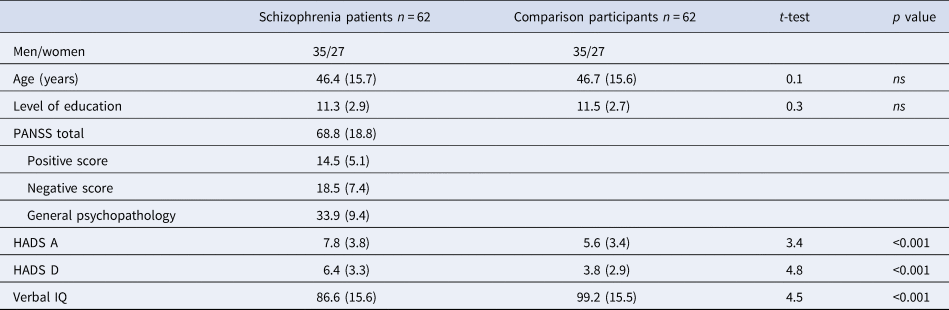
Table 1 presents the demographical, clinical and descriptive statistics of the group comparison data.
Demographic characteristics of patients with schizophrenia and comparison participants (standard deviations shown in brackets).
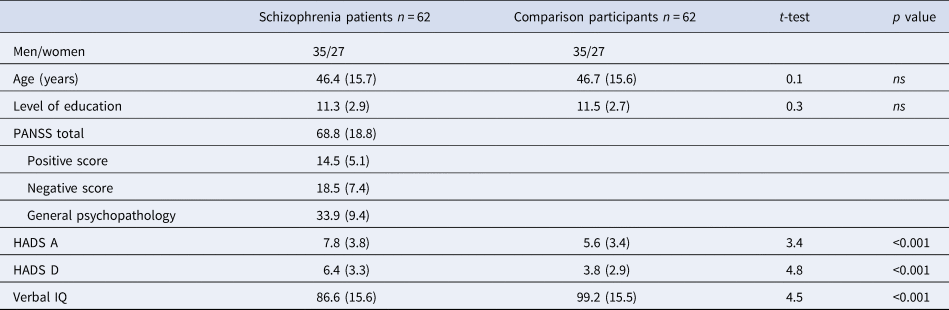
PANSS, Positive And Negative Symptom Scale; HADS, Hospital Anxiety and Depression Scale; IQ, Intelligence Quotient.
Material
EFs were assessed according to the framework proposed by Miyake et al. (Reference Miyake, Friedman, Emerson, Witzki, Howerter and Wager2000), which distinguishes three specific EFs (shifting, updating and inhibition), with the addition of Fisk and Sharp (Reference Fisk and Sharp2004) for the efficiency of access to long-term memory. Two tests were used for each specific function, and a further two tests were also used to assess PS. See the supplement for a more detailed description of the tests.
The scores used in the analyses consisted of:
Shifting tasks
Plus-minus task (Jersild, Reference Jersild1927; Spector & Biederman, Reference Spector and Biederman1976): Participants had to switch between adding and subtracting 3 in respect of different numbers. The shift cost was calculated as the difference between the time taken to complete the third list and the average for the first and second lists: T3 – [(T2 + T1)/2].
Number-letter task (Rogers & Monsell, Reference Rogers and Monsell1995): Participants had to switch between processing consonants and vowels. The shift cost was calculated in the same way as in the plus-minus test: T3 – [(T2 + T1)/2].
Updating tasks
N-back task: Participants had to remember and update in memory only the last three letters said by the experimenter to decide whether each new one was the same as one of the three previous letters. The score was the number of correct answers (hits and correct rejections).
Self-Ordered Pointing Task (Petrides & Milner, Reference Petrides and Milner1982): Participants had to update in memory the drawings they chose, in order not to choose them anymore. The score was the number of different drawings selected.
Inhibition tasks
Stroop color word task (SCWT, Stroop, Reference Stroop1935), card version: Participants had to inhibit word reading in order to name the color of the ink used for words depicting colors. To reduce the potential bias of patients’ cognitive slowing, we used the interference score proposed by Li & Bosman (Reference Li and Bosman1996): (Baseline – color word)/Baseline.
Hayling sentence Completion Test (HSCT, Burgess & Shallice, Reference Burgess and Shallice1996): Participants had to inhibit the final word of sentences and say aloud a word that was not linked in any way with either the sentence or final word. The scores were the time taken to complete Part B and the number of errors in Part B.
Access tasks
Verbal fluency: Participants had to say aloud as many words as they could according to a phonemic or semantic rule. Two verbal fluency tasks were assessed, namely phonemic fluency (Letter P) and semantic fluency (category ‘animals’). The score was the number of correct words in 60 s.
Processing speed tasks
Digit copying test (Weschsler, Reference Weschsler1989): Participants had to write down the digit matching a number according to a key. The score was the number of items correctly reported in 30 s. This time limit was chosen to reduce the impact of executive abilities and memory on performance (Knowles et al., Reference Knowles, Weiser, David, Glahn, Davidson and Reichenberg2015).
Letter comparison test: On a sheet of paper displaying pairs of X and O, participants had to decide whether each pair was identical or different and to tick the corresponding box. The score was the number of correct items in 30 s.
Data analyses
Data used in this article are available at: https://osf.io/ebn5a/
Not all of the participants completed all the tests: five failed to complete the plus-minus test (4%), one the n-back test (0.8%), and 10 the HSCT (8%). The missing data were replaced using Multiple Imputation by Chained Equations (Azur, Stuart, Frangakis, & Leaf, Reference Azur, Stuart, Frangakis and Leaf2011). See Thuaire et al. (Reference Thuaire, Rondepierre, Bacon, Vallet, Jalenques and Izaute2020) for more details.
Z-scores were computed for each task, based on mean and standard deviation of all participants, after which the means were calculated between the two tests in each of the four executive domains (shifting, updating, inhibition and access) and PS, to create a composite index for these cognitive abilitiesFootnote 1.
All analyses were run on SPSS Statistics 25 (IBM Corp, 2017), running the PROCESS script to test the mediation (Hayes, Reference Hayes2018). Mediation signifies that the effect of an independent variable (IV) on a dependent variable (DV) is at least partly driven by a mediator (M). Several effects are calculated by means of regression analyses: (a) is the effect of the IV on M; (b) is the effect of M on the DV when controlling for the effect of the IV; (c) is the total effect of the IV on the DV and is the sum of a direct effect (c’) of the IV on the DV and an indirect effect (a × b) which is the effect of the IV on the DV through M. As regression analyses cannot test the significance of the indirect effect (a × b), the latter is tested using a bias-corrected bootstrapping approach (n = 5000 bootstrap samples (Preacher & Hayes, Reference Preacher and Hayes2008)). Thus, if zero is not in the 95% confidence interval, we can conclude that the indirect effect is significantly different from zero. Moderated mediation means that a moderator (W) affects at least one path of the mediation relation. The effect of one variable on another may, therefore, be different according to the value of the moderator. Group (0 = Comparison participants, 1 = Schizophrenia patients) was the IV, PS was the mediator, age was the moderator, and the four specific EFs were entered as DVs in separate analyses. Thus, the total effect is the effect of schizophrenia on a specific EF without taking into account a possible effect of PS. The direct effect is the effect of schizophrenia on a specific EF after controlling for the effect of PS, and the indirect effect is the effect of PS on a specific EF after controlling for the effect of schizophrenia. Unstandardized coefficients (B) are reported in the analyses.
Results
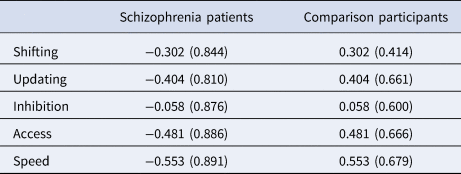
Table 2 presents means and standard deviations on the five indices for schizophrenia patients and healthy comparisons participants.
Mean z-scores on the four indices of specific functions and on processing speed (standard deviations shown in brackets)
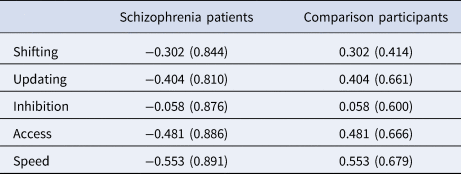
online Supplementary Table S1 presents intercorrelations among all study variables. All variables were significantly correlated with each other, except Group with Age, Group with Inhibition, and Age with Access.
Mediation analyses
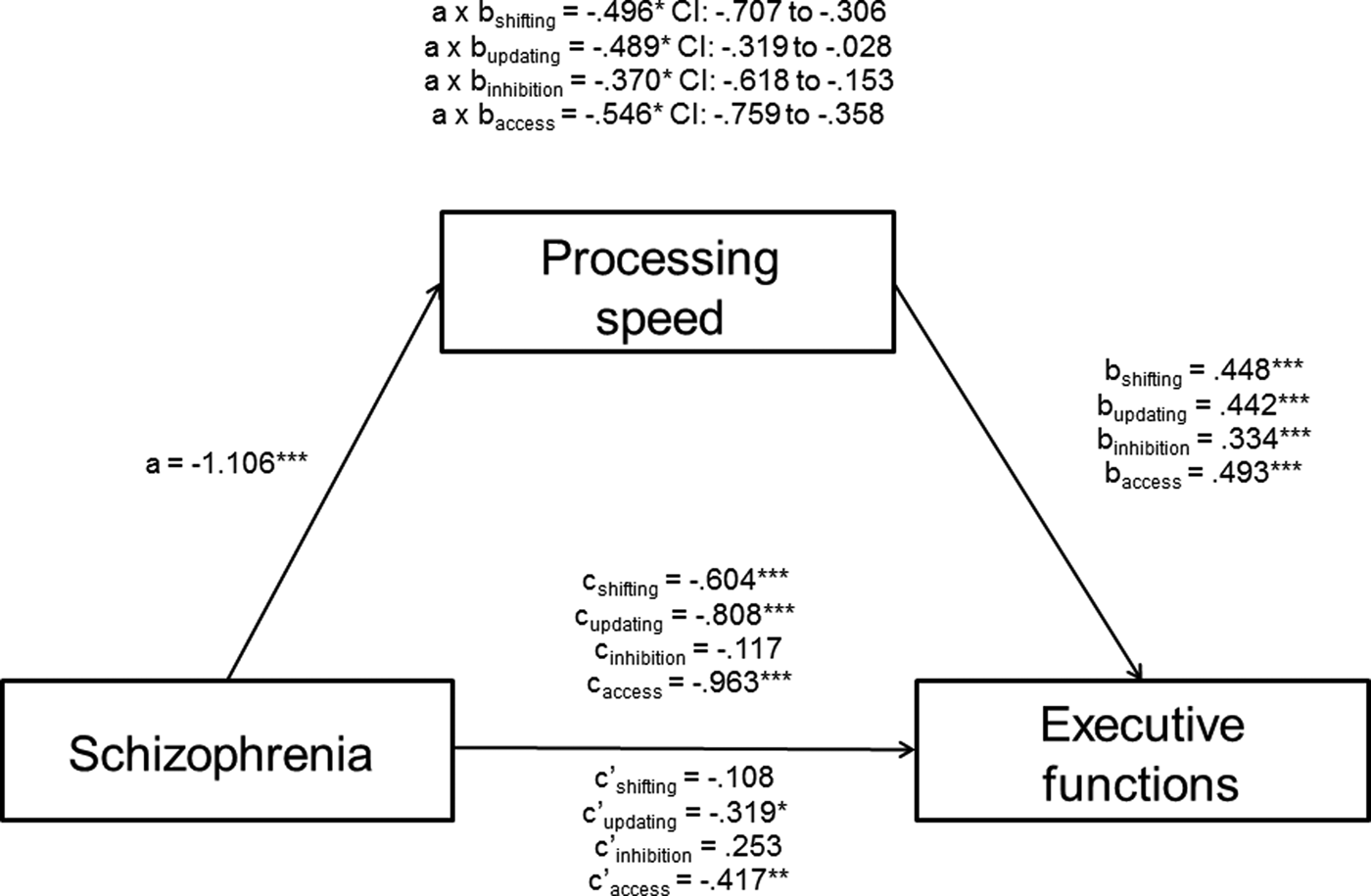
Figure 1 shows the results of the mediation analyses about the effect of schizophrenia on the four specific EFs through PS. Path (a) indicates that schizophrenia had a strong negative effect on PS. Path (b) shows that higher PS increases performance in the four EFs. Mediation (a × b) was significant for the four EFs, indicating that PS mediated the four EFs. Total effects of schizophrenia on EFs (c) were significant for shifting, updating and access, whereas direct effects of schizophrenia controlling for PS (c’) only remained significant for updating and access.
Mediation model for the direct and indirect effects of schizophrenia on the four specific executive functions through processing speed. Numbers associated with a, b, c, c’ and a × b are unstandardized regression coefficients. * p < 0.05. ** p < 0.01. *** p < 0.001. CI = 95% bias-corrected bootstrap confidence interval.

Moderated mediation analyses
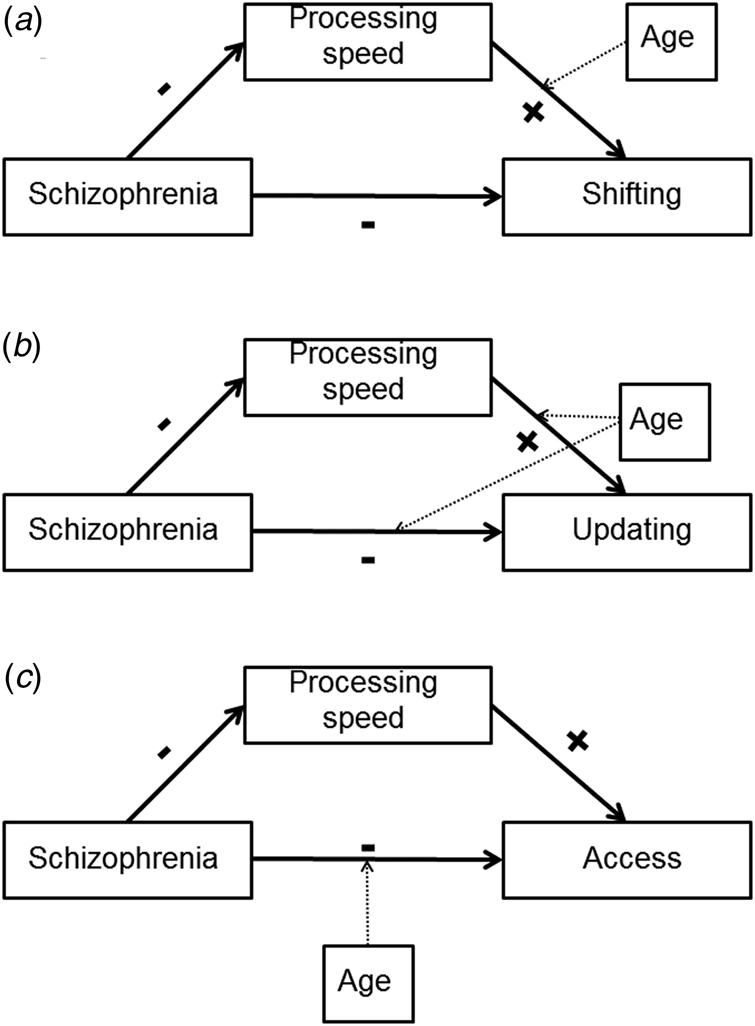
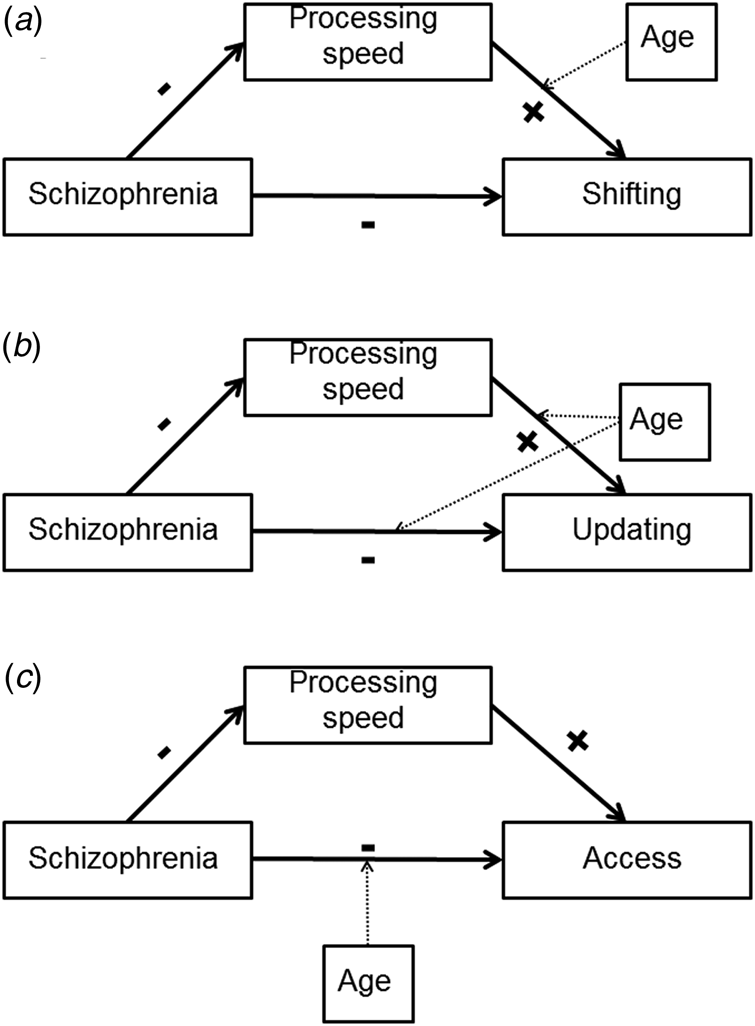
Moderation on a mediation model may be present in three paths: on the effect of the IV on M (path a), on the effect of M on the DV when controlling for the effect of the IV (path b), and the direct effect of the IV on the DV (path c’). However, as, despite a significant deleterious effect of age on PS (B = −0.029, p < 0.001), there was no moderation effect of age on path a (B = −0.010, p = 0.197), further analyses focus only on paths b and c’. Figure 2 shows the significant moderation effects of age on the mediation of the effect of schizophrenia on shifting (Panel A), updating (Panel B) and Access (Panel C) through PS. As may be seen in Fig. 2, age moderated the mediation of schizophrenia on three out of the four EFs, but in different ways.
Representation of the mediation of the effect of schizophrenia on executive functions through processing speed moderated by age for shifting (a), updating (b) and access (c).
Moderation by age of the mediation by speed of the group effect on shifting
Conditional process analyses using PROCESS macro revealed that only path b was significantly moderated by age (B = 0.011, p = 0.002). Thus, the effect of PS on shifting abilities is moderated by age in such a way that the effect of speed on shifting is greater in older participants. Therefore, schizophrenia patients, whose PS is slower, are more affected by age when it comes to shifting abilities. Online Supplementary Figure S1 shows the effects of age on shifting as a function of participants’ PS.
Moderation by age of the mediation by speed of the group effect on updating
PROCESS showed that both paths b (B = −0.011, p = 0.045) and c’ (B = −0.022, p = 0.030) were significantly moderated by age. Thus, concerning path b, the effect of PS on shifting abilities is less in older participants and, consequently, for schizophrenia patients, whose processing performance is lower, older patients’ updating performance would be less affected than that of younger patients. However, a counterbalancing effect is observed on path c’ as age increases the effect of schizophrenia on updating, leading older schizophrenia patients to record a lower updating performance. Taken together, the effects of age on paths b and c’ offset each other and resulted in an absence of accelerated aging in schizophrenia patients (Thuaire et al., Reference Thuaire, Rondepierre, Bacon, Vallet, Jalenques and Izaute2020). Online Supplementary Figure S2 shows that the direct effect of schizophrenia on updating is more negative with advancing years, whereas the indirect effect is less negative with age.
Moderation by age of the mediation by speed of the group effect on inhibition
The analysis failed to show any moderation effect of age on paths b (B = 0.005, p = 0.237) and c’ (B = −0.006, p = 0.403). Thus, the mediation by PS of the effect of schizophrenia on inhibition is not moderated by age.
Moderation by age of the mediation by speed of the group effect on access
PROCESS analysis revealed a significant moderation effect on path c’ (B = −0.016, p = 0.045). Thus, as shown in online Supplementary Figure S3, age moderated the direct effect of schizophrenia on access in a way that slowed the increase in schizophrenia patients’ access performance with age.
Discussion
The first aim of this study was to test the mediating role of PS on the effect of schizophrenia with respect to the four specific EFs, namely shifting, updating, inhibition and access. The second aim was to determine how age affected this mediation as a function of the four specific EFs.
Concerning the first goal, our results confirm the widely observed cognitive slowing in schizophrenia (Dickinson et al., Reference Dickinson, Ramsey and Gold2007; Leeson et al., Reference Leeson, Barnes, Harrison, Matheson, Harrison, Mutsatsa and Joyce2010; Mesholam-Gately et al., Reference Mesholam-Gately, Giuliano, Goff, Faraone and Seidman2009; Neill & Rossell, Reference Neill and Rossell2013; Ojeda et al., Reference Ojeda, Peña, Schretlen, Sánchez, Aretouli, Elizagárate and Gutiérrez2012; Savla et al., Reference Savla, Twamley, Thompson, Delis, Jeste and Palmer2011) and the effect of PS on EFs (Rose, Feldman, & Jankowski, Reference Rose, Feldman and Jankowski2011; Salthouse, Fristoe, McGuthry, & Hambrick, Reference Salthouse, Fristoe, McGuthry and Hambrick1998). Moreover, in accordance with the hypothesis that improving PS should bring widespread benefits in other cognitive functions (Cassetta & Goghari, Reference Cassetta and Goghari2016), PS mediates the effect of schizophrenia on EFs (Neill & Rossell, Reference Neill and Rossell2013; Ojeda et al., Reference Ojeda, Peña, Schretlen, Sánchez, Aretouli, Elizagárate and Gutiérrez2012; Savla et al., Reference Savla, Twamley, Thompson, Delis, Jeste and Palmer2011). This result is consistent with Salthouse's Processing Speed Theory (Salthouse, Reference Salthouse1996) and suggests PS should be efficient at successfully executing simple cognitive operations and keeping the result available for more complex operations such as cognitive strategies. Thus, fast processing may help to bear in mind current rules for shifting tasks, to switch faster between these rules, to update memory faster so that materials are not forgotten, to inhibit prepotent responses faster in order to activate an alternative response, and to activate and use efficient strategies to access memory.
With respect more specifically to mediation strength, shifting seems to be the specific EF mediated mainly by PS as it is the only one that showed significant total and indirect effects and no direct effect. The effect of schizophrenia on shifting is thus almost entirely the consequence of cognitive slowing. These results are in line with those of other studies which assessed shifting with the Wisconsin Card Sorting Test (Ojeda et al., Reference Ojeda, Peña, Schretlen, Sánchez, Aretouli, Elizagárate and Gutiérrez2012) or D-KEFS (Neill & Rossell, Reference Neill and Rossell2013; Savla et al., Reference Savla, Twamley, Thompson, Delis, Jeste and Palmer2011). Our results also indicate that updating and access showed the most important total effect of schizophrenia, and both the direct and indirect effect remained significant, indicating that PS mediated most of the effect of schizophrenia on these EFs.
Finally, the mediation effect of schizophrenia on inhibition through PS is more complicated insofar as the total effect was not significant. According to Haye's Framework and contrary to Baron and Kenny's method (Baron & Kenny, Reference Baron and Kenny1986), a significant total effect is not required to test for mediation. More precisely, our result seems to be due to the opposite signs of the direct and indirect effects (Hayes, Reference Hayes2018). Thus, schizophrenia would seem to have a weak (and non-significant) positive direct effect (which is in keeping with both Baron and Kenny's and Haye's methods) on inhibition and a stronger negative indirect effect through PS. As the total effect is the sum of both direct and indirect effects (Hayes, Reference Hayes2018), the result is a non-significant total effect. This result warrants further research, but it is possible to speculate that if schizophrenia patients were not cognitively slowed their performances would be similar to comparison participants and even slightly better. Nevertheless, our results are in keeping with those observed with the D-KEFS in showing that PS contributed significantly to inhibition (Neill & Rossell, Reference Neill and Rossell2013; Savla et al., Reference Savla, Twamley, Thompson, Delis, Jeste and Palmer2011).
The second aim was to determine whether age could be a moderator of this mediation effect as a function of the four specific EFs. Our main finding is that age moderated the mediation on three out of the four EFs, namely shifting, access and updating, albeit in different ways. According to a previous study (Thuaire et al., Reference Thuaire, Rondepierre, Bacon, Vallet, Jalenques and Izaute2020) which showed that with respect to shifting and access schizophrenia patients were more affected by age than comparison participants, we postulated that the mediation effect on these EFs would be moderated by age. Our results supported this hypothesis and contributed to furthering knowledge about how age affects these functions in schizophrenia. Thus, the effect of PS on shifting was greater in older participants, suggesting that, compared with slower participants, faster participants may benefit from age as regards shifting. Yet, schizophrenia patients whose PS was severely impaired saw their shifting performance decline with age compared to healthy subjects, a result interpreted as accelerated aging (Thuaire et al., Reference Thuaire, Rondepierre, Bacon, Vallet, Jalenques and Izaute2020).
With regard to access, the influence of age concerned the direct effect of schizophrenia and, as such, was independent of PS. More specifically, our results suggested that for comparison participants age was associated with an increase in access performance through the direct path, but that this was not the case for schizophrenia patients. The suggestion is therefore that it was the superior knowledge of vocabulary typical of healthy older adults (Fisk & Sharp, Reference Fisk and Sharp2004) which was responsible for this increase in performance in the direct path. Moreover, where both groups were concerned, age affected the indirect path in the same way, namely through a slowing of processing which in turn reduced access performance. It is our suggestion that the two paths offset each other out for comparison participants, resulting in the absence of age effects (Fisk & Sharp, Reference Fisk and Sharp2004), whereas for schizophrenia patients the direct path does not compensate for the indirect path. This interpretation of our results is in keeping with studies showing a greater age-related decline in verbal fluency in schizophrenia patients (Kosmidis et al., Reference Kosmidis, Bozikas, Vlahou, Kiosseoglou, Giaglis and Karavatos2005; Thuaire et al., Reference Thuaire, Rondepierre, Bacon, Vallet, Jalenques and Izaute2020). It is, therefore, possible that schizophrenia patients did not improve their vocabulary with aging as much as comparison participants, or that they failed to use effective strategies in both fluency tasks.
Surprisingly, and contrary to our hypothesis, mediation of the effect of schizophrenia on updating by PS was also moderated by age. However, an examination of the direct and indirect effects indicated that moderation of these effects had opposite signs and thus resulted in the absence of accelerated aging with respect to updating (Thuaire et al., Reference Thuaire, Rondepierre, Bacon, Vallet, Jalenques and Izaute2020). More precisely, moderation of the direct effect showed that schizophrenia patients were more impaired in terms of updating as they got older. Conversely, moderation of the indirect effect indicated that the influence of PS on updating decreased with age. As schizophrenia patients’ PS was slower, they were less affected by age on this path, which offset the effect of the direct path. These results suggest that older participants relied less on PS to complete these updating tasks than their younger counterparts. We presume they tried to compensate for their cognitive slowing by relying more on other processes such as working memory capacity or cognitive strategies, even if that was not enough for them to match the performance of younger participants (Thuaire et al., Reference Thuaire, Rondepierre, Bacon, Vallet, Jalenques and Izaute2020). Such assumptions are in line with a meta-analysis of neuroimaging studies (Turner & Spreng, Reference Turner and Spreng2012), which showed that during an updating task older participants increased their recruitment of brain areas associated with learning and acquisition of cognitive strategies and cognitive control in working memory.
Finally, in keeping with our hypothesis and the fact that schizophrenia patients failed to show accelerated aging on inhibition (Thuaire et al., Reference Thuaire, Rondepierre, Bacon, Vallet, Jalenques and Izaute2020), the mediation effect on this specific EF was not moderated by age.
These results suggest that PS should be assessed routinely during therapeutic follow-up and before including a patient in a remediation program. First, PS tasks are easy to administer and tap a central feature of the deficits in schizophrenia (Dickinson et al., Reference Dickinson, Ramsey and Gold2007; González-Blanch et al., Reference González-Blanch, Pérez-Iglesias, Rodríguez-Sánchez, Pardo-García, Martínez-García, Vázquez-Barquero and Crespo-Facorro2011). Second, since PS mediates EFs which are linked in turn to functional competencies (Harvey et al., Reference Harvey, Parrella, White, Mohs and Davis1999; Kalache et al., Reference Kalache, Mulsant, Davies, Liu, Voineskos, Butters and Rajji2015), evaluating it may help to target other functions for investigation and third, aging may have different effects on patients’ cognition depending on their PS. Specifically, lowest performance patients may show a major deterioration in shifting performance but relatively spared updating performance.
Moreover, our results also show the importance of the choice of pharmacological treatment. Long-term benzodiazepine use seems to have negative effects on several areas of cognition, including PS, even after withdrawal (Crowe & Stranks, Reference Crowe and Stranks2018), and so it should be prescribed with caution. Concerning the treatment of depression, which is a comorbidity of schizophrenia, a meta-analysis showed that selective serotonin reuptake inhibitors had greater positive effects on cognition in depressed patients than the other classes of antidepressants (Prado, Watt, & Crowe, Reference Prado, Watt and Crowe2018). This result should be confirmed with further researches and tested in schizophrenia because it represents a possible area for improving patients’ cognition. In any case, pharmacological treatment should be chosen and monitored so as to minimize neurocognitive side-effects, which may already be compromised by the disease process itself.
A potential implication of our results is that cognitive remediation programs should concentrate more on PS. Remediation programs targeting PS seem to be efficient (Garrido et al., Reference Garrido, Barrios, Penadés, Enríquez, Garolera, Aragay and Vendrell2013; Grynszpan et al., Reference Grynszpan, Perbal, Pelissolo, Fossati, Jouvent, Dubal and Perez-Diaz2011; Lindenmayer et al., Reference Lindenmayer, McGurk, Mueser, Khan, Wance, Hoffman and Xie2008; McGurk, Twamley, Sitzer, McHugo, & Mueser, Reference McGurk, Twamley, Sitzer, McHugo and Mueser2007; Sartory, Zorn, Groetzinger, & Windgassen, Reference Sartory, Zorn, Groetzinger and Windgassen2005; Vita et al., Reference Vita, De Peri, Barlati, Cacciani, Deste, Poli and Sacchetti2011). Thus, in light of our results showing that PS seems to underlie EFs, it is possible that increasing patients’ PS would improve executive functioning (Rodríguez-sánchez et al., Reference Rodríguez-sánchez, Crespo-facorro, González-Blanch, Pérez-Iglesias and Vázquez-barquero2007).
This research has a number of strengths and limitations. First of all, EFs were assessed according to a validated model (Fisk & Sharp, Reference Fisk and Sharp2004; Miyake et al., Reference Miyake, Friedman, Emerson, Witzki, Howerter and Wager2000) which depicts the diversity of EFs. Thus, our results lend further weight to arguments in favor of using specific models of executive functioning to study schizophrenia (Thuaire et al., Reference Thuaire, Rondepierre, Bacon, Vallet, Jalenques and Izaute2020) insofar as we demonstrated how age affects the specific EFs differently through PS. Then, despite the numerous studies suggesting an underlying role for PS in the executive deficit in schizophrenia (Dickinson et al., Reference Dickinson, Ramsey and Gold2007; Neill & Rossell, Reference Neill and Rossell2013; Ojeda et al., Reference Ojeda, Peña, Schretlen, Sánchez, Aretouli, Elizagárate and Gutiérrez2012; Raffard & Bayard, Reference Raffard and Bayard2012; Rodríguez-sánchez et al., Reference Rodríguez-sánchez, Crespo-facorro, González-Blanch, Pérez-Iglesias and Vázquez-barquero2007; Savla et al., Reference Savla, Twamley, Thompson, Delis, Jeste and Palmer2011), this article is the first to test this mediation with appropriate statistical analysis. Moreover, patients and comparison subjects were rigorously paired, one by one, for gender, age, and educational status. A recent meta-analysis (Fioravanti et al., Reference Fioravanti, Bianchi and Cinti2012) indicated that the imbalance in the number of cases, gender composition and age could artificially increase between-group differences. However, we were unable to control former patients’ medication or to clarify the long-term effects of medication on cognitive functioning. This may be a recurrent problem with cross-sectional studies on schizophrenia aging (Suzuki, Gen, & Inoue, Reference Suzuki, Gen and Inoue2011). Nonetheless, patients were treated in accordance with the guidelines for biological treatment of schizophrenia published by the World Federation of Societies of Biological Psychiatry (Hasan et al., Reference Hasan, Falkai, Wobrock, Lieberman, Glenthoj, Gattaz and Möller2012, Reference Hasan, Falkai, Wobrock, Lieberman, Glenthoj, Gattaz and Möller2013). They received stable doses of antipsychotics at least 4 weeks before inclusion and throughout the study, and most of the patients were administered only one antipsychotic which, presumably, would not cause the excessive cognitive deficit. Moreover, pharmaceutic research is making constant progress, and differences in treatments between younger and older patients not only affect current patients but will probably continue in the future too. The life expectancy gap between schizophrenia patients and the general population (Lee et al., Reference Lee, Liu, Tu, Palmer, Eyler and Jeste2018) makes it difficult to recruit patients over the age of 70, with the result that comparison participants were not as old as typically found in healthy aging studies. However, only longitudinal designs could overcome this limitation by keeping age pairing. Another recurrent limitation is that there is no pure measure of EFs or PS, and even symbol coding requires memory and executive functioning (Knowles et al., Reference Knowles, Weiser, David, Glahn, Davidson and Reichenberg2015). To reduce these biases, we aggregated two tasks for each function, and PS tasks were administered for 30 s to avoid the use of strategies or memory to perform them. However, it should be borne in mind that these cognitive processes are intrinsically linked, and it is still possible that, in combination with the model we tested, where PS mediates EFs, there is also a model where EFs mediate some PS performance.
Another statistical limitation concerns the use of psychometric assessment based on theory rather than statistics. However, the tests we used have a strong theoretical framework, and as cognition in schizophrenia patients differs from that of the general population it did not seem appropriate to us to calculate a principal component analysis.
In conclusion, this article is the first to show the mediation effect of PS on specific EFs with the help of a recent method that can be used to test the mediation directly (Hayes, Reference Hayes2018). Moreover, we showed that age affected the specific EFs through PS in different ways. These results have theoretical and clinical implications insofar as PS may explain various cognitive deficits in schizophrenia and should be a major target area for cognitive remediation. Several research studies have demonstrated the benefits of PS training (Garrido et al., Reference Garrido, Barrios, Penadés, Enríquez, Garolera, Aragay and Vendrell2013; Grynszpan et al., Reference Grynszpan, Perbal, Pelissolo, Fossati, Jouvent, Dubal and Perez-Diaz2011; Lindenmayer et al., Reference Lindenmayer, McGurk, Mueser, Khan, Wance, Hoffman and Xie2008; McGurk et al., Reference McGurk, Twamley, Sitzer, McHugo and Mueser2007; Sartory et al., Reference Sartory, Zorn, Groetzinger and Windgassen2005; Vita et al., Reference Vita, De Peri, Barlati, Cacciani, Deste, Poli and Sacchetti2011). However, there is a need for remediation programs that specifically target PS with a view to defining how speed improvement transfers to other abilities (Cassetta & Goghari, Reference Cassetta and Goghari2016). Further research could test the hypothesis of a cascade model of cognition in schizophrenia, where PS impairment affects executive functioning, which, in turn, affects other cognitive processes, quality of life, and outcome. Another avenue for future research would be to complete our knowledge about relationships between cognitive processes in schizophrenia. For example, we could measure the contribution of attention, some components of which are impaired in schizophrenia. Indeed, top-down control of selective attention would appear to be impaired in schizophrenia, but not bottom-up control (Gold et al., Reference Gold, Robinson, Leonard, Hahn, Chen, McMahon and Luck2018). Lastly, our results give indications for adapting cognitive remediation to suit older schizophrenia patients (Wykes et al., Reference Wykes, Reeder, Landau, Matthiasson, Haworth and Hutchinson2009) given that aging has a direct and stronger effect on updating and access in schizophrenia. However, there is no increased effect of age in patients with regard to inhibition and shifting, except through PS for the latter.
Supplementary material
For supplementary material accompanying this paper visit https://doi.org/10.1017/S0033291720002871
Acknowledgements
This work was supported by the CNRS, INSERM, the UCA of Clermont-Ferrand, and Clermont-Ferrand University Hospital. The authors would like to thank Elisabeth Bacon for her useful comments on a previous version of this article, Gillian Wakenhut for her accuracy and patience with correcting our English, and three anonymous reviewers for their helpful comments on the article. This project is co-funded by the European Union in the context of the European Regional Development Fund (ERDF) [Grant number AV0017611].
Conflicts of interest
None
Ethical standards
The authors assert that all procedures contributing to this work comply with the ethical standards of the relevant national and institutional committees on human experimentation and with the Helsinki Declaration of 1975, as revised in 2008.