Globally, there are currently between 2 and 8 million orphaned children who spend a significant portion of their early lives in institutions (Save the Children, 2009; Williamson & Greenberg, Reference Williamson and Greenberg2010). These children often face multiple forms of early adversity, including malnourishment, physical abuse, sexual abuse, and neglect (Gunnar, Bruce, & Grotevant, Reference Gunnar, Bruce and Grotevant2000). Even in the most advanced “model” institutions that provide adequate nutrition, medical care, and stimulation, the lack of consistent caregivers has significant effects on children's development (Tizard & Hodges, Reference Tizard and Hodges1978). Beginning in the 1990s, Western families began to adopt increasing numbers of children from institutions overseas in a natural experiment of the potential for families to reverse the negative impacts of early institutional care (Gunnar et al., Reference Gunnar, Bruce and Grotevant2000).
Although most postinstitutionalized (PI) children function well, as a group they are at risk for socioemotional deficits, cognitive delays, behavior problems, and psychopathology (e.g., Gunnar & van Dulmen, Reference Gunnar and van Dulmen2007). The most persistent and often profound effects are seen in children's socioemotional development. Parents rate children's interpersonal functioning as the area with least progress after adoption (Fisher, Ames, Chisholm, & Savoie, Reference Fisher, Ames, Chisholm and Savoie1997). One of these persistent socioemotional deficits is a general lack of developmentally appropriate reticence around strangers, or what can termed disinhibited social engagement (DSE). Associated characteristics include indiscriminate sociability, failure to check back with a caregiver in a novel situation, willingness to go away with a stranger, and failure to abide by social norms such as personal space. Once the child is verbal, age-inappropriate and intrusive personal questions are also observed, suggesting struggles with conforming to social boundaries. Children also exhibit inappropriate physical intimacy with strangers (hugs upon meeting them, sitting on their lap, etc.). While all these behaviors have been associated with DSE, they vary in the degree to which they violate social norms, and it is unclear whether they are all specific to children exposed to early deprivation and/or indicative of a problem. The present study aims to clarify the core components of this phenomenon and distinguish them from temperamental sociability using an observational measure. This is the first study to examine DSE behavior proximally to adoption, as well as changes that may occur in the first few months, with the goal of gaining more traction in our understanding. By studying change over time, we can examine which behaviors subside and which persist, and this can further inform clinical and diagnostic efforts.
The etiology for this cluster of behaviors remains under debate. For the remainder of this section, we discuss the hypotheses most often considered to explain the causes of DSE: as a symptom of attachment difficulties with primary caregivers; as an adaptive response to early social neglect; and as a consequence of cognitive deficits/delays that impact children's ability to inhibit their behavior and to understand social boundaries. Finally, we discuss our novel approach to this problem, namely, to deconstruct this set of disinhibited social behaviors and isolate the components that are elevated only in children who experienced early deprivation, teasing them apart from typically occurring differences in temperamental sociability. We believe that a developmental psychopathology approach (comparing typical and atypical behavior to explain abnormal processes) will be fruitful both for understanding etiology and for clinical diagnosis.
Do DSE Behaviors Relate to Attachment Difficulties?
Previous work has often labeled this constellation of behaviors as indiscriminate friendliness; however, the behavior is neither completely indiscriminate nor truly friendly. Instead, it is superficial and impersonal; even when children show a strong initial approach to strangers, they do show preference for known caregivers (e.g., O'Connor, Bredenkamp, Rutter, & the English and Romanian Adoptees [ERA] Study Team, Reference O'Connor, Bredenkamp and Rutter1999). Other researchers have referred to this behavior as disinhibited attachment behavior (or a symptom of reactive attachment disorder) or diffuse attachments; however, recent research suggests that the behavior may not signal attachment problems as previously thought (Zeanah & Gleason, Reference Zeanah and Gleason2010). For example, some PI children with secure attachments to their adoptive parents continue to show DSE (Chisholm, Reference Chisholm1998; O'Connor, Marvin, Rutter, Olrick, & Britner, Reference O'Connor, Marvin, Rutter, Olrick and Britner2003). Children still living in an institution showed equally high levels of these behaviors despite differences in attachment relationships (Zeanah, Smyke, & Dumitrescu, Reference Zeanah, Smyke and Dumitrescu2002). In addition, despite improvements in attachment over time, DSE remains evident in PI children for years (Chisholm, Reference Chisholm1998; Smyke, Zeanah, Fox, Nelson, & Guthrie, Reference Smyke, Zeanah, Fox, Nelson and Guthrie2010). Consequently, in the DSM-V the disinhibited subtype of reactive attachment disorder will be separated and renamed “disinhibited social engagement disorder” (American Psychiatric Association, 2013). For consistency with the new diagnostic category, we chose to use the term DSE throughout.
DSE Behaviors as an Adaptive Response to Social Neglect Early in Life
Chisholm (Reference Chisholm1998) suggested that while children are in institutional care, being overly sociable helps to attract attention and affectionate contact from staff members who have a large number of children to attend to; thus, it may be viewed as adaptive. However, the behavior is hard to extinguish after adoption, very persistent over time in some children, and also maladaptive in the child's new social environment. Thus, researchers and clinicians have recognized that this is more than a transient adaptive response. In an attempt to build causal inferences linking social deprivation early in life to DSE, researchers turned to parameters of early deprivation to see if they reliably predict the behavior. In general, DSE is not associated with degree of deprivation (indexed by nutritional deprivation or parent-reported deprivation; Bruce, Tarullo, & Gunnar, Reference Bruce, Tarullo and Gunnar2009; Chisholm, Reference Chisholm1998; O'Connor et al., Reference O'Connor, Marvin, Rutter, Olrick and Britner2003). The association between length of institutionalization and DSE has been quite mixed. For example, some studies find a dose-response relationship, with children exposed to longer institutionalization exhibiting more signs of DSE (e.g., O'Connor & Rutter, Reference O'Connor and Rutter2000), while others find no relationship between DSE and duration of deprivation (e.g., Gleason et al., Reference Gleason, Fox, Drury, Smyke, Egger and Nelson2011). In addition, even some children who have been institutionalized for long periods show no evidence of these behaviors (O'Connor & Rutter, Reference O'Connor and Rutter2000). High-quality care (including proper nutrition and stimulation) may not prevent the behavior. Tizard and colleagues (Tizard & Hodges, Reference Tizard and Hodges1978; Tizard & Rees, Reference Tizard and Rees1975) described this behavior even in children adopted out of very high-quality institutional settings, who had intact functioning in nearly every other aspect of development. Similarly, Zeanah, Smyke, Koga, and Carlson (Reference Zeanah, Smyke, Koga and Carlson2005) explored the correlates of DSE in children living in an institution and found no correlations with observations of care quality. Of course, this might merely mean that even the best quality of institutional care does not adequately meet the social needs of developing infants and young children. Consistent with this argument, DSE is also seen among children in foster care (Oosterman & Schuengel, Reference Oosterman and Schuengel2007; Pears, Bruce, Fisher, & Kim, Reference Pears, Bruce, Fisher and Kim2010; Zeanah et al., Reference Zeanah, Scheeringa, Boris, Heller, Smyke and Trapani2004), and one study found that it was predicted by the number of different foster homes the child had been in rather than the severity of abuse or physical neglect they had experienced (Pears et al., Reference Pears, Bruce, Fisher and Kim2010). Therefore, it is important to compare children adopted from institutions to adopted children who have experienced family-type care arrangements prior to adoption given their commonalities in experiences as well as their differences owing to institution effects. There is also growing evidence that the maintenance of the behavior may be related to some of the persistent self-regulatory deficits that are also associated with early deprivation, particularly attention regulation and inhibitory control (Bruce et al., Reference Bruce, Tarullo and Gunnar2009; O'Connor et al., Reference O'Connor, Bredenkamp and Rutter1999; Pears et al., Reference Pears, Bruce, Fisher and Kim2010; Roy, Rutter, & Pickles, Reference Roy, Rutter and Pickles2004). We review some of this evidence next.
DSE Behaviors as a Consequence of Cognitive Deficits/Delays
This kind of disinhibited social behavior is sometimes seen among children with severe cognitive deficits/delays, but findings are mixed in terms of the association with cognitive abilities among PI children. A recent study by Smyke et al. (Reference Smyke, Zeanah, Gleason, Drury, Fox and Nelson2012) found that this behavior was associated with cognitive ability, with children with lower developmental quotients demonstrating more DSE behaviors. However, past studies have not found this association, and they have noted this behavior even among children with normal or even high IQs (see review, Gunnar, Reference Gunnar, Nelson and Luciana2001; see also Bruce et al., Reference Bruce, Tarullo and Gunnar2009; Lyons-Ruth, Bureau, Riley, & Atlas-Corbett, Reference Lyons-Ruth, Bureau, Riley and Atlas-Corbett2009).
Some studies have focused on specific cognitive skills such as inhibitory control, given its relevance to these concerning behaviors. Children who had more difficulty stopping themselves from pressing the button on the NoGo trials of a Go/NoGo task (Bruce et al., Reference Bruce, Tarullo and Gunnar2009) or those who had more difficulty on the Day-Night Stroop task (Pears et al., Reference Pears, Bruce, Fisher and Kim2010) also exhibited more DSE. It is possible that general problems with inhibitory control underlie these behaviors. There is some evidence that turnover in caregivers also influences inhibitory control, and it is the impact on inhibitory control that influences preschool-aged children's ability to appropriately regulate social engagement (Pears et al., Reference Pears, Bruce, Fisher and Kim2010). Thus, inhibitory control deficits may be one of the mediators for the effect of high caregiver turnover on later social behavior.
Distinguishing Abnormal From Normal DSE Behaviors Soon After Adoption
In light of the mixed evidence in the prior literature and the difficulties in inferring the etiology of DSE, we sought to deconstruct these behaviors into normal and abnormal components soon after adoption. We adopted a developmental psychopathology approach (Cicchetti, Reference Cicchetti1984) to study this phenomenon by comparing it to normative social development and by analyzing its patterns of change over time soon after adoption. Stranger reticence is a normative developmental milestone that appears between 6 and 12 months of age (Sroufe, Reference Sroufe1977). However, some children exhibit little reticence and are quite outgoing. Even in studies of PI children, there are some non-PI comparison children who show substantial sociability with strangers (Chisholm, Carter, Ames, & Morison, Reference Chisholm, Carter, Ames and Morison1995; O'Connor et al., Reference O'Connor, Bredenkamp and Rutter1999; O'Connor & Rutter, Reference O'Connor and Rutter2000). This has also been noted in observational studies of DSE in PI and comparison children (Bruce et al., Reference Bruce, Tarullo and Gunnar2009; O'Connor et al., Reference O'Connor, Marvin, Rutter, Olrick and Britner2003). It is not clear, however, whether PI and comparison children differ only in quantity of these behaviors or whether there is also a difference in their quality. If there are qualitative differences, this might help isolate those PI children who are at the greatest risk of persisting in these behaviors and of developing other social deficits (Chisholm, Reference Chisholm1998; ERA Study Team, 2010; Kreppner et al., Reference Kreppner, Kumsta, Rutter, Beckett, Castle and Stevens2010).
The Measurement of DSE
Despite the extensive research on DSE in PI children, there is no single “gold standard” to measuring and coding DSE behavior, but several methods have proved informative. Many of the classic studies (e.g., Tizard & Rees, Reference Tizard and Rees1975), as well as more recent work (e.g., Chisholm, Reference Chisholm1998; O'Conner et al., Reference O'Connor, Bredenkamp and Rutter1999, Reference O'Connor, Marvin, Rutter, Olrick and Britner2003; Smyke et al., Reference Smyke, Zeanah, Gleason, Drury, Fox and Nelson2012), have used parent interviews, which collect information about everyday situations across a variety of settings, are relatively inexpensive, and are time efficient. However, parent interviews may also risk introducing reporter bias, especially when comparing DSE with other parent-reported concerns, such as behavior problems. Finally, the currently available interviews are designed to be used after a good deal of time in the caregiving situation, with no way of measuring DSE or tracking its course soon after adoption.
Behavioral observations have also been used in a number of studies (e.g., Bruce et al., Reference Bruce, Tarullo and Gunnar2009; Gleason et al., Reference Gleason, Fox, Drury, Smyke, Egger and Nelson2011; Lyons-Ruth et al., Reference Lyons-Ruth, Bureau, Riley and Atlas-Corbett2009; O'Connor et al., Reference O'Connor, Marvin, Rutter, Olrick and Britner2003), and are modestly associated with parent report measures (Gleason et al., Reference Gleason, Fox, Drury, Smyke, Egger and Nelson2011; O'Connor et al., Reference O'Connor, Marvin, Rutter, Olrick and Britner2003). Observational measures allow direct comparison of children's behavior in a controlled environment, absent of parental bias. This type of measurement is also available for use at any time point, including immediately after a care transition. However, behavioral observations are time consuming and relatively expensive. One observation protocol, called the Stranger at the Door (Gleason et al., Reference Gleason, Fox, Drury, Smyke, Egger and Nelson2011), was designed to assess whether a child was willing to go off with a stranger (the experimenter). While informative, such an extensive procedure is not always feasible, and it only yielded a dichotomous variable (left with stranger or not).
In terms of laboratory assessments, several studies have coded DSE during a modified Strange Situation Procedure (Lyons-Ruth et al., Reference Lyons-Ruth, Bureau, Riley and Atlas-Corbett2009; O'Connor et al., Reference O'Connor, Marvin, Rutter, Olrick and Britner2003) or other structured stranger interactions (Bruce et al., Reference Bruce, Tarullo and Gunnar2009). There is little consensus on how to code DSE behaviors in such observations. Some of the behaviors used to measure DSE (e.g., Bruce et al., Reference Bruce, Tarullo and Gunnar2009) are also used to assess individual differences in temperamental social inhibition and disinhibition, which may be why in some studies nonadopted, low-risk children display some evidence of DSE (e.g., Chisholm, Reference Chisholm1998; O'Connor & Rutter, Reference O'Connor and Rutter2000). Differentiating atypical responses to strangers from behaviors that may overlap with normative variation in friendliness and studying the developmental course of these behaviors would be an important next step for research in this area.
The Clinical Importance of Understanding DSE
This type of behavior is not just an oddity; it is related to functional impairments in children. Thus, DSE is associated with a higher rate of receiving both mental health and special education services when compared to noninstitutionalized controls (Rutter et al., Reference Rutter, Colvert, Kreppner, Beckett, Castle and Groothues2007). These behaviors have also been associated with later aggressive and hyperactive behavior problems (Lyons-Ruth et al., Reference Lyons-Ruth, Bureau, Riley and Atlas-Corbett2009). DSE could also be dangerous for the children (e.g., going away with a stranger). When PI children were invited out with a stranger as part of an assessment, one out of every six left with the stranger. These behaviors could also prove deleterious to the caregiver–child relationship if parents feel their adopted or fostered child is not attached to them. As children develop, these behaviors may lead to difficulties in the children's peer relationships as well (Hodges & Tizard, Reference Hodges and Tizard1989). Given these deleterious socioemotional and clinical outcomes, the present study sought to shed further light on the phenomenon.
Aims of the Present Study
Given the complexity and importance of accurately measuring DSE, the first aim of the present analysis was to describe the frequencies and mean levels of intensity for behaviors toward strangers that we might identify as being rarely exhibited by nonadopted (NA) children and to differentiate these behaviors from those that are more common and show wide variation in typically developing children. We expected that behaviors that most strongly violate social norms would be rare in NA children. The second aim was to compare adopted children to NA children on these behaviors, expecting that the groups might not differ on typical sociable behaviors, but only on those that are atypical or violate social norms. The third aim was to determine whether the atypical behaviors were unique to the PI children or would also occur in children adopted from foster care overseas. Given prior evidence that severity of deprivation is not predictive of DSE and that children in foster care also exhibit DSE behaviors, we anticipated some DSE behaviors in both adopted groups. The fourth aim was to examine changes in DSE behaviors over time to test whether trajectories of typical and atypical social behaviors would differ, as another tool for differentiating them. Finally, the fifth aim was to investigate correlates of DSE behavior that may help explain the emergence of this behavior. Based on prior literature, we chose to focus on associations with measures of preadoptive experiences, IQ, and temperamental shyness. We focused on shyness to test whether high levels of DSE behaviors may overlap greatly with this dimension and simply be an exacerbation of naturally occurring individual differences in sociability.
Methods
Participants
The participants in this study were 50 PI children, 47 NA children, and 41 early adopted/foster care (EA/FC) children. PI and EA/FC children were recruited from the Minnesota International Adoption Clinic, located at the University of Minnesota Hospital, and the Minnesota International Adoption Project Registry, which draws from multiple adoption agencies throughout Minnesota. The International Adoption Clinic provides services such as the initial medical visit after adoption, which is recommended for all families to establish the child's baseline physical health. All internationally adopted children who fit the inclusion criteria of the study, who were recently adopted into Minnesota during the course of the data collection, and were interested in participating in this research were recruited for participation. NA children were recruited from a departmental list of community families willing to participate in research.
The children in this study were part of a larger study examining physiological, behavioral, emotional, and cognitive recovery of children adopted from institutional care. PI children (28 female, 22 male) were adopted between 16 and 36 months of age (M = 24.2 months, SD = 4.9 months) and had spent between 4 and 34 months in an institution (M = 17.7 months, SD = 7.5 months; 14%–100% of preadoption life, median = 94%). PI children were adopted from diverse countries of origin (13 countries), distributed across the following regions: 30% Southeast Asia; 28% Africa; 30% Russia, Eastern Europe, or India; and 12% Latin America. The race of PI children as reported by parents was 6% Latin American Indian, 36% Asian, 30% African/Black, 20% Caucasian, 4% mixed race, and 4% other or unknown. Mean age of PI children was 25.9 months (SD = 4.9 months) at Session 1 and 32.5 months (SD = 5.1 months) at Session 2. Median income of the adoptive parents of PI children was $100,000–$125,000, with more than 90% of parents graduating from college.
EA/FC children (17 female, 24 male) were adopted between 6 and 12 months of age (M = 9.5, SD = 1.3), as is typical for children from countries that use foster care for wards of the state, and had spent less than 4 months in an institution (32% had no institutional care history; 73% of those who did had less than 1 month). EA/FC children were adopted from South Korea (n = 31) or Guatemala (n = 10). The race of EA/FC children as reported by parents was 19% Latin American Indian, 76% Asian, and 5% other or unknown. Mean age of EA/FC children was 32.4 months (SD = 4.9) at Session 1 and 39.8 months (SD = 4.9) at Session 2. Median income of the adoptive parents of EA/FC children was $100,000–$125,000, with approximately 80% of parents earning a bachelor's degree or higher. Examination of this group of children allowed assessment of factors common to children who are abandoned, orphaned, or removed from their homes and placed for adoption, without the experience of prolonged institutional care.
NA children (24 female, 23 male) were born and raised in their biological families in the Midwestern United States. All NA children were reported by parents to be Caucasian. Mean age of NA children was 27.4 months (SD = 5.6) at Session 1 and 34.4 months (SD = 5.8) at Session 2. Median income of the parents of NA children was $75,000–$100,000, with more than 85% of parents graduating from college.
NA and EA/FC children were age and sex matched to PI children as closely as possible. Mothers almost always (>90% of the time) participated in the session with their child, and in every instance, the same primary parent participated in both sessions.
Two layers of exclusion criteria were used for participation in this study. Participants were not recruited if they fell outside of the selected range for age at adoption/length of institutional care criteria or had any congenital or neurological disorders (including seizure disorders, endocrine disorders, or heart defects). In addition, participants who were recruited but excluded from the present analysis in order to focus on the effect of early life deprivation and to rule out prenatal insults (e.g., alcohol exposure) were as follows: PI participants with fetal alcohol syndrome or concern (n = 6) and extremely low IQ (n = 1). Two NA participants were excluded from this analysis owing to an autism diagnosis (n = 1) or suspected child abuse (n = 1) in order to recruit a typically developing comparison group.
Procedure
Each laboratory session consisted of several different tasks for the parent and child and lasted approximately 1.5 hr. Session 1 took place 1 to 3 months postadoption (M = 1.6, SD = 0.8) for PI children, and at the age-matched time for EA/FC and NA children. Note that the EA/FC children were slightly but significantly older than the other two groups, F (2, 135) = 19.4, p < .001, but as reported later, age was not a correlate of DSE behavior. Session 2 took place 8–11 months postadoption (M = 8.3, SD = 0.6).
An observational method for evaluating DSE behaviors was derived from Tizard and Rees (Reference Tizard and Rees1975) to evaluate children's tendency to initiate interaction with an unfamiliar adult. At the beginning of each session, a scripted stranger interaction (10 min total) was conducted. The parent and child were led into the testing room, where the child was given a picture book and told that the parent must complete some paperwork. The parent was present throughout the interaction but was discouraged from interacting with the child and especially from influencing the child's social behavior toward the stranger. The experimenter (an unfamiliar female adult) entered the room and greeted the parent, then walked directly to her chair and sat down quietly with a clipboard. Thirty seconds later, the experimenter introduced herself to the child, but then she returned her attention to her clipboard. During this time, the experimenter responded briefly to the child if the child spoke to her, but she did not initiate any communication. After another minute passed, the experimenter offered the child some toys to play with, laid the toys in the middle of the room, and sat down on the floor near her chair. Again the experimenter responded briefly to any initiations by the child, but she did not continue to interact. Four minutes into this block, the experimenter then asked the child if he or she would like to play together with the experimenter, brought out additional toys, and attempted to engage the child in interactive play. The experimenter and the child played for 4 min. This interaction was videotaped and later coded for interactions with the experimenter.
Following the stranger interaction, there was a modified Strange Situation (separation–reunion) procedure, followed by two 10-min free and structured play interactions with the parent and child, and four 2-min Laboratory Temperament Assessment Battery vignettes.
Measures
Disinhibited social approach
The 10-min stranger interaction was coded for social behaviors by reliable coders. Using the digital ProCoder program (Tapp, Reference Tapp2003), coders recorded initiations by the child (both verbal and nonverbal) as well as proximity and physical contact to the experimenter. Initiations were defined as any vocalization not directed toward the parent and any gestures or other preverbal communicative behavior (e.g., wave or pointing to an object) toward the experimenter. Initiations were measured as frequencies and only tallied during the phase prior to the experimenter interacting with the child, so as to capture attempts by the child to engage the stranger, rather than ongoing interaction during play. Proximity was considered within 2 ft of the experimenter, and it was coded throughout. The room was arranged so that the child's starting position was not proximal to either the parent or the experimenter. The toys were arranged in such a fashion so that the child could play with the toys without necessarily coming into proximity with the experimenter. In addition, even when the experimenter began engaging with the child in the final phase of the interaction, she never positioned herself within 2 ft of the child, so any proximity was the result of the child entering the experimenter's space and not vice versa. Proximity was measured as duration (i.e., length of time spent within 2 ft of the experimenter). Physical contact referred to direct contact between the child and the experimenter (initiated by the child), and this was measured in frequencies, duration, and overall degree (see below). Physical contact was also coded during the entire task, because it was always child initiated and represented a violation of social norms throughout the interaction.
Latency variables were also calculated, indicating latency to first initiation, first approach, and first touch. Coders also made several broad ratings, capturing the child's initial reaction to the experimenter's greeting, to the toy offering, and to the play invitation, as well as overall verbal and physical intimacy. Details of these qualitative codes are found in Appendix A. Coders were blind to group status. Two coders reviewed 20% of the tapes to calculate interrater reliability, which produced average κs of 0.71–0.98.
Experimenters also rated each child following the 1.5-hr session for verbal and physical intimacy over the entire length of the session using the same coding scale (see Appendix A).
Correlates and potential covariates
Length of institutionalization and number of transitions prior to adoption were based on parent report. IQ for PI children was assessed using the Mullen Scales of Early Learning (Mullen, Reference Mullen1995) at 12 months postadoption. Temperament characteristics were assessed at Sessions 1 and 2 using the Early Childhood Behavior Questionnaire (Putnam, Gartstein, & Rothbart, Reference Putnam, Gartstein and Rothbart2006). This is a parent-report questionnaire designed to assess temperament in children between the ages of 18 and 36 months, evaluating temperament along 18 separate dimensions. The “shyness” scale was selected a priori to represent a social inhibition (and reversed, disinhibition) dimension.
Data analysis plan
Data processing
Observational data from the 10-min stranger interaction was recorded in ProCoder and was reduced using the MOOSESTM program (Tapp, Reference Tapp2003) to yield discrete variables of the child's interaction with the unfamiliar adult: frequency of initiations, duration of proximity to experimenter, duration of physical contract, frequency of physical contact, and latency to initiation, approach, and touch. All variables were square root transformed to normalize the distributions and 99.7% Winsorized to prevent outliers from skewing the results (values higher than 3 SD from the mean were replaced with the value at the 99.7 percentile) The variables were then grand mean centered to allow for comparison of standardized scores over time.
Missing data
There were very few missing data (no more than 5.1% for any variable) and data was missing completely at random (MCAR) in the entire sample according to Little's MCAR test, χ2 (5) = 8.4, p = .14, and also according to the MCAR test within the adopted samples when including variables capturing adoption parameters such as duration of institutionalization (p = .21 for PI, p = .94 for EA/FCs). Given these conditions, missing data were not imputed because estimates would likely not be significantly different.
Statistical analyses
For the first aim, descriptive statistics were used to present the frequencies and mean levels of specific physical or nonphysical social engagement behaviors by adoption status. Then, principal components analysis (PCA) was used to examine the underlying factor structure of DSE variables and reduce the data. Given insufficient a priori knowledge regarding the factor structure and the specific behaviors loading on each factor, confirmatory factor analysis is not recommended (Brannick, Reference Brannick1995; Gorsuch, Reference Gorsuch1983; Mulaik, Reference Mulaik2010) and thus principal component analysis was chosen. For our second and third aims, repeated-measures generalized linear models (GLMs) were conducted to test the effects of group as a between-subjects factor, time of assessment (1 vs. 2) and DSE type (physical vs. nonphysical engagement) as within-subjects factors, with group being coded as having three levels (PI, EA/FC, NA). Correlations were then used to test within-subjects stability in behaviors from Time 1 to Time 2. For the last aim, correlations were computed to investigate associations between DSE and early preadoptive experiences, as well as temperament.
Results
Distinguishing atypical from typical behavior
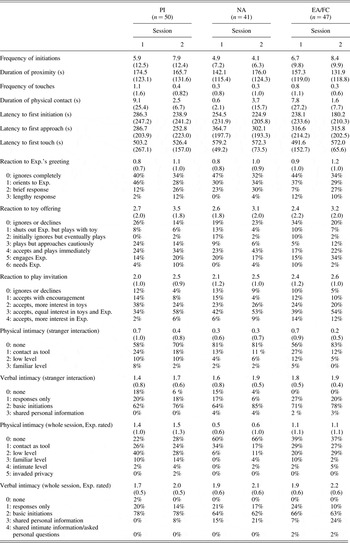
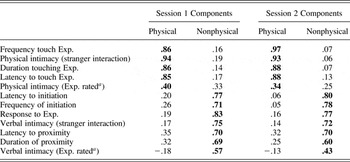
Descriptive statistics for the behaviors of interest are presented by group and session in Table 1. A PCA was then used to explore the existence of an underlying factor structure for the variables measuring DSE, including behavioral codes and experimenter ratings summarized in Table 1. A PCA with a varimax rotation was used to reduce the grand mean centered, square root transformed, Winsorized variables. The analysis was first conducted for Session 1. The PCA solution returned three factors with eigenvalues larger than 1; however, the third factor only had an eigenvalue of 1.08 and was only defined by the two experimenter ratings, likely capturing only measurement error. We repeated the analysis requesting up to two factors and obtained a two-factor solution. The first factor was defined by the following items: duration of proximity, frequency of initiations, latency to approach and initiation, coder and experimenter ratings of verbal intimacy, and response to the toy and play invitation (see Table 2). The most highly loading variable was responses to the experimenter's toy and play invitations (0.83), which was a normative behavior in this play context. This factor seemed to be a general sociability dimension. In contrast, the second factor was defined most strongly by physical contact items: duration of touch, frequency of touch, coder and experimenter ratings of physical intimacy, latency to touch, and duration of proximity. The most highly loading variable was coder ratings of physical intimacy (0.94). This seemed to be a physical engagement dimension.
Descriptive statistics and percentage frequencies for key variables

Note: PI, Postinstitutionalized; EA/FC, early adopted from foster care; NA, nonadopted; Exp., experimenter.
Principal components results: Rotated component matrix

Note: Exp., experimenter.
a Rated over the entire 2-hr session.
We then examined whether the same factor structure emerged at Session 2. Precisely the same variables defined the nonphysical social engagement factor and the physical engagement factor (see Table 2). In order to create unbiased composites of nonphysical and physical engagement that could be calculated in the same way at both sessions by equally weighing each variable, we constructed two scales using the variables loading most highly on each component. Both the nonphysical and the physical engagement scales had high internal consistency at Session 1 (α = 0.86 and 0.89, respectively) and at Session 2 (α = 0.82 and 0.87, respectively); thus, we proceeded to create separate nonphysical and physical social engagement composites for each session by averaging the variables identified by the PCA as loading most highly on each dimension.
Group differences and change over time
There were no significant gender differences on either composite, so gender was not considered in subsequent analyses. A repeated-measures GLM was conducted to test the effects of group as a between-subjects factor and session (1 vs. 2) and DSE type (nonphysical vs. physical engagement) as within-subjects factors. There were no significant main effects of session or type on DSE behavior, but there was a significant effect of group, F (2, 135) = 3.90, p = .02, partial η2 = 0.06, and a significant interaction of group by DSE type, F (2, 135) = 7.59, p = .001, partial η2 = 0.05, as well as a significant interaction of session by DSE type F (2, 135) = 20.58, p < .001, partial η2 = 0.13, and thus we did not interpret the main effect of group in the presence of interactions. We followed up on the group by type interaction with univariate GLMs to investigate the effect of group on each DSE subtype. There was a significant main effect of group on mean physical DSE behavior across sessions, F (2, 135) = 10.3, p < .001, partial η2 = 0.13, with Bonferroni post hoc tests indicating pairwise differences between PIs and NAs (p < .001), on the one hand, and EAs and NAs (p = .02), on the other hand. Both adopted groups (PI and EA/FC) exhibited on average significantly more physical DSE behavior (M = 0.22, SE = 0.08 and M = 0.05, SE = 0.09, respectively) compared to the NA group (M = –0.28, SE = 0.08). Among adopted children, EAs did not differ significantly from PIs (p = .41). There was no effect of group on nonphysical social engagement behavior, F (2, 135) = 0.36, p = .70, with mean levels of the social approach dimension of DSE being almost identical across the three groups.
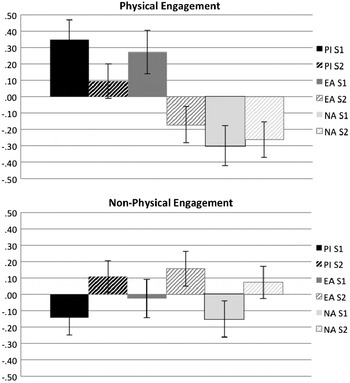
We then probed the session by type interaction on DSE behavior. Paired-samples t tests indicated that the interaction effect was due to physical DSE decreasing significantly from Time 1 to Time 2, t (137) = 2.16, p = .03, in the entire sample, while nonphysical social engagement increased significantly from Time 1 to Time 2 in the entire sample, t (137) = –3.27, p = .001. Mean levels of physical and nonphysical DSE by adoption group and session are displayed in Figure 1. As illustrated in Figure 1, the PI and EA/FC groups tended to show decrements in physical DSE over time, whereas the NA group did not show any significant changes in physical DSE over time, NA: t (46) = 0.26, p = .80. All groups showed the same pattern of increasing levels of sociability over time. Given the wide age ranges and the slightly higher age of the EA/FC group, we repeated this analysis controlling for age. Again, there were no significant main effects of session or type on DSE behavior, and there continued to be a significant effect of group, F (2, 134) = 3.95, p = .02, partial η2 = 0.06, and a significant interaction of group by DSE type, F (2, 134) = 7.12, p = .001, partial η2 = 0.10. Results of follow-up analyses did not change (i.e., PI and EA/FC continued to differ from NA children, but not from each other, on the physical factor, and there were no group differences on the nonphysical factor). The interaction of session by DSE type was no longer significant after controlling for age, but there was a nonsignificant trend for an association between age and DSE type, F (1, 134) = 2.77, p = .099, partial η2 = 0.02.
The descriptive levels of grand mean centered physical and nonphysical social engagement by adoption group over time. Error bars are standard errors of the means.

To examine within-subjects stability of DSE behaviors over time, we computed correlations between Time 1 and Time 2 levels of these behaviors. Physical DSE behavior was highly unstable across these two time points within each of the three groups, PI: r (48) = .04, p = .77; EA/FC: r (39) = –.11, p = .48; NA: r (45) = –.14, p = .35, whereas the more normative nonphysical sociability factor had high stability in the EA/FC, r (39) = .53, p < .001, and NA, r (45) = .50, p < .001, groups, with poorer stability in the PI group, r (48) = .20, p = .17.
Associations with parent-reported temperament
To further confirm the distinction between the physical and nonphysical DSE factors, the relationship between the composite scores and parent-rated temperamental inhibition (“shyness”) was examined. The DSE nonphysical composite was inversely correlated with parent-rated shyness at both time points, r (129) = –.24, p = .006, r (125) = –.25 , p = .004, for Sessions 1 and 2, respectively, whereas the physical DSE was not associated with temperamental shyness at either session, r (129) = –.09, p = .32, r (125) = .06, p = .48. In a repeated-measures GLM controlling for Time 1 shyness and examining the effects of group, session, and type, we obtained a similar pattern of results described, with a main effect of group, F (2, 127) = 3.95, p = .022, and a significant interaction of group by type, F (2, 127) = 8.41, p < .001. The interaction of type by session now became marginally significant, F (1, 127) = 3.41, p = .07. When probing the Group × Type interaction and still controlling for shyness, we obtained the same results previously mentioned such that there was a main effect of group on the physical engagement dimension, F (2, 127) = 10.6, p < .001, with PIs and EAs having higher levels of overall physical engagement than NAs (p < .001 and p = .004, respectively), but groups did not differ on the nonphysical dimension, F (2, 127) = 0.18, p = .83.
Correlates of DSE in adopted children
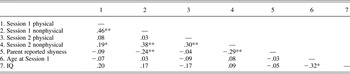
We first examined correlations of physical DSE with institutional care variables for the PI children. Bivariate correlations (see Table 3) showed that physical DSE in PI children at Session 1 was not associated with length of institutionalization, r (48) = .10, p = .50, or number of transitions prior to adoption, r (48) = –.05, p = .75. IQ was only available for the PI children 12 months postadoption, but physical DSE was not a significant correlate, r (43) = .20, p = .18. Physical DSE at Session 2 was also not associated with any of these variables (ps > .2). Finally, for both EA/FC and PI children, we examined whether there were differences by birth regions. Adopted groups were combined for these analyses to provide sufficient cell sizes. No differences were noted for either type of DSE: physical S1: F (3, 87) = 1.5, p = .22; S2: F (3, 87) = 1.3, p = .27; nonphysical S1: F (3, 87) = 1.4, p = .25, S2: F (3, 87) = 0.96, p = .56.
Correlations between variables of interest

*p < .05. **p < .01.
Discussion
DSE is one of the most commonly reported socially aberrant behaviors in PI children, but little research has systematically differentiated these behaviors from normative sociability. The current study examined DSE in a group of newly adopted PI children compared with EA/FC children and NA children. Using behavioral observations of an interaction with an unfamiliar adult, this study sought to deconstruct some of the complexities of DSE behavior. The first aim was to distinguish atypical behaviors from behaviors that are prevalent and show wide variation in NA children. Behaviors such as frequency of initiation, approach, and response to the stranger's initiation, duration of proximity, and latency to approach to the stranger all showed wide variation in NA children, increased over time with normative gains in social development, and were therefore considered typical. Conversely, all measures of nonincidental physical contact and intimacy were rare in NA children and, we argue, would be considered inappropriate by social and cultural standards, suggesting they represent a more atypical pattern of behavior. The two factors drawn from the observed behaviors represent the two dimensions of social engagement. The first factor suggests a temperamental nonphysical social engagement dimension, while the second factor suggests an atypical physical engagement dimension.
High levels of social approach behavior can be observed, in some settings, among typically developing nondisordered children. In the present experimental situation, the child met a stranger in the presence of a parent. It is not inappropriate to be social with that person, and thus results show a wide variety of nonphysical sociality, which could be considered normal temperamental disinhibition or extraversion. This nonphysical social engagement behavior is correlated inversely with parent reports of shyness, and the measures that load on this factor are the same measures that, if coded inversely, would be used to assess shyness. In this situation, results showed no group difference; however, it is possible that group differences might arise if children were assessed in a situation where it would be inappropriate to speak to or to be social with the stranger (perhaps if the parent had not been present). This possibility remains to be examined. Conversely, physical contact with a stranger is culturally inappropriate in our society. PI and EA/FC children continue to demonstrate this behavior even though there are few situations that we can imagine where intimate contact with a stranger would be normative behavior.
The division between nonphysical social engagement behavior and physical DSE is important for the study of DSE and related behaviors. Different measures of DSE may have been picking up different dimensions of social disinhibition. This is likely why some studies (e.g., O'Connor et al., Reference O'Connor, Bredenkamp and Rutter1999) found the presence of some DSE in noninstitutionalized children. It is interesting that there has been a high degree of consistency in the findings on DSE despite this possible measurement issue. It is likely that the measures used thus far have tapped, to some extent, both dimensions of disinhibition.
The second aim of the present study was to examine how atypical and typical behaviors differ among NA, EA/FC, and PI children. Examination of the nonphysical social disinhibition factor suggests that the groups did not differ significantly on this dimension, extending the evidence that these types of gregarious social behaviors reflect a temperamental social disinhibition rather than problematic DSE behaviors. In line with previous research, PI children did differ from NA children on the physical DSE dimension. PI children showed more physical engagement than NA children at both time points. This pattern of group differences further validates the scales we constructed and supports the notion that they are different dimensions. As in previous studies of PI children, the differences are driven by a minority of PI children showing excessive DSE behavior (e.g., five touches and 84 s of physical contact), while other PI children show no abnormal behavior.
The third aim was to examine whether DSE is unique to PI children. Replicating the results of a recent study (Bruce et al., Reference Bruce, Tarullo and Gunnar2009), EA/FC children also showed more physical DSE than did NA children, with means falling between the NA and the PI groups. This may indicate that prenatal factors may be involved in the etiology of DSE behaviors or that one significant care transition (i.e., adoption) is sufficient to increase rates of this behavior. However, it is also important to note that the EA/FC children also had nonnormative early experiences, for example, experiencing brief institutionalization, neglectful caregivers, or more frequent transitions, which may have contributed to the development of this behavior.
Finally, our fourth and fifth aims were to evaluate the extent to which DSE changed over time and how it relates to other child characteristics. Nonphysical social disinhibition increased over time, while physical DSE decreased in the adopted children but not in the NA children who had low levels of physical DSE to begin with. This could suggest that there is a developmental course of this type of social engagement, which is supported by the fact that these changes with time became nonsignificant when age was controlled in the analyses. In addition, reduction in novelty of the situation may also be playing a role. As the situation becomes more familiar (although not the stranger, because there is a unique experimenter at each session), children may be willing to be more social with a stranger, at least when they are in their mother's presence. In this case, it is possible that novelty was inhibiting sociability at Session 1. Conversely, with the reduction in novelty at Session 2, physical contact decreased. That may suggest that novelty was disinhibiting physical contact. Perhaps the strategy of disinhibited physical engagement is a coping mechanism for anxiety-provoking situations for internationally adopted children. Perhaps children are decreasing their physical DSE with the developing awareness of social boundary norms.
In terms of correlates of DSE behavior, levels of DSE were not related to length of institutionalization or number of care transitions, which is in contrast with other studies of PI children (e.g., Bruce et al., Reference Bruce, Tarullo and Gunnar2009; Chisholm, Reference Chisholm1998). This may be due to the differences between the current samples and prior adoption samples. The current sample is far more diverse in origin and experience than many previous studies, and it includes only children adopted at more than 6 months old (EA/FC) or 16 months old (PI). Work reporting no differences in DSE between PI and non-PI children have noted this for children adopted at 6 months or younger (e.g., O'Connor et al., Reference O'Connor, Bredenkamp and Rutter1999; O'Connor & Rutter, Reference O'Connor and Rutter2000). It may also be due to different methods of measuring DSE, although neither composite was correlated with length of institutionalization or number of transitions. Consistent with prior research (Bruce et al., Reference Bruce, Tarullo and Gunnar2009; O'Connor et al., Reference O'Connor, Bredenkamp and Rutter1999; O'Connor & Rutter, Reference O'Connor and Rutter2000), results showed no association between DSE and general cognitive ability in PI children. Thus, disinhibited social engagement does not seem to be a manifestation of a general developmental delay.
The current study had several limitations. This study did not include measures of DSE reported by the parents, a method commonly used to measure DSE in previous research (e.g., Chisholm, Reference Chisholm1998; O'Conner et al., Reference O'Connor, Bredenkamp and Rutter1999) and often the basis for seeking clinical services. It will be very important to see how parent-reported DSE relates to the physical and nonphysical dimensions of social disinhibition. Currently available parent-report measures are designed to be used after the child has been with the caregiver for an extended amount of time, and therefore they were not appropriate to use in the current study. However, we plan to address this limitation as part of the ongoing longitudinal study of these children. In addition, the predictive validity of the current DSE coding scheme was not tested, so future research should evaluate whether observational measures used soon after adoption predict which children will continue to show this behavior years later and whether it is associated with other deleterious outcomes. We also plan to investigate the predictive value of these behaviors for longer term socioemotional and clinical outcomes assessed during kindergarten.
It is also important to note that there was a large difference in racial compositions of the three groups. It is unlikely that these affected the results for a couple of reasons. First, when we analyzed the effect of world region of origin, we found no differences in DSE behaviors, despite the racial differences between Southeast Asia, Russia/Eastern Europe, and Latin America. Second, despite racial differences between the PI and EA/FC groups, we did not observe significant differences between these groups in DSE behaviors. In addition, many of the PI children were Caucasian, while none of the EA/FC children were, yet the largest mean differences were between the PI and NA groups. Taken as a whole, these data argue against a racial explanation for differences in DSE between the adopted and nonadopted groups.
Although the lack of homogeneity in the adoptive sample can be seen as a limitation because it introduces complexity, it is also a strength of this study because it increases generalizability of the findings. A final limitation is the need to verify these two DSE group in a future study using confirmatory factor analysis.
Despite these limitations, the present study provides valuable information regarding the delineation of typical and atypical social behaviors; the differences among PI, EA/FC, and NA children on these behaviors; and how these behaviors change over time. Future research should investigate further correlates of DSE, including aspects of the postadoption environment that could contribute to the lasting exhibition of this behavior. Because DSE has been demonstrated in domestic maltreated children in addition to internationally adopted children, future research should also investigate the possibility that variations in parenting may lead to variation in DSE behavior. This may help us elucidate the etiology of this behavior and offer insights into ways of changing it.
Differentiation of typical and atypical behaviors to strangers may facilitate better identification of emotional, social, and neurocognitive correlates of DSE and foster earlier identification of PI children at risk for DSE problems. Furthermore, it may reduce concerns by clinicians and parents about the possibility of a disorder in PI children who only exhibit normative temperamental sociability. Understanding the etiology of DSE behavior will help with creating interventions for these children and preventing DSE behaviors from leading to other socioemotional problems.
Appendix A: Observational Qualitative Coding Scheme
Response to experimenter greeting
-
0 Ignores
There is absolutely no positive nonverbal or verbal response to the introduction. Note that a wary child may stare at the experimenter (E), but this is not to be considered a positive nonverbal response.
-
1 Orients to the E
Child looks toward the E in response to the introduction and smiles or otherwise positively and nonverbally acknowledges the introduction. Child does not approach the E and does not attempt more than this brief acknowledgement.
-
2 Brief response to the E
Child gives a one-word response to the introduction (i.e., “Hi.”), or child leans toward, takes one or two steps toward, or shows the E something.
-
3 Lengthy response to the E
Child gives lengthy response following the introduction without pause. Child speaks with or approaches close to the E or engages in prolonged showing of things to the E.
Note that if child has begun to respond to the E before the E has a chance to introduce herself, give the code you would have given, had this level of interaction been occasioned by the introduction.
Response to toy offering
-
0 Ignores or declines and never plays with toys
Child ignores or declines the invitation to play and never plays with the toys during Phase 3.
-
1 Ignores or declines but does play with toys without the E
Child ignores or declines the invitation and never accepts the E and toys. Child manages to get a toy or two to play with while shutting the E out. This child either moves toys over near mom and turns back on or face away from the E, or this child corrals some toys to play with while sitting closer to the E but otherwise ignoring and shutting the E out.
-
2 Eventually plays with the E and toys
Child initially ignores or declines the invitation to play, but then eventually plays with toys in a way that includes acceptance of the E before the end of Phase 3. To get this score, the child must not seem to be shutting the E out. Playing with toys must seem like an acceptance of the E and her toys, though it takes a while.
-
3 Plays with the E and toys
Child accepts the invitation, but approaches slowly or cautiously. Once playing, child shows acceptance of the E and toys on a higher level than a “2.” This means child does not seem to be avoiding looking at the E, although child may still seem slightly unsure of the E.
-
4 Accepts and plays immediately
Child nonverbally or verbally accepts the invitation to play and plays immediately (e.g., helps get toys out or plays with first toy put out). This child plays with toys, but does not actively try to get the E to play with him/her. This can be scored if child's response is delayed owing to his/her needing to complete some task that he/she was already doing when the play invitation was made, but once involved child acts like a “4.”
-
5 Accepts and plays immediately; engages the E
Child accepts and plays immediately, not only focusing on toys but also actively attempting to engage the E in the toy play. When the E does not respond, child may become unsure and begin acting like a 4.
-
6 Accepts and plays immediately; needs the E
Child accepts and plays immediately, actively tries to get the E to play, and when the E responds minimally, child keeps up and intensifies his/her bids.
Response to play invitation
-
0 Ignores or declines
Child ignores or declines invitation.
-
1 Accepts with encouragement
Child accepts invitation with encouragement (i.e., “It's really fun.”). Child may spend most of this period watching the E play with the toys or engaging in parallel play with the E. Throughout, though, the sense is child would be happier if the E wasn't there. Quality of toy play may be lower during this period than when the E was sitting quietly.
-
2 Accepts; more interest in toys than in the E
Child accepts invitation immediately. Child responds avidly to the E's play initiations, but otherwise seems more interested in toys than in playing WITH the E and toys.
-
3 Accepts; equal interest in toys and the E
Child accepts invitation immediately, responds to the E's play initiations, and makes play initiations to the E, handing her toys, sharing her experiences with the E verbally and nonverbally. However, the overall sense is that toys are as important as playing with the E.
-
4 Accepts; more interest in the E than in toys
Child accepts invitation immediately, and responds to and initiates interactions with the E. Keeps the E responding throughout the together play time. The strong sense is that while toys are interesting, playing with the E is child's bigger goal.
Verbal intimacy (0–5)
This scale assesses child's level of intimacy in verbal or preverbal communication with the E. Score the highest achieved throughout the DSE task.
-
0 None
Child did not communicate with the E at all. There were no verbalizations or preverbal communications to the E.
-
1 Only verbal or preverbal responses
There were only brief responses to the E's questions (i.e., a one-sentence logical response). Include preverbal responses, such as looking at what the E is talking about or pointing to.
-
2 Initiated basic communication
Child initiated communication on a basic level verbally or preverbally. Child's verbalizations and/or preverbal communications were designed to initiate or maintain interactions with the E beyond a response to a direct question. However, all initiations involved events within the room. They did not involve divulging of information about child or his/her family, except for child's name or showing off of a pretty shirt or something as a way of starting a conversation.
-
3 Shared some personal information
Child's verbal interactions with the E involved sharing of personal information, but not of the particularly intimate type. Child may have talked about school, the fact he/she has a dog, or that he/she was going to McDonalds on the way home. Child didn't ask intimate questions of the E. If child asked personal information of the E, this information seemed to be a way of entering a topic child wanted to talk about: “Do you have a dog? I have a dog. …”
-
4 Shared intimate information or asked personal questions
Child's verbal interactions with the E involved sharing of intimate information beyond the usual public kind. This child might have told the E that she wet her bed last night, that her mom and dad had a fight, that her baby brother pooped in the bath tub, and so on. Even if child didn't divulge this level of intimate information, score a 4 if child asked the E questions about her personal life, like “Do you have a dog?” (unless this is just to introduce a topic child wants to talk about). Many questions may have followed about the E. Child may not even have stopped to hear the E's answer. However, child's questions were not of the embarrassing kind.
-
5 Shared highly intimate information or asked very personal questions
Child's verbal interactions with the E involve sharing of personal information and/or requests for personal information of the type typically not asked of strangers: “Are you married?”; “Do you have a boyfriend?”; “Are you having a baby?” If at any point child asks to come home with the E, visit the E's house, or meet the E's boyfriend, parents, and so on, score a 5 regardless of the content of the other vocalizations. If child only invites the E to his/her house or to join him/her at McDonalds, then base scoring on other aspects of his/her communication with the E, although in this instance child would not score below a 3.
Physical intimacy (0–5)
This scale assesses child's level of intimacy in physical contact with the E. Score the highest achieved throughout the DSE task.
-
0 None
Child did not physically contact the E. There was no physical contact between the E and child, except for that which happened by chance or is required to get a task done.
-
1 Physical contact as a tool
Physical contact between the E and child occurred, but it was as if the E was a tool or a piece of the furniture. Child may have used the E as a support in getting to a toy or pushed the E's hand to get her to do something.
-
2 Initiated low-level physical contact
Physical contact between the E and child occurred and was initiated by child. Child may have leaned against the E while playing, when it was unnecessary. The sense here is not that the E was furniture, but that the contact was pleasant to child. Contact was pretty low level, though, and tended to involve child's hand, back, leg, or arm. There was no evidence of child initiating contact that would have brought more “intimate” parts of his/her body into contact with the E.
-
3 Initiated physical contact on a familiar level
Physical contact between the E and child occurred, was initiated by child, and involved contact of child's bottom, chest, or face with the E's body. Sitting in the E's lap, or leaning of the torso and face against the E's side/arm counts here. This behavior might seem appropriate if the E were child's teacher or a friend of the family with whom child is very familiar.
-
4 Initiated intimate physical contact
Physical contact between the E and child occurred, was initiated by child, and involved active attempts to snuggle and to get the E to respond. This behavior would seem appropriate if the E were child's mother, childcare provider, close grandparent or aunt/uncle, or someone who is in the circle of “loved ones.”
-
5 Initiated physical contact that invaded the E's privacy
Physical contact between the E and child occurred, was initiated by child, and invaded the E's privacy. This may have involved playing with the E's face or earrings in a way that required child to bring his/her face within an inch or so of the E's face. Touching intimate parts of the E's body (i.e., breasts or bottom) would certainly count here. Counting would be lifting of child's clothing so that child's skin touched the E or if child rubbed his/her chest, bottom, and so on, against the E even if skin was not exposed. This level of physical contact would be odd even with the parent if child is beyond toddlerhood and with other “loved ones” even for a toddler. It has a sense of being sexually provocative.