Implications
Findings of this experiment support the fact that inclusion of dietary fibre (DF) in pig diets may enhance short-chain fatty acids and reduce ammonia production in the pig intestine, thereby reducing faecal nitrogen (N) excretion from pig. However, the common DF sources are rich in indigestible protein levels, which may counteract these benefits. Pea fibres and sugar beat pulp could be considered for incorporation in pig diet, in order to reduce faecal N excretion and improve the positive benefits of fermentation onto the gastrointestinal tract of pigs, compared with other feed ingredients such as wheat bran and distillers dried grains with solubles.
Introduction
Fermentation of both dietary fibre (DF) and protein in the pig intestine is a matter of interest for pig nutritionists, because of their possible beneficial or harmful effect on gut health and the environment. Fermentable DF constitutes a source of energy for the pig, after its fermentation and transformation into short-chain fatty acids (SCFA; Houdijk et al., Reference Houdijk, Verstegen, Bosch and van Laere2002; Awati et al., Reference Awati, Williams, Bosch, Gerrits and Verstegen2006). However, fermentation shifts from saccharolytic to proteolytic when there is depletion of fermentable carbohydrate substrate (Piva et al., Reference Piva, Panciroli, Meola and Formigoni1996), producing harmful metabolites such as ammonia (NH3) and amines (Cone et al., Reference Cone, Jongbloed, Gelder and de Lange2005). DF fermentation can also lead to a decrease in NH3 concentration in the gut, as the nitrogen (N) is converted into the bacterial proteins (Le et al., Reference Le, Aarnink, Ogink, Becker and Verstegen2005; Awati et al., Reference Awati, Williams, Bosch, Gerrits and Verstegen2006).
DF negatively affects the digestibility of nutrients and energy (Bach Knudsen, Reference Bach Knudsen2001). However, inclusion of fermentable DF (Awati et al., Reference Awati, Williams, Bosch, Gerrits and Verstegen2006) and reduction of protein (Htoo et al., Reference Htoo, Araiza, Sauer, Rademacher, Zhang, Cervantes and Zijlstra2007) in weanling diets reduces protein fermentation along the gastrointestinal tract. Moreover, the presence of fermentable DF in the diet can also reduce the emission of gaseous nitrogenous compounds by shifting N excretion from urine to faeces (Canh et al., Reference Canh, Verstegen, Aarnink and Schrama1997; Zervas and Zijlstra, Reference Zervas and Zijlstra2002; Bindelle et al., Reference Bindelle, Buldgen, Delacollette, Wavreille, Agneessens, Destain and Leterme2009), thus reducing the NH3 emission from piggery (Mroz et al., Reference Mroz, Moeser, Vreman, van Diepen, van Kempen, Canh and Jongbloed2000; Nahm, Reference Nahm2003). O'Connell et al. (Reference O'Connell, Callan and O'Doherty2006) found increased urinary N and decreased faecal N when pigs were fed with barley-based fibre-rich diet, with significant interaction between protein levels, fibre source and enzyme supplementation on NH3 emission.
These benefits outweigh the limitations of DF to be used in pig diets. However, most of these beneficial effects have been observed with isolated fibres. A finding from a recent study (Jha et al., Reference Jha, Rossnagel, Pieper, Van Kessel and Leterme2010) suggests that the fermentation characteristics of DF depend on how they are present in the diet: in the isolated form or embedded as an integrated part of grain matrix. Moreover, adding DF just for its fermentative properties is an economical nonsense. A more pragmatic approach would involve using feed ingredients that present desirable benefits of DF on gut environments of pig. By choosing barley varieties according to the properties of their fibre fraction, it is, for example, possible to enhance SCFA and reduce NH3 production in the pig intestines (Jha et al., Reference Jha, Rossnagel, Pieper, Van Kessel and Leterme2010 and Reference Jha, Bindelle, Rossnagel, Van Kessel and Leterme2011a), which in turn supports the growth of beneficial bacteria such as Lactobacilli (Pieper et al., Reference Pieper, Jha, Rossnagel, Van Kessel, Souffrant and Leterme2008).
Many feed ingredients with highly fermentable DF are also rich in indigestible CP (iCP, dietary CP entering the large intestine from the ileum), which can minimize the positive effects of fermented DF. Some studies (O'Connell et al., Reference O'Connell, Sweeney, Callan and O'Doherty2005 and Reference O'Connell, Callan and O'Doherty2006) have revealed the effects of protein and fibre content on N digestion and excretion in pigs. However, there is limited information available on the possible interactions between DF and CP of non-conventional feed ingredients, especially when it resided in its natural matrix on fermentation metabolites concentration in the pig intestine and faecal N excretion.
The main objective of the study was to evaluate different non-conventional DF sources, with a varying level of iCP for their fermentation metabolites production in the pig intestine, and their consequences on faecal N excretion. The study hypothesized that feed ingredients differing in their type and amount of fermentable fibre and iCP content affect the fermentation metabolites profile in the pig's gastrointestinal tract, as well as faecal N excretion.
Material and methods
The animal experiment was performed in accordance with the recommendations of the Canadian Council on Animal Care (CCAC, 1993), as specified in the Guide to the Care and Use of Experimental Animals and the standard animal care protocol (No. 970019) approved by the University of Saskatchewan Committee on Animal Care and Supply.
Animals and housing
The experiment was conducted at the Prairie Swine Centre Inc. (Saskatoon, SK, Canada). A total of 40 piglets (Camborough Plus females × C337 sires, PIC Canada Ltd, Winnipeg, Canada, both males and females) were used in a completely randomized design where one pig was the experimental unit. The pigs were weaned at 21 days of age and reared for 3 weeks with their littermates in nursery rooms and were fed with a normal nursery diet used at the Prairie Swine Centre. At 6 weeks of age (average BW 22.6 ± 1.84 kg), the pigs were moved to individual pens (1.2 × 0.6 m, slatted concrete floor), with free access to water, and randomly allocated to 1 of the 5 experimental diets with eight piglets per diet. Standard rearing conditions (24°C temperature, ∼40% humidity and 12 to 12 h light/dark lighting programme) were maintained during the whole experimental period. No antibiotics, neither for prophylactic nor for therapeutic purpose, were administered to the animals during the study.
Experimental diets
Five diets differing in soluble fibre and iCP content were formulated using different non-conventional ingredients: wheat bran (WB), pea hulls (PH), pea inner fibres (PIF), sugar beet pulp (SBP) and corn distillers dried grains with solubles (DDGS). The diets were semi-synthetic in nature, and balanced with soya protein isolates, pea starch, sucrose (sugar) and vitamin and mineral premixes in order to make sure that nutrient and energy requirements (National Research Council (NRC), 1998) would be met and that no adverse effect of the differences in energy or protein level between the diets would occur.
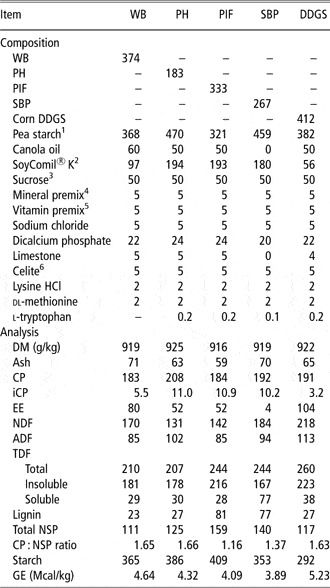
The analysed chemical composition of ingredients and diets used in the experiment is presented in Tables 1 and 2, respectively. Celite® (Celite 545, Celite Corporation, Lompoc, CA, USA) was incorporated into the diet (6 g/kg dry matter; DM) as a source of acid-insoluble ash (AIA), as an indigestible marker to measure the apparent total tract digestibility (ATTD). Chromic oxide (Cr2O3) was used as a marker to measure the apparent ileal digestibility (AID) because Cr2O3 is a preferred marker at the ileum level than AIA (Van Leeuwen et al., Reference Van Leeuwen, Veldman, Boisen, Deuring, Van Kempen, Derksen, Verstegen and Schaafsma1996; Jha et al., Reference Jha, Rossnagel, Pieper, Van Kessel and Leterme2010). The Cr2O3 was added to the diet (3 g/kg DM) directly before feeding from day 13 of the start of the experiment for 3 consecutive days. The diet was offered in mash form (110 g/kg BW0.75 per day) for 60 min twice daily (0800 and 1600 h) for 15 days, and residuals were collected subsequently and stored at −20°C until analysis.
Chemical composition of the ingredients (g/kg DM)

DM = dry matter; EE = ether extract; TDF = total dietary fibre; NSP = non-starch polysaccharides; WB = wheat bran; PH = pea hulls; PIF = pea inner fibre; SBP = sugar beat pulp; DDGS = distillers dried grains with solubles.
1Exlite® – pea hulls (Parrheim Foods, Saskatoon, SK, Canada).
2Swelite® – pea inner fibre (Cosucra-Groupe, Rue de la Sucrerie; B-7740 Warcoing, Belgium).
3Not analysed.
Composition and analysis of the experimental diets (g/kg DM)

DM = dry matter; WB = wheat bran; PH = pea hulls; PIF = pea inner fibre; SBP = sugar beat pulp; DDGS = distillers dried grains with solubles; iCP = indigestible CP; EE = ether extract; TDF = total dietary fibre; NSP = non-starch polysaccharides; GE = gross energy.
1Starlite® – pea starch (Parrheim Foods, Saskatoon, SK, Canada).
2SoyComil®K – ADM Speciality Ingredients (Europe) B.V., PO Box 2, 1540 AA Koog aan de Zaan, The Netherlands; contains 63% CP with 91% ileal digestibility (Mariotti et al., Reference Mariotti, Mahe, Benamouzig, Luengo, Dare, Gaudichon and Tome1999).
3White Sugars – Rogers Sugar Ltd, Canada.
4Minerals premix – provided (per kg of diet); Zn, 100 mg as zinc sulfate; Fe, 80 mg as ferrous sulfate; Cu, 50 mg as copper sulfate; Mn 25 mg as manganous sulfate; I, 0.50 mg as calcium iodate; Se, 0.10 mg as sodium selenite.
5Vitamins premix – provided (per kg of diet), vitamin A, 8250 IU; vitamin D3, 825 IU; vitamin E, 40 IU; niacin, 35 mg; d-pantothenic acid, 15 mg; 5 mg; menadione, 4 mg; folacin, 2 mg; thiamine, 1 mg; d-biotin, 0.2 mg; vitamin B12, 25 μg.
6Celite 545 – Celite Corporation, Lompoc CA, USA.
Slaughtering and sample collection
After an adaptation period of 9 days to the experimental diet, the faeces were collected for 3 days (days 10 to 12) and stored at −20°C for further analysis. On day 16, pigs were fed at 15 min intervals and were sacrificed by captive bolt and exsanguination 4 h after the meal in the order of feeding with the same time interval. One pig from each treatment (diets 1 to 5) was fed and sacrificed, followed by the other set of pigs from all five treatments in the same order. This procedure was conducted so that there would be similar fill in the stomach and small intestine in order to provide approximately equal amounts of nutrients for bacterial fermentation in the small intestine. After sacrifice of the animals, the abdomen was opened and the complete gastrointestinal tract was removed. Digesta samples from the ileum (last 1/4th of the small intestine) and colon (medial 20 cm) were collected and subsequently homogenized on ice. The pH-value of the ileal and colonic contents was measured immediately after sample collection by means of a digital pH-meter (SymPHony, VWR, PA, USA). Aliquots of digesta were taken for subsequent analyses of SCFA, total N and NH3 and stored in Eppendorf tubes at −80°C. The residual digesta were frozen in sealed plastic containers for subsequent analysis of nutrients, AIA and Cr2O3.
Proximate nutrients
All ingredients, diets and freeze-dried ileal and faecal samples were ground in a laboratory mill (Retsch Mill ZM1, Newton, PA, USA) to pass through 1-mm-mesh screen. The chemical analysis was performed according to the Association of Official Analytical Chemists (AOAC, 2007) standard procedures with specific methods as follows: DM (AOAC 930.15 using drying oven, Fisher Scientific, Ottawa, ON, Canada), N (AOAC 968.06 using an elemental analyzer LECO FP528, St Joseph MI, USA; CP = N × 6.25), ether extract (AOAC 920.39 using a Soxhlet apparatus (Labconco Corporation, Kansas City, MO, USA) and petroleum ether), ash (AOAC 942.05), ADF (AOAC 973.18), NDF (AOAC 2002.04), total, insoluble and soluble DF (TDF, iTDF and sTDF, respectively; AOAC 985.29), lignin (AOAC 973.18) and gross energy (PARR 1281 calorimeter, Moline, IL, USA).
Carbohydrate composition
For total starch and non-starch polysaccharides (NSP) analysis, all the diets and freeze-dried ileal and faecal samples were ground to pass through a 0.5-mm-mesh screen in a laboratory mill (Retsch Mill). The Commercial test kit (Megazyme International Ltd, Bray, Co. Wicklow, Ireland) was used to determine the total starch (AOAC 996.11). NSP were analysed by gas chromatography (GC) using the method described by Theander et al. (Reference Theander, Aman, Westerlund, Andersson and Pettersson1995; AOAC 994.13 method). Chromatographic analysis was conducted using a GC system (Agilent 6890 system, Agilent Technologies Inc., Waldbron, Germany) equipped with a flame ionization detector and a fused-silica capillary column (DB-17 HT, Agilent Technologies, Wilmington, DE, USA), using 2-Deoxy-d-Glucose as the internal standard.
Fermentation metabolites in intestinal contents
The SCFA of the ileal and colonic contents was analysed by GC (Agilent 6890 system, Agilent Technologies Inc.) fitted with a flame ionization detector and a fused-silica capillary column (ZB-FFAP, Phenomenex, Torrance, CA, USA), using trimethyl acetic acid as the internal standard. Before injection, the sample was acidified by adding 25% metaphosphoric acid to make pH ∼2.2. The following column conditions were used: initial temperature, 100°C; initial hold time, 1 min; and final temperature, 200°C with gradient, 8°C/min; carrier gas, helium (flow rate, 1.9 ml/min). To obtain the final SCFA concentrations in the sample, GC readings were corrected for dilutions made during sample preparation. SCFA were calculated as the sum of acetic acid (ACE), propionic acid (PRO), butyric acid (BUT), and iso-butyric and iso-valeric acids. Branched-chain fatty acids (BCFA) were estimated as the sum of iso-butyric and iso-valeric acids.
NH3 concentration was determined according to Novozamsky et al. (Reference Novozamsky, van Eck, van Schouwenburg and Walinga1974), with slight modifications. Briefly, NH3 was oxidized by sodium hypochloride in the presence of sodium nitroprusside, which forms a blue colour complex, and was measured at 600 nm using a spectrophotometer (Pharmacia LKB-Ultraspec III; Amersham, Freiburg, Germany).
Nutrient digestibility
The nutrients (DM and N) of the ileal and faecal contents of each piglet were analysed as described above. For determination of the ileal and faecal NSP content, two samples of the same treatment – but from consecutive replicates – were pooled, resulting in four samples per treatment. They were analysed using the methods described above. Dietary and faecal samples were analysed for their AIA content by gravimetry, after treatment with 3N HCl (AOAC 971.33), whereas the Cr2O3 content in the diets and ileal samples was determined by colorimetry after nitro-perchloric hydrolysis, as described by Furukawa and Tsukahara (Reference Furukawa and Tsukahara1966). The digestibility values were used to calculate the amount of NSP fermented in the large intestine and faecal N excretion.
Calculations and statistical analyses
The AID and ATTD of the different nutrients were calculated for each pig based on the ratio of the AIA and Cr2O3 content in the diet and ileal digesta/faeces using the equation:

where M d and M f are the concentrations of the marker (Cr2O3 or AIA) in the diets and ileal digesta or faeces, respectively, and N d and N f are the concentrations of the nutrient determined in the diets and ileal digesta or faeces, respectively.
The amount of NSP fermented in the large intestine was calculated by the difference between ATTD and AID of NSP. The iCP was calculated using the reference digestibility value of 15N soya protein isolate (Mariotti et al., Reference Mariotti, Mahe, Benamouzig, Luengo, Dare, Gaudichon and Tome1999).
Data were analysed using the Mixed model procedure of SAS (SAS Institute, 2003) using diet as the main effect, with the following statistical model:

where Y is the parameter to be tested, μ the overall mean, αi the effect of diets and εij the experimental error. Means were separated using the Tukey method. An α level of 0.05 was used to assess significant differences among means.
Finally, to explain the interrelationships among multiple nutritional properties of diets and digestibility, fermentation characteristics and faecal N excretion, a principle component analysis (PCA) was conducted using the JMP® software (SAS Institute, 2009).
Results
Pig performance, nutrient digestibility and N excretion
All piglets remained healthy throughout the experiment. There was no difference (P > 0.05) in feed intake (average 1106 ± 42.6 g/day) between treatments, whereas the highest average daily gain was observed for the diets based on PH (568 g/day), followed by PIF, SBP and WB (520, 500 and 425 g/day, respectively) and lowest with DDGS (378 g/day), with s.e.m. 37.2 g/day (P < 0.05).
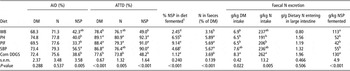
The AID and ATTD of DM, N and NSP of the experimental diets, amount of NSP fermented in large intestine and faecal N excretion in pigs are shown in Table 3. There was no difference (P > 0.05) in the AID of DM or N between treatments. However, differences in the ATTD were found (P < 0.001) both for DM and N. There was a difference in both AID and ATTD of NSP among diets (P < 0.05). The ATTD of DM was highest (P < 0.01) for PH, PIF and SBP and was lowest for the WB and DDGS-based diets, with a similar pattern for the ATTD of NSP and the amount of NSP fermented in the large intestine. However, the trend was different for the ATTD of N with no difference between diets, except for DDGS, which had the lowest ATTD (P = 0.005). Moreover, a greater DM/N ATTD ratio was found with PH, PIF and SBP diets (1.10, 1.12 and 1.14, respectively), compared with DDGS and WB (1.05 and 1.03, respectively).
Apparent digestibility of nutrients, NSP fermentation and faecal N excretion in pigs fed diets differing in fibre and protein source

NSP = non-starch polysaccharides; N = nitrogen; AID = apparent ileal digestibility; ATTD = apparent total tract digestibility; DM = dry matter; WB = wheat bran; PH = pea hulls; PIF = pea inner fibre; SBP = sugar beat pulp; DDGS = distillers dried grains with solubles.
a,bMean values with different superscripts within column differ.
1NSP fermented in the large intestine.
There was a difference in the ileal flow of NSP; PIH had the highest and DDGS the lowest amount of NSP available for fermentation in the large intestine (P < 0.001). This in turn influenced the N excretion. Pigs fed pea fibres and SBP had higher total faecal N content (P < 0.001), which was almost double that of pigs fed DDGS and WB (Table 3). In contrast, it was just the opposite when faecal N excretion was expressed per kg NSP fermented. However, when faecal N excretion was expressed per kg DM intake, DDGS ranked on the top, followed by SBP, whereas pigs fed pea fibres and WB had the lowest N excretion (P = 0.022). Expressed per kg N intake, faecal N excretion was highest (P < 0.05) in DDGS, intermediate in WB and SBP and lowest in PH- and PIF-based diets.
Fermentation metabolites and pH of intestinal contents
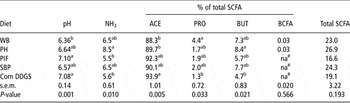
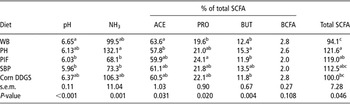
The results of pH measured and major fermentation end products along with the proportions of the individual SCFA in the ileal and colon contents are presented in Tables 4 and 5, respectively. Lower ileal pH was observed with the WB diet, medium with PH and SBP and higher with PIF and DDGS (P = 0.001). The pH-value of the colon contents was influenced by the amount of NSP fermented in the large intestine; PIF and SBP diets were found to have the lowest pH-value (P > 0.05), PH and DDGS had a medium pH-value and those fed WB-based diets had the highest pH-value. In all cases but with the WB-based diets, the pH of the colon contents was lower than that of the ileum contents.
Fermentation metabolites in the ileal digesta (mMol/kg) of pigs fed diets differing in fibre and protein source

SFCA = short-chain fatty acids; NH3 = ammonia; ACE = acetic acid; PRO = propionic acid; BUT = butyric acid; BCFA = branched-chain fatty acids (the sum of iso-butyric and iso-valeric acids); WB = wheat bran; PH = pea hulls; PIF = pea inner fibre; SBP = sugar beat pulp; DDGS = distillers dried grains with solubles.
a,bMean values with different superscripts within column differ.
Not available, concentration was below the detection limit.
Fermentation metabolites in the colonic digesta (mMol/kg) of pigs fed diets differing in fibre and protein source

SFCA = short-chain fatty acids; NH3 = ammonia; ACE = acetic acid; PRO = propionic acid; BUT = butyric acid; BCFA = branched-chain fatty acids (the sum of iso-butyric and iso-valeric acids); WB = wheat bran; PH = pea hulls; PIF = pea inner fibre; SBP = sugar beat pulp; DDGS = distillers dried grains with solubles.
a,b,cMean values with different superscripts within column differ.
As a result of the difference in fermentability, the diets had an effect on the metabolites concentration in the intestine. In ileal digesta, there was no difference (P > 0.05) in the total SCFA concentration between diets; however, differences were found (P < 0.05) in the individual components of SCFA. Pigs fed DDGS diets had the highest and WB and PH the lowest ACE proportion in ileal digesta (P = 0.005). In contrast, the proportion of PRO was highest in WB and lowest in DDGS-based diets (P = 0.033). However, PH ranked top in BUT concentration, with almost 80% higher than the lowest BUT-containing DDGS-based diet (P = 0.021). Unlike ileal digesta, the difference in the SCFA concentration was found in colon digesta, where the PH was not statistically different from PIF and SBP, but had 23% higher (P < 0.05) SCFA concentration than the WB. The trend for the individual SCFA in colon contents was similar to ileal contents. The proportion of ACE among the diets was in the range from 58% to 64% of total SCFA, with the only difference (P = 0.03) between PH and WB. The proportion of PRO was highest in PIF and lowest in WB-based diets with other treatments intermediate. However, the proportion of BUT in the colonic content of PH was 23% higher than the DGGS-fed pigs, which had the lowest BUT concentration (P = 0.004). There was no effect (P > 0.05) of dietary treatments on the BCFA concentration, either in the ileum or in the colon contents. The NH3 concentration was highest (P < 0.05) in the digesta of the pigs fed PH, both in the ileum and the colon, and lowest in pigs fed PIF and SBP in the colon.
PCA
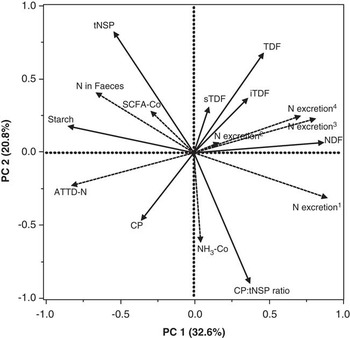
The PCA loading plot (Figure 1) indicates the relationship between the nutritional characteristics of diets and digestibility of nutrients, fermentation metabolite concentrations and faecal N excretion. In the loading plot, the CP : NSP ratio content in the diets and the NH3 concentration in colon contents were clustered closely together, opposite to the NSP content of the diets and the SCFA concentration in the colon contents. The CP : NSP ratio and NH3 in colon contents were also correlated with the CP content of the diets. The NDF, TDF, sTDF and iTDF contents of diets were correlated with faecal N excretion, which was negatively correlated with the ATTD of N.
Loading plot from principle component analysis (PCA) showing interrelationships of nutritional characteristics of diets (solid line) and digestibility of nitrogen, fermentation metabolites and N excretion (dotted line) in the intestine of pigs. In PCA, the length, direction and angle between arrows indicates the correlation between variables or between variables and principle component axes (e.g. α = 0° and r = 1; α = 90° and r = 0; and α = 180° and r = 1). The percentages on the X and Y axes indicate the proportions of variability of data that are described with the corresponding principle component in the model. ATTD-N = apparent total tract digestibility of nitrogen; N = nitrogen; NH3-Co = ammonia in colonic digesta; NSP = non-starch polysaccharide; SCFA-Co = short-chain fatty acids in colonic digesta; iTDF and sTDF = insoluble and soluble portion of the total dietary fibre, respectively; TDF = total dietary fibre. 1N excretion (g/kg NSP fermented); 2N excretion (g/g dietary N entering the large intestine); 3N excretion (g/kg N intake); 4N excretion (g/kg dry matter intake).

Discussion
The main objective of this study was to evaluate the effect of different DF sources with varying levels of iCP content on the intestinal fermentation activity in growing pigs and their effect on faecal N excretion. An in vitro experiment was previously conducted with the same feed ingredients, which provided information about the fermentation characteristics and rate of bacterial protein synthesis in the pig intestine, a basis for this in vivo study. The results of that study are published elsewhere (Jha et al., Reference Jha, Bindelle, Van Kessel and Leterme2011b). Previous studies (Canh et al., Reference Canh, Verstegen, Aarnink and Schrama1997; Zervas and Zijlstra, Reference Zervas and Zijlstra2002; Bindelle et al., Reference Bindelle, Buldgen, Delacollette, Wavreille, Agneessens, Destain and Leterme2009) have shown that the inclusion of isolated DF in pig diet shifts N from urine to faeces, which leads to reduced N excretion in the environment. This study assumed that it is also true when DFs are in their natural matrix as well. In the PCA loading plot, variables located close together were positively related, whereas variables located in an opposite quadrant were negatively correlated. The PCA plot thus provided clear indication that the nutrient contents and type, especially the fibre and CP, are important to influence the digestibility of nutrients, fermentation metabolites concentration in the pig intestine and faecal N excretion.
Overall, the differences in digestibility and fermentation activity can be explained by the differences in ingredient composition, especially the type and amount of DF and the level of iCP in the natural matrix of the ingredients. Lower ATTD of DM for the ingredients rich in insoluble fibre such as WB and DDGS is in agreement with several previous studies (Bach Knudsen and Hansen, Reference Bach Knudsen and Hansen1991; Kreuzer et al., Reference Kreuzer, Heindl, Roth-Maier and Kirchgessner1991; Hansen et al., Reference Hansen, Chwalibog, Tauson and Sawosz2006). This effect is ascribed to the higher insoluble DF content of these diets, which negatively affects the accessibility and action of the endogenous enzymes in the upper gut and microbial fermentation in the lower gut (Bach Knudsen, Reference Bach Knudsen2001), resulting in lower degradability. The negative correlation between the CP : NSP ratio content and the ATTD of N in the loading plot suggests that not only the DF content but also the ratio of CP and DF influence protein digestion. A similar interaction was reported by Lynch et al. (Reference Lynch, Callan and O'Doherty2009) while studying the effect of different levels of CP and lactose on N digestibility in pig. This is ascribed to the fact that highly fermentable DF fractions, such as hemicellulose and pectin, stimulate bacterial growth in the hindgut. This in turn increases faecal N excretion in the form of bacterial biomass and thus reduces apparent N digestibility (Kreuzer et al., Reference Kreuzer, Heindl, Roth-Maier and Kirchgessner1991; Hansen et al., Reference Hansen, Chwalibog, Tauson and Sawosz2006). However, this interaction might not only be due to the effect of soluble NSP on the digestive process, but also due to an increase in endogenous N excretion (de Lange et al., Reference de Lange, Sauer, Mosenthin and Souffrant1989; Huisman et al., Reference Huisman, Heinz, van der Poel, van Leeuwen, Souffrant and Verstegen1992; Leterme et al., Reference Leterme, Souffrant and Thewis2000). The endogenous N losses may increase the N excretion, resulting in lower ATTD of protein.
Decreases in NH3 concentration in the colon digesta and faecal N excretion with highly fermentable DF sources, as observed in this study, are commonly interpreted as a result of an increased incorporation of N into bacterial proteins in the presence of fermentable DF (Jorgensen et al., Reference Jorgensen, Zhao and Eggum1996; Van Nevel et al., Reference Van Nevel, Dierick, Decuypere and De Smet2006). The findings of this study suggest that both DF and iCP play a role in N excretion, as discussed above. However, high levels of fermentable DF in the diet do not necessarily result in a reduced N excretion. Pea fibre fractions, for example, have the highest rate of fermentation in the large intestine of pigs (Jha et al., Reference Jha, Bindelle, Van Kessel and Leterme2011b) but had lower N excretions (expressed per kg N intake basis) than DDGS, which is less fermented in the gut. On the contrary, DDGS with higher contents of iCP had higher levels of N excretion. It does not necessarily mean, though, that their DF was highly fermented and that the bacterial biomass produced would be responsible for high N excretion. It is certainly the case for SBP, which is rich in highly fermentable pectin and hemicellulose, and has low protein content. The DDGS are not well fermented in the pig intestine, as evidenced by an in vitro method (Jha et al., Reference Jha, Bindelle, Van Kessel and Leterme2011b), but contain high levels of iCP. The latter contributed to total N excretion. Our data also confirm that the proteins of fibrous feedstuffs are usually not well digested because they are embedded into the DF matrix, which eliminates the advantage gained by the presence of fermentable DF. Thus, the advantage of fermentable DF on N excretion will depend on the overall composition of the feed ingredients, especially the ratio of fermentable DF and iCP and how it is incorporated in the matrix of the ingredients.
The concentrations of total SCFA, both in the ileum and colon contents were influenced by the amount and type of fibre in the diets, which is consistent with the study of Bach Knudsen and Canibe (Reference Bach Knudsen and Canibe2000). The weak but positive correlation between the NSP content of the diets and the SCFA concentration in the colon contents suggests that not only the level of NSP, but also the type of NSP fraction available for microbiota affect SCFA production in the lower gut (Glitsø et al., Reference Glitsø, Brunsgaard, Højsgaard, Sandström and Bach Knudsen1998). Moreover, pigs fed pea fibre-based diets also had the lowest ACE proportion, both in the ileum and colon digesta. The lower ACE is associated with the higher proportion of BUT for PH. This is the most pronounced effect of all and corresponds to previous findings in rats (Stark and Madar, Reference Stark and Madar1993), and resulting increased concentrations of BUT in peripheral blood (Goodlad and Mathers, Reference Goodlad and Mathers1990).
In this study, the dietary influence on NH3 concentration in the colon digesta indicates the differences in carbohydrate and protein fermentation in the intestine. Proteins in excess enhance the growth of N-utilizing bacteria (Reid and Hillman, Reference Reid and Hillman1999) that ferment the available protein, leading to increased NH3 and amines concentration in the colon (Macfarlane et al., Reference Macfarlane, Gibson, Beatty and Cummings1992). NH3 is normally found in small amounts in a healthy colon (Rasmussen et al., Reference Rasmussen, Holtug and Mortensen1988). NH3 and amines are considered to be detrimental to gut health (Nollet et al., Reference Nollet, Deprez, Van Driessche and Muylle1999; Cone et al., Reference Cone, Jongbloed, Gelder and de Lange2005). These compounds at higher concentration in the gut can negatively affect the development of the intestinal mucosa (Visek, Reference Visek1984), namely the villus height (Nousiainen, Reference Nousiainen1991). The higher NH3 concentrations in the colon contents were found with the feedstuffs having the highest CP content (PH and DDGS). As evidenced in the loading plot, the CP : NSP ratio in the diets and NH3 concentration in the colon digesta were positively correlated, whereas NSP and NH3 concentration in the colon digesta were negatively correlated. This is in line with the observations by Le et al. (Reference Le, Aarnink, Jongbloed, van der Peet-Schwering, Ogink and Verstegen2008) that both the NSP content and the CP : NSP ratio in the diets affect the NH3 concentration in the pig intestine. The result of this study is also supported by the findings of O'Connell et al. (Reference O'Connell, Callan and O'Doherty2006) that the excretion of N and NH3 from pigs is influenced by the dietary protein level, and the effect interacts with the fibre content in the diet. A lower NH3 concentration obtained for the PIF diet indicates a reduction in bacterial hydrolysis of nitrogenous compounds in the presence of highly fermentable DF in the matrix. This confirms previous observation by Houdijk et al. (Reference Houdijk, Bosch, Verstegen and Berenpas1998) that when the supply in fermentable carbohydrate is increased an excess of indigestible protein is more likely to be incorporated into bacterial protein rather than being fermented and used as a source of energy. Moreover, the amount of NH3 in the colon also reflects the shift of N excretion pathway from urine to faeces, although the results must be linked with results of urinary N excretion before any conclusion can be drawn.
In conclusion, the results of this study showed that PH-, PIF- and SBP-based diets enhance bacterial fermentation and SCFA production in the large intestine of pig and decrease faecal N excretion. However, PH had higher NH3, both in the ileal and colonic digesta. The results on SCFA and NH3 can be attributed to both the source and level of DF and iCP content in the diets. Moreover, the sources of DF and their iCP content had a major effect on the accumulation of NH3 in the colon and faecal N excretion. Thus, PH, PIF and SBP could be considered for incorporation in pig diets, in order to reduce faecal N excretion and improve the positive response of fermentation onto the gastrointestinal tract of pigs, compared with other feed ingredients studied. However, the contribution of the iCP from these fibre sources has to be taken into account while considering fibre fermentation.
Acknowledgements
National Pork Board (Project no. 06-117) and Alberta Barley Commission (Project no. 60-192) are gratefully acknowledged for funding this study. The continuing core support of the Prairie Swine Centre received from Saskatchewan Pork, Manitoba Pork Council, Alberta Pork and the Saskatchewan Agriculture Development Fund is acknowledged. The authors thank the technical staff of the Prairie Swine Centre Inc. and the Department of Animal and Poultry Science at the University of Saskatchewan for their help provided during this experiment, especially Pam Kish for her help during laboratory analysis works.