INTRODUCTION
Allergic diseases such as asthma, allergic rhinitis and atopic dermatitis are the most popular diseases. Among the kinds of inhalant allergens inside homes in humid geographical areas, the most important are dust mites, especially the American house dust mite, D. farinae (Hughes), and the European house dust mite, D. pteronyssinus (Trouessart) (Arlian, Reference Arlian1989). Changes in living environments such as a rise in the number of apartment households with centrally installed heating, space heating, tighter windows and fitted carpets have improved conditions for mite growth.
Control of house dust mite is currently achieved by 3 different approaches: implementation of exceptional cleaning standards (Adilah et al. Reference Adilah, Fitzharris, Crane and Siebers1997; Nishioka et al. Reference Nishioka, Yasueda and Saito1998), reduction of humidity levels (Bischoff et al. Reference Bischoff, Fischer, Liebenberg and Kniest1998) and reduction of allergens by effective acaricides (Mitchell et al. Reference Mitchell, Wilkins, McCallum and Platt-Mills1985; Green et al. Reference Green, Nicholas, Salome and Woolcock1989) such as γ-benzene hexachloride (γ-BHC), pirimiphos-methyl, benzyl benzoate, N,N-diethyl-m-toluamide (DEET), and dibutyl phthalate (Pollart et al. Reference Pollart, Ward and Platts-Mills1987). The latter option must only be employed after careful consideration because acaricides could kill the house dust mite quickly and inhibit the breeding of them effectively. Although good control was obtained by these synthetic acaricides, their repeated use has sometimes resulted in the development of resistance (van Bronswijk and Sinha, Reference van Bronswijk and Sinha1971), has undesirable effects on non-target organisms, and has fostered environmental and human health concerns (Pollart et al. Reference Pollart, Ward and Platts-Mills1987). These problems have highlighted the need for the development of safer and more efficient alternatives in controlling mites in the indoor environment.
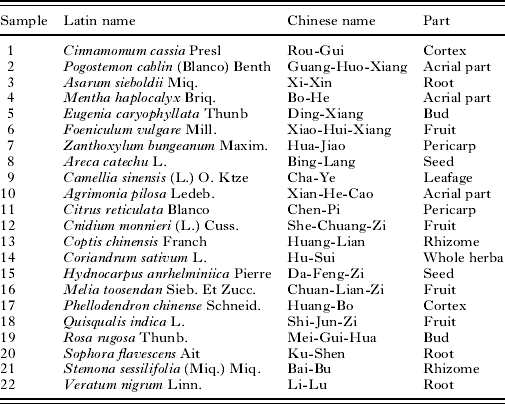
Plant products have been suggested as a promising alternative to chemical acaridices for mite control (Kim et al. Reference Kim, Kim and Ahn2003; Rezk and Gadelhak, Reference Rezk and Gadelhak2004; Rembold, Reference Rembold2005). In China, there are abundant plant materials designated as traditional Chinese medicine (TCM), which is compiled of different components of the same or dissimilar species of plant. The flowers, seeds, leaves, bark and roots etc. are prepared and purified by a chemical or physical process to provide the different TCM products, which exert different effects to cure disease. Table 1 lists 22 kinds of TCM having the characteristic of abundant essential oils or insecticidal or antibacterial effects. These 22 samples were selected to screen for activity against the house dust mite. This investigation could lead to the development of new classes of potentially safer acaricides for application inside homes and other hiding places. Comparative data have demonstrated that Eugenia caryophyllata (5), Narcissus pseudonarcissus, Chenopodium ambrosioides, Rosa rugosa (19) all of which contained caraway oils, have high activity against D. pteronyssinus (Saad et al. Reference Saad, Hussien, Saher and Ahmed2006). Eugenia caryophyllata (5, Clove) bud oil-derived methyleugenol was much more effective than benzyl benzoate and N,N-diethyl-m-toluamide (DEET) against D. pteronyssinus and D. farinae adults (Kim et al. Reference Kim, Kim and Ahn2003). Acaricidal activities of components from Foeniculum vulgare (10) fruit oil against D. farinae and D. pteronyssinus were much more effective than benzyl benzoate (Lee, Reference Lee2004). Materials derived from the rhizome of Cnidium officinate (12) were also shown to have higher acaricidal activity than DEET, but equitoxic to benzyl benzoate (Kwon and Ahn, Reference Kwon and Ahn2002a). Therefore, this paper describes a laboratory study that assessed the potential of TCM preparations for use as commercial acaricides. Acaricidal activities of petroleum ether extracts, ethyl acetate extracts and methanolic extracts from 22 TCM towards the adult house dust mite, D. farinae, were examined using direct contact and vapour-phase toxicity bioassay and compared with those of 2 current chemical acaricides of benzyl benzoate and dibutyl phthalate.
Crude materials collected from traditional Chinese medicine

MATERIALS AND METHODS
Chemicals
The two chemical acaridides used in this study were benzyl benzoate (98%) and dibutyl phthalate (98%) purchased from China National Medicines Corporation Ltd. All other chemicals were of reagent grade and commercially available.
Stock culture of house dust mites
A stock culture of the house dust mite, Dermatophagoides farinae, was maintained in our laboratory for 5 years without exposure to any known acaricide. Mites were reared on a finely ground mixture of dust, dried yeast and bean cake (1:1:0·5 by weight) in complete darkness. Stock jars were kept in an incubator at an average temperature of (25±2°C) and relative humidity of (80±5%).
TCM and sample preparation
Twenty-two TCM were used in this study (Table 1). They were purchased from Shenzhen Accordance Pharmaceutical Co., Ltd, China. Each sample (100 g) was pulverized and extracted with 400 ml of petroleum ether by soxhlet's extraction and filtered. The filtrate was dried by anhydrous Na2SO4 and concentrated to dryness by rotary evaporation at 50°C. Then, filter residues were extracted successively with 500 ml of ethyl acetate twice and 300 ml of methanol twice at room temperature for 3 days and filtered. The respectively combined filtrate was also dried by anhydrous Na2SO4 and concentrated to dryness by rotary evaporation at 50°C.
Contact toxicity bioassay
A filter paper contact toxicity bioassay (Lee, Reference Lee2004) was used to evaluate the toxicity of petroleum ether extracts, ethyl acetate extracts and methanolic extracts from 22 TCM and 2 chemical insecticides currently used against adult D. farinae. In a preliminary experiment, 0·00953 mg/cm2 was found to be an appropriate starting dose for a primary screening of the acaricidal activity of these extracts. Eight concentrations (100, 50, 25, 12·5, 6·25, 3·12, 1·56, 0·78 mg/ml) of each extract in petroleum ether were used. Amounts (1·21951, 0·60976, 0·30488, 0·15244, 0·07622, 0·03811, 0·01905, 0·00953 mg/cm2 or other doses) of each test material were applied to Whatman filter papers (5·6 cm diameter). The 2 acaricides tested were also dissolved in petroleum ether. Control filter papers received an equal volume of petroleum ether. After drying in a fume hood (20°C) for 2 min, each treated filter paper was separately placed on the bottom of a Petri dish (5·5 cm diameter×1·2 cm). Groups of 55–65 adult mites were introduced into Petri dishes containing a piece of cotton (5 mm×5 mm) impregnated with 2 ml of distilled water. Each Petri dish was then covered with a lid and kept in an incubator at an average temperature of (25±2°C) and relative humidity of (80±5%). Mortalities were determined at 24 h (or 0·5, 1, 1·5, 2, 2·5 h) post-treatment under a binocular microscope (20×). Adults were considered to be dead if the legs did not move when they were prodded with a fine pin (Kwon and Ahn, Reference Kwon and Ahn2002b). All treatments were replicated 3 times.
Vapour-phase toxicity bioassay
Experiments were conducted to determine whether the lethal activity of these extracts against adult D. farinae was attributed to contact or vapour-phase toxicity (Kim et al. Reference Kim, Yi, Tak and Ahn2004). One selected dose above which mortality of the extract was up to 100% in the preliminary fumigant bioassay of each preparation in petroleum ether was used. The amount of each selected test material was applied to Whatman filter papers (5·6 cm diameter). And each treated filter paper was separately attached to the top of a lid. When mites were introduced into the bottom of a Petri dish, each dish was covered with a lid with a treated filter paper tightly fitted (a closed container, method A) to investigate the potential vapour-phase toxicity of the extracts used, or 95% of the Petri dish was covered with the lid lightly fitted (an open container, method B). Mortalities were determined at 24 h post-treatment. Other operations were performed as described above.
Data analysis
Lethal activity was classified as follows: strong, mortality >80%; moderate, mortality 80–50%; weak, mortality 50–20%; little or no activity, mortality <20%. The mortality percentages were determined and transformed to arcsine square root values for analysis of variance (ANOVA). The Bonferroni multiple comparison method was used to test for significant differences among the test TCM preparations. A paired t-test was used to test for significant differences between two treatment methods. Means (±s.e.) of untransformed data are reported. The LD50 values were calculated by probit analysis. Acaricidal activity was considered to be significantly different when 95% confidence limit levels failed to overlap.
RESULTS
Contact toxicity with treated filter paper
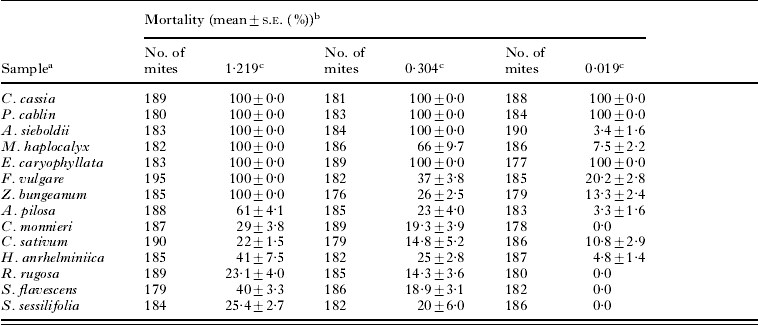
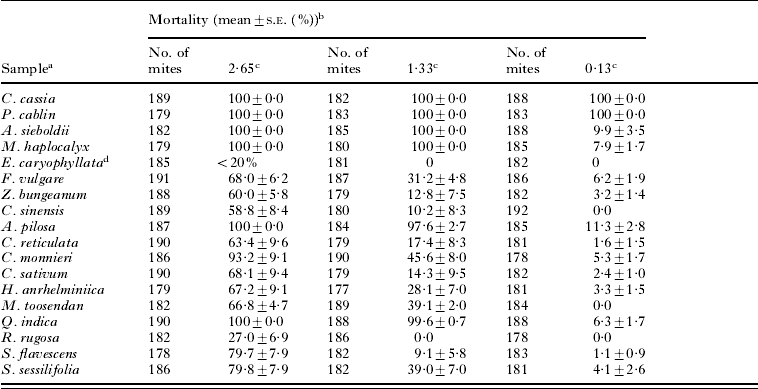
Toxic effects of the petroleum ether extracts, ethyl acetate extracts and methanolic extracts of 22 TCM on adult D. farinae were bioassayed by direct contact. Lethal activity varied according to medicine species, extracted components and exposure dose tested. At the dose of 1·219 mg/cm2, the results in Table 2 show that the petroleum extracts of samples 1–7 exhibited 100% mortality. Among the 22 petroleum ether extracts, C. cassia (1), P. cablin (2) and E. caryophyllata (5) preparations exhibited the highest lethal activities against D. farinae adults. At the dose of 2·65 mg/cm2, the ethyl acetate preparations of samples 1–4 and 10 exhibited strong (Table 3). Samples 1 and 2 demonstrated 100% lethal activity when they were tested at 0·13 mg/cm2.
Lethal activity of petroleum ether extracts from 22 TCM towards adult D. farinae using the filter paper contact toxicity bioassay, exposed for 24 h

a TCM preparations causing ⩾20% mortality at 1·219 mg/cm2 are presented.
b Means within a column followed by the same letter are not significantly different (P=0·05, Bonferroni's test).
c Dose (mg/cm2).
Lethal activity of ethyl acetate extracts from 22 TCM towards adult D. farinae using the filter paper contact toxicity bioassay, exposed for 24 h

a TCM preparations causing ⩾20% mortality at 2·65 mg/cm2 are presented.
b Means within a column followed by the same letter are not significantly different (P=0·05, Bonferroni's test).
c Dose (mg/cm2).
d Ethyl acetate extract from E. caryophyllata exhibited very low solubility in petroleum ether.
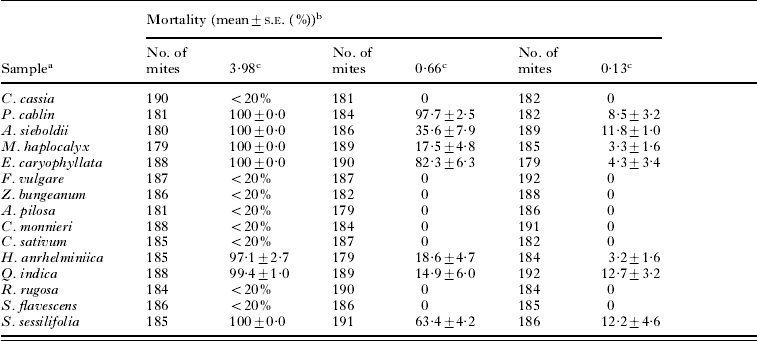
In a comparative listing, although 7 methanolic extracts exhibited strong lethal activity at the dose of 3·98 mg/cm2, the other 15 methanolic preparations showed little or no activity (Table 4). Methanolic extracts were less effective than petroleum ether extracts and ethyl acetate extracts against D. farinae adults by mortality values. There was no mortality in the solvent-treated controls.
Lethal activity of methanolic extracts from 22 TCM towards adult D. farinae using the filter paper contact toxicity bioassay, exposed for 24 h

a TCM preparations causing ⩾20% mortality at 3·98 mg/cm2 are presented.
b Means within a column followed by the same letter are not significantly different (P=0·05, Bonferroni's test).
c Dose (mg/cm2).
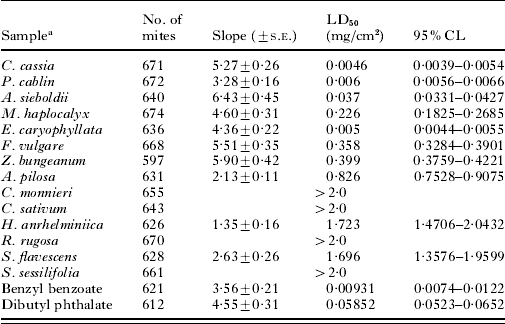
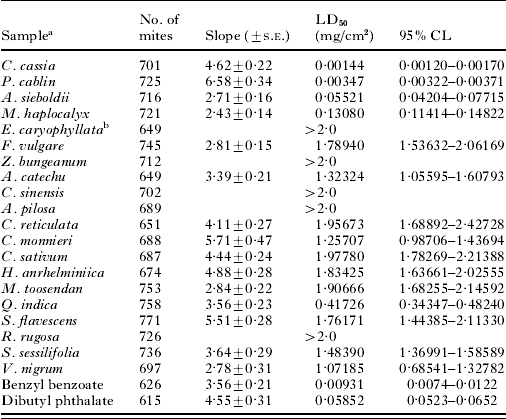
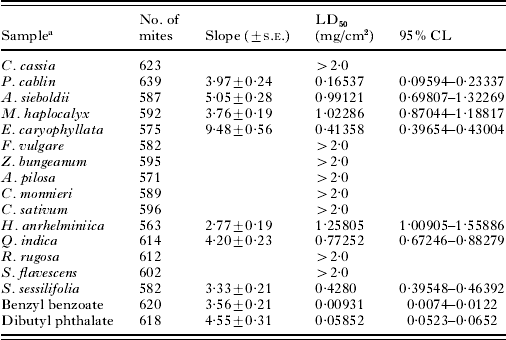
The acaricidal activity of the petroleum ether extracts, ethyl acetate extracts and methanolic extracts was compared with that of 2 acaricides currently used. As judged by 24 h LD50 values, C. cassia (1) extract was the most toxic material (0·0046 mg/cm2) among the 22 petroleum ether extracts (Table 5). Ethyl acetate extract from C. cassia (1) also was the most toxic material (0·00144 mg/cm2) (Table 6). And the acaricidal activity of many other petroleum ether and ethyl acetate extracts was higher than that of 2 currently used acaricides benzyl benzoate and dibutyl phthalate. By contrast, methanolic extracts from the 22 TCM exhibited much lower acaricidal activity. Even the most toxic material (0·16537 mg/cm2), P. cablin (2), was less effective than benzyl benzoate and dibutyl phthalate (see Table 7).
Toxicity of petroleum ether extracts and 2 currently used pesticides towards adult D. farinae using the filter paper contact toxicity bioassay, exposed for 24 h

a TCM preparations causing ⩽2·0 mg/cm2 24 h LD50 are presented.
Toxicity of ethyl acetate extracts and 2 currently used pesticides towards adult D. farinae using the filter paper contact toxicity bioassay, exposed for 24 h

a TCM preparations causing ⩽2·0 mg/cm2 24 h LD50 are presented.
b Ethyl acetate extract from C. sinensis exhibited very low solubility in petroleum ether.
Toxicity of methanol extracts and 2 currently used pesticides towards adult D. farinae using the filter paper contact toxicity bioassay, exposed for 24 h

a TCM preparations causing ⩽2·0 mg/cm2 24 h LD50 are presented.
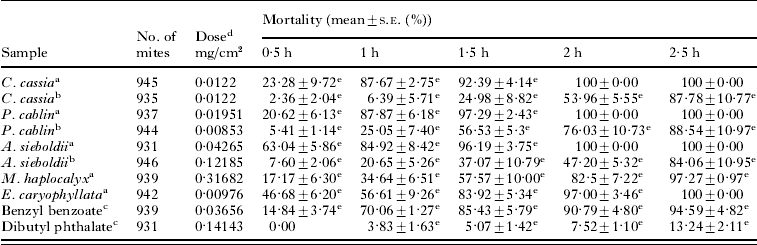
In addition, the acaricidal activity of the 5 selected petroleum ether extracts and the 3 ethyl acetate extracts was compared with that of 2 currently used acaricides by direct contact 0·5, 1, 1·5, 2 and 2·5 h after treatment. It was shown that petroleum ether extracts from C. cassia (1), P. cablin (2) and A. sieboldii (3) worked faster than other preparations (Table 8). The mortality of benzyl benzoate was comparable with that of petroleum ether extracts. There was no mortality recorded in the controls.
Lethal activity of 5 selected petroleum ether extracts, 3 ethyl acetate extracts and 2 currently used acaricides towards adult D. farinae using the filter paper contact toxicity bioassay at different times

a Petroleum ether extracts.
b Ethyl acetate extracts.
c Currently used acaricides.
d Extracts holding 100% mortality at this and at higher than this dose in 24 h in contact bioassay.
e Significant at P<0·05, according to a paired t-test.
Route of acaricidal action
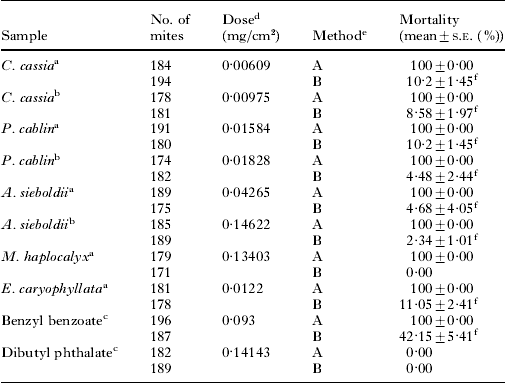
The fumigant activity of these selected extracts which showed strong acaricidal activity in the contact toxicity test was investigated using a vapour-phase toxicity bioassay in 2 formats. After 24 h of exposure to the different extracts at different doses, there was a significant difference in lethal activity of these extracts between exposure in a closed container (method A), which resulted in 100% mortality, and exposure in an open container (method B), which resulted a mortality range from 0 to 11·05% against D. farinae adults (Table 9). C cassia (1), P. cablin (2) and A. sieboldii (3) ethyl acetate preparations exhibited slightly weak lethal activity compared with their petroleum ether extracts in method A. This may be the result of the different volatilities of petroleum ether extracts and ethyl acetate extracts from the same TCM. The fumigant activity of these 8 extracts was comparable with that of benzyl benzoate in method A but slightly less effective in method B. There was no mortality in the dibutyl phthalate control exposures in both method A and in method B.
Fumigant activity of 5 selected petroleum ether extracts, 3 ethyl acetate extracts and 2 currently used acaricides towards adult D. farinae using the vapour-phase toxicity bioassay in 2 formats, exposed for 24 h, at different doses

a Petroleum ether extracts.
b Ethyl acetate extracts.
c Currently used acaricides.
d Extracts holding 100% mortality at this and at higher than this dose in fumigant bioassay.
e A, vapour in closed container; B, vapour in open container.
f Significant at P<0·05, according to a paired t-test.
DISCUSSION
TCM components are potential products for house dust mite control because many of them are selective for pests, and have no or little harmful effects on non-target organisms and the environment. Some extracts from the medicines or corresponding medicinal plants are known to possess acaricidal activity against house dust mites (Kwon and Ahn, Reference Kwon and Ahn2002a; Kim et al. Reference Kim, Kim and Ahn2003; Rezk and Gadelhak, Reference Rezk and Gadelhak2004; Rembold, Reference Rembold2005; Saad et al. Reference Saad, Hussien, Saher and Ahmed2006) and even other acarid parasites such as the tick Ixodes ricinus (Garboui et al. Reference Garboui, Jaenson, Borg-Karlson and Pålsson2007; Pålsson et al. Reference Pålsson, Jaenson, Bæckström and Borg-Karlson2008). Most of the reported naturally occurring acaricidal components are essential oils. Little work has been done with respect to the acaricidal activity of other components from the medicine or corresponding medicinal plants.
Although it has been reported that susceptibility to some plant essential oils such as almond bitter oil, caraway oil, and perilla oil was greater in D. farinae adults than in D. pteronyssinus adults (Watanabe et al. Reference Watanabe, Tadaki, Takaoka, Ishino and Morimoto1989; Furuno et al. Reference Furuno, Terada, Yano, Uehara and Jodai1994), D. farinae adults are also found to be more tolerant to the wood oils of Thuga heteropylla Sarg. and Cryptomeria japonica D. Don than D. pteronyssinus adults (Miyazaki et al. Reference Miyazaki, Yatagai and Takaoka1989). So, the acaricidal activity of 3 kinds of extracts from 22 TCM was tested against D. farinae adults using direct contact and vapour-phase toxicity bioassays in the present study.
Lethal activity of petroleum ether extracts from the 22 TCM was almost comparable with that of ethyl acetate extracts but much stronger than that of methanolic extracts. Petroleum ether extracts 3 and 4 showed stronger toxic activity than benzyl benzoate and dibutyl phthalate, respectively, as judged by 24 h LD50 values, and ethyl acetate extracts 2 and 3 showed stronger toxic activity than benzyl benzoate and dibutyl phthalate respectively. The toxic activity of all of the methanolic extracts was less effective than that of the 2 currently used acaricides. As a whole, C. cassia (1), P. cablin (2), A. sieboldii (3), M. haplocalyx (4) and E. caryophyllata (5) preparations showed stronger lethal activity than the other medicines.
There was a significant difference in lethal activity of the different extracts from the same medicine. For example, acaricidal activities of the ethyl acetate extracts from V. nigrum (22), Fructus cnidii (12) and A. catechu (8) were strong (1·07185, 1·25707 and 1·32324 mg/cm2 respectively), as judged by 24 h LD50, but the petroleum ether and methanolic extracts from them had little or no lethal activity against house dust mite adults.
Potencies also varied according to exposure times and, as a whole, petroleum ether extracts worked faster than ethyl acetate extracts. Mortalities of C. cassia (1), P. cablin (2) and A. sieboldii (3) were higher than 80% after 1 h of treatment by direct contact, but at the same exposure time, ethyl acetate extracts from them only caused 6·39%, 25·05% and 20·65% mortality respectively. Furthermore, the acaricidal activity of these extracts was dose dependent.
Volatile essential oils from the medicines or corresponding medicinal plants, such as clove bud oil (Kim et al. Reference Kim, Kim and Ahn2003) and Cnidium rhizome preparation (Kwon and Ahn, 2002 a) exhibit fumigant activity against adult D. farinae. In this paper, the fumigant activity of extracts was also tested using a vapour-phase toxicity bioassay. These 5 petroleum ether preparations and 3 ethyl acetate preparations were much more effective against D. farinae adults in closed containers than in open containers. These results indicate that the mode of delivery of these preparations was largely due to action in the vapor phase: they may be toxic when they penetrate the dust mite body via the respiratory system. However, the exact acaricidal mode of action remains unknown.
In conclusion, petroleum ether extracts from the bark of C. cassia (1), E. caryophyllata (5) and P. cablin (2), ethyl acetate extracts from C. cassia (1), P. cablin (2) and A. sieboldii (3), and methanolic extracts from P. cablin (2), E. caryophyllata (5) and S. sessilifolia (21) emerged as potential TCM-derived agents that provide promising results against the house dust mite, D. farinae, in our comprehensive screening. These studies suggest that some TCM preparations described herein may be useful as potentially effective, environmentally acceptable, inexpensive, simple and alternative acaricides. Further research is, however, necessary on the safety issues of these TCM on human health and insecticidal constituents of these extracts.
FINANCIAL SUPPORT
This study was supported by grants from the National 863 High Technology Research (No. 2006AA02A231); the National Natural Science Foundation of China (No. 30760082); the Guangdong and Hongkong Key Projects (No. 20054982207) and the Planned Science and Technology Project of Shenzhen (No. JSA200903190973A).