In 1899, a critic for the Musical Standard ditched work (the day was sunny) to spend an afternoon watching cricket at Lord's. He found himself in good company:
Turning round […] I was face to face with a well-known baritone. […] And then my eye caught a well-known tenor sitting a few rows behind and looking like a ‘mysterious musician’ at the seaside with the brim of his soft hat turned down over his eyes and his face shrouded in a white handkerchief. In the distance, too, I saw a celebrated English operatic tenor climbing to his seat; just below me sat a concert-agent unabashed by the knowledge that many would-be vocalists were probably calling on him at his office, and a few seats farther down was a well-known composer of popular songs trying to look a yachtsman. We all eyed each other furtively as if we were being discovered in the indulgence of some secret vice. I have forgotten to add that quite close to me was a very prominent member of the London Wagner Society dressed as if he were a painter in an old-fashioned play.Footnote 1
The collective guilty pleasure here is playful, and the subsequent question ‘Why should there be anything incompatible in a love of music and a love of sport?’ purely rhetorical: the music critic, who wrote under the pen name ‘R. Peggio’, took for granted that readers would be familiar enough with the game of cricket that it could be used to shed light on musical style and taste. He compared the flawless wicket defence of the ‘Nottingham school’ of batting to the perfect ‘economy’ of technique in the ‘older British school of composition’ (both were boring), and likened the effortless flamboyance of the Middlesex cricketer Andrew Stoddart to the dashing elegance of the Polish tenor Jean de Reszke. All his examples were based on an implicit assumption that music and sport were comparable forms of entertainment and that audiences were able, and quick, to determine what comprised a good show in both:
In the abstract [enthusiasts of cricket] deeply admire a scientific game, but immediately some man comes in who is noted for slogging at every ball, there goes up an excited murmur of expectation; from a somnolent high art attitude the cricket audience becomes quite vivacious, just as a catchy waltz-song by a French composer will set heads wagging at St. James's Hall which erstwhile were still in deep appreciation of Brahms's songs.Footnote 2
With respect to sport, this column participated in the kind of aestheticization of cricket that Anthony Bateman has identified elsewhere in nineteenth-century literature.Footnote 3 It also adumbrated different aspects of musical life in Victorian London, any of which could be explored further. But it is the assumption that readers of the Musical Standard – a journal aimed at ecclesiastical and amateur musicians – would be as conversant with the style of flashy batting as they would with Brahms songs that is particularly compelling. By the end of the century, sports and athletic recreations, both as forms of spectator entertainment and as participatory activities, were so pervasive in Britain that their impact was felt everywhere. More particularly, the burgeoning popularity of sports redefined the landscape of leisure and entertainment – not least by fostering commerce and new entrepreneurial possibilities – across all strata of society; in that sense, the rise of sports inevitably affected music and musical practice, too.
Although there have been some valuable studies of music and sports recently, their main emphasis has been on popular music and contemporary sporting events; a comprehensive study of the period when playing and watching sports began to acquire its present-day shape and global popularity has yet to be properly undertaken.Footnote 4 This article takes a small step towards that by looking at ways in which music and music-making intersected with the growth of sports during the latter half of the nineteenth century, a time when there were notable changes in the playing and watching of sports. While my focus is on events in Great Britain, sports and athletic pastimes were becoming important across the modern world. The practice of gymnastics in countries such as Germany and Sweden, for example, was strong throughout the nineteenth century; in America, although baseball embraced professionalization more readily than did, say, cricket or football in Britain, it otherwise followed similar patterns in forming clubs, codifying rules and establishing leagues during the latter half of the century. Institutionalization expedited baseball's dissemination across America, and the newly established sports journalists were quick to dub baseball America's ‘national pastime’.Footnote 5 Yet the biggest impetus to playing and watching sports and, in particular, to the development and global dissemination of team sports arguably came from Victorian Britain.
The sheer ubiquity and popularity of sports, then, made an impact on the music world by changing the terrain of Victorian leisure. The subject of this article, however, is not direct or explicit connections between music and sporting events. Instead, I aim to expose correspondences between music and sports through broader social and cultural developments, in particular new ideas about morality, health and notions of physical fitness. The first section positions nineteenth-century discussions of healthy music and singing as responses to connections between sport and moral improvement that arose from muscular Christianity and the implementation of sports in British public schools. How the healthfulness of singing began to be interpreted more literally, influenced in part by its endorsement in the British medical profession, is taken up in the second section. In the third, I demonstrate how values attached to different ways of engaging with sports – as participants, spectators, professionals or amateurs – allowed singing to be positioned advantageously as an activity akin to playing sports. Lastly, I extend and relocate early twentieth-century encapsulations of singing as physical exercise in the context of concern over degeneration in national fitness.
Sound of body
Nearly 20 years before R. Peggio's reflections on music and cricket, the Musical Standard had reported on an investigation into the influence of singing on health. This study, made by a physician named Vasilieff and published in the Russian Journal of War Medicine, surveyed the physical health and singing practices of Russian peasants living in rural and urban areas. Vasilieff found that children living in rural areas were less prone to tuberculosis than those who lived in the cities. At the same time, he determined that even in areas where the disease was rare, those who contracted it were not given to singing. The doctor concluded that ‘of two lads, one doing light work and using his voice, and the other powerfully exerting the muscles of his arms and chest, but not exercising his throat, the former is more likely to escape consumption than the latter’. Typical Victorian fascination with statistics supported the conclusion that singing acted as a preventative of disease: although tuberculosis was responsible for more deaths in St Petersburg than any other disease, not a single professional singer had contracted it in 25 years. The Musical Standard was at pains to point out that ‘were singing as much practised as playing instrumental music – and the doctor sagely observes that a man's own vocal instrument costs him nothing – the national health would benefit’.Footnote 6
The Musical Standard's commentary on the Russian study was followed, a few years later, by another report of connections between singing and health found abroad: this time an editorial in the Tonic Sol-fa Reporter on a new book entitled Deep Breathing. Translated into English and published in America, the book made an account of a system of ‘lung gymnastics’ developed by a Dutchwoman, Sophia A. Ciccolina, for the improvement of singing and, by extension, as a cure for lung and throat disorders.Footnote 7 The Tonic Sol-fa's review began by affirming the following connection between lung health and character: ‘The calmness, dignity, and power of man [is] in proportion to the depth and tranquillity of his respiration. If the lungs are strong and active, there is courage and boldness. If feeble there is cowardice and debility.’Footnote 8 These claims were nominally backed up by medical evidence, but the main focus of the article was the book's descriptions of the activities of a lung gymnastics class, which were quoted at length. For example:
Please imagine us out on the sunny side of our porch, enveloped in warm wraps, lying upon stretchers, inhaling the life-giving oxygen for hours each day, thus purifying our blood with the greatest blood purifier – oxygen! […] At the ringing of the bell [each morning] the occupants appear promptly and for hours practise lung gymnastics, alternating with short naps, quiet rest, pleasant conversations [and] listening to readings.Footnote 9
Aimed at a broad section of amateur musicians from the working and middle classes, the Tonic Sol-fa Reporter was the journal of John Curwen, creator of the Tonic Sol-fa sight-singing method. Curwen thus had a vested interest in promoting singing: lest his readers not take the idea of lung gymnastics seriously, the article concluded with a forceful reminder that ‘these matters are all of interest and importance to singers’.Footnote 10
These reports were not the first to pair singing with improved health (the idea had been around sporadically for centuries), but they can serve as barometers for changes in theories of health and medicine. For example, the eighteenth-century English physician Richard Browne's Medicina musica of 1729 argued for the medical benefits of singing and dancing on the body in terms of animal spirits.Footnote 11 In the early eighteenth century, the channelling of animal spirits through hollow tubes was still acceptable as a model for the body's nerve functions, though spirits and tubes would soon be replaced with solid nerve fibres along which vibrations travelled in accordance with wave theory.Footnote 12 Nineteenth-century arguments about singing and health were similarly shaped by that era's notions of human anatomy, body functions and medicine. In the latter half of the century, these were also in flux, and the passages from the Musical Standard and the Tonic Sol-fa Reporter reveal an important shift taking place around Victorian concepts of health and morality, which needs a more detailed explanation in order to locate the discourse around health and singing.
We are well acquainted with Victorian moral philanthropy's appropriation of Platonic views of music: that music-making was a morally, spiritually and mentally edifying activity, particularly singing, in which the right text could make the virtue explicit.Footnote 13 These had been the very motivations behind Curwen's singing system in the first place, as Charles McGuire has amply shown. Curwen, McGuire writes, ‘left no moral question untouched’. The Tonic Sol-fa system was ‘a palliative for poverty, slavery, prostitution, alcoholism, and excess of all kinds; a means of improving children's education; and an aid to evangelisation, missionary work, and the culture of domesticity’.Footnote 14 The moral education of the unenlightened masses underwrote the whole enterprise: Curwen even marketed his early song books as ‘courses’. The ‘Temperance Course’, for example, paired songs about the evils of alcohol with those that glorified nature, thus leading the good singing pupil out of the gin shop and into the fresh air.Footnote 15 The purpose of the Tonic Sol-fa Reporter, as house journal, was to promote the virtues of its own system as well as that of music more generally. The choral conductor Joseph Proudman's comment on the purpose of music, for example, represents a typical Victorian attitude towards music and morality in its declaration that ‘music should be [used for] the healthy purposes of recreation, both of mind and spirit, by the influence of that religion whose beautiful servant she was intended to be’.Footnote 16 The word ‘healthy’ in this passage, from an article the Tonic Sol-fa Reporter published in 1877, seven years before the lung gymnastics report, would have been understood by many Victorian readers to signify good morals. This sense of healthiness as a code for morality, however, was beginning to face competition from a far more literal sense of physical health that retained, nonetheless, a moral dimension.
The reasons for this shift in meaning were partly philosophical and partly theological; they were also conditioned by the growing popularity of athletic sports. As the historian Bruce Haley has argued, once nineteenth-century critiques of Cartesian dualism had reunited body and mind into a single system, Victorians such as the Anglican clergyman and novelist Charles Kingsley could interpret ‘the laws of physical health as theologically imperative’.Footnote 17 In other words, Kingsley reasoned that as God had seen fit to provide humans with bodies, neglecting them would be nothing short of an act of blasphemy: healthiness was thus intrinsically holiness. Kingsley was active alongside the sanitarians in cleaning up the living conditions of the poor, but it was primarily through his writings that he thrust his doctrine most widely into public notice.Footnote 18 In its narrowest application, muscular Christianity was a term coined by literary critics in the 1850s to describe the virtue and spiritual grace acquired through physical vigour by the fictional heroes in Kingsley's novels such as Yeast (1848) and Westward Ho! (1855), as well as in those by the like-minded Thomas Hughes.Footnote 19 What is more, the theological historian Dominic Erdozain argues that the muscular Christians replaced Romantic worship of nature with enthusiasm for athletic activity as the expression – Erdozain uses the word ‘vernacular’ – of reverence for God's creation.Footnote 20 In its broadest sense, then, muscular Christianity became a catchphrase for almost any pairing of strenuous bodily activity, such as sports, with spiritual edification and moral improvement. Reflecting both indebtedness to the resolution of mind–body dualism and its context in a period where waves of epidemics threatened public health, the most popular expression of the ideals of muscular Christianity, Haley demonstrates, became the motto ‘mens sana in corpore sano’ – ‘a sound mind in a sound body’.Footnote 21
Muscular Christianity made possibly its biggest impact via the public schools, where the mid-century implementation of organized sports created something of a cult around athleticism.Footnote 22 As J. A. Mangan has shown in his classic study, sports and games were introduced initially as a means of controlling anti-social behaviour in students. They were packaged as morally instructive and character building, and were supported by young and athletically inclined masters, in order to persuade students and parents to give up, respectively, their free time and their money.Footnote 23 The advertised benefits of sport had included greater physical abilities and fitness as well as a slew of character-building attributes, such as leadership, cooperation, courage, fairness, unselfishness, grace in winning and in losing, and so on. The belief that sports would provide regulation of the students’ bodies was, however, just as important: hours of football, rugby, cricket and cross-country running expended energies that otherwise might find outlet in sexual activities, whether solitary or communal. Though seldom explicitly stated, the campaign for ‘moral purity’ was hardly a covert operation: streams of thinly veiled warnings from the school-chapel pulpit and occasional reassurances to parents made what was at stake fairly obvious. One headmaster, for instance, waved away the tedium of family dinner conversations reduced to recitals of sports statistics and blow-by-blow accounts of games with the comment: ‘You may be thankful this is so. What do French boys talk about?’Footnote 24
While the extra-sporting outcomes were initially the justification for the introduction of organized sports into school life, they later became inherent to the appeal of sports.Footnote 25 The campaign to sell sports in the English public schools as an instiller of moral backbone and a former of manly character had been extraordinarily successful. It was, moreover, perpetuated through a range of printed discourses, of which Hughes's 1857 novel Tom Brown's Schooldays was only the most familiar example.Footnote 26 Hughes's fictional accounts of life at Rugby School, and the transformation of his protagonist from wayward boy into model English Christian, misled many into attributing the innovation of sport's special moral schooling to Rugby's headmaster, Thomas Arnold. Outside the novel, the real Arnold had almost no interest in sports, and certainly not as a means of character formation or spiritual instruction. However, organized sports and games were the means of controlling the student body for a number of mid-century headmasters around Britain, some of whom did hold more muscular conceptions of Christian theology than Arnold.Footnote 27 Furthermore, the misapprehension about Arnold's purpose in introducing organized sports to Rugby was evidence of what athleticism had come to signify by the last couple of decades of the century.
The notion that sports made its participants morally better people was crucial in fostering its popularity outside schools.Footnote 28 That said, it took a little longer for the credo of ‘mens sana in corpore sano’ to be widely accepted beyond school sports. Kingsley represented only one order of Christian theology – and that problematically as far as the rest of the Anglicans were concerned.Footnote 29 Even though from a strictly theological standpoint the muscular Christians had mostly failed the attempt to equate faith with physicality,Footnote 30 their ‘soteriology of sport’, Erdozain argues, had nonetheless exposed a fundamental problem in the unequal weighting Christianity gave to life in this world versus that in the next.Footnote 31 By the 1880s, orthodox Christians, as well as nonconformists and evangelicals, had finally all resolved in their own ways acceptance and even promotion of athletic exercise as ‘conducive to spiritual health’.Footnote 32 The Young Men's Christian Association neatly illuminates how protracted this process could be. It would have been easy for the YMCA, as a religious organization rather than a church, to include gymnasiums and sports teams in its recreational offerings. But, as Erdozain demonstrates, George Williams and W. E. Shipton founded the association, in 1844, on the classic evangelical principle that ‘religion is its own consolation’. The sole purpose of the YMCA was to provide young men with a ‘home-from-home’ that would shelter them from London's evil temptations and occupy them with religious activities, such as bible study.Footnote 33 Even instructive Christian literature, while intrinsically commendable, was not invested with ‘salvic potency’: Shipton reminded members at a YMCA conference in 1859 not to use ‘educational agencies […] with the idea that they can effect moral or spiritual transformation’.Footnote 34 And as late as 1869 he was insisting that although participation in sports was ‘perfectly legitimate’, such recreations ‘should be a matter of personal arrangement, and should not be brought inside the circle of the Associations, nor form part of their provision’.Footnote 35 Shipton's reminders and insistence, of course, signal an ongoing debate over the association's aims, but the issue of whether the YMCA should offer sports took nearly another decade to resolve, and the need to boost membership, it should be said, played no small part in the outcome. The first YMCA gymnasium was built in 1876 in Manchester, and the investment proved more than successful enough to galvanize branches in other cities into following suit – Bristol in 1880, and the flagship gym in London's Exeter Hall in 1881.Footnote 36 By 1895, when the association adopted the red triangle symbolizing the mind–body–spirit symmetry as its logo, the transformation from a voluntary evangelical and Salvationist organization to one propounding the tenets of ‘mens sana in corpore sano’ was complete.
Gymnastics systems, notably those of the Swede Per Henrik Ling and the German Turnvater Friedrich Ludwig Jahn, had been introduced to England prior to mid-century. Devotees of the respective systems established Ling and Turner institutions in Britain's largest cities, but had mixed success with them.Footnote 37 During the last couple of decades before the turn of the century, however, gymnasiums and gymnastics began to attract fresh interest. In addition to institutions such as the YMCA, individuals also exploited the new enthusiasm to their advantage. Several ‘strong men’ became famous celebrities through music-hall acts that popularized their strength-training and body-building. The ‘Russian Lion’ George Hackenschmidt, the ‘Danish Apollo’ Jørgen Peter Müller and, especially, Eugen Sandow were all, as Ina Zweiniger-Bargielowska has shown, successful in cashing in on the new ‘physical culture’, marketing themselves, their bodies and their respective fitness systems to an urban populace increasingly concerned about the sedentary lifestyle of office work.Footnote 38 Thus, in 1884, following the YMCA's adoption of sports and athletics, the appearance of the word ‘gymnastic’ in the Tonic Sol-fa Reporter's lung gymnastics article was nothing if not topical.
Even if the activities described in that article did not strike precisely the right chord with muscular Christianity's manly vigour, the connection between exercise and improvement of character the lung gymnastics article made, loaded as it was with words such as ‘power’, ‘courage’ and ‘boldness’, did. It also resonated with qualities associated more generally with the contemporaneous idea of Christian manliness, muscular Christianity's less theologically driven cousin.Footnote 39 The balance between the spiritual and the physical, it would seem, was beginning to tip more in favour of the latter – that is to say, towards a belief in bodily health as its own moral good. Only two months after its picture of the somnolent lung gymnastics class, the Tonic Sol-fa Reporter put out a more active explanation of singing's great physical benefits, though it still retained an element of moral edification:
Vocal music promotes health. […] Vocal music cannot be performed without an increased action of the lungs; and an increased action of the lungs necessarily causes an increased action of the heart and of all the organs of digestion and nutrition. The singer brings a greater quantity of air in contact with the blood. Hence, the blood is better purified and vitalised. Good blood gives more active and vigorous play to all the organs of absorption, assimilation, and execution. The better these functions are performed, the purer and more ethereal will be the influences which ascend to the brain.Footnote 40
This was ‘a sound mind in a sound body’ writ large (and literal, it is tempting to add) for singers. By capitalizing on singing as an activity carried out by and emanating from the body, the discourse of singing and health presented above articulated the way in which muscular Christianity, understood in its broadest sense, had connected morality with physical exertion. This is not to suggest that an entirely new discourse about music and morality replaced the old one; rather, new ideas about physical activity, healthfulness and spirituality opened up another space in which the activity of singing itself could be embraced as moral. Indeed, what music was sung received little written attention in the context of discussions of healthful singing. The assumption (or desire) by Curwen and other moral philanthropists like him was surely for singers in search of healthful improvement to bolster their salubrious activity with equally ‘wholesome’ vocal music such as that which Curwen published. Yet the lack of promotion of one kind of music over another is suggestive: music-hall ditties, the usual focus of moral attack, were absent from these discussions, but even opera houses and theatres, which were frequently regarded as unhealthy in the moral sense, could be rehabilitated through the reputedly good constitutions of their actors and, in particular, singers.
Healthy singing
The discourse that was beginning to develop around the idea of singing as a healthy activity can be further considered in light of changes taking place in the practice of medicine during the latter half of the nineteenth century. Some of the same ideas that had informed muscular Christianity also affected health and medicine. The continual reappearances of contagious diseases such as typhus, typhoid, influenza and cholera in particular prompted investigation into the state of urban living conditions (mostly those of the urban poor) and stimulated calls for sanitary reform. The competing conceptions of how such diseases were propagated and spread (through pythogenesis, atmospherically – either by miasmas or electrical imbalances – or via sewerage and water systems), along with the advancing professionalization of medical practice, made health and hygiene buzzwords for an era that would turn their attainment into a veritable craze.Footnote 41 The diet fads, patented pills, treatments and systems that proliferated during the second half of the nineteenth century attest to the preoccupation with health. Getting sufficient exercise and fresh air and ensuring that the body was kept clean were also significant features of the Victorian health craze; they not only contributed to interest in playing sports, outdoor games and swimming, but also furnished more terms for the value and discourse Britons attached to sports and to athleticism.
The fascination Victorians had with holistic remedies and homeopathy was as indebted to the critique of mind–body dualism as the development of ‘mens sana in corpore sano’. In other words, the power Victorians invested in any number of cures – hydropathy, patented pills, even singing – to act as a panacea could occur only in the context of the belief that everything in the human body was connected. And, for a while at least, disease was as tied to moral debility as healthiness was to moral soundness. As the literary historian Pamela Gilbert demonstrates, the clergy characterized the early nineteenth-century epidemics of disease, such as that of cholera in 1832, as divine punishment on the nation for the sins of its individuals.Footnote 42 Despite competing interpretations of causality (such as the sanitarians’ position during the 1848 epidemic that cholera was a ‘filth disease’, or the English physician John Snow's demonstration in 1854 that it was spread through sewage-contaminated water), the stench of immorality still clung to the discourse well into the latter half of the century.Footnote 43
Nor did physicians attribute only epidemic diseases to moral laxity. Chronic illnesses and a range of neuroses were similarly associated with failings in character, conduct and habits. Physicians, Haley points out, thus prescribed moral remedies such as abstinence, temperance and cleanliness accordingly.Footnote 44 But by the turn of the century, the Victorianist Mary Wilson Carpenter argues, ‘medicine had become the science of medicine’.Footnote 45 The discipline was increasingly informed by laboratory and clinical research, provided with proven theorems such as the germ theory of disease and armed with new tools such as antiseptics, anaesthetics and X-ray imaging that allowed for the safe (or at least safer) penetration of the skin to locate hidden bodily ailments. ‘Practitioners’, Carpenter writes, ‘became like prophets, able to see things about the body that were not visible to the naked eye, and thereby to forecast the patient's future.’Footnote 46 Gilbert also suggests something quite similar: with public respect for the profession increasing, the status of medical practitioners in the latter half of the nineteenth century became, she says, ‘that of a kind of secular established clergy’.Footnote 47 Medicine, in other words, was taking over from religion the task of interpreting public events and instructing people in both behaviour and belief as it pertained to their health. The new doctrine of science may partly explain why the music press began to pay closer attention in the 1890s to what was said about singing and health on the pages of The Lancet and the Medical Times and Hospital Gazette, as well as to reprint excerpts from medical texts such as the 1898 treatise Respiratory Exercises in the Treatment of Disease by the British physician Henry Campbell.
Even before Campbell's book came out, some music journals had been following his work on singing and health as it was published in The Lancet.Footnote 48 Respiratory Exercises thus did not announce but furthered the reach of his theories on singing's beneficial qualities. As a medical practitioner, Campbell was writing as much for his professional colleagues as for the general public, and early chapters are devoted entirely to technical discussions of the pulmonary and cardiovascular systems that are his particular focus. It is only later in the book that Campbell begins to explain how respiratory exercises are crucial to his specific concern with decreasing morbid rigidity in internal tissues while simultaneously increasing the flexibility of the thoracic cage and expanding the lungs, which he thought was the key to disease prevention. In addition to surveying different modes of breathing such as clavicular, abdominal and costal, and paying special attention to those utilized by professional singers, Campbell also covers various respiratory exercises that occur during normal or relatively passive daily activity: in one chapter, for example, he examines the relative benefits of talking, shouting, singing, coughing, crying and sighing.
Campbell was particularly interested in singing. He argued that the demands of breath control were exemplary exercise for the lungs, and that the exertions loud dynamics and high registers made on fluctuations in pulmonary circulation (that is, the process of oxygenation carried out in the heart and lungs), while not always positive, were at least stimulating.Footnote 49 Implied cautions against poor singing technique and forcing aside, Campbell maintained:
From the medical standpoint singing is a most important exercise, both by virtue of its influence on the respiratory movements, and on the development of the lungs. Such therapeutic importance do I attach to singing that I recommend it wherever opportunity affords. […] Provided the patient can sing with comfort, I know of no condition in which singing is contra-indicated, unless it be a tendency to tubercular or aneurysmal haemoptysis [the expectoration of blood].Footnote 50
But even then Campbell was inclined towards singing as treatment for tuberculosis on the grounds that it cleared the lungs of the bacteria now confirmed as the cause of the disease. To the pre-existing medical opinion that pulmonary haemorrhaging was not aggravated by respiratory exertion, Campbell added his own conclusion that ‘the more abundantly the lungs are flushed with blood, the more capable they are of resisting the bacillus’.Footnote 51 Thus, while caution should be taken if the patient was coughing up a great deal of blood, in most cases, he insisted, singing should be not only ‘sanctioned’ but actually encouraged, provided that the patient used proper breathing techniques and did not ‘unduly exert himself’.Footnote 52
In addition to diseases peculiar to the lungs, such as tuberculosis, bronchitis and pneumonia, a range of nervous and digestive diseases including obesity could be remedied by respiratory exercises such as singing. Campbell even claimed that singing could cure chronic heart disease. As he put it:
The more completely the lungs are developed, the more capacious is the pulmonary vascular system, and the less is the resistance that it opposes to the right heart, pulmonary resistance being in inverse ratio to pulmonary capacity. […] It is largely through their influence on the respiratory movements that such exercises as walking (especially hill climbing), running, swimming, rowing, riding, not to mention talking and singing, are useful in heart disease.Footnote 53
In contrast to the passages that were discussed in the context of muscular Christianity, Campbell makes no moral benefit explicit: his positioning of singing as a prophylactic activity is expressed in absolute medical and scientific terms. What is more (and unlike in the lung gymnastics article, in which singing is said to be good for the lungs, though precisely how is unclear), here there is a real attempt to explain how singing can improve health, prevent disease and even, in some cases, cure it. But possibly more significant than the science, at least for musicians, was the way in which this last passage put singing on the same level as sports in terms of healthful physical activity. Singing, then, was not only healthy – it was as healthy as running, rowing, cricket, football or cycling.
Several medical practitioners published books on the subject of health-improving singing and breathing exercises at the close of the Victorian era. Preceding Campbell's treatise by a few years, for example, was a small book by Arthur Lewis Hoper-Dixon, an army surgeon, entitled The Art of Breathing as Applied to Physical Development.Footnote 54 Although its opening chapters contained anatomical explanations and diagrams of the respiratory system, The Art of Breathing was accessible to a wider readership than medical practitioners. Hoper-Dixon had designed his exercise system in part to address a need for better cardiovascular fitness in British soldiers (one of his military duties was the evaluation of recruits), but his target readers were civilians and their families. The book laid out two series of exercises (one for children, the other for adults), but each was designed to train the body to breathe correctly, to increase the ‘vital capacity’ of the lungs and thus physical and cardiovascular endurance, and to improve overall health and physical fitness. Singing also formed part of Hoper-Dixon's exercises, but where Campbell had simply recommended singing as useful exercise, Hoper-Dixon provided a simple musical example to practice. (Indeed, the whole book was intended to appeal especially to singers and to wind and brass players.) In addition, several of the respiratory drills had accompanying strength exercises, which were to be performed simultaneously. Some of these called for hand weights or utilized other forms of resistance training, and the number of repetitions required for each exercise was occasionally noted. In this way, Hoper-Dixon had provided his manual for the ‘art’ of breathing with all the trappings of a fitness regime, which, in fact, was what it was.
Such claims for the healthiness of singing – particularly when issued from the scientific pulpits of the new medical ‘clergy’ – provided the music world with another way in which to renegotiate its relationship with ideas of the body and of well-being. Like many of the health-obsessed Victorians’ remedies, singing was given the hype and fanfare of a wonder cure. Testimonials to the new system's efficacy, editorials on the most recent medical and scientific research, notices for the latest lectures on the subject, articles describing the correct ways to breathe and sing: all were given plenty of space in publications ranging from trade journals to the general press. Not all the allusions were actually to singing; sometimes only breathing exercises were referenced. But singing and breathing were generally considered coterminous subsets of a larger class of respiratory exercises: even when a connection between them was not made explicit, it was frequently implied or inferred, particularly by the music press, though occasionally by physicians, too. By the end of the century, reminders that singing was a healthful and hygienic activity were appearing all over Britain, even in broadsheet gossip and women's columns. Here they were printed alongside reports of the latest vogue for fur toques, the increase in the number of women undertaking medical studies, the House of Commons’ plans to mature their own whisky, and other short news items of topical interest.Footnote 55 The healthfulness of singing was evidently becoming an issue of significance outside the musical and medical press.
Taking part
The two Tonic Sol-fa articles, Campbell's treatise and Hoper-Dixon's manual all positioned singing as exercise (that is to say, a physical activity that required exertion and active participation), thus appealing to the importance Victorians placed on participation and improvement. At least in principle, Victorians were self-improvers: Samuel Smiles's Self-Help (1859) was one of the best-selling books of the second half of the nineteenth century.Footnote 56 This, as Richard Holt has pointed out, paralleled the value that physical culture put on ‘strenuous effort over mere entertainment’.Footnote 57 In other words, it was far more meritorious to take part in sports than merely to watch them, a distinction made particularly stridently in the public-school discourse of athleticism and character. What is more, as John Lowerson has shown, the values attached to playing athletic sports had graduated along with the students of the public schools to the universities (particularly Oxford and Cambridge) and thence into society; like the alumni of these institutions, they were disseminated widely throughout Victorian Britain.Footnote 58 That said, the emphasis on club organization in the late nineteenth century, Holt argues, was as much about making sports accessible as regular exercise to a more sedentary working urban population as about continuing the interests of old boy networks.Footnote 59
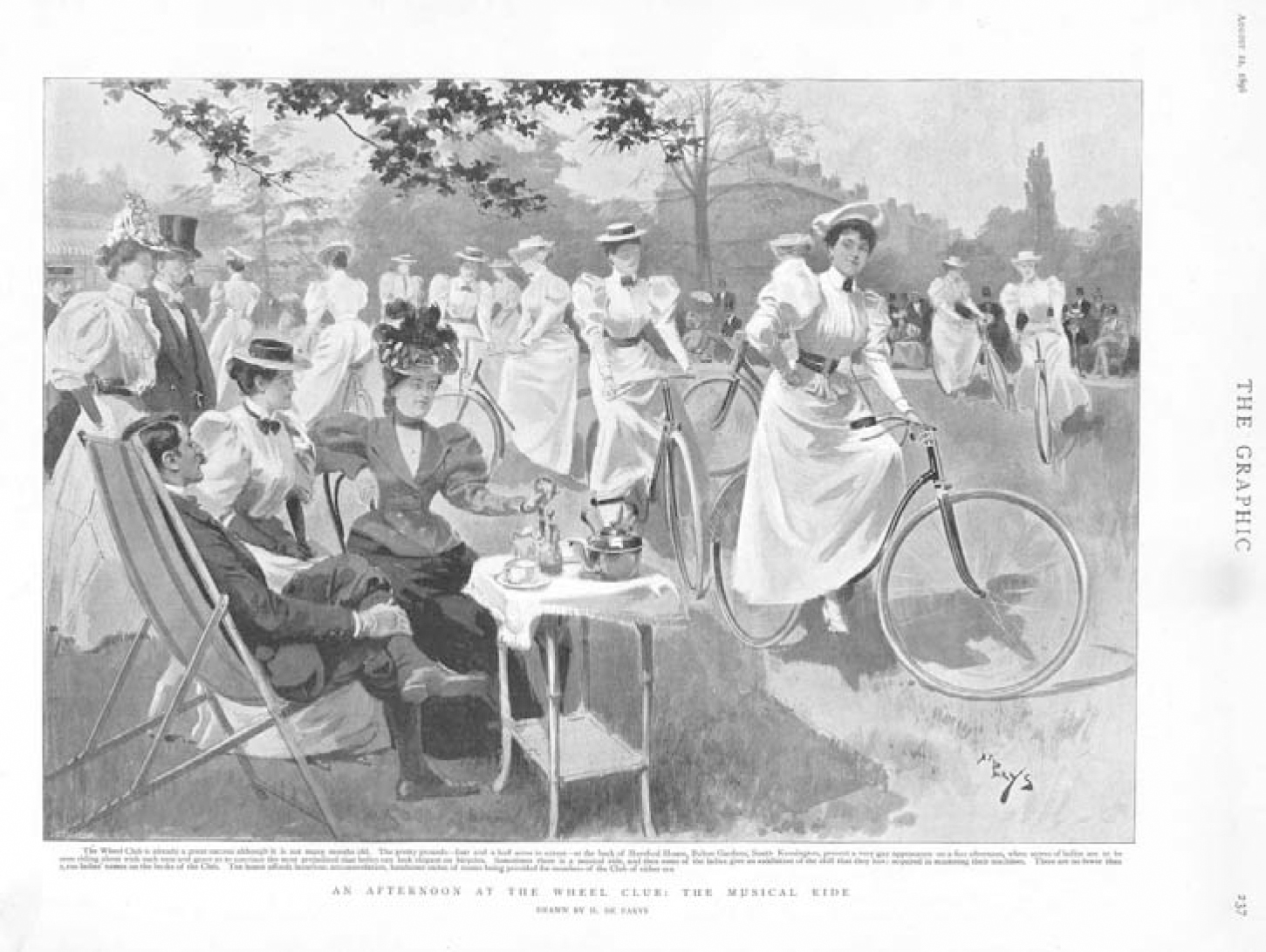
Certainly the formation of clubs allowed for an influx of sports such as bicycling, football, cricket, rugby, tennis and golf to the urban and suburban spaces of Britain's cities.Footnote 60 Lowerson's argument is that public-school sports were disseminated to the wider public as former students took up the majority of the organizational roles in these new urban clubs. This model illuminates part of the picture, but it is important to realize that not all sports clubs were formed with the same aims or for the same people.Footnote 61 The Wheel Club in South Kensington, whose 2,000 female members participated in outdoor teas, cycling demonstrations and musical rides, or lawn tennis clubs such as Wimbledon, whose tournament formed part of the official London ‘season’, provided upper-class social spaces and entertainment (see Figure 1).Footnote 62 Far different motivations, however, lay behind the foundation of clubs attached to factories, which were created by the upper and upper-middle classes, but not for them. The aim of these clubs was not to provide workers with a space for socializing, or even necessarily to improve the work environment with the introduction of leisure activities (though these increasingly became motivations for company sports provision, and were tellingly often initiated by employees).Footnote 63 The goal of early management-instituted sports clubs was the improvement of the workers themselves, and that in mind as much as in body: in other words, the sports club functioned as another form of moral philanthropy or rational recreation (however loosely interpreted).
Ladies ride their bicycles to music at the Wheel Club (The Graphic, 22 August 1896).

The discourse of sports’ moral benefits had been both so pervasive and so popularly upheld that the addition of sports to the more usual provisions of Victorian moral philanthropy – books, music and Bible study – was simple. By playing sports (the thinking went), workers would acquire the attributes that public schools had associated with athleticism and participation in teams: diligence, selflessness, sense of fair play and esprit de corps. A number of present-day professional association football clubs started out as amateur clubs with moral philanthropic underpinnings. Aston Villa, for example, was established in 1874 by men affiliated with the Wesleyan Church. Similarly, until it professionalized in 1898, West Ham was the Thames Ironworks Football Club of Canning Town. Arnold F. Hills, one of the company's directors, had established the Ironworks Club specifically for the betterment of its workers. An Old Harrovian, Hills was inculcated in the public-school discourse about athleticism, sports and games-playing, supported the temperance movement and was something of an athlete himself.Footnote 64 Projects such as Hills's were erected on the belief in the moral benefit of participation in sport, so the professionalization of the Ironworks Club was a fraught affair.Footnote 65 The antagonism and segregation between amateur and professional sporting bodies – which long outlived their Victorian origins – were in some part, of course, due to a matter of class. Gentlemen did not need to earn a living from playing: losing could be made its own virtue and preference could be given to stylish and, above all, effortless play (after all, trying too hard would imply a need to win).Footnote 66 R. Peggio's admiration of the effortless performances of both the cricketer Stoddart and the operatic tenor Reszke should be read through this idealization of amateurism, though neither of them in fact was an amateur.Footnote 67 Thus professionalization undid the notional purity of playing sport for its own sake by prioritizing winning and commercial profit. It also introduced the dual problems of gambling and drinking – or rather reintroduced them, since both had accompanied sport for centuries.Footnote 68 What is more, and in the case of institutional sports clubs more particularly, by rendering sport a spectator entertainment instead of a participatory activity, the original moral purpose was lost.Footnote 69
These distinctions between active and passive implicitly informed the discourse about singing, particularly regarding the physical and mental health benefits of the activity. The positioning of singing as a vigorous exercise allowed it to take on the trappings of moral and physical self-betterment associated with playing sports, for instance in Campbell's listing of singing alongside running and rowing as a preventative of heart disease. It also meant that singing could be discussed in different terms from music, which potentially connoted passive entertainment. Music, understood as a force (specifically, from the late eighteenth century onwards, a vibratory force that acted on the nerves of the listener), was much more contested in terms of its effect on mental and physical health, as recent studies by James Kennaway and Shelley Trower have shown.Footnote 70 With its sonic vibrations almost imperceptible to the body, music could be insidious in its effects. Trower, for example, explains how ‘it was important to retain awareness of vibrations in order to manage them, because while vibrations could be stimulating, therapeutic, and even life-giving, they were increasingly felt to be a dangerous force, or a kind of noise, causing pain and nervous illness’.Footnote 71
Fundamental to Trower's argument is the concept of materiality. She argues for the extension of materiality to subjects as well as objects (at least in the case of vibration), because vibrations affect animate bodies and their fibres and organs as much as they affect inanimate things. This perspective leads to Trower's claim that ‘vibration was key to the increasing understanding that mind itself was material, as Enlightenment thinkers had begun to shift attention from the transcendent soul to the mechanics of physical form’. The impact of vibration on Enlightenment thought is perhaps overstated, but it is clear from Trower's examination of a number of texts drawn from the eighteenth century onwards that the concept of vibration became both pervasive and stimulating as a way of linking physical, mental and spiritual perceptions. ‘Vibrations in the nerves’, she elucidates, ‘transmit sensations to the brain; vibration-sensations generate ideas, feelings, memories, thought, imagination.’Footnote 72 Trower's wide-ranging survey shows, moreover, that this model could persist far beyond the eighteenth century.
Once Trower reaches the nineteenth and twentieth centuries, however, music as a source of vibration is displaced in her narrative by machines, such as trains. Nonetheless, her argument that vibrations were understood to affect the materiality of a subject makes sense of the theoretical position that informs Agnes Savill's 1923 book Music, Health and Character, in which the Scottish surgeon surveyed contemporary international research on the effects of music on health. Savill contextualized her book through the lectures on sound given by John Tyndall, professor of physics at the Royal Institution of Great Britain in London. Tyndall had drawn on vibration and sound studies by Ernst Chladni and Hermann von Helmholtz, and the publication of his lectures in 1867 introduced the science of sound, and in particular its vibratory wave qualities, to the wider public. Thus Savill writes in a chapter on the ‘physical effects’ of music:
The predominating psychical effect of music is emotional […] it is well known that sudden emotion causes rapid action of the heart and raising of the blood pressure. Pleasant and continuous emotion causes a rise of blood pressure, a slower rhythm and a firmer action of the heart, with consequent improvement of the general health. […] It is impossible that the organism could remain unaffected by the complex vibrations set in motion with the production of the large volume of sound emitted from many instruments played simultaneously. Some change in the functioning of the circulatory system certainly occurs; probably there is also some modification of the cells of the nervous system.Footnote 73
In this passage, musical vibration of the nerves makes the ‘physical’ and the ‘psychical’ run together in a way that resonates with Trower's model. Moreover, and although Savill, who was a music-lover, was at pains to celebrate the more successful uses of music as treatments for mental and physical maladies, a number of the studies also reported deleterious results such as headaches, hysteria and negative mood changes.
It is significant, however, that nearly all the research Savill discussed was focused on the health effects of music on subjects who interact with it only through passive listening – Campbell's theories, for example, do not appear in her survey. Almost invariably the prevailing issue was how subjects – and by extension their bodies and mental states – responded to listening to music. Accordingly, the results frequently seemed to be temporary, lasting only as long as the music was playing (in the case of changes to blood pressure or heart rate), or subsiding shortly thereafter (headaches or mood swings). By contrast, research into singing considered it as physical exercise, which, when carried out regularly, provided the singer with lasting effects on, or permanent changes to, their health and moral well-being. Thus it seems evident that the turn-of-the-century discourse around singing was becoming entangled with ideas not only about health and hygiene but also about overall physical fitness. Its terms, moreover, were unlike those for discussions of music in general (even when, as occasionally was the case, the subject was music and health), but they did have some commonality with participation in sports.
National fitness
The alignment of singing with sports that I have described so far perhaps allowed it to escape the worst of the ravages inflicted on musicians. Such was the immense popularity of sports, games and other athletic pastimes – both for participation and spectatorship – that late nineteenth-century commentators paradoxically also sometimes appropriated the disease terminology so familiar to Victorian discourse to diagnose society's current afflictions: the ‘rinkomania’ of roller-skating, ‘golf crazes’ and ‘epidemics’ of football and cycling.Footnote 74 By the end of the century, Victorian Britain's sporting obsessions seemed to be causing musicians some anxiety – specifically, worries that music was losing out in the competition for the time and money that Victorians spent on leisure. There were, for example, warnings of a downturn in the music market. The costs of athletic pastimes could be quite high, as Lowerson has shown. For anyone with an annual income of around £300, hunting would consume a third of their salary, playing golf a tenth, and tennis or cycling a twentieth.Footnote 75 Choices were evidently being made. One private piano teacher in 1896 complained to the Musical News that her income had fallen to barely five shillings a week since ‘the bicycle had silenced the suburban piano’ and her pupils preferred a ‘“spin” before breakfast […] to practising scales’.Footnote 76 Similarly, in 1901, a report on the status of the music business in northern England, published in Musical Opinion, warned that the ongoing popularity of outdoor recreations such as cycling and cricket was having a negative effect on the music trade, particularly during summer months.Footnote 77 Even singing suffered, if we are to believe one commentator who, in 1902, blamed the growing popularity of football and cricket in Wales for siphoning off singing talent. When Welsh choirs failed to win the top prize at the National Eisteddfod three years running, he claimed that sports had caused ‘a Celtic choral collapse’.Footnote 78
Sports posed problems to musicians not only by threatening to commandeer the leisure market, but also through the type of ideal masculinity that it promoted – or at least that was attributed to it. The discourse that contributed to late nineteenth-century English interest in and support for sports and athletic games had also helped to redefine notions of Christian manliness and masculine beauty, to refit sports to a general climate of economic competition, and to promote athleticism and sports training as indispensable for imperial duty.Footnote 79 Mid-nineteenth-century concerns over public health had coalesced around the persistent recurrence of epidemics of disease.Footnote 80 By the first decade of the twentieth century, the devastating episodes of cholera were well in the past, but those of tuberculosis were not and, as the number of office workers burgeoned along with the cities, a new concern over obesity in urban centres raised its head. In addition to all this, the frequent failure of recruits in military physical exams during and after the Boer War had sparked a public debate over national fitness. It was in this context, around the turn of the century, that bodily health and especially physical fitness were increasingly understood in the biological evolutionary terms of Herbert Spencer and Charles Darwin.Footnote 81
As fears of feminization and degeneracy in the nation were heightened by foreign diseases, colonial others and social Darwinism, Oscar Wilde's 1895 conviction and imprisonment for ‘gross indecency’ sharpened the sense that artists in particular were decadently out of step with the times. As the Musical Standard reminded its readers late in 1895, the idea that a singer, a violinist or a pianist should be ‘pale and interesting’, that his ‘ways should be curious and his dress bizarre’ and that he should be a ‘strange mixture of a woman and a man’ was a thing of the past. Or, rather, it needed to become a thing of the past. What musicians should do now, the article advised, was ‘take an interest in outdoor exercises’, such as rowing or playing cricket or some other sport. In the view of the Musical Standard, not only were current British musicians neglecting the care of their bodies, but they were also going against the general grain of the nation in their singular lack of athleticism. ‘Tis almost a cause of pity’, the author lamented, ‘to see a congregation of musicians and to notice the extreme weakness of their physique. Even those that are strongly made by nature allow themselves to run to seed, and the weak become weaker still.’ At the very least, the article concluded, ‘a pianist should exercise the muscles of his body, and especially his arms, in order more easily to encompass the technical difficulties of his craft’.Footnote 82
The threat of feminizing degeneracy to which this article responds is precisely the context in which Kennaway has recently located nineteenth-century notions of ‘pathological’ music. ‘By the mid-nineteenth century,’ Kennaway writes, ‘“modern” music often came to stand for a whole range of perceived pathological developments in a Europe that some believed was morally and culturally decadent and physically degenerate.’Footnote 83 Of course, this was especially the case for Richard Wagner's music, which Wagner's contemporaries charged with being, in Kennaway's words, ‘both a symptom and a cause of a nervous modernity and its physical and sexual pathologies – fatigue, “neurasthenia”, perversion and degeneration’.Footnote 84 This is hardly a new observation about contemporaneous attitudes towards Wagner's operas, and some of the commentary about the unhealthiness of modern music Kennaway describes – notwithstanding his insistence on referring to music as a ‘pathogen’ – is surely more figurative than literal. That is to say, music criticism occasionally engaged with contemporary discourses about mental and physical health in order to critique the compositional languages of certain composers in relation to other (usually older) ones that were, by comparison, described as ‘healthy’. On the other hand, several of Kennaway's commentaries about unhealthy music came from practitioners in the fields of science, medicine and, in particular, the new discipline of psychiatry. These arguments posited that certain qualities heard in ‘modern’ music, such as its noisiness, extended harmonies and, in particular, its lack of rhythmic certainty, could cause fatigue, ‘provoke neurasthenia’ or provide ‘abnormal stimulation’. Music, thus, was placed in the same category as drugs, alcohol and indulgence in deviant sexual practices – all of which were then considered as dangerous stimulants of modern life.Footnote 85
Understood as a stimulant that threatened physical and mental health, music could not only endanger the virile athletic physiques demanded by Britain's imperial needs, but also undermine the importance Victorians placed on self-control and self-regulation. One response to the perceived crisis of masculinity created by sensory overstimulation, including that caused by listening to modern music, Kennaway argues, was the renewed emphasis on regulation of the body found in institutions organized around physical activities: as he puts it, ‘in militarism […] and, for that matter, the culture of English sport and the boy scouts’.Footnote 86 In other words, these two opposing discourses – music as debilitating and degenerate and singing as healthy and curative – are rendered comprehensible in part by the different values placed on participation versus spectatorship that I discussed in the previous section. What is more, the fact that singing (as a physical activity anyone could do) bestowed benefits that were physical, mental and moral was sufficiently established by the turn of the century that singing could be promoted as a means of maintaining the health and fitness of British people in the early twentieth century.
This was, perhaps, particularly the case for those who lived in Britain's burgeoning urban centres such as London. In 1906, the Scottish physician James Cantlie (celebrated today for his development of First Aid treatment) published his theory of racial degeneration in British urban populations, Physical Efficiency: A Review of the Deleterious Effects of Town Life upon the Population of Britain, with Suggestions for their Arrest. With some of the problems Cantlie described in big-city life – a preponderance of office work, poorly designed clothing and inadequate housing, food, exercise and fresh air – he contrasted the healthful occupation, exercise and location of rural life. There is an unmistakable tinge of nostalgia and naivety in Cantlie's idealization of natural country living as healthful. One of the physician's axioms for physical exercise, for example, was that ‘artificial exercises’ be modelled as closely as possible on actions, like ploughing fields, which provided balanced, holistic strengthening of the body.Footnote 87 In a similar vein, Cantlie argued that ‘monotonous “drill” and breathing exercises’ in schools should be replaced with singing and traditional dancing lessons. The implied Englishness of these latter activities in Cantlie's writing contrasted with his descriptions of the gymnastic drilling systems of German strongmen, such as Sandow, which produced not only top-heavy physiques, but also poor ‘staying and marching powers’.Footnote 88 Singing, on the other hand, was exercise that resulted in the expansion of the chest and increased lung strength. In other words, ‘artificial’ exercise produced superficial strength but little stamina for extended aerobic exercise, whereas the ‘natural’ exercise of traditional labour and recreations – such as singing and dancing, but also including athletic sports and games – made the body fitter from the inside out. Singing did so, moreover, Cantlie declared, ‘in a fashion at once attractive in its practice and pleasant in its acquirement’.Footnote 89 More was at stake, however, than pleasant, healthful occupation. ‘As a hygienic agent,’ Cantlie wrote, ‘singing is of national importance’:
Singing is, or should be, exercise with an object, namely chest expansion, in addition to the accomplishment acquired, which at once dispels the monotony of any form of exercise taken merely for exercise's sake. Singing should therefore be taught by competent teachers to all young people not merely for the accomplishment attainable and for the pleasure proficiency gives, but as a means of promoting national physical efficiency.Footnote 90
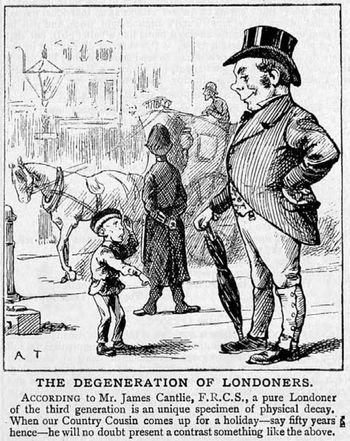
Several of Cantlie's causes of urban degeneration – inadequate housing, poor nutrition, air pollution and lack of exercise, for instance – had already been identified in the nineteenth century as problems of Victorian urban living without yet being attached to national degeneration. Indeed, when Cantlie first made his theory of urban degeneration the subject of a public lecture in 1885, satirical weekly magazines such as Fun and Funny Folk ridiculed ‘Cantlie-ism’ with punning rhymes and caricature (see Figure 2).Footnote 91 Over the next two decades, however, the mounting anxieties over racial degeneration and national fitness changed attitudes from derision to seriousness: in 1906, Physical Efficiency received no dismissive reviews and was advertised repeatedly in respected literary magazines such as the Athenaeum. Once more, music journals took note: the Musical Herald, for example, quoted lengthy passages of Cantlie's advice about health and singing.Footnote 92
Caricature of Cantlie's theory of urban degeneration (Fun, 18 February 1885).

Singing continued to be promoted to the general public in the early twentieth century not only as a form of participatory exercise, but also as a way for the whole nation to get fitter. In August 1908, the liberal quarterly Westminster Review issued a strident call to the whole nation to get itself in shape. It did so not in the perhaps more expected and usual terms of athletic or sporting activity, but in those of singing and health:
The great physical benefits accruing from a correct method of voice culture lie in the infinite energy generated by the acquisition and continued correct natural use of the organ. For the voice, when properly produced from its source, calls into play the wonderful recreative powers of the vital forces, and stimulates the whole being into vigorous activity, thus introducing a simple, hygienic, easily acquired, yet withal pleasurably artistic method of overcoming the fearful inertia, lassitude and general flabbiness now so prevalent amongst all classes – a state or condition which means destruction not only to the perfect voice, but also to the very fire and life of the individual, and is also largely the cause of much of the very evident deterioration of our national physique. […] The percentage of civilised men who breathe correctly is quite small, and the result is shown in contracted chests and stooping shoulders, and the terrible increase in diseases of the respiratory organs, including the ever-recurring cases of consumption, each of which might very possibly have been prevented, or arrested, in its earliest stages, by a study of how to breathe, speak, and sing correctly, according to psycho-physical and natural methods. […] As nothing is so creative of healthsome happiness as song, so nothing attracts disease like melancholy; therefore don't be sad, but instead, when feeling low and depressed, practise your breathing exercises, which will be found greatly to improve the voice and increase the breathing capacity.Footnote 93
The Westminster Review article clearly duplicates some of the ideas expressed in Cantlie's book: singing is described as a ‘natural’ activity that gives the whole body ‘vigorous’ exercise with the added bonus of being ‘pleasurably artistic’, too. There is similar attention drawn to the deterioration in national fitness and an echo of singing to be taken up as a counteraction. But the article also resonates with ideas and rhetoric that predated fears of racial degeneration in the British nation, as I have shown. It repeats, for example, the idea that singing was useful not only as healthy exercise, but also as a preventative of respiratory diseases, particularly tuberculosis (‘consumption’). What is more, the entire article is underpinned with the rhetoric of mental and bodily soundness popularized by the muscular Christians’ ‘soteriology of sport’ and the team sports that followed in its wake. Understood thus, the Westminster Review article encapsulates the key developments over nearly four decades of the Victorian discourse of singing and health as I have elucidated them here.
By its nature, the type of discourse I have analysed in this article makes it difficult to gauge the extent to which the average Victorian Briton truly put credence in the idea that singing could improve their health – whether conceived as moral, physical or both. Certainly by the beginning of the twentieth century, it is probable that the continuation of such a discourse by musicians was at least partly a capitalization on popular notions and prevalent fears: a self-interested move to boost music's position in a culture increasingly obsessed with sport, muscularity, masculinity and racial degeneration. Even so, my main point still stands: the presence of two strongly supported yet opposing portrayals of music – one as debilitating and one as healthy – was made possible by the growth of team sports in England. Moreover, it was English sport, and its perceived attributes of health, fitness and character building, that furnished commentators on the healthfulness of singing with their primary terms. The connections between music and sport that I have traced through discourses of health, exercise and singing here provide a more nuanced cultural context for understanding more specific musical activities such as the growth of choral societies and choral competitions in nineteenth-century Britain.Footnote 94 The same could be said for the flourishing of brass bands around this time as well.Footnote 95 Both, I suggest, were influenced not only by the discourse of singing and health, but also by the increasing appeal of competition which the growth of athletics and sports similarly fed. Though connections between sport and music may appear indirect, the two were – and arguably remain – firmly enmeshed.
Acknowledgements
I am grateful to the anonymous readers for the Journal whose observations and suggestions were invaluable in finalizing this article. I also have benefited hugely from innumerable comments ensuing from presentations of earlier versions at various conferences and institutions.