Introduction
Malnutrition is one of the most relevant problems affecting the health status of pregnant or lactating women as well as of their children throughout the world, especially in low-income regions Reference Keats, Das and Salam1 . Nutritional insults during early development have the potential to alter ontogenesis, advancing or delaying the onset of specific developmental events throughout life Reference Owino, Murphy-Alford and Kerac2 . It is well established that maternal malnutrition alters the offspring’s phenotype and metabolism Reference Reyes-Castro, Padilla-Gómez and Parga-Martínez3,Reference Castro-Rodríguez, Rodríguez-González, Menjivar and Zambrano4 , which could help explain the epidemiological relationship between size at birth and future risk of disease: The fetus would adapt to maternal malnutrition, slowing his/her growth and preparing for life in an unfavorable postnatal environment, possibly via epigenetic mechanisms Reference Wells5–Reference Orozco-Solís, Matos and Guzmán-Quevedo7 . However, not all adaptations are necessarily beneficial, as will be shown below.
As evidenced in studies using animal models of early malnutrition, these adaptive responses occur via structural and functional changes in systems such as the endocrine and nervous ones, which may even impact behavior Reference Younes-Rapozo, De Moura and Da Silva Lima8–Reference Soares, Miranda and Bertasso14 . For example, protein restriction (PR) during lactation is known to alter the ontogenetic distribution of the cocaine- and amphetamine-regulated transcript (CART) and alpha-melanocyte-stimulating hormone (α-MSH) anorexigenic molecules Reference Rocha, Fernandes, Tenório, Manhães and Barradas12 and of the neuropeptide y (NPY) orexigenic molecule Reference Rocha, Fernandes, Lotufo, Manhães, Barradas and Tenorio9 in the arcuate/paraventricular pathway and lateral hypothalamus. The dopaminergic and endocannabinoid systems are also disrupted by either PR or early weaning during the lactation period Reference Dutra-Tavares, Silva and Nunes-Freitas11,Reference Soares, Miranda and Bertasso14 . Pre- and postnatal malnutrition in rats increase motivation for the consumption of food and water due to a previously imposed deprivation, reduces cognitive flexibility, and causes damage to learning and memory processes in adult animals Reference Brioni and Orsingher15–Reference Valadares, Fukuda, Françolin-Silva, Hernandes and Almeida18 . Early-malnourished rodents show, later in life, alterations indicative of lowered anxiety-like behavior or increased impulsivity in experimental paradigms such as the light-dark transition test, elevated plus maze, and the elevated T-maze Reference Brioni, Cordoba and Orsingher19–Reference Hernandes and Almeida22 . Specifically, maternal PR results in lower levels of anxiety-like behavior in the elevated plus maze in adult rats Reference Françolin-Silva, da Silva Hernandes, Fukuda, Valadares and Almeida23–Reference Belluscio, Berardino, Ferroni, Ceruti and Cánepa25 . Locomotor/exploratory activity in adult animals also seems to be impacted by early malnutrition, albeit findings are somewhat contradictory. While one study evidenced increased locomotor activity in the open field as a result of perinatal PR, other studies showed a decrease in locomotion in PR animals, and still another study showed no differences in locomotor activity between PR and control Wistar rats Reference Belluscio, Berardino, Ferroni, Ceruti and Cánepa25–Reference Dutra-Tavares, Manhães and Silva28 . Assessment of learning and memory in rats showed that those that were submitted to PR had higher latencies to find the escape platform in the Morris water maze test as well as low recognition rates in the open field recognition memory test, suggestive of a deficiency in visual-spatial memory Reference Valadares, Fukuda, Françolin-Silva, Hernandes and Almeida18,Reference Fukuda, Françolin-Silva and Almeida29 .
The animal models used to evaluate the aforementioned behaviors are well established in the literature. However, most studies focus only on one age, two at the most, which is not ideal when a clear characterization of a programming effect of the initial insult is needed. For instance, increased anxiety-like behavior at adulthood may either be a short-term, but long-lasting effect of early PR or it may be a late-emerging one, which better fits the concept of ontogenetic plasticity. Some studies have carried out behavioral analysis at different ages, from adolescence to adulthood Reference Lynn and Brown30,Reference Lynn and Brown31 . However, the ontogenesis of behaviors related to anxiety, locomotion and exploration, and learning and memory have yet to be adequately studied. For example, anxiety-like behavior in rodents tends to reduce from adolescence to adulthood Reference Lynn and Brown31–Reference Estanislau and Morato33 , however, an absence of data has been identified regarding this behavior shortly after the lactation period, a critical period of development. The same gap can be observed for locomotion and exploratory activity. Studies using rats and mice have shown that, from adolescence onwards, animals tend to show less activity as they age in tests such as the open field Reference Lynn and Brown30,Reference Seliger34 , but information is lacking regarding the post-weaning period. As for cognitive functions such as those associated with memory and learning, several studies have shown age-related deficits in visuo-spatial tasks between adulthood and senescence in rats Reference Kobayashi, Kametani, Ugawa and Osanai35–Reference Jonasson37 , but next to nothing can be found in terms of data focusing on the post-weaning period and few studies have addressed visuo-spatial memory/learning at adolescence Reference Lotufo, Tenório and Barradas38 .
PR during gestation and lactation programs for endocrine-metabolic disorders and changes in the behavior of adult animals Reference Dutra-Tavares, Silva and Nunes-Freitas11,Reference Lotufo, Tenório and Barradas38–Reference de Oliveira, Gomes and Miranda41 . However, it is not known whether the behavioral changes observed in adult animals have been present since the nutritional insult or if such changes appeared later in life, particularly immediately after weaning. Therefore, the first objective of the present study was to evaluate, in Wistar rats, the impact of PR during the lactation period on the ontogenesis of the behaviors expressed in the Elevated Plus Maze, in the Open Field and in the Radial-Arm Water Maze, at different ages: weaning [postnatal day (PN) 21], adolescence (PN45), young adulthood (PN90) and adulthood (PN180). An interesting aspect of studying PR during lactation in rodents is the fact that brain development in animal models during this period shows equivalences to what is observed in humans during the third trimester of pregnancy and lactation, a time in which the metabolic demands on the mothers are high Reference Ladyman and Brooks42 . The observation of cognitive and emotional impairments resulting from PR in these models and the understanding of the mechanisms underlying such impairments may guide the development of therapeutic approaches that aim to minimize or avoid the health issues associated with this nutritional insult in humans.
Our group has previously shown, using the same model employed in the current study, that PR during the lactation period results in increased total adrenal catecholamine content and serum corticosterone concentration in PN180 offspring Reference Fagundes, Moura and Passos39,Reference Fagundes, Moura and Passos43 . Furthermore, in the same model, we evidenced a lower response of TSH to TRH, a reduction in serum TSH and increases in serum T3 and T4 also at PN180 Reference Lisboa, Oliveira and Fagundes44,Reference Lisboa, Fagundes and Denolato45 . Considering that most of the available data regarding this model of PR during lactation was obtained using the adult offspring and that alterations in the function of the hypothalamic–pituitary–adrenal axis and the hypothalamic–pituitary–thyroid axis could impact behavior, the second objective of the current wok was to study whether corticosterone, catecholamines, T3 and T4 ontogeneses, previously identified biomarkers of metabolic programing Reference Reyes-Castro, Padilla-Gómez and Parga-Martínez3,Reference Lisboa, Fagundes and Denolato40,Reference Ramos, Teixeira and Passos46,Reference Fagundes, Moura and Passos47 , were affected by PR during lactation and if associations with the selected behaviors were present.
Methods
Experimental groups
This study was conducted under the institutional approval of the Universidade do Estado do Rio de Janeiro (protocol: CEUA0232019) and in accordance with Brazilian Law 11.794/2008.
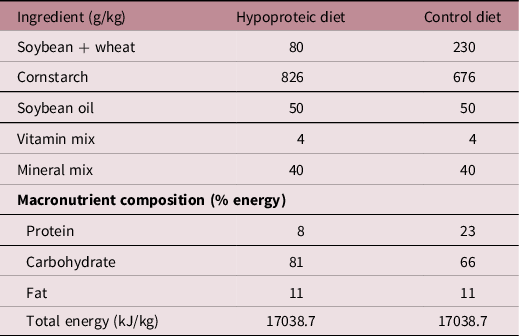
Wistar rats were kept in a temperature-controlled (22 ± 1°C) vivarium on a twelve-hour light/dark cycle (lights on: 7:00 a.m.). Food and water were available ad libitum throughout the experiment. Three-month-old, nulliparous female rats were mated with males (ratio 3:1). Pregnant dams were placed in individual cages, lined with wood shavings and small cotton pads, and were fed with a standard normoprotein (23% protein) chow during gestation (Nuvilab CR1 – São Paulo, SP, Brazil; Table 1).
Composition of the hypoproteic and normal protein diets

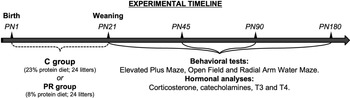
After delivery, considered as the first postnatal day (PN1), each litter was culled to six male pups to ensure standard nutrition Reference Passos, Ramos, Bernardo-Filho, de Mattos and Moura48 . After culling, the dams and respective litters were randomly assigned to one of two groups: (1) protein-restricted group (PR; n of litters = 24) – which received a hypoproteic chow (8% protein) from birth to weaning (PN21); and (2) control group (C; n of litters = 24) – which received normoprotein (23%) chow during the same period. One day of a rat’s life corresponds to approximately 9 days of a human’s life Reference Quinn49 . In this sense, the lactation period in rats, which lasts for 21 days, corresponds to around 6 months of breastfeeding in humans. The hypoproteic diet was manufactured in our laboratory using the control diet and replacing part of its protein with maize starch. The amount of starch was calculated so as to make up for the decrease in energy content due to protein reduction Reference Passos, Ramos, Bernardo-Filho, de Mattos and Moura48,Reference Passos, Vicente, Lisboa and de Moura50 . The hypoproteic diet consisted of 8% protein, 81% carbohydrate and 11% fat, and it was prepared as previously described Reference Passos, Ramos, Bernardo-Filho, de Mattos and Moura48,Reference Passos, Vicente, Lisboa and de Moura50 . Please see Table 1 for macronutrients content. Both diets included recommended amounts of vitamins and minerals Reference Reeves, Nielsen and Fahey51 . At weaning, the dams were removed and siblings from the same litter were kept together in the cage (39 cm long × 32 cm wide × 14 cm high) throughout the experiment. After weaning, PR and C offspring received normoprotein chow until PN180. Please see Fig. 1 for experimental timeline.
Timeline of the experiment. Lactating dams in the control (C) group received a normoprotein (23% protein) diet from birth to weaning. Those in the protein-restricted (PR) group received a diet containing 8% protein. At PN (postnatal) days 21, 45, 90 and 180, behavioral and hormonal parameters of the offspring of both groups were assessed (different animals at each age).

During the lactation period, each pup’s body mass was monitored every fourth day. After that, body mass was assessed at PN21 (weaning), PN45 (adolescence), PN90 (young adulthood) and PN180 (adulthood). The average body mass of the siblings in each litter was used as the datum in the statistical analysis.
Offspring’s behavioral tests
Animals were behaviorally tested exclusively at one of the following ages: PN21, PN45, PN90 and PN180 (n = 18 in each group per age). In order to avoid litter effects, only one animal per litter was tested at a given age. Sample sizes were determined based on previous studies that show that 10 animals or more are adequate for behavioral assessment Reference Dutra-Tavares, Manhães and Silva28,Reference Fukuda, Françolin-Silva and Almeida29,Reference Lotufo, Tenório and Barradas38,Reference Quinn49 . The following behavioral tests were performed (in the order indicated and in the same environment between 2 p.m. and 6 p.m.): Elevated Plus Maze (EPM) Reference Lotufo, Tenório and Barradas38,Reference Fraga-Marques, Moura and Claudio-Neto52–Reference Pinheiro, Moura and Manhães55 , Open Field (OF) Reference Fraga, Moura and Silva54,Reference Abreu-Villaça, Cavina and Ribeiro-Carvalho56,Reference da Silva, Pietrobon and Bertasso57 and Radial Arm Water Maze (RAWM) Reference Fraga-Marques, Moura and Claudio-Neto52–Reference Pinheiro, Moura and Manhães55,Reference Fraga, de Moura and da Silva Lima58 . Experimenters were blind as to group assignment. All tests have been extensively used in our laboratory and detailed descriptions of the testing procedures and the variables used to assess behaviors are provided in the supplementary material. The EPM is a test that assesses anxiety-like behavior based on the exploration of an unknown environment with open and enclosed areas, and it is one of the most popular experimental models currently used since it has an easy design, is fast, economical and not very tiring for the animal Reference Pellow, Chopin, File and Briley59–Reference Manhães, Guthierrez, Filgueiras and Abreu-Villaça62 . The main variables used to assess anxiety-like behavior in the EPM were %Entries OA (percentage of open arms entries) and %Time OA (percentage of time spent on the open arms). The variable Entries CA (number of closed arms entries) was used to assess locomotor activity. Twenty-four hours after the EPM testing, behavior in the OF was assessed. The OF is one of the most frequently used tests for the assessment of exploratory activity Reference Crawley63 , measured here using the Total Entries variable (total number of rectangles crossed during exploration). The OF is also used to assess anxiety-like behavior, albeit with less sensitivity and specificity than the EPM Reference Prut and Belzung64 . In fact, the anxiety-like behavior measured in the OF, assessed by the %Entries CNT (percentage of entries in the central area of the arena) variable, is considered to represent an altogether different dimension of anxiety when compared to what is observed in the EPM Reference Prut and Belzung64,Reference Jarrard65 . Twenty-four hours after the OF testing, short-term memory and learning assessments were initiated using the RAWM Reference Buresová, Bures, Oitzl and Zahálka66 . Each animal underwent 4 trials per day for 5 consecutive days in the RAWM. Water mazes are frequently used to study visuo-spatial learning and memory Reference Tomás Pereira and Burwell67 . The test is based on the fact that rodents have an aversion to immersion in water, so that they try to leave the water as quickly as possible using visuo-spatial strategies to locate a submerged escape platform Reference Buresová, Bures, Oitzl and Zahálka66 . The main variable assessed in the RAWM was Latency to Platform (measured as the time in seconds animals took to find the hidden escape platform).
Hormones measurements
On the day following the last day of the RAWM testing protocol, animals were euthanized by decapitation, which was followed by trunk blood collection. The 24-h interval was used to avoid the acute effects of the behavioral test on hormone levels. Blood samples were centrifuged (1,500 × g for 20 min at 4°C) to obtain plasma, which was kept at −20°C. The plasma levels of corticosterone, free triiodothyronine (T3) and free thyroxin (T4) were determined by radioimmunoassay (RIA), in duplicate and in a single test Reference Soares, Rodrigues and Peixoto68,Reference Miranda, de Moura and Soares69 . The content of total catecholamines (epinephrine and norepinephrine) in the adrenal gland was quantified using the trihydroxyindole method Reference Trevenzoli, Pinheiro and Conceição70 . Please see supplementary material for a detailed description.
Data analysis
All data were analyzed using the IBM SPSS Statistics, Version 21.0 (IBM Corp, Armonk, NY, USA). The Kolmogorov–Smirnov one sample test (K–S) was used to assess the normality of the distributions of each of the variables. Parametric data are compiled as means and standard errors of the means; nonparametric data are compiled as medians and interquartile ranges. Univariate analyses of variance (uANOVAs) were used to analyze the offspring’s body masses and hormone levels as well as data pertaining to the EPM and OF: Diet and Age were used as the between-subjects factors. Mixed-models analyses of variance (mANOVAs) were used to analyze the dams’ body masses and RAWM data: Diet and Age were used as the between-subjects factors while Day was used as the within-subjects factor. Whenever the sphericity assumptions appeared to be violated (Mauchly’s test) in the mANOVAs, an adjustment to the numerator and denominator degrees of freedom was made by using parameter ϵ Reference Huynh and Feldt71 . uANOVAs were used to analyze hormonal data (Diet and Age as between-subjects factors). Whenever Diet × Age interactions were observed, lower-order ANOVAs separated by Diet were carried out to identify whether significant Age effects were present within a group. Pairwise comparisons among ages were carried out using Fisher’s Protected Least Significant Difference (FPLSD) and pairwise comparisons between C and PR groups at a given age were carried out using Student t-tests. Kruskal–Wallis and Mann–Whitney tests were used for the nonparametric RAWM data (see supplementary material). Significance was assumed at the level of p < 0.05. For interactions at p < 0.10 (two-tailed), we also examined whether lower-order main effects were detectable after subdivision of the interactive variables Reference Snedocor and Cochran72 . The results and statistical data pertaining to secondary/ethological variables are shown in the supplementary material. Correlation data are also shown in supplementary material.
Results
Body mass and chow consumption
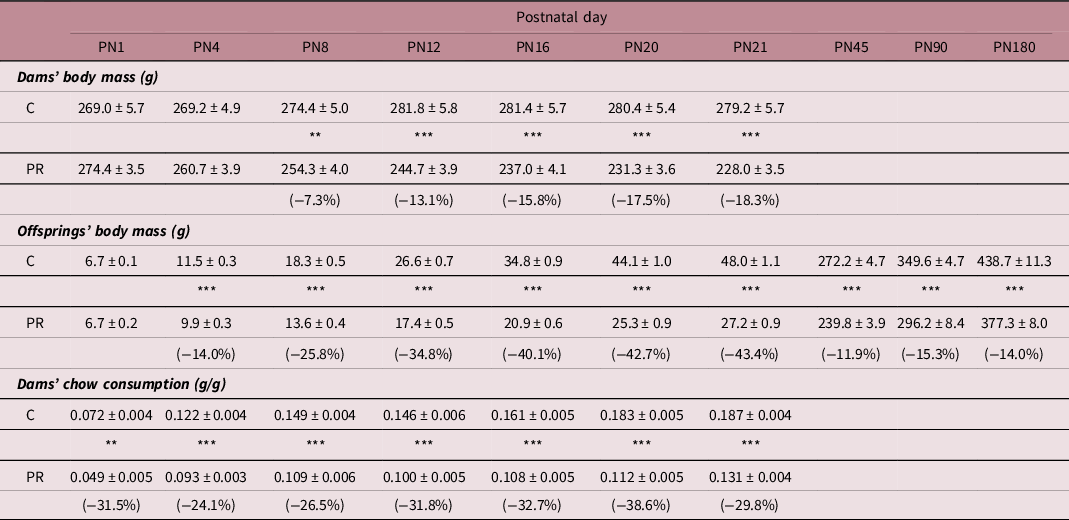
Body mass data are shown in Table 2. Dams’ body masses were affected by the PR diet (Day: F (2.9,116.8) = 21.6, p < 0.001; Day × Diet: F (2.9,116.8) = 69.1, p < 0.001). No difference between groups was found at the 1st day of lactation. However, by the 8th day of lactation, and from then up until the end of the lactation period, the low protein diet resulted in a reduced body mass in PR dams when compared to C. Regarding the offspring, their body masses increased throughout the lactation period (Day: F (1.7,66.8) = 1591, p < 0.001). However, the low protein diet restricted the somatic growth of PR offspring (Day × Diet: F (1.7,66.8) = 191, p < 0.001): By PN4, PR offspring showed reduced values when compared to C. PR offspring remained lighter than C until the end of the experimental period (PN180). Concerning chow consumption during the lactation period (Table 2), differences between C and PR groups were already present on the 1st day of lactation (Day × Diet: F (4.7,188.1) = 9.1, p < 0.001). PR animals ate, on average, 31% less chow when compared to C.
Body mass and chow consumption corrected for body mass

C: Animals that received the normoprotein (control) diet; PR: Animals that received the protein-restricted diet. Data are presented as mean ± SEM. PN: postnatal day. ** p < 0.01; *** p < 0.001.
Behavior
Elevated Plus Maze
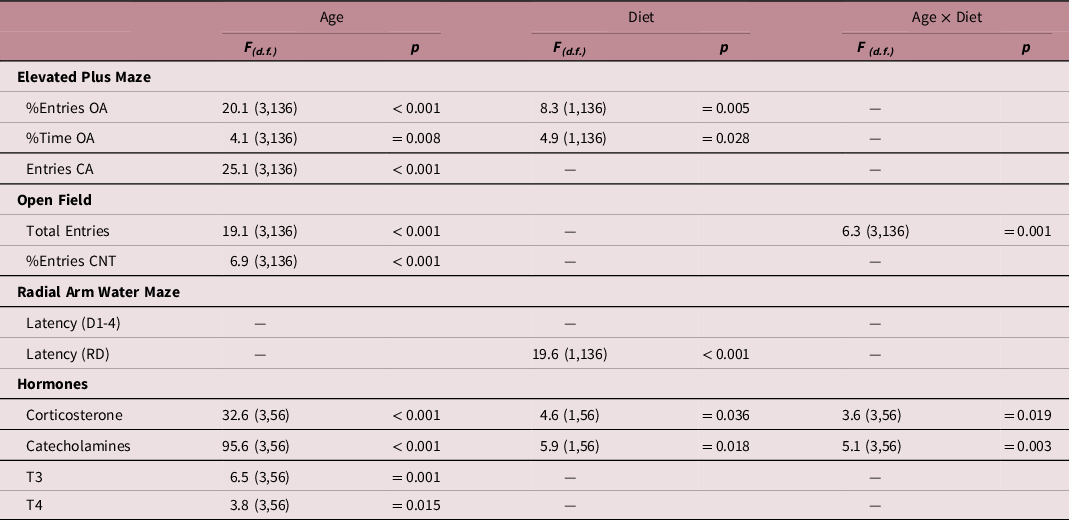
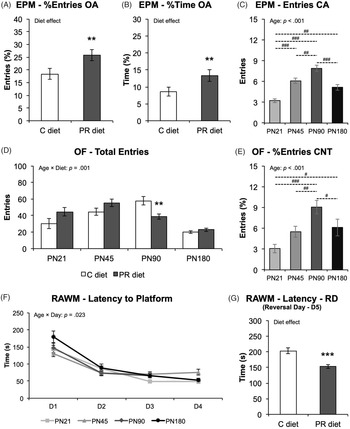
As shown in Table 3 (ANOVA data), the PR diet significantly affected anxiety-like behavior in the EPM. Both %Entries OA and %Time OA variables showed that PR offspring visited more (+29%) and stayed longer on (+35%) the open arms than C offspring (Fig. 2a and b). Significant ontogenetic variations were observed for both variables (Table 4), although profiles were not dissimilar between groups (no Age × Diet interactions). Locomotor behavior in the EPM was not affected by Diet. Conversely, a significant ontogenetic variation was observed (Fig. 2c): Activity progressively increased (2.4-fold) from PN21 to PN90, and then decreased by 35% at PN180. As for results on additional behavioral variables obtained in the EPM, please refer to the supplementary material.
ANOVA results

D1-4: Sum of the results of the initial 4 days (escape platform in the same position). RD: Reversal Day − platform placed on the opposite arm. — no effects or interactions were identified.
Effects of protein-restriction and ontogenesis on the behavior of Wistar rat offspring whose dams received, during lactation, either a diet with a low-protein content (8%, PR diet) or a normoprotein one (23%, C Diet). Graphs A and B show anxiety-like data in the Elevated Plus Maze (EPM): Higher values are indicative of reduced levels of anxiety-like behavior. Locomotor activity in the EPM is shown in graph C. Graph D shows exploratory activity in the Open Field (OF) and graph E shows anxiety-like data in the same test. Memory/learning data in the Radial Arm Water Maze (RAWM) are shown in graphs F (days (D) 1 to 4: escape platform in the same position) and G (day 5 – Reversal Day: escape platform placed on opposite arm). PN: Postnatal day. Values are Means ± S.E.M (n = 18 per Age and Diet). Diet effects: **p < 0.01, ***p < 0.001. Age effects: # p < 0.05, ## p < 0.01, ### p < 0.001.

Additional data concerning ontogenesis of behavior

All animals (C and PR offspring) were used to calculate the average for each age when only Age effects were present or no interaction with Diet was identified. D1-4: Sum of the results of the initial 4 days (escape platform in the same position). RD: Reversal Day - platform placed on the opposite arm. Data are shown either as mean ± SEM. a, b or c represent p < 0.05 within-group pairwise age comparisons. — no effects or interactions were identified.
Open Field
Regarding the main variables assessed with the OF, Total Entries (a measure of exploratory activity) was the one affected by Diet (Table 3). In PR offspring, peak activity occurred earlier in life, at PN45, when compared with C offspring, which showed their highest activity at PN90 (Fig. 2d). Regarding %Entries CNT (used to assess anxiety-like behavior in the OF), a significant age-dependent variation was observed (Fig. 2e): Irrespective of group assignment, values progressively increased (2.9-fold) from PN21 to PN90, and then decreased by 32% at PN180. The additional behaviors studied in the OF also showed a diverse pattern of Diet and Age effects (please see the supplementary material).
Radial Arm Water Maze
Neither Age nor Diet significantly affected the latency to find the escape platform in the RAWM during the first 4 days of the test (Tables 3 and 4), the testing phase during which the platform remained in the same position throughout all trials: Irrespective of age or group assignment, the offspring showed significant reductions in latency from the 1st to the 4th day of testing (Day effect: F 1.8,243.9 = 99.4, p < 0.001) (Fig. 2f), although the pattern of reduction was not consistent among age groups, as indicated by the significant Day × Age interaction (F (5.4,243.9) = 2.6, p < 0.023). However, this interaction reflects minor differences among ages that do not impact the interpretation of the results. Regarding the Reversal Day (5th day of testing), in which the platform was placed in an arm that was opposite to the one used from the 1st to the 4th days, a significant Diet effect was evidenced (Table 3): PR offspring, irrespective of age, showed shorter latency (-24%) to find the platform than C offspring (Fig. 2g). As for the additional variables assessed in the RAWM, only Age effects were observed (please see the supplementary material, Tables S1 and S2).
Hormone levels
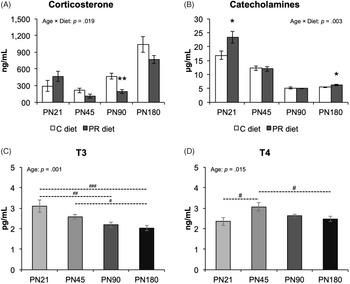
Corticosterone levels were affected by Diet (Table 3): Although an age-independent effect was evidenced, −24% in PR offspring when compared with C, the ontogenetic profile differed between groups (Fig. 3a). While C offspring showed no difference in levels between PN21 and PN45 and then an increase that approached significance (p = 0.060) from PN45 to PN90, and finally an increase (+122%, p < 0.001) from PN90 to PN180, PR offspring showed a 75% reduction in levels from PN21 to PN45 (p < 0.001), levels remaining stable from PN45 to PN90 and then increasing (p < 0.001) 4-fold from PN90 to PN180. The difference in ontogenetic profiles between groups resulted in a significant difference at PN90: PR offspring showed a 59% reduction in levels when compared to C.
Effects of protein restriction and ontogenesis on hormone levels of Wistar rat offspring whose dams received, during lactation, either a diet with a low-protein content (8%, PR diet) or a normoprotein one (23%, C Diet). Graphs A and B: Diet interactions were present. Graphs C and D: Only Age effects were present PN: Postnatal day. Values are Means ± S.E.M (n = 18 per Age and Diet). Diet effects: *p < 0.05, **p < 0.01. Age effects: # p < 0.05, ## p < 0.01, ### p < 0.001.

Regarding catecholamines, PR offspring also showed an age-independent increase (+17%) in levels when compared to C (Table 3). However, as previously indicated for corticosterone, a significant Age × Diet interaction was observed (Table 3). The overall shapes of the ontogenetic profiles were similar between groups, with significant reductions being present from PN21 to PN45 (C: p = 0.001; PR: p < 0.001) and from PN45 to PN90 (C and PR: p < 0.001), levels remaining stable in both groups from PN90 to PN180 (Fig. 3b). Similarities in ontogenetic profiles notwithstanding, PR offspring showed higher levels than C at PN21 and PN180 (Fig. 3b).
Both T3 and T4 showed only age-dependent effects (Table 3). T3 showed a progressive reduction from PN21 to PN180, totaling −35% between these two ages (Fig. 3c). As for T4, an increase (+30%) was observed between PN21 and PN45, which was followed by a decrease from PN45 to PN180 (-20%) (Fig. 3d).
Discussion
Body mass and chow consumption
Previous studies demonstrated that the milk of lactating PR rats has a lower concentration of proteins and that, in addition, the volume of milk produced is also reduced Reference Passos, Ramos, Bernardo-Filho, de Mattos and Moura48,Reference Bautista, Bautista and Montaño73 . Such changes affect satiety signs and define set points for energy consumption and metabolic rate during the life of the offspring Reference Hall74–Reference Liu, Roy and Guo76 . Lactating PR rats also have hypophagia, which is caused by a combination of hyperleptinemia and hypoprolactinemia Reference Lisboa, Passos and Dutra77 , findings that help explain the aforementioned reductions in milk protein content and volume.
Two aspects observed in our current results are in agreement with our previously reported ones using the PR model and demonstrate that the model was properly implemented in the present study Reference Passos, Ramos, Bernardo-Filho, de Mattos and Moura48,Reference Teixeira, Passos, Ramos, Dutra and Moura78,Reference de Moura, Lisboa, Custódio, Nunes, de Picoli Souza and Passos79 . PR dams showed a progressive reduction in body mass during the lactation period when compared to C, and PR dams’ chow consumption remained relatively stable throughout this period while C dams showed a progressive increase. The hypophagia that was already observed in PR dams on the first day of lactation, plus the high levels of leptin Reference Lisboa, Passos and Dutra77 , the low levels of prolactin Reference Lisboa, Passos and Dutra77 and the need to feed the growing pups, resulted in a lower body mass in these dams from the 8th day of lactation onwards when compared to C dams. The somatic development of the PR offspring reflected the quality and quantity of the milk produced by their mothers: Although PR pups were born with a body mass that was similar to that of C pups, they showed a pattern of body mass growth that was clearly compromised. Furthermore, the body mass deficit was maintained until adulthood, at PN180, evidencing that it was not possible for the PR offspring to fully recover from the early nutritional insult even after the access to a normoproteic chow was reinstated following weaning.
Behavior
Protein-restriction during lactation resulted in an early-onset and long-lasting reduction in the levels of anxiety-like behavior in the EPM, expressed as an age-independent increase in %Entries OA and %Time OA. Our data are in agreement with previously published studies: lowered anxiety in animals that were malnourished for long periods was observed for both prenatal and postnatal periods of development Reference Santucci, Daud, Almeida and de Oliveira20,Reference Almeida, Tonkiss and Galler21,Reference Reyes-Castro, Rodriguez and Rodríguez-González27,Reference Almeida, de Oliveira and Graeff80–Reference Batista, Veronesi, Ribeiro, Giusti-Paiva and Vilela82 . Malnutrition causes changes in structure Reference Cintra, Díaz-Cintra, Galván, Kemper and Morgane83–Reference Matos, Orozco-Solís, Lopes de Souza, Manhães-de-Castro and Bolaños-Jiménez85 , neurophysiology Reference Austin, Bronzino and Morgane86 and neurochemistry Reference Blatt, Chen, Rosene, Volicer and Galler87,Reference Del Angel-Meza, Ramírez-Cortes, Adame-González, González Burgos and Beas-Zárate88 of the hippocampus, which is an important structure in modulating inhibition in mammals Reference Bryant and Barker89 . Regarding locomotor activity (%Entries CA) in the EPM, the PR diet showed no effect or interaction, which supports the notion that the results concerning anxiety-levels are not activity-dependent. In fact, as indicated in the supplementary material, except for the %Time CN variable (considered as a measure of decision making), which was also increased in PR offspring, all the other behaviors that were assessed in the EPM (please see supplementary materials) showed no effects of the nutritional insult, indicating that PR actions were behavior-specific.
In the OF, the diet affected exploratory activity (Total Entries) in an age-dependent manner: While C offspring showed a progressive increase toward peak activity at young adulthood, PR offspring had its peak earlier in life, during adolescence. Although both groups showed significant reductions after the peak, resulting in equivalent levels of activity at adulthood, the change in the ontogenetic profile observed in the PR group was sufficient to cause a significant difference between groups at young adulthood. The literature seems to indicate that there is a natural tendency to decrease locomotion over the life of the animal Reference Lynn and Brown30,Reference Seliger34 , however, conflicting results regarding the effects of PR on activity, possibly associated with differences in the age in which animals were tested, have been reported: Some authors show that a reduction of protein intake during the lactation period results in an increase in the activity of the offspring Reference Lotufo, Tenório and Barradas38,Reference Almeida, Garcia and de Oliveira81 , while others observed a decrease in activity in PR animals when they were tested at the age of PN90 Reference Reyes-Castro, Rodriguez and Rodríguez-González27 , a finding that is in line with our present data. Except for the Rearing (considered as a measure of vertical exploration) and Entries PER (which represents a significant fraction of Total Entries) variables (please see supplementary material), all other variables in the OF failed to show significant effects of malnutrition, again lending support to the notion that the effects of malnutrition are behavior-specific.
Regarding the RAWM, both PR and C offspring showed remarkably similar performances during the first four days of testing: All offspring, irrespective of group assignment, showed improvements in performance during the testing period, indicating that they could memorize the external landmarks and use these spatial references to navigate to the escape platform. Changing the position of the platform on the last day of testing (Reversal Day) caused an increase in latency, an expected result, since animals initially went to the arm in which the platform was originally positioned. Only after realizing that the platform was no longer in that position, did the animals change strategy, restarting their exploration of the RAWM. Interestingly, PR offspring took less time to locate the platform in its new position when compared to C, an effect that was age-independent. Since PR and C offspring showed similar performances during the first four days of testing, the observed difference does not seem to result from a difference in swimming speed between groups. The differences observed in the Reversal Day may represent the fact that PR animals are more flexible regarding their searching strategies, more rapidly disengaging from an unsuccessful decision. Previous reports seem to indicate that PR animals could locate the escape platform in visuo-spatial in tasks such as the Morris Water Maze, but that latency was usually increased in these animals when compared to controls Reference Valadares, Fukuda, Françolin-Silva, Hernandes and Almeida18 . Although the conflicting results may have arisen due to differences in type of malnutrition, age at which the insult was caused, age at which performance was assessed and species that was tested, differences in the kind of memory that is being tested in the RAWM may have also contributed to the contrasting results. In many experimental protocols, the position of the platform remains fixed throughout the experiment and thus such protocols evaluate a specific type of spatial task: reference spatial memory Reference Puzzo, Lee, Palmeri, Calabrese and Arancio90 . However, aquatic labyrinths can also be used to evaluate operational spatial memory, in which information is stored for a limited time in a context-specific procedure Reference Kesner, Crutcher and Measom91 . As we only observed differences in the Reversal Day, it is conceivable that, in this case, malnutrition specifically affected this latter type of memory, which is activated when the platform position is switched.
Hormones
The PR diet changed how corticosterone levels varied as the animals aged: PR offspring showed a reduction in levels from weaning to adolescence that was not present in C offspring. In addition, while C offspring showed a progressive increase in values from adolescence to adulthood Reference Lotufo, Tenório and Barradas38,Reference Wong, Döhler, Atkinson, Geerlings and Hesch92 , this increase was delayed in PR offspring, so much so that the diet had an overall effect of reducing values when animals of all ages were considered. This reduction in corticosterone levels in PR offspring seems to be in line with the fact that these animals also showed a reduction in anxiety-like behavior. For its part, total catecholamines content in the adrenal medulla showed the opposite trend when compared to corticosterone levels: Values were higher in PR offspring, albeit both groups showed similarities between their ontogenetic profiles in that marked reductions from weaning to young adulthood were observed. Interestingly, all measures of locomotor/exploratory activity in the EPM and OF showed a progressive increase during the same period. This pattern of results would seem to suggest that hormone levels and behavior could be correlated, but, as indicated in the supplementary material, the clustering of data by age (all animals considered) prevented us from concluding that age-independent associations between behavioral and hormone levels exist. The hypothalamic-pituitary-adrenal axis is particularly sensitive to both prenatal and postnatal nutritional insults Reference Young93,Reference Matthews and McGowan94 . The sympathoadrenal system is also affected by such insults during development Reference Young93,Reference Venci, Ramos and Martins95,Reference de Oliveira, Grassiolli, Gravena and de Mathias96 : Changes in sympathetic innervation density and in the functional status of sympathetic nerves have been observed as well as functional changes in the adrenal medulla at rest or in response to specific stressors. T3 and T4 levels were not impacted by the PR diet. It is conceivable that longer periods of PR are needed to impact these hormones levels since it has been shown that adult rats whose mothers had been fed a PR diet during gestation and lactation and up to 50 days after weaning had higher T3 serum concentrations and T3-inducible enzymes, even after a long period of nutritional recovery Reference Coleoni, Munaro, Recúpero and Cherubini97 .
Ontogenesis
Except for the main variable Latency to Platform (RAWM) and the ethological variables Grooming (assessed both in the EPM and in the OF) and Stretching (assessed only in the EPM), all other variables (86% of them) showed considerable variation in values as the animals aged. No specific ontogenetic pattern of variation that was common to all these variables was identified, but several tended to have peak values either during adolescence or young adulthood (e.g. Return CA, Head Dipping and Entries CNT). Most of the highest differences between any given pair of ages for the variables assessed here ranged from 2- to 3-fold, but there were instances in which 30-fold or more increases were observed (please see supplementary materials). These ontogenetic variations in behavior have seldom been documented in the literature, particularly using the range of ages used in the present study. Given the paucity of available data, it would be highly speculative to discuss mechanisms that could explain the observed ontogenetic variations.
A relevant issue of the present report is the fact that only males were tested. This decision, which constitutes a limitation of the present study, stems from the fact that most of the previous work conducted using this model was carried out only in males Reference Fagundes, Moura and Passos43,Reference Lisboa, Oliveira and Fagundes44,Reference Fagundes, Moura and Passos47,Reference Passos, Ramos, Bernardo-Filho, de Mattos and Moura48,Reference Fraga-Marques, Moura and Claudio-Neto52,Reference Ramos, Teixeira and Passos98–Reference Lisboa, Fagundes and Denolato102 . While, to our knowledge, only a handful of studies included both sexes, PR during lactation was shown to have sex-specific effects on offspring glucose metabolism and leptin levels Reference Zambrano, Bautista and Deás103 and in hepatic lipid metabolism Reference Bertasso, de Moura and Pietrobon104 . Therefore, it would be relevant to complement the information provided in the present study by assessing the same parameters in females, both in an ontogenetic context as well as in the context of the effects of PR during lactation on these parameters.
Conclusion
The current report shows that the pattern of effects of PR during lactation can be quite complex in terms of behavior and hormone levels. We identified deleterious effects of the nutritional insult either at all ages, such as increased anxiety-like behavior in the EPM, or, contrastingly, only at specific ages, such as reduced exploratory activity in the OF and reduced corticosterone levels at PN90, and increased catecholamine levels at PN21 and PN180. These observations show that designing experiments in which programming is presumed must take into consideration the fact that differences in behavior or hormone levels between groups may be identifiable only at a given developmental stage. Our findings underscore the relevance of testing multiple ages when assessing the effects of programming events.
Supplementary material
To view supplementary material for this article, please visit https://doi.org/10.1017/S2040174423000107
Acknowledgments
The authors are thankful to Ulisses Risso for animal care.
Financial support
This work was supported by grants from: Fundação Carlos Chagas Filho de Amparo à Pesquisa do Estado do Rio de Janeiro (FAPERJ: E26/202.758/2015; E-26/110.082/2014), Conselho Nacional de Desenvolvimento Científico e Tecnológico (CNPq: 479400/2011-3) and Pró-reitoria de Pós-graduação e Pesquisa da Universidade do Estado do Rio de Janeiro (SR2-UERJ). Authors ACM, CCF, JOS, PCL and YAV received fellowships from CNPq. Author BML received a fellowship from Coordenação de Aperfeiçoamento de Pessoal de Nível Superior (CAPES).
Conflicts of interest
None.
Ethical standards
The authors assert that all procedures contributing to this work comply with the ethical standards of the Guide for the Care and Use of Laboratory Animals as adopted and promulgated by the National Institutes of Health and has been approved by the Animal Care and Use Committee of the Universidade do Estado do Rio de Janeiro (CEUA0312012).