Introduction
The number and rate of suicide deaths in the US has risen substantially over the past two decades. Recent national epidemiologic data indicate that from 2000 to 2019, there was a 34% increase in the age-adjusted number of suicide deaths in the general US population (Centers for Disease Control and Prevention, 2021). Suicide represents a leading cause of death in the US as well as a preventable public health problem. While suicide has increased nationwide during recent years, one subpopulation that remains at disproportionately elevated risk is US military veterans (Nichter et al., Reference Nichter, Hill, Na, Kline, Norman, Krystal and Pietrzak2021b), who die by suicide at considerably higher rates relative to civilians (United States Department of Veterans Affairs, 2020). Indeed, after adjusting for age and sex differences, veterans are approximately 52% more likely to die by suicide relative to non-veteran US adults (United States Department of Veterans Affairs, 2020). Given the substantial toll that suicide has on communities, families, and society at large, there have been recent calls to better understand the genetic, sociodemographic, and psychosocial risk factors that place veterans and civilians at risk for suicide (Bryan & Rozek, Reference Bryan and Rozek2018). In light of data suggesting that a history of non-fatal suicide attempt is the strongest risk factor for suicide mortality (World Health Organization, 2014), there has been particular interest in broadening current knowledge about the antecedents of this behavior to inform suicide prevention and intervention efforts (Nock et al., Reference Nock, Millner, Joiner, Gutierrez, Han, Hwang and Kessler2018).
Genetics play an important role in the manifestation of suicide attempts (DiBlasi, Kang, & Docherty, Reference DiBlasi, Kang and Docherty2021). Twin studies indicate that heritability estimates for suicide attempt range from 17% to 55% (Fu et al., Reference Fu, Heath, Bucholz, Nelson, Glowinski, Goldberg and Eisen2002; Pedersen & Fiske, Reference Pedersen and Fiske2010; Voracek & Loibl, Reference Voracek and Loibl2007). Furthermore, a recent genome-wide association study (GWAS) of suicide attempts yielded evidence for single nucleotide polymorphism (SNP)-based heritability of approximately 7% (Mullins et al., Reference Mullins, Bigdeli, Børglum, Coleman, Demontis, Mehta and Lewis2019). While earlier genetic studies focused on identifying specific candidate genes associated with suicidal thoughts and behavior (e.g. 5-HTTLPR; Gibb, McGeary, Beevers, & Miller, Reference Gibb, McGeary, Beevers and Miller2006), it has become increasingly clear that suicidal behaviors are genetically complex and highly polygenic (Stein et al., Reference Stein, Jain, Campbell-Sills, Ware, Choi, He and Ursano2021a, Reference Stein, Levey, Cheng, Wendt, Harrington, Pathak and Gelernter2021b). Indeed, a recent study characterized the polygenic architecture of suicidality spectrum in 122 935 participants from the United Kingdom (UK) Biobank cohort (Strawbridge et al., Reference Strawbridge, Ward, Ferguson, Graham, Shaw, Cullen and Smith2019). This study found evidence for a novel broadly-defined suicidality PRS including suicidal and self-harm thoughts (e.g. ‘thoughts that life was not worth living’, ‘contemplated self-harm or suicide’) as well as behavior (e.g. ‘acts of deliberate self-harm’ and ‘attempted suicide’). Such findings underscore the utility of polygenic risk scores (PRS) as a method to estimate an individual's genetic liability for suicidality.
A notable limitation in the existing suicide genetics literature is that few studies have examined whether environmental factors may moderate these effects. Exposure to traumatic experiences, for example, likely represents one of the most extreme forms of environmental stressor that has been shown to increase risk for multiple forms of psychopathology as well as suicidality (Hughes et al., Reference Hughes, Bellis, Hardcastle, Sethi, Butchart, Mikton and Dunne2017; Nichter, Hill, Norman, Haller, & Pietrzak, Reference Nichter, Hill, Norman, Haller and Pietrzak2020a; Nichter, Norman, Haller, & Pietrzak, Reference Nichter, Hill, Norman, Haller and Pietrzak2020b). Thus, it is plausible that greater cumulative exposure to traumatic life events may potentiate polygenic risk for suicidality and elevate odds of suicide attempt. Indeed, recent evidence suggests that genetic susceptibility for different forms of psychopathology may interact with traumatic stress to increase suicidality risk (Wendt et al., Reference Wendt, Pathak, Levey, Nuñez, Overstreet, Tyrrell and Polimanti2021; Wilcox et al., Reference Wilcox, Fullerton, Glowinski, Benke, Kamali, Hulvershorn and Nurnberger2017). This area of research may be especially relevant to examine among military veterans, given that they represent a subgroup who report high levels of childhood and combat-related trauma relative to civilians (Afifi et al., Reference Afifi, Taillieu, Zamorski, Turner, Cheung and Sareen2016). To date, however, no known study has examined whether suicidality polygenic risk is associated with elevated risk for suicide attempts among veterans, or whether exposure to traumatic stress may potentiate these genetic effects.
To address the aforementioned gaps in the literature, we analyzed data from a population-based study of US European-American (EA) veterans from the National Health and Resilience in Veterans Study (NHRVS) to evaluate the following four aims: (a) examine the association between PRS derived from a large-scale GWAS (Strawbridge et al., Reference Strawbridge, Ward, Ferguson, Graham, Shaw, Cullen and Smith2019) of a broad spectrum of suicidal behaviors (referred to hereinafter as ‘suicidality PRS’; N = 122 935) and lifetime suicide attempt among veterans; (b) investigate whether cumulative trauma exposure moderates the association between suicidality PRS and lifetime suicide attempt; (c) conduct a gene-enrichment analysis and a multivariate gene-by-environment genome-wide interaction study (GEWIS) to identify possible biological mechanisms driving any observed associations; and (d) perform a drug repositioning analysis to identify existing drugs that may be repurposed for treating this behavior. Based on prior work (Na et al., Reference Na, De Angelis, Nichter, Wendt, Krystal, Southwick and Pietrzak2021; Nichter et al., Reference Nichter, Hill, Norman, Haller and Pietrzak2020a), we hypothesized that higher levels of suicidality PRS would show stronger associations with suicide attempt, and that lifetime trauma exposure would moderate these effects, such that individuals with high suicidality PRS and high trauma exposure would evidence the highest probability of lifetime suicide attempt.
Methods and materials
Participants
Data were drawn from 1664 EA veterans who participated in the NHRVS, a population-based study of US military veterans. The sampling methodology of the NHRVS has been described previously (Nichter et al., Reference Nichter, Stein, Norman, Hill, Straus, Haller and Pietrzak2021a). Briefly, the NHRVS sample was drawn from KnowledgePanel®, a research panel of more than 50 000 households maintained by Ipsos, Inc. KnowledgePanel® is a probability-based, online, non-volunteer access survey panel of a nationally representative sample of US adults that covers approximately 98% of US households. Veterans completed a web-based survey and provided a saliva sample for genotyping. Ancestry and relatedness were verified using the provided genetic information. The average age of participants was 63.2 years (s.d. = 14.2: range 22–93); the majority were male (92.5%) and 31.4% were combat veterans. To permit generalizability of study results to the entire population of US veterans, Ipsos statisticians computed post-stratification weights using the benchmark distributions of sociodemographic characteristics of US military veterans from the most recent Current Veteran Population Supplemental Survey of the US Census Bureau's American Community Survey. The study followed the Strengthening the Reporting of Genetic Association Studies (STREGA) reporting guidelines. All participants provided informed consent and the Human Subjects Committee of the VA Connecticut Healthcare System approved the study.
Assessments
Suicide attempt
Affirmative endorsement of the dichotomous item, ‘Have you ever tried to kill yourself?’, with ‘yes’ indicative of a lifetime suicide attempt.
Trauma exposure
The Trauma History Screen (THS; Carlson et al., Reference Carlson, Smith, Palmieri, Dalenberg, Ruzek, Kimerling and Spain2011) was used to assess cumulative exposure to the lifetime occurrence of 14 potentially traumatic events; the NHRVS additionally assessed exposure to life-threatening illness or injury. The sum of potentially traumatic events endorsed, ranging from 0 to 15, was used as an index of lifetime cumulative trauma burden.
Combat veteran status
Combat veteran status was assessed with the following question: ‘Did you ever serve in a combat or war zone?’
Lifetime depression/PTSD. Probable lifetime major depressive disorder (MDD) was assessed using a modified self-report version of the Mini International Neuropsychiatric Interview (MINI; Sheehan et al., Reference Sheehan, Lecrubier, Sheehan, Amorim, Janavs, Weiller and Dunbar1998). Probable lifetime PTSD was assessed using a lifetime version of the PTSD Checklist-Specific Stressor version (Weathers, Litz, Huska, & Keane, Reference Weathers, Litz, Huska and Keane1994), which assessed PTSD symptoms related to veterans' ‘worst’ event on the THS; scores ⩾50 were indicative of a positive screen. Veterans with lifetime PTSD or MDD were grouped given high diagnostic overlap among these disorders and because these disorders frequently co-occur among US veterans (Nichter, Norman, Haller, & Pietrzak, Reference Nichter, Norman, Haller and Pietrzak2019).
Lifetime alcohol/drug use disorder. Probable lifetime alcohol use disorder (AUD) and drug use disorder (DUD) was assessed using a modified self-report version of the MINI (Sheehan et al., Reference Sheehan, Lecrubier, Sheehan, Amorim, Janavs, Weiller and Dunbar1998). The MINI has been found to have comparably high validity and reliability to longer psychiatric interviews such as the Composite International Diagnostic Interview (Lecrubier et al., Reference Lecrubier, Sheehan, Weiller, Amorim, Bonora, Sheehan and Dunbar1997). Veterans with lifetime AUD or DUD were combined given the substantial comorbidity between these variables in the NHRVS (Fuehrlein et al., Reference Fuehrlein, Mota, Arias, Trevisan, Kachadourian, Krystal and Pietrzak2016).
DNA extraction, genotyping, quality control, and imputation
DNA was extracted from saliva samples collected with Oragene DNA (OG-250) kits. Samples were genotyped on the Illumina (San Diego, CA, USA) PsychChip microarray at Yale. After quality control, to account for population stratification of non-related EA individuals, principal component (PC) analysis with the first 10 PCs was performed using Eigensoft (Price et al., Reference Price, Patterson, Plenge, Weinblatt, Shadick and Reich2006). Genotype imputation was conducted using SHAPEIT (Howie, Donnelly, & Marchini, Reference Howie, Donnelly and Marchini2009) for pre-phasing and IMPUTE (1000 Genomes Project Consortium, 2015) for imputation. The 1000 Genomes Project Phase 3 was used as the reference panel. After imputation, we retained 6 724 271 high-quality markers with imputed genotype probability >0.8, MAF>0.01, and SNP missingness <0.01. These variants were used for the PRS analysis.
Data analysis
Polygenic risk scoring
The PRSice-2 software was used to calculate PRS (Choi & O'Reilly, Reference Choi and O'Reilly2019). PRS approaches may have different accuracy in modeling polygenic risk of psychiatric traits (Ni et al., Reference Ni, Zeng, Revez, Wang, Zheng, Ge and McDonald2021). In the present study, we selected the clumping-thresholding method as it allows to follow up the PRS analysis with pathway enrichment and drug repositioning analyses. A suicidality GWAS performed in 129 335 participants of European ancestry from the UK Biobank was used as the base dataset (Strawbridge et al., Reference Strawbridge, Ward, Ferguson, Graham, Shaw, Cullen and Smith2019). In this previous study, the suicidality spectrum was defined with ‘no suicidality’, ‘thoughts that life was not worth living’, ‘ever contemplated self-harm or suicide’, ‘act of deliberate self-harm not including suicide in the past’, and ‘attempted suicide in the past’. The NHRVS imputed dataset was used as the target for the PRS analysis. The two datasets included 5 372 255 shared variants. An LD cut-off of R 2 = 0.3 within a 500 kb window was used to calculate the PRS while excluding the major histocompatibility complex region of the genome due to its complex LD structure. Multiple p value thresholds were considered for SNP inclusion (5 × 10⁻⁸, 10−7, 10−6, 10−5, 10−4, 0.001, 0.05, 0.3, 0.5, 1). PRS generated considering a PT = 5 × 10⁻⁸ showed the strongest association with suicide attempt in the NHRVS cohort and it was considered for the subsequent analyses.
PRS and PRS-by-moderator analysis
Suicidality PRS was not associated with cumulative trauma burden, combat veteran status, lifetime MDD/PTSD, or lifetime AUD/DUD (all r's < 0.05, all p's > 0.05), thus reducing the potential confounding due to PRS-by-environment correlations. A multivariable binary logistic regression analysis was conducted to examine associations between suicidality PRS, cumulative trauma exposure, and their interaction in relation to lifetime suicide attempt. These analyses were adjusted for age, sex, combat veteran status, lifetime MDD/PTSD, lifetime AUD/DUD, and the top 10 within-ancestry PCs.
Functional annotation
Nominally significant results (p < 0.05) from the multivariate gene–environment interaction analysis were mapped to genes using SNP Nexus (Chelala, Khan, & Lemoine, Reference Chelala, Khan and Lemoine2009). This tool maps each variant using dbSNP identifiers with the closest gene based on the major gene annotation systems (e.g. Ensembl, NCBI RefSeq). The GRCh38 genome assembly was used for the reference panel.
Multivariate gene–environment interaction analysis
To investigate further the gene–environment interactions (G×E) underlying the role of traumatic events as moderators in the association between suicidality PRS and suicide attempt, we used the Structured Linear Mixed Model (StructLMM) method to identify loci that potentially interact with multiple environments (multivariate gene–environment interaction) (Moore et al., Reference Moore, Casale, Jan Bonder, Horta, Franke, Barroso and Stegle2019). We tested whether variants contributing to suicidality PRS interacted with different types of lifetime traumatic events (online Supplementary Table S1). The information regarding suicide attempt was regressed on age, sex, combat exposure, lifetime MDD/PTSD, and lifetime AUD/DUD. Residuals were entered as outcomes into StrucLMM. We tested multivariate G×E interactions for 11 508 LD independent genetic variants (minor allele frequency >5%) previously associated with suicidality in the UK Biobank at p < 0.05 (Strawbridge et al., Reference Strawbridge, Ward, Ferguson, Graham, Shaw, Cullen and Smith2019). A Bonferroni multiple testing correction was applied to the G×E interaction analysis considering the number of variants tested (N = 11 508; p = 4.34 × 10⁻⁶). As a post hoc analysis, the model with all environments and the reduced model with each environment removed were compared using marginal log likelihoods [log; Bayes factor (BF)] to detect which environments contributed most to the G×E effects. Specifically, a backward elimination based on BF was conducted to identify the independent environments driving the multivariate G×E detected.
Gene enrichment analyses
The 5509 genes annotated using SNP Nexus were submitted to PANTHER (Thomas et al., Reference Thomas, Campbell, Kejariwal, Mi, Karlak, Daverman and Narechania2003) to test for enrichment of relevant biological processes, cellular components, and molecular functions. The p values adjusted by the conservative Bonferroni correction method were considered significant (p < 3.18 × 10⁻⁶). The redundant gene ontology (GO) terms were clumped using REVIGO (Supek, Bošnjak, Škunca, & Šmuc, Reference Supek, Bošnjak, Škunca and Šmuc2011), which applies a clustering algorithm that relies on semantic similarity measures.
Drug repurposing analyses
The Gene2drug tool (Napolitano et al., Reference Napolitano, Carrella, Mandriani, Pisonero-Vaquero, Sirci, Medina and Di Bernardo2018) was used for drug repurposing analysis. Gene2drug applies Pathway-Set Enrichment Analysis (PSEA), which uses gene sets to identify gene pathways that are up- or down-regulated by drugs. This tool converts gene expression profiles from Connectivity Map (Subramanian et al., Reference Subramanian, Narayan, Corsello, Peck, Natoli, Lu and Golub2017) to pathway expression profiles then ranks p values of their Kolmogorov–Smirnov statistics. An enrichment score (EScore) is assigned to each drug to indicate up- or down-regulation and its magnitude. All Bonferroni significant clumped GO terms were used as input for Gene2drug. Bonferroni significance threshold was defined considering the number of drugs tested (N = 1309; p = 3.81 × 10⁻⁵).
Results
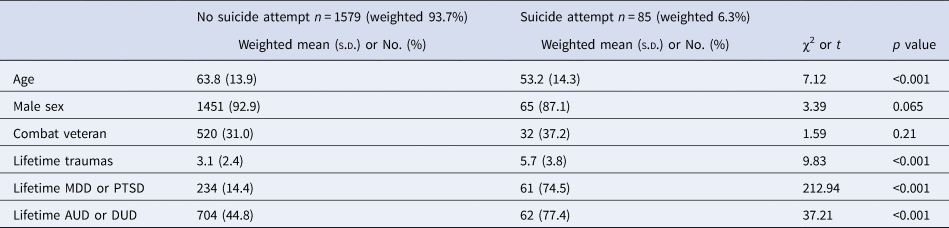
Table 1 presents descriptive statistics of the sample. Eighty-five veterans (weighted 6.3%, 95% CI 5.1–7.6%) reported a history of suicide attempt. Veterans with a history of suicide attempt were more likely to be younger (53.2 ± 14.3 v. 63.8 ± 13.8, p < 0.001), reported more lifetime traumas (3.8% v. 2.4%, p < 0.001), and were more likely to screen positive for lifetime MDD/PTSD (74.5% v. 14.4%, p < 0.001) and AUD/DUD (77.4% v. 44.8%, p < 0.001).
Sample characteristics by lifetime suicide attempt history

AUD, alcohol use disorder; DUD, drug use disorder; MDD, major depressive disorder; PTSD, posttraumatic stress disorder; s.d., standard deviation.
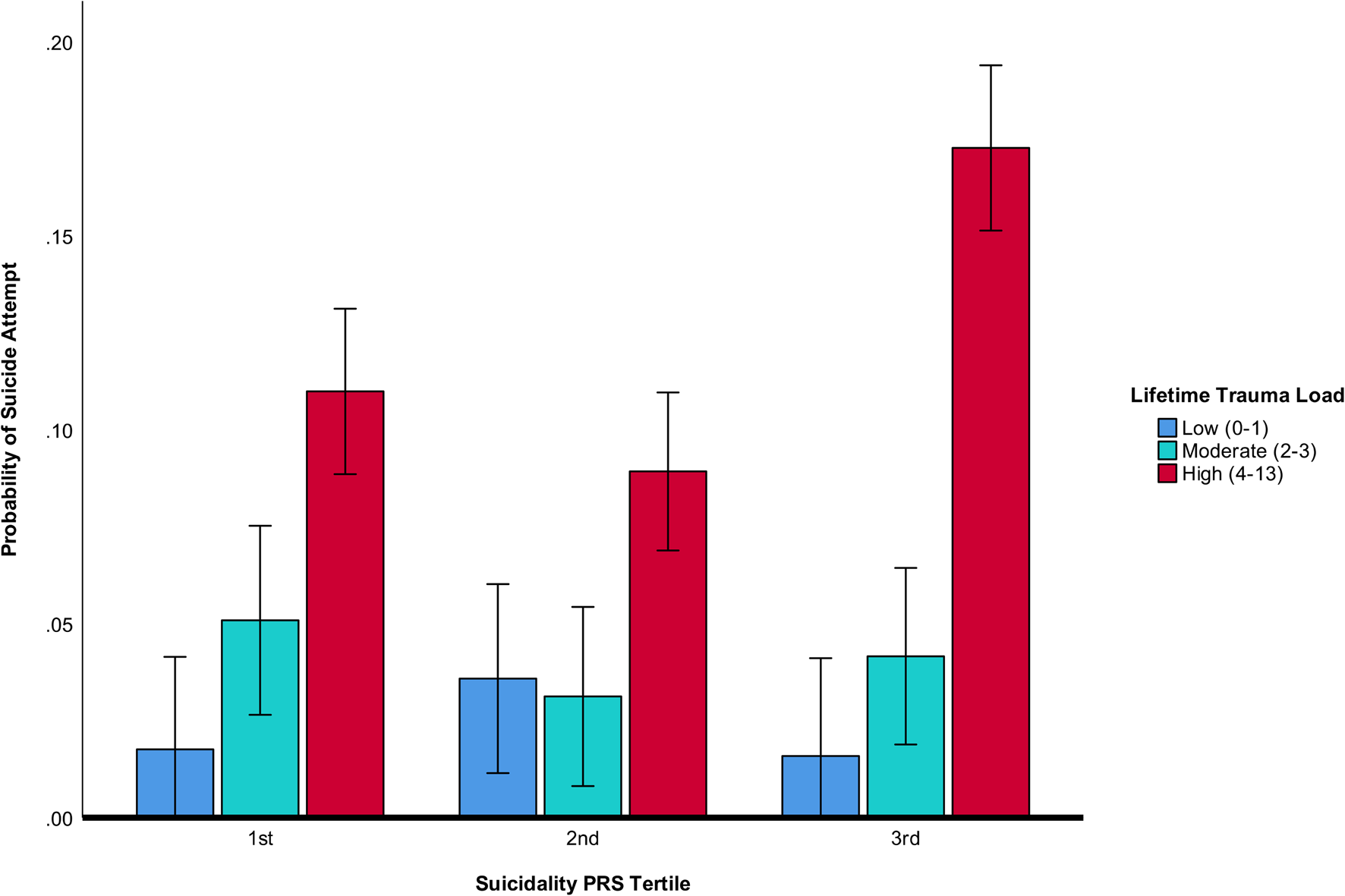
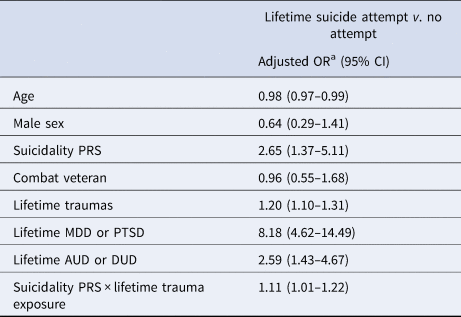
As shown in Table 2, suicidality PRS, cumulative trauma exposure, lifetime MDD/PTSD and AUD/DUD were positively associated with lifetime suicide attempt, while age was negatively associated with this outcome. A significant interaction of suicidality PRS × cumulative trauma exposure was also observed (adjusted OR 1.11; 95% CI 1.01–1.22). Figure 1 shows the interaction between suicidality PRS and lifetime trauma exposure, which indicated that veterans in the highest tertiles of suicidality PRS and lifetime trauma exposure had the highest probability of lifetime suicide attempt (0.173). Interactions between suicidality PRS and other potential moderator variables, including lifetime MDD/PTSD, AUD/MDD, and combat veteran status, were not significant.
Probability of lifetime suicide attempt as a function of suicidality PRS and cumulative lifetime trauma burden. Note. Error bars represent 95% confidence intervals.

Results of binary logistic regression analysis of suicidality PRS, lifetime trauma exposure, and their interaction in relation to lifetime suicide attempt

95% CI, 95% confidence interval; AUD, alcohol use disorder; DUD, drug use disorder; MDD, major depressive disorder; OR, odds ratio; PRS, polygenic risk score (standardized); PTSD, posttraumatic stress disorder; s.d., standard deviation.
a Results are adjusted for top 10 within-ancestry principal components.
Multivariate gene–environment interaction analysis
Based on the PRS results, we analyzed multivariate G×E effects with respect to 11 508 LD independent genetic variants (minor allele frequency >0.5%) that reached a nominally significant association (p < 0.05) with respect to suicidality in the UK Biobank (N = 122 822; Strawbridge et al., Reference Strawbridge, Ward, Ferguson, Graham, Shaw, Cullen and Smith2019). After false discovery correction (FDR q < 0.05), the multivariate G×E analysis revealed 25 variants with significant association with suicide attempt and significant multivariate G×E effects (online Supplementary Table S2). Among them, 11 loci showed large G×E interaction (BF>1) with at least one traumatic event. Three variants presented interactive effects with multiple types of traumatic events: rs12153248 (pa = 4.4 × 10⁻⁵, pint = 2.07 × 10⁻⁵; sudden abandonment BF = 4.35, sudden move/loss of possessions BF = 2.22; sudden death of loved one BF = 2.11); rs4656083 (pa = 5.11 × 10⁻⁵, pint = 3.33 × 10⁻⁵; natural disaster BF = 1.31, sudden abandonment BF = 1.29; child sexual abuse BF = 1.1); rs1351231 (pa = 7.56 × 10⁻⁵, pint = 3.87 × 10⁻⁵; sudden death of loved one BF = 2.24, life-threatening illness or injury BF = 1.43; natural disaster BF = 1.37). The rs12153248 and rs1351231 variants were annotated to the DAB2 and SPNS2 genes, respectively. The rs4656083 SNP is located in an intergenic region.
Gene set enrichment and drug repurposing analyses
GSEA was applied to detect overrepresented pathways for the 5509 genes identified with SNP Nexus (online Supplementary Table S3). After Bonferroni multiple correction testing, we identified 109 significant enrichments (p < 3.18 × 10⁻⁶) (online Supplementary Table S4). After clumping the redundant GO terms, 54 pathways (online Supplementary Table S4) were identified with >60% semantic uniqueness (i.e. the negative of average similarity of a term to all other terms) and <60% semantic dispensability (i.e. value reflecting the term's strong redundancy with respect to a chosen representative). The strongest enrichments included cellular process (GO:0009987; 1.11-fold enrichment, p = 2.73 × 10⁻²⁵), developmental process (GO:0032502; 1.32-fold enrichment, p = 4.57 × 10⁻²⁴), and nervous system development (GO0007399; 1.59-fold enrichment, p = 1.15 × 10⁻²³).
For the drug repurposing analysis, we submitted GO terms significant in the GSEA analysis to Gene2drug (Napolitano et al., Reference Napolitano, Carrella, Mandriani, Pisonero-Vaquero, Sirci, Medina and Di Bernardo2018). Among the drugs tested, two compounds survived Bonferroni multiple testing correction: medrysone, a synthetic glucocorticoid with anti-inflammatory properties (p = 2.29 × 10⁻⁵, EScore = 0.437); clofibrate, a triacylglyceride level lowering agent (p = 3.38 × 10⁻⁵, EScore = 0.430) (online Supplementary Table S6).
Discussion
Leveraging phenotypic and genetic data available from the NHRVS cohort, a nationally representative sample of US military veterans, we found that higher suicidality PRS in European Americans was associated with greater odds of lifetime suicide attempt. Specifically, results indicated that each standard deviation increase in suicidality PRS was associated with a more than 2.5-fold greater odds of suicide attempt, even after adjusting for sociodemographic and military characteristics, as well as lifetime PTSD, MDD, AUD, and DUD. These results are consistent with accumulating data, which suggest that the cumulative effects of numerous common genetic polymorphisms may contribute to individuals' propensity toward engaging in suicidal behavior (Mullins et al., Reference Mullins, Bigdeli, Børglum, Coleman, Demontis, Mehta and Lewis2019, Reference Mullins, Kang, Campos, Coleman, Edwards, Galfalvy and Leboyer2022; Na et al., Reference Na, De Angelis, Nichter, Wendt, Krystal, Southwick and Pietrzak2021). For example, our previous study (Na et al., Reference Na, De Angelis, Nichter, Wendt, Krystal, Southwick and Pietrzak2021) found that suicidality PRS was associated with approximately fourfold greater odds of developing new-onset of suicidal ideation over a 7-year period, above and beyond sociodemographic characteristics and lifetime psychiatric history. The current study extends our prior analysis investigating suicidality PRS in relation to the interplay with cumulative trauma burden and suicide attempt in US veterans of European descent.
Consistent with our hypotheses, we found a significant PRS-by-trauma exposure interaction, such that veterans with higher levels of suicidality PRS and lifetime trauma exposure showed the highest probability of lifetime suicide attempt (Fig. 1). Among individuals with high suicidality PRS, the likelihood of suicide attempt was greatest among those with high levels of lifetime trauma exposure (16.6%). Conversely, the probability of suicide attempt was only 1.4% among those with high suicidality PRS and low trauma exposure. This finding suggests that exposure to traumatic events may potentiate the effects of genetic liability for suicidality and contribute to increased risk for suicide attempt. Although our study is the first, to our knowledge, to document the synergistic effects of polygenic risk for suicidality and lifetime trauma exposure, findings are broadly consistent with other recent research demonstrating interactive effects between polygenetic risk for mood disorders and trauma exposure with suicide-related outcomes (Stein et al., Reference Stein, Jain, Campbell-Sills, Ware, Choi, He and Ursano2021a, Reference Stein, Levey, Cheng, Wendt, Harrington, Pathak and Gelernter2021b). Collectively, the PRS-by-environment effects found in our study are consistent with the vulnerability-stress model of suicidal behavior (Nock et al., Reference Nock, Deming, Fullerton, Gilman, Goldenberg, Kessler and Ursano2013), which posits that individuals possess genetic variants that heighten their vulnerability to environmental stressors, and that sets of genes can be activated by specific environmental adversities (i.e. trauma exposure), elevating risk for suicidality.
A notable contribution of the current study is the results obtained from our GEWIS to better understand how specific traumatic life events may interact with gene variants to modulate risk for suicide attempts. Among the 25 variants with significant association with suicide attempt and significant multivariate G×E effects, three variants were associated with different sets of traumatic events. This is in line with a previous study conducted in the UK Biobank where variants presented different profiles to timing (e.g. childhood v. adulthood) and types (emotional v. physical) of traumatic experiences (Wendt et al., Reference Wendt, Pathak, Levey, Nuñez, Overstreet, Tyrrell and Polimanti2021). Two risk loci were mapped to genic regions: rs12153248 mapped to DAB2 and rs1351231 mapped to SPNS2. The DAB2 gene encodes Disabled-2, a phosphoprotein with a possible role as a tumor suppressor. This protein binds to the GRB2 adaptor protein, which may modulate the Ras signaling pathway (Mok et al., Reference Mok, Wong, Chan, Lau, Tsao, Knapp and Berkowitz1994). GRB2 was found to be a risk gene for schizophrenia (Sun et al., Reference Sun, Wan, Jia, Fanous, Kendler, Riley and Zhao2011), a psychiatric disorder that can be exacerbated by traumatic events (Popovic et al., Reference Popovic, Schmitt, Kaurani, Senner, Papiol, Malchow and Falkai2019). In the present study, G×E with the DAB2 rs12153248 variant showed interaction with sudden abandonment, sudden move/loss of possession, and sudden death of loved one to predict suicide attempt. Although relatively few cases of schizophrenia result from an identifiable, sudden traumatic event (McIntosh & Story, Reference McIntosh and Story2021), this form of psychopathology is often associated with suicide attempt (Popovic et al., Reference Popovic, Schmitt, Kaurani, Senner, Papiol, Malchow and Falkai2019). This relationship suggests that the DAB2 gene may play a role in suicidality risk and inter-individual susceptibility to traumatic events.
The SPNS2 gene encodes a sphingosine 1-phosphate transporter, a secreted lipid relevant in cardiovascular, immunological, and neural development. SPNS2 deficiency was previously associated with early-onset progressive hearing loss (Chen et al., Reference Chen, Ingham, Kelly, Jadeja, Goulding, Pass and Steel2014) and the protein plays several roles in immune response, among them lymphocyte exit from lymphoid organs to circulation (Baeyens & Schwab, Reference Baeyens and Schwab2020). Lymphocytes have been suggested as useful biomarkers in several psychiatric disorders and suicidal behaviors (Brundin, Erhardt, Bryleva, Achtyes, & Postolache, Reference Brundin, Erhardt, Bryleva, Achtyes and Postolache2015; Kuballa, Nolte, Castoreno, & Xavier, Reference Kuballa, Nolte, Castoreno and Xavier2012; Osimo et al., Reference Osimo, Pillinger, Rodriguez, Khandaker, Pariante and Howes2020; Pandey, Reference Pandey2013). Specifically, various pro-inflammatory cytokines have been identified as potentially important in understanding the pathophysiology of suicidal behavior (Pandey, Reference Pandey2013). Our data suggest that SPNS2 may be associated with trauma-related suicidal behavior through inflammatory processes. Confirming this hypothesis, in the drug repurposing analysis, we found upregulation of suicide gene-sets in the context of medrysone, a drug used for chronic inflammation.
A previous study investigated electronic health records from medical claims for private health insurance, identifying several drugs associated with increased and decreased risk of suicidal events (Gibbons, Kwan, Lavigne, Wang, & Mann, Reference Gibbons, Kwan, Lavigne, Wang and Mann2019). None of the drugs reported in this investigation overlapped with the ones we identified in the current study. This is likely due to the different analytic design of the two studies. Indeed, while the results presented by Gibbons and colleagues are influenced by the comorbidities within the sample investigated and the prevalence of the drug prescriptions, our findings are influenced by the molecular targets known to be related to the drugs investigated. The different findings observed likely reflect the complexity of investigating suicidal behaviors.
Results from gene set enrichment analyses provide further insight into the possible biological basis of suicide attempts. Overrepresented pathways in the gene set enrichment analysis included cellular process, developmental process, and nervous system development. Other than lymphocytes, several other cells and cellular processes (e.g. platelets, leukocytes) have been implicated in the development of psychiatric disorders (Carballo, Akamnonu, & Oquendo, Reference Carballo, Akamnonu and Oquendo2008). Developmental processes, such as neuronal development through Brain-derived neurotrophic factor have also suggested to play a role in the pathophysiology of suicide (Pandey, Reference Pandey2013). Additionally, lasting alterations in the hypothalamic–pituitary–adrenal axis and serotonergic and dopaminergic systems in early life are associated with suicidal behavior in adulthood (Carballo et al., Reference Carballo, Akamnonu and Oquendo2008).
The results of this study should be interpreted in the context of several limitations. First, it is unclear from the current study to what extent polygenic risk and trauma exposure play a causal role in suicide attempts. Additional population-based, genetically-informed studies using techniques to strengthen causal inference (e.g. Mendelian randomization) are needed to better understand the nature of these relationships. Second, although a significant strength of this study was that it drew from a nationally representative sample of EA US veterans, results may not generalize to more racially/ethnically diverse veterans or non-veteran populations that may have different trauma histories. Although previous studies of multiple psychiatric disorders showed that genetic effects observed in predominantly-male cohorts are highly consistent with those identified in sample more equally representing males and females (Levey et al., Reference Levey, Gelernter, Polimanti, Zhou, Cheng, Aslan and Stein2020, Reference Levey, Stein, Wendt, Pathak, Zhou, Aslan and Gelernter2021; Stein et al., Reference Stein, Jain, Campbell-Sills, Ware, Choi, He and Ursano2021a, Reference Stein, Levey, Cheng, Wendt, Harrington, Pathak and Gelernter2021b), we acknowledge that the difference between the sex distribution in base and target samples of our PRS analysis may have affected our statistical power. Third, emerging evidence suggests that the timing of trauma exposure may be an important variable to consider in understanding the impact of polygenic risk for psychopathology (Aas et al., Reference Aas, Alameda, Di Forti, Quattrone, Dazzan, Trotta and Morgan2021; Carballo et al., Reference Carballo, Akamnonu and Oquendo2008), but timing was not assessed in this study; further research is needed to evaluate whether this may also apply to suicidal behaviors. Lastly, given the relatively limited sample size of the NHRVS cohort, it is possible that the effects detected in our study may be inflated due to the winner's course bias. Accordingly, further studies will be needed to replicate our results in an independent cohort.
Notwithstanding these limitations, results of this study have several important implications. From a research perspective, the finding that PRS scores for suicidality interacted with cumulative trauma exposure to elevate risk for suicide attempt suggests that future suicide research would benefit from incorporating genomic information to better understand how genetic and environmental factors may interact to heighten suicide risk, as well as to improve outcome prediction. Indeed, it is notable that suicidality PRS added to the explanatory power of the suicide attempt prediction model, above and beyond several of the strongest empirically validated risk factors, including lifetime MDD/PTSD/AUD (Nichter et al., Reference Nichter, Stein, Norman, Hill, Straus, Haller and Pietrzak2021a; Nock et al., Reference Nock, Deming, Fullerton, Gilman, Goldenberg, Kessler and Ursano2013). Moreover, results accord with a growing body of other evidence (Brundin et al., Reference Brundin, Erhardt, Bryleva, Achtyes and Postolache2015) to suggest that genes associated with inflammatory processes (e.g. DAB2, SPNS2) may be associated with increased risk for suicide attempts, and therefore warrant further investigation.
Although the predictive clinical utility of the PRS investigated in the present study remains to be determined, our results suggest that considering PRS generated from more powerful genomic studies (e.g. whole-genome sequencing studies) in combination with other environmental factors (e.g. trauma history; Nichter et al., Reference Nichter, Stein, Monteith, Herzog, Holliday, Hill and Pietrzak2022) may potentially help inform risk stratification and clinical decision-making for suicidality in the future. Indeed, as highlighted in a recent review (Murray et al., Reference Murray, Lin, Austin, McGrath, Hickie and Wray2021), genomic data needed to calculate PRS are inexpensive and easy to collect, and could help inform clinical decision-making in a similar way that clinicians currently use information recorded about family history of psychopathology to stratify patients at most risk and in need of a greater level of surveillance.
Finally, our drug repurposing analyses identified a molecular compound targeting inflammatory pathways, which preliminary results suggest could potentially be repurposed to treat suicidal behavior. However, our drug-repositioning approach is designed only to investigate drugs that could alter the expression profile (i.e. up- or down-regulation) of pathways associated with the phenotype of interest (suicide attempt in our study). Further studies are needed to clarify the potential consequences of these molecular changes. Indeed, there have been increasing calls in recent years for a better understanding of medications that may be helpful for reducing suicidal behavior both proximally and distally, particularly in light of rising rates of suicide in the United States over the past decade (Gibbons et al., Reference Gibbons, Kwan, Lavigne, Wang and Mann2019). Further research is additionally needed to examine the association between suicidality PRS and suicide-related outcomes in non-veteran EA and non-EA samples, as well as to identify biopsychosocial mechanisms linking this gene-by-environment interaction to the phenotypic expression of suicidal behaviors.
Supplementary material
The supplementary material for this article can be found at https://doi.org/10.1017/S0033291722003646.
Acknowledgements
Preparation of this report was supported in part by the US Department of Veterans Affairs National Center for Posttraumatic Stress Disorder. The authors acknowledge Ann Marie Lacobelle and Christa Robinson from the Gelernter Laboratory for their assistance in sample processing. None of the funding sources had a role in the design and conduct of the study; collection, management, analysis, and interpretation of the data; preparation, review, or approval of the manuscript; and decision to submit the manuscript for publication. The authors thank the veterans who participated in this study. RP and BN had full access to all the data in the study and take responsibility for the integrity of the data and the accuracy of the data analyses.
Financial support
Preparation of this report was supported in part by the Clinical Neurosciences Division of the US Department of Veterans Affairs National Center for Posttraumatic Stress Disorder. This funding source had no role in the design of this study, execution, analyses, interpretation of the data, or decision to submit the manuscript.
Conflict of interest
BN, DK, FD, JW, MG, PN, SN, and RHP have no conflicts of interest to declare. MH is a paid consultant for Spectrum Therapeutics. RP and JG are paid for their editorial work on the journal Complex Psychiatry. RP received a research grant from Alkermes. JK is a scientific advisor to Biohaven Pharmaceuticals, BioXcel Therapeutics, Inc., Cadent Therapeutics (Clinical Advisory Board), PsychoGenics, Inc., Stanley Center for Psychiatric research at the Broad Institute of MIT and Harvard, Lohocla Research Corporation. JK owns stock and/or stock options in Biohaven Pharmaceuticals, Sage Pharmaceuticals, Spring Care, Inc., BlackThorn Therapeutics, Inc., Terran Biosciences, Inc. JK reports income <$10 000 per year from: AstraZeneca Pharmaceuticals, Biogen, Idec, MA, Biomedisyn Corporation, Bionomics, Limited (Australia), Boehringer Ingelheim International, Concert Pharmaceuticals, Inc., Epiodyne, Inc., Heptares Therapeutics, Limited (UK), Janssen Research & Development, L.E.K. Consulting, Otsuka America Pharmaceutical, Inc., Perception Neuroscience Holdings, Inc. Spring Care, Inc., Sunovion Pharmaceuticals, Inc., Takeda Industries, Taisho Pharmaceutical Co., Ltd. JK reports income >$10 000 per year from Biological Psychiatry (Editor). JK received the drug, Saracatinib from AstraZeneca and Mavoglurant from Novartis for research related to NIAAA grant ‘Center for Translational Neuroscience of Alcoholism’ [CTNA-4] from AstraZeneca Pharmaceuticals. JK holds the following patents: (1) Seibyl JP, Krystal JH, Charney DS. Dopamine and noradrenergic reuptake inhibitors in treatment of schizophrenia. US Patent #:5447948. 5 September 1995; (2) Vladimir, Coric, Krystal, John H, Sanacora, Gerard – Glutamate Modulating Agents in the Treatment of Mental Disorders US Patent No. 8778979 B2 Patent Issue Date: 15 July 2014. US Patent Application No. 15/695164: Filing Date: 09/05/2017; (3) Charney D, Krystal JH, Manji H, Matthew S, Zarate C, – Intranasal Administration of Ketamine to Treat Depression United States Application No. 14/197767 filed on 5 March 2014; United States application or Patent Cooperation Treaty (PCT) International application No. 14/306382 filed on 17 June 2014; (4): Zarate, C, Charney, DS, Manji, HK, Mathew, Sanjay J, Krystal, JH, Department of Veterans Affairs ‘Methods for Treating Suicidal Ideation’, Patent Application No. 14/197.767 filed on 5 March 2014 by Yale University Office of Cooperative Research; (5) Arias A, Petrakis I, Krystal JH. – Composition and methods to treat addiction. Provisional Use Patent Application no. 61/973/961. 2 April 2014. Filed by Yale University Office of Cooperative Research.; (6) Chekroud, A., Gueorguieva, R., Krystal, J.H. ‘Treatment Selection for Major Depressive Disorder’ [filing date June 3, 2016, USPTO docket number Y0087.70116US00]. Provisional patent submission by Yale University; (7) Gihyun, Yoon, Petrakis I., Krystal J.H. – Compounds, Compositions and Methods for Treating or Preventing Depression and Other Diseases. U.S. Provisional Patent Application No. 62/444552, filed on January 10, 2017 by Yale University Office of Cooperative Research OCR 7088 US01; and (8) Abdallah, C., Krystal, J.H., Duman, R., Sanacora, G. Combination Therapy for Treating or Preventing Depression or Other Mood Diseases. U.S. Provisional Patent Application No. 62/719935 filed on 20 August 2018 by Yale University Office of Cooperative Research OCR 7451 US01.