Whey proteins have aroused interest in the improvement of nutritional quality of various dairy products (De Wit, Reference De Wit1998). Beta-lactoglobulin (β-lg) and alpha-lactalbumin (α-la), the main proteins, are rich in aromatic or branched side chains amino acid residues. The latter are known to improve muscular performances (Blomstrand et al. Reference Blomstrand, Hassmén, Ekblom and Newsholme1991). Concerning aromatic residues, α-la has the highest content in essential but sparse amino-acid tryptophan (W) (6% of residues) and the highest ratio W/large neutral amino acids among all food protein sources (Heine et al. Reference Heine, Radke, Wutzke, Peters and Kundt1996; Orosco et al. Reference Orosco, Rouch, Beslot, Feurte, Regnault and Dauge2004). Thus, α-l α-la rotein is suitable as W supplement in products such as infant formulas (Heine et al. Reference Heine, Radke, Wutzke, Peters and Kundt1996).
Due to their hydrophobic content, whey proteins are good substrates for the generation of lactokinins. Lactokinins were defined as peptides from whey protein able to inhibit Angiotensin Converting Enzyme (ACE) (Fitzgerald & Meisel, Reference FitzGerald and Meisel1999). They are thus cryptic peptides (Autelitano et al. Reference Autelitano, Rajic, Smith, Berndt, Ilag and Vadas2006) which are an interesting alternative to synthetic inhibitors with side effects. Their biological activity expressed as the concentration of peptide able to reduce 50% of the enzyme activity (IC50) range from μm to mm. For example, ALPMHIR the tryptic β-lg f(142–148) showed an IC50 value of 42·6 μm (Mullaly et al. Reference Mullaly, Meisel and FitzGerald1997a). Hernández-Ledesma et al. (Reference Hernández-Ledesma, Recio, Ramos and Amigo2002) found four novel ACE-inhibitory peptides from goat β-lg hydrolysed with thermolysin. LKPTPEGN β-lg f(46–53), LQKW β-lg f(58–61), LLF β-lg f(103–105) and LVRT β-lg f(122–125). They had IC50 that ranged from 34·7 to 2470 μm. α-Lactorphin YGLF α-la f(50–53) (Yoshikawa et al. Reference Yoshikawa, Tani, Yoshimura and Chiba1986) released from α-la by pepsin treatment had an IC50 value of 733 μm (Mullally et al. Reference Mullaly, Meisel and FitzGerald1996). Ingestion of ingredients containing lactokinins showed beneficial effects on blood pressure in spontaneously hypertensive rats (SHR) and humans (Tuomilehto et al. Reference Tuomilehto, Lindström, Hyrynen, Korpela, Karhunen, Mikola, Jauhiainen, Seppo and Nissinen2004; Jauhiainen et al. Reference Jauhiainen, Colline, Narva, Cheng, Poussa, Vapaatalo and Korpela2005; Lopez-Fandiño et al. Reference Lopez-Fandiño, Otte and Van Camp2006).
Different methods allowed antihypertensive peptides liberation. One of them exploits the proteolytic potential of microorganisms. Gobbetti et al. (Reference Gobetti, Ferranti, Smacchi, Goffredi and Addeo2000) showed that fermented milks produced by Lb. delbrueckii subsp. Bulgaricus and Lactococcus lactis subsp. Cremoris strains contained several casein-derived ACE inhibitory peptides. Whey fermentation by Kluyveromyces marxianus was able to generate the antihypertensive α-lactorphin (YLLF) from β-lg (Belem et al. Reference Belem, Gibbs and Lee1999). Another study showed the production of whey protein hydrolysate with antihypertensive activity after fermentation by Lb. helveticus and Saccharomyces cerevisiae (Vermeissen et al. Reference Vermeirssen, Van Camp, Decross, Van Wijmelbeke and Verstraete2003). Owing to the potential probiotics effect of selected microorganisms and to the biological activities of peptides within protein hydrolysates, whey-based beverages showing nutraceutical properties are being to developed.
We previously showed that Kluyveromyces marxianus and Lactobacillus rhamnosus were able to ferment acid goat whey. The hydrolysate produced exhibited an Angiotensin-I-Converting Enzyme (ACE) 50% inhibitory concentration (IC50) of 72 μg/ml (Hammé et al. Reference Hammé, Sannier, Piot, Didelot and Bordenave-Juchereau2009). The aim of this study was first to check the reproducibility of microorganisms' growth and proteins degradation and secondly to identify ACE inhibitors peptides responsible for the biological activity. Specific attention was paid to tryptophan release in relation to health potential.
Materials and Methods
Enzyme and substrates
Angiotensin I-Converting Enzyme (E.C. 3.4.15.1) extracted from rabbit lung, ACE synthetic substrate N-(3[Furyl]Acryloyl)-Phe-Gly-Gly (FAPGG), bovine chymotrypsin (EC 3.4.21.1), porcine pepsin (EC 3.4.23.1), bovin trypsin (EC 3.4.21.4) and L-Tryptophan (W) were purchased from Sigma-Aldrich (F38070 Saint-Quentin Fallavier). Synthetic NYW was prepared by Altergen (F67800 Bischheim).
Whey fermentation by Kluyveromyces marxianus and Lactobacillus rhamnosus
Samples of microorganisms pre-culture produced as described elsewhere were used to ferment increasing volumes (5, 100, 150, 200 and 300 ml) of acid goat whey. The pre-culture was inoculated at 1:100 (v/v). Fermentations were performed at 37°C under aerobic conditions using continuous stirring for 168 h. Aliquots of fermented samples were collected, cells were removed by centrifugation at 4045 g during 4 min and the supernatant was filtered through a 0·22 μm membrane before further analyses. Finally, the hydrolysate was freeze dried and dissolved in pure water. It had a final protein concentration of 29·56 g/l.
Purification and identification of ACE inhibitors peptides from α-la hydrolysate
Separation of peptides was done using RP-HPLC. 5·91 mg hydrolysate were loaded on a semi-preparative C4 column (Synchropak, 250×10 mm; Micra Scientific Inc.). Elution was performed at a flow rate of 2·5 ml/min with a binary gradient of TFA in water (0·1%, v/v) for solvent A and TFA (0·05%) in 50% acetonitrile for solvent B. The gradient used was 0–65 min, linear gradient from 0 to 50% B, 65–70 min, linear gradient from 50 to 100% B, 70–80 min, a linear gradient from 100 to 0% B. Between each injection, the column was re-balanced with 100% solvent A for 10 min. The first twenty fractions were collected from several runs according to the elution profile and pooled before freeze-drying.
Evaluation of ACE inhibitory activity was assayed with 5 μg (protein content) of each fraction and sub fractions using FAPGG as substrate (Didelot et al. Reference Didelot, Bordenave-Juchereau, Rosenfeld, Fruitier-Arnaudin, Piot and Sannier2006b). The IC50 of W and NYW was determined with commercial molecules. The area of each bioactive fraction was expressed as a percentage of the total peptide area (7–73 min.). After identification, we quantified W in the hydrolysate using a standard curve of synthetic W.
Identification of ACE inhibitors peptide was determined with an electrospray ionisation mass spectrometry analysis. Each selected fraction was freeze-dried, dissolved in 100 μl pure water. The molecular mass was determined using an Agilent system 1100 LC/MSD Trap mass spectrophotometer VL (Agilent, D76337 Waldbronn). Mass spectrometer was obtained in the positive detection mode. Nitrogen was used as the drying gas at 15 l/min and 350°C at a nebuliser pressure of 4 bars. The scan range was m/z 50–800 using five averages and m/z 13000 per second resolution. The capillary voltage was 4 kV. Processing was done off-line using LC-MSD trap software 6·0. 5 μl of the fraction solutions and of synthetic peptide were injected on a modulo-cart QK Uptisphere 300 Å ODB 150×2·0 mm column from Interchrom, (Montluçon F03103) and eluted with 50% water 0·1% acetic acid and 50% acetonitrile 0·1% acetic acid at 0·4 ml/min. UV detection was done at 280 nm.
Simulation of gastrointestinal digestion of synthetic NYW
NYW was dissolved in water (2·5 mm) and digested by pepsin, trypsin and chymotrypsin at an enzyme to substrate ratio of 1 over 250 (w/w relative to total protein content). For the peptic hydrolysis, the pH of the solution was adjusted to 2 with 1 m-HCl, while for tryptic and chymotryptic hydrolysis, the pH was adjusted to 7·6 and 7·8 respectively with 5 m-NaOH. The peptidic solution was incubated at 40°C for pepsin treatment and at 37°C for tryptic and chymotryptic hydrolysis during 2h30. The pH was maintained constant by continuous addition of 0·2 m-HCl (for peptic reaction) and of 0·1 m-NaOH (for tryptic and chymotryptic digestion) using a 718 pH-stat (Metrohm LTd., CH-9101 Herisau). After hydrolysis, the enzymes were inactivated by heating the digest at 95°C for 10 mins.
The IC50 of the resulting digest of NYW was determined as previously described.
Results
A co-culture of Lb. rhamnosus and K. marxianus was able to grow on acid goat whey and ACE inhibitory activities were detected in the resulting hydrolysate (Hammé et al. Reference Hammé, Sannier, Piot, Didelot and Bordenave-Juchereau2009).
The reproducibility of microorganisms' growth and proteins degradation were studied. Initially, the fermentation of 5 ml acid goat whey was performed four times. No significant difference was observed between samples concerning growth and peptide content (data not shown). Subsequently, the co-culture was successfully used to ferment increasing volumes from 5 to 300 ml acid goat whey. After 168 h fermentation, hydrolysates were separated by RP-HPLC and ACE inhibitory activities were checked. ACE inhibitory activities measurements were similar independently of the fermentation volume (data not shown).
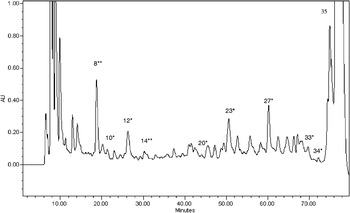
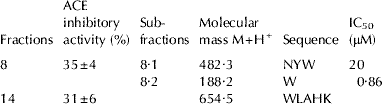
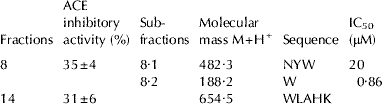
In order to characterise peptides involved in the ACE inhibition, 200 ml freeze dried hydrolysate were fractionated by RP-HPLC. The chromatogram presented in Fig. 1 shows 35 numbered fractions. The ACE inhibitory activity was measured only in the first 20 fractions, where peptides were reported to be potential ACE inhibitors (Bordenave et al. Reference Bordenave, Sannier, Piot and Ricart1999). The most active fractions were fractions 8 and 14. Protein (5 μg) of each fraction were respectively inhibited 35±4% and 31±6% of the ACE activity (Table 1). The fraction 8 is prevalent in the chromatogram. Its area represented 2·98% of the total area of α-la hydrolysate (elution time between 6 min to 73 min) whereas fraction 14 only represented 0·016%. Further C18 HPLC analyses of fraction 8 revealed the presence of three sub-fractions (termed 8·1, 8·2 and 8·3). Only sub-fractions 8·1 and 8·2 exhibited ACE inhibitory activity.
RP-HPLC profile (215 nm) of fermented acid goat whey using a C4 column. Numbered peaks marked by one asterisk correspond to peptidic fractions identified with tryptophan in their sequence. The fractions with ACE inhibitory activity are marked by two asterisks. The fraction 35 corresponds to β-lg.

ACE inhibitory activityFootnote * of the HPLC active fractions, peptide sequences and IC50 of ACE inhibitor peptides of whey fermented by Kluyveromyces marxianus and Lactobacillus rhamnosus at 37°C during 168 h
* ACE inhibitory activity was measured with 5 μg of protein of fractions
The sequence of these active sub-fractions were identified by LC/MS-ES. The full scan spectrum of sub-fractions 8·1 and 8·2 showed a M+H+ ion at m/z 482·3 and a M+H+ ion at m/z 188·2 Da respectively. Sub-fraction 8·1 was identified as NYW, corresponding to α-la f(102–104). The molecule contained in the 8·2 fraction was identified as tryptophan. The IC50 of synthetics NYW and W were measured using FAPGG as substrate for ACE. NYW had an IC50 of 20 μm and the IC50 of W was estimated to 0·86 μm (Table 1). Fraction 14 contained several peptides but only one had ACE inhibitory activity. It had an M+H+ ion at m/z 654 and was identified as WLAHK, α-la f(104–108) (Table 1).
To have a biological effect in vivo, the peptides have to cross the gastrointestinal barrier without degradation. WLAHK stability toward gastrointestinal enzymes was already evaluated (Didelot et al. Reference Didelot, Bordenave-Juchereau, Rosenfeld, Piot and Sannier2006a). Thus, the potential stability of the ACE activity in vivo was only performed on synthetic NYW using, pepsin, trypsin and chymotrypsin. The ACE activity measured after digestion was the same whatever the enzyme tested. A concentration of 20 μm- NYW inhibited 48·8±13. 1% of the ACE activity before hydrolysis and 49·3±11·3%, 46·3±10·5% and 49·3±12·2% after hydrolysis with pepsin, trypsin and chymotrypsin respectively.
W-content was estimated using second order derivative spectra analysis (Zhao et al. Reference Zhao, Sannier, Garreau, Le Cœur and Piot1996) of fractions. Nine fractions among 35 contained at least one W. The fraction 8, containing free W, was predominant and represented 76% of the area of fraction containing W.
Discussion
Acid goat whey fermentation by K. marxianus and Lb. rhamnosus allowed the generation of ACE inhibitory peptides mainly from the degradation of α-la. Three lactokinins were identified: NYW, α-la f(102–104), WLAHK, α-la f(104–108) and W.
We are reporting for the first time the ACE inhibitory activity of NYW. A decapeptide VGINYWLAHK containing this last tripeptide was previously identified by Pihlanto-Leppälä et al. (Reference Pihlanto-Leppala, Koshinen, Piilota, Tupasela and Korhonen2000) after enzymatic hydrolysis of α-la. This decapeptide corresponding to α-la f(99–108) had an IC50 of 327 μm. In our study NYW was characterised with a lower IC50 value of 20 μm and was released by K. marxianus and Lb. rhamnosus proteases.
α-La f(99–108) contains another lactokinin: WLAHK exhibiting IC50 from 77 to 8·8 μm depending on the test conditions used. It was first identified by Pihlanto-Leppälä et al. (Reference Pihlanto-Leppala, Koshinen, Piilota, Tupasela and Korhonen2000) after α-la hydrolysis by trypsin and was also found in a hydrolysate produced by fermentation. Indeed, Didelot et al. (Reference Didelot, Bordenave-Juchereau, Rosenfeld, Piot and Sannier2006a) showed that a co-culture of Candida parapsilosis and Lb. paracasei was able to generate WLAHK. Two arguments prevented the further exploitation of the produced hydrolysate: the use of a co-culture containing the yeast Candida parapsilosis which is a pathogenic opportunist and the fact that when WLAHK was submitted to simulated gastrointestinal digestion, it was degraded by chymotrypsin into W and LAHK (data not shown). Since LAHK pertained to α-la f(105–110) LAHKAL, which exhibited a quite high IC50 of 621 μm (Pihlanto-Leppälä et al. Reference Pihlanto-Leppälä, Rokka and Korhonen1998), the biological activity of WLAHK was considered as lost when hydrolysed.
In this work, we are describing the production of WLAHK by a co-culture of K. marxianus and Lb. rhamnosus, both GRAS. Moreover, we showed that single W exhibited an ACE inhibitory activity with an IC50 of 0·86 μm under our test conditions. Thus the WLAHK would possess in vivo ACE inhibitory activity due to the possible physiological implications of W after release. ACE inhibitory peptides could be absorbed in their intact form from intestine and be resistant to enzymes to reach their target after oral administration. This is probably the case of the single aromatic amino acid W and the case of NYW since we showed that it was resistant to pepsin, trypsin and chymotrypsin degradation. Consequently, NYW could cross the small intestine epithelium in vivo and may act locally on different sites present in the gastrointestinal tract or be absorbed intact to produce systemic effects.
It is interesting to note that the sequence 99–110 of α-la seems to be a lactokinin cryptic zone since at least 4 peptides exhibiting inhibitory activity of ACE were identified: WLAHK, VGINYWLAHK and NYW, in addition to LAHKAL α-la f(105–110). Comparison of ACE inhibitory activities of such peptides indicated that the presence of W104 seems important for the development of the biological activity: LAHKAL being less potent than VGINYWLAHK and WLAHK. Cheung et al. (Reference Cheung, Wang, Ondetti, Sabo and Cushman1980) already showed that W was effective at the C-terminal end for enhancing peptide binding to the ACE. Lactokinins exhibit high IC50 compared with ACE inhibitors from others sources and synthetics inhibitors. For example, IW derived from tuna and VW originating from sake lees were already identified and exhibited IC50 value of 2 μm and 1·4 μm respectively (Hong et al. Reference Hong, Ming, Yi, Zhanxia, Yongquan and Chi2008). These values are very close from the IC50 of W found in this study, underlying its biological importance. Moreover, W was added to the synthetic drug Lisinopril allowing an increase of the ACE C-domain selectivity (Nchinda et al. Reference Nchinda, Chibale, Redelinghuys and Sturrock2006) and thus a reduction of side effects of this ACE synthetic inhibitor.
The α-la hydrolysate produced by fermentation of whey by K. marxianus and Lb. rhamnosus contains various W-lactokinins (NYW, WLAHK and W) which could be physiologically active. This hydrolysate may not coincide with fermented milk like Calpis which contains more potent ACE inhibitors like VPP and IPP, but it could be interesting because of the biological potential of its W content. Indeed, tryptophan is the precursor for serotonin (a neurotransmitter) and a lack of serotonin is associated with affective disorders such depression, anxiety, and stress (Minet-Ringuet et al. Reference Minet-Ringuet, Le Ruyet, Tomé and Even2004). Studies showed that consuming α-la diet may favour the synthesis of serotonin and improve sleep and morning alertness (Markus et al. Reference Markus, Jonkman, Lammers, Deutz, Messer and Rigtering2005), cognitive performance under stress (Markus et al. Reference Markus, Olivier and de Haan2001), and mood under stress (Markus et al. Reference Markus, Olivier, Panhuysen, Van der Gugten, Alles, Tuiten, Westenberg, Fekkes, Koppeschaar and de Haan2000). The presence of free W in our hydrolysate could be relevant within mood control diet formulation in addition to reduction of hypertension.
Conclusion
Fermentation of acid goat whey by a co-culture of K. marxianus and Lb. rhamnosus generated α-la hydrolysate exhibiting ACE inhibitory activity. Peptides involved were identified as WLAHK (IC50=8·8 μm) and NYW (IC50=20 μm). The main biological activity appeared to be due to a single W (IC50=0·87 μm) which corresponded to the major molecule released.
This study underlines one more time the nutraceutical importance of α-la due firstly to the presence of a lactokinin cryptic zone (α-la f(99–110)) and secondly to its high W content. Our hydrolysate could be a good candidate for generation of functional health ingredients or beverages. But further in vivo anti-hypertensive and antianxiolytic-like potential should be assessed in order to know if it could be applied as a prophylactic treatment against hypertension and mood disorder.
Vanessa Hammé thanks the Conseil General of Charente Maritime for her Ph.D. grant.