Adolescents’ externalizing behaviors, including aggression, rule-breaking, and substance use, pose challenges for parents and practitioners alike. Adolescents’ peer groups provide an important context in which externalizing behaviors are learned and enacted. The similarity between an individual's own involvement in externalizing behaviors and their peers’ involvement (e.g., homophily; Brechwald & Prinstein, Reference Brechwald and Prinstein2011; Kandel, Reference Kandel1978) has generally been attributed to two distinct but interrelated processes: socialization and selection. Inspired by the research of Tom Dishion and colleagues on deviance training (Dishion & Patterson, Reference Dishion, Patterson, Cicchetti and Cohen2006), this research examined antisocial communication among peers in the context of text messaging. This paper presents two studies that used a novel observational design to examine the extent to which adolescents engage in antisocial text messaging with the broader peer network and whether this communication may relate to externalizing behaviors in ways that suggest socialization or selection effects.
Socialization vs. Selection Effects for Antisocial Behaviors
Socialization and selection are two processes that may explain the similarity in adolescents’ and their peers’ engagement in antisocial behavior. The socialization explanation for homophily suggests that adolescents learn to engage in aggressive and rule-breaking behaviors from interactions with their peers. Thus, the similarity between adolescents’ externalizing behaviors and their peers’ is the result of these behaviors’ being taught and encouraged within the peer group. In contrast, selection effects suggest that the similar levels of antisocial behavior are the result of adolescents’ seeking out peers who engage in the same sorts of problematic activities in which the adolescents themselves engage. Thus, individuals who drink heavily with their peers may have learned this behavior from those peers (e.g., socialization), but they may also have had an initial desire to engage in heavy drinking, so they may have sought out peers with whom they could engage in this activity (e.g., selection).
Communication among peers about antisocial topics may serve as a powerful driver of the socialization process. Deviancy training is one of the processes by which such communication leads to later antisocial behavior (Dishion & Patterson, Reference Dishion, Patterson, Cicchetti and Cohen2006). When antisocial friend dyads or groups spend time together, they are more likely to communicate about antisocial conversational topics compared with adolescents who do not engage in these behaviors (Dishion, Andrews, & Crosby, Reference Dishion, Andrews and Crosby1995). Importantly, these antisocial topics are more likely to be encouraged (e.g. complimented, laughed at) or followed by additional antisocial discussion (Piehler & Dishion, Reference Piehler and Dishion2007). Deviancy training is the specific mechanism through which socialization effects occur, and this type of antisocial communication has long lasting effects. In one study, involvement with deviant peers in elementary school predicted the development of antisocial behavior through 12th grade, and this relationship was fully mediated by deviancy training in 8th grade (Patterson, Dishion & Yoerger, Reference Patterson, Dishion and Yoerger2000). Indeed, a large body of longitudinal research consistently shows that the amount or frequency of antisocial communication with peers predicts future deviancy (DeLay et al., Reference DeLay, Ha, Van Ryzin, Winter and Dishion2015; Dishion, Spracklen, Andrews, & Patterson, Reference Dishion, Spracklen, Andrews and Patterson1996).
Evidence also suggests that adolescents select into similarly antisocial peer groups. For example, an analysis of National Youth Survey data suggests that selection actually provides a better explanation of substance use behaviors than do socialization processes (Rebellon, Reference Rebellon2012). Another study of Norwegian adolescents found that initial gang membership and violence was largely a function of individuals’ selecting peers who engaged in comparable delinquent behaviors themselves (Bendixen, Endresen, & Olweus, Reference Bendixen, Endresen and Olweus2006). The perspective that antisocial youth select into antisocial peer groups acknowledges the important fact that the roots of antisocial behavior are often established prior to adolescence (Dodge, Greenberg, Malone, & Conduct Problems Prevention Research Group, Reference Dodge, Greenberg and Malone2008; Dodge et al., Reference Dodge, Malone, Lansford, Miller, Pettit and Bates2009). This may be especially true for more serious forms of antisocial behavior, such as aggression and violence (Dodge, Coie, & Lynam, Reference Dodge, Coie, Lynam, Eisenberg, Damon and Lerner2006; Olweus, Reference Olweus1974).
Socialization and selection processes may also operate in a reciprocal fashion, with individuals selecting peers who are similarly antisocial and then being socialized by these peer groups (Brechwald & Prinstein, Reference Brechwald and Prinstein2011). One large-scale study that followed students from 6th through 9th grades found that adolescents who drank alcohol sought out peers who drink, viewing them as having high status and attractive. These friendships, in turn, resulted in opportunities for increased drinking, highlighting the reciprocal nature of selection and socialization processes (Osgood et al., Reference Osgood, Ragan, Wallace, Gest, Feinberg and Moody2013).
Both socialization and selection may predict increases in antisocial behavior by altering adolescents’ perceptions of normalcy—specifically, perceptions that certain types of antisocial behavior are normal or even expected in an adolescent's peer group (David, Cappella, & Fishbein, Reference David, Cappella and Fishbein2006). Perceptions of normalcy have been shown repeatedly to predict subsequent antisocial and high-risk behavior (e.g., Maddock & Glanz, Reference Maddock and Glanz2005; Rhodes, Ewoldsen, Shen, Monahan, & Eno, Reference Rhodes, Ewoldsen, Shen, Monahan and Eno2014). However, it is not clear how best to conceptualize and measure communication about antisocial behavior to capture this idea of normalcy. For example, if perceptions of normalcy are indeed an important operating factor, it might be argued that the absolute amount of communication among peers about antisocial topics (or the absolute amount of deviancy training) is not necessarily the key variable to measure. Rather, the key factor might be the proportion of peers in an adolescents’ peer group with whom the adolescent exchanges antisocial communication. If an adolescent communicates with most of his or her peers about antisocial topics, such communication truly is the norm within that particular adolescent's peer group. However, when an adolescent communicates about antisocial topics with only a small proportion of their peer group (even if one or two dyads are spending a lot of time on the topic), the perception that antisocial behavior is normal among their peers more generally may not emerge.
Studies in which peer communication is directly observed have greatly advanced knowledge about adolescents’ antisocial communication and how it relates to deviant behavior (Dishion & Andrews, Reference Dishion and Andrews1995; Dishion et al., Reference Dishion, Spracklen, Andrews and Patterson1996; Gottfredson, 2010). These studies, however, have often been limited to observing dyads (DeLay et al., Reference DeLay, Ha, Van Ryzin, Winter and Dishion2015; Dishion et al., Reference Dishion, Spracklen, Andrews and Patterson1996; Piehler & Dishion, Reference Piehler and Dishion2007; Piehler & Dishion, Reference Piehler and Dishion2014) or observing adolescents in artificially assigned groups (Dishion & Andrews, Reference Dishion and Andrews1995; Gottfredson, Reference Gottfredson2010; Rorie et al., Reference Rorie, Gottfredson, Cross, Wilson and Connell2011). Such designs allow researchers to measure the amount of communication about antisocial topics (in a particular dyad or group). However, these designs do not allow researchers to examine the proportion of the adolescent's naturalistic peer group with which they discuss these topics.Footnote 1
Similarly, studies that examine selection of antisocial friends generally ask adolescents to report on the delinquent behavior of a few “best friends” (DeLay et al., Reference DeLay, Ha, Van Ryzin, Winter and Dishion2015; Osgood et al., Reference Osgood, Ragan, Wallace, Gest, Feinberg and Moody2013). These restrictions on whom the adolescent is rating may further limit researchers’ abilities to assess the delinquency of the broader peer network. Even when studies allow the participant to nominate unlimited numbers of delinquent friends (e.g., Franken et al., Reference Franken, Prinstein, Dijkstra, Steglich, Harakeh and Vollebergh2016), adolescents’ estimates of peer delinquency are often conflated with adolescents’ self-reported delinquency (Meldrum & Boman, Reference Meldrum and Boman IV2013).
Assessing Peer Delinquency via Text Message Communication
To measure both the amount of communication among peers about antisocial topics and the proportion of peers in an adolescents’ peer group with whom the adolescent exchanges antisocial communication, researchers need to examine natural communication that occurs across each adolescent's broader peer group. Unfortunately, observing such communications over an extended period of time presents significant obstacles. The present research addresses this challenge by examining adolescents’ communications exchanged via text messaging. Observing text message communication provides an unobtrusive means of examining communication patterns between adolescents and their genuine peer network (i.e. the peers with whom they communicate by choice). Although examining text message communication will not capture all peer communication, it provides a uniquely naturalistic view of the most preferred methods of peer communication among teens (Lenhart & Page, Reference Lenhart and Page2015).
Prior research using self-reports of text messaging indicates that the total frequency of text messages exchanged predicts antisocial behavior (regardless of the content of the messages; Ling, Reference Ling, Harper, Palen and Taylor2005). Furthermore, similar to in-person observation of antisocial dyads (Dishion et al., Reference Dishion, Spracklen, Andrews and Patterson1996; Piehler & Dishion, Reference Piehler and Dishion2014), observed antisocial communication exchanged via text message predicts increases in rule-breaking and aggressive behavior (Ehrenreich, Underwood, & Ackerman, Reference Ehrenreich, Underwood and Ackerman2014). However, previous studies have not yet used text-messaging data to assess the proportion of an adolescents’ peer group with whom antisocial communication has occurred. Thus, the present research will be the first to examine the extent to which texting about antisocial topics permeates the broader peer group.
We investigated the proportion of adolescents’ peer groups who engage in text messaging in two studies. Study 1 examined how antisocial communication and the proportion of the peer network exchanging this communication during the 9th grade jointly and uniquely contribute to aggressive and rule-breaking behaviors during the summer prior to 10th grade. Based on the results of Study 1, Study 2 investigated the association between externalizing behaviors and the proportion of the peer exchanging antisocial communication across the four years of high school.
Study 1
The first study examined what it is about adolescents’ communication with peers about antisocial topics that predicts future antisocial behavior: (a) the absolute amount of communication about antisocial topics or (b) the extent to which such communication permeates the peer group. We hypothesized that the proportion of the peer group with which the adolescent exchanged antisocial texts would emerge as a significant predictor of both aggression and rule-breaking behavior, even after accounting for the amount of texting about antisocial topics (and total texting overall). We also explored sex differences in the relations between these texting variables and antisocial behavior. Although boys are more likely to engage in externalizing behaviors overall, previous examinations of potential gender differences in text messaging behaviors and their association with externalizing problems have not identified significant differences (Ehrenreich et al., Reference Ehrenreich, Underwood and Ackerman2014; Underwood, Ehrenreich, More, Solis & Brinkley, Reference Underwood, Ehrenreich, More, Solis and Brinkley2015; Underwood, Rosen, More, Ehrenreich & Gentsch, Reference Underwood, Rosen, More, Ehrenreich and Gentsch2012). Accordingly, we did not expect significant differences.
Method
Participants
Participants for both studies were part of a longitudinal study examining the role of digital communication in peer relationships. Letters inviting children and a parent to participate in the study were sent home during the 3rd grade. Participants completed assessment batteries annually, from 4th through 12th grade. The data presented in these studies were collected during the participants’ 4 years of high school.
Participants included 215 (113 boys) adolescents in grades 9 through 12. The sample was ethnically diverse, and generally representative of the metropolitan area in the suburban, southern-central United States where the study was conducted (52.6% Caucasian, 21.4% African American, 18.6% Hispanic, and 7.4% reported being of another race or mixed race). At the baseline assessment, the mean age for participants was 13.97 years old, and the median parent-reported annual income was between $51,000 and $75,000, which is slightly higher than the average for the county where data were collected (United States Census Bureau, 2000). Although the sample was distributed across 47 separate high schools when participants were entering 9th grade, the majority (56%) were students in three large high schools (each with more than 1,900 students; U.S. Department of Education, 2008-2009).
The sample for Study 1 included 167 participants (87 boys) whose text message communication was captured during 9th grade, and parent and teacher ratings of the adolescent's aggressive and rule-breaking behavior. The first year of high school was selected for Study 1 because this year corresponds with the age in which susceptibility to peer pressure peaks (Steinberg & Monahan, Reference Steinberg and Monahan2007). Participants were included in these analyses if they had captured text message data during 9th grade, and baseline and one-year follow-up ratings of aggressive and rule-breaking behavior. The Study 1 sample did not differ significantly from the Study 2 sample with respect to income, maternal education, or percent ethnic minority. The Study 1 sample did score higher on adolescents’ self-reports of rule-breaking behavior in 9th grade (M = 5.26, SD = 4.38) than the Study 2 sample, M = 3.53, SD = 2.93; t (186) = -2.36, p < .05. There were no significant differences between samples on any other outcome variables. The reporting parent was most often the mother in both the summer following the 8th and 9th grades (88% and 84%, respectively). Participants’ language arts teachers were contacted to rate the participants’ aggression and rule-breaking behavior at the end of the 8th and 9th grade school years.
Procedure
Participants completed questionnaires assessing antisocial behavior during the summer following their 8th-grade year and in each subsequent summer throughout high school. At the conclusion of each visit, participants were provided with BlackBerry phones configured to capture all text message communications sent and received by the phone. All text messages were stored in a secure, off-site digital archive. Participants were told that all communication, including topics about illegal and delinquent activities, would remain strictly confidential. The specific circumstances in which confidentiality would be broken (talk about suicide, imminent harm to others, and child/elder abuse) were also explained to the participants and their parent.
Measures
Parent reports of aggressive and rule-breaking behavior
Parents completed the Child Behavior Checklist (CBCL; Achenbach & Rescorla, Reference Achenbach and Rescorla2001). Relevant to these analyses are the 17-item rule-breaking behavior and 18-item aggressive behavior subscales. The parents completed baseline ratings in the summer following the 8th grade and outcome ratings during the summer following 9th grade. Ninety-five percent of participants’ parents completed baseline ratings of aggression (M T-score = 52.44, SD = 4.91) and rule-breaking behavior (M T-score = 52.15, SD = 4.2), and 89% of participants’ teachers completed outcome ratings of aggression (M T-score = 52.38, SD = 5.34) and rule-breaking behavior (M T-score = 52.73, SD = 5.31). The rule-breaking and aggressive behavior subscales indicated strong inter-item consistency in the summers following both the 8th grade (α = .77 and α = .88, respectively) and 9th grade (α = .85 and α = .89, respectively).
Teacher reports of aggressive and rule-breaking behavior
Participants’ language arts teachers assessed their student's antisocial behavior using the Teacher Report Form (TRF; Achenbach & Rescorla, Reference Achenbach and Rescorla2001). Of interest to these analyses are the 12-item rule-breaking and 20-item aggressive behavior subscales. Ninety percent of participants’ teachers completed baseline ratings of aggression (M T-score = 52.24, SD = 5.84) and rule-breaking behavior (M T-score = 52.23, SD = 4.65), and 84% of participants’ teachers completed outcome ratings of aggression (M T-score = 52.71, SD = 6.12) and rule-breaking behavior (M T-score = 52.54, SD = 4.93). These two subscales showed strong inter-item reliability for both grade 8 (α = .84 and α = .89, respectively) and grade 9 (α = .84 and α = .93, respectively).
Adolescents’ self-reports of aggressive and rule-breaking behavior
Following the 8th grade, participants completed the Youth Inventory-4: Self Report scale (YI-4; Gadow & Sprafkin, Reference Gadow and Sprafkin2009). The YI-4 consists of 128 items (ranging from 0 = “Never” to 3 = “Very Often”) that examine a range of personality traits and activities. Rule-breaking was assessed with the 15-item conduct disorder subscale (e.g., “I take things when other people are not looking”; “I set fires”). The YI-4 does not have an aggressive behavior subscale, and was assessed with three items: “I start physical fights,” “I threaten to hurt people,” and “I try to physically hurt people.” During the summer following the 9th grade year, the participants completed the 112-item Youth Self Report form (YSR; Achenbach & Rescorla, Reference Achenbach and Rescorla2001). Relevant to this study are the 15-item rule-breaking behavior subscale and the 17-item aggressive behavior subscale (αs = .84 and .83, respectively).
Text Message communication
Text message data were collected throughout each year of high school. To evaluate adolescents’ text message communication for this study, four days of text messages (sent and received) during each grade were selected for coding and analysis. Two days were selected from the fall semester, around the homecoming dance and football game, and two days were selected from the spring semester near Valentine's Day. These days were chosen to provide periods with numerous social activities. If a participant did not have any text messages during these two periods due to nonuse or phone malfunction, alternative dates were selected.
These four days within each grade were pasted into two-day transcripts, which were then micro-coded by a team of 31 undergraduate and graduate research assistants. Twenty percent of all transcripts were double coded by the coding supervisor to ensure that coders maintained inter-rater reliability. Every utterance was coded for content. An utterance refers to a complete thought (Stiles, Reference Stiles1978). This could range from a full sentence (e.g., “I am going to go swimming this afternoon at the Southwest pool from around 5:30–6:30”) to a monosyllabic response (e.g., “Ok”). Thus, a single text message could contain more than a single utterance if multiple topics were discussed in the text. However, texts contained an average of 1.14 utterances (SD = .45). Only messages exchanged between the target adolescent and their peers were used in the analyses. Coders used the name saved in the participants’ contacts (e.g., “my bff for life! <3”) and the context of the conversation to evaluate if the participant was a peer (e.g., “We have a test in Spanish tomorrow”; κ = .83).
Total frequency of text messages exchanged
The total number of utterances exchanged between the participant and their peers was used to control for overall frequency of communication with the peer network. Participants communicated heavily with their peers during the four micro-coded days (M = 410.77 utterances, SD = 386.34). The majority of texts contained one utterance (M = 1.14 utterances per text, SD = 0.14).
Amount of texting about antisocial topics
Antisocial communication included utterances about a range of antisocial behaviors, including acquiring and using illegal substances, discussing fights, property crimes (e.g., theft, vandalism, trespassing), and general discussion about a range of rule-breaking behaviors such as skipping school, sneaking out of the house, and getting arrested. There was a high degree of inter-rater reliability for antisocial codes (κ = .82). A more detailed description of the coding system used can be found elsewhere (Ehrenreich et al., Reference Ehrenreich, Underwood and Ackerman2014).
Proportion of peer network texting about antisocial topics
To calculate the proportion of the peer group that engaged in antisocial communication, each peer that sent or received at least one antisocial message was flagged as an “Antisocial Communication peer,” or AC peer. The number of AC peers was divided by the total number of peer dyads that were present in the four days of communication during any given year. A peer was flagged as an AC peer regardless of whether they sent antisocial messages, received them, or both. Our rationale for this was threefold. First, sending and receiving antisocial messages were highly correlated (r = .93, p < .05). Second, previous research suggests that both engaging in antisocial communication and observing peers’ communication contributes to increases in problematic behavior (Granic & Dishion, Reference Granic and Dishion2003; Piehler & Dishion, Reference Piehler and Dishion2007). Third, given that we were interested in how much of an adolescent's peer network engages in this type of communication, being willing to send these messages to a peer and receiving them from that peer both seemed conceptually relevant.
Analysis Plan
All aggression and rule-breaking behavior ratings were transformed into z-scores and averaged together into baseline and outcome ratings.Footnote 2 Parent-, teacher-, and self-reports were all significantly correlated with each other for baseline and outcome ratings of rule-breaking (all rs > .30, ps < .05) and aggressive behavior (all rs > .21, ps < .05). Because these reports were moderately correlated, we chose to average the three reporters’ data into a composite score for rule-breaking and aggressive behavior, respectively. We hypothesized that the proportion of the adolescent's peer network with which texts about antisocial topics were exchanged would emerge as a significant predictor of aggressive and rule-breaking behavior following the 9th grade, even after accounting for the total amount of texting and the total amount of antisocial texting during the 9th grade. Two hierarchical regression models were conducted to test these hypotheses—one with rule-breaking behavior as the dependent variable and the other with aggressive behavior as the dependent variable. In both models, the first block included gender; total frequency of text messages exchanged; baseline ratings of either aggressive or rule-breaking behavior (depending on the dependent variable); and the total amount of texting about antisocial topics. The proportion of AC dyads was added in the second block of each model. Because all baseline and outcome ratings were positively skewed, a bootstrapped resampling procedure (drawing 5000 samples) was used to account for the biased standard errors and provide more accurate confidence intervals.Footnote 3 Regression analyses were initially conducted with interactions between gender and each of the three texting variables. However, there were no significant main effects or interactions with gender, so the analyses are presented without the interaction terms included.
Study 1 Results
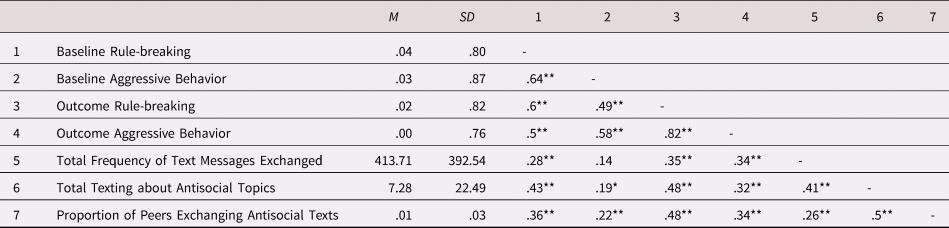
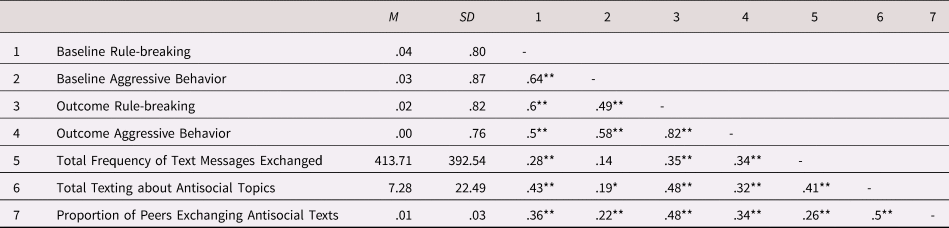
Table 1 presents the correlations among all study variables, their means, and standard deviations. Total frequency of text messages exchanged, total amount of texting about antisocial topics, and the proportion of peers that exchanged antisocial texts were all positively correlated with each other. Furthermore these three texting variables were all correlated with both baseline and outcome ratings of both rule-breaking and aggression, with one exception: total frequency of texting was not correlated with baseline aggressive behavior.
Descriptive statistics and intercorrelations between predictor and outcome variables for Study 1
* p < .05, ** p < .01.
Rule-Breaking Behavior
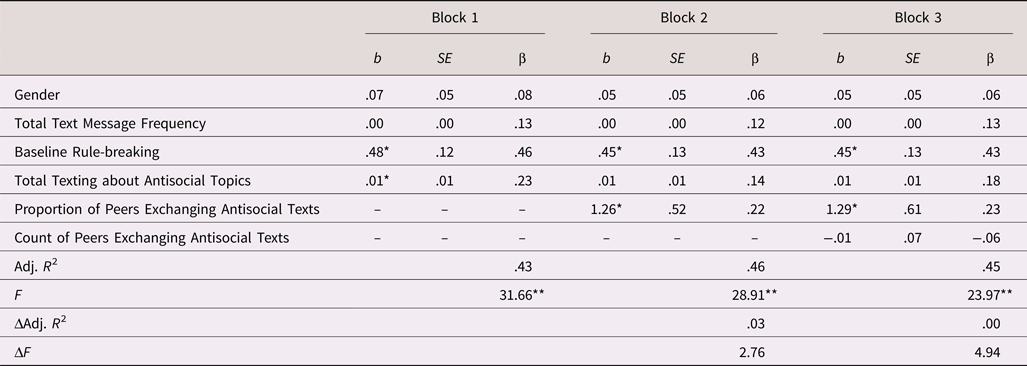
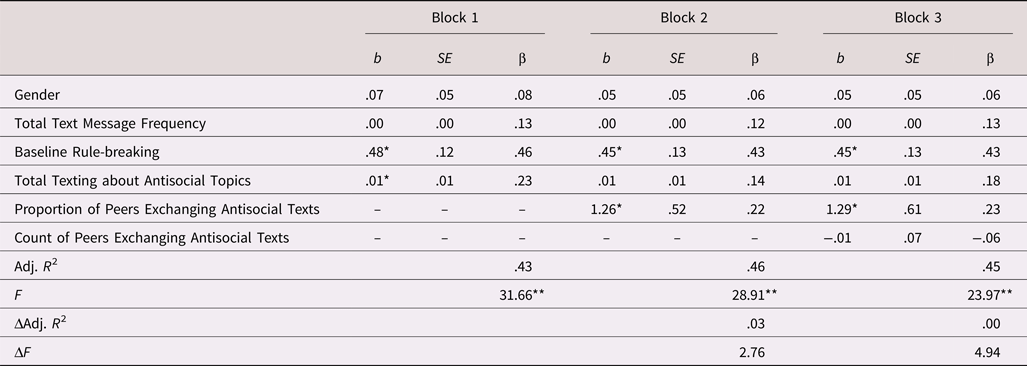
The first hierarchical regression, presented in Table 2a, examined how total text utterances, antisocial texting, and the proportion of the adolescent's peer network with which texts about antisocial topics were exchanged predicted rule-breaking behavior. Although antisocial talk was a significant predictor of rule-breaking behavior in the first block, it became nonsignificant when the proportion of the peer network with which antisocial messages were exchanged was included in the model. The proportion of the peer network exchanging antisocial messages predicted subsequent rule-breaking behavior, even after accounting for the other variables in the model. Neither gender nor total text message utterances predicted rule-breaking behavior.
Antisocial text messages and proportion of peers exchanging these messages as predictors of rule-breaking behavior in Study 1
*p < .05, **p < .01.
Aggressive Behavior
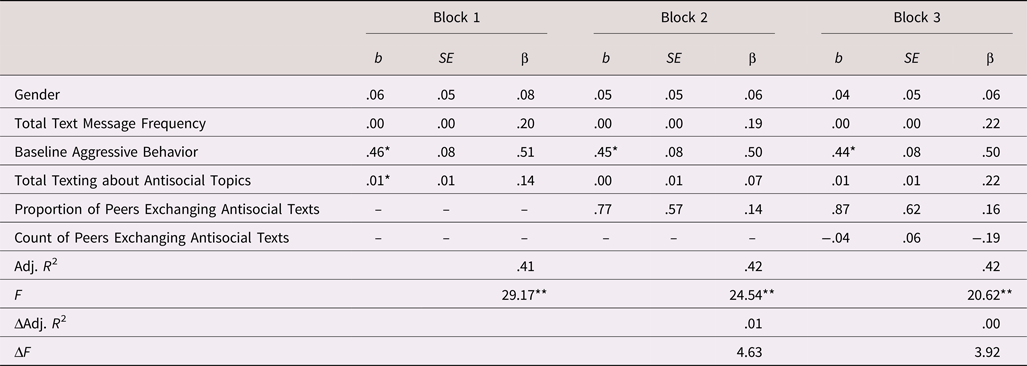
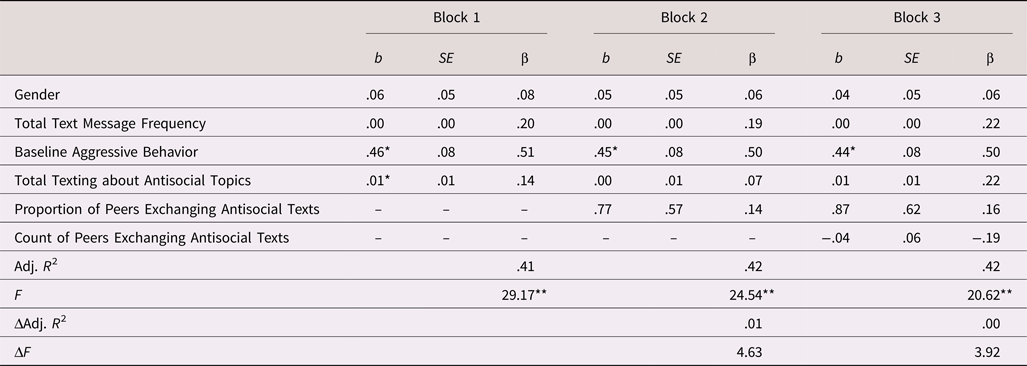
Next, we examined how the three texting variables predicted aggressive behavior (Table 2b). Although the amount of antisocial communication predicted aggressive behavior in the first block, it became nonsignificant when the proportion of the peer network that exchanged antisocial communication was included in Block 2. The proportion of peers exchanging antisocial messages was not a significant predictor of aggressive behavior. Gender and total text messages were not significant predictors.
Antisocial text messages and proportion of peers exchanging these messages as predictors of aggressive behavior in Study 1
*p < .05, **p < .01.
Exploratory Analyses
In the analyses reported above, the proportion of the peer group with whom antisocial texts were exchanged emerged as a significant predictor of rule-breaking behavior. A variable that is conceptually similar to this proportion is the absolute number of peers with whom adolescents are exchanging antisocial texts. It might be hypothesized that the total number of peers, as opposed to the proportion, is what is important in predicting future antisocial behavior. Specifically, it might be argued that if multiple peers are serving as antisocial models and/or encouraging rule-breaking and aggressive behavior, it does not really matter how many peers are not (which the proportion variable also considers).
To explore this hypothesis, we first computed the correlation between the proportion of the peer group with whom antisocial texts were exchanged and the absolute number of peers with whom adolescents are exchanging antisocial texts (AC peers), which resulted in a significant positive correlation (r = .54, p < .01). We added the number of AC peers as a predictor in a third block of the regression analyses (Tables 2a and 2b). The proportion of dyads exchanging antisocial texts remained a significant predictor of rule-breaking behavior. Finally, we also ran the two hierarchical regression models described above, controlling for several demographic variables: parents’ marital status, minority racial/ethnic status, and family income. The results from these analyses showed a similar pattern of findings, so the more parsimonious models are presented here. The additional analyses are presented in the supplemental materials.
Study 1 Discussion
The proportion of the adolescent's peer group with whom texts about antisocial topics were exchanged correlated with aggressive and rule-breaking behavior both concurrently and one year later. Consistent with our hypothesis, the proportion of the peer group with which adolescents exchanged antisocial texts predicted rule-breaking behavior one year later, even after accounting for baseline levels of rule-breaking behavior and other texting variables (total frequency of text messages exchanged, total amount of text-messaging communication about antisocial topics, and the number of dyads exchanging antisocial texts). In contrast, the proportion of the peer group exchanging antisocial content did not predict increases in aggressive behavior.
Although the absolute amount of antisocial texting was a significant predictor of both aggressive and rule-breaking behavior in univariate analyses, this frequency variable did not predict later adolescent rule-breaking behavior after accounting for the proportion of the adolescent's peer group with whom texts about antisocial topics are exchanged. Prior research has focused on either the absolute frequency of antisocial communication (e.g., Dishion, Andrews, & Crosby, Reference Dishion, Andrews and Crosby1995; Ehrenreich et al., Reference Ehrenreich, Underwood and Ackerman2014) or communication that occurs within an individual peer dyad (e.g., Dishion et al., Reference Dishion, Spracklen, Andrews and Patterson1996; Piehler & Dishion, Reference Piehler and Dishion2007) as correlates or predictors of antisocial behavior. These variables are undoubtedly meaningful, but the pattern of findings in Study 1 highlights the importance of considering the extent to which antisocial communication is occurring across the peer group as a whole.
Study 2
Study 1 indicated that the proportion of the peer network engaging in antisocial communication is an important predictor of both aggression and rule-breaking behavior, and it may be the more powerful predictor of rule-breaking behavior (relative to frequency of antisocial talk). Based on these results, Study 2 examined a potential reciprocal relationship between externalizing problems and the proportion of the peer network that discusses antisocial topics across four years of high school. We hypothesized that the proportion of peers with which a participant exchanged antisocial communication would predict increases in externalizing behaviors (a socialization effect). We also expected a selection effect such that adolescents’ own externalizing behaviors would predict an increase in the proportion of the peer network that exchanged antisocial communication the following year (Van Ryzin, Fosco, & Dishion, Reference Van Ryzin, Fosco and Dishion2012).
Method
Participants and Procedure
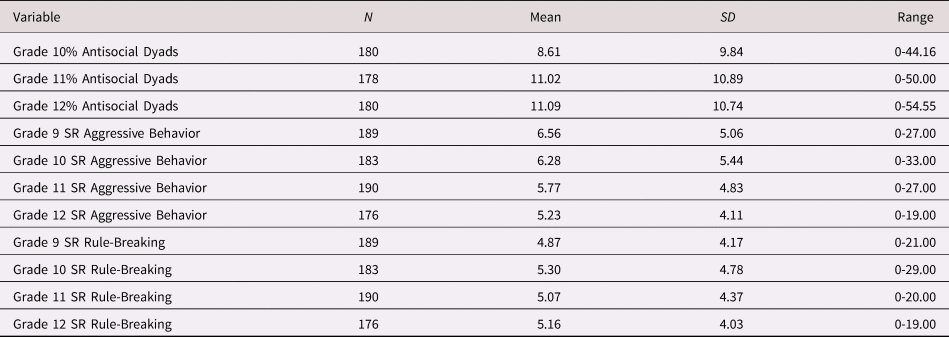
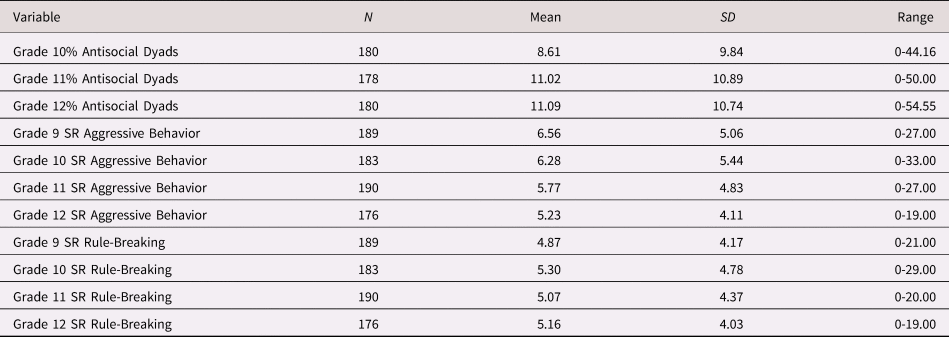
Participants for Study 2 included 205 adolescents (98 girls, 106 boys), assessed annually starting the summer following 9th grade (approximately 15 years old) through the summer following 12th grade (approximately 18 years old). These visits occurred either at their home or in the laboratory. Adolescents were included in the analyses if they participated in at least one wave of text or survey data collection through the three years of data collection. The number of participants for each variable at each time point are presented in Table 3.
Descriptive statistics for study the variables in Study 2
Note: SR = Self-report
Measures
Adolescents’ self-reports of aggressive and rule-breaking behavior
During each summer visit with the research team, participants completed the 112-item Youth Self Report form (YSR; Achenbach & Rescorla, Reference Achenbach and Rescorla2001). Relevant to this study are the 15-item rule-breaking behavior subscale and the 17-item aggressive behavior subscale (α’s ranged from .77–.84 and .77–.86, respectively).
Proportion of peer network texting about antisocial topics
Proportions of texting exchanged with AC peers during the 10th, 11th, and 12th grades were calculated as described in the general methods section above.
Study 2 Results
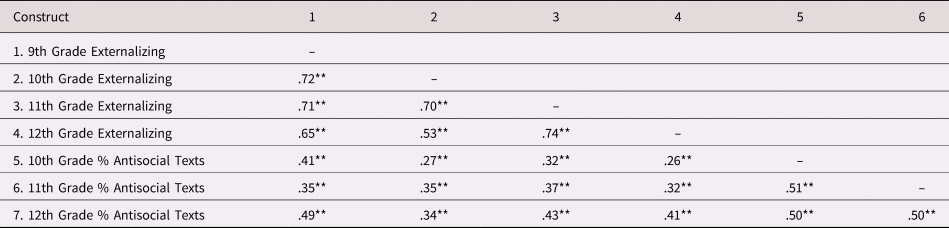
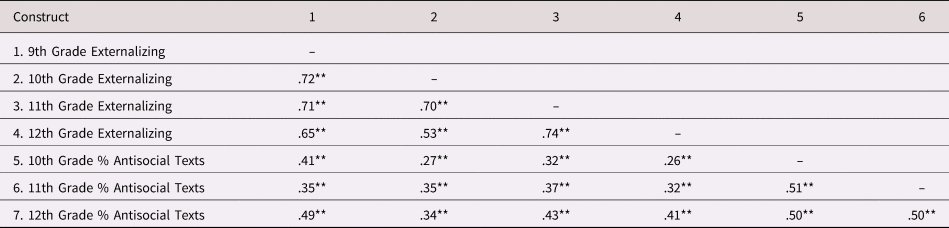
Descriptive statistics for the Study 2 variables are presented in Table 3. Correlations between indicators from the SEM are shown in Table 4. The percent of antisocial text dyads across time points were moderately associated. Aggressive behavior and rule-breaking correlated with each other across time and with each other within time to a large degree.
Correlations from the robust CFA model in Study 2
**p < .01.
We ran three confirmatory factor analyses (CFAs) with only the latent variables included to test for measurement invariance. These and subsequent models were run in R version 3.2.3 (R Core Team, 2015) using lavaan (Rosseel, Reference Rosseel2012). A robust estimator was used due to skewness of indicators and manifest variables. Table 5 presents the unadjusted and robust model fit of each model. An equality constraint was applied to each two indicators’ latent variable, equating the loadings of the two indicators within each time point in the configural invariance model and equating both within and between time points in the loading invariance model. The loading invariance model held according to the CFI reasonableness test, but the strong invariance model was not tenable (Cheung & Rensvold, Reference Cheung and Rensvold2002).
Regular and robust model fits of invariance testing models in Study 2

Note: Each nested model contained its constraints, plus the constraints of all tenable models. CFI, comparative fit index; TLI, Tucker–Lewis index; RMSEA, root mean square error of approximation.
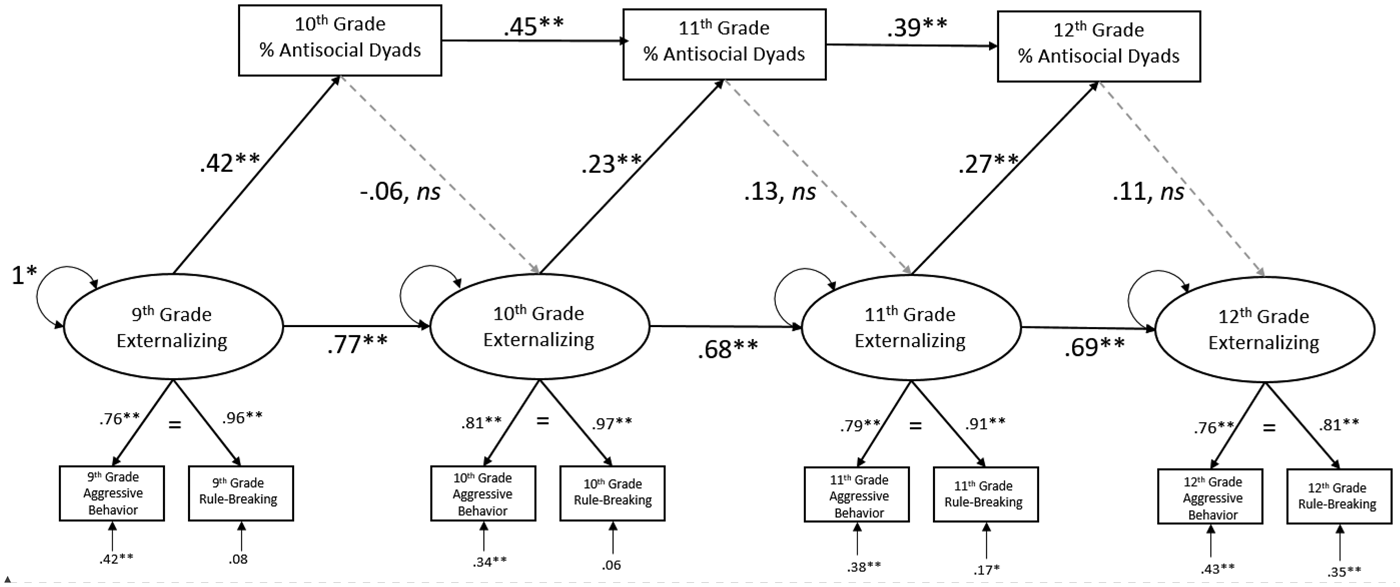
Next, the manifest percent antisocial dyads variables were added to the model and a CFA was run to assess model fit when manifest constructs were included. Model fit was satisfactory, χ2 (18, N = 205) = 48.67, p < .01, CFI = .98, RMSEA = .09 (.06–.12); robust χ2 (18, N = 205) = 46.17, p < .01, CFI = .98, RMSEA = .09 (.06–.12), scaling correction factor = 1.05. The structural equation model (SEM) was then run. Due to staggering in our data collection time points (text data recorded throughout the school year, self-report data collected in the summer), we set up the model so that the summer externalizing construct predicted the percent antisocial dyads in the following school year, and the percent antisocial dyads predicting externalizing as reported in the subsequent summer. The model fit of this SEM was satisfactory, χ2 (28, N = 205) = 94.54, p < .01, CFI = .95, RMSEA = .11 (.08–.13); robust χ2 (28, N = 205) = 84.85, p < .01, CFI = .95, RMSEA = .11 (.08–.13), scaling correction factor = 1.11. All indicator loadings were significant at the p < .01 level. Loadings and associations between variables are included in Figure 1. There was evidence of construct stability across time. Between each time point, externalizing positively and significantly predicted future percent antisocial dyads, suggesting a selection effect. There was no evidence of a socialization effect in that percent of antisocial dyads at no point predicted an increase in externalizing over time.
Results of the structural equation model testing associations between percent antisocial dyads and externalizing.

An additional model was run with equality constraints across the two indicators of self-reported externalizing within time, but not across time (configural invariance model). Although values were slightly different, the results did not change. We present the model with the loading invariance constraints.
Although the data collection time points were staggered, we imposed equality constraints on “cross-lagged” paths to test for a significant change in χ2, which would suggest whether the two paths significantly differ from each other. Specifically, we first equated the path from 9th grade externalizing to 10th grade proportion of antisocial dyads, and the path from 10th grade proportion of antisocial dyads to 10th grade externalizing, and we adjusted the χ2 using the Satorra-Bentler scaling correction because an MLR estimator was used in the SEM. Equating these paths resulted in a significant increase in chi square, Satorra-Bentler scaled χ2 (1 df) = 44.70, p < .01. Equating the path from 10th grade externalizing to 11th grade percent of antisocial dyads, and the path from 11th grade antisocial dyads to 11th grade externalizing, similarly resulted in a significant increase in chi square, Satorra-Bentler scaled χ2 (1 df) = 7.90, p < .01. The same pattern was found when the path between 11th grade externalizing to 12th grade percent antisocial dyads was equated with the path from 12th grade antisocial dyads to 12th grade externalizing, Satorra-Bentler scaled χ2 (1 df) = 9.65, p < .01. This suggests that the paths equated “within time” were not equal, giving credence to the finding that externalizing predicted the percent of antisocial dyads, but the percent antisocial dyads did not predict externalizing across time.
We also ran our SEM with covariates to test for whether our findings held beyond the effect of demographic variables. Gender (girls = 0, boys = 1) and ethnicity were time invariant. The reference group for race/ethnicity was the largest group, White. Differences between participants who identified as White and those who identified as Black/African American, Hispanic, and Other (mixed race or a poorly represented racial/ethnic group) were tested. Each construct from each time point was regressed onto these control predictors. Family income and mother's years of education were time-varying, and each construct in the model was regressed on these two control predictors measured at the appropriate time point. Family Income was reported on a 5-point scale, with higher scores indicative of higher income, from <$25,000 to >$101,000. Average maternal years of education in 9th grade was 14.55 (SD = 2.86). Our conclusions did not differ depending on whether we interpreted results from the original model or the model inclusive of demographic predictors. Therefore, we chose to report the more parsimonious model. The results of the full model with covariates are included in the supplemental materials.
Study 2 Discussion
The results for Study 2 present a pattern of findings consistent with the hypothesis of selection effects. Externalizing behaviors in grades 9, 10, and 11 all positively predicted increases in the percentage of peers who exchanged antisocial communications. As individuals engaged in more externalizing behaviors, this in turn predicted discussing these topics with an increasingly large portion of their peer network the following year. In contrast, these results provided no support for socialization effects; the proportion of the peer network that discussed antisocial topics was not a significant predictor of subsequent externalizing problems at any time point.
General Discussion
The results from these two studies provide distinct perspectives on the association between antisocial communication with the peer network and externalizing behaviors. Study 1 suggests that across one year of high school, the total frequency of antisocial text messaging and the proportion of the peer network with which these topics are discussed are predictors of rule-breaking behavior, controlling for baseline levels. However, total text messaging became insignificant when the portion of the peer network engaging in antisocial texting was entered in the model. This pattern of findings implies that the extent to which communication about antisocial topics permeates the peer group may more important than the absolute amount of communication about antisocial topics in predicting future rule-breaking. Study 1 also provided evidence consistent with a socialization effects hypothesis in that the proportion of peers who engaged in antisocial texting predicted increases in rule-breaking behavior. Study 2, in contrast, found that across four years of high school, the proportion of the peer network that discussed antisocial topics did not predict increases in externalizing behaviors; instead, the study demonstrated that externalizing problems predicted the proportion of the peer group engaged in antisocial texting. Thus, Study 2 provided evidence consistent with a selection effects hypothesis.
It is possible that the proportion variable reflects the extent to which antisocial behavior is normal or accepted within an adolescent's peer group more so than the absolute frequency of antisocial texts (Study 1). In prior research, perceptions of normalcy within the peer group have been highlighted as a potentially important factor in the prediction of antisocial and high-risk behavior (e.g., Maddock & Glanz, Reference Maddock and Glanz2005; Rhodes, Ewoldsen, Shen, Monahan, & Eno, Reference Rhodes, Ewoldsen, Shen, Monahan and Eno2014). Similarly, adolescents’ perceived similarity to the “typical person” who engages in antisocial behavior increases their willingness to engage in these behaviors (Gerrard, Gibbons, Houlihan, Stock, & Pomery, Reference Gerrard, Gibbons, Houlihan, Stock and Pomery2008). Thus, when a large proportion of the adolescent's peer group engages in antisocial communication, it may indicate that these behaviors are typical. As a result, adolescents’ may be more willing to engage in them when presented with the opportunity (Gibbons, Gerrard, Blanton & Russell, Reference Gibbons, Gerrard, Blanton and Russell1998).
A second possibility pertains to the potential importance of communicating with prosocial peers, or at the very least, peers who are not antisocial. Specifically, a unique feature of the proportion variable is that it considers the number of peers who are not exchanging antisocial texts in addition to those who are exchanging such texts. It is possible that some of the “nonantisocial” peers (those who are not exchanging texts about antisocial topics) disapprove of rule-breaking, model positive behavior, promote shared prosocial goals, or some combination thereof (Barry & Wentzel, Reference Barry and Wentzel2006). It is also possible that the presence of a meaningful proportion of nonantisocial peers simply counteracts any perceptions that antisocial behavior is completely acceptable or normal within the peer group. These actions might mitigate the influence of any deviancy training that is occurring with other peers. This hypothesis regarding the presence of prosocial (or nonantisocial) peers is consistent with other research suggesting that having pro-social peers decreases the likelihood of adolescents’ engaging in antisocial behavior (Guo, Hill, & Hawkins, Reference Guo, Hill and Hawkins2002; Hart, O'Toole, Price-Sharps, & Shaffer, Reference Hart, O'Toole, Price-Sharps and Shaffer2007) and functions as a protective factor among highly antisocial youth (Hoge, Andrews, & Leschied, Reference Hoge, Andrews and Leschied1996).
An important question to consider is why the proportion of peers with whom antisocial texts are exchanged would be a significant predictor of externalizing behaviors across the first year of high school in Study 1, but not predict increases in externalizing symptoms across four years of high school in Study 2. It is possible that key changes in adolescents’ abilities and environments, occurring after the first year of high school, can help explain this difference across studies. For example, during the first-year of high school, most adolescents are not able to drive. In this context, antisocial communication with the peer network via text messaging may be an important socializing force. As adolescents move through high school, their increasing autonomy and reductions in parental monitoring may afford them more opportunities to select the people with whom they interact in offline interactions. This may grant them greater freedom to selectively affiliate with more deviant peer groups that align with the antisocial behavior they are already engaging in. In addition, as adolescents move through high school and engage in more externalizing behaviors, it may seem more desirable for them to affiliate with others who tolerate these behaviors (as demonstrated by discussing these topics with a larger portion of their peer network).
These findings have meaningful implications for future research and intervention efforts. The emergence of the proportion of the peer network exchanging antisocial text messages as the primary predictor of rule-breaking behavior (Study 1) highlights the importance of examining the full peer network to understand the extent to which antisocial behavior permeates the group. Although deviancy training is a process that promotes and normalizes these behaviors, it has generally been examined in individual friend dyads (Dishion et al., Reference Dishion, Spracklen, Andrews and Patterson1996; Piehler & Dishion, Reference Piehler and Dishion2007), artificially created groups (Rorie et al., Reference Rorie, Gottfredson, Cross, Wilson and Connell2011), or randomly selected peer interactions (Snyder et al., Reference Snyder, Schrepferman, Oeser, Patterson, Stoolmiller, Johnson and Snyder2005). In addition, the present research examined digital communication among teens, as opposed to direct face-to-face communication. Digital communication is common among current teens (Anderson & Jiang, Reference Anderson and Jiang2018) and provides a unique opportunity to observe antisocial discourse across the broader, naturalistic peer network. Specifically, examining the proportion of the peer network that is texting about antisocial topics as a proxy for deviant peer affiliation may be a more naturalistic method for assessing selection effects than peer-nomination procedures, which may limit the respondent's ability to evaluate their full peer network. Even when respondents are allowed to nominate unlimited peers, they may not be able to accurately rate or recall all of their peers’ behaviors (Meldrum & Boman, Reference Meldrum and Boman IV2013).
Strengths, Limitations, and Future Directions
These two studies include a number of conceptual and methodological strengths. This research examined an important, powerful theory developed based on the observation of face-to-face interactions of friend dyads, deviancy training (Dishion et al., Reference Dishion, Spracklen, Andrews and Patterson1996) in the context of text messaging communication. Both studies included careful observation of antisocial text messaging with peers and examined antisocial texting in relation to adolescents’ offline externalizing behaviors. Both studies incorporated longitudinal designs (spanning one year in Study 1 and four years in Study 2). Study 1 incorporated multiple raters of externalizing problems. In addition, the present studies allowed observation of antisocial communication across the peer network, expanding upon previous studies examining deviant discourse within individual dyads (Dishion et al., Reference Dishion, Spracklen, Andrews and Patterson1996) or small groups (Dishion & Andrews, Reference Dishion and Andrews1995).
Nevertheless, there were several methodological limitations that restrict the conclusions that can be drawn from this research. First, the models tested in Study 1 imply that certain aspects of adolescents’ communication with peers about antisocial topics (e.g., proportion of peers with whom they are exchanging texts about antisocial topics) predicts later antisocial behavior or, at the very least, places adolescents on a pathway toward such behavior. The prospective design and data analysis approach employed in the present research provided a rigorous test of the hypothesized relationships, but the documented associations might still be explained by unmeasured third variables, such as family processes (e.g., lack of parental supervision) potentially linked to both exchanging antisocial texts with a large proportion of the peer group and rule-breaking behavior. Furthermore, although Study 2 used both self-reports and direct observations of text communication, both predictor and outcome data were obtained from the same source, which could contribute to shared method variance.
Second, the models tested implicate certain psychological or group processes (e.g., deviancy training, perceptions of normalcy of antisocial behavior), but these processes were not directly measured in this research. Furthermore, although exchanging antisocial text messages with peers indicates a willingness to discuss these topics, it does not explicitly measure the peer network's actual involvement with these behaviors. Third, the collection and coding of text message data is a relatively new method for studying antisocial communication among youth, and the limitations in interpreting such data are not yet fully understood. For example, it is not clear how well text messaging serves as a proxy for teens’ face-to-face communication about antisocial activities. Although observing texting communication provides a unique window into peer communication, we were not able to focus our analyses on communication exchanged with especially important or close peers.
Finally, although direct observation of digital communication provides a naturalistic way for assessing deviant communication, there is always the potential that adolescents will refrain from engaging in antisocial discussion because they are aware that they are being observed. Although this is a concern in all observational research, this methodology likely offsets some of this risk. Because participants’ communication was captured for four continuous years, refraining from antisocial communication would require censoring their social interactions with peers for the entire duration of high school. Participants reported that they felt comfortable with the observation of their texting and that they did not adjust their texting as a result of being observed (Meter, Ehrenreich, Carker, Flynn, & Underwood, Reference Meter, Ehrenreich, Carker, Flynn and Underwood2019).
Future research could observe antisocial communication in other digital contexts, such as social media platforms, to better understand the broader peer network. In addition, more detailed examinations of this communication could further refine both the mechanisms and assessment of socialization selection processes. For example, more fine-grained examination of responses to antisocial texts could illuminate highly naturalistic reinforcement processes. Alternatively, intensive longitudinal designs could observe the developmental pathways that show how newly selected peer relationships unfold. Because these data capture daily interactions over the course of four years, further analyses would allow researchers to identify exactly when a text relationship began, when antisocial topics first emerged, and the development of these discussions over the course of days, months, or even years. Similarly, the combination of using machine-learning algorithms to automate the micro-coding and longitudinal social network analyses could shed new light on how communication about these topics develops. Furthermore, intervention and prevention efforts may benefit from these findings by prioritizing efforts to address antisocial behavior at the peer-group level, instead of focusing on interactions with individual peers.
Conclusion and Implications for Intervention
These results extend previous research on the powerful role of antisocial communication in the development of antisocial behavior by examining antisocial communication that is exchanged across the wider peer network via text messaging. The finding that the proportion of peers in an adolescents’ network involved in antisocial texting predicted increases in rule-breaking behavior across the 9th grade year provides further evidence of socialization effects and supports the possibility of deviancy training in digital communication.
For an issue in honor of the tremendous legacy of Tom Dishion, we admit to some disappointment in the pattern of results across our two studies. The results of Study 1 extend previous research conducted by Tom on the powerful role of antisocial communication in the development of antisocial behavior (Dishion et al., Reference Dishion, Spracklen, Andrews and Patterson1996). The finding that the proportion of peers in an adolescents’ network involved in antisocial texting predicted increases in rule-breaking behavior across the 9th grade year provides further evidence of socialization effects and supports the possibility of deviancy training in digital communication. Study 2, however, did not provide evidence for socialization effects, but instead supported selection effects. Regardless, an important part of Tom's legacy is his honesty and openness when things did not turn out as expected; the theory of deviancy training was born in part out of the recognition of the unexpected and negative effects of interventions that introduced antisocial boys to each other and provided opportunities for peer socialization (Dishion, McCord, & Poulin, Reference Dishion, McCord and Poulin1999).
The selection effects that emerged in Study 2, that externalizing symptoms predicted the proportion of peers engaged in antisocial texting, and not vice versa, suggests that powerful forces may be at work when adolescents are high on externalizing symptoms. Engaging in externalizing behaviors offline may lead youth to focus their text messaging on peers who communicate about antisocial behavior.
As valuable as examining text messaging data are for understanding adolescent peer communication, the socialization processes that predict externalizing problems likely begin much earlier and have roots in coercive exchanges between parents and children (Utržan, Piehler, & Dishion, Reference Utržan, Piehler, Dishion, Lochman and Matthys2018). Some adolescents who engage in antisocial behavior may have been on their developmental trajectories since early childhood and are on a path toward life course persistent antisocial behavior, whereas others may not have started engaging in antisocial activities until adolescence perhaps as a form of pseudomaturity (Moffitt, Reference Moffitt and Beaver2017). If both early and late onset antisocial youth are engaging in antisocial text messaging, the early onset group may have plenty of peers to choose from when choosing to engage in antisocial text messaging.
In addition to focusing on the early childhood antecedents of antisocial behavior, intervention programs for adolescents must address digital communication. Interventions designed to reduce antisocial behavior by connecting antisocial youth with prosocial peers may face challenges if these youth are heavily engaged in text messaging with a large proportion of antisocial peers. Antisocial peer communication is difficult to curtail in the discreet world of text messaging where youth can instruct and reinforce each other's antisocial behavior. Data showing that 45% of adolescents reports being online constantly and over 70% enthusiastically embrace social media platforms (Smith & Anderson, Reference Smith and Anderson2018) indicates that digital contexts may provide nonstop opportunities for peer socialization and influence, as well as another forum for selection effects. In addition to curtailing the frequency of antisocial communication, intervention specialists should develop creative strategies for harnessing the power of digital communication for good, by working with YouTube influencers, Instagram celebrities, and prosocial peers to shift the online culture so that positive behavior is also modeled and reinforced. Think of a world where youth on antisocial trajectories could find positive peer influence online. The line between online and offline communication exists only in adults’ minds (Boyd, Reference Boyd2014), so the possibilities for positive online peer influence could be endless.
Acknowledgments
We gratefully acknowledge the support of the children and families who participated in this research, an outstanding local school system that wishes to be unnamed, a talented team of undergraduate research assistants.
Financial Support
This research was funded by the National Institutes of Health grants R56 MH63076, and R01 HD60995. The content is solely the responsibility of the authors and does not necessarily represent the official views of the National Institutes of Health.