INTRODUCTION
Amphipods are small crustacean peracarids distributed along the world coasts where they often live as epibionts on a variety of substrates. They colonize sessile organisms such as algae, seagrasses (McCain, Reference McCain1968; Bellan-Santini, Reference Bellan-Santini1999), sponges and tunicates (Vader, Reference Vader1984a, Reference Vaderb). They also frequently use vagile fauna as substrate, such as cnidarians (Vader, Reference Vader1983), other crustaceans (Vader & Myers, Reference Vader and Myers1996), brachiopods (Vader, Reference Vader1970), echinoderms (Vader, Reference Vader1978), fish (Vader & Romppainen, Reference Vader and Romppainen1985), and sea turtles (Chevreux & de Guerne, Reference Chevreux and de Guerne1888). In this study we focused on amphipods associated with this last group.
The loggerhead sea turtle Caretta caretta (Linnaeus, 1758) is known to be colonized by the largest and most diverse communities of epibionts fauna among all seven species of marine turtles (Frick et al., Reference Frick, Williams, Veljacic, Pierrard, Jackson and Knight2000). Their carapace provides a microenvironment for several groups of animals, particularly crustaceans, e.g. barnacles and crabs (Casale et al., Reference Casale, Freggi, Basso and Argano2004), copepods and tanaids (Morales-Vela et al., Reference Morales-Vela, Suárez-Morales, Padilla-Saldívar and Heard2008).
In the Mediterranean Sea, the loggerhead Caretta caretta is common on the Tunisian coasts, while the green turtle Chelonia mydas (Linnaeus, 1758) is rare (Laurent et al., Reference Laurent, Nouira, Jeudy de Grissac and Bradai1990). Few papers refer to sea turtles on the Tunisian coasts and most of these studies have dealt with the ecology, distribution, fishery interaction and nesting of Caretta caretta (Bradai, Reference Bradai1995; Jribi et al., Reference Jribi, Bradai and Bouain2002a, Reference Jribi, Bradai and Bouainb, Reference Jribi, Bradai and Bouain2007, Reference Jribi, Echwikhi, Bradai and Bouain2008); therefore, information about sea turtle epibionts remains non-existent. The aim of this study is to provide data about amphipod epibionts of sea turtles in the Gulf of Gabès (Tunisia) and to compare these epibionts with those reported from other sites of the Mediterranean Sea.
MATERIALS AND METHODS
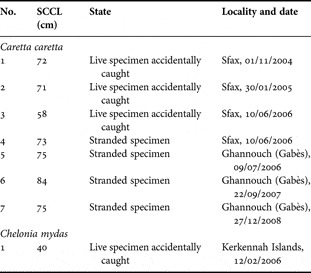
In the framework of the National Stranding Network, we examined the epibiont amphipod fauna of seven adult Caretta caretta and one Chelonia mydas collected along the coasts of the Gulf of Gabès. Epibionts of sea turtles were removed by scraping the carapace with a knife and placing into 70% ethanol. Later, amphipods were carefully collected, fixed and preserved. Specimens from each species were dissected to reveal specific taxonomic features. They were identified and counted.
The sea turtle's condition, the length of carapace, the site and the date of occurrence are reported in Table 1.
Sea turtle information: standard curved carapace length (SCCL), state, locality and date of occurrence.

RESULTS
Epibionts of sea turtles were observed concentrated on the posterior 1/3 of the carapace. All amphipod species were collected clinging to algae, except Podocerus chelonophilus. Among the eight amphipod species collected, five are free living species (Protohyale grimaldii, Podocerus chelonophilus, Caprella andreae, Elasmopus rapax and Stenothoe sp.) and three are domicolous species (Ampithoe riedli, Corophium acherusicum and Ericthonius punctatus).
Amphipods associated with Caretta caretta
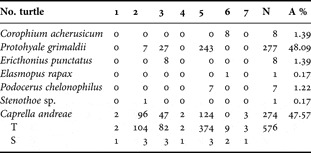
A total of 576 amphipods were collected from the seven Caretta caretta examined. The most abundant species were Hyale grimaldii and Caprella andreae, with respectively 277 and 274 individuals (Table 2). From one to three amphipod species per host were found. Number of amphipod specimens per host varied considerably between two and 374 individuals.
Amphipods epibionts of Caretta caretta in the Gulf of Gabès.

N, total number of individuals; A (%), relative abundance; T, total number of individuals per host; S, species richness.
EXAMINED MATERIAL
Eight specimens (3 males, 3 females and 2 juveniles).
This species occurred on only one loggerhead turtle's carapace. It was first found on Caretta caretta from all over the world in the Mediterranean Sea by Kitsos et al. (Reference Kitsos, Christodoulou, Arvanitidis, Mavidis, Kirmitzoglou and Koukouras2005). According to Ruffo (Reference Ruffo1982), Corophium acherusicum is frequent in infralittoral among algae and the fouling of man-made installations.
EXAMINED MATERIAL
277 specimens (54 males, 72 females and 151 juveniles).
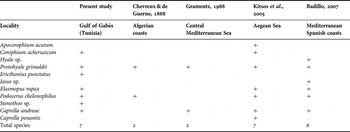
Protohyale grimaldii is the most abundant species observed in our study. It was found among epizoic algae, Jania rubens, Polysiphonia sp. and Bryopsis plumosa. In the Mediterranean Sea, it was always found on Caretta caretta (see Table 3), and the genus Hyale (Hyale spp.) was mentioned by Caine (Reference Caine1986) along the Atlantic coast of the USA. This species generally lives clinging to floating objects (Ruffo, Reference Ruffo1993).
Amphipods epibionts of Caretta caretta from the Mediterranean Sea.

EXAMINED MATERIAL
Eight specimens (3 males and 5 females).
Ericthonius punctatus was found only once on the Caretta caretta's carapace. It is the first time that this species is identified as an epibiont of sea turtle in the Mediterranean Sea. Another species from the same genus, E. brasiliensis (Dana, 1855), has already been observed by Caine (Reference Caine1986) on a sea turtle off the Atlantic coast of the USA.
This species is very common in the Tunisian shallow water among Posidonia oceanica (L.) Delile and algae (Zakhama-Sraieb et al., Reference Zakhama-Sraieb, Sghaïer and Charfi-Cheikhrouha2009). According to Ruffo (Reference Ruffo1982), Ericthonius punctatus was generally found in shallow water among algae, seagrasses, hydrozoans, etc., and in areas of high detritus accumulation, often in the fouling of ships and other man-made installations.
EXAMINED MATERIAL
One male.
Only one specimen of Elasmopus rapax was collected. In the Mediterranean Sea, this species was first found on Caretta caretta by Kitsos et al. (Reference Kitsos, Christodoulou, Arvanitidis, Mavidis, Kirmitzoglou and Koukouras2005), but it had already been recorded by Caine (Reference Caine1986) along the Atlantic coast of the USA. Commonly, this species lives in the infralittoral at sandy and muddy bottoms or among algae (Ruffo, Reference Ruffo1982).
EXAMINED MATERIAL
Seven specimens (2 males, 4 females and 1 juvenile).
Seven specimens were found on the carapace of one stranded Caretta caretta. Podocerus chelonophilus is known to develop a commensal relationship with sea turtles, mostly found under the tail and at the base of the legs of Caretta caretta and Chelonia mydas (Ruffo, Reference Ruffo1993; Moore, Reference Moore1995; Badillo, Reference Badillo2007).
EXAMINED MATERIAL
One female.
The presence of a single female did not allow identification until species level. The only species of this genus previously recorded as epibiont of a loggerhead turtle collected from the Atlantic coast is Stenothoe minuta Holmes (Caine, Reference Caine1986).
EXAMINED MATERIAL
274 specimens (18 males, 106 females and 150 juveniles).
Caprella andreae occurred on the carapace of six Caretta caretta, clinging to Polysiphonia sp. and Enteromorpha sp. This species is commonly known to live clinging to floating objects on the high seas, such as buoys and pieces of wood (Ruffo, Reference Ruffo1993). It has often occurred among the epibionts of Caretta caretta and Chelonia mydas (Caine, Reference Caine1986; Gramentz, Reference Gramentz1988; Frick et al., Reference Frick, Williams and Robinson1998; Pfaller et al., Reference Pfaller, Bjorndal, Reich, Williams and Frick2006; Badillo, Reference Badillo2007). Several other caprellids have also been observed attached to sea turtles, such as Caprella equilibra, C. penantis, C. scaura and Paracaprella tenuis (Caine, Reference Caine1986; Pfaller et al., Reference Pfaller, Bjorndal, Reich, Williams and Frick2006, Reference Pfaller, Frick, Reich, Williams and Bjorndal2008).
Amphipods associated with Chelonia mydas
EXAMINED MATERIAL
Four specimens (2 males and 2 females).
Ampithoe riedli, an endemic species of the Mediterranean Sea, was observed clinging to the epizoic algae Polysiphonia sp. This is the first record of Ampithoe riedli associated with a sea turtle. However, other species from the Ampithoidae family such as Ampithoe ramondi have been reported (Caine, Reference Caine1986; Frick et al., Reference Frick, Williams and Robinson1998). The present species generally inhabits the infralittoral among wave-exposed algae with rigid thalli (Ruffo, Reference Ruffo1982).
Comparison with other studies from the Mediterranean Sea on the epibiont of Caretta caretta
Available surveys dealing with epibionts of sea turtles in the Mediterranean Sea (Chevreux & de Guerne, Reference Chevreux and de Guerne1888; Gramentz, Reference Gramentz1988; Kitsos et al., Reference Kitsos, Christodoulou, Arvanitidis, Mavidis, Kirmitzoglou and Koukouras2005; Badillo, Reference Badillo2007), including the present investigation, allowed to identify 11 amphipod species belonging to ten genera and seven families (Table 3).
DISCUSSION
Among the eight amphipod species epibionts of sea turtles collected in this study, five are free-living and three are domicolous. Similar percentages between these two forms with dominance of free-living amphipod species were observed by Caine (Reference Caine1986).
The concentration of epibionts on sea turtles on the posterior 1/3 of the carapace was already observed by Pfaller et al. (Reference Pfaller, Bjorndal, Reich, Williams and Frick2006). The same authors explained that the hydrodynamic is an important factor that influenced the distribution of epibionts, especially the class of Malacostraca.
Among the 11 amphipod species that occurred on the loggerhead Caretta caretta in the Mediterranean Sea, the three species Caprella andreae, Protohyale grimaldii and Podocerus chelonophilus were the most frequent associates. Protohyale grimaldii and Caprella andreae are also the most abundant species.
During this study, seven amphipod species have been recorded on the sea turtle Caretta caretta in the Gulf of Gabès. This result is similar when compared with recent studies conducted in the Mediterranean Sea (Kitsos et al., Reference Kitsos, Christodoulou, Arvanitidis, Mavidis, Kirmitzoglou and Koukouras2005; Badillo, Reference Badillo2007) and much higher than former studies (Chevreux & de Guerne, Reference Chevreux and de Guerne1888; Gramentz, Reference Gramentz1988).
The highest number of amphipods found on Caretta caretta in July was five. This result could probably be explained by the life cycle of these species.
The presence of Podocerus chelonophilus on the carapace is probably related to the death of the host. Except for this species considered as a parasite of the sea turtle (Moore, Reference Moore1995) and found commonly under the tail and at the base of the legs, all other amphipods were observed among epizoic algae of the carapace. Indeed, epizoic algae provides a microenvironment and hosts several invertebrate species such as polychaetes, tanaids, amphipods, etc. (Caine, Reference Caine1986; Kistos et al., 2005). For example, Caprella andreae uses its last pair of pereopods to cling to the algae and obtains food by scraping periphyton and encrusting material from the sea turtle carapace.
Our study of amphipod epibionts of sea turtles in the Gulf of Gabès allowed us to add three species: Ericthonius punctatus, Stenothoe sp., as epibionts of Caretta caretta and Ampithoe riedli as epibiont of Chelonia mydas in the Mediterranean Sea.
On the basis of this study, four new species were recorded for the Gulf of Gabès, Ampithoe riedli, Caprella andreae, Protohyale grimaldii and Podocerus chelonophilus, therefore enriching the list of the marine amphipod fauna for the Tunisian coasts.
ACKNOWLEDGEMENTS
The authors wish to express their gratitude to Professor Wim Vader and to two anonymous referees who helped to improve the quality of the manuscript.