I
The Habsburg Army was distinct among the forces that fought the First World War for being, in the proud words of its official history, ‘an army of peoples’.Footnote 1 Its professional officer corps may have been dominated by German speakers, but its units were drawn from across the rich ethnic tapestry of central Europe. True, other armies had minorities in their ranks and some, notably the Russian and Ottoman, were very diverse, but no other force called its men to arms in the fateful summer of 1914 with posters issued in fifteen different languages.Footnote 2 The Habsburg Army's structure was shaped by the complex politics of and reflected the multi-ethnic ‘dualist’ empire that it served. The so-called Common (or k.u.k. – kaiserliche und königliche) Army, the main force with thirty-two divisions, all artillery and most cavalry in 1910, stood directly under the Emperor and was a rare unitary institution in a state which had been divided since 1867 into two main entities, Austria and Hungary. Supplementing its strength were two smaller forces, which each drafted men solely from one half of the Empire: the Austrian Landwehr (eight divisions) and the Hungarian Honvéd (seven divisions). These had initially been conceived as reserve formations, but by 1914, due to decades of pressure from Magyar nationalists, they had become first-line units. A tiny Croatian-Slavonian force, the Domobran, was constituted within the Honvéd in order to reflect the autonomous position of Croatia within Hungary. All regiments had been recruited territorially since 1882, which provided them with a firm regional character. A minority – around 40 per cent – were at least four-fifths filled with a single nationality, but due to the diversity of the Empire's local communities, most regiments had a mix of men of different language, culture and identity.Footnote 3
This special issue offers a welcome opportunity to reassess this dynastic, multi-ethnic army. The force operated in a world dominated by sovereign states, before the rise of modern international political institutions. Yet, as a supranational organisation managing men of many different nationalities in its ranks, its experiences presage some of the challenges faced by later internationalists. The article examines Habsburg officers in the 1914–18 war – the men responsible for leading this imperial military. To date, research on them has been very limited. Early scholarly work, undertaken in the 1960s and 1970s, reassessed the military performance of senior commanders and exposed serial incompetence.Footnote 4 Twenty years later, István Deák published his path-breaking social and cultural study of the officer corps between 1848 and the First World War. He focused especially on the professional corps, influentially casting its identity as dynastic and a-national in a period of rising national consciousness and conflict.Footnote 5 Recently, however, this portrayal has begun to be questioned. Scholars of the Habsburg Empire now have a greater appreciation than they did a quarter of a century ago of the complexity and multifaceted nature of identity. In the military context, Irina Marin's and Laurence Cole's new studies have provided evidence that supranationalism and indifference to political nationalism could go hand-in-hand with national identification.Footnote 6
Further research into Habsburg officers' identities is essential if their army's performance in 1914–18 is to be fully understood. New scholarship on peacetime Austria-Hungary points the way, drawing attention to factors below, beside and beyond the national which influenced both institutional and individual actions.Footnote 7 The first part of this article draws on transnational methodology to reconsider senior commanders and their wartime learning processes. While older literature noted that these officers' incompetence led from 1916 to significant German involvement in the force's command, this article goes a step further.Footnote 8 By reassessing secondary literature and presenting new evidence, it highlights their membership of a transnational military professional network in peace, and it explores how international influences shaped their learning processes in war. The article contends that the Habsburg military leadership was not introspective but from the first months of hostilities relied heavily on imitation of its German ally and its enemies to improve its force's performance.
The second part of the article focuses on the Habsburg junior officers who led frontline units. Interdisciplinary research on combat motivation has long emphasised the prime importance of these leaders. As Samuel Stouffer found in his pioneering sociological study of the Second World War's U.S. Army, ‘men's attitudes toward their [platoon and company] officers had a real importance in determining whether men fought aggressively and stayed in the fight’.Footnote 9 The article investigates the development of the corps in 1914–18 and assesses the impact of the officers commissioned in wartime who, after massive casualties and expansion, dominated frontline command by the middle years of the fighting. It highlights how this change of personnel exacerbated problems of inter-rank communication in the multi-ethnic army. It also explores how the new officers' more national attitudes and identities altered the ethos of the officer corps and contributed in the last years of the war to the army's rather mediocre combat performance.
II
The world of the professional military before 1914 had been tightly interconnected despite the arms races, tensions and intense competition that defined the period, and the Habsburg General Staff had invested substantial resources to maintain contacts with and understand other states' armed forces. Military attachés stationed in fifteen capitals and observers embedded in foreign armies fighting distant wars kept it in touch with the latest martial developments.Footnote 10 In the last decades of peace Habsburg officers followed and, through their own military press, engaged in the lively transnational debate on the most difficult and pressing martial issue of the day: how to manoeuvre under the tremendous firepower of the new magazine rifles, machineguns and hydro-pneumatic recoil artillery. Without movement, no decisive victory would be possible and battle would descend into gruelling and potentially socially destabilising attritional bloodletting.Footnote 11
The Habsburg General Staff, like its counterparts abroad, saw the cultivation of high morale as the answer to firepower's challenge. Even so, there were few commanders in Europe who embraced the ‘cult of the offensive’ so fervently as the Habsburg General Staff Chief since 1906, Franz Conrad von Hötzendorf. Already in 1890, he had argued in his book, On the Study of Tactics (Zum Studium der Taktik), that energy and decisiveness were the keys to modern conflict and attack ‘the action best fitting the spirit of war’.Footnote 12 He ignored lessons proffered by the Boer (1899–1902) and Russo-Japanese Wars (1904–5), and his overweening focus on willpower also permitted him to disregard his cash-strapped force's limitations. His 1911 infantry regulations rendered irrelevant his army's artillery inferiority with the assertion that foot soldiers could ‘win the victor's laurels even without support from other weapons . . . if imbued with confidence and aggression, if equipped with unbendable steadfastness of will and the greatest physical toughness’. Digging was discouraged, for fear that it might retard troops' offensive spirit.Footnote 13 International observers at peacetime manoeuvres clearly identified Habsburg doctrinal and training errors. As the German military attaché reported, reconnaissance was inadequate, the artillery failed to support attacks and, in the infantry, officers had no understanding of modern firepower and advanced their men slowly in closed ranks, paying no attention to terrain. The troops were ‘cannon fodder’.Footnote 14
The Habsburg Army suffered a catalogue of disasters at the opening of the First World War. Three invasions of Serbia were all humiliatingly repelled. On the Eastern Front, the Russian Army penetrated deep into the Austrian Crownland of Galicia, pushing the Habsburg force back to the outskirts of Cracow. By the end of 1914, for no gains the force had lost nearly a million men – around two and a half times its peacetime strength.Footnote 15 A bungled deployment, incompetent leadership and inferiority in guns and manpower contributed to the defeats, but so too did its defective tactics and training. The cavalry proved incapable of performing its reconnaissance role, cooperation between artillery and infantry was weak and the infantry wasted itself in unsupported frontal assaults launched in close formation.Footnote 16 As the pre-war commandant of the Habsburg Army's War School, Major General Alfred Krauß, later admitted, these were the reasons for why ‘our best soldierly material was squandered foolishly at the beginning of the war’.Footnote 17 Some officers, thanks to their pre-war engagement with other armies, quickly recognised the folly. Colonel Robert Trimmel, the commander of Infantry Regiment 8, had served as an observer in the Boer War where he had witnessed at first hand the defensive capabilities of entrenched men. When his unit was ordered to attack near Zamość on the Eastern Front at the start of September 1914, he refused to obey without artillery support. ‘I shall not lead my men into a slaughter’, he warned his superiors. Trimmel's attitude was correct, but his stand did not benefit him or save his soldiers. He was relieved of command and his regiment was led into attack by another officer, suffering extremely heavy casualties for no gain.Footnote 18
Nonetheless, the Habsburg Army quickly started to adapt. Within a month of the first battles, the High Command (Armeeoberkommando – AOK) hastily issued new instructions. Significantly, international imitation was central to its first improvements and would remain so throughout the war. Initially, the AOK looked to the Russians for inspiration. Its orders praised the enemy's deep and well-concealed trenches and urged that ‘there, where circumstances force us into the defence, we must do likewise and let the enemy attack break down in the fire of well-placed artillery and of infantry well-protected in trenches’.Footnote 19 Reconsideration was also given to how to capture such earth fortifications. Direct assaults ‘with great elan’ on Russian trenches had, it was belatedly recognised, brought terrible losses. New advice issued at the end of September 1914 urged units instead to use well dug-in troops to pin the enemy from the front, while simultaneously launching assaults with strong forces on the flanks, where defenders were most vulnerable.Footnote 20
Through 1914–16, the Habsburg Army ascended what historians of the Western Front have called a ‘learning curve’; a process of trial and error to learn how to fight in the unfamiliar conditions of the modern battlefield.Footnote 21 Of course, in large part, its lessons were based on analysis of its own operations. Thus, for example, after Hungarian troops repelled the Russian New Year's offensive in eastern Galicia in the winter of 1915–16, a report was written up and distributed as an exemplar of how to fight a defensive battle. In sharp contrast to the wanton disregard for enemy firepower displayed a year and a half earlier, the Hungarian defensive system was built around strong earth fortifications, with reserves held in readiness close behind the front.Footnote 22 New tactical possibilities were also opened up by improvements in armaments. By 1916 artillery production was at 264 guns per month and the manufacture of munitions had leaped from an average of 375,000 shells per month in 1914 to 1,400,000. Machinegun fabrication had doubled since the start of the war to 526 guns per month. Innovative techniques, such as the posting of artillery observers in the front line in order to keep the guns in close contact with the infantry and direct their fire onto targets, were developed. As the Hungarians' report recognised, cooperation between infantry and well-supplied artillery was a keystone of any successful defence.Footnote 23
Nonetheless the international dimension to this learning process was crucial. The Germans had long provided a model for Habsburg commanders (Conrad's tactical ideas were in part rooted in idiosyncratic interpretations of Prussian actions in the 1870–1 war), and, thanks to their successes on the Eastern Front, their influence grew during 1914 and 1915. Admiration for German methods prompted the dissemination across the Habsburg Army of reports analysing their crushing defensive victory over the Russians at Lake Narotch in March 1916.Footnote 24 The Habsburg General Staff also kept abreast of innovations on the Western Front and in the winter of 1916–17 started to copy the Germans' specialist assault units (Sturmtruppen), developed there over the course of 1915.Footnote 25 More directly, many Austro-Hungarian formations acquired experience fighting alongside their German allies. The first collaborative operations were conducted as early as September 1914. In May 1915, under the Prussian General August von Mackensen, the German Eleventh Army and the Habsburg Fourth Army, both of which contained a mix of German and Austro-Hungarian units, smashed the Russians at the Battle of Gorlice-Tarnów and advanced to liberate most of the Galician territory lost in 1914.Footnote 26
However, the event which brought German military influence over the Habsburg army to an unprecedented and, for its senior commanders, disquieting level was a spectacular defeat in eastern Galicia in the summer of 1916. Within a week, the Russian offensive under General Brusilov smashed two Habsburg armies and took one-third of all Habsburg soldiers on the Eastern Front – 2,992 officers and 190,000 men – prisoner. Command dissolved and a total rout ensued.Footnote 27 The disaster had many causes: the Russians planned the operation carefully and imaginatively and the Central Powers' forces were weak as the best troops and much artillery had been moved to the Italian and Western Fronts. Faulty Habsburg tactics also contributed: the army had been on a learning curve, but the lessons it had drawn were all too often wrong, imperfectly applied or rendered obsolete by Brusilov's innovative attack. The all-important cooperation between artillery and infantry proved to be no better than two years previously. The primary lesson which Habsburg commanders had instead taken from their defensive victory in the New Year's battle six months earlier, the need for strong trenches and nearby reserves to hold the first line at all costs, backfired spectacularly. When Brusilov's new tactics – a wide front, surprise, painstaking artillery preparation and troops concealed behind the line ready to exploit any success – broke this system, the Habsburg force quickly lost its reserves and lacked the flexibility to recover. Conrad, who had foolishly based his headquarters 600 kilometres away in Teschen, was forced to rush to Berlin to beg for German reinforcement.Footnote 28
At the very top level, the most important consequence of Habsburg defeat at the hands of the Russians was the establishment of a United Supreme Command over Central Powers forces. Kaiser Wilhelm II headed this up from its inception in September 1916. Conrad had unsuccessfully resisted the agreement; he bitterly blamed the Germans for Habsburg defeats since the start of the war and, more justifiably, he suspected what he called ‘our secret enemies’ of plotting to reduce the Empire to a satellite.Footnote 29 Yet, in practice, the new joint command heralded not total German control but instead a very loose international management of the Central Powers' war effort. The German Kaiser promised to prioritise the defence and integrity of the Habsburg realms equally with his own territories, and the AOK could appeal to its own Emperor if it disagreed with its ally's measures. Once Conrad was replaced as Chief of the General Staff in March 1917, his successor Arthur Arz von Straußenburg proved more amenable to cooperation. He was even able to benefit. Against the resistance of his own Emperor, who wanted a purely Habsburg operation, the arrangement helped him to gain German units for the Caporetto offensive of October 1917. These played a crucial role in the shattering breakthrough which forced the Italian Army back 150 kilometres and cost it 300,000 prisoners.Footnote 30
However, far more significant for the Habsburg Army's own performance after the Brusilov offensive were German interventions lower down the command chain. At the end of July 1916 the Germans took overall command of the northern sector of the Eastern Front, including sectors manned by the Austro-German Army Group Linsingen and the Austro-Hungarian Second Army. Further south, General Hans von Seeckt had already, on 12 June, been appointed Chief of Staff in the Austro-Hungarian Seventh Army, after it had been routed by the Russians. Conrad was not alone in feeling threatened. When the Habsburg general whom Seeckt had replaced was returned to the post at the end of June he found much of his staff humiliated and ferociously anti-Prussian.Footnote 31 Nonetheless, international cooperation continued to be expanded. Within formations, Habsburg and German units were mixed so that the latter could act as ‘corset staves’, strengthening the front. The German High Command's desire to introduce its own officers at lower levels to improve inter-arm cooperation, especially within the Austro-Hungarian artillery, was thwarted by Conrad, and instead a system of officer exchange was agreed. From September 1916 each Habsburg division was permitted to send one major and each Habsburg infantry regiment, cavalry brigade and artillery brigade one captain on an exchange for three months. Some Austro-Hungarian officers were posted to German units on the Western Front, in order to learn the latest combat techniques. On their return, they disseminated the lessons learned through their units. Prussian officers were also posted to Austro-Hungarian regiments, although language complications meant that this was only viable for those with German-speaking manpower. Other initiatives were also implemented. Shorter training trips for Habsburg officers to German sectors on the Eastern Front were organised. Some Austro-Hungarian reinforcements were even instructed by the German army at its base in Vilnius. According to Arz, these troops were valued by their regiments as particularly well trained.Footnote 32
The Habsburg General Staff under Conrad and many other of his army's senior officers thus became increasingly dependent upon, yet were also undermined by, international cooperation during the First World War. The Habsburg leadership had long looked at its military peers abroad for inspiration, and when its own doctrine and training were quickly exposed as flawed in the war's opening campaigns, to learn to fight better it turned first to its enemies and then to its ally, Germany. This international input grew ever more important, but also became increasingly problematic as the conflict dragged on, particularly after the Habsburg disaster during the Brusilov offensive, when it became clear that the army's learning curve had not been sufficiently steep. Conrad and his staff were deeply reluctant to allow the Germans to control the united command established for the Central Powers in the autumn of 1916, and they also viewed with great misgiving the insertion of German officers into their own formations. Nonetheless, German leadership and reinforcements were essential in ending the immediate emergency and, in the longer term, German military assistance offered opportunities to improve the skills and tactics of the Habsburg force, and thereby raise its performance. Whether this would meet with success depended greatly on the receptiveness of the reserve officers who led the army at the front in the second half of the war.
III
The Habsburg Army had gone to war in the summer of 1914 with only a small officer corps. It could call upon 18,506 career officers, supported by 13,293 reserve officers, to lead its 1,687,000 soldiers on mobilisation.Footnote 33 The professional corps cultivated an ethos of intense dynastic loyalty. Its mentality was well (if rather ominously) expressed in an order issued by General Freiherr von Kirchbach auf Lauterbach at the start of the war, when he told the men of his Cracow I. Corps ‘I do not know you; you do not know me. One thing we have in common, however: unconditional love and loyalty to our Kaiser and King, for whom we joyfully go into death.’Footnote 34 Whether the historian István Deák was right to cast the majority of career officers also as a-national is more debatable. Contemporary evidence offers support, yet hints too at more complex, multi-faceted identities. One pupil in the military academy at the end of the 1880s – well before the Empire's nationality tensions peaked – observed that most of his peers from military-run schools ‘had a rather suppressed national consciousness (even Czechs and Croats)’. Yet, he singled out his fellow Poles and Hungarians as different, claiming that officers of these nationalities ‘retained full consciousness of their affiliation’.Footnote 35
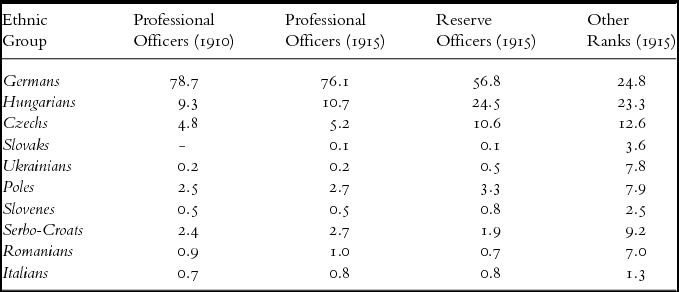
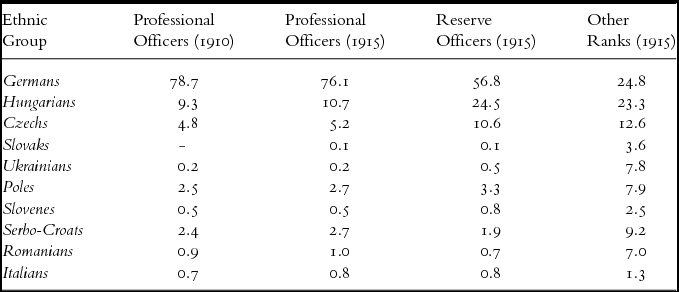
Peacetime commissioned reserve officers were more diverse than their professional peers. Whereas four-fifths of the professionals were recorded in the official statistics as German (although this was in all probability a considerable overestimation as it was based not on the birth language but on ‘language of everyday use’, which for career officers of all ethnicities was German), this was the case with only three-fifths of their peacetime reserve counterparts. Seventeen per cent were Jews – a group exceptionally loyal to the dynastic Empire – and some of the rest may well have fallen into that significant set of central Europeans whom historians have recently identified as ‘nationally indifferent’.Footnote 36 Reserve officers' roots within civil society were stronger than those of career officers, and they generally came from that most nationalist social demographic, the middle classes. However, they were men who could combine national identity with loyalty to the Empire. Second Lieutenant Stanisław Gayczak, mobilised to Landsturm Regiment 19, offers a revealing example. He was a Pole, born in Bielsko Biała and resident of Lwów. Yet he was also a cosmopolitan. He had studied law at Vienna University and his wife, with whom he had four children, was a German speaker from Moravia. For him, as his diary testifies, there was no contradiction in playing the Austrian state anthem followed by the Polish national song ‘Jeszcze Polska nie zginęła’.Footnote 37
The Habsburg Army's leadership underwent wholesale change during the First World War. On mobilisation, over half of most infantry regiments' officers had been professionals, but already by 1916 their proportion had dropped to one-quarter. The army expanded, reaching 3,500,000 men by March 1917.Footnote 38 Simultaneously, the pool of pre-war trained professional and reserve officers shrank due to horrendous casualties. In 1914 alone, 14.7 per cent of officers were killed and 12.8 per cent captured. The professionals suffered especially heavily. By 1918, nearly a third of them were dead.Footnote 39 The result was an urgent need for new officers, and a staggering 200,000 men were commissioned during the war.Footnote 40 In peace, the army had favoured well-educated middle- and upper-class men as officer material. Attendance at a military academy, cadet school or secondary school was a precondition for a commission.Footnote 41 This prioritisation of social status and education persisted through the First World War. However, the officers appointed in wartime brought new attitudes into the force. They were more ethnically diverse than their predecessors. Serving through compulsion rather than choice, among these middle-class men were not only cosmopolitans and imperial loyalists like those of the pre-war reserve corps but inevitably also bourgeois nationalists, who had only very conditional loyalty, were indifferent or were even opposed to the Habsburg Empire.
Wartime officers were not drawn uniformly from across the Empire. Economic development in the nineteenth century had been uneven, and in consequence educated men were not spread equally among the Habsburg peoples.Footnote 42 Outside the army's traditional ethnic Germans, the Magyar gentry and the new Czech-speaking middle class created through the emergence of Bohemia as a major industrial centre both provided large pools of educated men. Neither group was unproblematic from the Habsburg Army's perspective. The Magyar gentry had, in the decade before the war, elected a party which identified with the independence struggle of 1848, and its parliamentary representatives had blocked funding and manpower increases for Kaiser Franz Joseph's military. The Czech middle classes were the backbone of a nationalist movement which, although interested in autonomy rather than separation, had clashed with the imperial administration and army on language rights. Tensions had become such that the Habsburg Foreign Minister feared after the assassination of Archduke Franz Ferdinand that any mobilisation against Serbia might spark revolution in Bohemia.Footnote 43 Nonetheless, the Habsburg Army's need for educated men to lead its troops resulted, in the early war years, in many Magyar gentlemen and Czech bourgeoisie being accepted as reserve officers (see Table 1).
Ethnic Composition of the Habsburg Officer Corps, 1910 & 1915 (percentages)
Sources: I. Deák, Beyond Nationalism. A Social and Political History of the Habsburg Officer Corps, 1848–1918 (New York and Oxford: Oxford University Press, 1990), 183; and Bundesministerium für Heereswesen und Kriegsarchiv, Österreich-Ungarns letzter Krieg 1914–1918. II. Beilagen, 7 vols. (Vienna: Verlag der Militärwissenschaftlichen Mitteilungen, 1931), ii.2, Beilage 1, Tabelle 5.
The Empire's less developed Slavic peripheries generally enjoyed far lower education levels than the German, Magyar and Czech heartlands.Footnote 44 However, as the officer corps' need to recruit became more desperate, it loosened its entry requirements, opening itself up to less well-qualified elites, such as village teachers, in the second half of the war. Thus, Serbs and Croats, who had comprised less than 3 per cent of officers in 1915, totalled 9 per cent of the corps by the end of 1917.Footnote 45 Checks on the political reliability of the men appear to have been limited. It is telling that a Slovenian activist for the Yugoslav ideal, who had been accused of lesè majesté in July 1914, was still permitted to serve as an officer cadet until 1918.Footnote 46 Less is known about other Slavic groups, but what evidence exists suggests a similar rise in numbers in the second half of the war. The interwar Polish Army, for example, clearly inherited from the Empire a substantial pool of military expertise not reflected in Table 1. In 1921, its largest contingent of career officers – 9,476 of its 30,105-strong officer corps – had been trained by the Habsburg Army.Footnote 47
The shift from a dynastic-orientated professional leadership to a wartime reserve officer corps, whose members did not all combine a strong national identity with fervent imperial loyalty, at the head of the Habsburg Army's frontline units brought problems. Nationalist differences could undermine the cohesion of units' leadership. Political arguments in the mess of the 20thJäger – among whose officers, it appeared, ‘every principal nation in Austria-Hungary is present’ – in April 1916, for example, were fierce enough to cause one peacetime-trained captain to despair of Habsburg unity: ‘what a waste of the great shared loss of blood’, he rued.Footnote 48 Much worse, nationalist ideology motivated some spectacular cases of treason. Historiography has followed contemporary debate in focusing particularly on Czech soldiers. This group came under especially close scrutiny after first, in October 1914, six companies of the Jungbunzlau-based Infantry Regiment 36 and then, in April 1915, the Prague-raised Infantry Regiment 28 surrendered to the Russians. Later in the war, Czechs' reputation was further tarred when 45,500 Habsburg prisoners in Russia were recruited to a Czechoslovak Legion.Footnote 49 Some suspected frontline leaders, who possessed the influence and authority to organise mass capitulations. Czech officers had been reported for treasonous activities in the Cracow fortress as early as the autumn of 1914.Footnote 50 Major General Krauß, who served as the Chief of Staff of the Southwestern Front up to 1917, emphasised the exceptional danger posed by disloyal officers. ‘The men were everywhere superb – even the Czechs who fell into such disrepute – if they were in the right hands, if the officers were on the spot’, he asserted after the war. ‘However, where elements disloyal to the state came into leadership positions as reserve officers and where the active officers were infected with national sentiment or neutralised, these conditions led to the sorriest manifestations of the war.’Footnote 51
Whether Krauß was right with regard to the Czechs is not clear. Infantry Regiment 28's capitulation was due primarily to adverse military circumstances rather than nationalist-motivated disloyalty, but plenty of other evidence does indicate ideological disaffection in many Bohemian units.Footnote 52 Nevertheless, in broader terms the general was undoubtedly correct: above all in the second half of the conflict, traitorous reserve officers inflicted severe damage on the Habsburg Army. A few prominent examples suffice as illustrations. The joint Austro-German offensive at Caporetto in October 1917 was betrayed before its start by two Romanian officers, and the Habsburg Army's last offensive on the Piave in June 1918 by Czech officer deserters from Infantry Regiment 56.Footnote 53 Undoubtedly, the most spectacular and elaborate case of officer treason was the work of a Slovene officer, Ljudevit Pivko. Pivko was a reserve officer decorated for bravery and appointed temporary commander of his unit, the 5th Battalion, Bosnian-Hercegovinan Regiment 1. He was also a Slovene nationalist, who since the outbreak of war had sought secretly to undermine the Habsburg war effort and had recruited seventy fellow conspirators, mostly Czech officers and Bosnian Serb soldiers from his battalion. In the summer of 1917 he made contact with the Italians and offered to sabotage defences in the crucial Carzano sector, in which his unit was stationed and which guarded the path into Austrian Tyrol. On the night of 17 September, Pivko and his co-conspirators drugged the rest of the 5th Battalion, cut the telephone lines with neighbouring sectors and posted men to guide the Italians. Only the slow action of the distrustful Italian commander tasked with advancing to the defenceless line rendered the operation a failure and saved the Austrians from calamity. Pivko and his men crossed over and went on to play a key role during 1918, organising Italian propaganda against the Habsburg Army.Footnote 54
The vast majority of reserve officers were not so clearly disloyal. Indeed, there were among them men ardently committed to the ideal of a dynastic Great Austria, whom Jaroslav Hašek mercilessly lampooned in The Good Soldier Švejk with the character of 2nd Lieutenant Dub.Footnote 55 Nonetheless, these loyalists grew fewer as the war dragged on. Habsburg loyalism and nationalist identities, once compatible, were prised apart by the growing material deprivation within the Empire and the ideological polarisation catalysed by the Russian revolution and US intervention in the second half of the conflict. The Commander of Honvéd Infantry Regiment 27, a largely Croatian unit, recognised the change. The reserve officers who could be relied upon, he observed, were those trained before or early in the war. By contrast, officers who had entered the army from 1916 onwards were apathetic, untrustworthy and politically unreliable.Footnote 56 This passivity and torpor goes further than the exceptional cases of outright treason to explain the Habsburg force's mediocrity. It also played a part in the military's greatest disaster. On the Eastern Front in the summer of 1916, front officers had watched impassively as Brusilov's men dug toward their lines in preparation for attack. Although the threat to the force's defences was apparent already two months before the offensive, front units ignored or procrastinated over orders to launch raids and disrupt the Russians' work. A few units suggested that it might be preferable to shift their own lines back, rather than provoke a confrontation. When one unit's officers aborted a raid on the lame excuse that dawn had been approaching, the Corps Command in charge ordered another attempt to be made, and added a warning that company commanders who had shirked the operation claiming ill health, and platoon commanders who had thought they could escape through suicide attempts, would be court martialled.Footnote 57
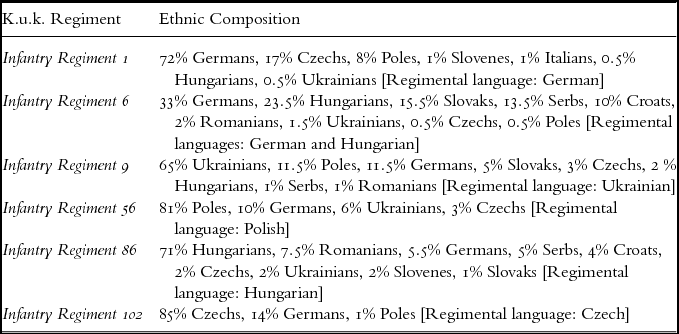
The lackadaisical and unheroic attitude of the Habsburg Army's wartime leadership was not the only difficulty. The new reserve officers were also less capable than their multilingual professional counterparts in communicating with their highly diverse troops. In May 1918, among the 142 k.u.k. infantry regiments for which data exist, just seventeen were more than 90 per cent ethnically homogenous.Footnote 58 The peacetime army had developed strategies to deal with linguistic diversity. German (Hungarian in the Honvéd and Croatian in the Domobran) had been designated its language of command and service, and officers were expected to be proficient in the language while their men learned eighty basic commands in German and another 1,000 military-technical terms.Footnote 59 Additionally, as this hardly sufficed to build the officer-man relations which modern sociological research has shown to be crucial in military resilience, the army had designated any language spoken by at least 20 per cent of a unit's soldiers as a ‘regimental language’. Career officers risked being dismissed or set back in promotion if they did not learn their regiment's languages within three years. Pragmatically, in the last years of peace the army began to use language knowledge as the primary criterion determining to which unit officers were posted. To further facilitate comprehension, multi-ethnic regiments sorted their troops by language and placed those speaking the same tongue together in particular battalions and companies.Footnote 60
These strategies for managing a multi-lingual force rapidly broke down in wartime. Reserve officers recruited for the war emergency were generally monolingual if German or possessed their own tongue and German if from another ethnic group, and had little time to learn their men's languages. The rapid turnover and mixing up of personnel due to heavy casualties further exacerbated difficulties. Even worse, a restructuring of the army in the spring of 1917 left many units with a mix of minorities whose numbers missed the 20 per cent bar, rendering even the regimental language inadequate (See Table 2).
Ethnic Composition of a Sample of Habsburg Regiments, May 1918

Source: R. G. Plaschka, H. Haselsteiner and A. Suppan, Innere Front. Militärassistenz, Widerstand und Umsturz in der Donaumonarchie 1918. Umsturz, 2 vols. (Munich: R. Oldenbourg, 1974), ii, 335–9.
Often, the reserve officers of this multinational army resorted to Army Slavic, a sort of informal military Esperanto, to talk to their soldiers. The language's military terms were usually from German, but matched with a Slavic language's grammar. Habsburg Polish troops, for example, would be told to antretować (from the German antreten – to form up) on parade, and would narugować (nachrücken – to move up) to the front into the szwarmlinia (Schwarmlinie – firing line).Footnote 61 Even so, as the army's official history conceded, it became ‘ever more common that even the platoon commander could no longer communicate with his often very motley collection of men’. This had extremely negative consequences. There are accounts of Habsburg officers following up their orders by beating their men, whether out of frustration, desperation or arrogance.Footnote 62 Even where there was no maltreatment, linguistic isolation from officers could alienate regiments' minorities. Conrad recognised this when warning in mid-September 1917 against mixing among loyal troops men from distrusted ethnicities. ‘In the midst of men speaking a foreign tongue’, he observed, ‘where in many cases the officer does not know the language, such elements naturally soon feel isolated, embittered and at the first opportunity flee to the enemy’.Footnote 63
The Habsburg Army was a large and diverse organisation, and among its formations were some elite units. British military intelligence on the Italian Front rated the 8thKaiserjäger Division as ‘first class’ and the 3rd Division and 22ndSchützen Division as ‘of considerable fighting efficiency’ in November 1917.Footnote 64 Historians and contemporaries alike suggest a correlation between ethnicity and performance; the core peoples of Austria-Hungry, the Germans and Magyars, were generally reckoned to have fought hardest.Footnote 65 This was asserted not just in regard to the men but also their officers. As the AOK's liaison officer to the Habsburg Sixth Army on the Italian Front reported at the end of September 1918:
The predominant part of the army's soldiers is, according to its national composition, in a patriotic sense reliable (Germans and Hungarians). Some regiments have an unfavourable composition in this regard (Czechs, Poles and Ruthenes). However, in these units the officers and NCOs are also not especially scrupulous in carrying out their duty.Footnote 66
At this late stage of the war, there was a particularly deep distrust of Czech officers. Those of Infantry Regiment 42 were, according to one officer prisoner captured by the British in August 1918, ‘carefully watched’, their correspondence ‘rigorously censored’ and they were ‘never allowed to go out on patrol’.Footnote 67
Nonetheless, there was no absolute correlation between ethnicity and performance. While two of the divisions identified by British intelligence as excellent in November 1917 did indeed have a largely German composition, the 22ndSchützen Division was an ethnically mixed unit. Rarely recognised but important, the presence of a professional Habsburg officer at the top who had ascended a ‘learning curve’, with or without the assistance of the German Army, could raise the performance even of difficult units.Footnote 68 The 9th Mountain Brigade, led by the Polish professional officer Jan Romer, offers a corrective to the view that nationalist alienation inevitably doomed the k.u.k. Army. One of the brigade's two regiments was mostly Austrian German, but the other, Infantry Regiment 117, contained Slovene officers and men. On taking up his post in March 1918, Romer found many of them disaffected, and he was clearly unable to change their nationalist sympathies for the regiment mutinied at the end of the following October.
Although Romer was powerless against his men's nationalist disaffection, through a mix of traditional paternalism and a modern training regime, which incorporated much of German best practice, he did prove able to raise his units' military value.Footnote 69 He set his officers a personal example of care by inspecting the men's facilities and inquiring about their wishes and problems, arranging bigger rations for them and improving their rest areas. The field instruction that he organised was far removed from the unsupported, unskilled assaults of the war's opening or the mistaken reliance on static fortifications in 1916. The 9th Mountain Brigade's soldiers undertook combined arms exercises with mortars, artillery and even aeroplanes. Tactical training was ‘based as far as possible on concrete combat experiences’, and live ammunition was used. Troops practised shooting, grenade-throwing, bayonet fighting and went through obstacle courses. This programme, which combined the pre-war officer corps' focus on psychological factors with the most up-to-date tactical thought, paid dividends: in the Habsburg Army's final, abortive offensive on the Piave in June 1918, the ‘especially well-trained battalions’ of the 18th Division, to which Romer's brigade belonged, were singled out for exceptional praise for capturing the strong Italian positions on the Monte di Val Bella.Footnote 70
IV
Refocusing on the multiple identities of the wartime Habsburg officer corps offers new insights into its army's performance during 1914–18. Professional and wartime reserve officers had great influence on shaping units' conduct on the battlefield, which has not been recognised by historiography interested almost exclusively in nationalism in the rank and file. A focus on officers' transnationalism – in preference to the a-national and nationalist outlooks usually discussed in the literature – draws attention to the overlooked attempts to improve the army's martial proficiency during the war. Crucially, it also offers one explanation for why by 1918 these attempts had achieved at best only limited success.
Senior Habsburg officers were not just a-national but also members of a professional military milieu that transcended state borders. When the first disastrous campaigns of 1914 revealed the shortcomings of their army's doctrine and training, it was only natural that they should look to their enemies and, above all, their allies for inspiration. The ‘learning curve’ mounted by the Habsburg army during the conflict was not always as steep as those of its enemies and there were plenty of missteps, but orders reveal incontrovertibly that, by 1917 at the latest, key lessons such as the decisive importance of artillery and inter-arm cooperation had been identified.Footnote 71 Cooperation with and tutelage from the German military contributed to this improvement, especially once it was intensified after the Habsburg force's shattering defeat on the Eastern Front in the summer of 1916. Yet many k.u.k. senior officers regarded this growing international cooperation with great reluctance, for despite the martial advantages that it brought, it threatened the Empire they served with loss of sovereignty and significantly reduced their own prestige.
The Habsburg army's frontline reserve officers' identities were also complex and have been surprisingly neglected in the literature. They were mostly men of the middle classes – the most nationalist milieu in the Empire – pressed into service to lead the force's multinational units. More than any other group, it was their character which stamped the army's wartime record of long endurance but mediocre combat performance. In a few units, lessons bloodily learned during the conflict were applied and even disgruntled Slav soldiers were melded into an elite by inspired leadership. Yet in most of the army, the junior leadership was rather poor. While only a small minority of fervent nationalists actually betrayed the Habsburg cause, the majority of frontline officers were unenthusiastic and rather passive. They remained obedient; even at the conflict's end, when mutinies swept through the army, officers rarely appear to have been the instigators.Footnote 72 Nonetheless, these commanders had, above all in the conflict's second half, no ideological motivation to risk themselves, and their relations with their men, in part due to problems of communication and in part because of rank and file resentment at their officer privileges, were distant. Their passive stance goes far to explain the Habsburg Army's war record of surprising longevity but limited fighting power.