INTRODUCTION
Current conventional treatment of inoperable Stage I & II NSCLC, consists of three-dimensional (3D) conformal radiotherapy; with the use of applied margins around the tumour volume accounting for setup error and organ tumour movement during treatment.Reference Jassem1–Reference Rietzel, Liu, Doppke, Wolfgang, Chen, Chen and Choi3 The margins currently applied are generally isotropic (of equal physical properties along all axes), population based, and systematically added or conjectured for all patients, rather than being tailored on the basis of individual motion characteristics.Reference Nelson, Starkschall, Balter, Morice, Stevens and Chang4,Reference Senan, Chapet, Lagerwaard and Ten Haken5 Using these margins, local control and overall survival with the standard 60 Gy dose is still poor.Reference Harsolia, Hugo, Kestin, Grills and Yan2,Reference Lagerwaard, Haasbeek, Smit, Slotman and Senan6,Reference Burnett, Sixel, Cheung and Hoisal7
Radiobiological studies have shown that the effectiveness of radiotherapy depends on the ability to deliver high doses to tumours, while sparing the surrounding healthy tissue, and that dose escalation improves local control rates.Reference Haas8,Reference Bradley, Graham, Winter, Purdy, Komaki, Roa, Ryu, Bosch and Emami9 The maximal dose that can be delivered to a tumour is restricted by the tolerance of normal tissues within the high-dose volume.Reference Bradley, Graham, Winter, Purdy, Komaki, Roa, Ryu, Bosch and Emami9 Therefore, in order to facilitate dose escalation, geometric uncertainties must be eliminated to facilitate the reduction of applied margins.Reference Liu, Balter, Tutt, Choi, Zhang, Wang, Chi, Luo, Pan, Hunjan, Starkschall, Rosen, Prado, Liao, Chang, Komaki, Cox, Mohan and Dong10,Reference Wolthaus, Schneider, Sonke, van Herk, Belderbos, Rossi, Lebesque and Damen11 Additionally, Respiratory Induced Tumour Motion (RITM) during a course of radiotherapy treatment will have an effect on accurate target coverage; thoracic tumours have been observed to move more than 2 cm (ref. 12) and unless there is some way of correctly assessing or inferring tumour position during treatment, on an individual basis, the margin that needs to be applied to account for the motion is too large to facilitate dose escalation.Reference Bradner, Heron, Wu, Huq, Yue and Chen12,Reference Fox, Simon, Elder, Rifferburgh and Johnstone13 Extra-cranial Stereotactic Radiation Therapy (ESRT) has been implemented using a variety of techniques to address the issue of RITM during treatment in a number of centres around the world.Reference Allen, Siracuse, Hayman and Balter14–Reference Baumann, Nyman, Lax, Friesland, Hoyer, Ericsson, Johansson, Ekberg, Morhed, Paludan, Wittgren, Blomgren and Lewensohn16
Localisation and targeting techniques in ESRT are similar to those developed and established in Intracranial Stereotactic Radiation Therapy (ISRT).Reference Senan, Chapet, Lagerwaard and Ten Haken5 ESRT immobilisation can be achieved using a body-fix vacuum pillow and a stereotactic body frame (SBF), which provides an external co-ordinate system referenced to ‘fiducials’ (markers whose position can be correlated to both the target volume and treatment delivery device), to target pre-defined areas within the patient with very high accuracy.Reference Senan, Chapet, Lagerwaard and Ten Haken5,Reference Timmerman, Galvin, Michalski, Straube, Ibbott, Martin, Abdulrahman, Swann, Fowler and Choy17
The purpose of this review is to evaluate the ESRT methods used: techniques, equipment and combinations thereof; as reported in the literature, in an attempt to identify any trends or possible future avenues of research. Issues regarding patient tolerance of treatment, staff training needs, equipment needs, time requirements and cost implications are beyond the remit of this project, and will require further study elsewhere.
METHODOLOGY: LITERATURE REVIEW
The search evidence is based on a structured approach to searching, using two medical literature databases: OVID and ScienceDirect. Both cover the health and social sciences, as well as all aspects of radiography, and include journals from a range of international publishers.
By breaking down the research question into its component parts using the Problem, Intervention, Comparison and Outcome (PICO) format, a list of terms was compiled.18 These terms were then used to develop a series of searches based on synonyms and index terms, aiming to maximize sensitivity of searches for each component. Preliminary inclusion criteria were applied to titles and abstracts to refine literature relevancy. These criteria were designed to ensure articles identified were up to date, peer reviewed, from a worldwide literature base to include research not currently being undertaken in the UK and relevant to both the patient group and research question.
In order to maintain a usable evidence base, without excluding any available seminal works, each remaining article was critiqued using a previously developed critical evaluation framework adapted from the Critical Appraisal Skills Programme (CASP).19 This framework was chosen in order to include only those works that were both relevant and were reported on with enough data to be statistically reliable in order to be applied to the research question.
A review database was created to enable recording of critical evaluation outcomes, to facilitate evaluation of the research question with a robust and systematic approach.
LITERATURE REVIEW
This review evaluates multiple techniques and modalities that are used in ESRT, and also attempts to examine evidence for effectiveness from reported studies.
It was initially hoped that data could be extracted from the cohort studies to combine together in an attempt to identify any trends in treatment technique, combinations, doses and fractionation schedules. However, due to institutional differences in establishing, reporting on, and presenting data within studies, it proved impossible to combine data from enough sources to make such comparisons possible.Reference Onimaru, Fujino, Yamazaki, Onodera, Taguchi, Katoh, Hommura, Oizumi, Nishinura and Shirato20 The majority of studies identified addressed either planning methods for ESRTReference Harsolia, Hugo, Kestin, Grills and Yan2,Reference Rietzel, Liu, Doppke, Wolfgang, Chen, Chen and Choi3,Reference Burnett, Sixel, Cheung and Hoisal7,Reference Liu, Balter, Tutt, Choi, Zhang, Wang, Chi, Luo, Pan, Hunjan, Starkschall, Rosen, Prado, Liao, Chang, Komaki, Cox, Mohan and Dong10,Reference Wolthaus, Schneider, Sonke, van Herk, Belderbos, Rossi, Lebesque and Damen11,Reference Fox, Simon, Elder, Rifferburgh and Johnstone13,Reference Allen, Siracuse, Hayman and Balter14,Reference Admiraal, Schuring and Hurkmans22–Reference McGarry, Papiez, Williams, Whitford and Timmerman39 or clinical evaluation of local control rates, toxicity and overall survival.Reference Lagerwaard, Haasbeek, Smit, Slotman and Senan6,Reference Bradley, Graham, Winter, Purdy, Komaki, Roa, Ryu, Bosch and Emami9,Reference Brown, Wu, Amendola, Perman, Han, Fayad, Garcia, Lewin, Abitbol, de la Zerda and Schwade15,Reference Baumann, Nyman, Lax, Friesland, Hoyer, Ericsson, Johansson, Ekberg, Morhed, Paludan, Wittgren, Blomgren and Lewensohn16,Reference Onimaru, Fujino, Yamazaki, Onodera, Taguchi, Katoh, Hommura, Oizumi, Nishinura and Shirato20,Reference Onishi, Kuriyama, Komiyama, Tanaka, Sano, Marino, Ikenaga, Araki and Uematsu21,Reference McGarry, Papiez, Williams, Whitford and Timmerman39–Reference Korreman, Mostafavi, Le and Boyer30 Other subjects covered included evaluation of CBCT, setup accuracy and internal fiducial placement.Reference Nelson, Starkschall, Balter, Morice, Stevens and Chang4,Reference Fox, Simon, Elder, Rifferburgh and Johnstone13,Reference Van Der Weide, van Sörnsen de Koste, Lagerwaard, Vincent, van Triest, Slotman and Senan37,Reference Baisden, Romney, Reish, Cai, Sheng, Jones, Benedict, Read and Larner61–Reference Weiss, Wijesooriya, Dill and Keall82
There is a wealth of information available outlining various planning, verification and treatment methods, but these are small cohort studies: the largest identified having only 257 participants.Reference Onishi, Shirato, Nagata, Hiraoka, Fujino, Gomi, Nübe, Karasawa, Hayakama, Takai, Kimura, Takeda, Ouchi, Hareyama, Kokubo, Hara, Itami, Yamada and Araki42 To date, there has been no publication of large, multi-centre, randomly controlled trials; although it has been intimated that these are now underway.Reference Nyman, Johansson and Hultén41
RITM
RITM can cause a significant degree of uncertainty in target delineation, dose distribution and treatment delivery.Reference Casamassima, Cavedon, Francescon, Stancanello, Avanzo, Cora and Scalchi24,Reference Koshani, Balter, Hayman, Henning and van Herk70 RITM has been shown to be at its greatest in small tumours of the lower lobes,Reference Liu, Balter, Tutt, Choi, Zhang, Wang, Chi, Luo, Pan, Hunjan, Starkschall, Rosen, Prado, Liao, Chang, Komaki, Cox, Mohan and Dong10,Reference Bradner, Heron, Wu, Huq, Yue and Chen12,Reference Purdie, Bissonnette, Franks, Bezjac, Payne, Sie, Sharpe and Jaffray76 with movements greater than 2 cm observed in some patients.Reference Bradner, Heron, Wu, Huq, Yue and Chen12
These movements are anisotropic (of unequal physical properties along different axes): studies have shown that the magnitude of tumour movement in the superior–inferior, anterior–posterior and left–right directions can vary significantly,Reference Liu, Balter, Tutt, Choi, Zhang, Wang, Chi, Luo, Pan, Hunjan, Starkschall, Rosen, Prado, Liao, Chang, Komaki, Cox, Mohan and Dong10 thus precluding the possibility of applying isotropic margins even on an individual basis. This highlights and emphasises the need for individualised treatment plans, with the incorporation of four-dimensional (4D) information to plan treatment of mobile tumours in the lungs.Reference Rietzel, Liu, Doppke, Wolfgang, Chen, Chen and Choi3,Reference Burnett, Sixel, Cheung and Hoisal7,Reference Nishioka, Nishioka, Kawahara, Tanaka, Hiromura, Tomita and Shirato74,Reference Underberg, Lagerwaard, Cuijpers, Slotman, van Sornsen de Koste and Senan78 In conventional radiotherapy treatment planning images from a single scan provide a 3D picture of the patient’s anatomy and tumour location, but only at one point in time. In order to significantly reduce treatment margins, the fourth dimension, time, needs to be included during simulation and planning stages.Reference Senan and Lagerwaard83
ESRT
Also known as Stereotactic Body Radiation Therapy (SBRT):Reference Nagata, Matsuo, Takayama, Norihisa, Mizowaki, Mitsumori, Shibuya, Yano, Narita and Hiraoka80
Recently the delivery of radiation has become more conformal, making tumour motion management critical to treatment delivery.Reference Bradner, Heron, Wu, Huq, Yue and Chen12,Reference Weiss, Wijesooriya, Dill and Keall82 Current research in the field of radiotherapy for lung cancers has centred on breathing motion and associated gating techniques,Reference Fox, Simon, Elder, Rifferburgh and Johnstone13,Reference Chang, Mageras, Yorke, De Arruda, Sillanpaa, Rosenzweig, Hertanto, Pham, Seppi, Pevsner, Ling and Amols62 with the development of four main strategies to reduce respiratory motion effects
1. Tumour motion minimising techniques (abdominal compression or breath hold, etc)Reference Brown, Wu, Amendola, Perman, Han, Fayad, Garcia, Lewin, Abitbol, de la Zerda and Schwade15,Reference Hoyer, Roed, Hansen, Ohlhuis, Peterson, Nellemann, Berthelsen, Grau, Engelholm and von der Maase52,Reference Kontrisova, Stock, Dieckmann, Bogner, Pötter and Georg68,Reference Underberg, Lagerwaard, van Tinteren, Cuijpers, Slotman and Senan79,Reference Nagata, Matsuo, Takayama, Norihisa, Mizowaki, Mitsumori, Shibuya, Yano, Narita and Hiraoka80
2. Integration of respiratory movements into treatment planningReference Lagerwaard, Haasbeek, Smit, Slotman and Senan6,Reference Allen, Siracuse, Hayman and Balter14,Reference Rietzel, Liu, Doppke, Wolfgang, Chen, Chen and Choi3,Reference Underberg, Lagerwaard, Cuijpers, Slotman, van Sornsen de Koste and Senan78,Reference Nagata, Matsuo, Takayama, Norihisa, Mizowaki, Mitsumori, Shibuya, Yano, Narita and Hiraoka80
3. Respiratory-gating techniques (free breathing; amplitude; or phase gating)Reference Fox, Simon, Elder, Rifferburgh and Johnstone13,Reference Haasbeek, Spoelstra, Lagerwaard, van Sörnsen de Koste, Cuijpers, Slotman and Senan28,Reference Wurm, Gum, Erbl, Schlenger, Sceffler, Agaoglu, Schild, Gebauer, Rogalia, Plotkin, Ocran and Badach58,Reference Lu, Parikh, Hubenschmidt, Bradley and Low71,Reference Neicu, Berbeco, Wolfgang and Jiang73,Reference Nagata, Matsuo, Takayama, Norihisa, Mizowaki, Mitsumori, Shibuya, Yano, Narita and Hiraoka80
4. Tumour-tracking techniques (Image Guided Radiation Therapy – IGRT; use of kV or MV imaging during treatment).Reference Wolthaus, Schneider, Sonke, van Herk, Belderbos, Rossi, Lebesque and Damen11,Reference Baumann, Nyman, Lax, Friesland, Hoyer, Ericsson, Johansson, Ekberg, Morhed, Paludan, Wittgren, Blomgren and Lewensohn16,Reference Haasbeek, Lagerwaard, Cuijpers, Slotman and Senan27,Reference Korreman, Mostafavi, Le and Boyer30
These strategies are often used in combination to provide the best possible margin reduction and dose escalation.Reference Haas8,Reference Jiang84
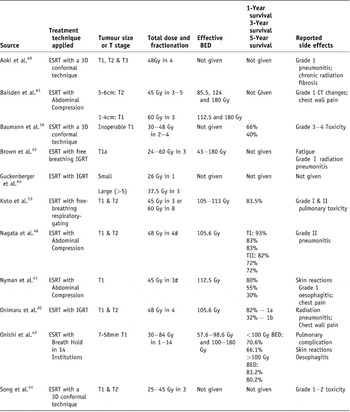
The last decade has seen many studies exploring the efficacy of ESRT.Reference Bradley, Graham, Winter, Purdy, Komaki, Roa, Ryu, Bosch and Emami9,Reference Brown, Wu, Amendola, Perman, Han, Fayad, Garcia, Lewin, Abitbol, de la Zerda and Schwade15,Reference Baumann, Nyman, Lax, Friesland, Hoyer, Ericsson, Johansson, Ekberg, Morhed, Paludan, Wittgren, Blomgren and Lewensohn16,Reference Grills, Fitch, Goldstein, Yan, Chmielewski, Welsh and Kestin25,Reference Beitler, Badne, El-Sayah, Makara, Friscia, Silverman and Terjanian44,Reference Guckenberger, Heilman, Wulf, Mueller, Beckmann and Flentje45,Reference Aoki, Nagata, Negoro, Takayama, Mizowaki, Kokubo, Oya, Mitsumori and Hiraoka49,Reference Nagata, Matsuo, Takayama, Norihisa, Mizowaki, Mitsumori, Shibuya, Yano, Narita and Hiraoka80. However, as with any emerging modality still in its ‘infancy’, there has yet to be a consensus on the optimum combinations of techniques, equipment and optimum total dose and fractionation schedulesReference Brown, Wu, Amendola, Perman, Han, Fayad, Garcia, Lewin, Abitbol, de la Zerda and Schwade15 (see Table 1).
Ranges of fractionation schedules, total doses, biological effective doses (BEDs) administered in ESRT, and clinical outcomes as reported in literature

BED, Biological Effective Dose; ESRT, Extra-cranial Stereotactic Radiation Therapy; IGRT, Image Guided Radiation Therapy.
Hallmarks of ESRT include prescriptions with high Biological Effective Doses (BEDs), and this is one area upon which all the literature seems to reach consensus: that a BED of over 100 Gy should be applied in order to increase treatment efficacy.Reference Bradley, Graham, Winter, Purdy, Komaki, Roa, Ryu, Bosch and Emami9,Reference Brown, Wu, Amendola, Perman, Han, Fayad, Garcia, Lewin, Abitbol, de la Zerda and Schwade15–Reference Timmerman, Galvin, Michalski, Straube, Ibbott, Martin, Abdulrahman, Swann, Fowler and Choy17,Reference Grills, Fitch, Goldstein, Yan, Chmielewski, Welsh and Kestin25,Reference Nyman, Johansson and Hultén41,Reference Nagata, Takayama, Matsuo, Norihisa, Mizowaki, Sakamoto, Sakamoto, Mitsumori, Shibuya, Araki, Yano and Hiraoka46,Reference Wulf, Baier, Mueller and Flentje57,Reference Baisden, Romney, Reish, Cai, Sheng, Jones, Benedict, Read and Larner61,Reference Nagata, Matsuo, Takayama, Norihisa, Mizowaki, Mitsumori, Shibuya, Yano, Narita and Hiraoka80 BEDs of over 100 Gy are routinely applied in ESRT, studies where lower BEDs were also used, report that treatment with BEDs under 100 Gy had significantly lower survival rates than treatment with BEDs of over 100 Gy.Reference Brown, Wu, Amendola, Perman, Han, Fayad, Garcia, Lewin, Abitbol, de la Zerda and Schwade15,Reference Onishi, Shirato, Nagata, Hiraoka, Fujino, Gomi, Nübe, Karasawa, Hayakama, Takai, Kimura, Takeda, Ouchi, Hareyama, Kokubo, Hara, Itami, Yamada and Araki42
ESRT is an ablative therapy: it is never used for prophylactic (adjuvant) treatment as the intent is to completely disrupt clonogenicity, and is likely to disrupt all cellular functioning within the target tissues.Reference Timmerman, Galvin, Michalski, Straube, Ibbott, Martin, Abdulrahman, Swann, Fowler and Choy17 It has been used in combination with 3D non-coplanar conformal techniques, using 5–10 radiation fields.Reference Baumann, Nyman, Lax, Friesland, Hoyer, Ericsson, Johansson, Ekberg, Morhed, Paludan, Wittgren, Blomgren and Lewensohn16,Reference Aoki, Nagata, Negoro, Takayama, Mizowaki, Kokubo, Oya, Mitsumori and Hiraoka49 When combined with image-guided technology, it is able to locate and define small targets with greater precision.Reference Onimaru, Fujino, Yamazaki, Onodera, Taguchi, Katoh, Hommura, Oizumi, Nishinura and Shirato20,Reference Casamassima, Cavedon, Francescon, Stancanello, Avanzo, Cora and Scalchi24,Reference Grills, Fitch, Goldstein, Yan, Chmielewski, Welsh and Kestin25,Reference Wurm, Gum, Erbl, Schlenger, Sceffler, Agaoglu, Schild, Gebauer, Rogalia, Plotkin, Ocran and Badach58,Reference Underberg, Lagerwaard, van Tinteren, Cuijpers, Slotman and Senan79,Reference Wang, Feigenberg, Chen, Pasklev and Ma81
Although large doses per fraction hold the promise of higher rates of local control, they also pose a higher risk for normal tissue complications as they can overwhelm repair mechanisms.Reference Mageras and Mechalakos85 Dose limits to protect the Organs At Risk (OARs) must be maintained to avoid serious complications.Reference Casamassima, Cavedon, Francescon, Stancanello, Avanzo, Cora and Scalchi24,Reference Nagata, Matsuo, Takayama, Norihisa, Mizowaki, Mitsumori, Shibuya, Yano, Narita and Hiraoka80 Accuracy is vital and care must be taken at all stages of the ESRT treatment process to ensure that the target is adequately dosed while normal tissues are spared as much as possible: target localisation errors are largely unrecoverable in this context.Reference Purdie, Moseley, Bissonnette, Sharpe, Franks, Bezjak and Jaffray75
Further hallmarks of ESRT are inhomogeneous dose distributions within the target volume, and hypo-fractionated treatment schedules utilising multiple highly focused radiation beams.Reference Onishi, Kuriyama, Komiyama, Tanaka, Sano, Marino, Ikenaga, Araki and Uematsu21,Reference Casamassima, Cavedon, Francescon, Stancanello, Avanzo, Cora and Scalchi24,Reference Purdie, Moseley, Bissonnette, Sharpe, Franks, Bezjak and Jaffray75
ESRT equipment is often used in conjunction with techniques that seek to either immobiliseReference Brown, Wu, Amendola, Perman, Han, Fayad, Garcia, Lewin, Abitbol, de la Zerda and Schwade15,Reference Onishi, Kuriyama, Komiyama, Tanaka, Sano, Marino, Ikenaga, Araki and Uematsu21,Reference Nagata, Matsuo, Takayama, Norihisa, Mizowaki, Mitsumori, Shibuya, Yano, Narita and Hiraoka80 or minimise tumour movement,Reference Grills, Fitch, Goldstein, Yan, Chmielewski, Welsh and Kestin25,Reference Hoyer, Roed, Hansen, Ohlhuis, Peterson, Nellemann, Berthelsen, Grau, Engelholm and von der Maase52,Reference Underberg, Lagerwaard, van Tinteren, Cuijpers, Slotman and Senan79,Reference Nagata, Matsuo, Takayama, Norihisa, Mizowaki, Mitsumori, Shibuya, Yano, Narita and Hiraoka80 and/or equipment that facilitates on set tumour tracking during treatment.Reference Wurm, Gum, Erbl, Schlenger, Sceffler, Agaoglu, Schild, Gebauer, Rogalia, Plotkin, Ocran and Badach58,Reference Wang, Feigenberg, Chen, Pasklev and Ma81
SBFs allow for effective patient immobilisation; greater daily setup accuracy; ease of setup due to measuring scales on the frame; and successful reduction of RITM through application of an abdominal pressure plate or belt.Reference Timmerman, Galvin, Michalski, Straube, Ibbott, Martin, Abdulrahman, Swann, Fowler and Choy17,Reference Onishi, Kuriyama, Komiyama, Tanaka, Sano, Marino, Ikenaga, Araki and Uematsu21
However, there are also some disadvantages associated with ESRT; it requires an excessive amount of time to arrange the stereotactic co-ordinates, demonstrated to be between 30 and 90 minutes;Reference Brown, Wu, Amendola, Perman, Han, Fayad, Garcia, Lewin, Abitbol, de la Zerda and Schwade15,Reference Guckenberger, Meyer, Wilbert, Baier, Mueller, Wulf and Flentje65,Reference Nyman, Johansson and Hultén41 SBFs cannot accommodate obese patients; and some cases have a limited availability of beam arrangement.Reference Onishi, Kuriyama, Komiyama, Tanaka, Sano, Marino, Ikenaga, Araki and Uematsu21 With a technique that may not cater to all because of these disadvantages, the significant investment in time as well as equipment required to facilitate the use of this technique may prove to be too costly for some.
ESRT setup and verification
Comparison of different correction techniques in verification for mobile lung tumours is less straightforward than comparison of correction techniques applied to non-mobile tumours because of the presence of breathing motion.Reference Hugo, Vargas, Liang, Kestin, Wong and Yan29
Increased precision in targeting mobile tumours in the thorax through ESRT, and any margin reduction it enables, is highly dependent on the accurate setup and verification of patients at the pre-treatment stage, and each subsequent treatment fraction thereafter: volumetric and positional variations during respiratory motion need to be addressed.Reference Casamassima, Cavedon, Francescon, Stancanello, Avanzo, Cora and Scalchi24,Reference Wurm, Gum, Erbl, Schlenger, Sceffler, Agaoglu, Schild, Gebauer, Rogalia, Plotkin, Ocran and Badach58,Reference Fuss, Salter, Rassiah, Cheek, Cavanaugh and Herman63,Reference Weiss, Wijesooriya, Dill and Keall82 Conventional setup accuracy has been reported for non-moving tumours to be no better than 1 cm.Reference Wurm, Gum, Erbl, Schlenger, Sceffler, Agaoglu, Schild, Gebauer, Rogalia, Plotkin, Ocran and Badach58 This is even worse for mobile tumours;Reference Wurm, Gum, Erbl, Schlenger, Sceffler, Agaoglu, Schild, Gebauer, Rogalia, Plotkin, Ocran and Badach58 highlighting the need for reliable immobilisation devices, combined with a reproducible respiratory or treatment technique, that is both well tolerated by the patients (in ability to comply, as well as minimized toxicity) and clinically feasible (with regards to treatment times, training needs and costs).Reference Liu, Balter, Tutt, Choi, Zhang, Wang, Chi, Luo, Pan, Hunjan, Starkschall, Rosen, Prado, Liao, Chang, Komaki, Cox, Mohan and Dong10,Reference Casamassima, Cavedon, Francescon, Stancanello, Avanzo, Cora and Scalchi24,Reference Hugo, Vargas, Liang, Kestin, Wong and Yan29,Reference Slotman, Lagerwaard and Suresh34,Reference Fuss, Salter, Rassiah, Cheek, Cavanaugh and Herman63,Reference Nishioka, Nishioka, Kawahara, Tanaka, Hiromura, Tomita and Shirato74,Reference Underberg, Lagerwaard, Cuijpers, Slotman, van Sornsen de Koste and Senan78
The purpose of immobilisation systems is the precise alignment of the defined target relative to the isocentre of the treatment machine by means of repositioning the patient’s body accurately and reproducibly.Reference Hodge, Tomé, Jaradat, Orton, Khuntia, Traynor, Weigel and Mehta64,Reference Wang, Feigenberg, Chen, Pasklev and Ma81 Immobilisation devices like the Body-Fix (or Vac-fix™) have been used in combination with ESRT’s innate external co-ordinate system to achieve accurate setup.Reference Fuss, Salter, Rassiah, Cheek, Cavanaugh and Herman63,Reference Wang, Feigenberg, Chen, Pasklev and Ma81 For ESRT treatments, use of an alpha cradle with the co-ordinate system alone has been found to be ‘sub-optimal’; due to the mobility of the tumours in question, image guidance is required to improve target positioning and allow for margin reduction.Reference Casamassima, Cavedon, Francescon, Stancanello, Avanzo, Cora and Scalchi24 With the modern image guidance available on treatment units today, online corrections of tumour position variations are possible, justifying the use of margins smaller than 5 mm.Reference Onishi, Kuriyama, Komiyama, Tanaka, Sano, Marino, Ikenaga, Araki and Uematsu21,Reference Underberg, Lagerwaard, Cuijpers, Slotman, van Sornsen de Koste and Senan78 External markers can also be used to verify setup accuracy.Reference Cai, Read, Baisden, Larner, Benedict and Sheng23,Reference Mageras and Mechalakos85,Reference Meeks, Tomé, Willoughby, Kupelian, Wagner, Buatti and Bova86
Issues regarding verification and localisation for target positioning of mobile pulmonary targets are less clear, not in the least because ESRT requires more accurate and robust verification than less conformal treatments.Reference Strassmann, Braun, Kress, Richter, Neidel, Klose, An, Vogel, Rose and Engenhart-Cabillic77 However, advancements in CBCT have led to the development of onboard imaging systems with increased soft-tissue definition.Reference Burnett, Sixel, Cheung and Hoisal7,Reference Wang, Wu, Marks, Larrier and Yin38,Reference Underberg, Lagerwaard, van Tinteren, Cuijpers, Slotman and Senan79 Using soft-tissue registration, CBCT also enables the performance of online corrections directly to the tumour.Reference Grills, Fitch, Goldstein, Yan, Chmielewski, Welsh and Kestin25,Reference Wang, Wu, Marks, Larrier and Yin38,Reference Nuyttens, Prévost, Praag, Hoogeman, van Klaveren, Levendag and Pattynama51
Tumour tracking: IGRT
The development of IGRT has now extended to a range of tools to provide a means for effectively handling inter- (between) and intra- (during) fraction motion: dynamic targeting IGRT.Reference Huntzinger, Munro, Johnson, Miettinen, Zankowski, Ahlstrom, Glettig, Filliberti, Kaissl, Kamber, Amstitz, Bouchet, Klebanov, Mostafavi and Stark87 These tools include automated treatment-couch movements for setup precision (removing the possible error introduction through manual couch adjustments); integrated respiratory-gating systems (using gating signals to trigger beam on time at pre-specified gating windows); on board electronic portal imaging (EPI), including the ability to use MV imaging modalities as fluoroscopy (‘movie’ rather than just a static image); ultrasound imaging systems (increased soft-tissue imaging); and on board Cone Beam Computed Tomography (CBCT), allowing for increased accuracy in setup verification and internal marker monitoring.Reference Grills, Fitch, Goldstein, Yan, Chmielewski, Welsh and Kestin25,Reference Wang, Wu, Marks, Larrier and Yin38,Reference Purdie, Moseley, Bissonnette, Sharpe, Franks, Bezjak and Jaffray75,Reference Huntzinger, Munro, Johnson, Miettinen, Zankowski, Ahlstrom, Glettig, Filliberti, Kaissl, Kamber, Amstitz, Bouchet, Klebanov, Mostafavi and Stark87
Use of bony anatomy as a surrogate for tumours can result in clinically significant errors in localization and verification,Reference Purdie, Bissonnette, Franks, Bezjac, Payne, Sie, Sharpe and Jaffray76 therefore soft-tissue delineation is of utmost importance when margin reduction is being attempted. As CBCT usually operates at kV energies,Reference Chang, Mageras, Yorke, De Arruda, Sillanpaa, Rosenzweig, Hertanto, Pham, Seppi, Pevsner, Ling and Amols62 it has an obvious advantage over MV EPI imaging modalities. However, the impact to the patient in terms of risk from the additional dose from daily CBCT imaging is not yet fully established.
Immobilisation of tumour motion: ABC, DIBH or DEBH
Several methods for reducing dose margins and dose-targeting errors associated with respiratory motion have been investigated.Reference Rietzel, Liu, Doppke, Wolfgang, Chen, Chen and Choi3,Reference Fox, Simon, Elder, Rifferburgh and Johnstone13,Reference Jiang84,Reference Wang, Wu, Marks, Larrier and Yin38,Reference Jiang84 The simplest approach is to minimize the motion itself. The simplest way to do that is through breath holding.Reference Onishi, Kuriyama, Komiyama, Tanaka, Sano, Marino, Ikenaga, Araki and Uematsu21,Reference Kimura, Hirokawa, Murakami, Tsujimura, Nakashima, Ohno, Kenjo, Kaneyasu, Wadasaki and Ito67,Reference Underberg, Lagerwaard, Cuijpers, Slotman, van Sornsen de Koste and Senan78,Reference Underberg, Lagerwaard, van Tinteren, Cuijpers, Slotman and Senan79 Active Breathing Control (ABC),Reference Burnett, Sixel, Cheung and Hoisal7,Reference Huntzinger, Munro, Johnson, Miettinen, Zankowski, Ahlstrom, Glettig, Filliberti, Kaissl, Kamber, Amstitz, Bouchet, Klebanov, Mostafavi and Stark87,Reference Kimura, Hirokawa, Murakami, Tsujimura, Nakashima, Ohno, Kenjo, Kaneyasu, Wadasaki and Ito67,Reference Koshani, Balter, Hayman, Henning and van Herk70 Deep-Inspiration Breath Hold (DIBH) and Deep-Expiration Breath Hold (DEBH) techniques use audio and/or visual coaching of the patient to achieve reproducible lung volumes over a course of treatment. These techniques use external markers placed on the patient’s abdomen and cameras monitoring the marker motion to correlate with pre-defined gating intervals.Reference Burnett, Sixel, Cheung and Hoisal7,Reference Haasbeek, Spoelstra, Lagerwaard, van Sörnsen de Koste, Cuijpers, Slotman and Senan28,Reference Kimura, Hirokawa, Murakami, Tsujimura, Nakashima, Ohno, Kenjo, Kaneyasu, Wadasaki and Ito67 The beam is turned on during either deep inspiration or deep expiration: when the tumour occupies a pre-defined target volume, localised using respiratory correlated 4DCT scans. DIBH ensures that normal lung tissue is expanded out of the high-dose region.Reference Van Der Weide, van Sörnsen de Koste, Lagerwaard, Vincent, van Triest, Slotman and Senan37,Reference Kontrisova, Stock, Dieckmann, Bogner, Pötter and Georg68 However, some studies have found that DIBH can produce varying lung volumes, as patients do not always inhale the same volume of air at each inspiration, and hold that DEBH are more reproducible over treatment fractions,Reference Wurm, Gum, Erbl, Schlenger, Sceffler, Agaoglu, Schild, Gebauer, Rogalia, Plotkin, Ocran and Badach58 unfortunately DEBH does not displace healthy lung tissue out of the field.
There can also be some variability in tumour position during breath holds, thereby precluding margin reduction.Reference Burnett, Sixel, Cheung and Hoisal7 Although margin reduction through ABC is possible for some patients, individualised dosimetric-based, (as opposed to margin-based) approaches,Reference Koshani, Balter, Hayman, Henning and van Herk70 combined with kV IGRT, are required to determine tumour position during breath hold at each treatment fraction.
Studies have shown that not all pulmonary tumours are significantly mobile, so tumour movement minimisation or immobilisation is not always required.Reference Guckenberger, Wilbert, Meyer, Baier, Richter and Flentje26,Reference Haasbeek, Lagerwaard, Cuijpers, Slotman and Senan27 However, these techniques can be applied for those patients with significantly mobile tumours (>10 mm).Reference Onishi, Kuriyama, Komiyama, Tanaka, Sano, Marino, Ikenaga, Araki and Uematsu21,Reference Slotman, Lagerwaard and Suresh34,Reference Nyman, Johansson and Hultén41 It is possible to achieve a reproducible reduction of chest and diaphragm motion through regulation of the patient’s respiratory cycle (by reducing breath volume – using ABC techniques); thus enabling reduction of treatment margins.Reference Onishi, Kuriyama, Komiyama, Tanaka, Sano, Marino, Ikenaga, Araki and Uematsu21,Reference Kimura, Hirokawa, Murakami, Tsujimura, Nakashima, Ohno, Kenjo, Kaneyasu, Wadasaki and Ito67,Reference Koshani, Balter, Hayman, Henning and van Herk70 In order to identify those patients requiring the use of ABC techniques, assessment of tumour mobility may be made on the basis of a pre-treatment 4DCT.Reference Liu, Balter, Tutt, Choi, Zhang, Wang, Chi, Luo, Pan, Hunjan, Starkschall, Rosen, Prado, Liao, Chang, Komaki, Cox, Mohan and Dong10,Reference Bradner, Heron, Wu, Huq, Yue and Chen12,Reference Purdie, Bissonnette, Franks, Bezjac, Payne, Sie, Sharpe and Jaffray76
Either ABC technique requires a certain amount of patient training and compliance, however, due to the nature of the disease, lung cancer patients suffer from decreased respiratory function, which may translate into inability to comply with breath coaching instructions.Reference Onishi, Kuriyama, Komiyama, Tanaka, Sano, Marino, Ikenaga, Araki and Uematsu21,Reference Underberg, Lagerwaard, Slotman, Cuijpers and Senan36,Reference Underberg, Lagerwaard, Cuijpers, Slotman, van Sornsen de Koste and Senan78
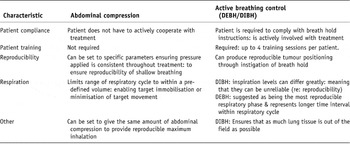
Conversely, use of shallow breathing abdominal compression techniques mean that the patient is not required to actively participate in their treatment: they may feel uncomfortable with having their breathing restricted, but issues regarding patient ability to comply with breathing instructions are avoided.Reference Grills, Fitch, Goldstein, Yan, Chmielewski, Welsh and Kestin25,Reference Underberg, Lagerwaard, Cuijpers, Slotman, van Sornsen de Koste and Senan78,Reference Underberg, Lagerwaard, van Tinteren, Cuijpers, Slotman and Senan79 ESRT using the SBF, combined with shallow breathing abdominal compression techniques compare favourably with ABC techniques, especially if treatment delivery efficiency is considered: no need for patient training saves staff and patient timeReference Kontrisova, Stock, Dieckmann, Bogner, Pötter and Georg68 (see Table 2).
Characteristics of abdominal compression and ABC techniques (adapted from: refs. 24,34,41,68)

ABC, active breathing control; DEBH, deep-expiration breath hold; DIBH, deep-inspiration breath hold.
Minimisation of tumour motion: forced shallow breathing with abdominal compression
Patients are immobilised within the SBF, with or without a whole (or partial) body mould such as a Vac Fix™.Reference Fuss, Salter, Rassiah, Cheek, Cavanaugh and Herman63,Reference Hodge, Tomé, Jaradat, Orton, Khuntia, Traynor, Weigel and Mehta64 Abdominal compression is achieved with an external device, abdominal belt,Reference Timmerman, Galvin, Michalski, Straube, Ibbott, Martin, Abdulrahman, Swann, Fowler and Choy17 abdominal pressure plate,Reference Strassmann, Braun, Kress, Richter, Neidel, Klose, An, Vogel, Rose and Engenhart-Cabillic77 or pillowReference Hodge, Tomé, Jaradat, Orton, Khuntia, Traynor, Weigel and Mehta64, which can be adjusted to provide different levels of compression; restricting respiratory motion (Table 2).
Respiratory cycle information can be acquired through a tension-based breathing sensor or spirometerReference Burnett, Sixel, Cheung and Hoisal7,Reference Koshani, Balter, Hayman, Henning and van Herk70 or by utilising external markers and a camera to detect the displacement of the marker.Reference Senan, Chapet, Lagerwaard and Ten Haken5,Reference Willoughby, Forbes, Buchholz, Langen, Wagner, Zeidan, Kupelian and Meks56,Reference Neicu, Berbeco, Wolfgang and Jiang73,Reference Purdie, Moseley, Bissonnette, Sharpe, Franks, Bezjak and Jaffray75
When compared to motion without abdominal compression, ABC techniques have been found by researchers to significantly control both overall, and superior–inferior motion of lower lobe lung tumours.Reference Burnett, Sixel, Cheung and Hoisal7,Reference Timmerman, Galvin, Michalski, Straube, Ibbott, Martin, Abdulrahman, Swann, Fowler and Choy17 The technique is commonly used to limit tumour motion during ESRT treatment of lung tumours.Reference Wurm, Gum, Erbl, Schlenger, Sceffler, Agaoglu, Schild, Gebauer, Rogalia, Plotkin, Ocran and Badach58
Adaptive and coached FBRG
The advent of new technologies that assist with IGRT delivery, and improvements in gating hardware and software, allow for gated delivery during a specific fraction of the respiratory cycle.Reference Fox, Simon, Elder, Rifferburgh and Johnstone13,Reference Slotman, Lagerwaard and Suresh34 Gating is specifically advantageous for thoracic lesions less than 100 cmReference Rietzel, Liu, Doppke, Wolfgang, Chen, Chen and Choi3 in size,Reference Fox, Simon, Elder, Rifferburgh and Johnstone13 with the potential to reduce internal target volumes, clinical target volumes and planning target volumes.Reference Senan, Chapet, Lagerwaard and Ten Haken5,Reference Jiang84,Reference Senan and Lagerwaard88,Reference Keall, Vedam, George, Bartee, Siebers, Lerma, Weiss and Chung89
FBRG allows patients to breathe freely, while a tracking and control system monitors tumour position.Reference Senan, Chapet, Lagerwaard and Ten Haken5,Reference Fox, Simon, Elder, Rifferburgh and Johnstone13,Reference Mechalakos, Yorke, Mageras, Hertanto, Jackson, Obeemea, Rosenzweig and Ling32 Again, studies have utilised patient coaching methods (audio and/or visual) to increase the reproducibility of respiratory motion during treatment and each subsequent fraction.Reference Haasbeek, Spoelstra, Lagerwaard, van Sörnsen de Koste, Cuijpers, Slotman and Senan28,Reference Van Der Weide, van Sörnsen de Koste, Lagerwaard, Vincent, van Triest, Slotman and Senan37,Reference Korreman, Juhler-Nøttrup and Boyer69,Reference Nishioka, Nishioka, Kawahara, Tanaka, Hiromura, Tomita and Shirato74,Reference Senan and Lagerwaard88,Reference Keall, Vedam, George, Bartee, Siebers, Lerma, Weiss and Chung89 As with ABC techniques, patient ability to comply with coaching instructions may limit the use of FBRG.Reference Wurm, Gum, Erbl, Schlenger, Sceffler, Agaoglu, Schild, Gebauer, Rogalia, Plotkin, Ocran and Badach58,Reference Neicu, Berbeco, Wolfgang and Jiang73
FBRG techniques use either adaptive technology to adapt the alignment of the radiation beam continuously to follow the moving target,Reference Neicu, Berbeco, Wolfgang and Jiang73 or the treatment radiation exposure can be limited to the portion of the breathing cycle when the tumour is in the path of the beam itself, using Image Guided Respiration-Gated Radiation Therapy.Reference Jiang84 Further complexities associated with this technique, like methods used to accurately infer tumour positions during treatment, utilise either soft-tissue imaging (fluoroscopy, or in room kV imaging); the placement of internal fiducials in or near the tumour, or external markers to monitor the respiratory cycle.
Although respiratory gating is an attractive alternative to breath-holding techniques, advanced gating equipment at the CT scan and linear accelerator are mandatory.Reference Senan, Chapet, Lagerwaard and Ten Haken5 In either case, FBRG requires some sort of method to track the tumour itself during treatment,Reference Van Der Weide, van Sörnsen de Koste, Lagerwaard, Vincent, van Triest, Slotman and Senan37,Reference Korreman, Juhler-Nøttrup and Boyer69 although tumours are seldom visualised directly, owing to a lack of radiographic contrast.Reference Underberg, Lagerwaard, Slotman, Cuijpers and Senan36 With respect to daily variability in breathing pattern during the course of treatment, reproducibility of tumour position is dependent on correlation between the tumour and surrogate internal or external marker signal.Reference Van Der Weide, van Sörnsen de Koste, Lagerwaard, Vincent, van Triest, Slotman and Senan37,Reference Korreman, Juhler-Nøttrup and Boyer69
Studies have shown that patient coaching results in more reproducible respiratory cycles,Reference Haasbeek, Lagerwaard, Cuijpers, Slotman and Senan27 yet the same is true of adaptive FBRG, combined with shallow breathing abdominal compression techniques.Reference Wurm, Gum, Erbl, Schlenger, Sceffler, Agaoglu, Schild, Gebauer, Rogalia, Plotkin, Ocran and Badach58,Reference Kontrisova, Stock, Dieckmann, Bogner, Pötter and Georg68 With FBRG the tumour can be targeted when it is in a pre-specified location, while the abdominal compression ensures that the level of inspiration achieved is consistent.Reference Kontrisova, Stock, Dieckmann, Bogner, Pötter and Georg68 Meanwhile the lack of need for active patient participation means this combination could prove more suitable for patient groups unable to comply with breathing instructions.
Integration of respiratory movements into treatment planning
Although CT allows more accurate delineation of tumours than plain X-ray films, there is currently no imaging modality that clearly defines the boundaries between normal tissue and the tumour in absolute terms.Reference Grills, Fitch, Goldstein, Yan, Chmielewski, Welsh and Kestin25 To enable margin reduction, tumour boundaries need accurate identification: if boundaries between tumour and normal tissue cannot be reliably depicted, any margin reduction could result in over dosage to normal tissue and/or under dosage to the target.Reference Grills, Fitch, Goldstein, Yan, Chmielewski, Welsh and Kestin25,Reference Underberg, Lagerwaard, Slotman, Cuijpers and Senan36
In conventional radiotherapy, treatment planning is based on images taken at a single time point, before the start of radiotherapy. Therefore any changes in tumour volume, motion or breathing frequency during the course of fractionated treatment are not incorporated into the planning process.Reference Meeks, Tomé, Willoughby, Kupelian, Wagner, Buatti and Bova86 4DCT radiotherapy planning tries to understand and address anatomic and dosimetric changes due to motion (breathing or otherwise) happening during the “beam-on” time.Reference Senan, Chapet, Lagerwaard and Ten Haken5,Reference Slotman, Lagerwaard and Suresh34 4DCT planning is used in conjunction with patient coaching techniques to address RITM.
This modality can demonstrate both spatial and temporal anatomic changes during planning and delivery of radiotherapy, and can result in smaller treatment targets.Reference Harsolia, Hugo, Kestin, Grills and Yan2,Reference Lu, Parikh, Hubenschmidt, Bradley and Low71,Reference Senan and Lagerwaard88 However, current limitations in 4D planning software, and the tools to analyse the large volume of 4D data sets generated, as yet remain an obstacle for routine clinical use.Reference Admiraal, Schuring and Hurkmans22,Reference Senan and Lagerwaard88 There is also some concern regarding the uncertainty that may arise from inter- and intra-fraction variation of the breathing pattern.Reference Casamassima, Cavedon, Francescon, Stancanello, Avanzo, Cora and Scalchi24 Additionally, the radiation exposure from 4DCT acquisition is approximately six times that of a single conventional helical CT scan (range 0.02–0.09 Gy),Reference Slotman, Lagerwaard and Suresh34 which may be a barrier to wider application in practice.
Outcomes: local control and overall survival rates reported
Table 1 provides details of local control, overall 1–5 year survival rates, reported side effects together with dose, fractionation and stages treated. Again, not all studies provided comparable data, for example: Takeda et al.,Reference Takeda, Kunieda, Takeda, Tanaka, Sanuki, Fujii, Shigematsu and Kubo55 conducted a study into possible misinterpretation of radiation fibrosis on CT scans in patients identified as having tumour recurrence: there were no similar studies identified, although Aoki et al.Reference Aoki, Nagata, Negoro, Takayama, Mizowaki, Kokubo, Oya, Mitsumori and Hiraoka49 conducted a study into lung injury following ESRT using CT appearance. The conclusions raised by Takeda et al.Reference Takeda, Kunieda, Takeda, Tanaka, Sanuki, Fujii, Shigematsu and Kubo55 regarding possible misinterpretation of such findings (re: recurrence rates), may impact on local control rates from other studies, including the results from Aoki et al.Reference Aoki, Nagata, Negoro, Takayama, Mizowaki, Kokubo, Oya, Mitsumori and Hiraoka49 More clinical research may be required to establish if this is a valid confounding issue, and whether it is present in the published local control studies.
While most studies report that complications were less than the National Cancer Institute’s common toxicity criteria,Reference Onishi, Shirato, Nagata, Hiraoka, Fujino, Gomi, Nübe, Karasawa, Hayakama, Takai, Kimura, Takeda, Ouchi, Hareyama, Kokubo, Hara, Itami, Yamada and Araki42,Reference Guckenberger, Heilman, Wulf, Mueller, Beckmann and Flentje45,Reference Nagata, Takayama, Matsuo, Norihisa, Mizowaki, Sakamoto, Sakamoto, Mitsumori, Shibuya, Araki, Yano and Hiraoka46,Reference Hoyer, Roed, Hansen, Ohlhuis, Peterson, Nellemann, Berthelsen, Grau, Engelholm and von der Maase52,Reference Xia, Li, Sun, Wang, Fan, Yu, Li and Chang59,90 the leading side effect being pneumonitis,Reference Zimmermannn, Geinitz, Schill, Thamm, Nieder, Schratzenstaller and Molls40 the relative infancy of ESRT means that the long-term toxicities are still unknown:Reference Beitler, Badne, El-Sayah, Makara, Friscia, Silverman and Terjanian44,Reference Zimmermann, Geinitz, Schill, Groscu, Schratzenstaller, Molls and Jeremic48 the longest reported follow up to date had a mean of 42 months.Reference Nyman, Johansson and Hultén41 With increased survival rates it becomes not only possible to, but also important to study the possible long-term treatment side effects of ESRT. Complications from the treatment may only be evidenced many years after treatment has been completed.Reference Beitler, Badne, El-Sayah, Makara, Friscia, Silverman and Terjanian44
CONCLUSION
Although there seems no doubt that ESRT is a safe and potentially effective treatment option for inoperable NSCLC patients,Reference Sinha and McGarry43,Reference Nagata, Matsuo, Takayama, Norihisa, Mizowaki, Mitsumori, Shibuya, Yano, Narita and Hiraoka80 therefore warranting further clinical research:Reference Nagata, Matsuo, Takayama, Norihisa, Mizowaki, Mitsumori, Shibuya, Yano, Narita and Hiraoka80 analysis of the literature does not yet suggest any specific optimal treatment regime:Reference Onimaru, Fujino, Yamazaki, Onodera, Taguchi, Katoh, Hommura, Oizumi, Nishinura and Shirato20 the total doses ranged from 24 to 100 Gy, given in 2–8 fractions. Local control rates, reported toxicities and overall survival rates were promising in all studies, regardless of these differences.Reference Lagerwaard, Haasbeek, Smit, Slotman and Senan6,Reference Bradley, Graham, Winter, Purdy, Komaki, Roa, Ryu, Bosch and Emami9,Reference Brown, Wu, Amendola, Perman, Han, Fayad, Garcia, Lewin, Abitbol, de la Zerda and Schwade15,Reference Baumann, Nyman, Lax, Friesland, Hoyer, Ericsson, Johansson, Ekberg, Morhed, Paludan, Wittgren, Blomgren and Lewensohn16,Reference Onimaru, Fujino, Yamazaki, Onodera, Taguchi, Katoh, Hommura, Oizumi, Nishinura and Shirato20,Reference Onishi, Kuriyama, Komiyama, Tanaka, Sano, Marino, Ikenaga, Araki and Uematsu21Reference McGarry, Papiez, Williams, Whitford and Timmerman39–Reference Yousefi, Collins, Reichner, Anderson, Jamis-Dow, Gagnon, Malik, Marshall, Chang and Banovac60
Although higher dose radiation has been associated with improved outcomes,Reference Lagerwaard, Haasbeek, Smit, Slotman and Senan6,Reference Wulf, Haedinger, Oppitz, Thiele, Mueller and Flentje47,Reference Kong, Ten Haken, Schipper, Sullivan, Chen and Hayman50 concerns regarding evaluation of lung injuryReference Aoki, Nagata, Negoro, Takayama, Mizowaki, Kokubo, Oya, Mitsumori and Hiraoka49 and possible inaccurate diagnosis of recurrenceReference Takeda, Kunieda, Takeda, Tanaka, Sanuki, Fujii, Shigematsu and Kubo55 should also be addressed. Follow-up scans for all patients should be carefully assessed for indication of lung fibrosis and other radiation induced complications, rather than simply recurrence.Reference Takeda, Kunieda, Takeda, Tanaka, Sanuki, Fujii, Shigematsu and Kubo55
It is important that patients already treated by this modality continue to be followed up and results reported in the future. Until then, caution should be advised when assessing clinical outcomes until longer follow up has been achieved.
What is needed now is a refinement of the data available: if agreement can be reached on the equipment and technique of choice, perhaps this can be tested in multi-centre trials to establish the most favourable treatment regime. These trials may lead to refinement of the equipment and technique. However, greater study may find that there is no one solution and that the technology needs to be re-evaluated to create a new answer to the problem.
Factors which impact on practice such as the amount of time and resources required to set up and run an ESRT programme, require further study elsewhere.
For the ESRT treatment of stage 1 & 2 (T1–2 N0 M0), inoperable NSCLC patients, with highly mobile tumours, this paper suggests further clinical research using the combination of: abdominal compression, free-breathing respiratory-gating, 4DCT planning, and kV CBCT IGRT for localisation and verification.