INTRODUCTION
The genus Lophius, found in all but the eastern Pacific Ocean, comprises seven commercially important bottom species (Caruso, Reference Caruso1983). Lophius gastrophysus (Miranda Riberio, 1915) is found between 39°N and 39°S (Froese & Pauly, Reference Froese and Pauly2009) and is the only Lophius species found in the south-west Atlantic.
In September 2008 a single L. gastrophysus specimen was taken in a trawl targeting hake (Merluccius hubbsi) that was fishing in international waters off the coast of southern Argentina between 45°26.6–45°52.7S and 60°36.8–60°43.4W at depths of between 110 and 114 m. The fish was photographed, then frozen for identification after returning to port. It was provisionally identified as L. gastrophysus using Caruso (Reference Caruso2005) and this was later confirmed from photographs by J.H. Caruso (personal communication). A tissue sample was taken and preserved in 96% ethanol. The specimen was then fixed in 10% BFS solution and stored at the Falkland Islands' Fisheries Department.
DESCRIPTION
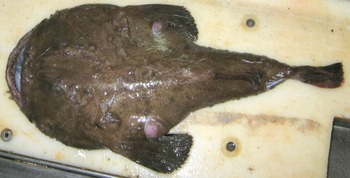
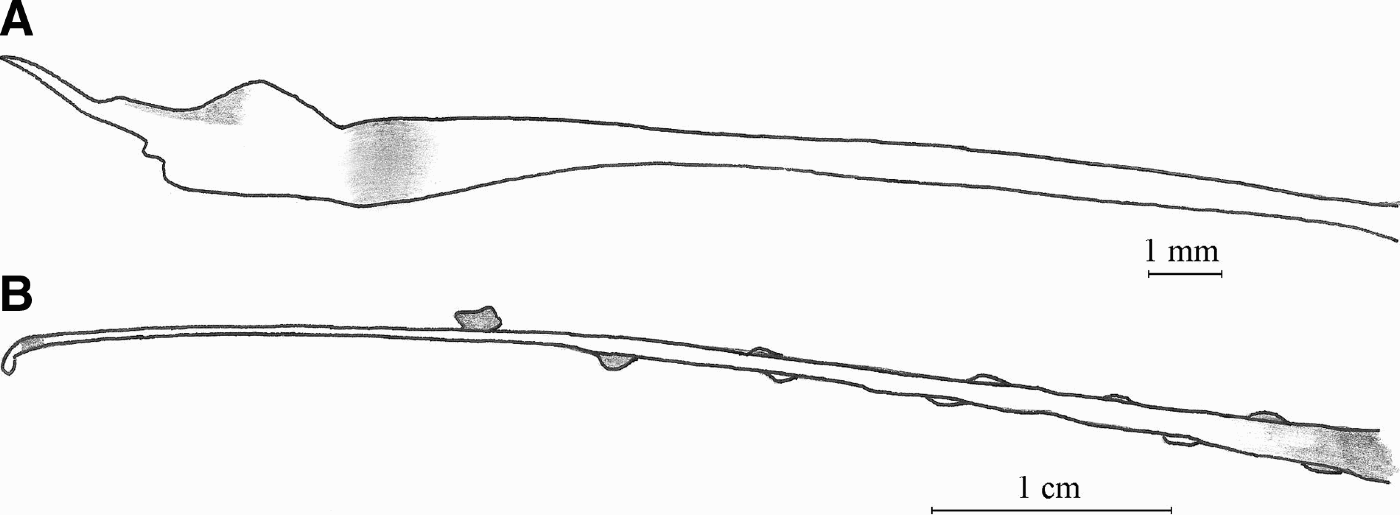
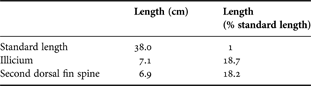
Dorsal coloration of the fresh specimen (Figure 1) was brown with a slight mottling produced by darker pigments. Ventral coloration was a mottled pale brown. The pectoral fins were the same colour as the body but darkened distally; the underturned posteromedial margin of the pectoral fin was black, a diagnostic characteristic of the species. Lateral fleshy tendrils were located around the head and tail but not on or near the pectoral fins. The esca was a simple pennant structure (Figure 2). The fish was not dissected so sex and maturity were not determined. The fresh specimen weighed 1408 g and measured 48 cm total length (TL). Following freezing more extensive measurements were taken. The TL was found to be 45 cm, indicating a shrinkage of 6%. Other measurements are shown in Table 1.
Freshly caught Lophius gastrophysus, 48 cm total length. (Photograph: Sarah Hearne.)

(A) Esca on illicium (first dorsal spine); (B) second dorsal spine. Scale bars: A, 1 mm; B, 1 cm.

Body measurements of the Lophius gastrophysus specimen found between 45°26.6–45°52.7S and 60°36.8–60°43.4W. Measurements were taken following freezing and defrosting and further preservation in 10% BFS solution.

DISCUSSION
The illicium length is proportionally longer than has been previously recorded for specimens from the South Atlantic. According to Caruso (Reference Caruso1983) the illicium length for fish from the South Atlantic was between 8.8 and 10.0% of standard length (SL). This specimen has an illicium length of 18.7% of SL which, while well in the range for this species, is much higher for those recorded from this area.
The discovery of this specimen extends the southern range of this species by 6° from a current southern limit of 39°S (Caruso, Reference Caruso1983) to 45°S. This is the second species of anglerfish (Lophiiformes) that has had a range extension southwards in the south-west Atlantic (Hearne, Reference Hearne2009). It is not possible to say whether these fish have recently extended their range or whether better coverage by scientists have made discoveries of rare fish more likely. It may be that while the South Atlantic Current (Campos et al., Reference Campos, Miller, Müller and Peterson1995) provides a southern limit for some species, a few eggs may be brought further south by eddies in this current. Vianna & Almeida (2005) found that L. gastrophysus catches along the Brazilian coast increased during spring due to the South Atlantic Central Water (SACW) which caused a concentration of the fish. The specimen was caught in September, southern hemisphere spring, and it may be that the SACW was responsible for the presence of the fish in the waters off Argentina. However, in a time when global climate change and its effects on species distributions are becoming increasingly visible (Perry et al., Reference Perry, Low, Ellis and Reynolds2005) these range extensions could be seen as yet another example of a growing trend.
ACKNOWLEDGEMENTS
Many thanks to J. Caruso for help with identification and to V. Laptikhovsky for his additional help and support. Thanks also to the anonymous referees whose comments improved this manuscript.