

Introduction
The African rice gall midge (AfRGM) Orseolia oryzivora H. & G. (Diptera: Cecidomyiidae), diopsid flies Diopsis sp. (Diptera: Diopsidae) and lepidopteran stem borers are key insect pests of rice in Africa. In Burkina Faso, the most serious stem borer species include the African white stem borer, Maliarpha separatella Rag. (Lepidoptera: Pyralidae), the African pink stem borer, Sesamia calamistis Hamp. (Lepidoptera: Noctuidae) and the African striped stem borers, Chilo zacconius Bleszynski (Lepidoptera: Crambidae) and Chilo diffusilineus J. De Joannis (Lepidoptera: Pyralidae) (Dakouo et al., Reference Dakouo, Nacro and Sié1988; Dakouo et al., Reference Dakouo, Nacro and Bacye1991; Tankoano, Reference Tankoano2005, Ba et al., Reference Ba, Dakouo, Nacro and Karamage2008).
Lepidopteran rice stem borers are a recurring problem in the Vallée du Kou irrigated rice scheme (Dakouo et al., Reference Dakouo, Nacro and Bacye1991, Ba et al., Reference Ba, Dakouo, Nacro and Karamage2008). An average of 40% whiteheads were recorded in this scheme during the 1999 dry cropping season. Yield losses associated with these insect pests can often reach 30% in Burkina Faso (Dakouo et al., Reference Dakouo, Nacro and Bacye1991) or even more in other parts of the world (Muralidharan and Pasalu, Reference Muralidharan and Pasalu2005). Stem borers, diopsid flies and the AfRGM are difficult to control with insecticides because they feed within the stems where they are protected. No resistant cultivars have been identified as yet, and that is why this study explores cultural practices as a control method of these insect pests. Several authors have investigated the impact of rice planting or sowing date on insect pest dynamics or damage. On studying the effect of four different planting dates on the population dynamics of the AfRGM, Dakouo et al. (Reference Dakouo, Nacro and Sié1988), clearly demonstrated that rice from the third transplanting date was the most damaged by the midge. This study aimed at identifying planting periods that could favour avoiding the most sensitive stages of the rice plant to stem borers. This paper intends to answer the question: Can transplanting periods affect the agro-morphological, entomological and the yield parameters?
Materials and methods
Study site
This study was carried out in Vallée du Kou, located approximately 30 km northwest of Bobo-Dioulasso, in western Burkina Faso. It is an irrigated rice area that covers 1200 ha with full water control. The geographic coordinates of the location are as follows: 4°22′ West longitude, 11°22′ North latitude and altitude of 300 masl. The climate is South Sudanian type (Guinko, Reference Guinko1984) characterized by the alternation of a monomodal rainy season from May to October and a dry season from November to April. During this study, the average minimum temperature ranged from 12 °C in January to 24.4 °C in May. The lowest average temperature was 31 °C, while the highest recorded in March was 39.8 °C. The minimum relative humidity of 57% was recorded in June and the maximum relative humidity ranged from 65% in January to 94% in September.
On-station experimentation
The FKR 62N rice variety with maturation duration of 118 days was used in this study. This variety was released after a participative varietal selection conducted in 2006. NPK (14:23:14) was applied at the dose of 200 kg/ha, 10 days after transplanting (DAT). Urea was used at the dose of 150 kg/ha and equally split three times (50 kg/ha for each application) at 30, 45 and 60 DAT, respectively. Then, 21-day seedlings were transplanted using 25 × 25 cm spacing. The seedling rate was 1–2, and there were 20 rows per plot and 40 hills per row. Weeding was performed three times at 25, 40 and 55 DAT, respectively. The experimental design consisted of a Fisher block arrangement with three treatments T1, T2 and T3 (planting dates) and four replications. Regular intervals of 14 days were used for subsequent planting dates. These three planting dates were 24 January 2010 for T1 (early planting date), 10 February 2010 for T2 (medium planting date) and 24 February 2010 for T3 (late planting date). The plot area was 50 m2 (10 m × 5 m) and that of a block was 160 m2 (16 m × 10 m). The space between plots was 0.5 m and that between consecutive blocks was 1 m. The total area where the experiment was carried out was 688 m2. No pesticides were applied.
Entomological observations in farmers' fields
Observations were performed on 25 hills of 1 m2 (quadrat) randomly set up in each treatment plot. Data were recorded once a week from the 21st DAT to the 85th DAT. These data included the number of tillers, deadhearts and whiteheads, and panicles.
Entomological investigations in the laboratory
In each plot, five hills were randomly removed out of a quadrat of 1 m2 every week from the 21st DAT to the 85th DAT. The five hills were removed once in the quadrat. Then, in the following week, another quadrat was set up, where five hills were removed and so on. The material was taken to the laboratory, where it was dissected and the following variables were assessed:
– Number of larvae;
– Number of pupae;
– Number of parasitoids.
Grain yield
To determine grain yield, a 4 m2 (2 m × 2 m) sub-plot was harvested in each treatment. The weight of the paddy was corrected to 14% humidity.
Data analysis
The percentage of damage and the percentage of parasitized larvae were calculated by the following equations:
 $$\%\ Deadhearts\ of\ 1\ m^{2} = (\Sigma \ of\ deadhearts\ of\ 1\ m^{2}/\Sigma \ of\ tillers\ of\ 1\ m^{2})\times 100; $$
 $$\begin{eqnarray} \%\ of\ parasitized\ larvae = \,(\Sigma \ of\ parasitized\ larvae/\Sigma \ of\ non\hyphen parasitized\ larvae + \Sigma \ of\ parasitized\ larvae)\times 100. \end{eqnarray}$$
The XLSTAT 2010 (Addinsoft Sarl, 40 rue Damaremont, 75018 Paris, France) was used for data analysis. Means were separated using the Student–Newman–Keuls test at 5% level of significance.
Farmers' fields
A total of 48 farmers' fields were selected based on three transplanting periods: from 22 January to 1 February 2010 for the first transplanting period (P1), from 4 February to 14 February 2010 for the second transplanting period (P2) and from 23 February 2010 for the third transplanting period (P3). Within a given transplanting period, farmers were randomly selected. Farmers were allowed to apply their usual cultural practices (varieties, weeding, etc.).
Entomological observations
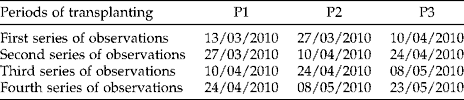
Visual entomological observations were the same as those performed on-station. In addition, 20 deadhearts and 20 whiteheads were removed every 15 days in each selected farm (Table 1) and dissected in the laboratory to assess the immature stages of stem borers and their associated parasitoids.
Calendar of observations in farmers' fields based on planting date (Vallée du Kou, Burkina Faso, 2010)
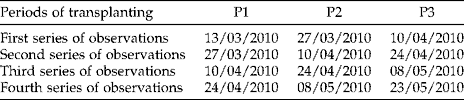
P1, P2 and P3 are the first, second and third period of planting, respectively.
Data analysis
Data were transformed according to Gomez and Gomez (Reference Gomez and Gomez1984) and then analysed using the same methods as for on-station data. A (X+1)½ transformation was performed.
Results and Discussion
On-station results
Average percentage of deadhearts and whiteheads
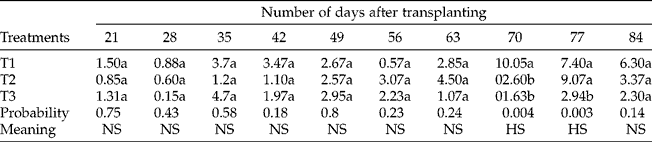
The analysis of variance of the percentage of deadhearts showed significant differences at 5% level between treatments at the 70th and 77th DAT (Table 2). T1 (10.05%) was significantly different from the other two treatments, T2 (2.6%) and T3 (1.63%). However, no significant difference was observed between T2 and T3 at the 70th DAT. At the 77th DAT, the percentage of deadhearts in T1 and T2 was significantly higher at 5% level (P= 0.003) than that recorded in T3. No significant difference was observed between T1 and T2 treatments at 5% level.
Evolution of the percentage of deadhearts based on the planting date (Vallée du Kou, Burkina Faso, 2010)
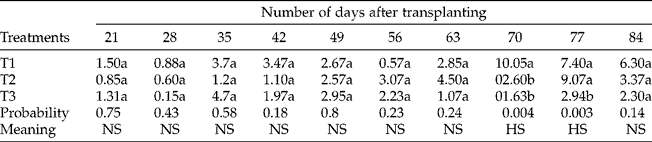
T1, T2 and T3 are the first, second and third planting dates, respectively.
Within the same column, the values with different letters are significantly different by the Student–Newman–Keuls test at 5% significance level. NS, not significant; HS, highly significant.
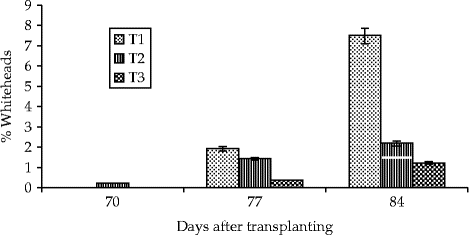
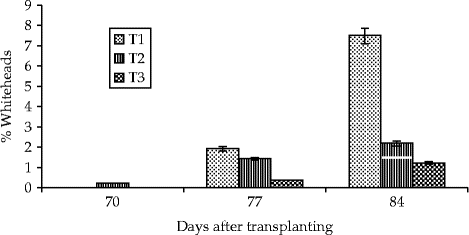
Whiteheads were recorded between the 70th and the 84th DAT (Fig. 1). Significant differences at 5% level between treatments were only observed at the 84th DAT. T1 (7.5%) was significantly different from T2 (2.17%) and T3 (1.42%).
Average percentage of whiteheads based on planting dates (Vallée du Kou, Burkina Faso, 2010). T1, T2 and T3 are the first, second and third planting dates, respectively.
Average percentage of tillers infested with Chilo spp. Maliarpha separatella and Sesamia calamistis larvae
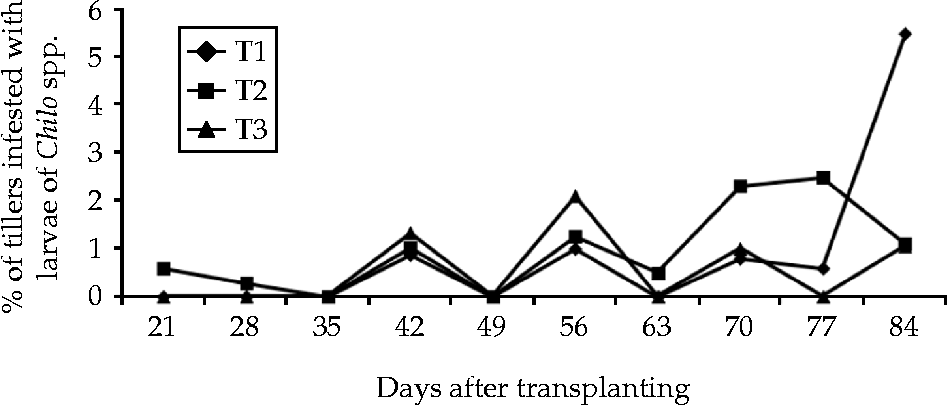
The evolution of the average percentage of infested tillers with Chilo spp. larvae is illustrated in Fig. 2. Highly significant and significant differences at 5% level between treatments were recorded, respectively, at the 77th and the 84th DAT for the respective levels of probability of P= 0.001 and P= 0.007. Overall, the highest average percentage of tillers infested with Chilo spp. larvae (5.5%) was recorded in T1 (Fig. 2).
Average percentage of tillers infested with larvae of Chilo spp. based on planting dates (Vallée du Kou, Burkina Faso, 2010). T1, T2 and T3 are the first, second and third planting dates, respectively.

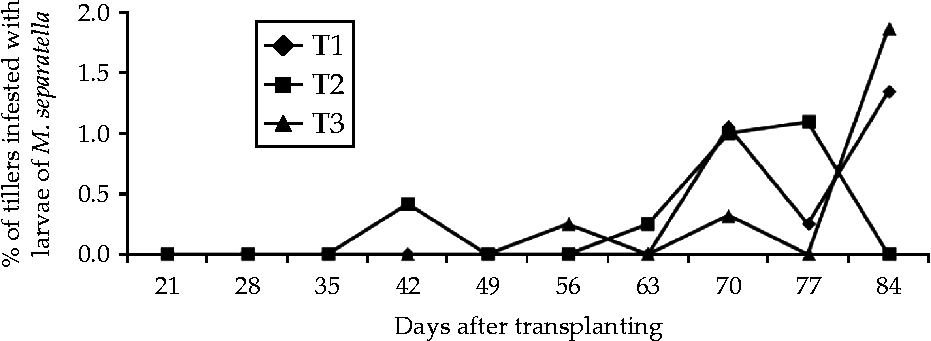
Few larvae of M. separatella were observed during the dissections in the laboratory. The highest average percentage (1.87%) of tillers infested with M. separatella larvae was recorded on the late planting date (T3) at the 84th DAT (Fig. 3). No larva of S. calamistis was recorded.
Average percentage of tillers infested with larvae of Maliarpha separatella based on planting dates (Vallée du Kou, Burkina Faso, 2010). T1, T2 and T3 are the first, second and third planting dates, respectively.
Yield
Results in farmers' fields
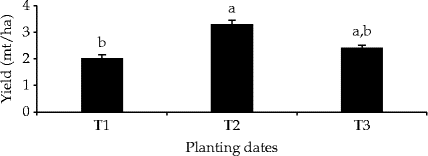
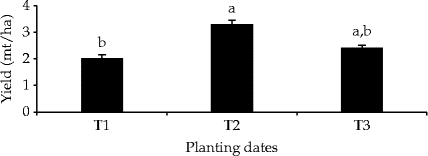
The highest grain yield (3.27 metric tons (mt)/ha) was recorded on the medium planting treatment. This yield was significantly different from the one recorded on the early planting treatment (2 mt/ha) but was not significantly different at 5% level from the one recorded on the late planting treatment (2.39 mt/ha) (Fig. 4).
Average yield (metric tons/ha) based on transplanting period (Bama, Burkina Faso, 2010). T1, T2 and T3 are the first, second and third transplanting periods, respectively.
Evolution of the average percentage of deadhearts and whiteheads
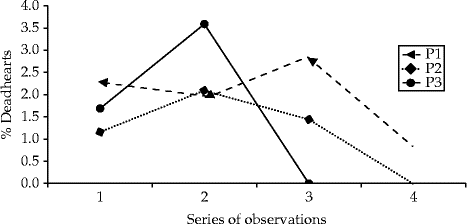
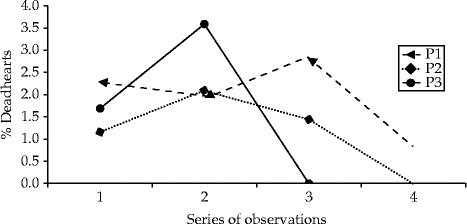
Two peaks in the average percentage of deadhearts were observed at the second and the third series of observations regarding the average deadheart rates, respectively (Fig. 5). The analysis of variance showed significant differences at 5% level between treatments during the third series of observations. The average percentage of deadhearts in P1 was significantly different from that of the other two treatments P2 and P3 (P= 0.019). No significant difference at 5% level was observed between P1 and P2 or between P2 and P3.
Average percentage of deadhearts based on periods of rice transplanting (Bama, Burkina Faso, 2010). P1, P2 and P3 are the first, second and third periods of rice transplanting, respectively.
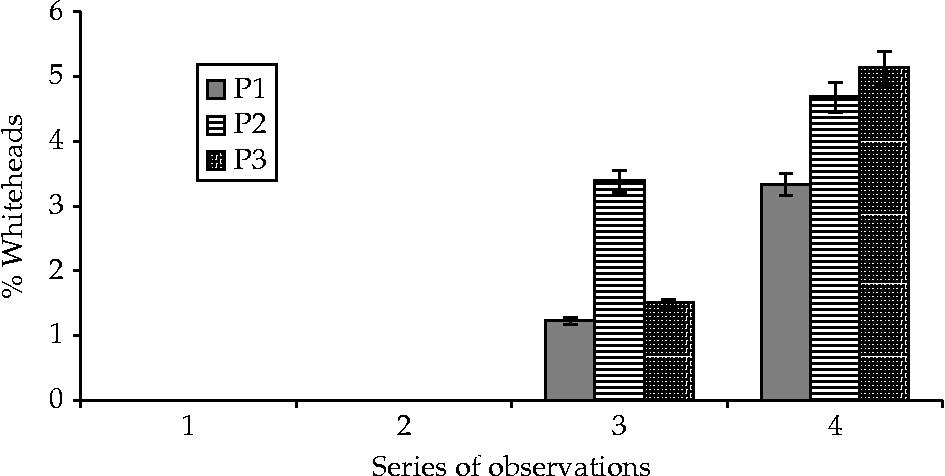
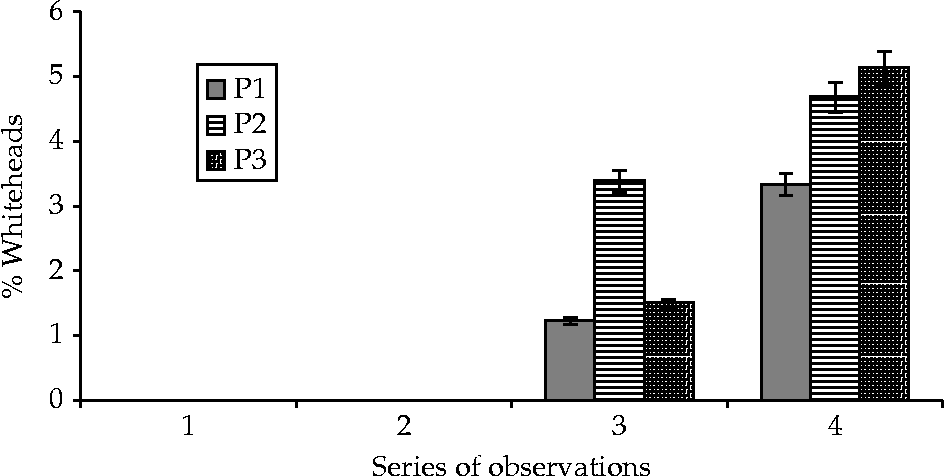
Regarding the average whitehead rates, a significant difference was observed between P2 and the two other treatments (P= 0.037) during the third series of observations. The highest damage rate (5.15%) was recorded in P3 (Fig. 6).
Average percentage of whiteheads based on periods of rice transplanting (Vallée du Kou, Burkina Faso, 2010). P1, P2 and P3 are the first, second and third periods of rice transplanting, respectively.
Average percentage of parasitized Chilo spp. larvae
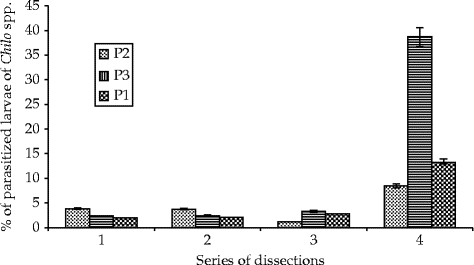
Larval parasitism of Chilo spp. was relatively low (less than 5%) during the first two series of dissections. The highest average of parasitized larvae of Chilo spp. was recorded in P3 (38.5%) during the 4th and last series of dissections (Fig. 7). Three parasitoid species were identified and they are as follows: Tropobracon antennatus (Granger) and Bracon testaceorufatus Granger (both Hymenoptera: Braconidae), and Goniozus indicus Ashmead (Hymenoptera: Bethylidae).
Average percentage of parasitized larvae of Chilo spp. based on periods of rice transplanting (Vallée du Kou, Burkina Faso, 2010). P1, P2 and P3 are the first, second and third periods of rice transplanting, respectively.
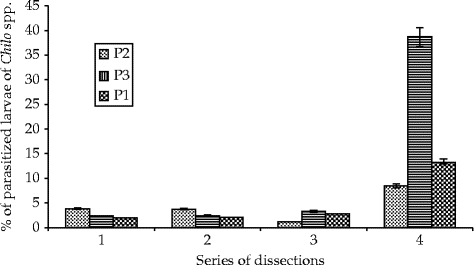
Significant differences between treatments were revealed during the third and the fourth series of dissections. During the third series of dissections, the average percentage of parasitism in P3 was significantly higher than that of P2 (P= 0.03). P3 was significantly different from P1 and P2 in the last series of dissections (P= 0.03).
Conclusion
For both on-station and farmers' fields, the highest percentage of deadhearts and whiteheads due to lepidopteran stem borers was recorded towards the end of the plant development cycle of rice. In these conditions, the early planting date T1 (on-station) and the late planting periods P2 and P3 (in farmers' fields) were the most affected. Rice-transplanting period significantly influenced the incidence of stem borers. Fields in the third transplanting period are those of farmers who do not comply with the recommendations of the extension services regarding the crop establishment calendar. Therefore, the non-adherence to these recommended practices could have exposed these fields to the most important damage due to stem borers. As much as 40% of whiteheads were reported on the same site during the 1999 dry cropping season. This level of damage is much higher than the maximum recorded in our study. The release of newly improved rice varieties combined with the training of hundreds of farmers in integrated pest management (IPM) practices is probably the reason for the reduction of stem borer damage. However, the level of damage recorded in this study still exceeds the economic threshold, which is 1% (Nacro et al., Reference Nacro, Dakouo and Heinrichs1995).
The percentage of pre-imaginal populations of lepidopteran stem borers was generally lower for the late planting dates. Larval populations of Chilo spp. fluctuated and varied with the planting dates. In other words, planting dates apparently affect larval populations of this species. However, the populations of M. separatella were negligible and those of S. calamistis were absent. These results indicate that Chilo spp. is the most important rice stem borer in the Vallée du Kou area.
According to the analysis of variance, planting dates significantly influenced rice yield. The lowest yield was recorded in the first planting date and the same treatment suffered the highest stem borer damage. From the above, we conclude that planting date has a significant effect on the yield.
The parasitism that affected the larval population of Chilo spp. may explain the high larval mortality of this insect pest. The implementation of the IPM training programme in this agroecosystem has promoted the conservation of the natural enemies associated with rice insect pests. This implies a rational, judicious and selective use of agrochemicals and farmers' capacity building, so that they can analyse the functioning of the agroecosystem and identify the interactions between the different components (plant, pests, predators, parasitoids, soil, etc.) of this agroecosystem. Since the 1980s, this is the first time that parasitoids are found to be associated with Chilo spp. in the Vallée du Kou rice location. Before the implementation of the IPM programme, insecticides were applied by farmers on a calendar basis, regardless of the occurrence of insect pests. This indicates that the Vallée du Kou ecosystem has recovered from the days of heavy pesticide use due to the training of farmers in IPM. In addition, pest populations can recover quicker than natural enemy populations.
In light of these results, we recommend the second transplanting period as the most appropriate for the dry cropping season in Vallée du Kou.
Acknowledgements
This work was supported by the fund from the International Institute for Education, USA, through the Alumni Impact grant of the Hubert Humphrey Fellowship Program awarded to the second author. The authors also thank Professor E. John Foster, Department of Entomology, University of Nebraska-Lincoln, for reviewing this manuscript.