1. Introduction
Within the framework of Cognitive Linguistics, research on the emotions has been heavily influenced by Conceptual Metaphor Theory (CMT), which has posited a metaphorical motivation for linguistic expressions representing emotional states (cf. inter alia Kövecses, Reference Kövecses1986, Reference Kövecses and Radman1995). These studies have been essentially qualitative, and from a methodological point of view have relied on introspective evidence. Criticism of this methodological perspective, of what has been labelled ‘intuitive metaphor analysis’, can be found inter alia in studies by Dobrovol’skij and Piirainen (Reference Dobrovol’skij and Piirainen2005), Pragglejaz Group (2007), and Stefanowitsch (Reference Stefanowitsch, Stefanowitsch and Gries2006); cf. also pertinent responses in Kövecses (Reference Kövecses, Handl and Schmid2011). What seemed to be missing in the early phases of conceptual metaphor research was sound quantitative investigation to support theoretical tenets and hypotheses. Empirically oriented studies began to appear when the question of the role of conceptual metaphor in discourse and text was posed, and this research direction was strengthened with the development of Corpus Linguistics. The tools developed by Corpus Linguistics offer researchers the possibility of mining large quantities of data and of accessing frequency and concordance algorithms, thereby permitting statistically supported quantitative analysis which can more safely warrant qualitative conclusions. Among the many metaphor scholars working in this direction we can mention, for example, Deignan (Reference Deignan2005), Semino (Reference Semino2002), and Stefanowitsch and Gries (Reference Stefanowitsch and Gries2006). As far as metaphor research on emotions is concerned, we can cite the study on the emotion “fear” by Oster (Reference Oster2010), using the COCA corpus (http://corpus.byu.edu/coca/), a significant example of the contribution that Corpus Linguistics research can offer for our understanding of the linguistic representation of the emotions. Recent studies by Ogarkova and Soriano (Reference Ogarkova and Soriano2014a, Reference Ogarkova, Soriano, Mussolf, MacArthur and Pagani2014b) on metaphors for the emotion “anger” go a step further providing Corpus Linguistics evidence from a cross-cultural point of view. However, many questions remain in contemporary metaphor theory, and research still struggles with the methodological strategies required to adequately explore its object of investigation.
The complexities of these methodological issues have been repeatedly posed in several noteworthy studies (cf. inter alia Barcelona, Reference Barcelona, Dirven and Porings2002, Reference Barcelona2003a [2000]; Cameron & Low, Reference Cameron and Low1999; Kövecses, Reference Kövecses, Handl and Schmid2011; Pragglejaz Group, 2007; Steen, Dorst, Herrmann, Kaal, Krennmayr, & Pasma, Reference Steen, Dorst, Herrmann, Kaal, Krennmayr and Pasma2010; Valenzuela & Soriano, Reference Valenzuela and Soriano2005). Nevertheless, empirical/experimental evidence in Cognitive Linguistics, which could be derived from investigations with human subjects themselves, and thereby support the reality of the cognitive processes behind the conceptual and linguistic representation of emotions, is still insufficient. Thus, the present study attempted to address this issue by developing a statistically supported empirical procedure with human subjects in order to verify further the psychological reality of the conceptual construals often claimed to motivate linguistic representations. The study moved through several pilot investigations, two of which are reported in Ponterotto (Reference Ponterotto, Mininni and Manuti2012, Reference Ponterotto, Rundblad, Tytus, Knapton and Tang2014), and which led to the more formalized statistically supported methodology of the present study. After a brief review of the pilot phases, the results of the final investigation are presented.
The empirical procedure is developed and verified through the exploration of the conceptual link between motion and emotion. A test protocol was constructed aimed at eliciting judgements by human subjects regarding the possible link between motion verbs and emotional states. In particular, the study investigates the possible conceptual connection between the physical movement of jumping and the emotional state of happiness.
2. Aims
The aim of this paper is thus first of all methodological. By means of a statistically supported investigation designed to uncover the possible existence of a conceptual construal linking motion and emotion, it attempts to suggest methodological strategies useful for research in Cognitive Linguistics on this topic. For this specific study, this motion/emotion construal is hypothesized to be represented linguistically in some contexts by the use of several motion verbs. The investigation focuses on motion verbs featuring the semantic trait of jumping, or jump-like movement, to evoke the emotional state of happiness. The study is also cross-linguistic. By observing two typologically different languages (English and Italian), it aims to lend further support on the one hand to theoretical positions in cross-cultural/linguistic research regarding the co-presence of similarity/difference in conceptualization and, on the other hand, to the methodological framework for its investigation.
3. Research rationale
We shall now briefly refer to the major theoretical and methodological questions which motivated this research direction.
Within research on the cognitive processes underlying emotion representation, many studies have focused on the role of metaphor and its ability to convey the subtle nuances of emotional experiences (cf. inter alia Athanasiadou, Reference Athanasiadou, Athanasiadou and Tabakowska1998, Reference Athanasiadou2014; Fainsilber & Ortony, Reference Fainsilber and Ortony1987; Foolen, Lüdtke, Racine, & Zlatev, Reference Foolen, Lüdtke, Racine and Zlatev2012 ; Fussell, Reference Fussell2002; Fussell & Moss, Reference Fussell, Moss, Fussell and Kreuz1998; Gibbs, Leggitt, & Turner, Reference Gibbs, Leggitt, Turner and Fussell2002; Kövecses, Reference Kövecses1990, Reference Kövecses2000, Reference Kövecses and Fussell2002b, Reference Kövecses2003; Ortony, Reference Ortony1975). In Psychology, several studies have pointed to the presence of metaphorical links between spatial location and affect (for instance, feeling up or feeling down). The study by Meier and Robinson (Reference Meier and Robinson2004), for example, provides experimental evidence for an association between affect and vertical position, evidence which seems to support hypotheses concerning the grounding of affect in sensorimotor perception (cf. inter alia Casasanto & Dijkstra, Reference Casasanto and Dijkstra2010; Crawford, Margolies, Drake, & Murphy, Reference Crawford, Margolies, Drake and Murphy2006; Lakoff & Johnson, Reference Lakoff and Johnson1999; Neumann, Förster, & Strack, Reference Neumann, Förster, Strack, Musch and Klauer2003). In Cognitive Linguistics, it has been suggested that emotions are embodied, i.e., grounded in human bodily experiences (cf. Evans & Green, Reference Evans and Green2006; Gibbs, Reference Gibbs2005). In Conceptual Metaphor Theory, it is commonly argued that, although constrained by differences determined by both cultural specificity and individual life situations, emotions present shared conceptual configurations, and consequently similar linguistic realizations (cf. for example, Athanasiadou & Tabakowska, Reference Athanasadiou and Tabakowska1998; Kövecses, Reference Kövecses2002a; Lakoff & Johnson, Reference Lakoff and Johnson1999; Zlatev, Racine, Sinha, & Itkonen, Reference Zlatev, Racine, Sinha and Itkonen2008).
One of the emotions extensively studied is “happiness”, an emotional state claimed to be conceptualized through a wide range of metaphorical frameworks, among which are found a set of evaluatively positive metaphors, such as: HAPPINESS IS FEELING LIGHT (not heavy) (I was floating), HAPPINESS IS UP (I’m feeling up today), HAPPINESS IS BEING IN HEAVEN (I was in seventh heaven) (cf. Kövecses, Reference Kövecses1991, Reference Kövecses, Tissari, Pessi and Salmela2008). In both English and Italian, we can find many conventionalized expressions apparently motivated by such a metaphorical conceptualization; in English: flying high, in seventh heaven, on cloud nine, over the moon, walk on air; in Italian (with their literal glosses): essere al settimo cielo [to be in seventh heaven], salire alle stelle [to climb up to the stars], toccare il cielo con un dito [to touch the sky with your finger], volare dalla gioia [to fly for joy], sentirsi su [to feel up].
Some scholars have described the role apparently played by motion verbs in representing emotional states. Faber and Mairal Usón (Reference Faber and Mairal Usón1999) highlight how choice of verb in English conveys the subject’s perception of a particular emotion. Against the background of research on the typological differences of motion event representation (Özçalişkan & Slobin, Reference Özçalişkan, Slobin, Greenhill, Littlefield and Tano1999; Slobin, Reference Slobin, Shibatani and Thompson1996, Reference Slobin, Bybee, Haiman and Thompson1997, Reference Slobin, Stromqvist and Verhoeven2004, Reference Slobin, Hickman and Robert2006; Talmy, Reference Talmy and Shopen1985, Reference Talmy1991, Reference Talmy2000), the question of ‘metaphorical motion events’ has been posed (Özçalişkan, Reference Özçalişkan2004) and has also been explored from a cross-linguistic perspective (cf. Özçalişkan, Reference Özçalışkan2003, Reference Özçalişkan2005; Athanasadiou, Reference Athanasiadou2014; Zlatev, Blomberg, & Magnusson, Reference Zlatev, Blomberg, Magnusson, Foolen, Lüdtke, Racine and Zlatev2012).
Now the emotional state of happiness is often evoked through the use of a motion verb like “jump”. In fact, in English we find the conventionalized expression Maria was jumping for joy ; in Italian, we likewise find the expression Maria saltava dalla gioia [Maria was jumping for joy]. This line of reasoning led us to our basic research question, i.e., the possible existence in both English and Italian of an association in conceptualization between the movement “jumping” and the emotion “happiness”. The present research then attempted to develop a cross-linguistic investigative method for verifying the existence of a conceptual link between the emotional state of happiness and some motion verbs encoding the semantic feature of “jumping”.
4. The pilot studies
Before presenting the data of the present study, this section summarizes the pilot phases of this investigation (in this paper labelled ‘Pilot Study 1’, ‘Pilot Study 2’, and ‘Pilot Study 3’) on the link between motion verbs and the domain of emotional states.
4.1. pilot study 1
The first pilot study, reported in Ponterotto (Reference Ponterotto, Mininni and Manuti2012), made a random selection of fifty verbs in both languages (English and Italian) and submitted a questionnaire to two small groups of subjects (English-speaking and Italian-speaking), who were asked to describe for each verb the type of movement encoded and then to state if, in their opinion, the verb evoked an emotional state, and which emotional state. The stimulus items (the motion verbs) were presented with a model sentence which included the path as “across the room” (e.g.. She went across the room). An example from the English is given in Table 1.
Example of presentation of target items in the English questionnaire

For most verbs, the subjects of both language groups produced detailed descriptions for movements and consistently associated emotional states with them. Moreover, in this first pilot study, the emotion “happiness” emerged frequently. When we considered the verbs associated by the English-speaking subjects with this emotion, we found a somewhat systematic response across the subjects linking certain verbs with this emotion (like bounce, for example). Then, when we looked at the terms given by the subjects to describe the movements, we noted that despite the presence of a wide variety of descriptions, most of the responses included terms like jump, up, up and down, airy, and lightly. A similar pattern emerged for the Italian language where the responses included terms like salti [jumps], or su [up], or su e giù [up and down], or staccandosi da terra [lifting oneself off the ground].
On the basis of this first data collection, a specific hypothesis began to take shape. First of all, the verb/movement/emotion associations seemed to confirm that, in both languages, specific movements encoded in the motion verbs are often associated with specific emotional states. Second, as far as “happiness” is concerned, the emotion often seemed to be represented by several motion verbs, encoding a specific type of upward movement, which we termed “jump-like”. These observations led to the hypothesis of a conceptual construal linking this specific emotion, happiness, with some verbs encoding upward movement and in some cases with a specific manner of motion: jumping.
4.2. pilot study 2
In order to verify this hypothesis, the next step was to narrow the focus of the investigation and to refine the investigative design. For this second phase, it was decided to elicit judgements referred only to the emotional state of happiness, to use a larger number of subjects (35 subjects for each language group), and to incorporate statistical tools for the quantitative analysis. The results, reported in Ponterotto (Reference Ponterotto, Rundblad, Tytus, Knapton and Tang2014), revealed a statistically significant association between “happiness” and some verbs encoding jump-like movements for both groups: in the Italian-speaking group, the verb saltellare [skip, hop], (z-test for proportions-Dependent Groups p < .05); in the English-speaking group, the verbs bounce, hop, and skip (z-test for proportions-Dependent Groups p < .05). Moreover, in the inter-group comparison between the highest-ranking verb in the English group (bounce) and the highest-ranking verb in the Italian group (saltellare [skip, hop]), a z-test for proportions-Independent Groups revealed no significant differences, leading to a conclusion of similarity. In other words, the statistically supported results pointed to an association in both the English and Italian groups between a jump-like upward movement and the emotional state of happiness.
4.3. pilot study 3
However, despite the basic similarity which emerged in the second study, an ex-post re-examination of the data led us to reflect on the wide variety of terms produced by both the Italian-speaking subjects and the English-speaking subjects for both movements and emotions. Responses were by no means totally similar across informants, a fact which suggested the existence of a complex, articulated conceptualization both of the types of movement encoded in the verbs and of the emotional states associated with them. A closer investigation of these descriptive terms was thought to be in order for those motion verbs which had emerged statistically in Pilot Study 2 as more salient, and which is reported in the following section.
4.3.1. Procedure
Following McNaught and Lam (Reference McNaught and Lam2010), where the Wordle software tool is used to analyze qualitative data of informants’ responses, we submitted our data to the program Wordle (available on the website, www.wordle.net). A word cloud is a special visualization of text in which the more frequently used words are effectively highlighted by occupying more prominence in the pictorial representation. This prominence emerges by means of graphic highlighting, including font size, and position, as well as depth, breadth, and, if required, colour of lettering. The algorithms used to balance various aesthetic criteria and create the distinctive Wordle layouts are described in Viegas, Wattenberg, and Feinberg (Reference Viegas, Wattenberg and Feinberg2009) and in Feinberg (Reference Feinberg, Steele and Ilinsky2010). Footnote 1
It was thought that such a graphic representation could reflect the conceptual map, so to speak, of the entire group of informants, i.e., which semantic traits were more salient for movements and which descriptive terms were more frequently used for the emotional state.
Thus, in order to give a visual description of the major differences between the Italian-speaking subjects and the English-speaking subjects in the conceptualization of the link between motion verbs and the emotional state of happiness, ‘word clouds’ were generated for those verbs which had registered the highest statistically significant values in the results of Pilot Study 2, i.e., bounce, skip, and hop for English and saltellare [skip, hop] for Italian. For each motion verb, all the responses (whether single-word or multi-word units) of all the thirty-five subjects for each group were inserted into the source text file of the Wordle software program, first for movements and then for emotions, and relative ‘word clouds’ were generated.
We here suggest that the ‘word cloud’ can be said to approximate a representation of the most salient conceptualization of each group of thirty-five speakers. In other words, by means of graphic letter evidencing, it represents the movement-related and emotion-related senses judged by the speakers to be potentially encoded in the verbs.
4.3.2. Results of the word-cloud analysis
We now give the generated images, first for “Movements” and then for “Emotions”, of the statistically significant verbs (Italian saltellare [skip, hop] and English bounce, skip, and hop.
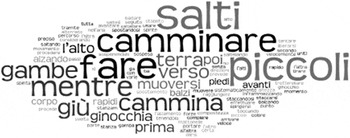
In Italian, for movements, the most salient terms are salti [jumps], camminare [walk] piccoli [small]. In fact, the protocols often reported camminare con piccoli salti [walking with small jumps] (Figure 1).
Wordle cloud layout for total responses of informants for “movements” associated with the Italian word saltellare [skip/hop].

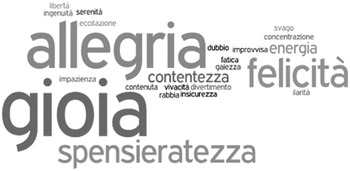
For emotions, it can be seen in Figure 2 that what emerges is a group of terms synonymous with, or related to “happiness”. They were gioia [joy], allegria [glee, mirth], felicità [happiness], followed by words clustering close to the central terms like spensieratezza [carefreeness, lightheartedness], contentezza [contentment, gladness].
Wordle cloud layout for total responses of informants for “emotions” associated with the Italian word saltellare [skip/hop].

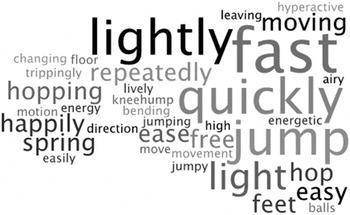
In English, for movement, the most prominent terms for bounce were lightly, fast, quickly, jump, light, followed by terms clustering close to the central terms like hopping, spring, hop, energetic, airy, and we can also see the assignment of emotional terms like easy or happily (Figure 3).
Wordle cloud layout for total responses of informants for “emotions” associated with the English word bounce.

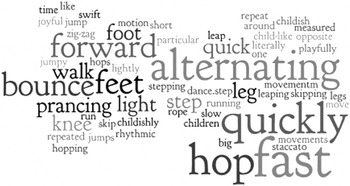
For skip, the most prominent descriptors are hop, fast, quickly, alternating, bounce, feet, forward, prancing, light, foot (Figure 4).
Wordle cloud layout for total responses of informants for “movements” associated with the English word skip.

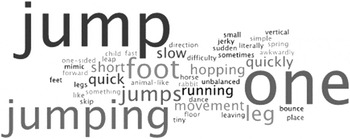
For the motion verb hop, the sense of “jumping” is obviously extremely salient, since besides the terms one, foot, leg, the word cloud yielded the prominent visualization of jump, jumping, and jumps (Figure 5).
Wordle cloud layout for total responses of informants for “movements” associated with the English word hop.

For emotions, for the word bounce , the term happiness emerges with evident prominence; other terms are only very slightly associated: excitement, playful, fun, exhilaration, and active (Figure 6).
Wordle cloud layout for total responses of informants for “emotions” associated with the English word bounce.

For the motion verb skip, the term happiness is again salient, and we find a minor presence of the terms carefree, fun, and joy (Figure 7).
Wordle cloud layout for total responses of informants for “emotions” associated with the English word skip.

For the motion verb hop, happiness again emerges as a very prominent term, but is associated with several related terms: playfulness, fun, playful, excitement (Figure 8). Footnote 2
Wordle cloud layout for total responses of informants for “emotions” associated with the English word hop.

4.3.3. Conclusions of the word cloud analysis
The similarities and differences emerge clearly from the word cloud maps.
The Italian subjects associated “happiness” mainly with one verb saltellare [skip, hop], perceived as walking accompanied by small jumps. The emotional state of happiness, however, is expressed by a set of related terms: gioia [joy], allegria [glee, mirth], felicità [happiness], spensieratezza [carefreeness, lightheartedness], contentezza [contentment, gladness]. So the conceptualization of “happiness” in the Italian group seemed to be somewhat complex, encompassing various nuances and multiple labels for this emotional state.
The English speakers, on the other hand, associated more than one verb with the emotional state, bounce, skip, and hop, each one foregrounding differently clustered associations but all three featuring a jump-like movement. In comparison with the Italian speakers, the English speakers seemed to produce fewer descriptive terms for the emotional state and indicated instead a consistent preference for the emotion term: happiness.
We can also note that the preferred choice of emotion term seemed to be “happiness” in the group of English-speaking subjects and “gioia” [joy] in the group of Italian-speaking subjects.
5. The present study
Although the use of word clouds can contribute to the interpretation of results, it can only be used as an adjunct tool. As suggested by McNaught and Lam (Reference McNaught and Lam2010), Wordle is useful primarily either for preliminary analysis or for ex-post validation of previous findings. Thus, further empirical evidence seemed to be required.
The results of the pilot investigations revealed for both English and Italian an association between a jump-like upward movement and the emotional state of happiness. Thus, it was then decided to focus on the sense of “jumping” and explore this association for a larger set of similar motion verbs with statistical tools for the quantitative analysis. Thus, the last study posited a more focused hypothesis which can be formulated thus:
For some motion verbs encoding a jump-like upward movement, both speakers of English and speakers of Italian perceive the possibility of a conceptual link with the emotional state of happiness.
5.1. procedure
5.1.1. Target items
This empirical procedure again used a questionnaire. The target items, however, were selected in the following way. In the pilot studies, statistically significant values emerged for the English verbs bounce, skip, and hop, and for the Italian verb saltellare [skip, hop]. Since these verbs encode a manner sense whose dictionary definitions include a “jump-like” movement (a connotation which had emerged in our pilot data), it was decided to focus on this connotation of “jumping” by incorporating a larger set of similar motion verbs in the investigative design. A dictionary search enabled us to select other verbs, lexicographically recorded as equivalent, near-synonymous, or related to those resulting from the previous pilot studies. Thus, eight verbs were chosen for English and eight for Italian, all of which include, in some form or another or to some extent, the semantic trait of jumping. For the English language, the verbs were: bounce, bound, hop, jump, leap, lollop, skip, spring; for the Italian language, the verbs (indicated here with their dictionary equivalents in brackets) were: ballonzolare [skip about], balzare [leap, jump], balzellare [skip, hop], saltare [jump], saltellare [skip, hop], salterellare [hop, skip], scattare [spring up], sobbalzare [jerk, start]. Footnote 3 For the present study, it was also decided to insert into the questionnaire a larger number of distractor items. Footnote 4 Thus, the questionnaire in this study presented the eight target items along with eight distractor items. The sixteen verbs for each group were listed in random order. Since all the motion verbs selected as target items included the semantic feature of jumping or jump-like movement, the questionnaire in this study excluded the requirement of movement description and simply asked the subjects to state whether or not they associated the verb with the emotion “happiness”. Thus, unlike the open-ended format of the pilot studies, the subjects were given a closed questionnaire (yes/no). In other words, they were asked to check for each stimulus item either the yes column (+happiness) or the no column (–happiness). Examples of the questionnaires are found in ‘Appendix 3’.
5.1.2. Subjects
Each group of subjects (Italian-speaking and English-speaking) included thirty adults, male and female, between the ages of 18 and 35, making a total of sixty subjects. The Italian informants were university students primarily from the area of Rome, in central Italy. The English informants were from Canada, England, Ireland, and the United States, and included students and young teachers living temporarily in Rome or acquaintances contacted by email. The questionnaire was administered in person for the Italian-speaking group and both in person and on-line for the English-speaking group.
5.1.3. Data analysis
The results were quantified for the target items (the eight motion verbs) for both groups, English and Italian. The relative values which emerged were submitted to non-parametric statistical analysis.
5.2. results Footnote 5
5.2.1. English data
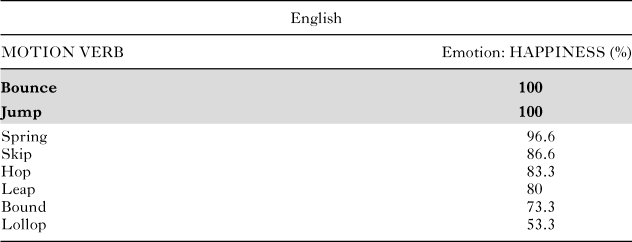
Table 2 reports the relative values of responses of total number of English-speaking subjects (30), associating motion verbs with jumping movement and the emotion “happiness” (in decreasing order and with bold face and shading of the highest percentages).
Percentage of English-speaking subjects associating motion verbs with the emotion “happiness”

The highest percentages in the English group emerged for bounce and jump (both 100%), followed by spring (96.6%), skip (86.6%), hop (83.3%), leap (80%), and bound (73.3%). The lowest value resulted for the verb lollop (53.3%).
Z-tests for proportions-Dependent Groups were conducted in order to determine if there were statistically significant differences among the verbs regarding the strength of association between the motion verbs and the emotion “happiness”. The results of the statistical analysis for the English data are detailed in ‘Appendix 1’.
In the English data, bounce and jump score significantly higher than bound and lollop (p < .001), as well as leap (p < .01), and also hop and skip (p < .05); spring scores significantly higher than lollop (p < .001), bound (p < .01), and leap (p < .05); skip and hop are higher than lollop (p < .01). Thus, it would seem that the strength of the association differs. In other words, in English, some motion verbs encoding a jumping movement display a stronger conceptual link with the emotional state. The strongest associations emerged for the set of verbs bounce and jump, followed closely by spring. The set leap, hop, skip, and bound follows, with the weakest association resulting for lollop.
5.2.2. Italian data
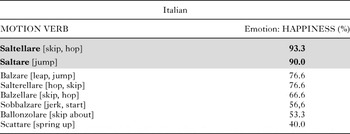
Table 3 reports the relative values for the responses of the total number of Italian-speaking subjects (30), associating motion verbs with the emotion “happiness” (ordered alphabetically and with bold face and shading of the highest percentages).
Percentage of Italian-speaking subjects associating motion verbs with the emotion “happiness”

The highest percentage in the Italian group is for saltellare [skip, hop] registering 93.3% of positive responses. This was followed closely by the verb saltare [jump] (90%). Both balzare [leap, jump] and salterellare [hop, skip] emerged with a result of 76.6%, followed by balzellare [skip, hop] (66.6%), sobbalzare [jerk, start] (56.6%), and ballonzolare [skip about] (53.3%). The lowest value was for scattare [spring up] (40%).
Z-tests for proportions-Dependent Groups were conducted in order to determine if there were statistically significant differences among the verbs regarding the strength of association between the motion verbs and the emotion “happiness”. The results of the statistical analysis for the Italian data are detailed in ‘Appendix 2’.
In the Italian data, saltellare [skip, hop] scored significantly higher than ballonzolare [skip about] (p < .001), balzare [leap, jump] (p < .05), balzellare [skip, hop] (p < .005), salterellare [hop, skip] (p < .05), scattare [spring up] (p < .001), and sobbalzare [jerk, start] (p < .001). No significant difference emerged between saltellare [skip, hop] and saltare [jump]. The verb saltare [jump] follows, being significantly higher than four other verbs: ballonzolare [skip about] (p < .001), balzellare [leap, jump] (p < .01), scattare [spring up] (p < .001), and sobbalzare [jerk, start] (p < .001). Then comes balzare [leap, jump], significantly higher than three other verbs: salterellare [hop, skip] (p < .05), scattare [spring up] (p < .001), and sobbalzare [jerk, start] (p < .05), followed by salterellare [hop, skip], significantly higher than two other verbs: scattare [spring up] (p < .001) and sobbalzare [jerk start] (p < . 005).
Thus, in the Italian-speaking group also, it would seem that the strength of the association differs. In other words, in Italian, some motion verbs encoding a jumping movement display a stronger conceptual link with the emotional state. The strongest association emerged for the set saltellare [skip, hop] and saltare [jump]. Then comes the set balzare [leap, jump] and salterellare [hop, skip], followed by sobbalzare [jerk, start] and ballonzolare [skip about], with the weakest association for scattare [spring up].
5.3. english – italian comparisons
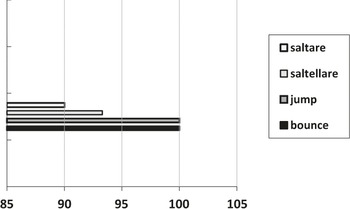
An analysis of the global results reveals that, in both language groups, the emotion “happiness” was associated with some motion verbs encoding a jumping movement. Figure 9 presents a comparative view of the highest rankings in each group.
Comparison of motion verbs with highest relative values of subjects associating motion verbs featuring jumping movement and the emotion “happiness” (English bounce and jump, Italian saltellare [skip, hop] and saltare [jump]).

The relative frequencies for the association between motion verbs and the emotion “happiness” reported in Figure 9 revealed higher values for the English verbs bounce and jump compared to the Italian verbs saltellare [skip, hop] and saltare [jump]. This also suggested a stronger association for the English verb jump than for its Italian equivalent saltare [jump].
A z-test for proportions-Independent Groups was then performed to determine if there exists a difference between the highest-ranking items of the set of Italian verbs (saltare [jump] and saltellare [skip, hop]) and the set of English verbs (bounce and jump). A statistically significant value (p > .05) emerged for the difference between saltare [jump] and both bounce and jump (to the advantage of bounce and jump (z-score = 1.80, 1 tail p < .05). No significant difference resulted for the comparison between bounce and saltellare [skip, hop], nor between jump and saltellare [skip, hop]. In other words, for the Italian verb saltellare [skip, hop] Footnote 6 and the English verbs bounce and jump, the strength of the emotive association is equally potent. A z-test for proportions-Independent Groups was also performed for a comparison between the two groups of the mean values of the entire set of verbs (all 8 English verbs vs. all 8 Italian verbs). No significant difference emerged (z-score = 1.37; n.s.). The comparison was also conducted for the top (highest) four verbs across languages (z-score = 1.51; n.s.) and for the bottom (lowest) four verbs across languages (z-score = 1.48; n.s.). Again, no significant differences emerged. Thus, although to varying degrees, both groups of subjects (English and Italian) associated “jumping” movement with the emotional state of happiness.
From a semantic point of view, if we wished to compare the meanings of the top English words bounce and jump and the top Italian words saltare and saltellare, we could note how dictionary definitions register some subtle differentiating nuances. The Collins dictionary definition of the English word jump is “to move your body upward from the ground and often forward, backward, or sideways through the air by pushing with your legs”. This is similar to the Treccani dictionary definition for the Italian word saltare: “staccarsi di slancio da terra, rimanendo per un attimo sospeso in aria, con tutti e due i piedi sollevati, e ricadendo poi sullo stesso punto o a una certa distanza” [remove oneself with a leap from the ground, remaining suspended for a moment in the air, with both feet raised, and then falling on the same spot or at a certain distance]. Both seem to feature the image of the legs pushing the body into the air. The definition for English jump, however, also highlights direction: “often forward, backward, or sideways”, and the action of “pushing”. The dictionary definition for the Italian verb saltare highlights position off the ground “remaining suspended for a moment in the air” and the aspect of falling down again. The dictionary definition of the English word bounce emphasizes a movement in one and then in an opposite direction. It also includes the connotation of the energetic “to move with a lot of energy and excitement”. The dictionary definition of the Italian word saltellare includes the word “salti” [jumps], highlighting, however, small repeated jumps: “fare dei salti piccoli e frequenti” [make frequent small jumps]. Similar to the connotation of energetic in the English word bounce, the Italian word saltellare includes liveliness in its definition “vivacemente” [lively].
5.4. conclusions
First of all, by means of a different investigative design, the results confirmed the findings in the previous pilot study (Ponterotto, Reference Ponterotto, Rundblad, Tytus, Knapton and Tang2014), which had revealed significant values for the English verb bounce and the Italian verb saltellare [skip, hop]. More importantly, the results verify the hypothesis stated for the investigation: for some motion verbs encoding a jump-like upward movement, both speakers of English and speakers of Italian perceive the possibility of a conceptual link with the emotional state of happiness. Those verbs are primarily in English bounce and jump followed closely by spring, and in Italian saltellare [skip, hop] and saltare [jump]. Other similar verbs emerged, especially in English, although with a lower level of statistical significance. Thus, there seem to be sets of motion verbs which can carry the function of such a conceptual association. As far as the difference between the two groups is concerned, a greater number of verbs seems to constitute the English set.
These results point to the existence of a conceptual link between some motion verbs encoding a jump-like movement and a happiness-related emotional state. It seems that, despite the range of lexical meanings of the motion verbs investigated, the presence of a common semantic feature (jumping) can trigger an affective connotation, at least for the emotion under investigation here, i.e., “happiness”.
6. Discussion
The series of investigations provides empirical support for the hypothesis of a mental construal associating the concept of movement with the concept of emotion. For both groups of speakers, a link was confirmed between some motion verbs encoding a jump-like movement and the emotion happiness.
In other words, one of the ways this emotion finds its lexical realization is in several motion verbs which share the semantic feature of “jumping”. Thus we find partially fixed conventionalized expressions like She/He was jumping for joy in English and Saltava dalla gioia [She/He was jumping for joy] in Italian, which are frequent in many contexts in contemporary discourse, Footnote 7 as in the following examples:
-
(1) London 2012 Olympics: not jumping for joy doesn’t make you a traitor. (Alex Andreou) <http://www.theguardian.com/commentisfree/2012/jul/27/london-2012-olympics-not-jumping-for-joy>
-
(2) Quanti neopadri si sono messi a saltare per strada dalla felicità…! (Natalia Aspesi, Festa d’aprile)
[How many brand new fathers began jumping down the street from happiness…!] <http://d.repubblica.it/dmemory/1998/04>
-
(3) For a second she thought she couldn’t look as the little dial spun toward a number. It stopped. She was almost a full 6 pounds lighter! She wanted to jump for joy. This was going to be a very good day! This was going to be the start of something great. … The world looked brighter and she was happier. (Shape, 2006) <http://corpus.byu.edu/coca>
-
(4) Il Pontificato di Francesco: “Un saltare di gioia” [The Papacy of Frances: “A jumping for joy”] <http://vaticaninsider.lastampa.it/> (last accessed 17 November 2015)
However, distinct differences also emerged in the study, consisting in both within-group and across-group variation. First of all, within both groups, statistically significant differences emerged among the verbs regarding the strength of association. In the set of Italian verbs, saltellare [skip, hop]) and saltare [jump] and, to a lesser extent, balzare [leap, jump] and salterellare [hop, skip], seem to have strong associations with the emotion; in the set of English verbs, the strong associations resulted for bounce, jump, and spring, and, to a lesser extent, hop, leap, and skip. Moreover, the statistically significant difference which emerged between the English verbs bounce and jump and the Italian verb saltare [jump] suggests a stronger association for English bounce and jump than for Italian saltare [jump].
Furthermore, as illustrated in the word clouds in Section 4.3.2 above, it should also be emphasized that, in the pilot investigations, our subjects gave different and differentiated descriptions for the movements perceived in each motion verb. This points to the complex multiplicity of movement types as well as to the heterogeneity of their verbal representation.
In addition, it should likewise be noted that in the pilot studies the subjects also produced differentiated labels of the emotional states associated with the verbs. Within-group and across-group differences emerged in the happiness-related labels given by the subjects. The English language data seemed to converge on the term “happiness”; the Italian language data, on the other hand, foregrounded several terms: “goia” [joy], “allegria” [glee, mirth], “felicità” [happiness], “spensieratezza” [carefreeness, lightheartedness], “contentezza” [contentment, gladness]. Footnote 8 Thus, what emerged was a cross-cultural difference in emotion labelling, an effect coinciding with reflections by Wierzbicka (Reference Wierzbicka1990, Reference Wierzbicka1992a, Reference Wierzbicka1992b, Reference Wierzbicka1999, Reference Wierzbicka2009) on the cross-linguistic and cross-cultural specificity of emotion terms.
7. Further reflections
The investigation reported here therefore can advance a number of conclusions, but leaves several theoretical and methodological problems unresolved.
The study explores an empirical approach for an investigation into similarities and differences across languages and cultures on the conceptualization of emotions. As far as the specific object of investigation is concerned, the conceptual association between movement and emotion, it developed a methodological strategy for deriving statistically supported empirical evidence for the role of motion verbs in representing emotional states. By eliciting judgements from human subjects, and by using statistically elaborated data analysis, the study was able to verify for the emotion “happiness” one of the many conceptual construals claimed to motivate its linguistic representation. Although represented by different formal configurations, i.e., different sets of motion verbs, the emotion “happiness” was associated by our subjects, although to varying degrees, with a physical jump-like movement. Second, the study confirms the centrality of the question of universality vs. cultural variation in research on conceptual construals. On the one hand, the data revealed fine-tuned differentiated subtleties in movement description and various labels for emotions, lending support both to the variationist perspective in Cognitive Linguistics (cf. Kövecses & Koller, Reference Kövecses and Koller2006; Kristiansen & Dirven, Reference Kristiansen and Dirven2008) and to the cross-cultural perspective in emotion research (cf. Ogarkova & Soriano, Reference Ogarkova and Soriano2014a, Reference Ogarkova, Soriano, Mussolf, MacArthur and Pagani2014b). On the other hand, while unveiling the many differences between the two languages in the specific articulation of conceptual associations, the data also pointed to common patterns.
Nonetheless, several theoretical and methodological problems remain which could indicate future research avenues. We have shown that a common pattern in the construal motion verbs / emotion may lie in the coincidence of one or more of their shared semantic features. In our investigation, both our Italian-speaking and English-speaking subjects seemed to perceive an association between the emotion happiness and some motion verbs encoding jumping movements, which then led us to postulate a potential motion/emotion conceptual construal linking jumping upward movements with “happiness”.
Jumping is a physical behaviour which often accompanies the experience of this emotion. Would the semantic trait of jumping be merely the literal fact that people jump when happy? Footnote 9 To what extent can we claim that this conceptual association is motivated by other cognitive processes? Footnote 10
Now, the literature in CMT definitely seems to agree on the existence of the CM: HAPPY IS UP, whose cognitive reality has been demonstrated in psychologically oriented experimental research (cf. for example, Meier & Robinson, Reference Meier and Robinson2004; Weger, Meier, Robinson, & Inhoff Reference Weger, Meier, Robinson and Inhoff2007). In fact, Crawford et al. (Reference Crawford, Margolies, Drake and Murphy2006, p. 1166) comment on the connection between the concept of verticality and that of happiness:
According to Lakoff and Johnson (Reference Lakoff and Johnson1980, Reference Lakoff and Johnson1999), spatial concepts are learned through sensorimotor experience, and, as a result, are some of the few concepts that are understood directly rather than metaphorically. They note that such sensorimotor experiences often accompany subjective experiences; for example, happiness is accompanied by upright posture. Consequently, associations are learned between the subjective domain of happiness and the sensorimotor domain of verticality, producing a cross-domain mapping that allows spatial concepts to be used to conceptualise and describe the subjective experience of happiness.
Can we hypothesize that, along with verticality, the domain of movement also triggers mental access to the emotional domain of happiness through other cognitively motivated processes? Indeed, this association may be rooted in metonymical relations based on a behavioural response (cf. Barcelona, Reference Barcelona and Barcelona2003b [2000]); Kövecses, Reference Kövecses, Tissari, Pessi and Salmela2008, Reference Kövecses2013; Panther & Radden, Reference Panther and Radden1999; Panther & Thornburg, Reference Panther, Thornburg, Geeraerts and Cuyckens2007; Radden, Reference Radden, Dirven and Pörings2002) to an emotional experience. In this case, when a person experiences a happy or joyful reaction to an event, her/his body tends to project itself upward. This physical response to felicitous events perhaps triggers a mental image of the body rising by means of slight jumping and extending upward into the air, as often represented in the common iconic imagery of all kinds of print and digital media (cf. Forceville & Urios-Aparisi, Reference Forceville and Urios-Aparisi2009), for which the image in Figure 10 is an example. Footnote 11
A Google image featuring the emotion “Happiness”.

We can also note that the etymological basis of both the English word “emotion” and the Italian word “emozione” [emotion] refers to movement. The OED notes the etymological origin as Latin emovere, from e- (variant of ex-) ‘out’ + movere ‘move’. Footnote 12 This historically encoded lexical association could point to an added culturally motivated correlation in conceptualization, at least where both Romance and Anglophone speakers are concerned, between emotions and movements. Thus, by way of both correlated experiential relations (jumping when happy) and perhaps metonymical processes (jumping for happiness), we may suggest that a mental frame can emerge, become schematized, and represent a link between affect and movement. This mental frame, in addition to the basic association of verticality (upward) with happiness, would also encode the added connotation of motion (jumping), at least for some motion constructions and in some contexts. However, evidence for the exact nature of this conceptual link between “jumping” and the emotional state of happiness can only be determined by additional experimental research.
Another methodological problem concerns the choice of emotion labels to be used in experimental/empirical investigations. In this study, for purposes of symmetry in our cross-linguistic comparison, the question to the informants used the word “happiness” for the English-speaking subjects and the word “felicità” [happiness] for the Italian-speaking subjects. But on what basis can we say that they are always equivalent? If it is difficult to establish equivalence of emotion labels across languages, as argued by Ogarkova, Soriano, and Lehr (Reference Ogarkova, Soriano and Lehr2012), if emotion categories from two different cultural scripts are sometimes untranslatable, as affirmed by Wierzbicka (Reference Wierzbicka2004), then we have an additional complication which should always be taken into consideration for methodological procedures in cross-linguistic research on emotion representation.
As a concluding point, this study calls attention to the need for more empirically/experimentally grounded research in the exploration of the link between motion and emotion, whereby the investigative strengths of various theoretical/methodological frameworks (typology, cognitive grammar, construction grammar, corpus linguistics, but also experimental psychology and psycholinguistics) can be harnessed to devise valid scientific hypotheses and sound methodological procedures for future research. A substantial addition of solid experimental evidence would confirm the depth of knowledge and wealth of language data which to date have been produced by qualitative analysis in contemporary Cognitive Linguistics. In that way, research can move more safely towards the verification of the psychological reality of mental construals, hypothetically suggested in the literature to be present in people’s minds when giving voice to their conceptualizations.
APPENDIX 1
Statistical data for English verb comparisons

APPENDIX 2
Statistical data for Italian verb comparisons

APPENDIX 3
Questionnaires
A. Questionnaire for English-speaking subjects
I would like to ask your help with an experiment about emotional states For example, to express sadness, sometimes we use the verb: to fall (“I fell into a deep depression”).
This questionnaire is about HAPPINESS. In the following list, can you indicate which verbs are sometimes used to express feelings of happiness?
Put a tick in the column yes or the column no.

B. Questionnaire for Italian-speaking subjects
Vorrei chiedere il tuo aiuto con un esperimento sugli stati emotivi. Per esempio in italiano per indicare la depressione si usa il verbo “cadere” (“Sono caduto in una profonda depressione”).
Questo questionario tratta l’emozione della FELICITÀ.
Nell’elenco che segue puoi indicare quali verbi possono essere usati per esprimere uno stato di felicità?
Metti una crocetta nella colonna Sì o la colonna No.