INTRODUCTION
The class Hydrozoa includes approximately 3200 species worldwide (Schuchert, Reference Schuchert1998). This diverse group exhibits complex life cycle strategies and ambiguous taxonomy. Their medusae are usually small, only a few millimetres to centimetres at maximum size and generally transparent or lightly pigmented.
The family Aequoreidae Eschscholtz, Reference Eschcholtz1829 belongs to the Leptothecata order and comprises six genera: Aequorea Péron & Lesueur, 1810; Rhacostoma L. Agassiz, 1850; Zygocanna Haeckel, Reference Haeckel1879; Gangliostoma Xu, 1983; Aldersladia Gershwin, 2006, and Tarracodiscus Romero, Rogers & Gershwin, 2011 (Schuchert, Reference Schuchert2013). The taxonomic difficulties of Aequoreidae have long been recognized by researchers, indicating that the family is in clear need of revision (Gershwin et al., Reference Gershwin, Zeidler and Davie2010).
Currently there are only three publications (Haque, Reference Haque1977; Javed & Mustaquim, Reference Javed, Mustaquim, Thompson and Tirmizi1995; Moazzam & Moazzam, Reference Moazzam and Moazzam2006) reporting on the hydroid fauna of Pakistan and unfortunately, there is no previous record of any hydroidomedusa. The present report is, therefore the first and documents the occurrence of Aequorea pensilis (Haeckel, Reference Haeckel1879) from Pakistan which is an important contribution in the cnidarian biodiversity of the region and also provides knowledge about the blooming of this hydroidomedusa on the Pakistan coast (North Arabian Sea).
MATERIALS AND METHODS
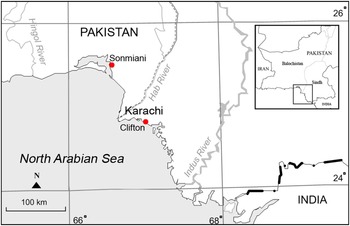
Massive amounts of the hydroidomedusa Aequorea pensilis with average density of 5–10 specimens per square metre were observed at Damb, Sonmiani (25°25′22″N 66°35′44″E). Additionally, three specimens were collected from Clifton (24°48′59″N 67°02′04″E) in 2012; both localities are along the Pakistan coast (Figure 1). Stranded specimens from both the sites were collected by hand, photographed and fixed in 4% formaldehyde solution. Identification was made following Kramp (Reference Kramp1956, Reference Kramp1961, Reference Kramp1968), Russell (Reference Russell1970), Cornelius (Reference Cornelius1995) and Bouillon et al. (Reference Bouillon, Medel, Pagès, Gili, Boero and Gravili2004). The specimens are housed in the Museum of Zoology Department (MZD) Jamia Millia Government Degree College, Malir, Karachi, Pakistan.
Map of Pakistan coast (eastern part) showing collection sites (red circles).

RESULTS
SYSTEMATICS
Class HYDROZOA Owen, 1843
Order LEPTOTHECATA Cornelius, 1992
Family AEQUOREIDAE Eschscholtz, Reference Eschcholtz1829
Genus Aequorea Péron & Lesueur, 1810
Aequorea pensilis (Haeckel, Reference Haeckel1879)
(Figures 2–4)
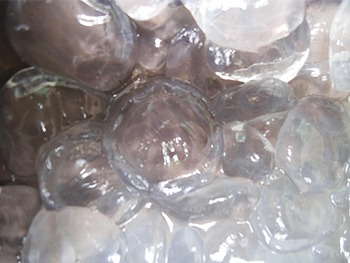
Freshly collected specimens of Aequorea pensilis (Haeckel, Reference Haeckel1879) from the Pakistan coast at Damb, Sonmiani. Note the glassy appearance.

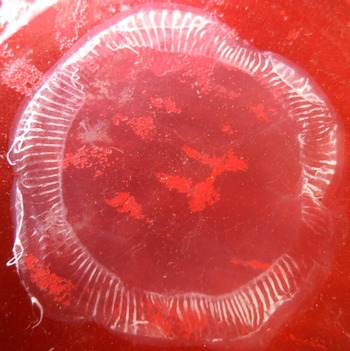
Aequorea pensilis (Haeckel, Reference Haeckel1879) specimen in subumbrellar view.

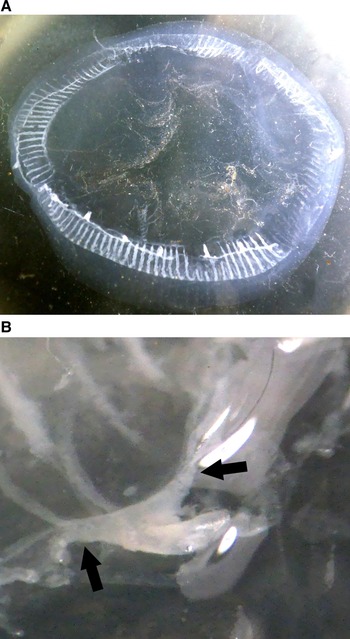
Aequorea pensilis (Haeckel, Reference Haeckel1879): (A) another specimen in subumbrellar view; (B) tentacle bulb in enlarge (abaxial) view (tentacle broken). Arrows pointing to lateral extensions of tentacle bulb.

MATERIAL EXAMINED
MZD/CN-11A, 3 specimens, Clifton, 2 December 2012, bell diameter 38–45 mm; MZD/CN-11B, 73 specimens, Damb at Sonmiani, 17 August 2013, bell diameter 33–52 mm.
DESCRIPTION
Umbrella: biconvex, without any apical projection, quite thick in the middle and thinner towards margin; transparent, colourless and glassy in appearance (Figure 2); mesoglea thick and soft.
Velum, ring canal and radial canals: ring canal tubular; number of radial canals up to 150, thin and undivided; 4, 6, 8 and up to 10 radial canals are present between two successive tentacles; velum narrow (Figures 3, 4A).
Gonads: linear in shape and present on almost the whole of the length of the radial canals (Figures 3, 4A). The mature gonads are observed as prominent, bulging structures, whitish in the preserved material.
Tentacle bulbs and tentacles: tentacle bulbs are funnel shaped, simple, without abaxial keel and no excretory papillae. The base of tentacle bulbs is produced into long lateral extensions on both sides (Figure 4B). There is one tentacle per bulb. Tentacles are simple and hollow (Figure 3). The specimens were somewhat damaged at the margin; however, the examination of a sufficient collection shows the number of tentacles which are 14 and 16 in various specimens, round the umbrella.
Stomach: circular in outline and 3/4 of the diameter of umbrella (Figures 3, 4A).
DISCUSSION
Medusae of Aequorea can be distinguished from other Aequoreidae by having numerous simple, undivided radial canals and a subumbrella without rows of gelatinous papillae (Kramp, Reference Kramp1961).
Aequorea is the major genus of the family Aequoreidae, carrying 25 species of which two have been recognized as nomen dubium (Schuchert, Reference Schuchert2013). Kramp (Reference Kramp1968) discussed eight Indo-Pacific species: Aequorea conica, A. australis, A. coerulescens, A. parva, A. macrodactyla, A. pensilis, A. globosa and A. aequorea.
The shape of umbrella, number of radial canals (and relative number of tentacles), position of gonads on radial canals, and morphology of tentacle bulbs are important distinguishing features among various species of Aequorea Péron & Lesueur, 1810. Aequorea pensilis is rather similar to Aequorea macrodactyla and both differ mainly in the shape of tentacle bulb with no abaxial spur/keel and without excretory papillae in the former, while both characters are present in the latter. The material at hand satisfies the diagnoses of Aequorea pensilis.
Aequorea Péron & Lesueur, 1810 is also known by its bioluminescent activity that has been extensively studied in Aequorea victoria (Murbach & Shearer, 1902) and Aequorea macrodactyla (Brandt, 1835) (Xia et al., Reference Xia, Luo, Zhang, Xie, Yang, Li, Chen and Ng2002).
Aequorea pensilis has been reported as host of Peachia larvae (Actiniaria) (Panikkar, Reference Panikkar1938) and Hemiurid larvae (Trematoda) (Rao, Reference Rao1959).
The hydroidomedusae Aequorea pensilis is distributed in the Atlantic and Indo-Pacific Oceans, and the Mediterranean Sea (Mayer, Reference Mayer1910; Bigelow, Reference Bigelow1913; Browne, Reference Browne1916; Menon, Reference Menon1931, Reference Menon1932; Dawydoff, Reference Dawydoff1936; Nair, Reference Nair1951; George, Reference George1953; Kramp, Reference Kramp1953, Reference Kramp1956, Reference Kramp1958, Reference Kramp1961; Ganapati & Nagabhushanam, Reference Ganapati and Nagabhushanam1958; Rao, Reference Rao1959; Navas-Pereira & Vannucci, Reference Navas-Pereira and Vannucci1991; Boero & Bouillon, Reference Boero and Bouillon1993; Bouillon et al., Reference Bouillon, Medel, Pagès, Gili, Boero and Gravili2004; Nicholas & Yong, Reference Nicholas and Yong2012). Aequorea pensilis is a eurythermal and euryhaline species, taken in 33 to 36% (or higher) salinity and a long-lived meroplanktonic species (see Navas-Pereira & Vannucci, Reference Navas-Pereira and Vannucci1991).
ACKNOWLEDGEMENTS
We are grateful to Yap. W.L. Nicholas (Tropical Marine Science Institute, National University of Singapore) for his valuable comments regarding identification of the discussed species. Thanks are also due to Professor Khalid Hanif (Department of Geography, Jamia Millia Government Degree College, Malir, Karachi, Pakistan) for constructing the map.