Introduction
Extant research has explored how CEOs’ ‘career horizon’ influences firms’ outcomes, where shortening of career horizon of CEOs has adverse implications on their strategic investment decisions (Lee, Park, & Folta, Reference Lee, Park and Folta2018; Oh, Chang, & Jung, Reference Oh, Chang and Jung2018). This negative effect on investment happens because CEOs with shorter career horizons are more concerned with the ‘legacy of their success’ (Matta & Beamish, Reference Matta and Beamish2008: 638) or the aspiration of inflating retirement earnings (Antia, Pantzalis, & Park, Reference Antia, Pantzalis and Park2010). Although extant studies have emphasized the CEO’s career horizon, several concerns remain.
First, the CEO career horizon explains how risk propensity varies with time, i.e., consider the risk aggressiveness of the CEO as a time-varying trait. However, it does not consider how this time-varying trait interacts with other personality traits that are also a function of time. Specifically, the temporal focus of CEOs, such as past or future temporal focus (Levasseur, Shipp, Fried, Rousseau, & Zimbardo, Reference Levasseur, Shipp, Fried, Rousseau and Zimbardo2020a; Levasseur, Tang, Karami, & Busenitz, Reference Levasseur, Tang, Karami, Busenitz and Atnic2020b). Temporal focus refers to an individual’s disposition reflecting the degree to which their attention is directed toward the past, present, and future (Bluedorn, Reference Bluedorn2002; Shipp, Edwards, & Lambert, Reference Shipp, Edwards and Lambert2009) which shapes the CEO’s field of vision, selective perception, and interpretation of the information (Nadkarni & Chen, Reference Nadkarni and Chen2014). Hambrick, Finkelstein, and Mooney (Reference Hambrick, Finkelstein and Mooney2005: 503) stressed that ‘we can imagine no more fertile terrain in the organizational sciences today than the study of executive personality’ because CEOs are ‘finite flawed human beings who reside in jobs where the stakes associated with their humanness – both positive and negative – are enormous.’ A CEO’s career horizon and temporal perspective in this regard can have a significant influence on organizational outcomes.
Second, researchers have explored the influence of a CEO’s career horizon on several strategic outcomes such as international acquisitions (Matta & Beamish, Reference Matta and Beamish2008); or firm performance (McClelland, Barker, & Oh, Reference McClelland, Barker and Oh2012). However, scholars have long emphasized exploring why some organizations are more inertial and imitative while others exhibit much more novelty (Crossland, Zyung, Hiller, & Hambrick, Reference Crossland, Zyung, Hiller and Hambrick2014). Given that following novel strategies have risk implications for firms, it is vital to explore how the CEO’s time-varying risk propensity, i.e.., the CEO’s career horizon, influences the firm’s strategic novelty outcomes. Correspondingly, it is also necessary to explore how the time-varying trait of CEOs interacts with CEOs’ temporal focus (which does not change with time) to gauge the net influence of career horizon on novelty-based outcomes such as strategic novelty. Intriguing questions from these temporal perspectives involve the effects of the CEO’s career horizon (Heyden, Reimer, & Van Doorn, Reference Heyden, Reimer and Van Doorn2017) on a firm’s strategic novelty under boundary conditions set by the CEO’s temporal perspective.
We specifically explore two research questions (1) How CEOs’ career horizon is associated with the strategic novelty of the firms, measured through two dimensions: strategic dynamism and strategic distinctiveness (Crossland et al., Reference Crossland, Zyung, Hiller and Hambrick2014) and (2) How CEOs’ temporal focus moderates the CEOs’ career horizon and strategic novelty relationship. We assert that CEOs become more concerned with retaining prestige and status with decreasing career horizons and hesitate to take any novel strategic action with uncertain outcomes. CEOs tend to continue with past strategies and do not prefer to deviate from industry norms, thus reducing firms’ strategic dynamism and distinctiveness.
For the second objective, we assert that CEOs’ past, present, and future temporal focus moderate this relationship. A negative influence of a shorter career horizon on strategic dynamism and distinctiveness is enhanced when CEOs have past or present temporal focus, given their preference to leverage the past (Nadkarni & Chen, Reference Nadkarni and Chen2014). The future temporal focus of CEOs, on the contrary, diminishes the negative influence of shorter career horizons on strategic dynamism and distinctiveness, as their tendency to explore new strategies would be enhanced under the influence of future temporal focus (Gamache & McNamara, Reference Gamache and McNamara2019).
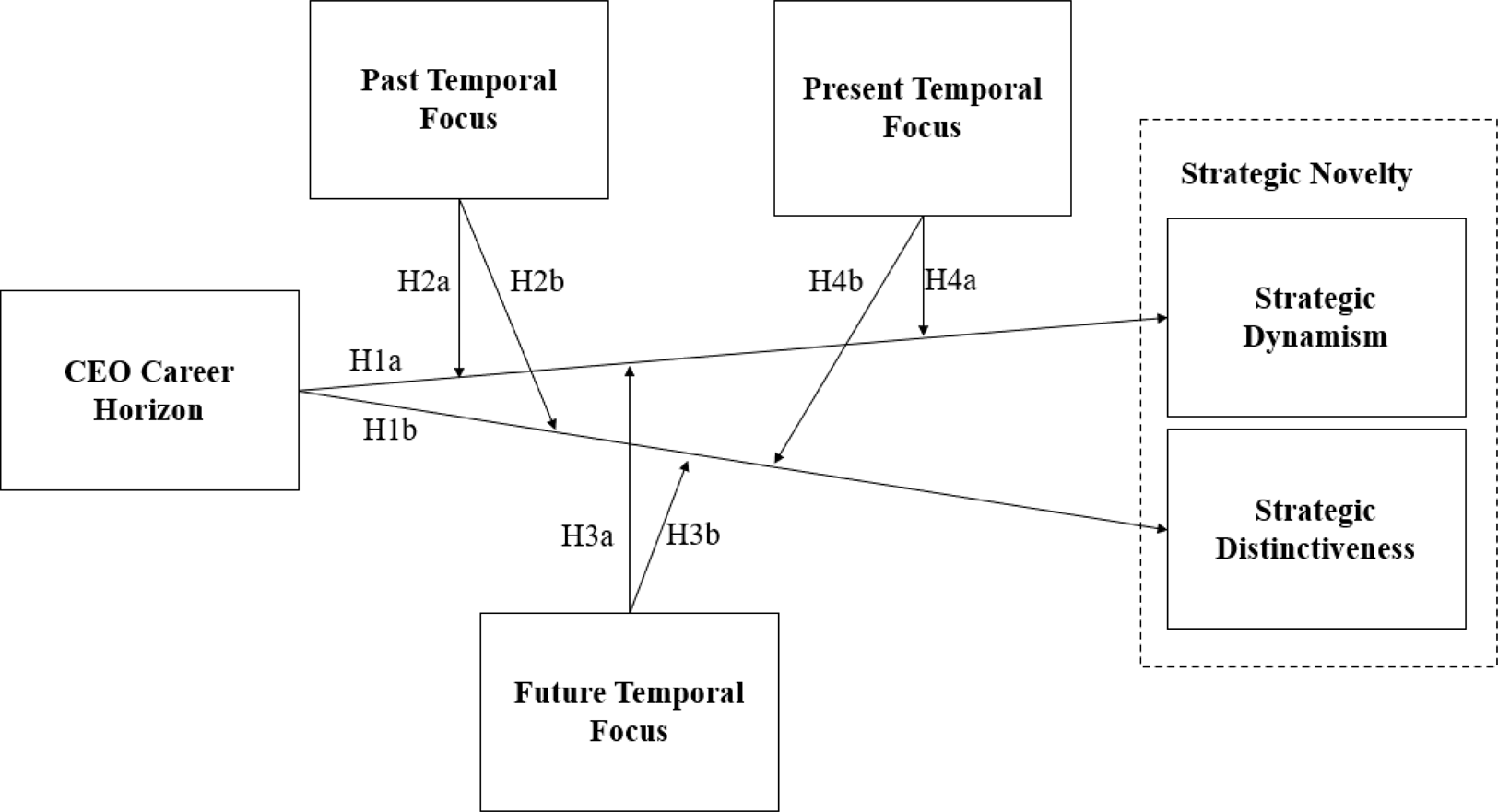
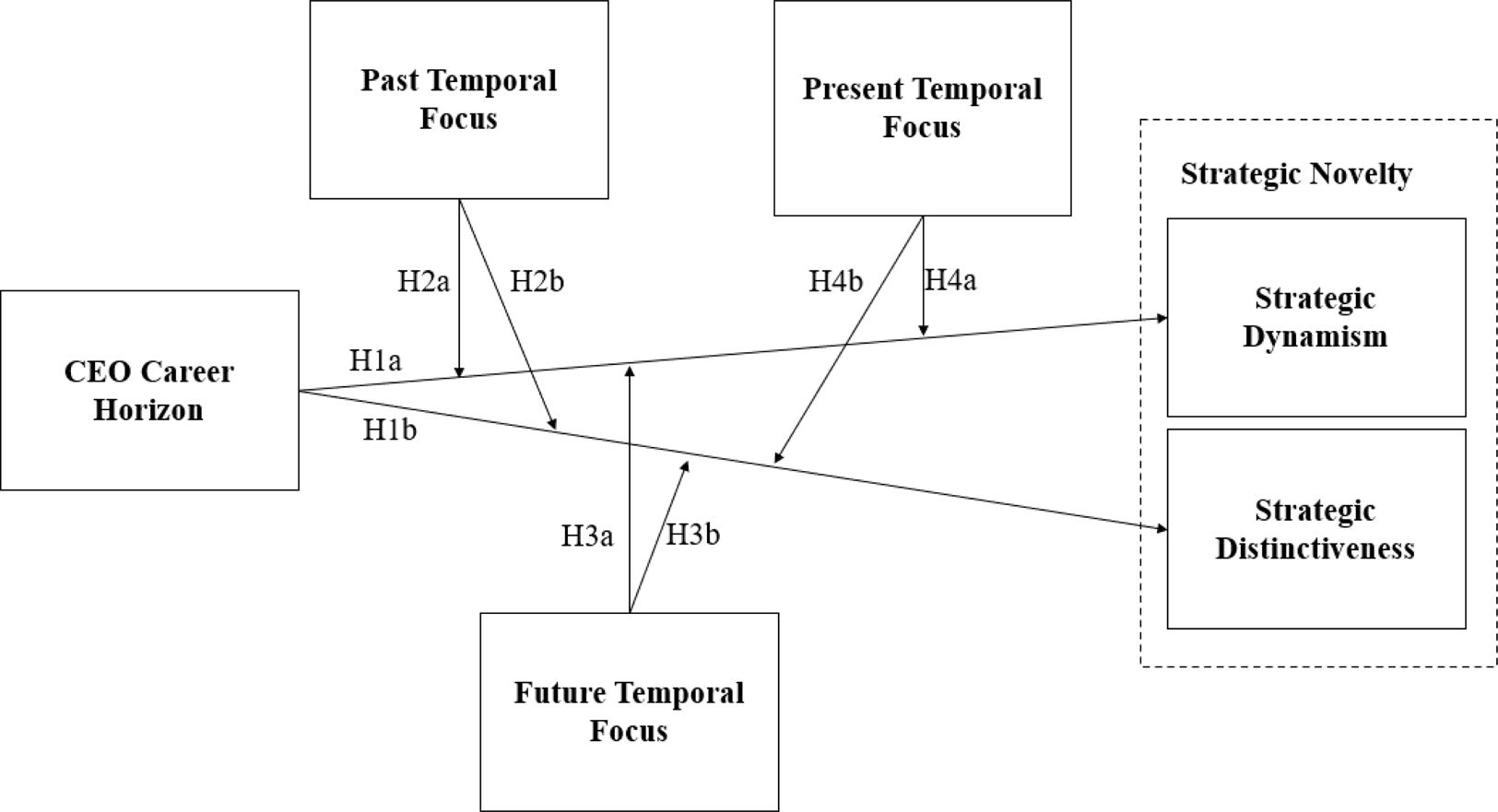
Figure 1 presents the conceptual framework. According to the conceptual framework in Figure 1, the career horizon of a CEO influenced the firm’s strategic novelty, and the CEO’s past, present, and future temporal focus moderated this relationship. Specifically, with a decreasing career horizon, strategic novelty decreased. When CEOs had past and present temporal focus, the negative influence of shorter career horizons on strategic novelty was more. The negative impact of shorter career horizon on strategic novelty decreases for future temporal-focused CEOs.
Conceptual framework for moderated mediated relation between CEO career horizon and strategic novelty.
We make several contributions to the management literature. First, we contribute to strategic novelty literature. Only scant studies have explored drivers of firms’ strategic novelty. Scholars have called for more research on the relationship between firms’ strategic novelty and temporal perspective at the microfoundation level (Crossland et al., Reference Crossland, Zyung, Hiller and Hambrick2014; Park, Reference Park2019). By examining the influence of CEO career horizon on strategic novelty under moderating effect of CEO temporal focus, we contribute to strategic novelty literature. Extant research exploring temporal focus in the context of innovation (Nadkarni & Chen, Reference Nadkarni and Chen2014; Yadav, Prabhu, & Chandy, Reference Yadav, Prabhu and Chandy2007) investigated the direct influence of temporal focus on innovation outcomes.
Our second contribution is to the upper echelons theory that urges researchers to explore CEO traits for differences in a firm’s strategic decisions (Hambrick, Reference Hambrick2007). CEO career horizon represents time-varying demographic traits, given that legacy concerns vary with time left with the CEO retiring. Therefore, CEO’s career horizon reflects CEO behavior concerning objective time (Levasseur et al., Reference Levasseur, Shipp, Fried, Rousseau and Zimbardo2020a, Reference Levasseur, Tang, Karami, Busenitz and Atnic2020b). Recently scholars have urged to explore CEOs’ subjective perspectives of time (Gamache & McNamara, Reference Gamache and McNamara2019). The trait perspective of subjective time gives ‘temporal personality’ to CEOs (Ancona, Goodman, Lawrence, & Tushman, Reference Ancona, Goodman, Lawrence and Tushman2001; Francis-Smythe & Robertson, Reference Francis-Smythe and Robertson2003). Research exploring CEO traits’ interaction with objective time and subjective time perspective has largely lacked. We contribute to this stream of temporal research.
By exploring CEO career horizon and strategic novelty relationship, under the moderating influence of CEO temporal focus, our second contribution is to the CEO temporal focus literature, where extant literature has explored how temporal focus moderates the factors influencing mergers and acquisitions decisions taken by CEOs (DesJardine & Shi, Reference DesJardine and Shi2021; Gamache & McNamara, Reference Gamache and McNamara2019). Overall, our research offers integration of objective and subjective time perspective explanations for why some organizations are imitative and inertial while others take a quantum leap in strategic actions.
Our paper proceeds as follows. We first present the theory and hypothesis section. The data and methods section follows the theory section. Next, we discuss the results of the empirical study. Finally, we present the discussion, theoretical and managerial implications, limitations, and conclusion sections.
Theory and hypothesis
Strategic novelty
Strategic novelty refers to how novel a firm’s strategies are, i.e., if a firm tends to imitate strategies taken in the past or taken by peers in the industry or exhibit changes and distinctiveness relative to competitors (Crossland et al., Reference Crossland, Zyung, Hiller and Hambrick2014). Strategic novelty has two manifestations, namely, strategic dynamism and strategic distinctiveness. Strategic dynamism refers to the magnitude of change in a firm’s resource allocation over time (Miller, Reference Miller1991; Wiersema & Bantel, Reference Wiersema and Bantel1992). For instance, a firm may increase investment in R&D compared to previous years and thus signal strategic dynamism, whereas it may invest in R&D above the industry average, thus depicting distinctiveness.
Moreover, highly dynamic firms engage in considerable year-on-year resource allocation changes across strategic choice domains, including advertising, research and development, and capital investment. While executives throughout the firm are involved in the resource allocation process through an amalgamation of top-down and bottom-up actions (Noda & Bower, Reference Noda and Bower1996), the CEO remains the ultimate decision-maker regarding how resource allocations happen in the firm (Zacharias, Six, Schiereck, & Stock, Reference Zacharias, Six, Schiereck and Stock2015). Research on resource allocation suggests that not all executives adapt their resource allocation policies with time (Zhang & Rajagopalan, Reference Zhang and Rajagopalan2010). Some prefer to preserve historical resource allocation patterns (Bardolet, Fox, & Lovallo, Reference Bardolet, Fox and Lovallo2011). Given the predictions made by upper echelon theory regarding possible variation in resource reallocation or strategic dynamism with CEOs’ traits (Quigley & Hambrick, Reference Quigley and Hambrick2012), we explore the influence of CEO career horizon on strategic dynamism.
Strategic distinctiveness (or strategic non-conformity) refers to how much a firm’s strategic investment differs from other firms’ profiles or its industry’s central tendencies at any given time (Geletkanycz & Hambrick, Reference Geletkanycz and Hambrick1997; Miller & Chen, Reference Miller and Chen1996). Thus, distinctiveness signals the degree to which a firm coheres to or disregards prevailing industry norms (Geletkanycz & Hambrick, Reference Geletkanycz and Hambrick1997; Miller & Chen, Reference Miller and Chen1996). Distinctive strategies have outcome uncertainty as it does not conform to industry norms (Le & Kroll, Reference Le and Kroll2017; Zhang & Rajagopalan, Reference Zhang and Rajagopalan2010). In the long run, value creation requires that CEOs integrate a unique group of assets and resources, implying CEOs deviate from both industry norms and investment trends set up by the firms internally. However, for the equity market to reward such uniqueness and dynamism respectively takes time. In the short term, the stock market might even penalize these dynamic and unique resources and strategies due to information asymmetry (Litov, Moreton, & Zenger, Reference Litov, Moreton and Zenger2012). As explained below, CEOs’ career horizon is likely to influence dimensions of strategic novelty.
Career horizon
Career horizon concerns relate mainly to the stages of the career of a CEO as they approach retirement. The closer a CEO is to retirement, the shorter is the career horizon. Upper echelons theory asserts that CEOs nearing retirement become more concerned with conserving a legacy of success. Thus, they avoid any novel strategic actions as their failure may have legacy implications (Heyden, Reimer, & Van Doorn, Reference Heyden, Reimer and Van Doorn2017). Novel strategic actions with uncertain outcomes could also endanger firm performance, and this poor performance may also taint the reputation of CEOs during the last years of employment. Thus, shorter career horizon CEOs have reduced risk propensity and overemphasize their career stability and security, unlike longer career horizon CEOs (Hitt & Tyler, Reference Hitt and Tyler1991; Wiersema & Bantel, Reference Wiersema and Bantel1992). Prospect theory (Kahneman & Tversky, Reference Kahneman and Tversky1979) also suggests that a basic motive in the career horizon problem for CEOs is legacy conservation, as CEOs’ strategic investment decisions have considerable bearing on their reputations and wealth.
CEOs prefer to maintain a legacy of success, implying an increasing risk aversion near retirement, given limited ability and time to reverse any performance downfall. Stakeholders often interpret perceptions of CEOs’ skills and reputations from firms’ success. CEOs whose companies underperform or go bankrupt, stakeholders perceive them as incompetent (Hayward, Rindova, & Pollock, Reference Hayward, Rindova and Pollock2004). However, risky strategic choices could reward shareholders and the CEO in the long run, even if current returns are jeopardized and CEO’s reputation and wealth are adversely affected (Berger, Ofek, & Yermack, Reference Berger, Ofek and Yermack1997; Murphy & Zimmerman, Reference Murphy and Zimmerman1993). Therefore, with a shorter career horizon, CEOs are less willing to risk their legacies and become less inclined to invest in novel strategies because CEOs may not experience a positive influence of such strategies in the short run, destroying their legacy (Bryan, Hwang, & Lilien, Reference Bryan, Hwang and Lilien2000).
CEO career horizon and strategic dynamism
CEOs’ career horizons significantly influence their concern for reputation and legacy. CEOs with shorter career horizons are less propelled to take risks and emphasize career stability and security over firms’ growth (Hitt & Tyler, Reference Hitt and Tyler1991; Wiersema & Bantel, Reference Wiersema and Bantel1992). Consequently, they are more likely to prefer stagnancy in firms’ strategic investment decisions rather than introducing any changes, thus reducing strategic dynamism (Wiersema & Bantel, Reference Wiersema and Bantel1992). Strategic investments made by CEOs also have implications for their reputation and wealth. Given that legitimacy is a more significant concern for CEOs with a shorter career horizon (Matta & Beamish, Reference Matta and Beamish2008), strategies that worked in the past and helped CEOs gain legitimacy among shareholders are more likely to be preferred and continued by less career horizon CEOs. Furthermore, CEOs’ eagerness to maintain a legacy of success implies less risk propensity near retirement, as they may not be able to reverse any possible performance downfall due to changes in strategic investment in a short period.
On the contrary, CEOs with long career horizons would be more risk-taking than low career horizon CEOs and undertake dynamic strategic investments. CEOs with long career horizons would be less concerned with maintaining a short-term legacy due to their confidence to reward shareholders and enhance firms’ performance in the long run. CEOs do this by bringing dynamic changes to firms’ strategic investment, even if short-term performance is jeopardized (Berger, Ofek, & Yermack, Reference Berger, Ofek and Yermack1997). Given this preference for dynamism by long career horizon CEOs, they may introduce strategic changes to any strategic resource allocation made in the past. Hence, we hypothesize:
Hypothesis 1a: A CEO’s career horizon is positively associated with a firm’s strategic dynamism such that with decreasing career horizon, strategic dynamism decreases.
CEO career horizon and strategic distinctiveness
CEOs seek legitimacy among stakeholders. One crucial source of legitimacy is conformity (Deephouse, Reference Deephouse1999; Miller & Chen, Reference Miller and Chen1996). CEOs who conform to industry practices are seen as more legitimate than those that deviate. This may be because, first, as firms adhere in their conduct to a familiar strategy, stakeholders value it (Cattani, Porac, & Thomas, Reference Cattani, Porac and Thomas2017; Gehman & Grimes, Reference Gehman and Grimes2017; Voronov, De Clercq, & Hinings, Reference Voronov, De Clercq and Hinings2013). Second, strategies seen as deviant may arouse suspicion and alienate stakeholders who provide resources (Deephouse, Reference Deephouse1999; Le Breton-Miller & Miller, Reference Le Breton-Miller and Miller2013; Zhao, Fisher, Lounsbury, & Miller, Reference Zhao, Fisher, Lounsbury and Miller2017). Third, one of the indicators of strategic conformity is adherence to industry strategic investment norms (Deephouse, Reference Deephouse1999; Le Breton-Miller & Miller, Reference Le Breton-Miller and Miller2013). CEOs that depart too much from such norms are likely to be viewed by shareholders, bankers, and other stakeholders, as less competent, less trustworthy, ‘hard to categorize,’ or too risky (Deephouse, Reference Deephouse1999; Miller & Chen, Reference Miller and Chen1996; Zhao et al., Reference Zhao, Fisher, Lounsbury and Miller2017).
Overall, as shareholders value strategic conformity, CEOs with a shorter career horizon to appear legitimate may reduce the strategic distinctiveness of firms. Firms led by CEOs having shorter career horizons would have significantly less preference for being distinctive. Due to increasing risk conservativeness, CEOs with a shorter career horizon would have less preference toward uniqueness and the modest likelihood of developing unique approaches and being strongly pulled by industry norms to have a risk-conservative approach of aligning with industry norms and practices. Although strategic distinctiveness may enhance the shareholders’ wealth in the long run (Haans, Reference Haans2019), the nearing retirement age would make CEOs less incentivized to engage in any long-term paying strategies.
On the contrary, firms headed by CEOs with a long career horizon will exhibit higher levels of strategic distinctiveness. First, such CEOs’ innate dispositional desire for uniqueness and openness to unique ideas and solutions will propel them to contemplate a broader range of strategic options (Lee, Park, & Folta, Reference Lee, Park and Folta2018). Second, long career horizon CEOs will also have time to enhance their legitimacy over a more extended period, as deviant strategies may take time to reap benefits. Third, such CEOs are less likely to be relatively creative and question prevailing wisdom. Overall, decreasing career horizons of CEOs are more likely to see standard industry practices and profiles as established industry practices to be closely followed and not as starting points to be outrivaled. Based on these arguments, we expect CEOs with shorter career horizons are less likely to generate more original and unique strategic approaches and view distinctive solutions proposed by others less positively. Hence, we hypothesize:
Hypothesis 1b: CEO career horizon is positively associated with strategic distinctiveness such that with a decrease in career horizon, the magnitude of strategic distinctiveness decreases.
CEO temporal focus
The subjective time perspective explains how individuals conceive about time, reflecting their ‘temporal personality’ (Ancona et al., Reference Ancona, Goodman, Lawrence and Tushman2001; Francis-Smythe & Robertson, Reference Francis-Smythe and Robertson2003). A key concept detailing subjective time is the temporal focus that reflects the totality of their psychological past, present, and future (Lewin, Reference Lewin and Henry1942). CEOs’ temporal personality shapes their strategic decisions (Shipp & Aeon, Reference Shipp and Aeon2019; Stolarski & Matthews, Reference Stolarski and Matthews2016). Over time an individual develops natural tendencies to focus on specific periods to varying degrees (Zimbardo & Boyd, Reference Zimbardo, Boyd, Stolarski, Fieulaine and van Beek2015). This development of a general temporal focus is stable over time. It is generally influenced in the early years by several factors, including a person’s childhood experiences, socioeconomic status, and parental beliefs about time (McGrath & Tschan, Reference McGrath and Tschan2004).
Early studies suggested temporal focus as a continuum, where an individual was predominantly fixated on only one temporal focus: the past, the present, or the future (De Volder & Lens, Reference De Volder and Lens1982). However, Shipp, Edwards, and Lambert (Reference Shipp, Edwards and Lambert2009: 14) asserted that past, present, and future temporal focus could coincide as they were different dimensions of time, implying that the ‘temporal focus profile is best represented by three separate effects of past, present, and future focus.’
Individuals high on past focus are inclined to direct their attention toward past events (Shipp, Edwards, & Lambert, Reference Shipp, Edwards and Lambert2009). They expend significant time eliciting past events and picking vital cues from them (Leroy, Shipp, Blount, & Licht, Reference Leroy, Shipp, Blount and Licht2015). Thus, significant emphasis is given to the usage of past memories in decision-making for past temporal focus individuals (Nadkarni & Chen, Reference Nadkarni and Chen2014: 1812). A present focus reflects an orientation on what Happenings ‘here and now’ (Nadkarni & Chen, Reference Nadkarni and Chen2014: 1812). Individuals high in present focus tend to act impulsively with current opportunities and are more focused on considering current issues when making decisions (Shipp, Edwards, & Lambert, Reference Shipp, Edwards and Lambert2009). Individuals focused on the future are less impacted by past events, and the effect of past knowledge reduces over time. As future temporal-focused individuals are more concerned with future events, they focus more on long-term plans (Mohammed & Harrison, Reference Mohammed and Harrison2013; Nadkarni & Chen, Reference Nadkarni and Chen2014). CEOs’ psychological perspective on time influences their strategic decisions (Das, Reference Das2004; Nadkarni & Chen, Reference Nadkarni and Chen2014).
We assert that CEOs’ focus on past versus future by virtue of their preferred temporal focus can significantly influence the association between their career horizon and dimensions of strategic novelty in the firm. We explain our assertions below:
The moderating role of past temporal focus
CEOs with shorter career horizons tend to continue with strategies taken in the past without bringing any change or uniqueness. When CEOs’ temporal focus is past-oriented, it implies that they prefer a focus on events that happened in the past. With past temporal focus, CEOs tend to focus on the past, and this focus further drives them to pursue strategies they took in the past, thus amplifying the effect of a short career horizon on strategic novelty.
A past temporal focus also implies overgeneralization bias, where ‘individuals overemphasize similarities and underemphasize differences between the past and current context’ (Nadkarni & Chen, Reference Nadkarni and Chen2014). As shorter career horizon CEOs, owing to risk conservativeness, tend to rely on knowledge generated in the past, over-generalization bias tendencies of past temporal focus would further drive shorter career horizon CEOs to draw similarities between past and current information. Thus, CEOs having shorter career horizons make similar strategic decisions that they took in the past (Lu, Kwan, & Ma, Reference Lu, Kwan and Ma2021). Focus on past experience by past temporal-focused CEOs may also facilitate using mental shortcuts and not engaging in counterfactual thinking such as imagining alternative positive outcomes. Using past phenomenon-based mental shortcuts would further decrease the risk propensity of shorter career horizon CEOs, driving them to confine to past strategies and not any distinctive and non-confirming strategies that are more futuristic oriented (Baron, Reference Baron1998).
Overall, CEOs with shorter career horizons are more risk conservative and thus less likely to bring any deviation in strategic investment made in the past. Past temporal focus of CEOs owing to over-generalization biasness and focus on past events further amplify CEOs with shorter career horizons to focus on past strategies while making futuristic decisions. Thus, as CEOs with shorter career horizons do not prefer to deviate from committed strategies in the past or from industry norms to minimize risk, the past temporal focus further strengthens their propensity to rely on strategies taken in the past and reduces the strategic dynamism distinctiveness they bring to the organization. Hence, we hypothesize:
Hypothesis 2a: A CEO’s past temporal focus moderates the influence of the CEO’s career horizon on strategic dynamism such that the negative influence of a shorter career horizon on strategic dynamism is strengthened when the past temporal focus is high than low.
Hypothesis 2b: A CEO’s past temporal focus moderates the influence of the CEO’s career horizon on strategic distinctiveness such that the negative influence of a shorter career horizon on strategic distinctiveness is strengthened when the past temporal focus is high than low.
The moderating role of present temporal focus
Individuals with a strong present temporal focus follow a ‘here-and-now’ mentality and tend to pay attention to the current timeframe in their decision-making (Shipp, Edwards, & Lambert, Reference Shipp, Edwards and Lambert2009) without considering the future implications of their actions (Zimbardo & Boyd, Reference Zimbardo, Boyd, Stolarski, Fieulaine and van Beek2015; Zimbardo, Keough, & Boyd, Reference Zimbardo, Keough and Boyd1997). Thus, CEOs’ present temporal focus may diminish the consideration of their future legacy and wealth implications for their novel strategic actions. Present temporal focus is likely to drive a shorter career horizon and risk conservative CEOs forego novel strategic actions, as their benefits may not be redeemed in the present.
Focusing on present temporal focus may also prohibit shorter career horizon CEOs from predicting future competition, changing macro-environment, and firm performance. Consequently, they may decrease their investment in strategically novel areas. Overall, the present temporal focus of CEOs may drive CEOs with shorter career horizons to act risk conservatively, explore current strategic resources, and become more psychologically attached to the current strategic directions and not novel strategic directions. This may drive shorter career horizon CEOs to consider how pursuing the same strategic course of actions puts less burden on the existing resource portfolios of firms, implying lesser and lesser changes in dynamism and distinctiveness of firm resources, thus reducing overall strategic novelty. Hence, we hypothesize:
Hypothesis 3a: CEO’s present temporal focus moderates the influence of the CEO’s career horizon on strategic dynamism such that the negative influence of a shorter career horizon on strategic dynamism is strengthened when the present temporal focus is high than low.
Hypothesis 3b: CEO’s present temporal focus moderates the influence of the CEO’s career horizon on strategic distinctiveness such that the negative influence of a shorter career horizon on strategic distinctiveness is strengthened when the present temporal focus is high than low.
The moderating role of future temporal focus CEO
Future temporal focus makes individuals focus on what they aspire to be in the future. Rabinovich, Morton, and Postmes (Reference Rabinovich, Morton and Postmes2010) reported that future temporal-focused primed individuals opted for choices that gave higher payoffs in the long run rather than the short run. However, envisioning a brighter future and taking strategies for the same may not yield any positive payoff as future-oriented strategies are often risky (Keh, Der Foo, & Lim, Reference Keh, Der Foo and Lim2002). When CEOs with shorter career horizons are future-oriented by their temporal focus, risk aggressiveness developed as part of their personality is likely to override short-term risk conservativeness that CEOs develop with decreasing career horizons and is more temporary. With reduced risk conservativeness, the propensity to take strategically novel decisions by CEOs with shorter career horizons will increase, or the adverse effect of shorter career horizons on strategic novel investment decisions would decrease.
Furthermore, future temporal focus encourages individuals to explore the environment and set new goals accordingly (Cacioppo & Gardner, Reference Cacioppo and Gardner1999; Spronken, Holland, Figner, & Dijksterhuis, Reference Spronken, Holland, Figner and Dijksterhuis2016). These attributes of future-focused CEOs would drive even CEOs with shorter career horizons to take risks and strategies that may pay off in the long run and not in the short run. Overall, though CEOs with shorter career horizons are less willing to invest in new strategies that pay off only in the long run (Hambrick & Fukutomi, Reference Hambrick and Fukutomi1991), with the future temporal focus, the focus of CEOs having a shorter career horizon propensity on short-term payoff may decline and become more willing to invest in future-oriented novel strategies. Future temporal focus may also inspire shorter career horizon CEOs to process new sources of information that are required to make novel strategic investment decisions (Chaganti & Sambharya, Reference Chaganti and Sambharya1987). Overall, bringing dynamic and distinctive strategies to organizations requires CEOs to have unique and deviant perspectives about strategic actions, which CEOs with shorter career horizons are less likely to have. However, their future temporal focus may drive them to have a unique perspective and invest in dynamic and distinctive strategies. Future temporal focus may thus diminish the negative influence of shorter career horizon CEO on dynamic and distinctive strategies. Hence, we hypothesize:
Hypothesis 4a: CEO’s future temporal focus moderates the influence of the CEO’s career horizon on strategic dynamism such that the negative influence of a shorter career horizon on strategic dynamism is lessened when the future temporal focus is high than low.
Hypothesis 4b: CEO’s future temporal focus moderates the influence of the CEO’s career horizon on strategic distinctiveness such that the negative influence of a shorter career horizon on strategic distinctiveness is lessened when the future temporal focus is high than low.
Methods
We focused on the A and B category Bombay Stock Exchange-listed manufacturing firms in India from 2010 to 2016. India was one of the fastest-growing emerging markets globally (Heinberg, Ozkaya, & Taube, Reference Heinberg, Ozkaya and Taube2018). Extant research has also explored the Indian context for this reason (Buckley & Munjal, Reference Buckley and Munjal2017; Kale, Reference Kale2010). A and B listed firms have more liquid stock, which increases the chances of obtaining their financials, CEO information, and annual reports from publicly available sources (Nathan & Ahmed, Reference Nathan and Ahmed2018). We focused on manufacturing firms to explore a homogenous group of firms to minimize any variation arising from differences in the manufacturing and service sectors. This resulted in a sample of 384 firms. Following previous studies, we did not include public or foreign sector firms (Stucchi, Pedersen, & Kumar, Reference Stucchi, Pedersen and Kumar2015). A key criterion for selecting firms was no CEO changes for the entire time frame of the study (i.e., 2010–2016), as CEO changes could have resulted in heterogeneity in temporal focus that could result in confounding results (Nadkarni & Chen, Reference Nadkarni and Chen2014). Another key criterion was data availability on firms’ and CEOs’ financials and demographics. After using all these filtering criteria, we were finally left with a sample of 285 firms and 285 firms × 6 years = 1,710 firm-year observations. Data on firms and CEOs were collected from multiple sources, including Prowess (the Centre for Monitoring Indian Economy, a financial database of Indian firms) and online sources such as company websites and annual reports. Information on CEO temporal focus was obtained from letters to shareholders, published interviews of CEOs, CEO speeches, and press releases.
Operationalization of variables
Dependent variable
Strategic Novelty. The dependent variable of the study is a strategic novelty. Following Crossland et al., (Reference Crossland, Zyung, Hiller and Hambrick2014), we captured strategic novelty through two measures, namely strategic dynamism and strategic distinctiveness. Strategic dynamism was measured as resource reallocation, that is, change in a series of six strategic choice variables on a year-on-year basis. These variables are: (1) advertising intensity (advertising expenditure/sales); (2) R&D intensity (R&D expenditure/sales); (3) overhead efficiency (selling, general, and administrative expenses/sales); (4) capital intensity (fixed assets/total employees); (5) plant and equipment newness (net plant and equipment/gross plant and equipment), and (6) financial leverage (total debt/shareholder’s equity). We winsorized (Dixon, Reference Dixon1960) strategic dynamism at the two-percent level to minimize extreme values’ impact. We took the absolute difference from the prior year to the focal year for each of the six variables. Since measures were right-skewed, we also took the log of each value and then standardized them to z-scores. These scores were then summed to create a single standardized index of resource reallocation (Crossland et al., Reference Crossland, Zyung, Hiller and Hambrick2014).
Strategic distinctiveness was measured using the same six resource allocation variables as strategic dynamism. For each year, the standardized absolute difference between the firm’s score and the industry mean of each variable was calculated (Geletkanycz & Hambrick, Reference Geletkanycz and Hambrick1997). Next, the log of each value obtained was taken and summed to create an overall strategic distinctiveness index for the firm in the focal year. We calculated the industry mean by taking the average of each variable for all players in the industry, where the industry was defined as a two-digit National Industrial Classification code. Therefore, the industry mean was ∑ Pi/n, where Pi was the value of the variable of the ith focal firm, and n is the total number of firms in a given industry.
Independent variables
CEO career horizon . In line with extant research (Matta & Beamish, Reference Matta and Beamish2008), the career horizon for each CEO was measured by deducting the CEO’s current age from 65 years which is the usual age of retirement. Older CEOs had shorter career horizons. For robustness, we conducted the analysis with CEOs of 60 years and 70 years of age who were at the end of their careers.
CEO temporal focus . In the present study, CEOs’ past and future focus were the predictor variables. We measured CEOs’ past, present, and future focus through the psycholinguistic approach (Pennebaker, Francis, & Booth, Reference Pennebaker, Francis and Booth2001). Linguistic Inquiry and Word Count (LIWC) text analysis program, developed by Pennebaker, Francis, and Booth (Reference Pennebaker, Francis and Booth2001), specified a set of 145 words that reflected an individual’s past focus (e.g., ‘had,’ ‘did,’ ‘was,’ ‘were’), 169 words that reflected individual’s present focus (such as ‘is,’ ‘does,’ ‘are’), and a set of 48 words that reflects individual’s future focus (e.g., ‘will,’ ‘may,’ ‘might,’ ‘shall,’ ‘going to’). We conducted a content analysis of the letter to shareholders, CEO interviews, speech, and press releases using LIWC to measure different CEO temporal focus dimensions. Nadkarni and Chen (Reference Nadkarni and Chen2014) computed correlations between the LIWC measures for temporal focus and the corresponding scales Shipp, Edwards, and Lambert (Reference Shipp, Edwards and Lambert2009) suggested. They reported strong correlations (.70–.80) for all three temporal dimensions. This validated the usage of the content analysis approach based on LIWC.
For measurement purposes, we calculated the LIWC scores of the past, present, and future focus as the percentage of words from each LIWC dictionary in the CEO information set (Pennebaker, Francis, & Booth, Reference Pennebaker, Francis and Booth2001), where we normalized the scores by the total length of the text.
Interaction effect of CEO career horizon and CEOs temporal focus. After mean-centering CEO career horizon and CEO temporal focus: past, present, or future, we multiplied the variables to obtain the interaction terms (Shieh, Reference Shieh2010).
Control variables
We controlled for several firm-level and CEO-level variables. We controlled CEO functional background, CEO compensation, and CEO tenure among CEO-level variables. The firm-level variables we controlled were financial slack, firm size, firm age, and leverage.
CEO functional background was dummy coded as ‘1″ if the CEO had an output-oriented functional background and ‘0″ if the background was throughput-oriented (Heyden, Reimer, & Van Doorn, Reference Heyden, Reimer and Van Doorn2017). Output-orientation functions refer to functions that ‘emphasize growth and the search for new domain opportunities and are responsible for monitoring and adjusting products and markets’ (Mason & Hambrick, Reference Mason and Hambrick1984: 199). Sales, marketing, and R&D are concerned as output-oriented functions. Throughput-orientation functions ‘work at improving the efficiency of the transformation process’ (Mason & Hambrick, Reference Mason and Hambrick1984: 199). Finance, operations, and HRM are considered throughput-oriented functions (Heyden, Reimer, & Van Doorn, Reference Heyden, Reimer and Van Doorn2017).
Next, we operationalized CEO compensation as the log of price-deflated compensation of a CEO. CEO compensation consisted of salary, allowances, performance bonuses, commissions, perquisites, and retirement benefits (Jaiswall & Bhattacharyya, Reference Jaiswall and Bhattacharyya2016). We operationalized CEO tenure as the natural log of the total number of years the CEO was associated with the focal firm.
Next, financial slack was measured as cash-in-hand (John, Li, & Pang, Reference John, Li and Pang2017). We captured firm size as the natural log of the total number of employees. Financial performance was captured as a return on assets (McClelland, Barker, & Oh, Reference McClelland, Barker and Oh2012). Firm age was operationalized as the natural log of a firm’s total number of years since its inception. We also controlled year dummies and industry dummies at the two-digit National Industrial Classification level.
Model specification
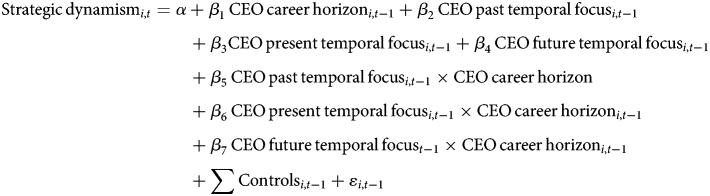
We analyzed panel data using a random-effect model. We first conducted Hausman’s (Reference Hausman1978) specification test to detect if a fixed and random effects model is more suitable. The Hausman test was not significant for fixed-effect models, so we used random-effects models. Moreover, time-specific factors such as economic downturns might also affect strategic novelty (Certo & Semadeni, Reference Certo and Semadeni2006). We thus included time dummy variables in the panel data model (Certo & Semadeni, Reference Certo and Semadeni2006). Overall, we implemented the random-effects model and included a set of dummy variables for the year effect. In addition, we also lag explanatory variables by one year behind the dependent variable to account for reverse-causality effects. Our model can be represented as:
Results
Descriptive and control variables
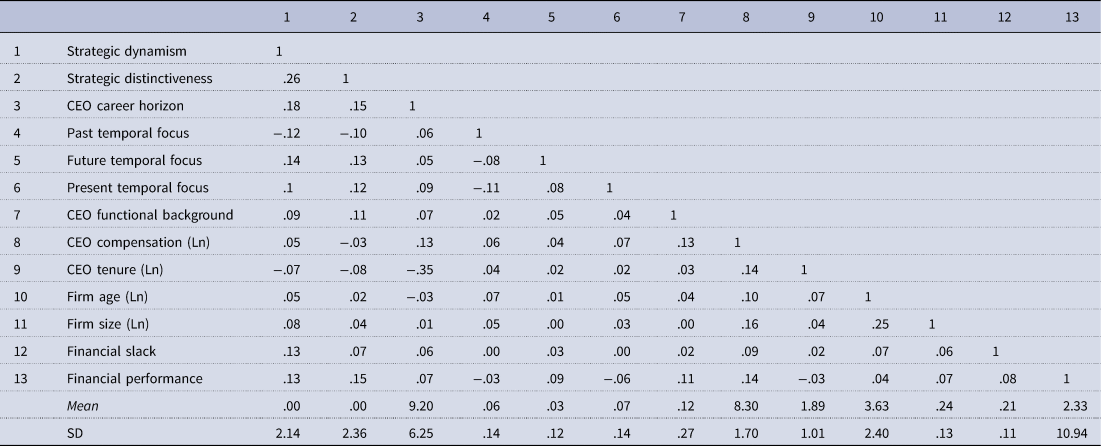
Table 1 presents the descriptive and correlations for the variables used in the study. As can be observed from Table 1, the mean career horizon was 9.2, with a standard deviation of 6.25. Previous studies conducted in developed markets also reported a similar average career horizon (Heyden, Reimer, & Van Doorn, Reference Heyden, Reimer and Van Doorn2017). Furthermore, the correlation coefficient between the career horizon and dimensions of strategic novelty, i.e., strategic dynamism (r = .18, p < .01) and distinctiveness (r = .15, p < .01), was found to be positive and significant, thus signaling some preliminary evidence for CEO career horizon and strategic dynamism and strategic distinctiveness relationship. VIF ranged from 1.39 to 1.71, implying multicollinearity was not an issue.
Descriptive statistics and correlation matrix (n = 1,710)

r-.06-.07, p < .01, r-.08 onwards, p < .001, r- .04, p < .10, r-.05, p < .05.
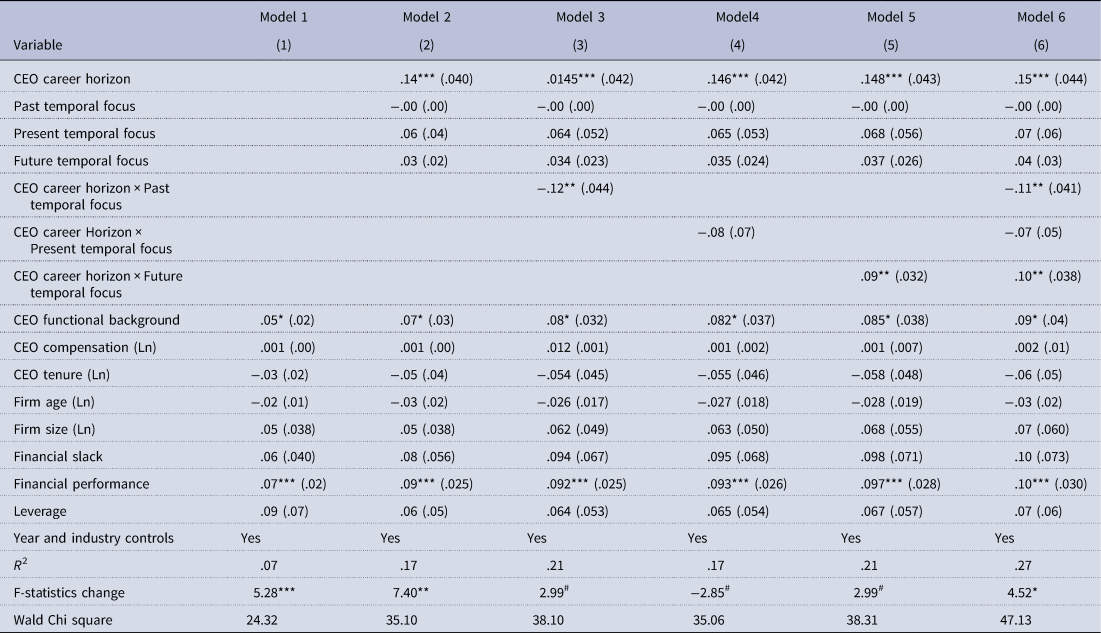
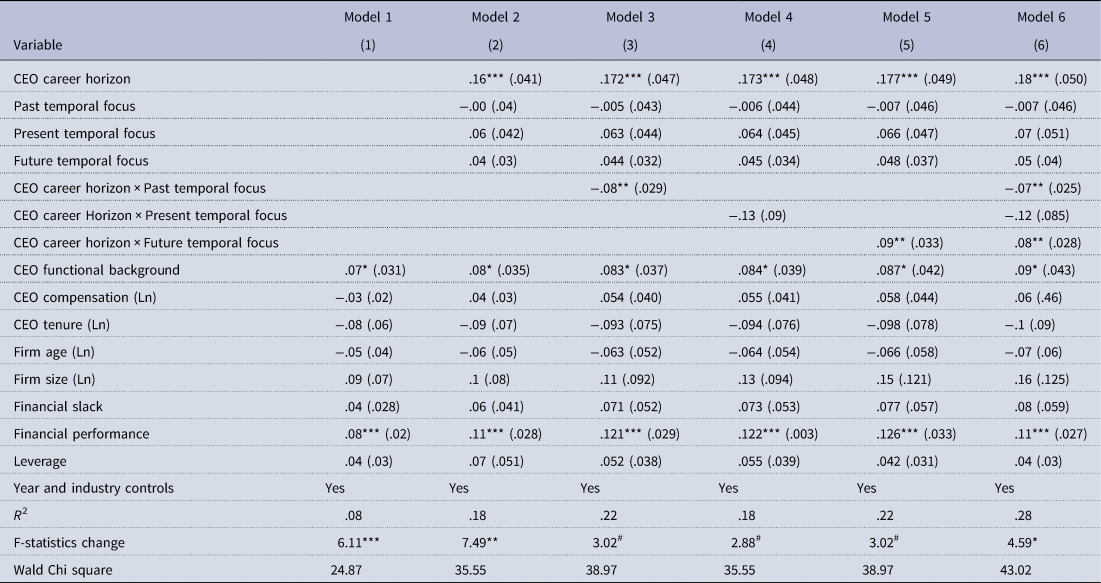
Tables 2 and 3 present the regression analyses. Following a stepwise procedure, we first estimated a model with control variables only (Model 1), followed by introducing the explanatory variables and interaction terms in a stepwise procedure (Models 2 to 6, respectively). Among control variables CEO functional background (β = .05, p < .05; β = .07, p < .05) and financial performance (β = .07, p < .01; β = .08, p < .01) in column 1 of Tables 2 and 3, respectively were found to be statistically significant. Thus, CEOs with a more output-oriented functional background took more dynamic and distinctive strategic actions. This is consistent with past literature, where output-oriented upper echelons were more risk aggressive (Heyden, Reimer, & Van Doorn, Reference Heyden, Reimer and Van Doorn2017).
Regression analysis (D.V. = Strategic dynamism) (n = 1,710)

#p < .10; ***p < .001; **p < .01; *p < .05.
Regression analysis (D.V. = Strategic distinctiveness) (n = 1,710)

#p < .10; ***p < .001; **p < .01; *p < .05.
Main effects and interaction effects
Through hypotheses 1a and 1b, we speculated that the CEO career horizon is positively associated with strategic dynamism and novelty. Column 2 of Tables 2 and 3 reveal that the CEO career horizon was positively associated with strategic dynamism (β = .14, p < .001) and strategic distinctiveness dimensions (β = .16, p < .001) of strategic novelty, respectively. Thus, we receive evidence in support of both subsets of hypothesis 1.
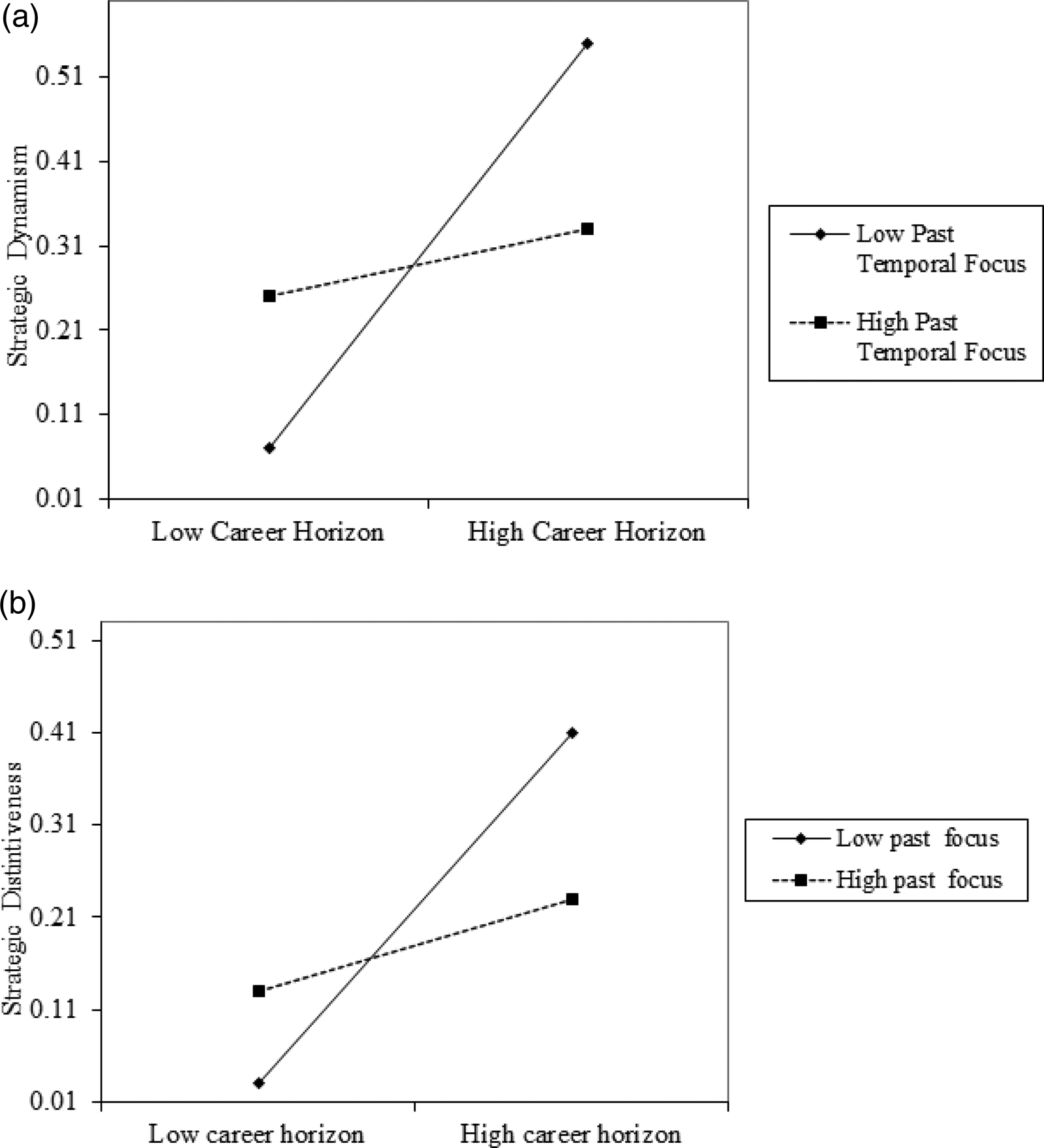
Our second hypothesis subsets stated that CEO past temporal focus moderates the relationship between CEO carrier horizon and (a) strategic dynamism and (b) strategic distinctiveness. We can see from column 6 of Tables 2 and 3 that the beta coefficient of the interaction effect of CEO career horizon and past temporal focus is negative and significant (β = −.11, p < .01; β = −.07, p < .01). Since moderating effect is best depicted by a graph, we present moderating effect in Figure 2a and b. As can be seen in both figures, an increase in strategic dynamism and strategic distinctiveness is less with an increase in career horizon, when the past temporal focus is high than low. We thus receive evidence in support of both subsets of hypothesis 2.
(a) Moderating effect of past temporal focus on CEO career horizon and strategic dynamism relationship; (b) Moderating effect of past temporal focus on CEO career horizon and strategic distinctiveness relationship.

Our third hypothesis subsets suggested that CEO’s present temporal focus negatively moderated the CEO career horizon and strategic novelty dimension relationship. Although the beta coefficients of the interaction effects were negative, they were statistically insignificant (β = −.07, p > .05; β = −.12, p > .05). We do not receive any evidence in support of the third hypothesis.
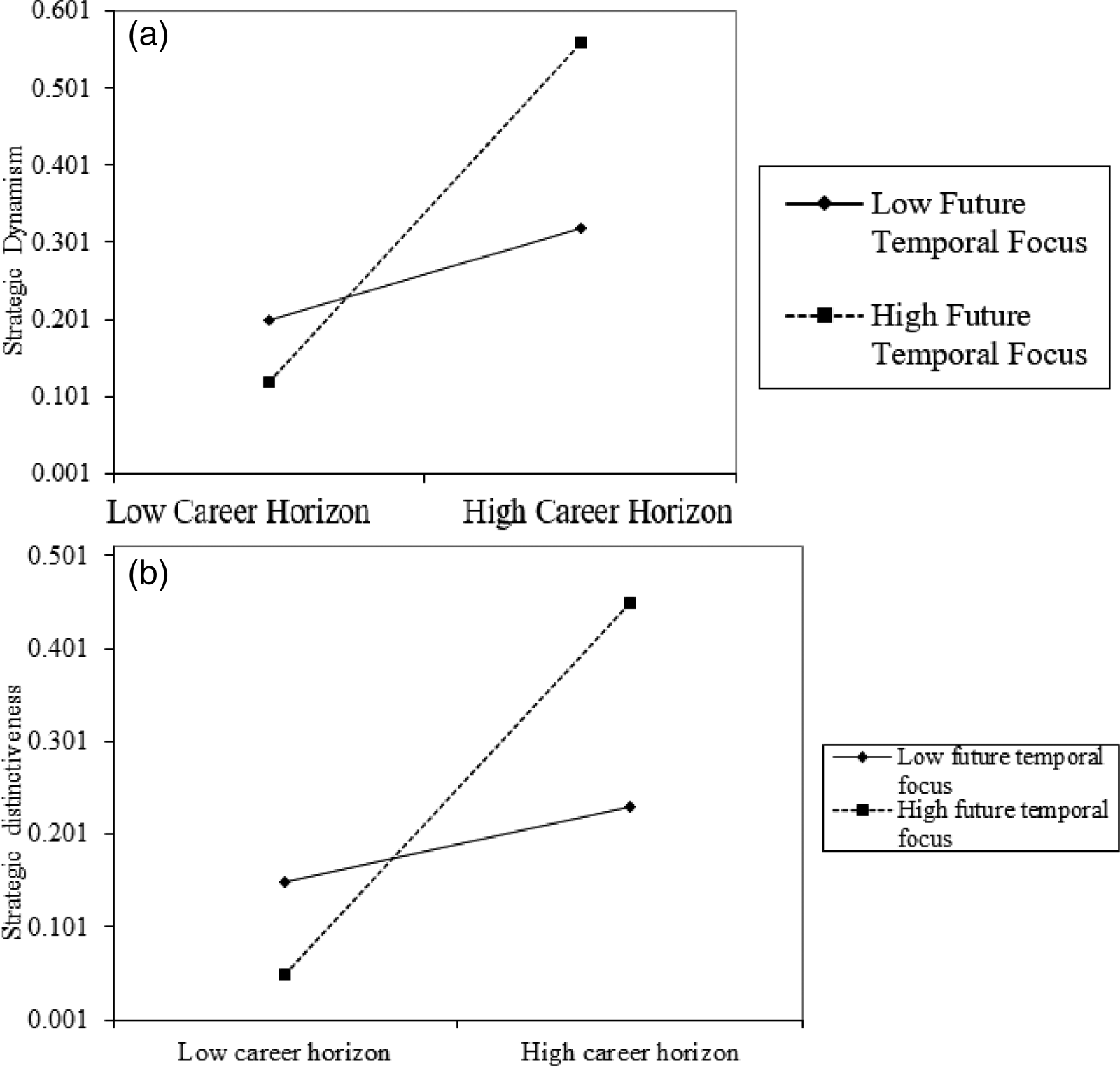
Our fourth hypothesis subsets stated that CEO’s future temporal focus positively moderates CEO’s career horizon and (a) strategic dynamism and (b) strategic distinctiveness relationships. Column 6 of Tables 2 and 3 reveal that the beta coefficient of the interaction effect of CEO career horizon and future temporal focus is positive and significant for both (β = .10, p < .01) and distinctiveness (β = .08, p < .01), respectively. We present moderating effect results in Figure 3a and b. As can be observed from the figures increase in strategic dynamism (Figure 3a) and strategic distinctiveness (Figure 3b) with an increase in career horizon is more when CEO future temporal focus is high than low. Hence, we receive evidence in support of both subsets of the fourth hypothesis.
(a) Moderating effect of future temporal focus on CEO career horizon and strategic dynamism relationship; (b) Moderating effect of future temporal focus on CEO career horizon and strategic distinctiveness relationship.

Finally, we conducted robustness tests with changes in retirement age values to 60 years and 70 years. Although the beta coefficient value changed, overall statistical significance remained unchanged.
Discussion
Findings
This study explored how CEO’s career horizon is associated with a firm’s strategic novelty under boundary conditions of the CEO’s past and future temporal focus. We proposed that a better understanding of the CEO’s decision on strategic choices can be gained by simultaneously considering time-varying CEO demographics, that is, career horizon and time static trait, that is, past and future temporal focus. We hypothesized that CEOs with longer career horizons have time to redevelop their legitimacy and legacy in organizations if lost due to an adverse impact on the firm’s performance in the short run. Thus, their risk-taking propensity is higher. This results in investment in strategic novel decisions, i.e., more strategic dynamism and distinctiveness.
We further hypothesized that CEO’s past, present, and future temporal attributes would moderate the CEO’s career horizon and strategic novelty relationship. Our findings supported most of the assertions we made and corroborated with extant studies where the time-variant demographic trait of the CEO was found to influence strategic decisions by firms (Heyden, Reimer, & Van Doorn, Reference Heyden, Reimer and Van Doorn2017). We did not find any support for the fourth hypothesis, that is, the moderating role of the CEO’s present temporal focus. This may have happened as the present temporal focus does not drive CEOs to be either futuristic in their vision or leverage on strategies in the past for making a current strategic decision. Thus, the present temporal focus may not influence how risk conservativeness varies with career horizon, unlike past and future temporal focus. Our findings are in corroboration with extant studies where CEO temporal focus influenced a firm’s acquisitions decisions (DesJardine & Shi, Reference DesJardine and Shi2021).
Our study uncovers the possibility that in examining the risk-conservative tendencies of CEOs with shorter career horizons, we should consider their general temporal disposition, i.e., preference to focus their attention on past events or future possibilities. Interestingly, consistent with prior studies, these temporal dispositions’ main effects were insignificant in our analyses (Gamache & McNamara, Reference Gamache and McNamara2019; Nadkarni & Chen, Reference Nadkarni and Chen2014). Therefore, in adopting the CEO-temporal disposition interface in our strategic choice context, it is more appropriate to examine attributes that capture both time-variant and invariant temporal motivations of the CEO to understand variation in the strategic novelty of the firm. In taking this approach, we offer several contributions to the literature with theoretical implications.
Theoretical implications
Our study contributes to the literature on upper echelon theory (Chatterjee & Hambrick, Reference Chatterjee and Hambrick2011; Hayward, Rindova, & Pollock, Reference Hayward, Rindova and Pollock2004). Upper echelons theory suggests that certain risky strategies such as engagement in entrepreneurial behaviors (Levesque & Minniti, Reference Levesque and Minniti2006) decline as CEOs’ retirement age nears, and their career horizon decreases as they become more concerned with protecting their legacy and reputation (Kahneman & Lovallo, Reference Kahneman and Lovallo1993). The context of strategic novelty in its substantial complexity and risk provided an ample test of the misalignment of CEOs’ career horizons with the strategic horizon of their respective firms. Consistent with the literature on CEO career horizon, we explain how a CEO’s career horizon shapes their willingness to undertake risky strategic novelty investment in the organization.
Moreover, studies also revealed career horizon divergent influence on strategic outcomes (Heyden, Reimer, & Van Doorn, Reference Heyden, Reimer and Van Doorn2017; Luo, Wan, Cai, & Liu, Reference Luo, Wan, Cai and Liu2013; Strike, Berrone, Sapp, & Congiu, Reference Strike, Berrone, Sapp and Congiu2015). We tend to demystify these differences by exploring the CEO’s time perspective and examining the CEO career horizon under boundary conditions of the CEO’s past and future temporal focus. We thus also add to CEO time perspective literature. Extant studies exploring the CEO’s time perspective considered either time-variant attributes such as career horizon and tenure (Ortiz-de-Mandojana, Bansal, & Aragón-Correa, Reference Ortiz-de-Mandojana, Bansal and Aragón-Correa2019) or time-invariant perspectives such as the past and present and future temporal focus (Nadkarni & Chen, Reference Nadkarni and Chen2014) individually. Scholars have asserted to explore time perspective holistically (Levasseur et al., Reference Levasseur, Shipp, Fried, Rousseau and Zimbardo2020a, Reference Levasseur, Tang, Karami, Busenitz and Atnic2020b). We respond to this call by exploring how CEOs’ temporal perspective influences CEO career horizon and strategic novelty in the firm relationship.
Overall, our study advances a reinterpretation of the CEO horizon problem by contextualizing CEO dispositions in the different stages of their careers as temporal focus enabled or constrained behavioral inclinations. We assert that conventional views of the CEO traits represented by their time-variant demographic traits might provide an oversimplified and incomplete way to understand and manage the horizon problem. Our model suggests that CEO behaviors are not enacted by their demographic trait but in combination with temporal perception, where past and future temporal focus plays a significant role in constraining or enabling CEO risk propensity. Thus, we make an important addition to the literature by contextualizing CEO dispositions as a temporal perception phenomenon and suggesting that the CEOs’ past and future temporal focus play a key role in accentuating or counterbalancing the risk proclivities of CEOs in their career context.
Managerial implications
Our findings are relevant for understanding the implications of managing strategically novel strategies, as attributed to CEO’s temporal dispositions and characteristics that can also have significant implications for firms’ future, such as market competitiveness (Xin, Yeung, & Cheng, Reference Xin, Yeung and Cheng2008) or firm growth (Del Monte & Papagni, Reference Del Monte and Papagni2003), or financial performance (Miller & del Carmen Triana, Reference Miller and del Carmen Triana2009). Executives who aim to reduce the horizon problem could benefit from considering CEO’s temporal focus.
Generally, it is assumed that CEOs with shorter career horizons may invest less in novel strategies as they are more interested in retaining legacy post-retirement. Our results suggest that if such CEOs’ temporal focus is more future-oriented, the adverse influence of a shorter career horizon on novel strategies can be decreased. This implies that as the board of directors recruits and selects CEOs, they should also consider their temporal focus apart from the career horizon. If novel strategies are a priority for a firm, then a future temporal-focused CEO should be considered. A past temporal-focused CEO may benefit if the board of directors prefers stable strategies.
Limitations and directions of future research
Our study has certain limitations that offer key opportunities for future inquiries. First, we tested our hypotheses using a sample of firms from only the manufacturing industry and a single country. Although focusing on a single industry sector and country has several advantages, it is unclear if our predictions also hold good in different institutional settings. Given that managerial discretion varies across manufacturing versus service industries and countries, future research could test the generalization of results in other institutional and industry settings.
Next, the policies on mandated retirement age vary across countries, which could influence executives’ temporal career expectations in different institutional settings. We only focused on large-sized firms and did not consider SMEs. Future studies could also be conducted in the context of SMEs.
Fourth, although the validity and reliability of the archival approach for temporal focus have been established (Gamache & McNamara, Reference Gamache and McNamara2019; Nadkarni & Chen, Reference Nadkarni and Chen2014), the biases associated with the usage of secondary data and psycholinguistic approach for measuring psychological constructs such as temporal focus cannot be denied. Primary data can be used to triangulate and further strengthen the results.
Fifth, we theoretically explained how risk propensity and legacy concerns cause variation in CEO decision-making over the career horizon. However, not empirically examine these drivers. These are likely to be mediators, and future studies could explore these underlying mechanisms.
Sixth, we only explore the influence of boundary conditions-led career horizons on strategic novelty. This need not necessarily imply that novel strategies would always enhance firm performance. Thus, future studies could consider this more holistic model, where the influence of career horizon on firm performance through novel strategies can be examined.
Finally, strategic decision-making involves not only the CEO but also the remaining top management team (TMT) and the overall risk propensity of the firm. Future studies can explore the influence of the entire TMT career horizon and temporal focus on strategic novelty outcomes. Similarly, future studies can also explore how firm-level risk propensity interacts with the risk propensity of the CEO to create an influence on risky strategic choices. Lastly, it would be interesting to explore how CEOs with a decreasing career horizon mend their decision towards strategic novelty when they join a new organization.
Conclusion
To conclude, our study explores the influence of a CEO’s career horizon under their temporal focus boundary conditions. We asserted that the CEO might become less flexible with strategic novelty with a decreasing career horizon. However, the future temporal focus can diminish this hesitation to invest in strategically novel strategies. Also, our findings suggest that past temporal focus can increase the propensity of minimizing investment in strategically novel decisions for a CEO with decreasing career horizons.
Financial support
The research was supported by internal grants of Newcastle University Business School.