Implications
Methane is a potent greenhouse gas. A major source of methane results from the activity of methanogenic archaea, methanogens, in ruminant digestion and is released into the atmosphere through eructation and to a lesser extent through flatulence. A flaxseed-supplemented diet suppresses methane production, but how flaxseed affects methanogens has not been elucidated. The purpose of this study was to utilize molecular techniques to evaluate the effect of flaxseed on archaeal abundance and their gene expression in the rumen of dairy cows. Flaxseed decreased the archaeal population and activity of enzymes involved in methane production, and thus provides a means to reduce greenhouse gas emissions from dairy cattle.
Introduction
A number of dietary approaches for reducing methane emissions from dairy cows have been investigated. Of these, feeding fats has been suggested to have the greatest probability for success (Martin et al., Reference Martin, Morgavi and Doreau2010). An additional 2% to 4% fat in the diet can reduce methane emissions by 10% to 20% (Beauchemin et al., Reference Beauchemin, McGinn, Benchaar and Holtshausen2009). Flaxseed is a rich source of the essential n-3 fatty acids. However, the mechanism by which flaxseed reduces methane production is currently unknown.
Methane is produced in the rumen, in a large part, by archaeal methanogens, but few methanogens have been isolated from the rumen (Janssen and Kirs, Reference Janssen and Kirs2008). Independent of the isolation of the individual methanogens, this study utilized quantitative PCR (qPCR) to precisely monitor the changes in abundance of 16S ribosomal RNA (16S rRNA) and methyl coenzyme-M reductase subunit A (mcrA) genes. 16S rRNA is a highly conserved gene that traditionally serves as a phylogenetical marker of microbes (Luton et al., Reference Luton, Wayne, Sharp and Riley2002; Case et al., Reference Case, Boucher, Dahllöf, Holmström, Doolittle and Kjelleberg2007; Janssen and Kirs, Reference Janssen and Kirs2008). The archaeal mcrA is a gene coding for a terminal enzyme in the methanogenesis pathway where it catalyzes the reduction of a methyl group with the concomitant release of methane (Luton et al., Reference Luton, Wayne, Sharp and Riley2002). The objective of this study was to evaluate the changes in abundance of the 16S rRNA and mcrA genes in the rumen of dairy cows fed a flaxseed-supplemented diet.
Material and methods
Animals, diets and experimental design
All procedures and animal care for this experimental feeding trial were approved by the Oregon State University (OSU) Animal Care and Use Committee (IACUC no. 3907). In all, 11 non-lactating dairy cows from the OSU Dairy Center were fed two different diets for five 21-day periods, which included the adaptation period, followed by two treatment and two wash out periods. Animals were randomly divided into two groups: group A and B. There were five cows (three Holsteins and two Jerseys) in group A and six cows (three Holsteins and three Jerseys) in group B. Given that there were only 11 cows, a cross-over feeding trial was performed. All cows received the same number of treatments (diets) and all cows participated for the same number of periods. The cross-over feeding design is shown in Table 1.
Cross-over feeding design

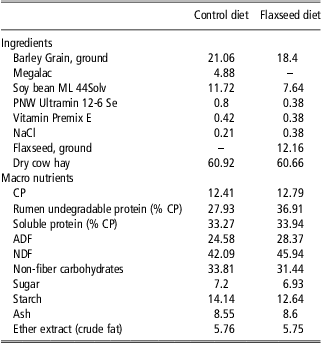
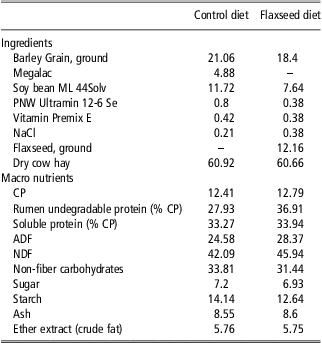
The two diets were formulated using the Cornell–Penn–Miner System (CPM Dairy, version 1.0). The nutrient profiles of the two diets were comparable except for their flaxseed content (Table 2). The diet formulations were: (1) the control diet, a conventional dry cow ration (OSU Dairy Center, Corvallis, OR, USA); and (2) the flaxseed-supplemented diet (purchased from Union Point Custom Feeds, Brownsville, OR, USA), a conventional dry cow ration adjusted with 12.16% ground flaxseed incorporated into the total mixed ration (dry matter (DM) basis). The total fat content in the control and the flaxseed-supplemented diets did not differ (5.76% and 5.75% DM basis, respectively). Energy and protein content of the two diets were also equivalent: net energy lactation (MJ/kg) was 7.19 (the control diet) and 6.73 (the flaxseed-supplemented diet), and CP content in the control diet and the flaxseed-supplemented diet was124 and128 g/kg DM, respectively. Head gates were used to ensure that each animal received the designated amount of their control or flaxseed-supplemented dietary ration.
Dietary ingredient and chemical composition of experimental diets (% dry matter)
Rumen sample collection
Rumen samples were collected by rumenocentesis (Garrett et al., Reference Garrett, Pereira, Nordlund, Armentano, Gooder and Oetzel1999) after a fasting period of 10 h on the last day of each feeding period and before introducing the ‘next’ period's diet. Approximately 5 ml of rumen fluid was aspirated from each cow with a 10 ml syringe. The samples were placed on ice and refrigerated until the following day when DNA extractions were performed. Cows were monitored during subsequent feedings for adverse reactions to the rumenocentesis procedure. Body condition and food consumption were monitored for evaluation of the overall health status of the experimental cows.
DNA extraction from rumen samples
A volume of 0.25 ml of rumen fluid was used for DNA extraction. DNA was isolated and purified using a commercial DNA extraction kit (Qiagen, Valencia, CA, USA). DNA concentration and purity were determined using a Nanodrop 1000 spectrophotometer (Thermo Fisher Scientific Inc., Waltham, MA, USA). All DNA samples were frozen at −20°C for use in qPCR analyses.
qPCR analysis of 16S rRNA and mcrA genes
Primers were purchased from IDT Corporation (Newark, NJ, USA). DNA was amplified with the mcrA-specific primers and with archaeal primers A109f and A934b based on previously mentioned publications (Luton et al., Reference Luton, Wayne, Sharp and Riley2002; Vianna et al., Reference Vianna, Conrads, Gomes and Horz2006; Denman et al., Reference Denman, Tomkins and McSweeney2007).
mcrA forward: 5′ GGTGGTGTMGGATTCACACARTAYGCWACAGC 3′ and reverse: 5′ TTCATTGCRTAGTTWGGRTAGTT 3′, 16S rRNA forward: 5′ ACKGCTCAGTAACACGT 3′ and reverse: 5′ GTGCTCCCCCGCCAATTCCT 3′. The amplicon length was 464 bp for mcrA and 798 bp for 16S rRNA. Optimized amplification conditions for both 16S rRNA and mcrA genes were: 1.15 × 10⁻⁷ mol/l primers, Hotstart-ITTM SYBR® qPCR master mix (USB Corporation, Cleveland, OH, USA) including 5 × 10⁻³ mol/l MgCl2, 2 × 10⁻⁴ mol/l dNTPs, 1.25 units of HotStart-IT tag DNA polymerase, 10 μg of bovine serum albumin and 1 × 10⁻⁸ mol/l fluorescein passive reference dye (USB Corporation, Cleveland, OH, USA). A sample of 60 ng of DNA was loaded into each well of a 96-well microplate. Total reaction volume was 20 μl. qPCR of 16S rRNA and mcrA genes was performed by a DNA Engine Opticon® 2 System real-time thermocycler (Bio-Rad Laboratories, Hercules, CA, USA). Samples were run in triplicate. The intra-assay variation for each sample triplicate was very small (data not shown). qPCR complete thermocycling parameters for both genes were: 95°C × 2 min, 95°C × 15 s, 60°C × 30 s, 72°C × 45 s, repeat 39 cycles, read plate, 72°C × 10 min, melting curve read from 65°C to 90°C, hold 1°C/s, 72°C × 10 min, hold at 10°C forever. The quality of 16S rRNA and mcrA amplicons was analyzed by running both amplicons on 1.5% agarose gels containing ethidium bromide. The amplicon specificity was performed via dissociation curve analysis (data not shown). The 16S rRNA and mcrA standards were made using rumen fluid. Briefly, DNA was extracted from whole rumen fluid and PCR was performed using mcrA or 16S rRNA primers. PCR products were purified and cloned into Escherichia coli using one shot cells (Qiagen, Valencia, CA, USA). Knowing the exact size of the amplicons and using the average molecular weight of a single DNA base pair, the measured DNA could then be converted to target molecule copy numbers per microliter (ABI Biosystems, Foster, CA, USA). A dilution series of these PCR products was then used as a calibration standard for generating the standard curves (Y = −0.2592X + 7.23, r 2 = 0.973 for the 16S rRNA standard curve; and Y = −0.2693X + 7.9, r 2 = 0.98 for the mcrA standard curve). The linear scope of detection for both 16S rRNA and mcrA assays ranged from 102 to 105 target copy numbers, with an amplification efficiency of 1.18 for 16S rRNA and 0.98 for the mcrA. Cqs (the threshold cycles) of the no-template controls were 34.69 for the 16S rRNA based assay and 36.64 for the mcrA based assay. Cqs for the lower limits (100 to 300 copy numbers) were 18.09 to 21.34 for both assays. Opticon monitor™ version 3.1 software was used for calculations (Bio-Rad Laboratories, Hercules, CA, USA).
Statistical analysis
To determine the differences in gene abundance between control and flaxseed-supplemented diets, the statistical program R (version 2.11.0) was used. The statistical model included a paired t-test of the differences of values between the two diets from the second and the fourth feeding periods. Data were expressed as log mean ± log s.e.d. (standard error of difference), n = 11 cows. If there was a statistically significant difference in the paired t-test, then the interactions between breed × diet and between period × diet were analyzed separately, using a model Yi = μ + Xi +  $\epsilon<$><!--$$i. μ is the mean difference between Y and X;
 $\epsilon<$><!--$$i are normal (0, σ). Statistical significance was accepted at P < 0.05.
Results and discussion
The gene abundance was represented as copy number per 60 ng DNA in the sample. There was convincing evidence that the flaxseed-supplemented diet decreased the 16S rRNA gene copy number by 49% (P = 0.007) and the mcrA gene copy number by 50% (P = 0.002), compared with the corresponding control. The P-values from the interaction analysis were all >0.05: P = 0.226 (period × diet) and 0.755 (breed × diet) for 16S rRNA and P = 0.146 (period × diet) and 0.375 (breed × diet) for mcrA. These results indicate that: (1) there was no carry-over or period effect of flaxseed on either gene abundance change; and (2) the difference in gene abundance between flaxseed and control diets was not due to the fact that there were two different breeds.
Methane production from enteric fermentation can be affected by many factors such as dietary interactions and alterations in the ruminal microflora. Previous studies have reported that the n-3 polyunsaturated fatty acid (PUFA)-rich flaxseed fed to cattle reduces daily methane production by 10% to 20% depending on the dosage of flaxseed (Beauchemin et al., Reference Beauchemin, McGinn, Benchaar and Holtshausen2009; Eugène et al., Reference Eugène, Martina, Mialona, Kraussb, Renandc and Doreau2011). However, the mechanism by which flaxseed inhibits methane is unknown, although PUFA is involved in methane inhibition (Fievez et al., Reference Fievez, Vlaeminck, Jenkins, Enjalbert and Doreau2007). This study is the first to show that flaxseed supplementation alters the abundance of certain genes from ruminal microbes belonging to the domain archaea, which is the unique methanogenic microflora in the rumen (Janssen and Kirs, Reference Janssen and Kirs2008). Although a previous publication suggested the monitoring of methanogen populations by targeting the 16S rRNA marker gene using specific archaeal primers (Vianna et al., Reference Vianna, Conrads, Gomes and Horz2006), many researchers suggest using the functional gene mcrA, which encodes a terminal enzyme in the methanogenesis pathway (Luton et al., Reference Luton, Wayne, Sharp and Riley2002). Flaxseed supplementation to the diet was found to significantly decrease the abundance of both 16S rRNA and mcrA genes to a similar extent in the two breeds of dairy cows, which were used in the present study (Figure 1). The observation that the abundance of 16S rRNA is greater than mcrA is likely expressed as a single copy gent (Case et al., Reference Case, Boucher, Dahllöf, Holmström, Doolittle and Kjelleberg2007); the primer used for mcrA was from a conserved region (Luton et al., Reference Luton, Wayne, Sharp and Riley2002).
Effect of flaxseed supplementation on the abundance of 16S ribosomal RNA (16S rRNA) and methyl coenzyme-M reductase subunit A (mcrA) genes. Data were expressed as mean ± s.e.d; n = 11 cows in each group. **P = 0.002 and *P = 0.007, respectively.

In order to determine whether the gene abundance changes induced by flaxseed were due to individual animal variations, the interaction of the two different dairy breeds (Holstein and Jersey) was analyzed. Results indicated that the difference in breed did not affect the gene abundance for the markers used in this study.
Feeding fats is a dietary strategy with great probability of reducing methane emissions from ruminants (Beauchemin et al., Reference Beauchemin, McGinn, Benchaar and Holtshausen2009; Martin et al., Reference Martin, Morgavi and Doreau2010). In the present study, overall fat concentrations were the same in both control and treatment diets; the difference was in the type of fat. Fats high in n-3 PUFAs, such as are present in flaxseed, appear to have the greatest potential to reduce methanogenesis in ruminants compared with long chain fatty acids in the control diet.
Previous studies have not monitored the effect of dietary flaxseed supplements on the population numbers of methanogens in the rumen. This study demonstrated that flaxseed fed to cows effectively decreases the methogenic gene abundance in the rumen. Future studies should focus on the mechanisms by which flaxseed decreases methanogenic genes and protein expression in the rumen, as well as the relationship between methanogenic gene expression and methane production.
Acknowledgments
The authors would like to thank Dr Alix I. Gitelman for statistical analysis, Ms Zelda Zimmerman and Dr Jennifer Duringer for revising the manuscript. This work was supported by the Merck Merial Veterinary Scholarship program.