I. INTRODUCTION
Al–Si alloys, both hypoeutectic and hypereutectic grades, are known as typical high-strength, corrosion resistance, and light-weight materials, which makes them attractive for applications in automobile and aerospace industries. Reference Chirita, Stefanescu, Soares and Silva1–Reference Cai, Wang, Zhang, Peng and Wang4 The excellent mechanical and the physical properties of these alloys are attributed to hard Si particles embedded in an Al matrix. Reference Hogg, Lambourne, Ogilvy and Grant5–Reference Ma, Prashanth, Scudino, Jia, Wang, Zou, Wei and Eckert8 It is known that the size and shape of Si particles in the Al–Si alloy play an important role in determining the properties, and fine Si particles are a necessary prerequisite to get desirable properties. Reference Prashanth, Scudino, Klauss, Surreddi, Löber, Wang, Chaubey, Kühn and Eckert7,Reference Birol9–Reference Prashanth, Scudino and Eckert13
The Al–Si alloys have been fabricated and investigated widely for decades; several fabrication techniques, such as stir casting, Reference Rao, Rao, Deshmukh, Shah and Kashyap14 squeeze casting, Reference Yu and Yu15,Reference Chen and Chung16 spray forming, Reference Jia, Cao, Scudino, Ma, Li, Yu, Eckert and Sun17,Reference Cui, Schulz, Schimanski and Zoch18 powder metallurgy, Reference Liu, Wei, Fan, Ma and Zuo19–Reference Wang, Prashanth, Chaubey, Löber, Schmansky, Pyczak, Zhang, Scudino and Eckert21 additive manufacturing via powder bed fusion processes, Reference Prashanth, Debalina, Wang, Gostin, Gebert, Calin, Kühn, Kamaraj, Scudino and Eckert22–Reference Prashanth, Damodaram, Scudino, Wang, Prasad Rao and Eckert24 can be applied to produce this alloy. The casting techniques offer low cost for production and high performance, however lack in flexibility and design. Nevertheless, some pores get entrapped during the solidification process due to the large size and irregular shape of the Si phase. In addition, the Si content is difficult to control precisely during the casting process and also the morphology of the Si particles. Reference Liu, Samuel, Samuel, Doty and Valtierra25 Lately, refiners/modifiers are used to control the morphology of the Si particles during the casting process. Reference Liu, Zhang, Beausir, Liu, Esling, Yu, Zhao and Zuo26,Reference Guo, Wang, Yu, Zhang, Pan, Zhou, Liu, Qin, Wang and Tian27 The spray deposition method can also effectively decrease the size of the Si phase and can change the morphology of the Si phase. Since, it involves the use of inert gases like nitrogen during the atomization process, a small amount of nitrogen may be adsorbed at the surface of the powder, which may be detrimental during the consolidation process. Reference Ji, Yang, Gao, Watson and Fan28 Even though solid state production costs are relatively higher than conventional casting processes, this alloy produced using solid state processes may exhibit excellent finished performances. Reference Jia, Cao, Ma, Scudino, Eckert, Sun and Wang29 Powder metallurgy (PM) followed by sintering or extrusion is a common solid state manufacturing technique, which offers low sintering temperature, near net-shape formability, high productivity, as well as high relative density, and it is possible to use the processes efficiently. Reference Bedir30 Additive manufacturing is another option to process these alloys; however, it becomes expensive, if large batches of alloys are to be processed. Reference Prashanth, Löber, Klauss, Kühn and Eckert31
In this study, both hypoeutectic and hypereutectic Al–Si alloys were fabricated by the powder metallurgy process using hot pressing followed by hot extrusion. The effect of Si morphology (size, shape, and distribution) on the mechanical properties and the thermal expansion behavior is investigated in detail followed by fracture mechanism studies.
II. EXPERIMENTAL DETAILS
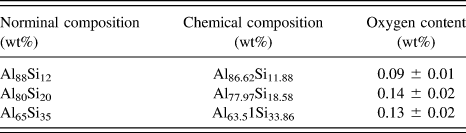
Al–Si gas atomized powder with three different compositions was used in this study. The composition of the powders is given in Table I. The powders were hot pressed at 673 K for 15 min under a protective argon gas atmosphere to form cylindrical compacts with a size of about φ10 × 10 mm. Sintered compacts were then hot-extruded at 723 K with an extrusion ratio of 9:1. The pressures applied in hot pressing and hot extrusion are 500 MPa and 700 MPa, respectively.
Compositions and oxygen contents of Al–Si gas atomic powders.

Chemical analysis of the powders were conducted by LSM International using bead fusion and analysis on a wavelength dispersive X-ray fluorescence (XRF). The microstructure of the Al–Si alloys was characterized by a scanning electron microscope (SEM; Gemini 1530, Zeiss, Oberkochen, Germany). The samples for SEM observation were etched in 0.5 vol% HF solution (0.5 vol% HF + 99.5 vol% H2O) for 20 s. ImageJ software (National Institutes of Health, Wayne, Rasband) was adopted to calculate the average size of Si particles based on the SEM images. Structural characterization of the samples was studied using X-ray diffraction (XRD; X’Pert Pro Diffraction, PANalytical B.V., Almelo, The Netherlands; Cu Kα radiation, reflection geometry). Archimedes’ principle was used to evaluate the density of the samples.
The Vickers microhardness measurements were carried out at a load of 500 gf and were held for 15 s using a HV-1000Z-type digital microhardness tester (Jinan Kason Testing Equipment Co. Ltd., Jinan, China). Room temperature mechanical properties were performed on an Instron 5569 electronic universal testing machine (Fiedler Optoelektronik GmbH, Luetzen, Germany) at a strain rate of 10−4 s−1. The tensile fracture morphology was studied using SEM. To ensure the reproducibility, at least six measurements were carried out at each condition.
Thermal expansion analysis was performed on a NETZSCH DIL 402C dilatometer (NETZSCH GmbH & Co., Selb, Germany) using heating and cooling rates of 5 K per minute from room temperature to 723 K under an argon atmosphere. To eliminate systematic errors, the dilatometer was calibrated by measuring a silica sample under the same experimental conditions. Each result presented here is an average of three distinct experiments. Cylindrical samples of 4 mm diameter and 25 mm length were used for the thermal expansion analysis measurements. The top and the bottom of the specimens were polished to guarantee plane-parallel surfaces.
III. RESULTS AND DISCUSSION
A. Microstructure and phase composition of Al–Si alloys
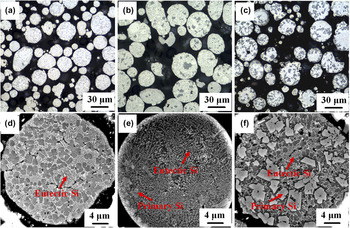
The microstructures of the gas atomized powders are given in Fig. 1. As can be seen, most of the particles are spherical in shape, with their size ranging between 20 and 30 μm. Eutectic Si and primary Si can be observed obviously in the microstructure. Moreover, the grain boundaries can also be found clearly and the grain size observed in these alloys were similar, which is ∼8 ± 0.5 μm.
Microstructures of (a, d) Al–12Si, (b, e) Al–20Si, (c, f) Al–35Si gas atomized powders.

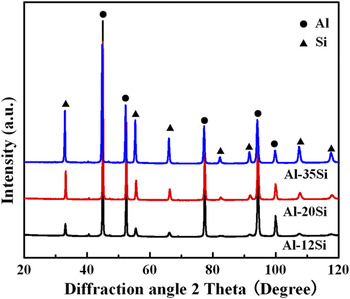
Figure 2 shows XRD patterns of the Al–Si alloys fabricated with hot extrusion. As expected, only α-Al and Si reflections are visible. There are no distinct peaks of impurities like oxygen visible, since they are present in small amounts that are hard to detect by X-rays. As the Si content increases, the intensity of the Si diffraction peaks increases.
XRD patterns of Al–Si alloys prepared with hot extrusion.

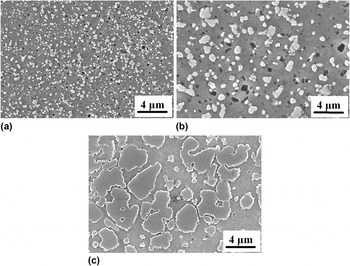
The microstructures of the three different Al–Si alloys are shown in Fig. 3. As it can be seen in the Al–12Si sample, the small particles of Si are evenly distributed in the Al matrix after hot pressing and hot extrusion. As the Al–Si alloy is composed of soft Al and hard Si, during the extrusion, the Al becomes softer, and the deformation becomes homogeneous; thus, the Si particles can be evenly distributed in the Al matrix. Eutectic Si in the Al–12Si alloy varies its morphology from a fibrous to particulate shape. Both eutectic Si and primary Si in Al–20Si are present in the form of small particles, and it is difficult to distinguish primary Si and eutectic Si after hot extrusion. Fibrous eutectic Si in the Al–35Si alloy also varies to a particulate shape. It has been reported that an elongated Si phase tends to fracture more frequently than a particulate shape as a result of the introduction of high levels of stress concentration. Si breaks and partially dissolves into the matrix during extrusion. This would result in outstanding fracture elongation values as well as good yield strength (YS). Reference Li, Wang, Jie and Wei32 In addition, the size of primary Si in the Al–35Si alloy does not change significantly, however, its morphology changes to an irregular shape.
SEM micrographs of Al–Si alloys after hot extrusion: (a) Al–12Si alloy, (b) Al–20Si alloy, and (c) Al–35Si alloy.

During the hot pressing and subsequent hot extrusion process, eutectic Si breaks and changes to a spherical shape gradually. Meanwhile, due to the friction between primary Si and the matrix, the edges of primary Si display a slight passivation. In addition, the diffusion of the Si atoms is also helpful for the passivation of the primary Si phase. Moreover, some Si particles grow in size due to diffusion aided by the hot pressing/extrusion conditions, mainly the thermal energy, as depicted in Fig. 3. The average sizes of the Si particles are found to be 0.62 ± 0.04 μm, 1.18 ± 0.07 μm, and 3.35 ± 0.15 μm calculated to be in Al–12Si, Al–20Si, and Al–35Si alloys, respectively. The size of Si particles increases and its shape becomes more irregular with increasing the Si content.
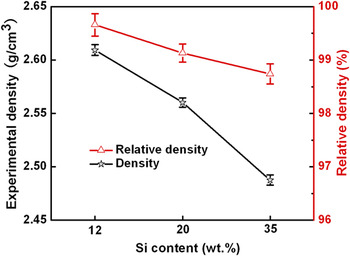
The density and the relative density of the three different Al–Si alloys are measured and the results are demonstrated in Fig. 4. Due to the lower density of Si (∼2.3 g/cm3) than Al (∼2.7 g/cm3), the density of these alloys decreases with increasing Si content. In addition, the relative density decreases slightly with increasing Si content. With increasing Si content, the Si particles are observed to be larger in size leading to increased porosity levels at the interface between Al and Si in these samples as shown in Fig. 3.
Density of the Al–Si alloys consolidated by hot extrusion.

B. Mechanical properties of Al–Si alloys
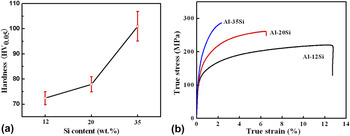
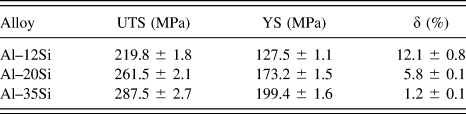
The effect of the Si content on the mechanical properties is depicted in Fig. 5. Both the hardness and the tensile strength increase significantly with increasing Si content. The hardness values are found to be 72.4 ± 0.4 HV0.05, 77.9 ± 0.5 HV0.05, and 101 ± 0.7 HV0.05 for Al–12Si, Al–20Si, and Al–35Si alloys, respectively. The tensile property results are demonstrated in Table II in the form of true stress–strain curves. As observed, the ultimate tensile strength (UTS) and the YS of these alloys increase with increasing Si content, whereas the elongation shows an adverse trend. Published reports on powder metallurgy processed Al–Si alloys show UTSs of 148 MPa for Al–22Si and 196 MPa for Al–50Si alloys (fabricated by hot pressing). Reference Cai, Zhang, Wang, Peng, Qiu and Feng33 Hence, the results observed here show improved mechanical properties, even though the comparison may not be fair, since the reported results consolidate the Al–Si samples by hot pressing and the present samples are consolidated by hot pressing and subsequent hot extrusion processes.
Mechanical properties of the three different Al–Si alloys: (a) Hardness data, (b) tensile strain–stress curves.

Tensile properties of Al–Si alloys after hot extrusion.

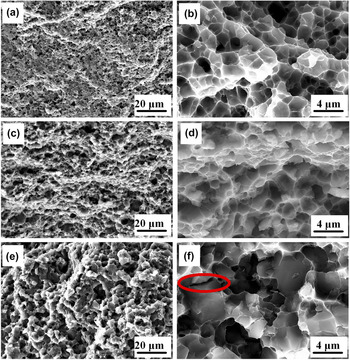
Figure 6 shows the fracture surfaces of Al–Si alloys after tensile tests. They exhibit the presence of large amounts of dimples and shapes in the Al–12Si alloy, indicating that the failure is the result of ductile fracture. As a result, all the tested Al–12Si samples exhibit better elongation. The dimples become larger in the Al–20Si alloy and some cleavage can be found in the fracture surfaces, which indicates the presence of both ductile and brittle modes of fracture. Whereas, in Al–35Si samples apart from dimples and cleavage surfaces, some cracks are also observed, as marked in Fig. 6(f), which indicates that the failure of the sample is predominantly by a brittle fracture mode. As a hard phase, the Si particles play a key role in the strengthening of the Al–Si alloy. The tensile loading generates stresses in the Al–Si samples, where Al as a soft phase deforms readily than hard Si. Consequently, a number of dislocation sources can be excited and started up within the matrix. When the dislocations move and reach the Al/Si interfaces, the dislocations’ pileup may take place due to the hindrance of the Si particles, which can effectively reduce the movement of dislocations. A relatively high stress must be applied to move the dislocation overcoming the obstacle which deforms it plastically. This maybe the main reason for improving the strength of the Al–35Si alloy. As it can be observed in Fig. 6(f), the Al–35Si alloy cracks at the interface between Al and Si, which triggers the failure. Due to the irregular shape of Si particles, the stress normally segregates at the corners of the Si phase and can lead to premature crack initiation, deteriorating the overall mechanical properties of the alloy.
Fracture surfaces of Al–Si alloys after hot pressing and subsequent hot extrusion: (a, b) Al–12Si alloy, (c, d) Al–20Si alloy, and (e, f) Al–35Si alloy.

C. Thermal expansion behavior of Al–Si alloys
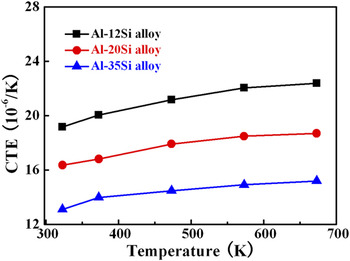
The variation in the CTEs as a function of temperature for the Al–Si alloys is shown in Fig. 7. The CTEs of all the alloys monotonically increase with increasing temperature. The CTEs of the sample with a high Si content show lower values compared with the ones with a low Si content. The coefficient of thermal expansion (CTE) decreases with increasing Si content. On the one hand, this can be attributed to the low CTE of Si particles. On the other hand, a high volume fraction of Si particles have a larger total specific surface area than that of the low content of Si in the Al–Si matrix, leading to a more effective restriction on the thermal expansion of Al in the matrix. Thus, the CTE of the alloy with more Si is lower than that with less ones, and its value decreases from 19.2 × 10⁻⁶/K for the Al–12Si alloy to 13.1 × 10⁻⁶/K for the Al–35Si alloy at room temperature. Moreover, compared with the CTE of Al–Si alloys fabricated by hot pressing, Reference Cai, Zhang, Wang, Peng, Qiu and Feng33 this study displays a lower value as a result of the small size of the Si particles. The decreased size of the Si particles contributes to more Si/Al interfaces after hot extrusion, which can effectively inhibit the expansion of the Al matrix.
CTEs of the three different Al–Si alloys after hot extrusion.

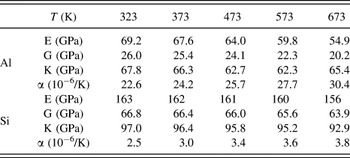
Several models are applied to calculate the effective CTE of alloys, such as the linear rule of mixtures (ROM), Reference Elomari, Skibo, Sundarrajan and Richards34,Reference Uju and Oguocha35 the Turner model, Reference Nagarajan, Dutta and Surappa36,Reference Chawla, Deng and Schnell37 the Kerner model, Reference Chawla, Deng and Schnell37,Reference Hashin and Shtrikman38 and the Schapery’s model. Reference Hashin and Shtrikman38 All the models are based on different assumptions as depicted in our previous work, Reference Wei, Ma, Wang, Zou, Scudino, Song, Prashanth, Jiang and Eckert39 and some physical properties of Al and Si are given in Table III.
Physical properties of Al and Si. Reference Jia, Cao, Scudino, Ma, Li, Yu, Eckert and Sun17,Reference Huber, Degischer, Lefran and Schmitt40

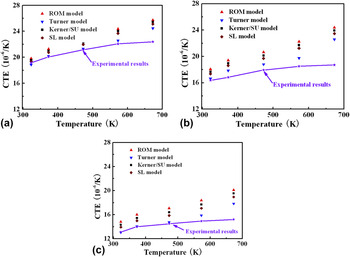
Figure 8 shows the comparison between theoretical and experimental CTEs for the three different Al–Si alloys. It can be found that all the experimental CTEs agree well with the Turner model at temperatures lower than 573 K, but deviate from the other theoretical values. This can be ascribed to the small size of the Si phase after hot extrusion and well bonding between the Si phase and Al matrix. However, the experimental CTEs are lower than the Turner model when the temperature is higher than 573 K, which is caused by the increased solid solubility of Si in the Al matrix at elevated temperatures.
Comparison between theoretical and experimental CTEs for the three different Al–Si alloys: (a) Al–12Si alloy, (b) Al–20Si alloy, and (c) Al–35Si alloy.

IV. CONCLUSIONS
In this study, by means of hot pressing and hot extrusion, Al–Si alloys with three different Si contents (12, 20, and 35 wt%) were manufactured and evaluated. Considering the results achieved, it is concluded that
-
(1) Al–Si alloys containing three different Si contents were fabricated using hot pressing and subsequent hot extrusion with relatively high densities. Si particles are homogeneously distributed in the Al matrix. The sizes of the Si particles in Al–12Si, Al–20Si, and Al–35Si are 0.62, 1.18, and 3.45 μm, respectively.
-
(2) Both the UTS and YS increase with increasing the Si content from 219.8 MPa, 127.5 MPa in the Al–12Si alloy to 287.5 MPa, 199.4 MPa in the Al–35Si alloy, whereas the elongation exhibits an opposite trend. The fracture surfaces vary significantly. It shows a ductile fracture mode in the Al–12Si alloy, turns to be a mixture of ductile and brittle in the Al–20Si alloy, and finally changes to brittle fracture in the Al–35Si alloy.
-
(3) The CTE decreases with increasing Si contents. And its value decreases from 19.2 × 10⁻⁶/K for the Al–12Si alloy to 13.1 × 10⁻⁶/K for the Al–35Si alloy at room temperature. The Turner model could be used to predict the CTE of the alloys for temperatures less than 573 K.
ACKNOWLEDGMENTS
This project was supported by the National Key Research and Development Program of China (2016YFB0700203), the National Natural Science Foundation of China (Nos. 51601110, 51601109, 51375294, 51402189), the China Postdoctoral Science Foundation (No. 2016M601563), the Natural Science Foundation of Shanghai (No. 17ZR1440800, 14ZR1418300), the Youth Teacher Development Program of Shanghai Universities (Nos. ZZGCD15100, ZZGCD15036).