Implication
Inbreeding, when quantified as the inbreeding coefficient, has been reported to influence many reproductive traits causing long-term economic losses. However, its impacts over traits associated with the performance on embryo production biotechnologies need clarification. In the present study, the inbreeding coefficient of the donor, the sire and the embryos were included both as continuous and categorical variables in the models in order to comprehend its effect over phenotypic performances of Guzerá females. Extreme inbreeding coefficients should be avoided when choosing female donors, as well as when planning mating for in vitro embryo production (IVEP) programmes.
Introduction
Inbreeding is defined as the mating of individuals who have related ancestors (Falconer and Mackay, Reference Falconer and Mackay1996). The inbreeding coefficient is an indirect measure of the degree of inbreeding, or better, of the probability that two alleles in any locus sampled at random from each individual be identical by descent (Malecót, Reference Maximini, Fuerst-Waltl, Gredler and Baumung1948). Consequences of the increase of inbreeding on finite populations are justified by two well-established theories. The first is based on the partial dominance concept, in which inbreeding is responsible for increasing the frequency of homozygote individuals in the population, leading to an increase of undesirable recessive disorders (Crow and Kimura, Reference Crow and Kimura1970). The overdominance theory states that heterozygote individuals express higher phenotypic mean than the homozygotes for any determined locus. Then, decrease in heterozygotes frequency would consequently reduce the overdominance effects in the population (Croquet et al., Reference Croquet, Mayeres, Gillon, Hammami, Soyuert, Vanderick and Gengler2007). As a result, inbreeding may imply in negative effects over economically interesting traits, being this event referred to as inbreeding depression (Dickerson, Reference Dickerson1963).
Several studies have reported unfavourable effects of inbreeding on the conventional reproductive traits, such as age at first calving, for both dairy and beef cattle (González-Recio et al., Reference González-Recio, López De Maturana and Gutiérrez2007; McParland et al., Reference Merton, Ask, Onkundi, Mullaart, Colenbrander and Nielen2007; Rokouei et al., Reference Rokouei, Vaez Torshizi, Moradi Shahrbabak, Sargolzaei and Sørensen2010). As natural reproduction is considered a complex biological process, influenced by numerous factors, this complexity must also be assumed for the assisted reproduction traits (in vitro or in vivo embryo production) (Perez et al., Reference Perez, Peixoto, Bruneli, Ramos and Balieiro2016). If so, both conventional and assisted reproduction may even be affected by similar genetic and environmental factors, as reproductive biotechnology focusses on simulating natural reproductive conditions in order to obtain greater success (Baruselli et al., Reference Baruselli, Vieira, Batista, Ferreira, Sales, Gimenes, Torres, Martins, Sá filho and Bó2015; Stroebech et al., Reference Strøebech, Mazzoni, Pedersen, Freude, Kadarmideen, Callesen and Hyttel2015).
Ovum pick-up (OPU) followed by IVEP, particularly, has been growing remarkably in North and South America, whereas slightly decreasing in Europe (Stroebech et al., Reference Strøebech, Mazzoni, Pedersen, Freude, Kadarmideen, Callesen and Hyttel2015). Despite the evidences of genetic components underlying artificial reproduction variability, to our knowledge, studies accounting for the effects of inbreeding on IVEP traits are rare or non-existent.
Thus, the objective of this study was to estimate the effects of donor, sire (used in on in vitro fertilization) and embryo inbreeding on IVEP traits for a dual-purpose Guzerá breed population.
Material and methods
Ovum pick-up and in vitro embryo production proceedings
The structures were obtained by transvaginal ovarian puncture guided by ultrasound, as described by Seneda et al. (Reference Seneda, Esper, Garcia, Oliveira and Vantini2001), followed by in vitro fertilization 1 day after aspiration. The OPU sessions were performed by the technician of the IVEP central located in Minas Gerais state, Brazil. Ovum pick-up and in vitro fertilization procedures were performed according to Perez et al. (Reference Perez, Peixoto, Bruneli, Ramos and Balieiro2016). Structures were classified according to the number of the cumulus cells and the cumulus complex oocyte cytoplasm in grades I, II and III (considered viable), and without cumulus in atresic or degenerated.
Data
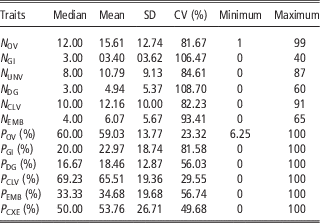
Information on oocyte and embryo production were analysed based on a data file containing results of 5716 OPU/in vitro fertilization (IVF) sessions (which yielded 34 696 embryos) performed on 1205 Guzerá breed female donors originated from 16 breeding herds under different selection criteria (beef and dual purpose), located in northeast and southeast regions of Brazil. All herds had similar pasture-based production systems. Cows submitted to OPU/IVEP were daughters of 262 sires. Descriptive statistics for the data are presented in Table 1. Sessions that yielded no structures were removed from the data set, as it may be impossible to discriminate technical failures from an impaired performance of the animals. Guzerá donors were 1 to 20 years old at the OPU moment. The sessions were accomplished by a private embryo production company between March 2003 and July 2013, and were all performed in the herds. The number of sessions per donor varied from 1 to 49, where 245 cows had only one session, 648 cows had between 3 and 5 sessions, 194 animals had between 6 and 10 sessions and 118 had more than 10 sessions in the data set. The intervals between sessions varied from 7 to 120 days, being categorized for the analyses (1=7 days, 2=between 7 and 14 days, 3=between 14 and 30 days, 4=between 30 and 60 days, 5=between 60 and 90 days and 6=between 90 and 120 days). Semen from 147 different Guzerá bulls was used on in vitro fertilization procedures.
Median, mean, SD, CV, minimum and maximum values for the traits analysed

N OV=number of viable oocytes; N GI=number of grade I oocytes; N UNV=number of unviable oocytes; N DG=number of degenerated oocytes; N CVL=number of cleaved embryos; N EMB=number of viable embryos produced; P OV=percentage of viable oocytes; P GI=percentage of grade I oocytes; P DG=percentage of degenerated oocytes; P CLV=percentage of cleaved embryos; P EMB=percentage of viable embryos; P CXE=the percentage of cleaved embryos that became viable embryos.
Originally, the relationship matrix to be used in all analyses performed in the present study contained 6850 animals, including 1562 with unknown parents, 89 with only one parent known and 5199 with both parents known. Genealogical data have been registered since the first Guzerá animals were imported to Brazil (end of the 19th century). In order to obtain the inbreeding coefficients of the produced embryos, each of the occurred in vitro mating (n=5716) was included in the pedigree file as an individual. The final pedigree file had 12 566 entries (6850+5716). The inbreeding coefficient was calculated for each individual in the pedigree file based on an adaptation of the method proposed by Meuwissen and Luo (Reference Mc Parland, Kearney, Rath and Berry1992), included as a routine in ASREML software (version 4.0, Gilmour, 2014).
Analysis and models proposed
All analyses were conducted in ASReml (version 4.0, Gilmour et al., 2014). In order to obtain least biased estimates, count traits were analysed by generalized linear mixed models assuming a Poisson distribution of the dependent variable and a log link function
 $\left( {\eta _{i} \, {\equals}\, {\rm ln}[\mu _{i} ]} \right)$
. At the same time, percentage traits were analysed assuming a Gaussian distribution of the response variable and an identity link function
 $\left( {\eta _{i} \, {\equals}\, {\rm ln}[\mu _{i} ]} \right)$
. Solutions for the fixed effects, and respective standard errors, were back transformed by its inverse link function (
 $\left {\mu _{i} {\equals}{\rm exp}[\eta _{i} ]} \right$
for the Poisson model and
 $\eta _{i} \, {\equals}\, \mu _{i} $
for the Gaussian model) in order to allow inference for the inbreeding effects on the original scale.
The statistical significance of all effects, including level of inbreeding, was based on the Wald F-test (West et al., Reference West, Welch and Galecki2007), as its usage fits both (overdispersed) categorical (Poisson) and continuous (Gaussian) variables. The present study accounted for the inbreeding coefficient (donor, sire and embryo) effects by including it (separately) in the models either as continuous or as a categorical variable (F=0; 0<F⩽3.5; 3.5<F⩽7.0 and F>7.0), as proposed by McParland et al. (Reference Merton, Ask, Onkundi, Mullaart, Colenbrander and Nielen2007). The F=0 category was treated as the reference category. When inbreeding was considered as a continuous variable, both linear and quadratic effects of inbreeding were tested on the traits.
Count traits related to oocyte and embryo production were as follows: number of viable oocytes (N OV), number of grade I oocytes (N GI), number of unviable oocytes (N UNV), number of degenerated oocytes (N DG), number of cleaved embryos (N CVL) and number of viable embryos produced (N EMB). Percentage traits were as follows: percentage of viable oocytes (P OV), percentage of grade I oocytes (P GI), percentage of degenerated oocytes (P DG), percentage of cleaved embryos (P CLV) and percentage of viable embryos (P EMB) and the percentage of cleaved embryos that became viable embryos (P CXE). P OV was calculated as a proportion of the total number oocytes, whereas P GI, P CLV and P EMB were calculated as proportions of N OV, P DG was calculated as a proportion of N UNV and P CXE calculated as N EMB proportional to N CLV. For the ovarian puncture related traits (N OV, N GI, N UNV, N DG and P OV, P GI, P DG), the model was proposed as follows:
 $$\eqalignno{ y_{{ijklmn}} \, {\equals}\, & \beta _{0} {\plus}hy_{i} {\plus}bh_{j} {\plus}season_{k} {\plus}intOPU_{l} {\plus}tech_{m} {\plus}\beta _{1} age \cr & {\plus}\beta _{2} age^{2} {\plus}\beta _{3} F{\plus}\beta _{4} F^{2} {\plus}a_{n} {\plus}p_{o} {\plus}e_{{ijklmno}} $$
where y
ijklmno
represent the value for the trait; β
0 an intercept; hy
i
the fixed effect of herd-year of OPU interactions (i=1,2, … ,84); bh
j
the fixed effect of the donors birth herd (j=1,2, … ,16); season
k
the fixed effect of the season of the OPU occurrence (k=1 or 2); intOPU
l
the fixed effect of the classes of interval between OPU sessions (l=1,2, … ,6), tech
m
the fixed effect of the technician responsible for the OPU (m=1,2, … ,7); β
1 and β
2 the coefficients of the covariate (linear and quadratic, respectively) age at OPU (in months); β
3 and β
4 the coefficients of the covariate (linear and quadratic, respectively) inbreeding coefficient, which were substituted by a fixed effect of the F category for the proposed analysis; a
n
the random effect of the nth animal (o=1,2, … ,6850), where
 $a\!\sim\!N(0,A\sigma _{a}^{2} )$
, A being the relationship matrix connecting all animals in the pedigree; p
o
the random permanent environment effect of the oth animal (o=1,2 … ,1205), where
 $p\!\sim\!N(0,\sigma _{p}^{2} )$
; and e
ijklmno
the random residual terms, where
 $e\!\sim\!N(0,\sigma _{e}^{2} )$
.
For the embryo production traits (N CLV, N EMB and P CLV, P EMB and P CXE), the following model was proposed:
 $$\eqalignno{ y_{{ijklmn}} \, {\equals}\, & \beta _{0} {\plus}hy_{i} {\plus} bh_{j} {\plus} season_{k} {\plus}intOPU_{l} {\plus}tech_{m} {\plus}\beta _{1} age \cr & {\plus}\beta _{2} age^{2} {\plus}\beta _{3} F{\plus}\beta _{4} F^{2} {\plus}a_{n} {\plus}p_{o} {\plus}s_{p} {\plus}e_{{ijklmno}} $$
where s
p
is the random effect of the bull whose semen was used in IVF (father of the embryos) (P=1, 2, … ,147), where
 $s\! \sim \!N(0,\sigma _{s}^{2} )$
. All other effects were identical to the model (1).
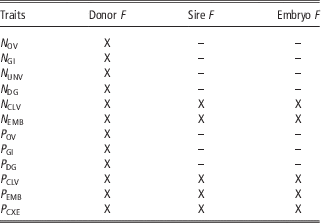
Table 2 shows the scheme of traits in which each proposed inbreeding effects were tested. As sire and embryo effects only have influence when in vitro fertilization begins, those were tested only for embryo production traits.
Inbreeding effects of the donor; sire and embryo included to each determined trait

N OV=number of viable oocytes; N GI=number of grade I oocytes; N UNV=number of unviable oocytes; N DG=number of degenerated oocytes; N CVL=number of cleaved embryos; N EMB=number of viable embryos produced; P OV=percentage of viable oocytes; P GI=percentage of grade I oocytes; P DG=percentage of degenerated oocytes; P CLV=percentage of cleaved embryos; P EMB=percentage of viable embryos; P CXE=the percentage of cleaved embryos that became viable embryos.
Results
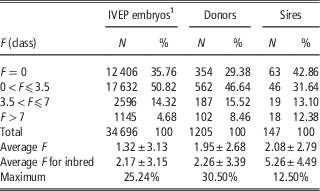
Descriptive statistics found a large variation for the traits considered in the present study. Coefficient of variation values ranged from 29.55% to 108.70%. Average inbreeding for donors, embryos and sires was 1.32±3.13; 1.95±2.68 and 2.08±2.79, respectively (Table 3). When considering only inbred animals, inbreeding coefficient means were 2.26%, 5.26% and 2.17%, respectively, for donors, sires and embryos. The proportion of non-inbred individuals was 29.38%; 42.86% and 35.76% for the same groups. The sire group showed a proportion of 12.38% for the number of animals with F>7%, whereas donors and embryos had 8.46% and 4.68%, respectively.
Number (N) and percentage (%) of individuals (or IVF session) according to F classes, average F for the inbred and non-inbred animals and maximum F values for the embryos, donors and sires

1 N for the in vitro embryo production (IVEP) embryos data set refers to each embryo representing an individual.
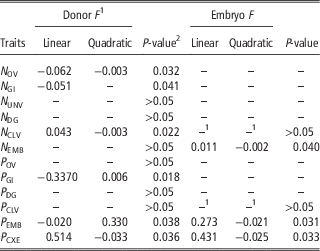
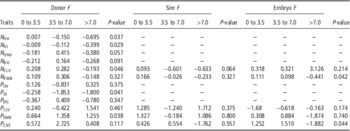
Regression coefficients for the linear and quadratic terms of F and solutions for the fixed effects of each F category over oocyte and IVEP traits studied are shown in Tables 4 and 5, respectively. The inbreeding coefficient of the donor as a covariate had a quadratic effect over N OV. Differences between the inbreeding coefficient categories showed that the effect of the F assumed an increasing impact on N OV as the value of F increased. The effect of the donor’s F on N GI as a continuous variable was linear and unfavourable (−0.050/1% of increase in F). When included as categories, donors with F>7.0% produced −0.40±0.20 grade I oocyte when compared with non-inbred donors. Effects of the donors’ inbreeding coefficient over N UNV and N DC were not significant either as covariate or as categories, but indicated a similar behaviour, where donors located in the 3.5<F⩽7.0 category exhibited higher numbers of N UNV and N DG than non-inbred cows. Quadratic effect was also detected for N CLV for increasing values of donors’ F. Donors with 0<F⩽7.0% showed higher numbers of cleaved embryos, but donors with F>7.0% produced −0.19±0.15 cleaved embryos than non-inbred donors. No significant effect was detected for the donors’ F over N EMB, but an unfavourable effect of −0.15±0.21 was estimated for females with F >7%, which exhibited less embryos produced when compared with non-inbred animals.
Model solutions and P-values for the effect of the donor and embryo inbreeding coefficients included as a continuous variable over the number/percentages of oocytes or embryos in Guzerá cattle

N OV=number of viable oocytes; N GI=number of grade I oocytes; N UNV=number of unviable oocytes; N DG=number of degenerated oocytes; N CVL=number of cleaved embryos; N EMB=number of viable embryos produced; P OV=percentage of viable oocytes; P GI=percentage of grade I oocytes; P DG=percentage of degenerated oocytes; P CLV=percentage of cleaved embryos; P EMB=percentage of viable embryos; P CXE=the percentage of cleaved embryos that became viable embryos.
1 Non-significant effects were not reported for visualization purposes.
2 No quadratic effect of the donor inbreeding over NGI was detected, thus, P-value reported refers exclusively to the linear effect.
Effects of the donor’s inbreeding coefficient over percentage traits are presented in Tables 4 and 5. No influence of the donor’s F was observed for P OV and, similarly, no clear differences were detected for the F categories. The same was noted for P UNV and P DG. The non-linear (quadratic) component of the regression model was significant for P GI, indicating notable unfavourable effects for donors with F>3.5% when compared with non-inbred females. For embryo production traits, no significant donor’s F effects were observed over P CLV, however, a non-linear effect was detected over P EMB. Inbred donors presented higher phenotypic mean for the embryo percentage, in special, donors with F between 3.5% and 7.0%, which produced +1.36%±0.88% viable embryos when compared with non-inbred donors. A non-linear effect was also detected for the donors’ inbreeding increase over P CXE. Similar to the observed for P EMB, the category containing Guzerá donors with F values between 3.5% and 7% had a favourable effect of +2.72%±1.16% over the percentage of cleaved embryos proceeding to viable embryo (P CXE) status when compared with the results for non-inbred donors.
Model solutions and P-values for the effect of the donor, sire and embryo inbreeding coefficients included as a categorical variable (0% to 3.5%, 3.5% to 7.0% and >7.0%) over the number/percentage of oocytes and embryos in Guzerá cattle

N OV=number of viable oocytes; N GI=number of grade I oocytes; N UNV=number of unviable oocytes; N DG=number of degenerated oocytes; N CVL=number of cleaved embryos; N EMB=number of viable embryos produced; P OV=percentage of viable oocytes; P GI=percentage of grade I oocytes; P DG=percentage of degenerated oocytes; P CLV=percentage of cleaved embryos; P EMB=percentage of viable embryos; P CXE=the percentage of cleaved embryos that became viable embryos.
No significant effect was detected for the sire (father of the embryos) inbreeding coefficient over IVEP traits, for neither count nor percentage traits. However, P-value (0.064) for the effect of sire F over N CLV suggested a possible significance not detected in this study. Sires with 3.5%<F⩽7.0% and F>7.0% presented in average, respectively, −0.60±0.63 and −0.63±0.47 cleaved embryos per IVF session when compared with the results of sessions in which semen from non-inbred sires was used.
Embryo’s inbreeding coefficient influence on the IVEP is presented in Tables 4 and 5. For both as covariate and as categories of inbreeding levels, embryo’s F seems to affect N EMB, P EMB and P CXE non-linearly. The embryo’s inbreeding coefficient influenced N EMB non-linearly (β 1=0.0108; β 2=−0.0024). When F was included in the models as a categorical variable, little difference was observed between non-inbred embryos and embryos with F between 0% and 7%, whereas mating with F>7% presented in average, −0.44±0.27 embryos produced when compared with non-inbred mating. P EMB was also non-linearly influenced by the embryo’s F. No difference was detected between categories of F for this trait. For P CXE, a quadratic effect of the mating F was also noted. The same behaviour was observed, little detected variation for F values from 0% to 7%, whereas mating with F>7% had, in average, −1.88%±1.16 cleaved embryos that concluded the in vitro embryo process into viable embryos.
Discussion
Detected effects for the change of inbreeding coefficient over the studied traits were mainly non-linear. For Lynch and Walsh (Reference Lynch and Walsh1998), non-linear effects detected when studying inbreeding depression over productive and reproductive traits must be attributed to possible epistatic interactions. This leads to the idea that IVEP traits in Guzerá cattle may be partly under epistatic control. However, as affirmed by McParland et al. (Reference Merton, Ask, Onkundi, Mullaart, Colenbrander and Nielen2007), due to the paucity of animals with high values for the inbreeding coefficient, non-linear effects of inbreeding coefficients observed in the present study, although significant, must be interpreted carefully. The lower frequency of the number of observations for higher classes of F may lead to an inaccurate estimation for the actual effect of F on the trait concerned.
Another important point is that both the oocyte and the spermatozoon follow completely different paths when under IVEP procedures, which may lead to the perception that environmental and genetic influence over those structures are distinct.
Under the IVEP scenario, donors’ inbreeding coefficient may be interpreted on different perspectives. When related to oocyte production traits, donors’ F may be considered as the individual inbreeding coefficient affecting a reproductive trait. However, when considering traits related to embryo production, the donors’ F can be considered both as individual inbreeding (when under the donor perspective) and as maternal inbreeding (under the embryo’s perspective). The same can be applied to sire inbreeding coefficient (father of the embryos).
Inbreeding coefficient of the donor
Inbreeding has been reported to negatively influence more commonly studied reproduction traits in cattle (Hinrichs and Thaller, Reference Hinrichs and Thaller2011; McParland et al., Reference Merton, Ask, Onkundi, Mullaart, Colenbrander and Nielen2007) and the same behaviour must be expected for embryo production traits. Carthy et al. (Reference Carthy, Ryan, Fitzgerald, Evans and Berry2015) have reported positive genetic association between early embryo loss, inferior uterine score and lower breeding values for other reproductive traits in Irish dairy cows.
In this study, the effect of donors’ inbreeding coefficient on the N OV was non-linear and overall negative as the F value increased. Results indicate that the decrease in the number of viable oocytes was pronounced for donors whose F was >3.5%. Previous studies (Merton et al., Reference Meuwissen and Luo2009; Perez et al., Reference Perez, Peixoto, Bruneli, Ramos and Balieiro2016) demonstrated considerable genetic variance for the number of viable oocytes whose heritability estimates varied from 0.19 to 0.25. Considering the magnitude of genetic influence, it is plausible to assume that the reduction of genetic variation caused by inbreeding may also affect this trait. The number of grade I oocytes produced (N GI) was linearly and negatively influenced (P<0.05) by the increase of the donor’s inbreeding coefficient. This indicates that oocyte quality may be impaired when OPU is performed on highly inbred Guzerá donors. Similar effects also influenced P GI, which indicates that high F levels of the donor can dramatically decrease oocyte quality. Donor’s inbreeding coefficient did not seem to influence the percentage of viable oocytes (P OV) produced by Guzerá cows. Considering the importance of this trait, females producing drastically low percentages of viable oocytes are most likely to be discarded early, which causes the absence of these individuals in data, impairing the capacity to detect significant effects.
On the attempt to elucidate the genetic effect over oocyte and embryo quality, Coyral-Castel et al. (Reference Coyral-Castel, Ramé, Monniaux, Fréret, Fabre-Nys, Fritz, Monget, Dupont and Dupont2012) compared favourable and unfavourable haplotypes at a quantitative trait loci (QTL) located on chromosome 3 (QTL-F-Fert-BTA3) which, based on previous discoveries (Coyral-Castel et al., Reference Coyral-Castel, Brisard, Touze, Dupont, Rame, Uzbekoya and Dupont2011), were associated with fertility. The authors showed that in vivo oocyte maturation was significantly impaired in cows that had the unfavourable haplotype. This result indicated that lower fertility in Holstein cows could happen due to low oocyte quality, which would result on impaired embryo development. The presence of genomic regions affecting oocyte and embryo quality (both direct or indirectly) reinforce the idea that there is genetic variation influencing oocyte and embryo quality traits, which may be affected by the increase of unfavourable allele’s frequency, due to inbred mating.
Bezdíček et al. (Reference Bezdíček, Stádník, Makarevich, Kubovičová, Louda, Hegedüšová, Holásek, Beran and Nejdlová2014) suggested that superovulated Holstein cows with inbreeding coefficient >3.1% would yield significantly (P<0.05) more unfertilized embryos than non-inbred cows under in vivo embryo production. Although not significant, results suggest that higher number of unviable oocytes were produced by donors between F of 3.5% and 7.0%, but not for donors over 7% inbreeding coefficient. This result may also be a consequence of early discarding of donors which produced high numbers of unviable oocytes.
When considering embryo production traits, a significant effect was reported for the impact of the donors’ inbreeding coefficient over N CLV (P<0.05) but not for N EMB. This result could indicate that after cleavage, donor’s genetic component assumes minor influence on embryo’s ability to maintain its development under the in vitro environment, which from this point, is probably mostly influenced by the embryo’s genetic merit.
Changes in methylation of the embryonic genome have been documented in the literature, indicating clear differences between in vivo and in vitro produced embryos (Tveden-Nyborg et al., Reference Tveden-Nyborg, Alexopoulos, Cooney, French, Tecirlioglu, Holland, Thomsen and D’Cruz2008; Mendonça et al., Reference Mendonça, Guimarães, da Silva, Caetano, Dode and Franco2015). Aberrant methylation timing on imprinted genes which were in homozygosis (for the unfavourable allele) in the donor supports the idea of a significant effect of the donor inbreeding coefficient over N CLV, but not for N EMB. Moreover, a possible parental-associated differential allelic expression on the embryos could cause a similar effect if parental imprinting was aberrantly more frequent on in vitro produced embryos for the commonly maternal imprinted genes involved in embryo development after cleavage.
Donor’s inbreeding coefficient affected positively the percentage of viable embryos produced (P EMB), suggesting that genes involved on embryo cleavage and post-cleavage viability may not be the same. Peixoto et al. (Reference Peixoto, Pereira, Bergmann, Penna and Fonseca2004) detected a supposed positive effect of inbreeding coefficient on the embryo production of superovulated Nelore female donors, although not significant (P<0.05). This effect may be explained by the presence of pre-selected (even if indirectly) females for embryo production performance traits in data. On the other hand, Bezdíček et al. (Reference Bezdíček, Stádník, Makarevich, Kubovičová, Louda, Hegedüšová, Holásek, Beran and Nejdlová2014) reported significant differences for the percentage of transferable embryos produced by non-inbred animals (71.77%) and animals with inbreeding coefficient >3.1% (55.13%) on superovulated Holstein cows. Likewise, Alvarez et al. (Reference Alvarez, da Silva, Carvalho and Binelli2005) have found an impaired (transferable) embryo production capacity associated to Mantiqueira breed cows with >9% inbreeding coefficient (also superovulated).
Conflicting results may happen due to different genetic selection criteria applied for each breed in each country, leading to different alleles been favoured in different populations over time. The perception that inbreeding may affect determined chromosome regions in which the alleles in homozygosis are positively associated to the trait studied suggest the possibility of positive effects of inbreeding. At the same time, it is impossible, at least in concern of the data analysed in this study, to specify if the inbreeding, in this case, is generating homozygosis for the alleles ‘A1’ or ‘A2’, which will clearly influence the linear (and non-linear) estimated effects. Further studies considering genomic information would help to clarify in what regions of the genome homozygosis is happening in the Guzerá cattle and what the effect (if any) of those specific regions on IVEP traits.
Inbreeding coefficient of the sire (father of the embryos)
Male fertility traits were studied in the literature (Gredler et al., Reference Gredler, Fuerst, Fuerst-Waltl, Schwarzenbacher and Sölkner2007; Santana et al., Reference Santana, Lopes, Verneque, Pereira, Lagrotta and Peixoto2010) for both Bos indicus and Bos taurus breeds. Perez et al. (Reference Perez, Peixoto, Bruneli, Ramos and Balieiro2016) suggested notable effects of the sire (father of the embryos) on the total phenotypic variation (from 1.1% to 9.5%) for IVEP traits on Guzerá cattle. Jaton et al. (Reference Jaton, Koeck, Sargolzaei, Malchiodi, Price, Schenkel and Miglior2016) have studied genetic variation on in vivo embryo production in superovulated Holstein cattle, and reported 1.4% of the total variation coming from genetic component of the bull (used in IVF). Those results indicate the existence of a ‘sire effect’ on embryo production both in B. indicus and B. taurus,
Maximini et al. (Reference Malécot2011) reported signs of inbreeding depression on semen quality traits. Based on these previous results, it would be expected that the inbreeding coefficient of the sire could also influence IVEP. However, no effects were detected for the sire inbreeding coefficient over embryo production traits in Guzerá cattle on the present study. This result clarifies that both gametes (spermatozoon and oocyte) suffer influence from distinct factors through the in vitro production procedures, or that both are differently affected by similar factors. Frozen thawed semen utilized on in vitro fertilization may impair spermatozoon’s capabilities (Vishwanath and Shannon, Reference Vishwanath and Shannon2000) and could mask possible variation that existed before the freezing process. Moreover, the fact that all 147 bulls used for IVF procedures came from highly selected populations could be another factor causing the absence of significant effects, especially when considering that most of those bulls had a considerable genetic connection. Another explanation could rely on particularities of the IVF technology, as IVEP procedures focus on simulating the female reproductive tract as best as possible and provide a favourable environment condition to overcome possible effects of male fertility defects.
Although not significant (P>0.05), sire inbreeding effects were considerably negative for bulls over 7% inbreeding coefficient for N CLV, N EMB and P CXE. Results for N CLV, which P-value for was 0.064 when the sire F was considered as categories, could indicate that the effect may actually exist, but could not be detected in the present study by particularities of the sample. Further studies focussed on investigating the influence of sire (father of the embryos) inbreeding coefficient over IVEP traits could help elucidate the role of the sire on artificial reproduction results.
Inbreeding coefficient of the embryos
Solutions estimated for F categories suggested that the embryo’s inbreeding coefficients over 7% may be harmful to the number of embryos produced (N EMB) and for the percentage of cleaved embryos (P CXE) that yield viable embryos. Van Raden and Miller (Reference Van Raden and Miller2006) reported negative impact of embryo inbreeding coefficient increase on the conception and else on the embryo survival after 70 days after insemination. Similarly, Cassel et al. (Reference Cassel, Adamec and Pearson2003) have observed remarkable inbreeding depression for the same trait in Jersey cattle. When analysed under the embryo’s perspective, N EMB and P CXE traits may also be understood as measures of the embryo’s ability to survive through IVEP environment. Considering the latter, results presented in this study suggest that there seems to be an association between the embryos inbreeding coefficient and its stability on both in vivo and in vitro production environments.
The absence of significant effects of the embryo inbreeding coefficient on P CLV, when evaluated together with the findings of Perez et al. (Reference Perez, Peixoto, Bruneli, Ramos and Balieiro2016) of very low heritability (0.01±0.005) for the same trait estimated with the same data set of the Guzerá cattle lead to an interesting idea. This result points out that this trait must have been indirectly selected by the extreme environmental conditions pressuring B. indicus populations under tropical regions, leading to a situation in which alleles that allow embryos to cleave under extreme unfavourable conditions get fixed in the population. The latter hypothesis is reinforced by the heritability estimated for P CLV (0.07±0.02) for Holstein cows in the Netherlands (Merton et al., Reference Meuwissen and Luo2009), which despite may also be considered low, is much higher than the previously mentioned results for the Guzerá cattle.
Bamber et al. (Reference Bamber, Shook, Wiltbank, Santos and Fricke2009) studied genetic aspects of pregnancy loss in dairy cattle. The authors reported higher proportions of total variation coming from the embryo’s genetic component than from its mother. This result implies that the embryo’s genetic component has notable impact on its ability to survive, which agree with the results observed in the present study. The latter results suggest the need to maintain lower levels of inbreeding on in vitro planned mating, by the cost of causing an impairment on donors’ productivity due to a reduction on the embryos ability to maintain development when under IVEP procedures.
Conclusions
In the present study, both favourable and unfavourable effects of the increase on inbreeding coefficient were detected over IVEP traits from Guzerá cattle. High values of inbreeding coefficient may decrease Guzerá donor’s performance on IVEP. Sire (father of the embryos) inbreeding did not seem to influence results of IVEP. Extreme values of inbreeding may impair optimal embryo survivability on in vitro environment. In order to prevent possible economic losses, high levels of inbreeding should, therefore, be avoided when selecting Guzerá donors and planning mating on IVEP programmes as it may cause economic losses.
Acknowledgements
The authors would like to thank Cenatte Embriões Ltda. for kindly providing the data for this study. The authors are also grateful to Fapemig and the government funding agencies Conselho Nacional de Desenvolvimento Científico e Tecnológico (CNPq) and Coordenação de Aperfeiçoamento de Pessoal de Nível Superior (CAPES) for the financial support.