Introduction
One of the crucial challenges of space exploration is planetary quarantine or how it can be ensured. This is why assessment of risks related to potential transfer of biological matter across interplanetary space is a high priority goal of space research. Exteriors of human and robotic space vehicles are inhabited by millions of microbial cells, many of which are carried as spores that are highly resistant to the adverse environmental effects (La Duc et al. Reference La Duc, Nicholson, Kern and Venkateswaran2003). Their resistance to outer space conditions needs to be verified by specifically designed experiments, as already independently demonstrated in several successful experiments (for review see Horneck et al. Reference Horneck, Klaus and Mancinelli2010, Reference Horneck, Moeller, Cadet, Douki, Mancinelli, Nicholson, Panitz, Rabbow, Rettberg, Spry, Stackebrandt, Vaishampayan and Venkateswaran2012; Tepfer et al. Reference Tepfer, Zalar and Leach2012; Vaishampayan et al. Reference Vaishampayan, Rabbow, Horneck and Venkateswaran2012; Wassmann et al. Reference Wassmann, Moeller, Rabbow, Panitz, Horneck, Reitz, Douki, Cadet, Stan-Lotter, Cockell and Rettberg2012).
It should be also borne in mind that the state of dormancy plays a protective role in the existence of not only bacteria and fungi but also of many plants exposed to extreme environments, which can remain in the resting stages from several months to hundreds or even thousands of years (for review see Horneck et al. Reference Horneck, Klaus and Mancinelli2010).
Short-term experiments in outer space as well as the Russian ‘Biorisk’ experiments (Horneck Reference Horneck1993; Baranov et al. Reference Baranov, Novikova, Polikarpov, Sychev, Levinskikh, Alekseev, Okuda, Sugimoto, Gusev and Grigor’ev2009) demonstrated that bacterial and fungal spores showed high resistance to the adverse effects of the space environment. More recent results of the Biorisk experiment (Novikova et al. Reference Novikova, Gusev, Polikarpov, Deshevaya, Levinskikh, Alekseev, Okuda, Sugimoto, Sychev and Grigoriev2011) gave evidence that after long-duration exposure to the extreme space environment not only microbial spores but also dormant forms of other organisms that were at higher developmental levels (higher plant seeds, resting form of invertebrates) remained viable.
However, the Biorisk experimental equipment itself protected biological specimens from ultraviolet (UV) radiation, a powerful survival-limiting factor, which made it impossible to confirm or refute the possibility of their survival in space. Due to this, the experiments performed in the EXPOSE hardware that provided no UV protection were of key importance (Rabbow et al. Reference Rabbowa, Rettberg, Barczyk, Bohmeier, Parpart, Panitz, Horneck, Burfeindt, Molter, Jaramillo, Pereira, Weiß, Willnecker, Demets, Dettmann and Reitz2014, this issue).
Methods
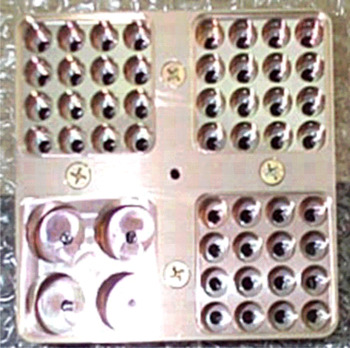
The EXPOSE-R hardware of the European Space Agency (ESA) consists of three sample carriers, each containing four wells (Fig. 1). Some of the wells can be sealed while others can be aerated by a fan built into the cuvette. The airflow channel can be sealed by a valve that opens in response to a command after the payload is attached to the outer wall of the Russian Segment (RS) of the International Space Station (ISS) (for details see Rabbow et al. Reference Rabbow, Horneck, Rettberg, Schott, Panitz, L'Afflitto, von Heise-Rotenburg, Willnecker, Baglioni, Hatton, Dettmann, Demets and Reitz2009, Reference Rabbow, Rettberg, Barczyk, Bohmeier, Parpart, Panitz, Horneck, von Heise-Rotenburg, Hoppenbrouwers, Willnecker, Baglioni, Demets, Dettmann and Reitz2012).
Sample tray N1 in EXPOSE-R hardware where IMBP samples were located.

Each well is made of three layers (that can be exposed in the light and darkness) and contains several cell samples that differ in their geometry (16–64 cells per layer). The wells are equipped with covers made of different glasses as well as with filters and dosimeters (Rabbow et al. Reference Rabbow, Rettberg, Barczyk, Bohmeier, Parpart, Panitz, Horneck, von Heise-Rotenburg, Hoppenbrouwers, Willnecker, Baglioni, Demets, Dettmann and Reitz2012).
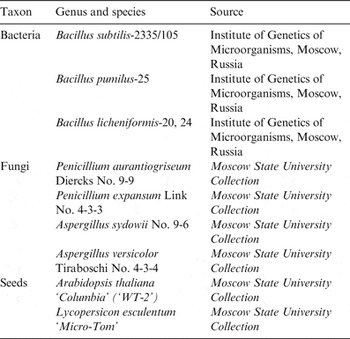
The biological specimens used in the experiments included bacterial and fungal spores and seeds of higher plants. Table 1 lists the biological specimens of the Institute of Biomedical Problems used in the EXPOSE-R mission.
Biological specimens used in the EXPOSE-R experiments of IBMP

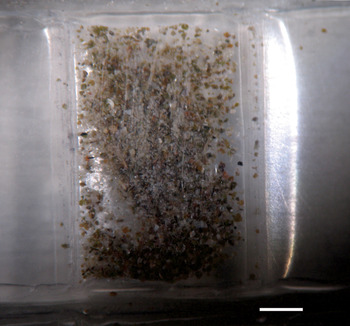
Bacillus spores were placed on quartz discs and all other specimens were contained in UV permeable polymer bags and glued (Fig. 2).
Example of biological samples (fungi spores) in polymer bags (scale bar is 2 mm).

To prepare Bacillus spores, Bacillus pumilus-25, Bacillus licheniformis-20, Bacillus licheniformis-24 and Bacillus subtilis-2335/105 (the strain with well-described genetic characteristics and widely used in biotechnology, see Potebnia et al. Reference Potebnia, Safronova, Cheremshenko, Lisovenko, Sorokulova, Prykhod'ko, Trokhymenko, Tanasiienko and Bombin2006) placed on dense growth medium (potato agar, see Atlas and Parks, Reference Atlas and Parks1993) and incubated for 24 h at 37°C and then kept for 4–5 days at room temperature. Following this, the spores which had formed were counted and if a count of 95% spores was reached, the spores were suspended in sterile water and 0.02 ml of the suspension were deposited on quartz discs (see above) of 5 mm in diameter. Then the number of viable spores was measured by determining the colony forming units (CFU). It was 5.8 × 10⁶ CFU for B. pumilus-25, CFU for B. licheniformis-20, 6.3 × 10⁶ CFU for B. licheniformis-24, and 7.4 × 10⁶ CFU for B. subtilis-2335/105. The samples were inserted into sterile bags, sealed and shipped to the EXPOSE-R hardware assembly facility.
After experiment completion the bacterial spores that survived the exposure to the space environment were counted using the procedure for detecting single cells of viable microbes. The discs carrying the test bacteria were placed into vials containing 2 ml sterile saline, thoroughly mixed, and then transferred onto Petri dishes, to which 10 ml of dense growth medium (Trypticase soy agar, BioMerieux) were added. The medium was melted and then allowed to cool down to 45°C. When the medium solidified, Petri dishes were kept at 37°C for 24–48 h. The grown colonies were counted and then used for studying taxonomic and biological properties of bacteria. Bacterial synthesis of DNase and RNase exoenzymes was measured on solid growth medium (Trypticase soy agar) supplemented with high molecular weight DNA or sodium nucleinate along the depolymerization zones formed around microbial colonies (Jeffries et al. Reference Jeffries, Holtman and Guse1957). Antibacterial activity of a set of antibiotics (see Novikova et al. Reference Novikova, Gusev, Polikarpov, Deshevaya, Levinskikh, Alekseev, Okuda, Sugimoto, Sychev and Grigoriev2011) was evaluated by the disc diffusion method (Labinskaya & Volina Reference Labinskaya and Volina2008).
Fungal test-cultures (see Table 1) were prepared using well-described strains grown on the Czapek Dox medium (Sigma-Aldrich) for 14–20 days at 28°C. (It was important to exclude moisture condensing on Petri dish covers.) Then fungal spores (1000 of each species) were collected, placed in polymer bags sized 7 mm × 7 mm, closed and sealed (Fig. 2).
After experiment completion the fungal spores, that survived the exposure to the space environment, were transferred to the vials containing sterile saline and placed onto the Czapek Dox agar medium. Fungal spores in each vial (bag) were counted in the Goryaev chamber (BioLot). The relative concentration of the fungal spores that remained viable was determined as the number of CFUs on the growth media detectable in the Gorayev chamber.
Antibiotic resistance of the exposed fungi was compared to that of the control strains (the methodology is described in Novikova et al. Reference Novikova, Gusev, Polikarpov, Deshevaya, Levinskikh, Alekseev, Okuda, Sugimoto, Sychev and Grigoriev2011). In addition, fungal activity in the acid and alkali production was assessed by cultivating the experimental strains on the Czapek Dox broth containing 10% glucose at room temperature. pH changes were measured for 14 days at 3–5 day intervals.
Germination analysis of the seeds (tomato and Arabidopsis, Table 1) was done using standard methodology (Sugimoto et al. 2011). The exposed seeds were placed in Petri dishes on double layered tissue paper and covered with 5–10 ml (depending on the seeds size and number) of de-ionized water. The dynamic of germination was estimated during following 8–12 days. The seeds stored for the duration similar to that of space exposure were used as a control. The seedlings of Arabidopsis were plated in the pods with Seramis substrates with addition of 2 g of Basacote nitrates (Compo). The plants were cultivated in ‘Luminostat’ КC−200 (RosTechnika) hardware under constant light conditions. The humidity was maintained using free capillary supply. The constant temperature value in the chambers was 22°C.
Results and discussion
The EXPOSE-R hardware with biological specimens was attached to the exterior platform of the ISS RS on 10 March 2009 and brought back inside ISS on 21 January 2011. The samples were returned to Earth on board of the Space Shuttle Discovery. For further details see Rabbow et al. (Reference Rabbowa, Rettberg, Barczyk, Bohmeier, Parpart, Panitz, Horneck, Burfeindt, Molter, Jaramillo, Pereira, Weiß, Willnecker, Demets, Dettmann and Reitz2014). Thus, the biological specimens remained exposed to outer space for over 22 months.
Bacteria
Table 2 summarizes the survival data of bacterial spores exposed to outer space conditions in the light and in the dark. Our investigations showed that the samples located in the upper layer, i.e. exposed to 100% solar UV radiation, space vacuum and other factors of outer space were sterilized. None of the test microorganisms, although they were exposed to outer space conditions as spores, remained viable. From the four microorganisms contained in the second assembly exposed to 1% UV only two showed, albeit minimal, viability. For instance, the survival of B. pumilus-25 spores amounted to as little as 0.00045% of the untreated control group, i.e. 2.6 × 101 CFU. The count of survived B. subtilis-2335/105 spores was even lower, making 2 CFU (0.0003%). In contrast, all four test bacteria contained in the assembly that was well shielded from UV exposure (UV was only 0.01%) survived, though their count was low. For example, the count of viable B. pumilus-25 bacteria was 3.1 × 10² CFU (0.0053%), that of B. licheniformis-24 was 2.6 × 10² CFU (0.4%), B. licheniformis-20 was 1 CFU and B. subtilis-2335/105 was 9.7 × 101 CFU (0.013% of the untreated control).
Survival of Bacillus spores exposed to UV irradiation on the ISS

T = transmission.
The space experiments allowed the conclusion that UV radiation could kill microorganisms (even when exposed as spores); however, microorganisms shielded from direct UV exposure could survive and remain capable of reproduction when placed in favourable environments. The experiments also showed that UV exposure could adversely affect microbial activity, including the synthesis rate of DNase and RNase that we used for assay.
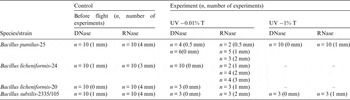
Changes in the DNase and RNase activities of Bacillus sp. after exposure to UV radiation are summarized in Table 3.
DNase and RNase activity of Bacillus before and after spaceflight

T = transmission.
Prior to installing test-cultures on the outer wall of the ISS, DNase and RNase activity of 10 samples of each strains of each microorganism was measured. DNase activity (evaluated in mm in the DNA depolymerization zone on the solid growth medium) was undetectable in B. licheniformis-20 bacteria and was 1 mm in B. pumilus-25, B. licheniformis-24 and in B. subtilis-2335/105. RNase activity was 4 mm in B. pumilus-25, B. licheniformis-20 and in B. subtilis-2335/105 and 3 mm in B. licheniformis-24. Virtually all test microorganisms exposed to 0.01% UV dose lost the ability to produce DNase. In most cases RNase activity decreased 1.5–4 times, reaching 0.5–3 mm. Exposure to a higher –1% – UV dose impacted test-microorganisms in a greater degree: no DNase activity was detected in any of the survivors, and RNase activity diminished to 1 mm from 4 mm in the initial strains.
One of the most important characteristics of biological activity of potential pathogens is their antibiotic resistance. In the EXPOSE-R experiments the following six antibiotics were tested: Ampicillin, Rifampicin, Tetracycline, Kanamycin, Carbenicillin and Ristomycin (the concentration are the same with Novikova et al. Reference Novikova, Gusev, Polikarpov, Deshevaya, Levinskikh, Alekseev, Okuda, Sugimoto, Sychev and Grigoriev2011).
Post-flight it was found that some of the antibiotics on the discs showed antimicrobial activity against the above bacterial cultures while others did not. The growth zones around antibiotic discs in the test and control strains were measured. Comparative analysis of the resistance of experimental and control strains to the above antibiotics demonstrated its decrease. It was found that out of 60 tests there were only two cases when B. licheniformis-24 and B. pumilis-25 showed higher resistance to kanamycin.
In summary, exposure to UV radiation had a killing, sterilizing effect on microbial spores. Nonetheless, microorganisms shielded from direct UV rays could survive and, when placed in a favourable environment, reproduce.
Thus, our study of biological properties of bacterial spores following germination demonstrated that their exposure to UV radiation adversely impacted their biological activity, assessed as DNase and RNase synthesis, and their antibiotic resistance.
Fungi
After exposure to UV radiation and other stressed of outer space several Aspergillus spores remained viable since they formed CFUs. It is likely that Aspergillus spores clustered forming a densely packed lump, which helped some of them to survive. In contrast, Penicillium spores were loosely packed, due to which UV rays could reach and impact all of them across the layers.
Fungal spores located in the middle and at the bottom of the assembly survived: the survival rate varied from 50 to 32.8% in the middle and from 100 to 88.9% at the bottom. The lowest survival rate was detected in Penicillium aurantiogriseum spores.
It can be concluded that fungal spores are able to survive UV radiation behind a minimal shielding. It should be added that no morphological changes were detected in Aspergillus versicolor and Aspergillus sydowii colonies grown from samples in the bags located at the upper layer of the assembly.
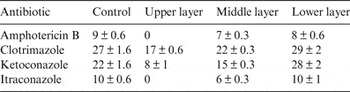
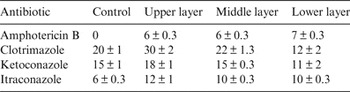
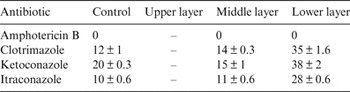
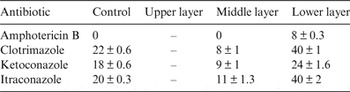
Tables 4–7 illustrate changes in antibiotic resistance shown by different fungi.
Aspergillus versicolor susceptibility to antibiotics assayed by the diffusion method (growth inhibition zone in mm; standard deviation in three experiments is given as ± value)

Aspergillus sydowii susceptibility to antibiotics assayed by the diffusion method (growth inhibition zone in mm; standard deviation in three experiments is given as ± value)

Penicillium expansum susceptibility to antibiotics assayed by the diffusion method (growth inhibition zone in mm; standard deviation in three experiments is given as ± value)

Penicillium aurantiogriseum susceptibility to antibiotics assayed by the diffusion method (growth inhibition zone in mm; standard deviation in three experiments is given as ± value)

Antibiotic susceptibility of A. versicolor, P. expansum and P. aurantiogriseum spores located at different levels of the assembly increased with the distance from top to bottom. Antibiotic susceptibility of A. versicolor grew gradually, reaching the degree seen in the control strain, only at the very bottom of the assembly. Antifungal susceptibility of both P. expansum and P. aurantiogriseum to clotrimazole, ketoconazole and itraconazole located in the middle layer was close to that of the controls; as compared to the antifungal activity of the controls it almost doubled in the strains located in the upper layer of the assembly.
Susceptibility of A. sydowii test-culture to the above antifungal agents varied in the opposite manner. The strains located at the top of the assembly were least resistant, those located in the middle displayed the level similar to that of the controls whereas the strains located at the bottom showed the highest resistance.
Thus, in most strains, unlike A. sydowii strain, antibiotic resistance tended to increase as the distance from UV radiation increased.
As the distance from the UV exposure site grew, A. versicolor increased its synthesis of alkali whereas A. sydowii and P. expansum increased their acid synthesis. It should be noted that in comparison with the controls
-
- Aspergillus versicolor strains exposed in the lower layer of the assembly showed enhanced formation of alkali by day 14;
-
- Aspergillus sydowii strains exposed in the middle and lower layers of the assembly showed minor acid formation changes while those in the higher layer displayed no pH changes at all;
-
- Penicillium expansum strain located in the lower layer tended to increase acid formation compared to that in the middle layer although pH of those strains was higher than in the controls;
-
- Penicillium aurantiogriseum strains across the entire assembly did not show any pH variations, which remained equal to pH of the growth medium.
Our findings have demonstrated that as the distance from the top of the assembly grew pH tended to change in a manner seen in the controls. In some fungal strains pH increased. It still remains unclear whether the trend was common for all cultures: A. sydowii strain located in the upper layer did not increase its acid formation activity during 14-day exposure. Again, it needs to be verified whether this was specific for this particular strain or would be true for all strains of the fungus.
It can be hypothesized that the changes in the fungal strains exposed at different layers of the assembly, including variations in antibiotic resistance and pH levels, were caused by different effects of the space environment upon spore membranes, which resulted in adaptive responses that could be transient or could become ingrained changes of mechanisms of adaptation to a new environment. However, the changes displayed by one culture cannot be interpreted as a typical pattern of alterations in this fungal species in response to various space effects, one of which is UV radiation.
Seeds
Analysis of the germination ration revealed that the tomato seeds did not survive both types of exposure – under UV and in the dark layer. Arabidopsis seeds survived only in dark layer and the germination ratio was close to 100% and showed no significant differences with control group.
We have compared morphological properties of Arabidopsis plants obtained from space exposed and control seeds. We found that in both groups, the plants were characterized by 15.0 ± 2.5 cm in height and formed 6–12 pods. Thus, complex influence (including solar UV) of outer space resulted in death of higher plant seeds. At the same time, under conditions of shielding against UV, seeds of Arabidopsis survived and preserved normal ability to geminate and further develop.
Conclusion
The EXPOSE-R experiment performed over 22 months outside the Russian Segment of the ISS revealed the selective effects of space UV radiation (wavelength ≥200 nm) upon dormant forms of various biological specimens and stay in agreement with previous studies (Horneck Reference Horneck1993). Microbial spores, higher plants seeds, which survived exposure to the space environment when shielded from UV radiation, died under its impact. Nonetheless, spores of microscopic fungi (A. sydowii and A. versicolor) retained their viability, albeit in part.
Acknowledgements
This work was supported by subsidy of the Russian Government to support the Program of competitive growth of Kazan Federal University among world class academic centres and universities and Russian Foundation for Basic Research No 14-04-01657_A