


Introduction
Bovine respiratory disease (BRD) prevalence estimates range from 11% (Cramer et al., Reference Cramer, Ollivett and Stanton2016) to 39% (Van Donkersgoed et al., Reference Van Donkersgoed, Ribble, Boyer and Townsend1993). BRD accounts for approximately 20% of heifer deaths during the preweaning period (USDA, 2010). Immediate effects of BRD include reduced calf growth (e.g. Virtala et al., Reference Virtala, Mechor, Grohn and Erb1996) and treatment and labor costs (reviewed by Gorden and Plummer, Reference Gorden and Plummer2010). The effects of BRD can last into adulthood; calves that get BRD are less likely to complete their first lactation (Adams and Buczinski, Reference Adams and Buczinski2016; Teixeira et al., Reference Teixeira, McArt and Bicalho2017) and will produce 1200 pounds less milk in their first lactation (Dunn et al., Reference Dunn, Ollivett, Renaud, Leslie, LeBlanc, Duffield and Kelton2018).
Despite years of research, the number of calves affected with BRD and deaths due to BRD have remained relatively unchanged over the last 20–30 years (Gorden and Plummer, Reference Gorden and Plummer2010; USDA, 2010). On-farm personnel are primarily responsible for the diagnosis and treatment decisions regarding calves (Gorden and Plummer, Reference Gorden and Plummer2010). Unfortunately, previous studies indicate that producers only identify 25–56% (Sivula et al., Reference Sivula, Ames, Marsh and Werdin1996; Buczinski et al., Reference Buczinski, Forté, Francoz and Bélanger2014; Cramer et al., Reference Cramer, Ollivett and Stanton2016) of calves that are actually sick. Inadequate detection can reduce treatment success and increase the rate of recurrence (McGuirk, Reference McGuirk2008). Furthermore, one study reported that 28% of calves with no ultrasonographic indication of pneumonia were treated by producers with antimicrobials (Buczinski et al., Reference Buczinski, Forté, Francoz and Bélanger2014), which could indicate unnecessary antimicrobial use, animal handling, and labor costs.
A potential avenue for improving early BRD identification includes recognizing deviations in healthy behaviors. The behavioral changes that accompany illness, and therefore result in deviations from healthy behavior, are termed sickness behaviors. Sickness behaviors include depression, anorexia, reduced water intake, decreased grooming, and decreased exploratory behavior (Hart, Reference Hart1988; Haba et al., Reference Haba, Shintani, Onaka, Wang, Takenaga, Hayata, Baba and Hashimoto2012). These behaviors help conserve heat and energy in order to facilitate the febrile response to infection. The expression of sickness behaviors is thought to enhance the ability of the immune system and inhibit pathogen proliferation (Hart, Reference Hart1988; Johnson, Reference Johnson2002). In recent years, behavioral changes associated with disease have been investigated for their usefulness in BRD detection.
The objectives of this report are to (1) summarize previous research on behavioral assessment for identifying BRD in dairy calves and (2) discuss limitations of using behavioral assessments.
Behavioral assessments to identify calves with BRD
Automated
The focus of disease detection in dairy calves has primarily centered on using data collected from automated milk feeders, which automatically collect drinking speed, milk consumption, and number of visits to the feeder. In calves on a restricted milk allowance diet, Svensson and Jensen (Reference Svensson and Jensen2007) observed a 25% decrease in the number of unrewarded (without milk) visits in diseased calves (defined as one or more of the following for ≥2 days: arthritis, diarrhea, ‘dull calf syndrome’, fever, swollen navels, or respiratory disease) compared to unaffected herdmates. Borderas et al. (Reference Borderas, de Passillé and Rushen2009) observed sick calves (defined as diarrhea, respiratory illness, or a combination thereof) fed a high milk allowance drank 2.6 L d−1 less and had 2.4 fewer visits per day compared to unaffected herdmates. More recently, Knauer et al. (Reference Knauer, Godden, Dietrich and James2017) observed that sick calves (defined as respiratory disease, diarrhea, or ‘ill thrift’) drank 183 mL min−1 slower, drank 1.2 L d−1 less, and had 3.1 fewer unrewarded visits compared to healthy calves. It is important to recognize that the aforementioned studies did not differentiate between disease types in sick calves and disease definitions varied between studies.
Non-automated
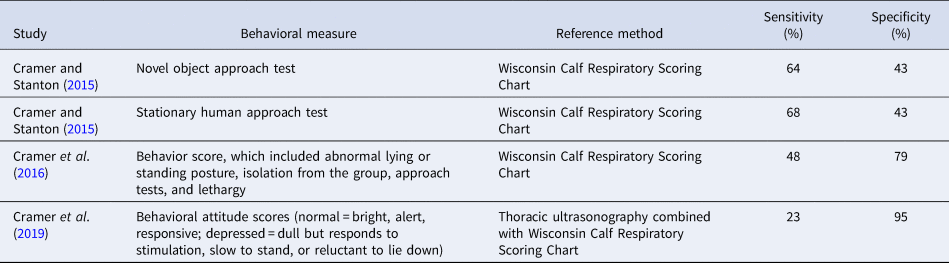
A few studies have investigated behaviors other than feeding behavior to determine their usefulness for BRD detection. Dairy calves that were positive on the Wisconsin Calf Respiratory Scoring chart (CRS+; ≥2 categories (nasal discharge, eye discharge, ear position, cough, and rectal temperature) with abnormal scores were present; Mcguirk and Peek, Reference McGuirk and Peek2014) were less likely to approach both a novel object and stationary person on the day of BRD diagnosis (Cramer and Stanton, Reference Cramer and Stanton2015). Additionally, a score that included five behaviors (abnormal posture when lying or standing, isolation from the group, lethargy, and two approach tests that tested the willingness of calves to approach a stationary person) was developed for use on farms who may not have automated feeders (Cramer et al., Reference Cramer, Ollivett and Stanton2016). Dairy calves that were CRS+ were more likely to have an abnormal behavior score, and therefore exhibited more sickness behaviors, compared to calves who were CRS− (Cramer et al., Reference Cramer, Ollivett and Stanton2016).
Limitations
Using detection methods with low sensitivity to define BRD
One limitation with the previously described studies centers on methods used to define BRD. The BRD detection methods in previous studies included visual observations and lung auscultation (Svensson and Jensen, Reference Svensson and Jensen2007; Borderas et al., Reference Borderas, de Passillé and Rushen2009) or the Wisconsin Calf Respiratory Scoring chart (McGuirk and Peek, Reference McGuirk and Peek2014; Cramer and Stanton, Reference Cramer and Stanton2015; Cramer et al., Reference Cramer, Ollivett and Stanton2016; Knauer et al., Reference Knauer, Godden, Dietrich and James2017) to define BRD. Lung auscultation and the Wisconsin Calf Respiratory Scoring chart lack sensitivity (Buczinski et al., Reference Buczinski, Forté, Francoz and Bélanger2014). Furthermore, clinical signs are transient (White et al., Reference White, Anderson, Renter, Larson, Mosier, Kelly and Walz2012) and have discrepancies among observers (Buczinski et al., Reference Buczinski, Faure, Jolivet and Abdallah2016). Additionally, the prevalence of subclinical BRD (lung consolidation, but no visual signs of disease) can range from 23 to 67% (Ollivett and Buczinski, Reference Ollivett and Buczinski2016), meaning a large population of calves are likely misclassified in previous studies. The limitations of auscultation, visual observations, clinical BRD detection methods preclude our ability to accurately identify all calves with BRD in studies, and therefore we are unable to fully grasp the behavioral changes associated with BRD.
Recently, in an effort to address the limitations of scoring methods used in behavioral studies, two studies were performed (Cramer, Reference Cramer2018; Cramer et al., Reference Cramer, Proudfoot and Ollivett2019) in which calves underwent twice weekly health exams. Health exams included the Wisconsin Calf Respiratory Scoring chart (McGuirk and Peek, Reference McGuirk and Peek2014) and lung ultrasound (Ollivett and Buczinski, Reference Ollivett and Buczinski2016). Automated changes in feeding behavior for the 3 days prior and the day of BRD diagnosis were compared among calves with clinical BRD (CRS+ with or without lung consolidation), subclinical BRD (CRS− and with lung consolidation ≥1 cm2), and no BRD (CRS− and lung consolidation <1 cm2; Cramer, Reference Cramer2018). Calves with subclinical BRD drank faster than calves with clinical BRD (768 versus 664 mL min−1), and calves with clinical BRD tended to drink slower than calves with no BRD (664 versus 772 mL min−1). There was no difference in drinking speed between calves with subclinical BRD and calves with no BRD (768 versus 772 mL min−1). Therefore, drinking speed may be useful to identify calves with clinical BRD. However, calves with subclinical BRD would not be identified using drinking speed. Additionally, milk intake and number of visits to the feeder failed to differentiate between calves with either type of BRD and unaffected herdmates.
In a companion study to the feeding behavior study described above, Cramer et al. (Reference Cramer, Proudfoot and Ollivett2019) compared behavioral attitude scores (normal = bright, alert, responsive; depressed = dull but responds to stimulation, slow to stand, or reluctant to lie down) among calves with clinical BRD, subclinical BRD, and no BRD. The attitude score did not differentiate between calves with subclinical BRD and calves with no BRD, suggesting subclinical BRD does not affect the probability of a calf having a depressed attitude.
Sensitivity and specificity of behavioral assessments
Detection methods for BRD should have high sensitivity in order to identify a large proportion of sick calves, as well as a moderate specificity to avoid false-positives. When comparing sensitivity and specificity among studies, it is important to consider the study population and the ‘gold-standard’ or reference method. Test characteristics are often not reported for behavioral studies, in part because no research has addressed cutoffs for feeding alarms to indicate BRD+ or BRD−. Four behavioral studies reported sensitivities (ranging from 23 to 68%) and specificities (ranging from 43 to 95%; Table 1).
Summary of test characteristics for studies that investigated behavioral changes associated with BRD

Sickness behavior is motivational and non-specific
Using behavior to identify calves with BRD is challenging due to the nature of sickness behavior, which is both motivational (Aubert, Reference Aubert1999) and non-specific (Hart, Reference Hart1988). An animal may or may not be motivated to express sickness behavior, depending on internal or external factors (Aubert, Reference Aubert1999). Factors that affect the expression of sickness behaviors have been investigated in other species and include reproductive status (Owen-Ashley and Wingfield, Reference Owen-Ashley and Wingfield2006), environmental conditions (Aubert et al., Reference Aubert, Goodall, Dantzer and Gheusi1997), social conditions (Lopes et al., Reference Lopes, Adelman, Wingfield and Bentley2012), and gender (Avitsur et al., Reference Avitsur, Pollak and Yirmiya1997). In calves specifically, milk allowance affected the expression of sickness behavior whereby calves fed 4 L d−1 displayed fewer sickness behaviors compared to calves fed 12 or more liters per day (Borderas et al., Reference Borderas, de Passillé and Rushen2009), suggesting calves fed less milk were more motivated to drink milk than to express sickness behavior.
Sickness behaviors are also common across species, non-specific, and often associated with fever (Hart, Reference Hart1988; Haba et al., Reference Haba, Shintani, Onaka, Wang, Takenaga, Hayata, Baba and Hashimoto2012). Therefore, it is difficult to find behaviors associated solely with BRD, as the behaviors often associated with BRD (e.g. depression, anorexia) can also be indicative of other calf diseases as well.
Conclusion and future directions
The changes that accompany illness represent a potential avenue that can be utilized to improve BRD detection in dairy calves. Currently, most behavioral measures used to detect BRD have sensitivities ranging from 23 to 68% and specificities ranging from 43 to 95% (Cramer and Stanton, Reference Cramer and Stanton2015; Cramer et al., Reference Cramer, Ollivett and Stanton2016; Cramer et al., Reference Cramer, Proudfoot and Ollivett2019). Due to this range and the potential for low sensitivity and specificity, behavioral measures may not be ideal as the sole means of disease detection, especially when other detection tools, such as calf lung ultrasound (Bayesian estimates for sensitivity: 79%; specificity: 94%; Buczinski et al., Reference Buczinski, Ollivett and Dendukuri2015), have better test characteristics. However, behavioral assessments may improve the ability of farm staff to identify disease if no systematic scoring occurs on-farm (e.g. Cramer et al., Reference Cramer, Ollivett and Stanton2016) and may be combined with other detection methods to form a robust BRD detection program which results in earlier detection and mitigation of negative consequences of BRD.
Future research regarding behavioral changes associated with BRD should consider the following: (1) use accurate BRD detection tools as the reference methods, (2) investigate both internal and external factors that change the expression of sickness behaviors in dairy calves, and (3) seek to better understand if and when calves with subclinical BRD exhibit behavioral changes.