Introduction
Hormesis is the stimulatory effect induced in organisms exposed to low doses of potentially toxic agents. It has been reported in numerous biological, toxicological and pharmacological studies. It should be considered as an adaptive response of insects and characterized by a biphasic (i.e., U- or inverted U-shape pattern) quantitative dose-response (Southam & Ehrlich, Reference Southam and Ehrlich1943; Calabrese & Baldwin, Reference Calabrese and Baldwin1999, Reference Calabrese and Baldwin2001, Reference Calabrese and Baldwin2002; Calabrese, Reference Calabrese2010). Considerable mechanistic evidence indicates that the hormetic effects represent the overcorrection of growth in response to stimulation by low level of inhibitors (Stebbing, Reference Stebbing1982), or the overcompensation in response to disruption in homeostasis (Calabrese & Baldwin, Reference Calabrese and Baldwin2002). Usually, organisms were left in contact with the toxin at low-doses for a long time, and the responses in the biological characteristics could be described by using a hormetic dose-response model (Calabrese & Baldwin, Reference Calabrese and Baldwin2003). Because the biphasic dose response represents a general pattern of biological responsiveness, it is expected to become increasingly significant within the toxicological evaluation and risk assessment practices as well as for biomedical applications (Calabrese, Reference Calabrese2008). Hormesis is now generally accepted as a stress response phenomenon (Cutler, Reference Cutler2013; Guedes & Cutler, Reference Guedes and Cutler2014).
Frequent or improper insecticide use can result in ecological backlashes: insecticide resistance and pest resurgence or outbreaks, both of which have threatened the sustainability of agriculture (Guedes & Cutler, Reference Guedes and Cutler2014). In field crops, lowering of insecticide concentration usually occurs after its initial application (Desneux et al., Reference Desneux, Fauvergue and Dechaume-Moncharmont2005). Therefore, under field conditions, in addition to direct mortality by typical acute toxicity (lethal effect), insecticides may also affect various key biological traits of the exposed insects through physiological and behavioral sublethal effects. Identifying and characterizing such effects could be crucial for understanding the global effects of insecticides on pests, and therefore, for optimizing the management of their applications on crops (Haynes, Reference Haynes1988; Desneux et al., Reference Desneux, Decourtye and Delpuech2007; Tan et al., Reference Tan, Biondi, Desneux and Gao2012; Guo et al., Reference Guo, Desneux, Sonoda, Liang, Han and Gao2013). Traditionally, measurement of the acute toxicity of pesticides to arthropods has relied largely on the determination of an acute median lethal dose or concentration. In addition to the direct mortality induced by pesticides, their sublethal effects on biology, physiology and behavior in arthropods had been also studied for a complete analysis of the experiments. An increasing number of experimentations and methods relating to the identification and characterization of the effects have been published. However, the doses they applied were mostly lower than LC20 (the dose resulted in 20% mortality of the sample population) but far higher than the lowest observed adverse effect levels (OAELs). For instance, there are studies on the sublethal effects in arthropods (Symington, Reference Symington2003; Desneux et al., Reference Desneux, Decourtye and Delpuech2007), the reproduction, fecundity and/or wing formation stimulated by the sublethal doses of insecticide in diamondback moth (Plutella xylostella , DBM) (Sota et al., Reference Sota, Motoyama, Fujisaki and Nakasuji1998), green peach aphids (Myzus persicae) (Lowery & Sears, Reference Lowery and Sears1986; Yu et al., Reference Yu, Shen, Zhu and Lu2010), soybean aphids (Aphis glycines) (Qu et al., Reference Qu, Xiao, Li, Chen, Biondi, Desneux, Gao and Song2015), cotton aphids (Aphis gossypii) (Kerns & Stewart, Reference Kerns and Stewart2000), brown planthoppers (Nilaparvata lugens) (Bao et al., Reference Bao, Liu and Gu2009) and yellow stem borer (Tryporyza incertulas) (Wu et al., Reference Wu, Wang, Xu, Yang, Qiu and Li2003). The LC10-dose of β-cypermethrin stimulated the DBM population growth by affecting its survival, development and reproduction (Yin et al., Reference Yin, Wu, Li, Zhang and Xu2008). At LD20-dose of clothianidin, the hormetic-like effect on the orientation behavior was observed on black cutworm (Agrotis ipsilon) (Kaouther et al., Reference Kaouther, Esancy, Voisin, Crespin, Corre and Tricoire-Leignel2014). The effects of sublethal insecticide on in vivo enzymatic detoxifications were reported, such as the acetylcholinesterase (AChE) activity inhibited by sublethal organophosphates in Tasmanian lacewing (Micromus tasmaniae), glutathione S-transferases (GSTs) by LC17-abamectin and β-cypermethrin in DBM (Liang et al., Reference Liang, Bing and Shi2003), and AChE by LC10-organophosphate phoxim or LC10-organophosphates malathion and methomyl in cotton bollworm (Helicoverpa armigera) (Liu et al., Reference Liu, Gao and Zheng2003). Sublethal insecticides also showed a dose-dependent variation in isoesterase profiles in beetle (Tribolium castaneum) (Mukherjee et al., Reference Mukherjee, Rawal, Ghumare and Sharma1993).
Hormesis in many insect species has been confirmed (Luckey, Reference Luckey1968; Guedes & Cutler, Reference Guedes and Cutler2014). Because it might potentially result in the insecticide resistance and pest resurgence or outbreaks, insecticide-induced hormesis is practically important in pest management as the initial field applications of insecticides may end up boosting the insect population (Cutler, Reference Cutler2013; Guedes & Cutler, Reference Guedes and Cutler2014). In the past, sublethal effects were mainly studied using sublethal doses of insecticides. For example, the sublethal dosage used by Desneux et al. (Reference Desneux, Decourtye and Delpuech2007) was the one that ostensibly directly caused the death of the insects. It was lower than the median lethal dose, usually below LC20 but far greater than the lowest OAEL. However, in addition to the high doses predominated in toxicological experiments, the present study also included the lowest OAEL, as well as the no-OAEL to serve for the quasi-toxicological threshold. A no-OAEL dose is lower than the level that caused sublethal effects (Calabrese, Reference Calabrese2004). Theoretically, LC1 dose is the minimum dosage to ostensibly directly cause the death of the affected insects. Many studies used the insecticides at different dosages to examine the sublethal effects on insects, but few applied the doses that were far below LC1. In reality, insects in the field may initially encounter a lethal or sublethal insecticide treatment, but subsequently, due to chemical degradation and/or dissipation, the concentration of the insecticide might likely drop below LC1. Unfortunately, many experiments intended to study the chemical-induced hormesis failed to consider this possibility. Some of them did not use sufficient variations on doses; some employed no or only a few sub-no-OAEL concentrations; and, some used high doses between LC5 and LC20 (Cutler, Reference Cutler2013; Guedes & Cutler, Reference Guedes and Cutler2014). Thus, the questions, first raised in the report on Sitophilus zeamais by Guedes et al. (Reference Guedes, Tolledo, Correa and Gudes2010), remained: (1) Would hormesis still occur in insects at insecticide doses far below LC1? (2) How does heat stress affect the insecticide-induced hormesis? (3) How do the insecticide-resistant and -susceptible insects differ in their responses to the hormesis?
DBM is one of the most devastating pests in the world (Talekar & Shelton, Reference Talekar and Shelton1993). At present, the only effective means of controlling them is frequent applications of insecticides. Then, DBM could evolve to resist the insecticides, such as organophosphate chlorpyrifos (CPF), as reported in China (Wang et al., Reference Wang, Li, Shen and Wu2010). It was believed that the insensitive AChE and heightened GSTs activity were involved in the resistance of DBM (Zhang et al., Reference Zhang, Wu, Wang, Liu, Zhuang and Wu2015a). The present study attempted to determine the hormetic effects induced by CPF on the fecundity, development and activities of AChE and GSTs of the CPF-resistant (Rc) and CPF-susceptible (Si) DBM. Since the evolution of the insecticide resistance in the field DBMs is affected by heat stress (Zhang et al., Reference Zhang, Wu, Wang, Liu, Zhuang and Wu2015a, Reference Zhang, Jing, Li, Li, Bourguet and Wub), as well as under normal temperatures, the temperature effect was also studied. Results from this study would provide useful information concerning the intricate mechanisms of the hormesis induced by CPF on DBM.
Materials and methods
Strain selection, sources and rearing of insects
Rc and Si strains of DBM were used in the experimentation. They were collected from a population near Shangjie, Fuzhou, Fujian, China in November 2005. Rc and Si DBM were selected as described in detail previously (Zhang et al., Reference Zhang, Jing, Li, Li, Bourguet and Wu2015b). The strains varied in their frequencies of a resistance allele of ace1 – the gene coding AChE, the enzyme targeted by CPF. In Rc, the frequency of ace1R is 0.85, while that in Si, 0.15 (Zhang et al., Reference Zhang, Jing, Li, Li, Bourguet and Wu2015b). The life cycle of DBM includes the stages of egg, 1st to 4th instar larva, pupa and adult. The development time at 25°C for each instar larva and pupa was approximately 3 days. And, 25°C was commonly considered optimal for DBM leaves (Zhang et al., Reference Zhang, Wu, Wang, Liu, Zhuang and Wu2015a). The larvae were fed on the leaves of Brassica oleracea in a glass bottle and the adults were fed on 10% honey solution in a glass vial at 25°C in the laboratory.
Insecticide bioassay
The bioassay on larvae was conducted as described in the leaf-dipping method (Wu & Miyata, Reference Wu and Miyata2005). Toxicity regression was calculated from the mortality data after the 3rd instar larvae fed on the CPF-treated leaves for 24 h at 25°C in an environmental chamber. For control, acetone, instead of CPF-acetone solution, was used. LC1, LC10 and LC50 (i.e., lethal concentration to 1, 10 and 50 of a population, respectively) were calculated based on the toxicity regression equation by using 180 3rd instar larvae.
Preparation of CPF solutions for hormetic response in DBM
To prepare varied CPF doses for determining the hermetic response in DBM, 95% technical grade CPF (Dursban®, Shanghadong Huayang Technology, Co., Ltd., Shangdong, China) and acetone were used. The doses far below LC1 (i.e., 7.21 mg l−1 for Si DBM, and 1286 mg l−1 for Rc DBM) were designed to represent the no-OAEL. The concentrations of the CPF-acetone solutions applied for the test included: (1) 0.000025, 0.00025, 0.0025, 0.025, 0.25 and 2.5 mg CPF l−1 for levels below LC1, 25 mg CPF l−1 for LC10 and 250 mg CPF l−1 for LC50 for applications on the 3rd instar Si DBM larvae; and (2) 0.000025, 0.00025, 0.0025, 0.025, 0.25, 2.5, 25 and 250 mg CPF l−1 for levels below LC1, 2000 mg CPF l−1 for LC10 and 3500 mg CPF l−1 for LC50 on the 3rd instar Rc DBM larvae.
To produce the leaf with CPF, a portion of a leaf of B. oleracea (5 × 5 cm2) was treated with the acetone solutions of CPF for 5 s by using leaf-dipping method (Wu & Miyata, Reference Wu and Miyata2005). Because DBM would face the insecticides for both short- or long-term time under normal temperature (during autumn and spring) or high temperature (during in summer) in the vegetable fields in Fuzhou, Fujian, China, different environmental temperatures (25 and 38°C) and treatment time (24 h or long-term) were designed. In 24 h treatment, the experiments were carried out to screen the hormetic dose of CPF, 3rd instar larvae were fed on the leaf with CPF at 25°C for 24 h before the insects were used for enzyme assays. In long-term treatments, the insects were fed on the leaf which was treated with CPF during the 1st to 4th instar larvae. The 4th instar larvae were then used for enzyme assays. Because mortality occurred at high dosages of CPF, 200 individuals of larvae were used for each concentration of CPF treatment, respectively. Three biological replicates were performed for each assay. Acetone was used as the blank for control.
Effect of CPF on development and fecundity of DBM
One dose of CPF, i.e., 0.0025 mg l−1 for Si DBM and 2.5 mg l−1 for Rc DBM, was assigned as the ‘hormetic-CPF’ for the respective strains in this study. These doses were far below LC1 but were among all that showed positive hermetic effect in the DBM. They were, subsequently, selected to study their effects on the enzymatic activities of AChE and GSTs in the DBM. The leaf or the glass vial treated with the hormetic dose of CPF (i.e., 0.0025 mg l−1 for Si DBM or 2.5 mg l−1 for Rc DBM, respectively) was produced by leaf-dipping method (for leaf-CPF-film) or dry-film method (for glass vial-CPF-film), respectively (Wu & Miyata, Reference Wu and Miyata2005). The larvae were reared on the CPF-treated leaves from 1st instar larva to pupa formation at 25°C. The CPF-treated leaves were replaced every day. The development time of the 1st to 4th instar larvae, or pupa were recorded. Considering individuals that might not finish the development to form pupae, more than 50 of the 1st instar larvae were used to start with. From 30 of those that completed the developmental stages, the time taken was recorded for each insect. On the other hand, after pupation, the pupae were transferred to the glass vials covered with CPF-film until the adults emerged. A pair of female and male adults was placed in a glass vial covered with a CPF-film. The glass vial covered with a CPF-film was replaced with a fresh one daily. The number of eggs laid by each female adult was recorded for the first 5 days. Thirty replications were obtained for the egg count calculation. Larval development was observed in the glass bottle kept at 25°C.
Determination of effect of hermetic-CPF on AChE and GSTs at different temperatures
Because temperature is an important environmental factor that can exert critical influences on the development of insects (Neven, Reference Neven2000), and the insecticide-resistant DBM showed significant disadvantages in biological fitness than the insecticide-susceptible DBM (Zhang et al., Reference Zhang, Wu, Wang, Liu, Zhuang and Wu2015a, Reference Zhang, Jing, Li, Li, Bourguet and Wub), to study the hormetic effects under field condition during summer, the hormetic effects under heat stress condition were also studied in addition to the normal temperature condition. The 3rd instar DBM larvae were fed on the leaves treated with the hormetic-CPF or acetone at 25 or 38°C for 4, 12, 18 and 24 h before the 3rd instar larvae were collected for the enzyme assays. The temperatures selected were to simulate the summer time field conditions in Fuzhou including 38°C exposures for 6–8 h per day between July 10 and August 10. One hundred larvae were used for each treatment, and 3 biological replicates were performed for each assay.
Enzymatic inhibition by LC10- or LC50-CPF
To determine the inhibition effect of the CPF doses on AChE and GSTs, feeding leaves were treated with acetone or acetone solutions of 25 mg CPF l−1 (~LC10) or 250 mg CPF l−1 (~LC50) for Si DBM, and 2000 mg CPF l−1 (~LC10) and 3500 mg CPF l−1 (~LC50) for Rc DBM. The 3rd instar larvae were fed on the leaves for 4, 12 and 24 h at 25 or 38°C before the enzyme assays. Three biological replicates were performed for each assay.
Enzymatic inhibition by LC10- or LC50-CPF after hormetic-CPF pretreatment
To determine the effect of the hormetic-CPF pretreatment, the leaf was treated with the hermetic-CPF (0.0025 mg l−1 for Si DBM and 2.5 mg l−1 for Rc DBM) by the leaf-dipping method (Wu & Miyata, Reference Wu and Miyata2005). The 3rd instar larvae of Rc and Si DBM were first reared at 25°C for 24 h on the leaves treated with the hermetic-CPF. Then, the larvae were reared at 25 or 38°C for 4, 12, 18 and 24 h on leaves treated with LC10-CPF (25 mg l−1 for Si DBM and 2000 mg l−1 for Rc DBM), or LC50-CPF (250 mg l−1 for Si DBM and 3500 mg l−1 for Rc DBM) before the enzyme assays. For control, the 3rd instar larvae were fed on the acetone-treated leaves followed by those treated with LC10- or LC50-CPF. Three biological replicates were performed for each assay.
Enzyme assays
Sample preparation
Six larvae were homogenized at 4°C in a 1.0 ml, 0.066 M sodium phosphate buffer. The buffer used in the preparation of AChE samples had a pH of 7.8 and contained 0.5% (v/v) Triton X-100, and that of GSTs had a pH of 7.4 and contained 4 mM glutathione (GSH). The homogenate was centrifuged at 10,000 g at 4°C for 20 min, and supernatants used to determine the AChE and GSTs activities. Three biological replicates were performed for each assay.
Enzymatic activity
AChE activity was determined according to the method of Ellman et al. (Reference Ellman, Courtney, Andress and Featherstone1961) with ATCh iodide as a substrate in the presence of 5, 5′-dithiobis (2-nitrobenzoic acid) (DTNB) at 25°C (Wu & Miyata, Reference Wu and Miyata2005). Optical density was measured at 412 nm in microplate recorder. The reaction mixture (0.2 ml) consisted of 0.6 mM ATCh, 0.4 mM DTNB and 0.005 ml aliquot of the enzyme solution. GST activity was determined according to the method of Habig (Reference Habig and Willian1981) with 1-chloro-2, 4-dinitrobenzene (CDNB) as a substrate at 25°C (Wu & Miyata, Reference Wu and Miyata2005). Absorbance changes were recorded at 340 nm for 1 min in microplate recorder. The reaction mixture (0.2 ml) consisted of 4.0 mM GSH, 0.4 mM CDNB and 0.005 ml aliquot of the enzyme solution. Protein concentrations were determined by the method of Bradford (Reference Bradford1976) using bovine serum albumin as a standard (Wu & Miyata, Reference Wu and Miyata2005). AChE activity was expressed as μM mg−1 protein min−1 and GSTs activity as OD per mg protein·per min.AQ:
Statistical analysis
Bioassay data were analyzed for LC values and their 95% confidence intervals (CI) by probit analysis using DPS data processing system. The t-tests and Duncan's multiple range tests were performed using the DPS data processing system (Tang & Feng, Reference Tang, Feng, Tang and Feng1997).
Results
Candidate hormetic-CPFs for Rc and Si DBM
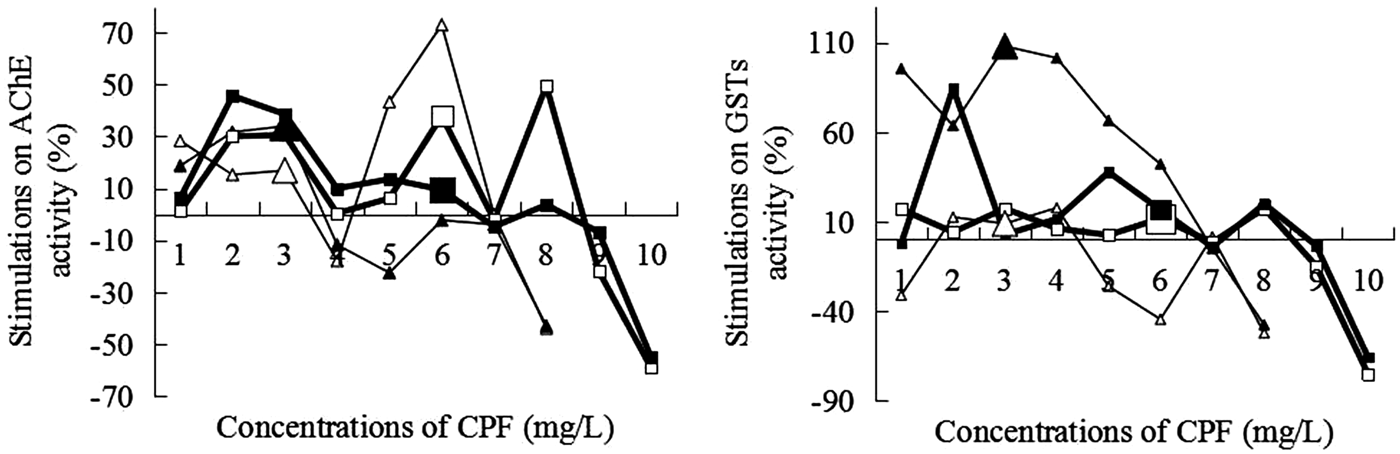
Based on the toxicity regression equation, LC1, LC10 and LC50 values for the Si and Rc DBM larvae were calculated. Significant resistance to CPF was evident in Rc DBM (table 1). To determine the hormetic-CPF doses for the strains, varied concentrations of CPF-acetone solution were made between 0.000025 and 250 mg l−1 for Si DBM, and between 0.000025 and 3500 mg l−1 for Rc DBM. These concentrations were 3.5 × 10⁻⁶–3.5 × 101 times lower than the LC1 for Si DBM and 1.9 × 10⁻⁸–2.7 times for Rc DBM. As compared with control, CPF doses below LC1 caused approximately 20–80% increases on the AChE or GSTs activities in DBM on average either in short- or long-term treatment. The hormesic effect was apparent. On the other hand, at CPF doses higher than LC10, significant declines on the AChE and GSTs activities were observed in both Si and Rc DBM. Thus, the CPF-induced hormesis with a biphasic dose-response pattern characterized by a low-dose stimulation and a high-dose inhibition appeared to be present in the DBM (fig. 1). Based on this finding, 0.0025 mg CPF l−1 for Si DBM and 2.5 mg CPF l−1 for Rc DBM were defined as the hermetic-CPFs for the respective DBM strains in this experimentation.
Effect of CPF concentration on AChE and GSTs activities at 25°C in larvae of Rc (squares on thick lines) and Si DBM (triangles on thin lines). On abscissa, numbers 1–10 represent the doses of 0.000025, 0.00025, 0.0025, 0.025, 0.25, 2.5, 25 and 250 mg CPF l−1, respectively, used to treat leaves for feeding Si DBM, or 0.000025, 0.00025, 0.0025, 0.025, 0.25, 2.5, 25, 250, 2000 and 3500 mg CPF l−1, respectively, for Rc DBM. Lines with hollow squares or triangles represent 24 h-treatments. Lines with filled squares or triangles represent long-term treatments. Acetone was used to treat leaves for control. Large triangles indicate CPF dose of 0.0025 mg l−1 for Si DBM, and large squares, that of 2.5 mg l−1 for Rc DBM. Stimulation of enzymatic activity (%) = (enzymatic activity in treatment group – enzymatic activity in control)/enzymatic activity in control) × 100%. Large triangles show activation rates at 17.0% (under 24 h-treatment) and 34.0% (under long-term treatment) for AChE activity, and 7.33% (under 24 h-treatment) and 108% (under long-term treatment) for GSTs activity in Si DBM, when 0.0025 mg CPF l−1 were used. Large squares show activation rates at 37.9% (under 24 h-treatment) and 9.52% (under long-term treatment) for AChE activity, and 11.9% (under 24 h-treatment) and 16.7% (under long-term treatment) for GSTs activity in Rc DBM, when 2.5 mg CPF l−1 were used. Enzymatic activity is presented as mean ± SD.

Susceptibility of 3rd instar Rc and Si DBM larvae to CPF1.
1 χ2 (df = 3) of toxicity regression functions are lower than 7.82 (P < 0.05), indicating a significant fit between observed and expected regression lines.
Effect of hormetic-CPF on fecundity and development of DBM
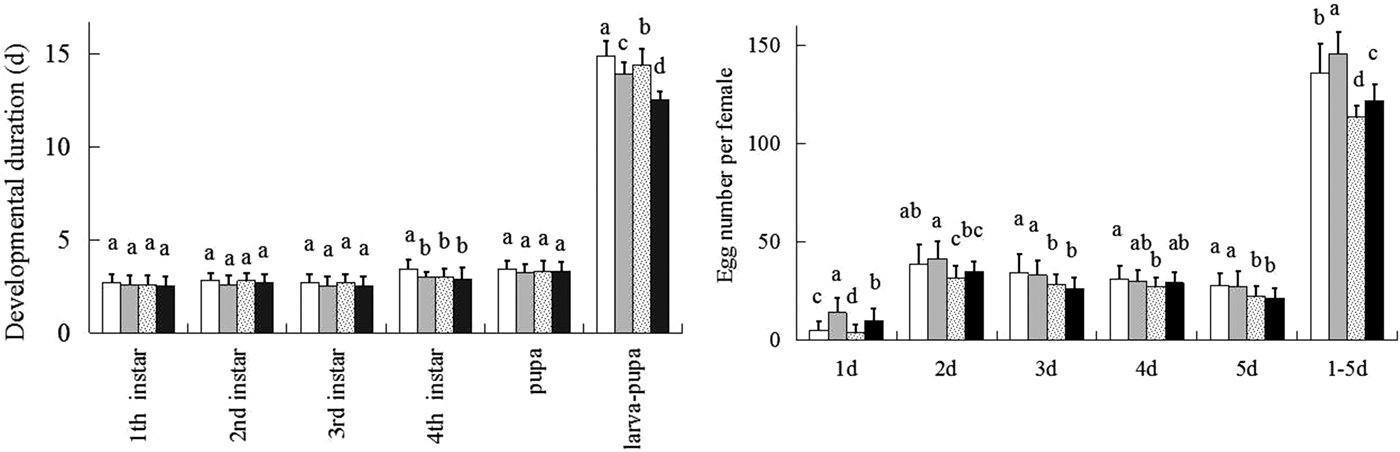
At 25°C, no significant differences were found between control and treatment on the development time for the 1st, 2nd, 3rd or 4th instar larvae or pupa for either Si or Rc DBM. However, the shortened development time could be accumulative. Indeed, when the entire durations from the 1st instar larva to pupa were compared, statistically significant differences between control and treatment were found in both Si and Rc DBM (Duncan's multiple range tests, P ≤ 0.05) (fig. 2). On the other hand, at the same temperature, the hermetic-CPF caused a significant increase in egg counts per female Si or Rc DBM adult on the first day, but not on the following second through the fifth day. And, the daily counts on Si DBM were significantly higher than those on Rc DBM (fig. 2). The effect on fecundity could also be accumulated, as the increases on the number of eggs in Si and Rc DBM became significant when 5-day total counts were compared.
Effect of hormetic-CPF on fecundity and development time at 25°C of Si (white and gray columns) and Rc (dotted and black columns) DBM in vivo. Gray and black columns: insects were fed on leaves treated with hermetic-CPF, i.e., 0.0025 mg l−1 dosage for Si DBM, or 2.5 mg l−1 for Rc DBM. White and dotted columns: controls for Si or Rc DBM, i.e., insects were fed on leaves treated with acetone. Left panel: development time (days) of each instar larva and pupa was recorded; larva-pupa development time is from 1st instar larva to pupa; 30 individuals (i.e., 30 replicates) were used for each determination; and, different letters indicate significant differences among 4 columns in each developmental stage by Duncan's multiple range tests (P ≤ 0.05). Right panel: only one pair of adults was placed in a vial covered with CPF-film to lay eggs; the vial with CPF-film was replaced daily; egg counts were recorded on 1st–5th day for each DBM pair; 1–5 days is accumulated total egg count in first 5 days; 30 replicates were used for each determination; and, different letters indicate significant differences among 4 columns on 1st–5th day, and 1–5 days by Duncan's multiple range tests (P ≤ 0.05).
Stimulation on AChE and GSTs activities by hermetic-CPF under different treatment times and temperatures
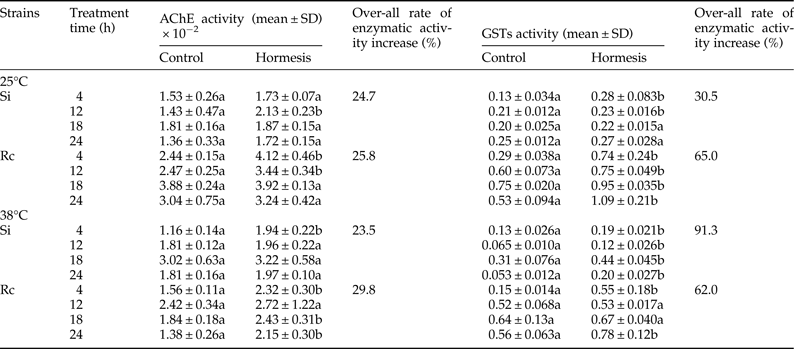
As compared with control, the hermetic-CPF treatments at 25 or 38°C for 4–24 h resulted in increased activities of the AChE and GSTs in the 3rd instar Si and Rc DBM larvae. The over-all rates of the enzymatic activity increases were calculated. As shown in table 2, the hermetic-CPFs increased the activities approximately 23.5–29.8% on AChE and 30.5–91.3% on GSTs. The increases were significant in most of the cases (t-tests, P ≤ 0.05). But, it was insufficient to make a conclusion on whether or not a higher hormesis was induced by the hermetic-CPF in either Si or Rc DBM.
Effect of hormetic-CPF on enzymatic activities in 3rd instar Rc and Si DBM larvae.
Note: 3rd instar larvae were fed on leaves treated with 0.0025 mg l−1 (for Si DBM) or 2.5 mg l−1 (for Rc DBM) at 25 or 38°C for 4, 12, 18 and 24 h before biochemical assays. Leaves were treated with acetone for control. AChE activity is expressed as μM mg−1 protein min−1, and GSTs activity as OD per mg protein·per min. Same for tables 3 and 4. Different letters indicate significant differences between control and treatment (t-tests, P ≤ 0.05). Over-all rate of enzymatic activity increase (%) = (rates of enzymatic activity increase for 4, 12, 18 and 24 h at 25 or 38°C)/4 × 100%.
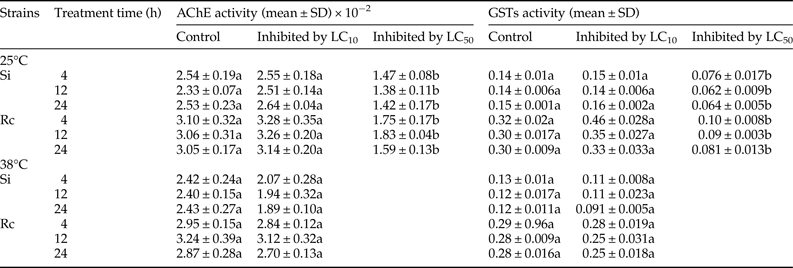
Inhibition of enzymatic activities by LC10- or LC50-CPF in 3rd instar DBM larvae.
Notes: Enzymatic activities of 3rd instar larvae were determined after DBM were fed on leaves treated with CPF (at LC10 or LC50 dose) for 4, 12 or 24 h at 25 or 38°C. Leaves were treated with acetone for control. Three biological replicates were performed for each assay. Different letters indicate significant differences between control and treatment (t-tests, P ≤ 0.05).
Enzymatic activities affected by LC10- or LC50-CPF in 3rd instar DBM larvae with hormetic-CPF pretreatment.
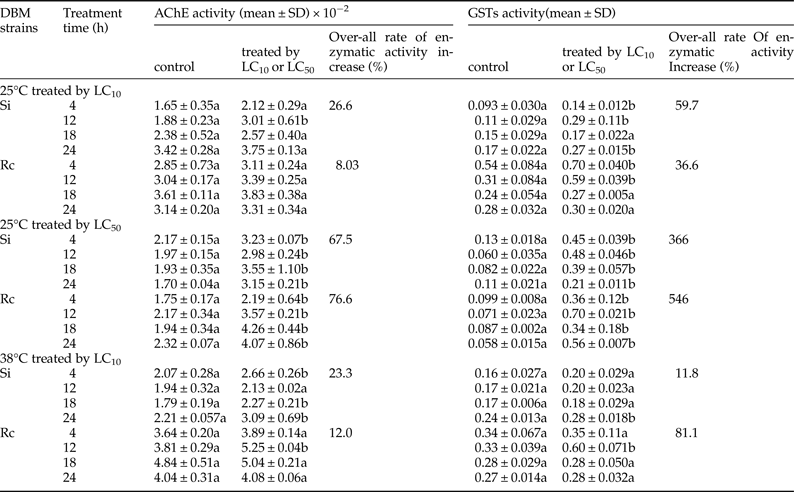
Notes: 3rd instar larvae were first fed on leaves treated with hermetic-CPF (0.0025 mg l−1 for Si DBM and 2.5 mg l−1 for Rc DBM) at 25°C for 24 h followed by feeding on leaves treated with LC10-CPF at 25 or 38°C for 4, 12, 18 and 24 h, or LC50-CPF at 25°C for 4, 12, 18 and 24 h before biochemical assays. For control, 3rd instar larvae were first fed on leaves treated with acetone at 25°C for 24 h followed by feeding on leaves treated with LC1-CPF at 25 or 38°C for 4, 18 and 24 h, or LC50-CPF at 25°C for 4, 12, 18 and 24 h before biochemical assays. Different letters indicate significant differences between control and treatment (t-tests, P ≤ 0.05).
Effect of LC10- or LC50-CPF on enzymatic activities with or without hormetic-CPF pretreatment
As compared with control, LC10-CPF showed no significant inhibition or stimulating effect on AChE or GSTs at 25 or 38°C for 4–24 h. On the other hand, LC50-CPF demonstrated a significant inhibition on the enzymes at 25°C for 4–24 h in Si and Rc DBM larvae (t-tests, P ≤ 0.05) (table 3). However, when the 3rd instar larvae were first fed on the leaves treated with the hermetic-CPF at 25°C for 24 h followed by a feeding with the leaves treated with LC10-CPF at 25 or 38°C for 4–24 h, the enzymatic activities in the larvae increased significantly in some cases. Specifically, as shown in table 4, the GSTs activity increased significantly in 5 out of 8 treatments (t-tests, P ≤ 0.05). Whereas, both AChE and GSTs activities increased significantly (t-tests, P ≤ 0.05), when the 3rd instar larvae were fed with a follow-up diet containing LC50-CPF at 25°C for 4–24 h. And, at 25°C, the over-all rates of enzymatic activity increase were 8.03–26.6% for AChE and 36.6–59.7% for GSTs on LC10-CPF, but they became 67.5–76.6% for AChE and 366–546% for GSTs on LC50-CPF.
Discussion
The inverted U dose-response hormesis, i.e., stimulation at low dose and inhibition at high dose, encompasses the growth, longevity, metabolic parameters and disease incidences in the insects (Calabrese & Blain, Reference Calabrese and Blain2005). With only a few exceptions, the low-dose stimulatory response is usually no more than twofold greater than the blank, while the range of the response is typically less than 10- to 1000-fold immediately contiguous with the toxicological no-OAEL (Calabrese & Baldwin, Reference Calabrese and Baldwin2001; Calabrese & Blain, Reference Calabrese and Blain2005). In this study, CPF dosages ranging from 0.000025 to 0.25 mg l−1 for Si DBM or from 0.000025 to 2.5 mg l−1 for Rc DBM were used. They are far lower than the dose of the lowest OAELs or LC1. Yet, significant stimulating effects on the fecundity and development of DBM, as well as the AChE and GSTs activities were found in the insects treated with the hormetic-CPF at the normal or under high temperature. There were variations on the data obtained, however, as the biphasic hormesis might also be affected by factors including insecticide dosage, environment temperature, treatment time, insect strain, as well as heterogeneity of population.
The activities of AChE and GSTs in Si or Rc DBM were stimulated significantly by CPF doses far lower than LC1 (table 2), but inhibited slightly by LC10-CPF and significantly by LC50-CPF (table 3), which could be significantly relieved by a hormetic-CPF pretreatment (table 4). This finding could be of interest insofar as the evolution of insecticide resistance of DBM is concerned, as the efficacy of organophosphate insecticides in controlling the pests could be compromised due to the increased AChE and GSTs activities resulted from the pre-exposure of hermetic-CPF.
Prior to this study, no report on a long-term exposure of DBM to CPF at a dosage below the lowest OAEL was found. In our experimentation, when the Rc and Si DBM were fed on CPF-treated leaves, either from their 1st to the 4th instar larvae (approximately 12 days) or from the 1st instar larvae to the adult stage (including the egg-producing period, approximately 20 days), significant hormesis was evident. Moreover, differed from the effects by the sublethal insecticide doses on insects, as reported previously, the hermetic-CPF used in the present study was far lower than LC1. Since the half-life of the technical grade CPF is about 20 days in water or in soil with degradation to about 33% residues (Shi et al., Reference Shi, Lin, Xu and Chen2000), an LC1 or the hermetic-CPF dose would be expected to present in the field long after an initial CPF application. Hence, after an insecticide application the field population of DBM would continue to be exposed to the low-dose CPF during that period of time and beyond. Thus, the stimulating effects from CPF would inevitably remain a factor on the evolution of OPs resistance for the insects in the field.
In assessing the ecological risks of insecticide applications, the insecticide-induced hormesis has been taken into consideration, as the resurgence and secondary outbreaks of pest insects were commonly observed following a pesticide application in the field (Chapman, Reference Chapman2002; Guedes et al., Reference Guedes, Tolledo, Correa and Gudes2010; Cordeiro et al., Reference Cordeiro, de Moura, Fadini and Guedes2013). Insecticides applied at a sublethal level could stimulate the biological (such as life-history or behavior traits) or physiological (physiological and biochemical traits) fitness of the insects as well. Therefore, in addition to high doses, it would be prudent to integrate measures for counterbalancing the potential effects by the hermetic, as well as the sublethal insecticide doses in the pest management, and incorporate appropriate controls in the pesticide registration procedures (Williams et al., Reference Williams, Price and Manrique2003; Desneux et al., Reference Desneux, Decourtye and Delpuech2007). Otherwise, the insecticide exposure could worsen, instead of suppressing, the proliferation of insecticide-resistant insects in the field (Guedes et al., Reference Guedes, Tolledo, Correa and Gudes2010; Guedes & Cutler, Reference Guedes and Cutler2014).
The effect of elevated temperatures (e.g., heat stress) on the development, fecundity, metabolism, respiration, nervous and endocrine systems, and behaviors in insects had been observed (Neven, Reference Neven2000). It is known that, when physiological injuries occurred under heat stress, an insect has to adjust accordingly during its life cycle (Neven, Reference Neven2000). Consequently, a fitness cost resulted from the hormesis on the temporary reallocation of resources in insects was also suggested (Forbes, Reference Forbes2000; Cutler, Reference Cutler2013). It could have a significant impact on the biological and physiological fitness and the evolution of Rc under heat stress (Liu et al., Reference Liu, Miyata, Li, Wu, Wu, Zhao and Xie2008; Zhang et al., Reference Zhang, Wu, Wang, Liu, Zhuang and Wu2015a, Reference Zhang, Jing, Li, Li, Bourguet and Wub). However, in the past, the insecticide-induced hormesis was conducted mostly under normal temperatures. The study on the hormetic effects under heat stress was sparse. Our previous studies also found the evolution of insecticide resistance of DBM affected by heat stress. Heat stress appeared to impose a significant fitness cost to Rc, more so than Si DBM. Insecticide resistance of insects declines sharply during summer, but maintains at high levels during spring and autumn (Liu et al., Reference Liu, Miyata, Li, Wu, Wu, Zhao and Xie2008). Based on the results obtained in present study, it was difficult to conclude the differences in the hormesis between 25°C and heat stress or between Si and Rc. However, significant hormesis generally was confirmed in Si and Rc DBM treated with hermetic-CPF at 25°C or under heat stress at 38°C either in a short-term or a long-term treatment (tables 2 and 4).
Seemingly, our findings might have uncovered some important implications of the hormesis on the evolution of insecticide-resistance and the response to heat stress of DBM, particularly at the time of heightened concerns with the use of insecticides and the effects of global warming. Although the present study discovered the CPF-induced hormesis in Rc and Si DBM, no conclusion on the direct effect of the hormesis and biological and physiological fitness in the insect could be drawn at present, as no differentiation on the effects between Si and Rc DBM was made. Further studies will be necessary to arrive at a better understanding in that respect.
Acknowledgements
This study was financially supported by the National Natural Science Foundation of China (31272049) and Key project of Fujian Province (2014N0003).