In his classic study of American government, E.E. Schattschneider (Reference Schattsneider1942) famously said that ‘political parties created democracy and modern democracy is unthinkable save in terms of the parties’ (cited in Wren and McElwain Reference Wren and McElwain2009: 555). Other political scientists, from Schumpeter in the 1940s and V.O. Key in the 1950s and 1960s through to Aldrich, Mair, Katz, Bartolini and Norris more recently, have likewise seen the vibrancy and strength of political party organizations as a key reason why democracy works. A sufficient number of strong, stable and well-organized parties is vital to a well-institutionalized party system (Mainwaring and Scully Reference Mainwaring and Scully1995: 22). A stable party system in turn allows effective government and provides voters with a clear, predictable and simplified set of electoral alternatives. Party leaders and organizations provide voters with a commitment that their election promises, or at least some of them, will be carried out, through their control of the party organization and the leverage they have over the careers and votes of individual representatives.
But despite the broad agreement that the organized nature of political parties and the strength of party systems are important, there is no consensus about just which features of party organization and competition might be the most crucial to democracy, or on how to measure the many facets of party system strength that seem important theoretically. In assessing the strength of party systems, should we measure party identification in the electorate, party cohesion in the legislature, party volatility, or the number of effective parliamentary or legislative parties? Or should we instead look at direct indicators of party organization and institutionalization, such as whether a party has a large and diverse membership, a well-functioning organization, clear rules for decision-making and succession, or a dynastic and personalistic leadership?
The issue of which indicators are most important is particularly pressing because, by many measures, parties seem to be in serious trouble. Their core membership is declining in many countries, party organizations are weak, and parties are often regarded as self-interested and venal by much of the electorate. There are many studies that suggest that this party weakness is a real problem for democracy. In the US, civil engagement, party membership and public concern with politics have all dropped dramatically, as has electoral turnout (Fiorina 2002: 513–15; Putnam 2000). Scholars have also explored the implications of the decline of party identification among the American electorate and decreasing party unity in Congressional votes in preventing effective coordination and the breaking of gridlock in Washington (Abramson et al. Reference Abramson, Aldrich, Paolino and Rohde2000; Fiorina Reference Fiorina2002).Footnote 2 More seriously, in Latin America, Levitsky and Cameron have pointed to the weakness of political parties in Peru as severely inhibiting the post-1992 opposition to Alberto Fujimori’s increasingly authoritarian rule, especially by preventing a sustained coordinated democratic opposition from emerging (Levitsky and Cameron 2003). And in Russia, Henry Hale has explored the ways in which extremely weak parties – replaced in many respects by what he terms ‘party substitute’ machines supported by regional governors and oligarchs – have prevented the emergence of genuine democratic accountability under Putin (Hale Reference Hale2006). Hale suggests that strong executive institutions at the national and regional levels in post-communist systems more generally stack the deck against the emergence of strong parties in Central and Eastern Europe (Hale Reference Hale2006: 236–8). In contrast to these cases, Chavez (Reference Chavez2003) shows us that in Argentinian provinces with strong party competition there are much better levels of accountability, the rule of law and judicial independence.
In this article I explore some of these issues of party strength and democratic stability with reference to the world’s most populous democracy – India. I argue that some of the classic indicators of party decline and party system breakdown (such as high volatility, a profusion of parties and weak dynastic parties) seem to co-exist much better than we might imagine with robust competition, high turnout and an electorate with a deep commitment to democracy. This suggests that those who think that indicators of party system breakdown or weak party organization might always be a problem for democracy may not be right.
The Importance of Parties
There are a number of comparative studies that make the connection between indicators of party organization and strength to good outcomes in terms of democracy and stability. Perhaps most notable in the comparative politics literature, Mainwaring and Scully’s influential 1995 study explains good democratic outcomes in Latin America in terms of whether countries have had good or bad levels of what they define as ‘party system institutionalization’, by which they mean four things: ‘stability in inter-party competition, the existence of parties that have somewhat stable roots in society, acceptance of parties and elections as the legitimate institutions that determine who governs, and party organizations with reasonably stable rules and structures’ (Mainwaring and Scully Reference Mainwaring and Scully1995: 1, 22).
There is significant empirical support for Mainwaring and Scully’s argument about the importance of party system institutionalization, especially in terms of parties that have stable, long-established roots in society. Kuenzi and Lambright (Reference Kuenzi and Lambright2005: 432), for instance, in an interesting paper examining party institutionalization in Africa in the 1990s, constructed an index for 30 African states using the four Mainwaring and Scully criteria, and found a strong relationship between party longevity (age) and countries’ Polity democracy scores. My own recent work with Massimiliano Onorato, which looks at all western colonies, finds that those colonies with long-established electoral processes and political parties also did much better in terms of democratic outcomes after independence, even controlling for such important variables as the identity of the colonizer and the overall length of colonial rule (Wilkinson and Onorato 2014). We find that a one standard deviation increase in the years of colony-wide elections (that is, about 49 years) is associated with an increase in the average Polity democracy score index after independence of 2.29, which is about the difference between Colombia and New Zealand (Wilkinson and Onorato 2014).
Of course, one counter-argument that could be made is that party system institutionalization might be the product, rather than the cause, of political stability (or of some other factor) and, therefore, any relationship we observe between indicators of party strength and political stability might be spurious. There are, however, several empirical cases – where the progress of party aggregation and institutionalization was artificially retarded – that offer helpful ‘natural experiments’ that we can use to help disentangle the impact of these variables and demonstrate that strong parties are very important at least in consolidating new democracies. One interesting case is the Belgian Congo, where because of Belgian colonial policy, all political parties were banned until the late 1950s, while regional and tribal associations were legal. Not surprisingly, in the absence of political parties, much of the political energy in the country in the early and mid-1950s went into the dozens of recently founded tribal and regional politics, such as the Abako, which represented the Bakongo people of the lower Congo; or the Lulua Frères, representing the Lulua (Young Reference Young1966, 1965: 160–70).
When restrictions on political parties were loosened in the Congo in 1957, local elections were immediately dominated by parties that grew out of these established ethnic associations, rather than broader-based national parties. These new parties (with their narrow bases, lacking a history of compromise with each other, and without strong disciplined party organizations) had a very difficult time negotiating, aggregating interests and competing over the whole country (Young Reference Young1976). In the first and last national elections before independence, in 1960, 131 separate parties competed in a country of 14 million people, and only one of these new parties had enough reach to run in as many as five of the country’s six regions. That party, the Abako-derived National Congolese Movement, won a plurality of the seats, 38 of 137, mostly from the Bakongo ethnic group on which the party was based. But that was still far from a majority, and the short-term coalition of convenience that resulted soon fell apart (Crowley Reference Crowley1963: 72–4).Footnote 3
The contrast in terms of party aggregation and party system institutionalization with India is stark. There, the initial provincial party elections in the 1920s and early 1930s also generated a very large number of parties, though fewer than in the Congo because it came on top of 40 years of previous political mobilization and interest aggregation at the provincial level. The party institutionalization of the Indian National Congress (formed 1885) allowed it rapidly to defeat or absorb its rivals. Party fractionalization was high in the first elections in the 1920s, but by my calculations it dropped to 3.07 (effective parties) in 1936–7, and to 2.61 effective parties by 1945–6, by which date Congress had successfully established itself as the dominant broad-based party. In India, unlike in the Congo, at independence there was therefore at least one strong national party able to aggregate interests during the democratic transition of the 1940s and early 1950s.Footnote 4
Party Deinstitutionalization and Weakness in India
If party organization and party system institutionalization is important, how has it fared in India since independence? The Indian National Congress, the country’s dominant party, was one of the best-institutionalized political parties in any colony at independence in 1947. It was internally competitive, broad based (with around 4 million members even a decade before independence) and had been fighting elections and governing at the provincial and local levels for nearly three decades. The party’s open internal structure, which offered challengers the ability to mobilize new groups of voters in order to defeat incumbents and win office, was an important contributor to the party’s responsiveness and ability to respond to competitors. As Low (Reference Low1977: 15) says, ‘Those holding power at one level never found it easy . . . to deny access to the level above to dissidents from a level below’. For two decades after independence, what Rajni Kothari termed the ‘Congress system’ was very effective at providing party system stability and in moderating conflicts in the country as a whole. During the 1950s and 1960s, the Congress functioned as a well-institutionalized catch-all party, with district offices throughout the country, a broad ethnic and religious support base, run by a working committee of senior leaders from across the country, and it managed to beat off all competitors (Kothari 1964; Weiner 1967).Footnote 5 In this party system there was a broad party of ‘national consensus’, the Congress, and various ‘parties of pressure’ such as the Swatantra and Socialists, which kept the system competitive and allowed excluded groups and interests to put pressure upon the Congress and prevent it from getting too out of step with the electorate (Kothari 1964).
Since the 1960s, however, and in the aftermath of a succession fight between Prime Minister Indira Gandhi and senior leaders from the Congress organization (the ‘Syndicate’), which Mrs Gandhi and her son Sanjay won, the Congress itself has been gradually deinstitutionalized and personalized, and the Congress system as a whole has broken down. No internal Congress party-wide elections have been held since the late 1960s, local Congress offices are often non-functioning, and the party operates along familial lines, with intrigues, personality cults and battles between court favourites dominating behind an attempted public façade of bureaucratic party organization (Baru Reference Baru2014; Kohli Reference Kohli1990). The obstacles to rising up to positions of power in the party that this creates have driven a whole host of people to leave, from individuals whose careers were stalled to whole social groups which felt that they were being excluded from the party leadership. Kanchan Chandra, for instance, has shown that the Scheduled Caste activists and voters left the party in droves in states such as Uttar Pradesh and Punjab in which they were excluded from Congress’s leadership hierarchies, leaving as soon as they were presented with a plausible alternative in 1984 (Chandra, 2004: 178–85).
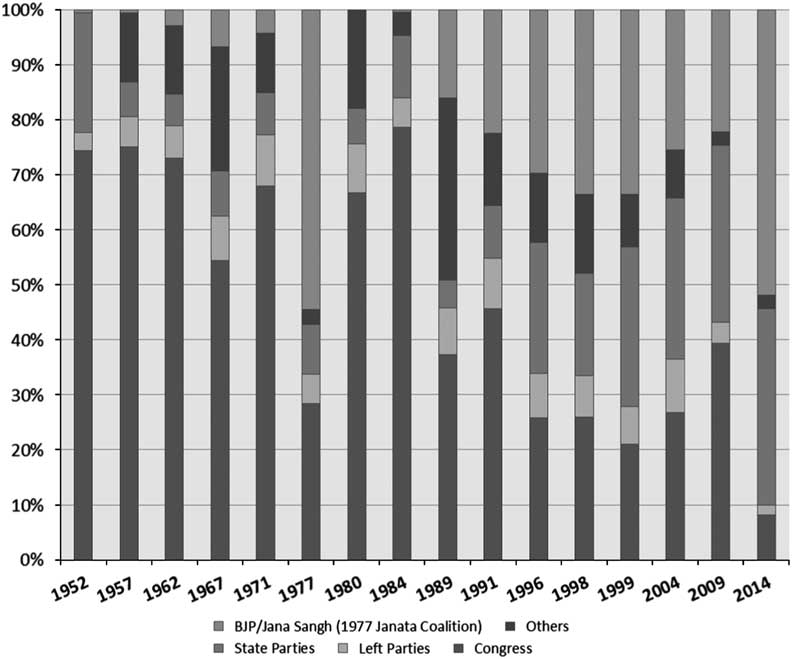
A profusion of other parties have risen since the 1960s to challenge the Congress. Most of the early serious competitors, such as the Independent Party (Swatantra), the People’s Party (Janata Party), Communists, and various regional parties, have gradually imploded. Only the Hindu Nationalist Jana Sangh, reformed as the Bharatiya Janata Party (BJP, Indian People’s Party) in 1980, remains a truly national party competitor to the Congress, winning a sweeping victory in the 2014 Lok Sabha elections. But especially since the mid-1980s, Congress and the other national parties such as the Communists and the People’s Party (Janata Dal) have lost the electoral dominance they once had (see Figure 1) to a new generation of regional parties: the Dravidian Progress Federation (Dravida Munnetra Kazhagam –DMK) and All India Anna Dravidian Progress Federation (All India Anna Dravida Munnetra Kazhagam – AIADMK) in Tamil Nadu, the Party of the Telugu Land (Telugu Desam) in Andhra Pradesh, the Army of Shiva (Shiv Sena) and Nationalist Congress in Maharashtra, the Grassroots (Trinamool) Congress in West Bengal, the Socialist (Samajwadi) Party and People’s Majority (Bahujan Samaj) Party in Uttar Pradesh, the Biju People’s Party in Orissa, the National People’s Party (RJD) in Bihar, and so on. There were more than three times as many parties competing at the national level in the mid-2000s (233), as there had been in India’s first election in 1952 (Heath et al. Reference Heath, Glouharova and Heath2008: 146). From 1989 to 2014 (Figure 1), neither Congress nor the Bharatiya Janata Party had enough seats to form a national government on its own, and every national government was a coalition which could only be formed after careful pre-election agreements, and (more often) a great deal of post-election horse-trading among 15 or more coalition parties.
Party Balance in the Indian Parliament (Lok Sabha), 1952–2014

Most of these parties are if anything even more dynastic and personalistic than the Congress, often based on locally dominant caste coalitions, or on the charismatic authority of a party leader, such as Kanshi Ram and his companion and successor Ms Mayawati of the People’s Majority (Bahujan Samaj) Party in Uttar Pradesh, or the movie star M.G. Ramachandran and his mistress and eventual successor Jayalalitha in the All India Anna Dravidian Progress Federation in Tamil Nadu. Jayalalitha fought and won a very public battle with Ramachandran’s widow Janaki Ramachandran after his death, as sitting chief minister in 1987 for control of the party.Footnote 6 Other examples would include the Patnaik family’s Biju Janata Dal in Orissa (a party named for Patnaik’s father), Sharad Pawar’s Nationalist Congress Party in Maharashtra, or the Yadav family’s Samajwadi Party in Uttar Pradesh. By Kanchan Chandra’s estimate, around a quarter of all elected MPs are the children of MPs, and around two-thirds of all parties are family-based parties. In 2014, according to Chandra’s data, around half of the winning Congress MPs were from the families of previous Congress leaders (Nerurkar Reference Nerurkar2014). Even the main competitor to the Congress, the Bharatiya Janata Party, ran what was generally agreed to be a charismatic campaign in the 2014 elections, highlighting the personality and leadership qualities of its prime ministerial candidate, the controversial chief minister of Gujarat, Mr Narendra Modi. After winning a stunning parliamentary majority and taking office in May 2014 (15 per cent of the winning Bharatiya Janata Party MPs were the children of Bharatiya Janata Party leaders, according to Chandra), Modi took this personalistic style into national government. He has limited the authority of his fellow cabinet ministers; for instance, through his office approving important personnel decisions of their ministries in advance, and marking the files ‘Approval of the Home Minister will be obtained ex post facto in the ACC [Appointments Committee of the Cabinet]’, in which, at that point, there was no question of disagreement (Express News Service 2014).
Together with this personalistic party ‘weakness’ there are a whole host of other well-acknowledged problems with Indian parties. Parties have to raise huge amounts of money to fight elections, and given stringent limits on honest contributions this is done illegally, especially by trading influence and government decisions for money. One study has found that demand for construction materials (such as cement) drops significantly in election campaigns because the construction companies – whose business depends on discretionary political decisions over land – are forced to divert money to support political parties’ campaign expenses (Kapur and Vaishnav Reference Kapur and Vaishnav2011). Parties often have to contend with the big influence of ‘muscle power’ in local elections: this has encouraged parties to employ their own heavies to intimidate opponents and for protection. Inevitably, this has encouraged some criminals to cut out the party middlemen, go into politics themselves, and enjoy the huge discretionary power and insulation from prosecution that control of the state provides. In 2009, 76 of the 543 MPs elected to parliament had been charged with serious crimes, including rape and murder, which did not disqualify them from election on the grounds that the wheels of Indian justice had not yet found them guilty (Panda Reference Panda2013). And many elections are still won and lost not through programmatic appeals, but with specific clientelistic promises to voters of cash, goods in kind, jobs, infrastructure and access to government services that by right ought to have been provided to all (Wilkinson 2007).
The Link Between Party Weakness and Democratic Weakness
There are several major studies that take the view that this decline in party organization and party system institutionalization in India has created some real problems for Indian democracy as a whole. Perhaps the most important early study was Atul Kohli’s Reference Kohli1990 book Democracy and Discontent. Kohli deliberately built on earlier 1960s studies of the Congress Party, visiting the same districts that at that time – in a study by Myron Weiner (1967) – had exemplified the party’s relatively good organization and ability to incorporate new groups and beat off competitors. By the late 1980s, though, Kohli in his fieldwork found a deeply decayed party organization in India’s states and districts which, following Huntington, he linked to an inability to manage the inevitable conflicts caused by political and social mobilization. The result, he argued, was the hollowing-out of the state and widespread and growing violence, which in turn further weakened the party (Kohli Reference Kohli1990).
More recently, Pradeep Chhibber and several coauthors have used statistical methods to examine the scope of party deinstitutionalization in contemporary India and to explore the ways in which this might weaken democracy. In one study, Chhibber looks at the negative effects of India’s many ‘dynastic parties’, such as the Biju Janata Dal in Orissa, the Shiromani Akali Dal in Punjab and the two main parties in Tamil Nadu: the Dravidian Progress Federation and All India Anna Dravidian Progress Federation. These parties are controlled by the ruling family. Leadership positions pass from family member to family member (or to a family nominee), and important decisions are made by the dominant family rather than by a non-family controlled party organization (Chhibber Reference Chhibber2011: 278). Chhibber argues that such parties weaken the quality of representation and democracy in several ways. First, Chhibber shows that states with more dynastic parties (as a proportion of votes cast) have party systems with higher levels of electoral volatility, which he links to less responsive and stable representation. Second, he provides some evidence that voters in states with higher proportions of dynastic parties have lower levels of overall satisfaction with political parties. A 2002 survey showed that voters in more ‘dynastic’ states expressed lower levels of belief that the parties represented their interests than those in states with more organized parties, and there were also some small differences in belief in efficacy among voters for dynastic and non-dynastic parties in the 2004 Centre for the Study of Developing Societies (CSDS) national election survey data (Chhibber Reference Chhibber2013: 89–91).
In a second study, with Francesca Jensenius and Pavithra Suryanarayan (2012), Chhibber and his coauthors have constructed their own index of party organization for a variety of Indian political parties from 1967 to 2000, which they then link to specific indicators of party system ‘health’ such as volatility and a higher degree of fractionalization. They label individual parties as organized, moderately organized and less well organized. Then for each state the authors calculate the proportion of organized versus personalistic parties. Using regression analysis with these data, Chhibber et al. (Reference Chhibber, Jensenius and Suryanarayan2014) find that ‘in Indian states where parties are more organized, both the effective number of parties and electoral volatility are lower’ – measures that Chhibber has elsewhere (2011) related to worse democratic outcomes in terms of the quality of representation.
Problems With The Literature on Party Institutionalization
There are several reasons, however, why even if we agree with Chhibber and others about the fact that party deinstitutionalization is not good, we might want to question the strength of the overall relationship between party (dis)organization, the weakness of the party system as a whole and bad democratic outcomes.
First, as Randall and Svåsand (Reference Randall and Svåsand2002) pointed out more than a decade ago, there are real problems in assuming that the strength or weakness in individual parties necessarily leads to the instability or weakness of the party system as a whole. One important challenge is that numerical indicators, such as electoral volatility and the effective number of parties, are not always reliable guides to the stress in the overall system. Consider the measure for electoral volatility; the proportion of seats that change hands from one party to another at each election. The problem with this as a measure of instability in the system is that in several Indian states, most notably in Kerala and Tamil Nadu, there are relatively stable coalitions of parties that agree on seat-sharing agreements before an election, support each other’s candidates, and whose coalition identities are well known to voters. In Kerala, power has alternated for decades between the United Democratic Front and Left Democratic Front coalitions, each of which contains several parties. But the measures typically used to calculate both electoral volatility and the number of parties competing in a system, are based on individual party results, rather than the vote shares obtained by the party coalition as a whole and movements from one bloc to another. So a 5 per cent swing from coalition party A to coalition party B, whether because of a seat-sharing arrangement or close ideological proximity of the voters within the coalition, would be coded just the same as a swing from one party to which it was in clear opposition.Footnote 7 Yet as Bartolini and Mair (Reference Bartolini and Mair1990) pointed out in their analysis of voting in Europe more than two decades ago, shifts from one party or coalition to another might be qualitatively different from shifts within party coalitions.
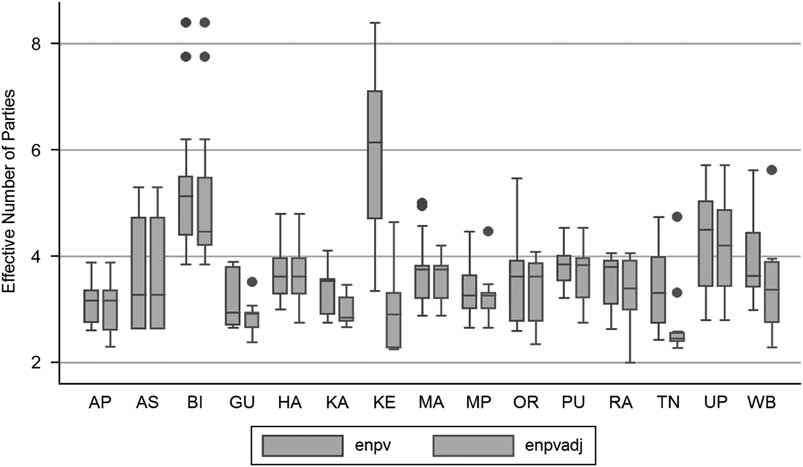
In Figure 2, drawn from my own data set on Indian state elections, I provide some idea of just how large the differences can be if we do not adjust our party scores for the presence of stable coalitions. For each major state, I display a box plot giving the average and range of the effective number of parties (votes) – ENPV – from 1967 to 2000, as well as the same statistic adjusted for the presence of coalitions.Footnote 8 As we can see, the difference in the effective numbers of parties can sometimes be dramatic, especially in the southern states of Kerala and Tamil Nadu, and in West Bengal. In Kerala, the effective number of parties averages a very high six if we do not adjust for coalitions, but a much more institutionalized three if we do.
Number of Parties in Indian States, 1967–2000 (ENPV and ENPV adjusted for coalitions) Source: All data from Election Commission India (Wilkinson state elections data set).

Of course it would not make sense to adjust for coalitions in this way if they were always ‘coalitions of convenience’ – post hoc short-term election deals between rival parties, rather than longer-term stable arrangements. In such short-term arrangements the ENPV measure would still be appropriate. But in many Indian states, the party alliances are in fact much more stable than this: a number of small parties coalesce around a formateur party to fight elections and then govern, and these relationships are stable over time, and well known to voters. In Tamil Nadu, for instance, recent politics has been a competition between the Dravidian Progress Federation-led Democratic Progressive Alliance and the All India Anna Dravidian Progress Federation-led alliance. However, in Kerala, politics since the 1970s has revolved around a fight between the Communist-led Left Democratic Front, which currently has six parties, and the Congress-led United Democratic Front, with nine parties.
Turning now to measures of volatility, there are, as Kitschelt et al. (Reference Kitschelt, Mansfeldova, Markowski and Tóka1999: 400) remind us, lots of ways in which volatility might theoretically matter – movement from well-established to new parties, or movements of voters within blocs versus the more significant movement of voters from one bloc to another – but only a few of these are actually ever measured and tested in the literature (Kitschelt et al. Reference Kitschelt, Mansfeldova, Markowski and Tóka1999: 400). Another measurement problem comes from the fact that we calculate volatility scores using total party seat wins and losses, rather than controlling for the individuals who remain in the seats. This is a problem because in systems with very high levels of individual party defection and larger party splits, such as we see in India, we might as a result observe very high degrees of party volatility without it necessarily indicating a high degree of instability in the candidates who are representing a particular constituency, or instability in the country as a whole.Footnote 9
The second major issue with the doom-and-gloom perspective on party decline in India is that it seems difficult to reconcile with the empirical evidence that Indian democracy seems to be alive and well, and even thriving. Turnout was under 50 per cent in the country’s first election, in 1952, but has hovered around the 60 per cent level ever since, before rising to its highest ever level of 66 per cent in 2014, partly as a result of the ‘Modi wave’. Moreover, unlike in most countries, participation in India is very broad in terms of social participation, with all major religious and social groups participating at roughly the same levels. The ‘deinstitutionalized’ parties also seem to be doing a relatively good job in reaching out to voters. While in 1971 only 12 per cent of voters went to election meetings and 3 per cent to processions or rallies, this total was up to 19 per cent and 13 per cent, respectively, by the 2009 election (The Hindu 2009: 8). In the 2014 campaign, 61 per cent of those surveyed reported that a party worker or canvasser had come to their house during the election campaign to ask for their vote, and 20 per cent reported that they had been contacted by phone (almost all by the now-ubiquitous mobile phone) with a message or SMS.Footnote 10
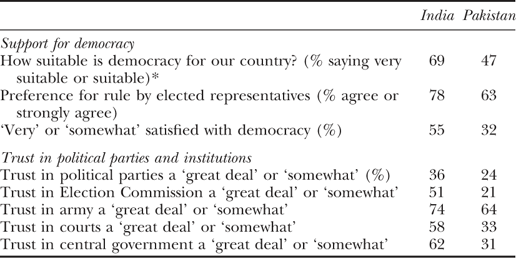
This participation reflects a deep attachment to the democratic process and to democracy. A large-scale comparative survey of South Asian attitudes in 2004–5, conducted by the Centre for the Study of Developing Societies in New Delhi, found that 69 per cent of Indians believed that democracy was suitable or very suitable for their country, with only 9 per cent thinking it was not suitable. Of those polled, 78 per cent expressed a preference for rule by elected representatives, compared with only 47 per cent over the border in Pakistan. And 55 per cent expressed themselves satisfied or very satisfied with democracy, compared with 32 per cent in Pakistan (CSDS 2008).
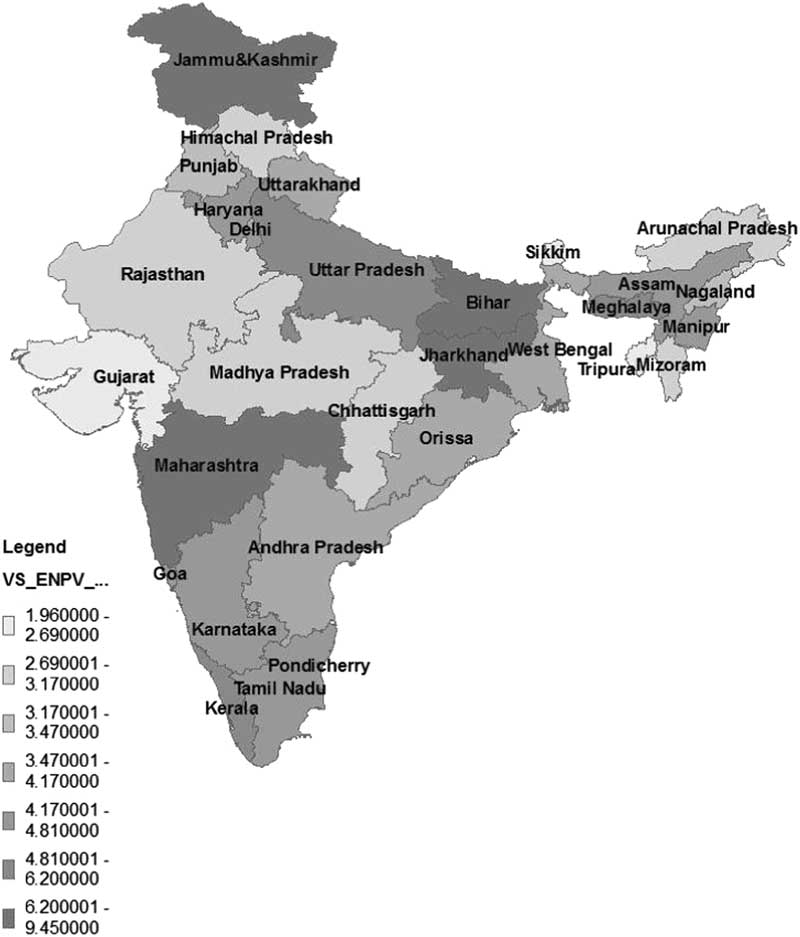
Nor is it easy to relate the main indicators of party weakness cited by Chhibber and others to particularly bad outcomes in terms of growth, violence or the stability of state government. For instance, if we calculate the party fractionalization of each major state in India in 2014, in terms of the effective number of parties (seats) and effective number of parties (votes) in state elections, we find very low correlations (0.06 and 0.19, respectively) between these figures and the levels of GDP growth in the states, which perhaps indicates that there seems to be no obvious relationship between economic investment and apparent political stability. (The levels of party fractionalization in each state’s Vidhan Sabha in May 2014 are shown in Figure 3.) Tamil Nadu, for instance, although its growth rates have recently slowed, enjoyed overall economic growth levels as high as those in Gujarat over the past decade, despite its much higher apparent levels of political instability and volatility (Planning Commission 2014). We see similarly weak relationships between party fractionalization and levels of poverty: the correlations between party fractionalization (seats) and the most recent (2011–12) Planning Commission poverty estimates is 0.22 and between party fractionalization (votes) and poverty the correlation is 0.15.
State Party Fractionalization in India, 2014

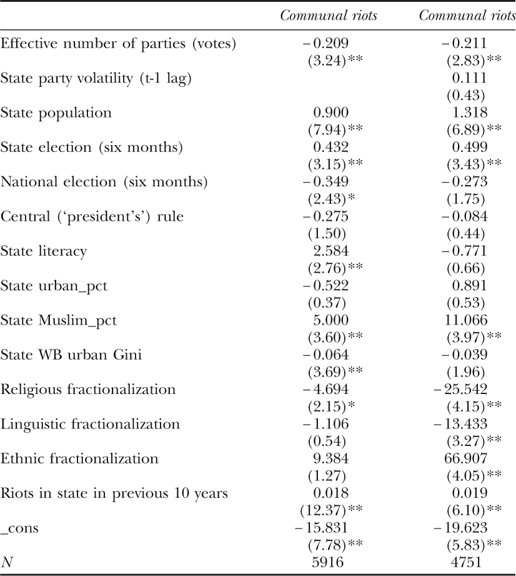
And, as I have argued elsewhere (Wilkinson Reference Wilkinson2004), it might be the case that higher levels of state party fractionalization – the variable seen as negative in Chhibber et al. – might even be a positive sign for some aspects of democratic stability, for instance, by encouraging more majority parties to compete for the votes of minorities and offer them protection from communal violence. In my book Votes and Violence (2004), I found a strong negative relationship between overall levels of party competition in Indian states and lower levels of communal violence, for just this reason. And if we add in state levels of party volatility to the basic regression model I use in chapter 5 of that book, we find (see Table 1 below) that it does not seem to be significantly related to the levels of riots we observe.Footnote 11
State Party Competition, Volatility and Violence

Note: *p<0.05; **p<0.01.
If we look at Chhibber et al.’s 2012 party organization measure – which tracks the dynastic and personalistic quality of state party systems – it is likewise hard, at least at first glance, to see an easy correlation between more personalized and deinstitutionalized party systems and worse state outcomes. The picture is a very muddy one. There is a very low correlation of measures such as growth or the reduction of poverty with the ‘proportion of strong parties’ measure developed by Chhibber et al. Some extremely dysfunctional states in terms of party organization, such as Tamil Nadu, seem to do well in terms of the outcome measures, while other states with personalistic parties, such as Punjab and Bihar, do very badly.
The lack of an observed relationship, of course, may arguably just be a problem with our measures of state governments’ performance. One obvious problem here is that most of the outcome measures of government performance that we use to assess state government performance (such as data on violence, arrests, corruption, and so on) are themselves endogenous to the peculiarities and weaknesses of individual states (Wilkinson Reference Wilkinson2010). The most well-governed states often have the highest reported levels of corruption, crime, and so forth, while the least well governed have the ‘best’ reported data. One way of correcting for this, therefore, might be to look for data on government performance that have been collected outside state government data-generating processes, rather in the way that Putnam did in his 1990 book on Italy, Making Democracy Wo rk.
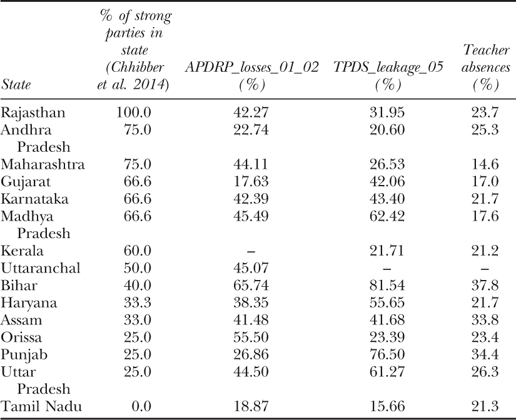
The best such sources I have been able to find are three surveys by private and government audit agencies on government performance which were conducted at the same time, using the same methodology, and across all major Indian states. In this article I use three of these national audits: (1) Michael Kremer et al.’s (Reference Kremer, Chaudhury, Halsey Rogers, Muralidharan and Hammer2005) survey data on the proportion of teachers employed who were actually present in public schools when the audit team visited, which ranged from a high of 85 per cent (that is, 15 per cent absent) in Maharashtra to a low of 62 per cent present (38 per cent absent) in Bihar; (2) data from a Planning Commission audit in 2005 into ‘leakages’ from all sources from the Targeted Public Food Distribution System (TPDS), which ranged from a low of 16 per cent in Tamil Nadu to an astounding 81 per cent in Bihar; (3) audit data on the Accelerated Power Development and Reform Programme (APDRP), which takes account of state billing and collection capacity, as well as the mis-categorization of commercial use as agricultural.Footnote 12
In Table 2, I display the Chhibber et al. measure of party strength in individual states together with these three measures of state government performance: data on Accelerated Power Development and Reform Programme losses, Targeted Public Food Distribution System food leakages from all sources, and teacher absences. Again the relationships are unclear. A few states with very weak party systems, such as Tamil Nadu and Orissa, do quite well in terms of avoiding high levels of Targeted Public Food Distribution System leakages and teacher absences. However, party weakness is clearly not a recipe for good government: some states with strong parties, such as Andhra Pradesh and Gujarat, also do well on most performance measures, and a few states with weak parties – such as Uttar Pradesh and Bihar – do pretty badly on most of the output measures. The overall correlations among the variables are not high, never higher than −0.38 (for party strength and teacher absence).
State Party Weakness and the Quality of Government Service Delivery

The fact that we cannot identify a clear relationship between measures of party performance and output measures – even using these improved output measures – is not in any way to suggest that all is well with Indian parties, or to say that Indians love their politicians and political parties. In Table 3, I report some of the results from the 20,000-person State of Democracy in South Asia survey carried out in 2004–5. This survey showed that most Indians, while they like democracy, definitely do not like their politicians or the main political parties. When asked to name their most disliked attribute of democracy, 43 per cent of Indians named increasing corruption, 13 per cent stated that ‘those who have more votes dominate the others’, and 19 per cent felt that ‘too many parties divide the people’ (CSDS 2008: 245). The overall level of trust in political parties was also very low, with the proportion that had a great deal (13 per cent) or somewhat (23 per cent) trust was outweighed by those who had not very much (21 per cent) or none at all (24 per cent) (CSDS 2008: 253).
Support for Democracy and Trust in Political Parties and Institutions in South Asia

Note: *On the democratic suitability question, 26 per cent of Indians had no opinion, and only 5 per cent said it was ‘not suitable’ or ‘not at all suitable’.
Source: CSDS (2008).
The difficulty of correlating even the very nice state measures developed by Chhibber et al. to negative state-level outcomes in India is perhaps not very surprising. In a very interesting piece on party competition in Latin America, written in 2003, the late Juan Linz also found that voters there could have a deep distrust of parties (especially vis-à-vis coercive institutions such as the army), but that this did not necessarily have a bad effect on democracy. Linz analysed the Latino Barometer survey data for 1997 and found that it showed that most voters (62 per cent) regarded political parties as essential to democracy, but that only 28 per cent of voters had some or much confidence in the parties in their own countries! Two-thirds of the voters, in fact, had no or little faith in their political parties and had much more confidence in their militaries (Linz Reference Linz2003: 296–7). But this did not, as Linz pointed out, indicate a desire for a return for a military role, and the polling data he examined were clear that ‘the critique of parties does not reflect a rejection of democracy’ (Linz Reference Linz2003: 295).
Discussion
How can we make sense of the absence of a clear relationship between indicators of party instability and weakness, and outcome measures (such as voter turnout and democratic participation), as well as things such as economic growth or state levels of violence? The literature tells us that weak parties and weak party systems are bad for democracy, and yet India appears to have a strong democracy without strong parties or a stable party system.
The first thing to say is that Indian parties are still highly clientelistic, with a large number of parties related to high levels of ethnic diversity and not necessarily indicating high levels of ideological opposition (Kitschelt and Wilkinson 2007). The meaning of party weakness in a society where a lot of politics revolves around direct transfers to multiple groups of caste, linguistic and religiously defined voters (as part of a pattern of clientelistic exchange) is likely very different from a society where parties represent more stable – and therefore less negotiable – ideological differences. The usual measures of party systems simply do not track these underlying patterns of transfers, which may provide much more stability and legitimacy to a system than measures of volatility or party fractionalization might suggest.
Second, the fact that there is high party volatility does not necessarily destabilize governments in India at the national or at the state level as it might do in other countries, for several reasons to do with the way in which governments are formed and the returns to office. To begin with, India is still in many respects what Chandra (2004) calls a ‘patronage democracy’ in which government regulatory and spending power is immense. So the rewards for being attached to the party in government are huge, and the penalties for leaving an electoral coalition are considerable. State parties outside the ruling coalition in New Delhi, for instance, constantly complain about the poor levels of transfers they receive from central anti-poverty schemes compared with other similarly poor states that are within the governing coalition’s embrace. This provides one important source of stability for coalitions, even when they include 10 or more parties. Another thing that provides stability in government despite party proliferation is that every national government since 1999 and most state coalitions have been formed as oversize coalitions, in which the coalition has deliberately been made so large that it includes several extra parties beyond that needed to form a minimum winning coalition. This has obvious advantages, of course, in limiting the ability of individual parties to hold the government hostage on any particular issue, and it reduces the incentives to threaten to bring down the government. As a consequence, every government since 1999 has served its full term at the national level.
Third, there is at least some evidence that technological advances can help parties compensate for their organizational weakness judged by traditional measures such as the number of members, meetings, committees, etc. Consider the personalistic BSP or People’s Majority Party, which represents lower-caste ex-untouchables (Dalits) in northern India, especially in the state of Uttar Pradesh. One key aspect of its ability to campaign effectively during the 2007 state elections in Uttar Pradesh – which it won – seems to have been the very intensive use of mobile phone technology to convince its existing Dalit voters, as well as the upper-caste Brahmin voters it wished to attract, that the party was a viable choice compared with other parties (Doron and Jeffrey Reference Doron and Jeffrey2013). The party constructed a six-tier hierarchy in which verbal and SMS messages and talking points devised at the top could be transmitted through elaborate mobile phone trees to voters in each of the 120,000 polling stations in Uttar Pradesh (Doron and Jeffrey Reference Doron and Jeffrey2013: 151–4). The use of mobile phones also lessened the ability of the existing ‘muscle power’ parties to prevent lower-caste voters from voting, because it allowed party workers to quickly record, report and publicize incidents of voter intimidation in a way that would not have been possible 30 years earlier (Doron and Jeffrey Reference Doron and Jeffrey2013: 156–7).
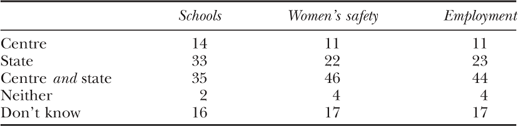
Fourth, and this is more speculative, one key argument made for the importance of parties is that they facilitate electoral accountability for individual voters. One point to make here is that if this is so, it appears that Indian voters – like voters elsewhere – sometimes appear to have only the haziest idea about which levels of government, and therefore which parties, are actually responsible for particular government outputs. In Table 4, drawn from the 2014 Centre for the Study of Developing Societies post-poll of voters in the Indian national elections, I display the extent to which voters seem to understand which level of government is responsible for what. It appears from these data that education, which is a state responsibility under the constitution, is regarded as a central or central and state responsibility by around half of the Indian electorate. And law and order, which again is a state subject, is regarded as a central or central and state issue by two-thirds of voters. So in terms of accountability it has to be said that models of what parties do in a political system in terms of accountability seem to assume a more rational and knowledgeable voter than we find in reality. Maybe that is why parties and party institutionalization matter less than we think.
‘Which Level of Government is Mainly Responsible for . . .’ (percentage of respondents who identify centre, state or both as mainly responsible for each issue area)

Note: Totals may not add up to 100% because of rounding.
Source: CSDS (2014).
What does all this mean for the future of democracy? One point that the Indian experience demonstrates is that previous models that highlight the importance of large stable parties and party systems seem, from the vantage point of 2014, to be very much the product of a particular time and a particular place – that of nineteenth- and twentieth-century Europe and the Americas. Throughout Europe, formal political party membership has declined sharply since the 1960s, but if we look at polling data there seems to be no consistent fallout from this decline in terms of the broader legitimacy of democracy. In some countries where traditional parties and the party system have declined, such as the Netherlands or Denmark, there is considerable faith in democracy, while in others such as Italy there seems to be deep disenchantment and a crisis of legitimacy.
The Indian experience seems to suggest several reasons why this might be so, and why democracy in the future might thrive even as parties do not, and why party systems are subject to increasing stresses. First, our previous conclusions about the robustness of the relationship between measures of party system strength and party organization were not always accurate, because our measures were imperfect. Second, research in very different contexts, by Hale in Russia (2006) and by Doron and Jeffrey (Reference Doron and Jeffrey2013) in India, suggests that there are various ways in which politicians can substitute for the goods that were provided in the past by political parties: through the use of state patronage, money and advertising in Russia, and through the use of new phone technologies in India. The continuing rapid evolution of social media and remote communication technologies as well as the ability of databases to target key groups of voters with increasing accuracy and deliver tailored messages to them will surely accelerate this trend.
Acknowledgements
I would like to thank Katharine Adeney, Paul Taggart and an anonymous reviewer for their helpful comments and suggestions for revision, not all of which I am afraid I have been able to carry out. The fault is not theirs.