Introduction
Recently, two new factors, density of Aedes aegypti (L.) females in an oviposition cage (Chadee, Reference Chadee2007) and physical interference at the oviposition substrate (Chadee, Reference Chadee2008), were added to the already known impacts of endogenous and exogenous factors which influence the shape and form of the diel oviposition periodicity of mosquitoes in the laboratory and field (Corbet, Reference Corbet1966; Clements, Reference Clements1999). The density of mosquitoes in experimental cages was found to affect the peak in the diel oviposition periodicity by intraspecific competition among females at the oviposition site, delaying oviposition from 16.00–18.00 h to 18.00–20.00 h (Chadee, Reference Chadee2007), while the physical interference/movement caused by removing and replacing the oviposition substrate was also found to disturb ovipositing females, delaying the time of peak oviposition from 16.00–18.00 h to 18.00–20.00 h (Chadee, Reference Chadee2008).
Forced egg-retention has been reported to change the physiology and behaviour of Ae. aegypti mosquitoes (Woke, Reference Woke1955; Clements, Reference Clements1999). Dhileepan (Reference Dhileepan1997) suggested that egg retention was possibly responsible for influencing physical and chemical factors, including visual, olfactory and tactile responses of mosquitoes (Bentley & Day, Reference Bentley and Day1989). In addition, egg-retention has been found to affect vitellogenesis when these gravid females take a second blood meal (Elsie & Judson, Reference Elsie and Judson1972). Chadee (Reference Chadee1997) reported that females forced to retain eggs modified their egg dispersal pattern, with most or their entire egg batch being laid in a single container. However, this pattern was not maintained in subsequent gonotrophic cycles, with females distributing their egg installments in two or more containers when not forced to retain eggs.
Nothing is known about the impact of forced egg retention on the diel oviposition periodicity of Ae. aegypti, especially as source reduction programs remove most or all oviposition sites from the field and females may have to search for long periods for suitable sites. Indeed, acquisition of such information, which is relevant to attempts to control the vectors and standardize laboratory methods, is long overdue.
In this paper, the effects of forced egg retention on the diel oviposition periodicity of Ae. aegypti in the laboratory is determined.
Materials and methods
The Ae. aegypti strain used during these studies originated in St Joseph, Trinidad, collected as eggs from June to August (1986) and designated the Trinidad strain. This strain was accommodated in two light-proof rooms at 26±1°C and 70–75% relative humidity and a regime of 12 h light (06.00–18.00 h) and either 12 h dark (room1) or 11 h dark (room 2) with two 30 min ‘twilight’ periods immediately before and after the scotophase. Illumination was as described by Corbet & Ali (Reference Corbet and Ali1987).
The colony was maintained in room 1 in accordance with regimes that standardized density and nutrition of larvae as described by Corbet & Chadee (Reference Corbet and Chadee1993). All Ae. aegypti used for experiments were transferred as eggs to room 2 and reared to adults. Female adults were selected so that the post-emergence age of each was the same and known to within one hour. On the third day post emergence, a sample of females (10–15) was confirmed as inseminated by post-mortem dissection. Thereafter, females were allowed to engorge on blood from an experimenter's arm within a 20 min period centered on 17.20 h, a time close to the main peak of landing and biting of Ae. aegypti in the field in Trinidad (Chadee & Martinez, Reference Chadee and Martinez2000).
Experiment 1
On the fourth day post emergence, blood engorged females (assessed as such by eye) were placed individually, one per oviposition cage (30×30×30 cm) consisting of white cloth netting enclosing a wooden frame and containing a cube of white sugar in an uncovered Petri dish in the center of the cage. In each cage, eight numbered, small, white, polyethylene tubs (SWT) (diameter of tops 8.2 cm and bottoms 7 cm, height 5.8 cm, capacity 300 ml), painted black outside with the inside of each tub lined with a white paper towel and containing 200 ml of temperature-equilibrated tap water, were placed as described in the oviposition assay method developed by Corbet & Chadee (Reference Corbet and Chadee1993).
The oviposition periodicity was monitored by manually placing eight pre-prepared SWTs into each cage labeled in accordance with the cage number. The eight SWTs were exposed for intervals of two hours and removed and replaced with another set bearing the time of exposure and cage number. These females were monitored every two hours for 48 h.
Experiment 2
On the fourth day post emergence, engorged females (assessed as such by eye) were placed individually, one per oviposition cage as described above. The females were denied oviposition sites for four days after oviposition was due. That is, day 11 post emergence or seven days after blood engorgement.
On the eight day post blood feeding, eight numbered SWTs were placed in each cage. The oviposition periodicity was monitored by manually placing eight pre-prepared SWTs into each cage labeled in accordance with the cage number. The SWTs were exposed for intervals of two hours and removed and replaced with others bearing the time of exposure and cage number. These females were monitored every two hours for 48 h.
Results of the number of eggs laid during each time interval were analyzed to determine the effect of forced egg retention on the oviposition periodicity and dispersal of eggs among various containers and are given as the percentages of the William's mean (Haddow, Reference Haddow1960). In addition, the temporal changes in the number of eggs laid were analyzed by transforming the data into contingency tables and a G-test applied (Sokal & Rohlf, Reference Sokal and Rohlf1981).
Results
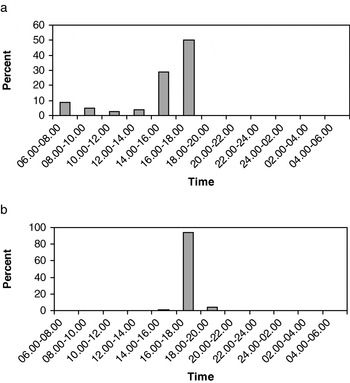
The results of the oviposition periodicity are shown in fig. 1.
Aedes aegypti. Showing the diel patterns of oviposition of females in the laboratory of (a) females allowed access to oviposition sites and (b) females forced to retain eggs for four days.

Individuals allowed access to oviposition sites
Twenty-five individuals of the Trinidad strain exhibited a distinct diel periodicity, with peak oviposition occurring between 16.00–18.00 h (fig. 1). A small morning peak (9%) was observed during the first two hours of the photophase, after which oviposition declined; during the second half of the photophase, oviposition increased, reaching a peak (comprising about 50% of eggs (G=58.3; P>0.01)) between 16.00–18.00 h (fig. 1a). No eggs were collected during the scotophase. This is regarded as the definitive baseline periodicity of the Trinidad strains and is similar to that described by Chadee (Reference Chadee2007, Reference Chadee2008).
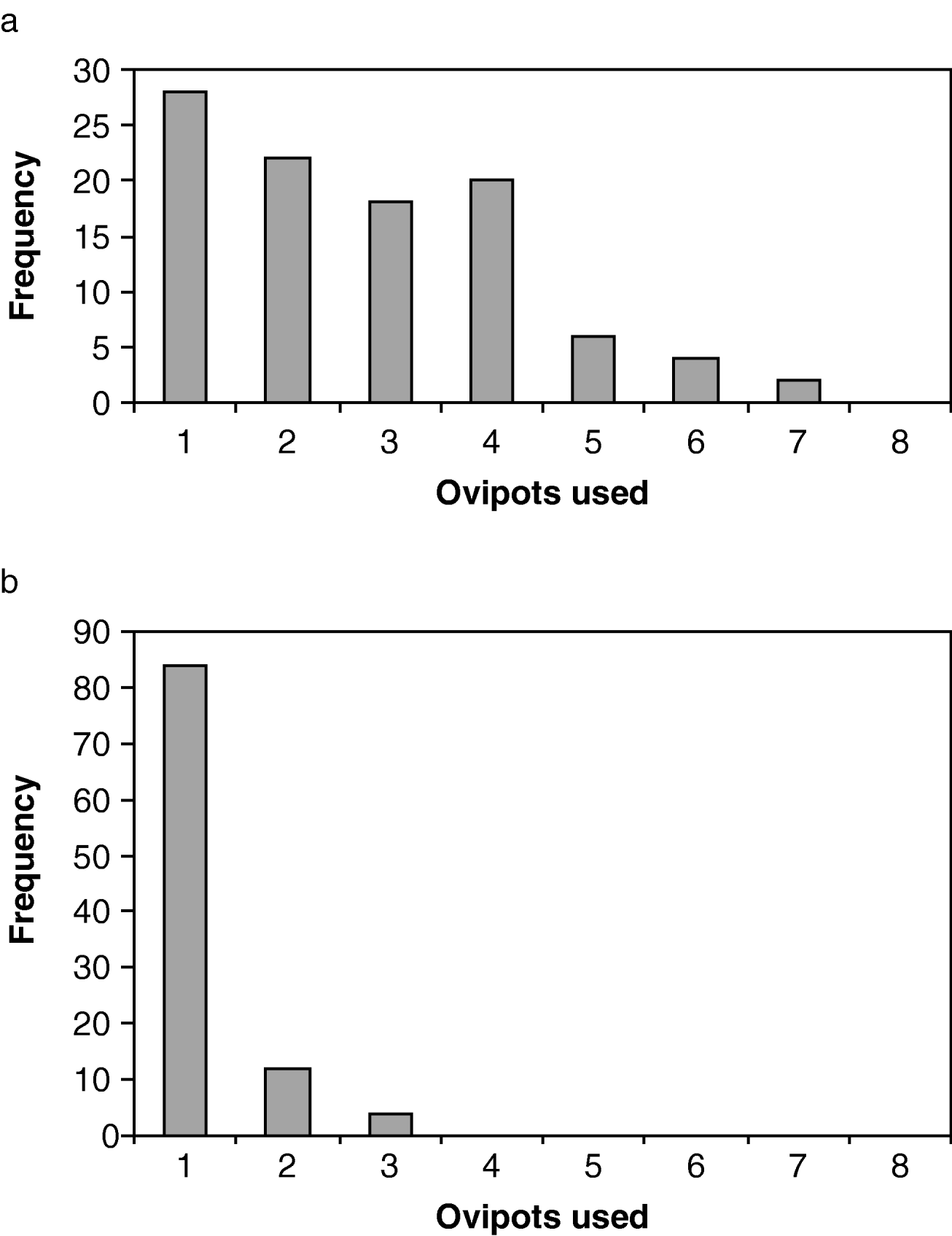
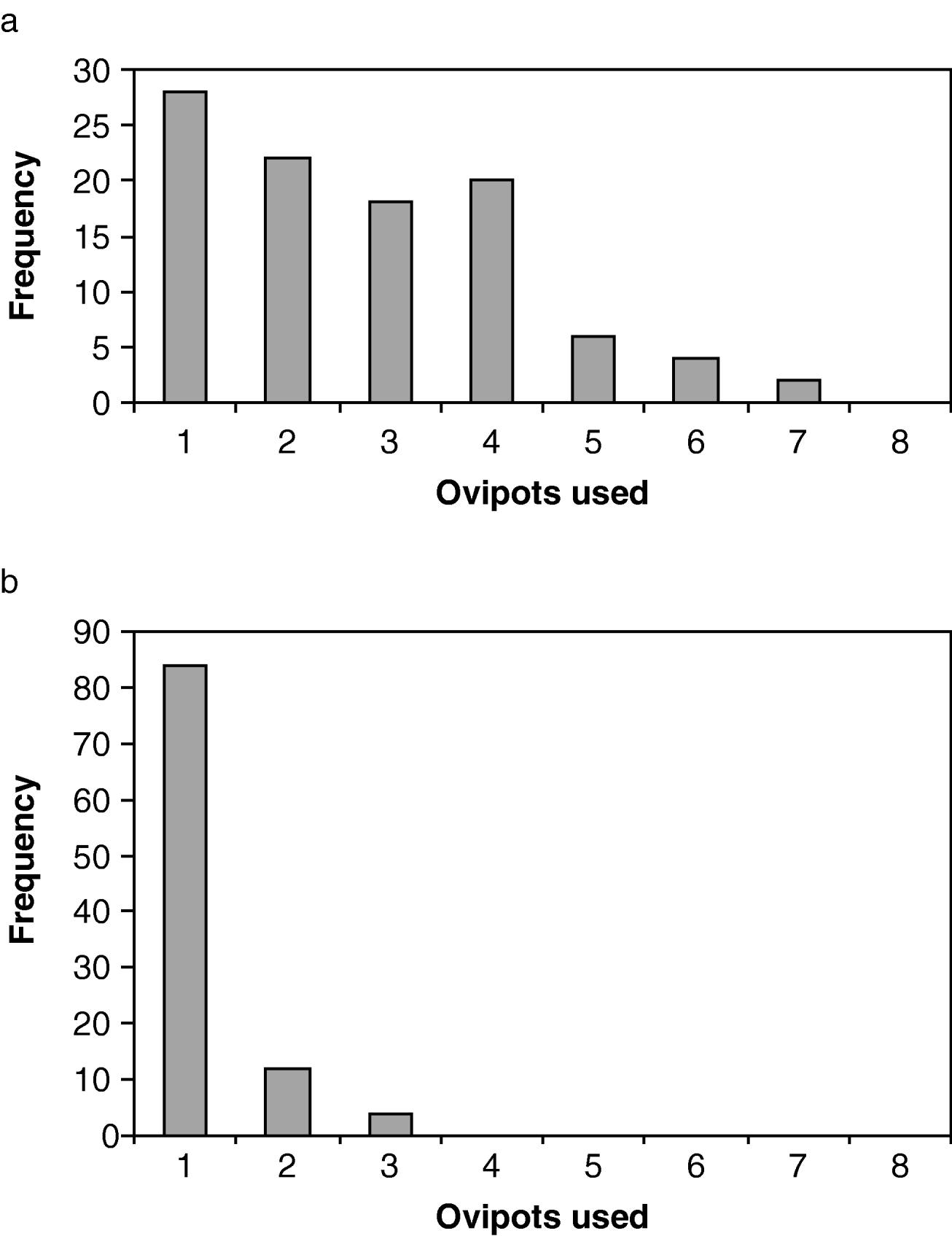
Twenty-three (94%) of all females distributed their eggs among two or more SWTs during their peak oviposition period, which occurred at 16.00–18.00 h (fig. 2a).
Aedes aegypti. Frequency of ovipots usage (a) by females allowed access to oviposition sites and (b) of females forced to retain eggs for four days.
Individuals forced to retain eggs
Twenty-five individuals of the Trinidad strain forced to retain eggs for four days (after oviposition was due) also exhibited a diel periodicity, with peak oviposition occurring between 16.00–18.00 h (fig. 1b). No morning oviposition activity was observed during the beginning of the photophase; but, during the second half of the photophase, oviposition increased significantly (G=101.23; P<0.001), reaching a peak (comprising about 94% of eggs) between 16.00–18.00 h (fig. 1b). Eighty-eight eggs (4.3%) were collected during the beginning of the scotophase but none thereafter.
Twenty-one females (84%) laid all their eggs in one container during the period 16.00–18.00 h (fig. 2b), while four females distributed their eggs in more than one container during the time intervals 14.00–18.00 h.
Discussion
The results of the present laboratory study showed that the oviposition periodicity of Ae. aegypti was diurnal with significant peaks in oviposition restricted to the last two hours of the photophase. This pattern was consistently observed during field oviposition periodicity studies in Kenya when peak oviposition occurred at 14.00–18.00 h and in Trinidad when peak oviposition occurred at 16.00–18.00 h when using four-hour (McClelland, Reference McClelland1968) and two-hour (Chadee & Corbet, Reference Chadee and Corbet1987) monitoring intervals, respectively. In addition, these results are consistent with that of the pioneering work of A.J. Haddow, J.D. Gillett and P.S. Corbet, who demonstrated the influence of different light regimens on the oviposition periodicity of different mosquito species, including Ae. aegypti in the laboratory. It is clear that light influences oviposition by enabling Ae. aegypti females to search visually for oviposition sites (Beckel, Reference Beckel1955) and that the transition from light to dark (sunset or twilight) may set a time cue which positions egg laying on the following day (Gillett et al., Reference Gillett, Corbet and Haddow1961; Haddow et al., Reference Haddow, Gillett and Corbet1961).
It is well known that females frequently lay a single batch of eggs in installments, at 24-h intervals. Sometimes, however, a female which had oviposited at the end of one light stretch (06.00–18.00 h) would lay a few eggs of the same batch at the beginning of the next stretch. This pattern is clearly discernible from fig. 1a, which showed a large peak (50%) in the afternoon and a small (9%) peak in the morning. Gillett (Reference Gillett1962) examined the contribution of individual females to the oviposition periodicity and found a similar pattern with both an evening and morning peak in oviposition in the laboratory. So, it is reasonable to assume that the morning peak is an extension of the previous evening's activity and not a new event.
In addition, this assumption is further supported by the fact that the morning peak reflects the activity of females which remained at the site during the night (when neglible oviposition occurs), probably waiting to complete the bout of oviposition begun the evening before (Chadee & Corbet, Reference Chadee and Corbet1990). Consistent with this view is the knowledge that, in the laboratory (Gillett, Reference Gillett1962) and in the field (Chadee & Corbet, Reference Chadee and Corbet1987), Ae. aegypti lay their eggs of one batch in installments; and that, in the first two gonotrophic cycles at least and regardless of the time of blood feeding, eggs are nearly always first laid in the evening, and a morning oviposition is nearly always preceded by oviposition the previous evening (Gillett, Reference Gillett1962).
Figure 1b shows an absence of a morning peak in oviposition among females forced to retain eggs; that is, there was only one major peak (94%) occurring between 16.00–18.00 h (fig. 1b). This pattern of oviposition by Ae. aegypti may reflect at least two important factors, the absence of suitable resting sites for gravid females during the night following oviposition (Corbet & Chadee, Reference Corbet and Chadee1990) or when females are forced to retain eggs for over four days after oviposition was due (present study). During the present study, females were allowed access to oviposition sites over-night, so the change in oviposition patterns detected relate to forcing females to retain her eggs.
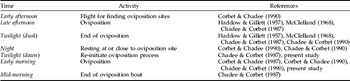
Studies by Chadee & Corbet (Reference Chadee and Corbet1990), Corbet & Chadee (Reference Chadee and Corbet1990) and the present study suggest that entry of gravid females into oviposition sites during the early afternoon is crucial for the initiation of the oviposition waves. This would suggest that visual cues (Beckel, Reference Beckel1955) and the highly sensitive ommatida to dim light (as low as >0.1 lx) (Kawada et al., Reference Kawada, Takemura, Arikawa and Takagi2005) in Ae. aegypti may contribute to females locating and staying at oviposition sites. Based on these results, it seems clear that oviposition follows the sequence summarized in table 1. Conversely, the sequence night-twilight-morning may not allow gravid females the opportunity to search and to find suitable oviposition sites because of the dark conditions at night and, consequently, may be unsuitable to initiate the oviposition wave.
Showing the possible sequence of activity of gravid Ae. aegypti females from searching for oviposition sites to completion of oviposition.

Gillett et al. (Reference Gillett, Corbet and Haddow1959) and Haddow et al. (Reference Haddow, Gillett and Corbet1961) demonstrated the strength of the circadian rhythm, with females having matured eggs at night and during different times during the day but waiting until the afternoon period, 14.00–18.00 h, before laying her eggs. In the present study, similar results were observed; although females were forced to retain eggs for four days, oviposition did not occur until 14.00–18.00 h despite being offered oviposition sites from 06.00 h (fig. 1b). Similar oviposition periodicity was observed among females not forced to retain eggs and given access to oviposition sites from 06.00–08.00 h, 48 h post blood feeding (fig. 1a).
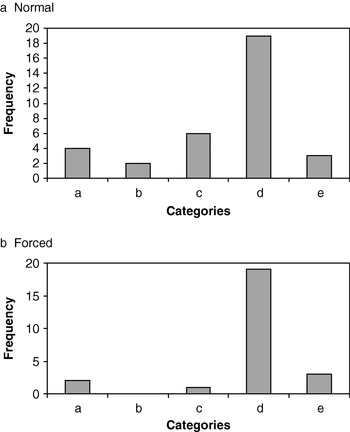
It is noteworthy that females forced to retain eggs for four days modified their oviposition patterns or egg dispersal patterns (figs 2 and 3). Buxton & Hopkins (Reference Buxton and Hopkins1927) and Chadee et al. (Reference Chadee, Corbet and Greenwood1990) observed that gravid females dispersed their eggs over several sites with approximately 11–30 eggs per oviposition container, a behaviour often described as ‘skip oviposition’ (Corbet & Chadee, Reference Corbet and Chadee1993). Recent studies using contemporary molecular markers (both DNA and RFLP) in Puerto Rico (Apostal et al., Reference Apostal, Black, Reiter and Miller1994) and Trinidad (Colton et al., Reference Colton, Chadee and Severson2003) also confirmed the skip oviposition behaviour described above. Using the assay method developed by Corbet & Chadee (Reference Corbet and Chadee1993), Ae. aegypti females forced to retain eggs laid most or the entire installment in one container, while females not forced to retain eggs dispersed their eggs among two or more containers and displayed the skip oviposition strategy (fig. 3a, b). These results demonstrate the usefulness of the assay method developed by Corbet & Chadee (Reference Corbet and Chadee1993) in determining not only oviposition preferences but the oviposition periodicity of females forced to retain eggs.
Aedes aegypti. Frequency distribution of number of eggs laid during each occurrence (encompassing a two-hour period at each ovipot) recorded separately during all times of day for (a) females given access to ovipots and (b) females forced to retain-eggs for four days. Number grades: a, 1–2; b, 3–8; c, 9–30; d, 30–90; e, >91.

In light of these findings, vector control workers conducting source reduction programs may create conditions which may force females to retain eggs and to seek new oviposition sites. This searching behaviour can expand the geographical distribution of the vector, foster the transmission of dengue fever in new locations and, at the same time, females may lay most or all their eggs in one container in the new location(s).
Acknowledgements
This study is dedicated to the memory of Prof. Philip S. Corbet, University of Edinburgh, a mentor and friend who collaborated with me on the oviposition behaviour of mosquitoes for the last 25 years. I also thank Dr Joan M. Sutherland for assistance and for reviewing the manuscript. This study was supported by funds from the Government of Trinidad and Tobago Research Development Fund FSA-6.