Introduction
Eating disorders (ED) affect approximately three percent of the population and remain a significant challenge for mental health services (Thompson Brenner et al. Reference Thompson-Brenner, Satir, Franko and Herzog2012). They have an elevated risk of mortality, with anorexia nervosa (AN) having a standardised mortality ratio of 5.86 (Arcelus et al. Reference Arcelus, Mitchell, Wales and Nielsen2011). Approximately 10% of AN sufferers will die within 10 years of onset, from self-starvation, physical complications or suicide (Steinhausen, Reference Steinhausen2009). After asthma and obesity, ED remain the third most common chronic illness in adolescents (Chamay-Weber et al. Reference Chamay- Weber, Narring and Michaud2005).
The cost can be enormous. An economic analysis in the United Kingdom estimated the total cost at £1.4 billion/annum when healthcare, DALY’s, GDP and economic burden are included (BEAT, 2012). With recent advances in evidence-based treatment, up to 50% can make a full recovery (Lock et al. Reference Lock and La Via2015). Conversely, an inadequately skilled workforce has been cited as contributing to poor clinical outcomes, patient dissatisfaction, disengagement from treatment, costs and increased inpatient admissions (Gowers et al. Reference Gowers, Clarke, Roberts, Byford, Barrett, Griffiths, Edwards, Bryan, Smethurst, Rowlands and Roots2010).
In 2013, this led to the Health Service Executive (HSE) prioritising ED as one of three National Clinical Programmes in Mental Health. The aim was to develop a skilled clinician workforce to provide specialised ED treatment across the public mental health service. Nationally, multidisciplinary clinicians were identified from each community mental health team (adult and child) in order to develop ED treatment at local level. The next step was training, and this too was a challenge. There are literally hundreds of treatments mooted for ED, and few are evidence based. In addition, few of the many training courses that exist have been evaluated educationally or provide a comprehensive biopsychosocial perspective. Subsequent clinician adherence to working in evidence-based models has been shown to be poor (Waller et al. Reference Waller, Stanger and Meyer2012).
The HSE has resourced specific training for the two most effective and evidence-based psychological treatments for adolescents and adults (family-based therapy and Cognitive Behaviour Therapy for Eating Disorders (CBT-E), respectively). However, comprehensive ED is more complex than psychological therapy, and spans primary care, community mental health, medical, paediatric and psychiatric inpatient services, with psychiatrists, psychologists, paediatricians, physicians, general practitioners, dieticians, family therapists and nursing, etc., all playing a role at different times.
One of the key findings from the patient safety literature of the last 20 years is that poor interprofessional communication and care coordination are major contributors to medical errors, patient dissatisfaction and non-implementation of evidence-based medicine on the ground (Stephen et al. Reference Stephen, Melville and Krause2012). Up to 50% of these are preventable (DeVries et al. Reference De Vries, Rambatten, Smorenburg, Gourna and Boermeester2008). ED treatment is no different, and systemic errors, poor decision-making and communication have all been associated with poor outcomes, patient risk and dissatisfaction. (Royal College of Psychiatrists 2012, 2014).
In order to address this, the World Health Organisation (WHO) has strongly endorsed Interprofessional Education (IPE), as the cornerstone of collaborative working, patient outcomes and safety across healthcare, and it has a well-established evidence base (WHO, 2010). IPE is particularly relevant for ED services where, as mentioned above, specialised treatment is often systemically complex and must be collaborative (Carter et al. 2003; Lock et al. Reference Lock and La Via2015). The multidisciplinary nature of the HSE’s clinical programme in ED is a unique opportunity to explore its potential for real world effectiveness. In addition, IPE has the potential to overcome some of the powerful barriers to the dissemination of evidence-based practice at local team level, such as unidisciplinary education, interdisciplinary rivalries and stereotyping (Ferlie et al. Reference Ferlie, Fitzgerald, Wood and Hawkins2005, Zwarenstein & Reeves Reference Zwarenstein and Reeves2006)
IPE
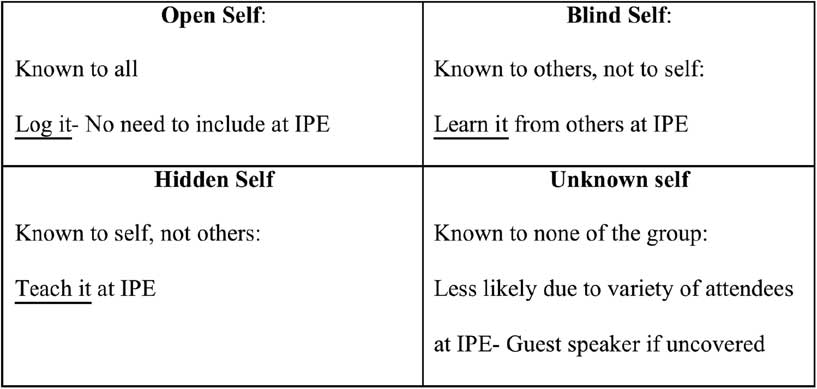
IPE is ‘when two or more professions learn with, from and about each other to improve collaboration and the quality of care’ (CAIPE, Reference Carter, Garside and Black2002). Key is that IPE is interactive, that it is more than just two different professions sitting in a room and learning in parallel. It is informed by insights from adult learning theory (Knowles, Reference Knowles1973), the contact hypothesis (Allport, Reference Allport1954; Hean et al. Reference Hean and Dickenson2005), social identity theory (Tajfel, Reference Tajfel1981, Burford, Reference Burford2012), reflective practice (Brookfield, Reference Brookfield1995) and the concept of uncovering what we do not know (Luft, Reference Luft and Ingham1955) (Fig. 1).
A Johari window concept model adapted for Interprofessional Education (IPE; Luft and Ingham, 1955)

As well as better patient outcomes, continuing IPE known as CIPE has been shown to lead to significant improvement in clinician attitudes towards teamwork, institutional support, job satisfaction, work conditions and safety awareness and openness (Morey et al. Reference Morey, Simon, Gregory and Wears2002; Dieleman et al. Reference Dieleman, Farris, Feeny, Johnson, Tsuyuki and Brilliant2004; Bleakley et al. Reference Bleakley, Allard and Hobbs2012; Priest et al. 2008). From a service development perspective, CIPE has also been shown to translate into to better patient services and more highly skilled clinicians (Lee et al. Reference Lee, Weston and Hillier2013).
Educational evaluation of IPE
The purpose of educational evaluation in healthcare is to ensure that training needs are met, that teaching gaps are identified, to provide feedback, to inform development and resource allocation, and to articulate what is valued (Morrison et al. Reference Morisson2003). In IPE, additional learning outcome domains are: teamwork skills, roles and responsibility (own and those of others), two-way communication, learning and critical reflection (regarding team and work), patient needs and relationship (collaboration, patient as partner), and ethical practice (understanding and holding valid the views of others) (WHO, 2010). In the context of the complexity of ED treatment, it is essential to evaluate these components of any training.
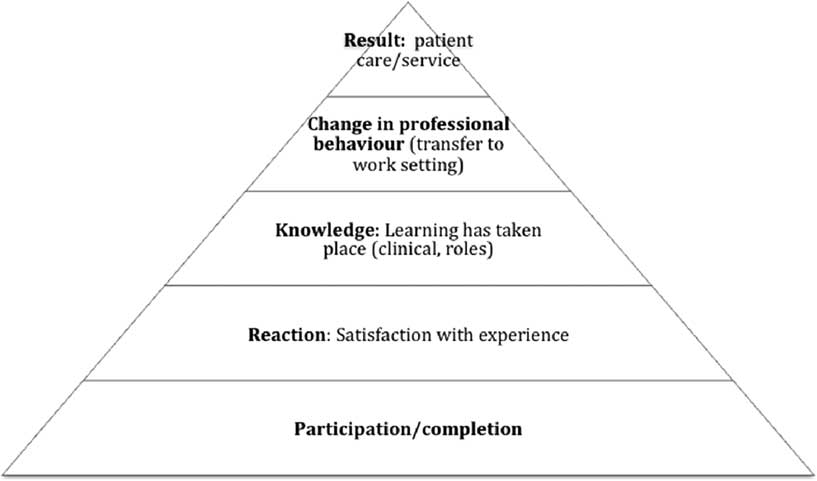
IPE is complex to evaluate and so traditional models have been adapted to reflect this (Barr, Reference Barr2009) (Fig. 2). The higher on the pyramid, the greater educational impact and quality. However, lower levels are the essential building blocks to achieving this, for example, attitude and participation are necessary for behavioural change.
Kirkpatrick/Barr’s hierarchy of evaluation in Interprofessional Education (adapted from Wall, Reference Wall2007).

The ED perspective
The research on evaluation of ED training is very limited, especially with regard to IPE. Pettersen et al. (Reference Pettersen, Rosenvinge, Thun- Larsen and Wynn2012) studied 207 participants at an 18-month ED programme based in Norway, and found via qualitative analysis that the learners from multiple disciplines reported developing ‘clinical confidence’ in areas of interpersonal interventions, competency and organisation. Heath et al. (Reference Heath, English, Simms, Ward, Hollett and Dominic2013) conducted a pilot evaluation of a 2-day IPE workshop for ED in Canada. Attendees reported an increase in knowledge, confidence, interprofessional attitudes and perceptions on standardized measures. Unfortunately, only 26.5% of the original group responded to the follow-up in this study, so it is unknown if this was sustained. Finally, a recent Australian study of 130 psychiatry undergraduates found that case-based learning (CBL) was as effective as problem-based learning for learning about ED (Katsikitis et al. Reference Katsikitis, Hay, Barrett and Wade2002).
Aims and objectives
The aim of this study was to evaluate the acceptability and impact of a CIPE programme for providing specialist training in ED using a CBL approach. A secondary aim was to explore the factors that underlie these findings, and to make related recommendations for further educational practice.
Methods
Subjects
Multidisciplinary mental health clinicians from Child and Adolescent Mental health Service (CAMHS) and adult Community Mental Health Teams (CMHTs), who attended their local CIPE programme in ED from March 2014 to June 2014 as part of the HSE national clinical programme, were invited to participate. There were no exclusion criteria.
Setting
The group met for 2 hours each month, and a total of five CIPE sessions took place during the study period. The researcher designed the programme, and in line with best IPE standards each session was facilitated by rotation, and the attendees also steered content and cases (CAIPE, Reference Carter, Garside and Black2002). The case discussion was the core component of each session, where participants brought anonymised complex cases they were working with, for presentation, discussion, reflection and advice.
Study instruments
Study instruments were chosen to enable educational evaluation of the interprofessional nature of the course (Fig. 2).
The Readiness for Interprofessional Learning Scale (RIPLS) measured pre-existing attitudes of attendees towards IPE (Parsell et al. Reference Parsell and Bligh1999). Its psychometric properties have been evaluated extensively (MacFadyen et al. Reference MacFadyen, Webster, Strachan, Figgens, Brown and McKechnie2005). The version used has excellent internal consistency for the total scale (α=0.84–89), and good internal consistency for the subscales. Respondents score themselves on a five-point Likert scale on a series of 19 statements. Results yield a total score and four subscales: teamwork and collaboration, negative professional identity, positive professional identity and roles and responsibility.
Learner reaction questionnaire
Learner reaction was evaluated using an adaptation of the Short Demand Driven Learning Model Evaluation Tool (MacDonald et al. Reference MacDonald, Breithaupt, Stodel, Farres and Gabriel2002). Originally developed for web-based IPE, it was chosen here for its face validity and psychometric properties [robust validity and excellent internal consistency (0.93–0.97)]. However, in order to improve feasibility and acceptability, the shorter version was used in this study, with items specific to web learning excluded. This yielded a 19-item Likert questionnaire that mapped into four subscales: content, superior structure, delivery and outcomes (Breithaupt et al. Reference Breithaupt and MacDonald2006).
Four-month evaluation
At 4 months, candidates were given an open response series of prompts regarding the impact of the programme on aspects of their clinical work and any barriers that they had encountered. The prompts were taken from an interview schedule developed by Garrard et al. in Reference Garrard, Choudary, Groom, Dieperink, Willenbring, Duefey and Ho2006, which was adapted for an ED setting for the purpose of this study.
Data collection
The RIPLS and learner reaction questionnaires were distributed in paper form and collected at the end of each session. They were stored in a secure location until the analysis stage began after the last session. At that time the final questionnaire was sent to all participants via Survey Monkey. All stages were anonymised with participants using an identifier known only to them, in order to record multiple attendances
Data handling and analysis
The RIPLS and learner reaction scores were input into EXCEL and analysed using STATA. Missing data was recoded as ‘three’, that is, a neutral response. The Shapiro–Wilk test for normality of the data indicated a significant non-normal distribution for one subscale of the learner reaction scale (z=1.73, p=0.04171). Because of this and the small sample size, non-parametric testing was used (Petrie et al. Reference Petrie and Sabin2009). However, Means were also calculated for learner reaction subscales as some were normally distributed. In order to account for clustering (i.e. that some participants had attended multiple times), scores for multiple attendances for the ‘Learner Reaction’ questionnaire were collapsed upon their mean score.
Results were compared between those with and without prior IPE experience using the Wilcoxon rank sum test for two unpaired groups, where the null hypothesis (H0) assumed no difference. The Kruskal–Wallis test was used to compare response styles across the disciplines, for which χ 2 and p values were calculated.
Analysis of the open questionnaire
The final evaluation questionnaire was in open response format, and so was not suitable for quantitative analysis. Responses were systematically indexed, coded, summed and interpreted categorically where possible.
Ethical approval
Ethical approval for this study was obtained from the Biomedical and Scientific Research Ethics Committee, University of Warwick and from the Clinical Research Ethics Committee of the Cork teaching hospitals.
Results
Participation and session characteristics
A total of 25 clinicians attended the IPE at least once over the study period (seven from adult services, 18 from CAMHS), and the attendance rate was 72.1%. In all, 23 (92%) participated in the study by completing at least one questionnaire. The experience of the total group in working with ED ranged from 0 to 20 years. All were female, and 18 identified their professional discipline (psychology, psychiatric nursing, child psychiatry, social work/ family therapy, occupational therapy) – five left this question blank. A total of 10 clinical cases were presented over the timeframe by eight clinicians (32%) from across five disciplines.
Attitudes towards IPE
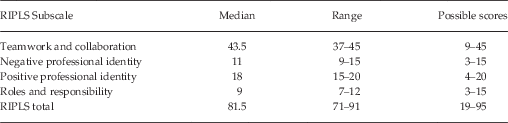
Medians and ranges for the RIPLS questionnaire are presented in Table 1, and attitudes to IPE were strongly positive with a median ‘Total Score’ of 81.5/95 (r=71–91). Scores were particularly high for the teamwork and collaboration subscale (median=43.5/45, r=37–45) and for positive professional identity (median 18/20, r=15–20). Scores for negative professional identity (the importance of clinical problem solving together for patients were good (median=11/15, r=9–15), but here a very high score indicates that cooperative learning is not as valued as uniprofessional learning. Attitudes were also positive but not too high for the roles and responsibilities subscale, where again a very high score indicates unclear or distorted attitudes about professional and team roles.
Readiness for Interprofessional Learning Scale (RIPLS) questionnaire total and subscale (n=20)

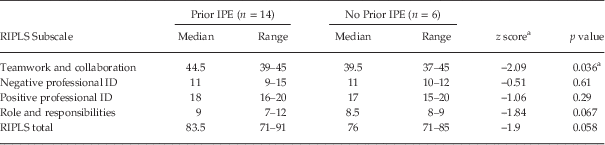
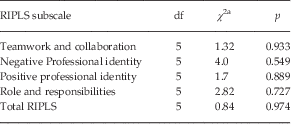
There was a statistically significant difference at p=0.0363 for the teamwork and collaboration subscale between those with and without prior experience of IPE, with the less experienced clinicians scoring lower (Table 2). A similar tendency was found for roles and responsibilities awareness and the Total RIPLS score, though these fell just short of statistical significance. No significant difference was found in attitudinal style between the clinical disciplines (Table 3).
Impact of prior experience of IPE on attitudes

IPE, Interprofessional Education; RIPLS, Readiness for Interprofessional Learning Scale.
a Two sample Wilcoxon rank sum (Mann–Whitney test) adjusted for ties.
Analysis of Readiness for Interprofessional Learning Scale (RIPLS) score differences by profession

a Kruskal–Wallis χ 2 statistic adjusted with ties. 5 df.
Learner reactions
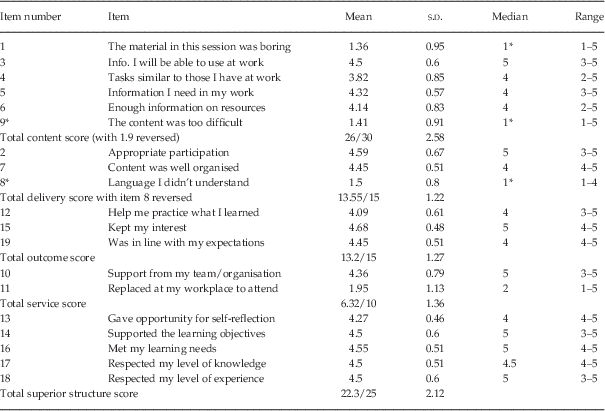
A total of 22 (88%) of attendees completed at least one learner reaction questionnaire, yielding a total of 46 questionnaires from their 49 attendances (93.9% return). Overall, learner reactions for the total scale were very positive with only 5% (21/418) of total statements (22 individuals×19 items) being negative and 6.6% (29/418) being neutral (Table 4). Two-thirds of the negative responses related to item 11 ‘replaced in work to attend’.
Learner reactions

*Negatively worded items.
In terms of the content subscale, participants were strongly positive about the training, and all the neutral responses relating to question four (tasks similar to what I have in work). In terms of delivery, 91% of responses were positive, but ‘language was difficult to understand’ was endorsed with one negative and one neutral response.
There was also a strongly positive reaction in the total Outcome subscale where the group mean was m=13.23/15, ±1.27. All agreed or strongly agreed that it had met their expectations and held their interest, and 19/22 (86.4%) thought that it would help them practice what they had learned (the rest were neutral). An individual who scored the content to be ‘boring’ in item 1, also scored highest for the item ‘it kept my interest’ which may indicate confusion over the reverse scoring on item 1.
A majority of participants (n=17, 77.3%) agreed or strongly agreed that their team/organisation had supported their attendance, but three (13.6%) were neutral on this, and two (10%) disagreed. More significantly, only six (27.3%) felt that they had been replaced enough in their other duties to attend.
Finally, in terms of ‘Superior Structure’, all agreed that the IPE sessions had given them opportunity for self-reflection, with 16 (72.7%) strongly agreeing with this statement. All endorsed the view that the sessions supported their learning needs and respected their level of knowledge. All but one felt that it respected their level of experience. The total mean score for this subscale was 22.32/25 (±2.12), with medians between four and five for all items.
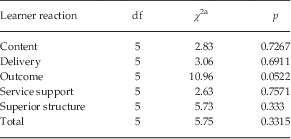
There was no statistically significant difference between the clinical disciplines or those who did not name one (Table 5). The Outcome subscale came closest to significance here at p=0.0522, where the highest scores were from the social workers (28/30, r=25–28), and the lowest were from the occupational therapists (25/30, r=24–29).
Differences in learner reaction between the professions

a Kruskal–Wallis analysis. χ 2 adjusted with ties, 5 df (only one subgroup contained more then five observations).
Four-month evaluation
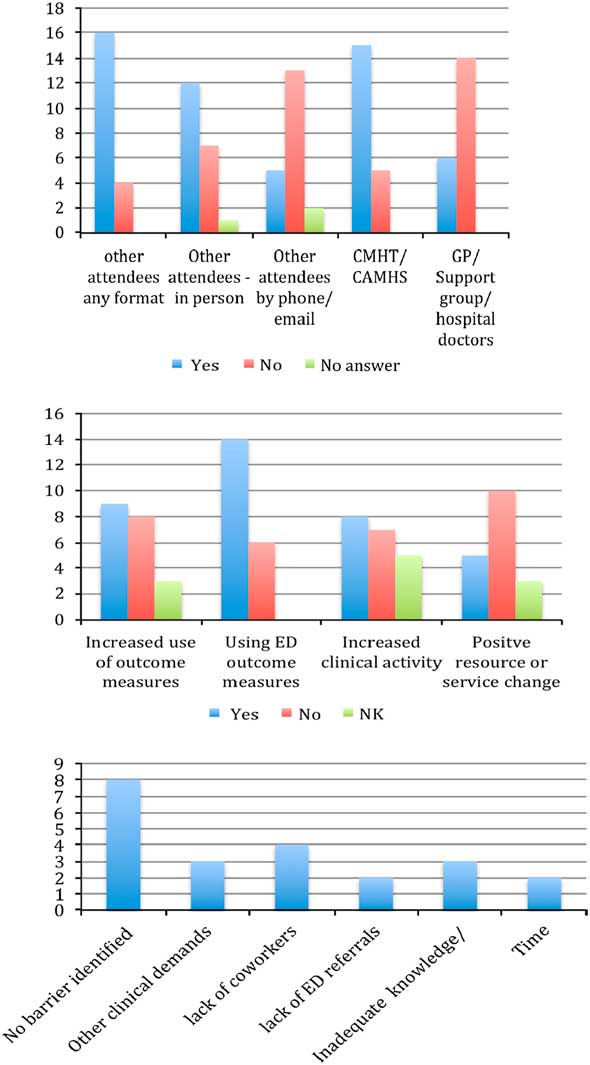
In all, 20 (80%) of the 25 clinical staff who attended an IPE session went on to complete the 4-month open question evaluation. Details of the percieved impact of the CIPE programme on their clinical practice and any barriers are displayed in Fig. 3. In all, 14 (70%) had engaged in new educational reading, with 12 (60%) giving specific reading resource recommendations. Eight (40%) mentioned that they now had a better understanding of how the other disciplines worked and of their roles, particularly regarding dietetics and family therapy, and of how they could work collaboratively. Eight (40%) also mentioned that it helped them understand how to manage complex cases, with five (25%) finding it helped them manage their caseload better. In all, 18 (90%) had communicated collaboratively about cases with other professionals outside of the meetings, and this was linked to higher attendance (mean=2.14 connection types versus mean=1.113 for the whole group) (see Fig. 3). Increased clinical activity (screening, assessing, consulting, treating) and outcome evaluation were reported by almost half. Of the five who did not notice any changes, two had attended once, one said it was not a special interest and two (10%) said they were already engaged in these behaviours.
Perceived impact of continuing Interprofessional Education on clinician behaviour and associated barriers (y axis=number of participants). GP, general practitioner; ED, eating disorder; CAMHS, child and adolescent mental health service; CMHT, adult community mental health team.

Key barriers to attending and implementing IPE are also displayed. Only five (25%) reported an increase in ED resources on their teams during the study period, and for three this involved more manuals only. Conversely, three (15%) reported a decrease in MDT (Multidisciplinary team) colleagues to co-work cases. Overall, eight (40%) had not encountered a barrier to their development of their ED skills.
Discussion
Learner attitudes and participation in CIPE
In terms of attitudes, this group indicated very positive attitudes towards CIPE as endorsed on the RIPLS, and the 72% attendance rate is comparable to the 78% rate found for optional IPE in a mental health setting (Young et al. Reference Young, Chinman, Forquer, Knight, Vogel, Miller, Rowe and Mintz2005). Coupled with the level of volunteerism in presenting cases (36%), these are all indicative of positive prior internal motivation in the group and an openness towards interprofessional learning. There is significant overlap in clinical models and co-working in effective community mental health teams, and knowledge about roles and collaboration may have already been established. The finding that less experienced clinicians of CIPE scored lower on the teamwork and collaboration scale was similarly reported by Tunstall-Pedoe et al. (Reference Tunstall- Pedoe, Rink and Hilton2003). It may be that more recently qualified clinicians have not yet experienced or fully developed their own concept of interprofessional collaboration in order to frame it into a specialist setting. This lends strong support to the view of the WHO framework that IPE begin at undergraduate level (WHO, 2010). Reeves et al. (Reference Reeves, Zwarenstein, Goldman, Barr, Freeth, Hammick and Koppel2009) in a systematic review of IPE, notes that females hold more positive attitudes towards the benefits of collaborative work than males, and this may also have been a factor here.
Learner reactions
The participants strongly endorsed CIPE sessions and the use of a CBL approach in training in ED. This is consistent with Thistlethwaite et al.’s (Reference Thistlethwaite, Davies, Ekceoka, Kidd, MacDougall, Matthews, Purkis and Clay2012) finding that health clinicians tend to have a positive reaction to IPE in a CBL format, which seems to aid both the development of applied reasoning skills and also deeper, more active learning in a real world context. Given that case complexity and safety arises very commonly in working with the ED patient group, this approach may be particularly suited to the complexity of learning needed.
From an interprofessional perspective, the level of interactivity in the sessions was particularly positively received, (median score of five). Combined with the reported positive impact of learning from others, and volunteerism in presenting, this suggested that the adult learning ‘shared ownership’ model worked well and was highly acceptable. Curran et al. (Reference Curran, Sharpe, Foristall and Flynn2008) questioned whether the group process of IPE and CBL is a key mediator of learner satisfaction, and it may be that this is the case here, where patient focus, group learning and interprofessional interaction all entwined into a positive learning experience. Many of this group had not worked together or met before and the interactive format may have enabled them to ‘form’ and ‘storm’ while also to demonstrate their professional identity through rotating the presenter and feedback roles (Tuckmann, Reference Tuckmann1965). This may have enabled risk and safety group issues in the IPE to be gradually addressed through presenting and giving feedback in an interplay of ‘teacher’ and ‘learner’ roles. Interestingly, six of the eight participants who presented cases were the clinicians experienced with a lot of ED experience, and this may indicate that a greater confidence and experience enables individuals to participate more fully, whereas less experienced clinicians initially take a more observer stance. This has implications for the development of specialist clinical programmes and collaborative working on them across services and teams.
Even without a fixed curriculum, the CBL format was effective in steering the group across discipline, service and experience to common learning threads to which they could all relate. Pre-existing concerns that the group had very different initial learning requirements were not borne out in this study and did not undermine the sessions. However, the finding that one participant found that the content was challenging and another that the language hard to understand, suggests the need to be alert to this issue.
Change in knowledge and attitude
We can conclude that attitudes about IPE and collaboration remained positive over the 4 months. For example, of the 68 final comments made about the programme, none were negative. When collaboration and attitudes are viewed as processes and not as discrete events, then this group is continuing a positive trajectory of valuing and understanding collaborative work. In terms of ED, as Thistlethwaite et al. (Reference Thistlethwaite, Davies, Ekceoka, Kidd, MacDougall, Matthews, Purkis and Clay2012) noted ‘the use of authentic clinical cases’ in CBL links theory to practice and was most appreciated by learners. A number of the attendees perceived an increase in clinical confidence at the 4-month stage as bring as a result of the IPE programme, and this is similar to aforementioned findings of Pettersen et al. (Reference Pettersen, Rosenvinge, Thun- Larsen and Wynn2012). As there was no formal assessment of competency in this study, we can hypothesise that this confidence may relate to the development of a sense of membership within a special interest group, the complexity of the case discussions, the giving and getting feedback that is valued, with experienced clinicians.
The perception of acquiring knowledge and understanding was the key impact that all but one learner had noticed over the five IPE sessions, and diversity of knowledge and perspective was strongly respected by the group. Heath has found that statistically significant increases in self-reported knowledge when coupled with increased confidence, is a key factor in predicting behavioural change (Heath et al. Reference Heath, English, Simms, Ward, Hollett and Dominic2013). The use of regular formal reflective logs and feedback forms, may enhance this as the group progresses, while their motivation and engagement may be maintained by asking all to share relevant supplementary material, for example, literature, reference lists, tools. Optional tutorials on special topics for those who identify specific gaps.
Professional behaviour and patient impact
The finding that more attendance results in more communication and collaborative pathways about ED cases outside of the sessions is an important finding in terms of the dissemination of knowledge and patient impact for the clinical programme. This may relate to increasing confidence, awareness of the importance of collaborative care or that group membership that in itself caused a change in behaviour, relationships having been formed. Of note, there have been no role requirements finalised by HSE in this regard to date.
That almost half of attendees attributed their increased use of clinical outcome evaluation tools to attending the sessions, when paired with increased scientific reading (70%) and sharing of recommendations, strongly supports the conclusion that the IPE programme has been educationally effective in enhancing professional development behaviours. From a patient perspective, the increase in clinical activity in ED, with more than half of those (25%) attributed this to the IPE programme, as well as reported changes in clinics and referral pathways and outcome evaluation, is also supportive of the potential for improved patient care and outcomes through IPE over a longer period.
Barriers to implementation
This IPE training was not compulsory and this is commonplace in clinical services (Reeves et al. Reference Reeves, Zwarenstein, Goldman, Barr, Freeth, Hammick and Koppel2009). However, if the aim of the national clinical programme is to enhance patient access to specialised ED treatment at local level and to improve outcomes, then this needs to be considered carefully so that all patients with ED can equally benefit no matter where they live. The literature identifies that a number of systemic barriers to attendance at IPE programmes can play a role in undermining it at local level. This includes professional stereotyping and professional resistance (Ferlie et al. Reference Ferlie, Fitzgerald, Wood and Hawkins2005; Ateah et al. Reference Ateah, Snow, Wener, MacDonald, Metge, Davis, Frieke, Ludwig and Anderson2011; Curran et al. Reference Curran, Sharpe, Foristall and Flynn2007) and different clinical demands for mental health staff (Vostanis et al. Reference Vostanis, O’Reilly, Taylor, Day, Street, Wolpert and Edwards2012; Mancini et al. Reference Mancini and Miner2013). At an individual level, non-attenders at IPE risk being in the ‘Blind’ quadrant with regard to learning from others (Fig. 1), reinforcing negative assumptions and also undermining collaborative patient care and dissemination of best practice. Strategies such as circulating a summary after each meeting, telephone check in to low attenders and formally updating local heads of disciplines about the programme may all serve to manage this risk.
A final important finding of this study was that 40% had not made changes to their clinical practice with reasons such as ED not being of special interest, not having an adequate ED caseload or not having co-workers to work with. Vostanis et al. (Reference Vostanis, O’Reilly, Taylor, Day, Street, Wolpert and Edwards2012) found similarly that resource limitations and training gaps undermine the practical application of IPE in a CAMHS setting. Knowledge translation into the workplace is, at a fundamental level, a function of resource as well as educational effectiveness, and barriers due to the former undermine the latter. This highlights again the importance of regular communication about the clinical programmes to local managers and clinical leads, who are in a position to support the allocation of resources and the development of expertise. It also raises the issue of specialist hubs for clinical programmes that focus on less common conditions, in order to provide the structural means for clinicians to enhance their expertise.
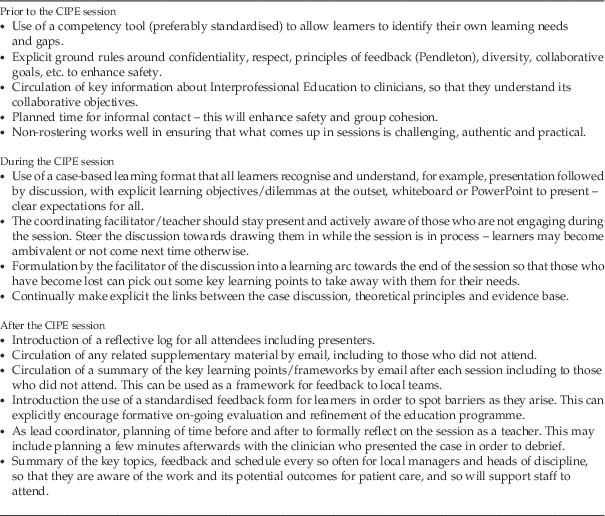
From a clinical education and practice perspective, a number of suggestions can be made based on the findings for the consideration of any clinician who is planning IPE in clinical services (Table 6).
Recommendations for continuing Interprofessional Education (CIPE) development based on study findings and the literature

Limitations
Although the participation rate was high in the analysis, this was a pilot study with relatively small sample size. However, the wide variety of disciplines, experience, teams and services that participated deepen its generalisability and relevance within a clinical programme context nationally.
The evaluation was also limited by its timeframe, and it is too early to evaluate its longer-term impact on clinical practice. The on-going use of patient satisfaction questionnaires, clinical audit and clinical outcomes will be worth exploring with the IPE group in this regard. Finally, a third limitation of this study is that the measures obtained were self-reported, and therefore a proxy that may not reflect real clinical outcomes or behaviours. Measures taken to minimise this included prioritising anonymity over the gathering of demographic information, and the use of reliable and validated study instruments.
Acknowledgements
The authors would like to thank Joseph McDevitt for his statistical advice, and all of the clinicians who participated in this IPE research project.
Financial Support
This research received no specific grant from any funding agency, commercial or not-for-profit sectors.
Conflicts of Interest
None.
Ethical Standards
The authors assert that all procedures contributing to this work comply with the ethical standards of the relevant national and institutional committee on human experimentation with the Helsinki Declaration of 1975, as revised in 2008. The study protocol was approved by the institutional review board of each participating institution. Written informed consent was obtained from all participating patients.