Introduction
In the context of the global ageing of the population, and people living more years with disability, the number of people in need of care is increasing substantially (ONS, 2014; Burchardt et al., Reference Burchardt, Obolenskaya and Vizard2015; Pickard, Reference Pickard2015; Scheil-Adlung, Reference Scheil-Adlung2015). At the same time, the relative size of the working-age population is declining and female labour force participation continues to rise (Colombo et al., Reference Colombo, Llena-Nozal, Mercier and Tjadens2011; Pickard, Reference Pickard2015). Reconciliation of unpaid care and employment is an increasingly important societal, economic and equality issue, in the UK and internationally (Fine, Reference Fine2012; Eurofound, 2015). Difficulties around combining work and care have consequences for stress, and mental and physical health (Buckner and Yeandle, Reference Buckner and Yeandle2011; Milne et al., Reference Milne, Brigden, Palmer and Konta2013). Provision of unpaid care impacts on employment, including reduction of working hours, taking on less well-paid employment and leaving employment (Colombo et al., Reference Colombo, Llena-Nozal, Mercier and Tjadens2011). Leaving employment has individual and societal costs (Age UK, 2012; Pickard et al., Reference Pickard, Brimblecombe, King and Knapp2013; Aldridge and Hughes, Reference Aldridge and Hughes2016). In England, it is estimated that approximately 315,000 unpaid carers of working age have left work because of caring at a cost to the government of at least £1.3 billion (Pickard et al., Reference Pickard, Brimblecombe, King and Knapp2013).
Previous research shows that unpaid carers feel that provision of social care services for the person they care for is important in enabling them to remain in employment. Carers say that they need more, or more appropriate and better quality, services for the person that they care for to enable them to combine work and care (Yeandle et al., Reference Yeandle, Bennett, Buckner, Fry and Price2007; Milne et al., Reference Milne, Brigden, Palmer and Konta2013). Those who do receive such services place great value on them in supporting them to work and provide care (Yeandle et al., Reference Yeandle, Bennett, Buckner, Fry and Price2007). Using a large-scale national dataset, the Personal Social Services Survey of Adult Carers in England, our recent research found that unpaid carers providing care for 10 or more hours a week were more likely to be in employment if the person they care for receives ‘key’ paid services (home care, personal assistant, daycare, meals-on-wheels and/or short-term breaks) (Pickard et al., Reference Pickard, King, Brimblecombe and Knapp2015).
Recent policy in England aims to support working carers to remain in employment. The Carers’ Strategy 2014–2016 gives high priority to ‘enabling those with caring responsibilities to fulfil their education and employment potential’ (HMG, 2014: 28). The 2014 Care Act introduced new legal duties on local authorities to provide support to meet carers’ needs (Care Act, 2014), including need or desire to be in paid employment. This can be through provision of services to the care-recipient. However, this takes place in the context of historical underfunding of social care exacerbated by accelerating and substantial cuts to adult social care budgets in England since 2009/10, (HSCIC, 2015; ADASS, 2016; Burchardt et al., Reference Burchardt, Obolenskaya, Vizard, Lupton, Burchardt, Hills, Stewart and Vizard2016; Glendinning, Reference Glendinning2016) a period when ‘the scale of reductions in spending and provision are almost certainly without precedent in the history of adult social care’ (Fernandez et al., Reference Fernandez, Snell and Wistow2013: 7). There has been a reduction in the numbers of adults receiving publicly funded care services. Need, meanwhile, remains high with a resultant unmet need for services (Ismail et al., Reference Ismail, Thorlby and Holder2014; Maplethorpe et al., Reference Maplethorpe, Darton and Wittenberg2015; Burchardt et al., Reference Burchardt, Obolenskaya, Vizard, Lupton, Burchardt, Hills, Stewart and Vizard2016). Working carers report similar experiences, with only a minority receiving the services they feel are needed (Milne et al., Reference Milne, Brigden, Palmer and Konta2013; Brimblecombe et al., Reference Brimblecombe, Pickard, King and Knapp2016).
There is thus potential conflict between the policy goal of enabling working carers to remain in employment, including through the provision of formal social care, and cuts to provision of that care. It is in this context that our study collected quantitative and qualitative data from carers and the person they care for. Using these data, we describe the extent of unmet need for services for people cared for by working carers and explore barriers to receipt of services.
Methods
Ethics approval was obtained from the Social Care Research Ethics Committee (References: 12/IEC08/0029; 15/IEC08/0002). Consent for both screening survey and questionnaire was assumed from their voluntary self-completion. Consent for the interviews was obtained verbally at the start of the interview. Participants were sent Information Sheets explaining the study, confidentiality and that participation was voluntary. For those aged under 16, written consent was also obtained from their parent or guardian.
Survey
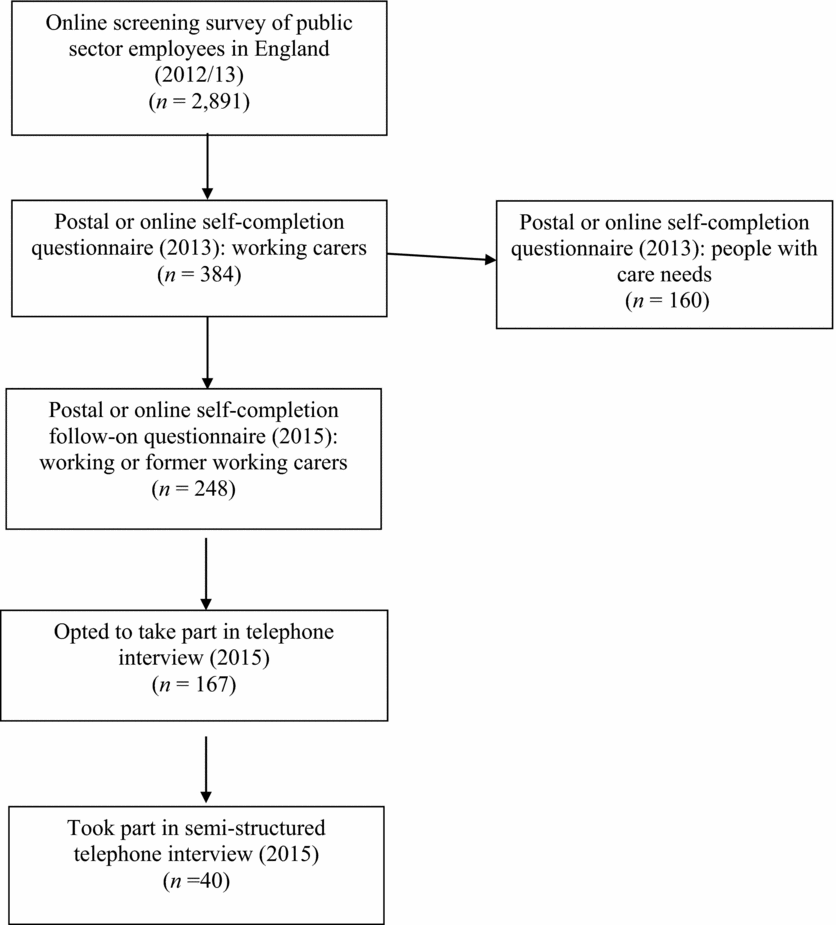
Figure 1 shows the primary data collection methods. Data collection began in 2013 with an online screening survey of public sector employees in England to identify people in employment who provide unpaid care. The majority of respondents worked in local government and the others in national government (Brimblecombe et al., Reference Brimblecombe, Pickard, King and Knapp2016). The question used to identify carers was the 2011 Census question: ‘Do you look after, or give any help or support to family members, friends, neighbours or others because of either long-term physical or mental ill-health/disability; problems related to old age? Do not count anything you do as part of your paid employment’ (ONS, 2011). In the analysis, ‘working carers’ are all carers in the paid labour force. Within our sample, this represents a range of employment types and levels and a range of caring experiences.
Methods for primary data collection

Carers identified in the initial survey who opted into the second stage of the study were sent a self-completion questionnaire for themselves and a questionnaire for the main person they cared for to complete and return directly to us. The main person cared for was defined as the person who the carer spent most time helping and, if they spent an equal amount of time helping two or more people, was the care-recipient who lived with them. Questionnaires included questions on socio-demographic characteristics, disability, employment, provision of care and perceived needs for services. In 2015, respondents who completed the working carers’ questionnaire in 2013 were sent a follow-on self-completion questionnaire, which included similar questions. Questionnaires used validated questions from other surveys, including Phillips and colleagues (Reference Phillips, Bernard and Chittenden2002); the 2011 Census (ONS, 2011); 2009/10 Survey of Carers in Households (HSCIC, 2010a); and the 2009/10 Personal Social Services Survey of Adult Carers in England (HSCIC, 2010b). Additional questions were piloted in 2013 and 2015 with respondents who did not take part in the main study.
Unmet need for services
Variables for unmet need for services were derived from a question asked to carers in 2013 and 2015 about whether or not the person they cared for had the right amount of support or services and, if not, what services they needed from a list: home care, personal assistant, cleaner, daycare, lunch club, meals on wheels, supported employment, special school or college, after-school club or holiday club, community transport services, equipment, short break, residential home and other services not already specified. The unmet need for services variable for care-recipients was derived from similar questions, but about unmet need for services for themselves.
Care-recipients’ perceived unmet need for services was based on data collected from 160 care-recipients who completed a questionnaire in 2013. Data were not collected directly from care-recipients in 2015. Carers’ perceived unmet need for services for the care-recipient is based on data from 189 carers who completed a questionnaire in both 2013 and 2015. We excluded respondents where the care-recipient was living in a care home because the focus is on unmet need for services for those being cared for in the community. We used descriptive statistics to report sample characteristics in 2013 and 2015 and extent of perceived unmet need for services in 2013 and 2015.
Interviews
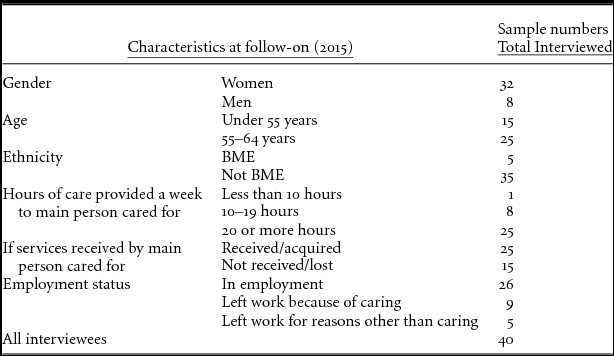
At the end of the follow-on questionnaire, respondents were asked if they would like to take part in a telephone interview, and 40 interviews were subsequently conducted in 2015. Purposive sampling was used to select interviewees (Bryman, Reference Bryman2015). The sample was selected to reflect the age, gender, ethnicity and employment status of those completing the follow-on questionnaire, and included different caring and employment situations (Table 1). Interviews, which lasted for approximately one hour, were semi-structured and designed to collect qualitative information on the experiences of carers since 2013. This included employment, unpaid care provision, service receipt for the care-recipient and reasons for non-receipt. In the main, we did not ask directly about cuts in social care. The interview schedule was piloted with respondents who did not take part in the main study.
Characteristics of interview sample

Note: Not all respondents were still providing unpaid care in 2015; the hours of care provided relate to 34 respondents who were still caring at follow-on.
Qualitative analysis: barriers to receipt of services
Interviews with carers were recorded and transcribed in full, with the permission of participants. Each transcript was read by two researchers and analysis was undertaken both manually and using a qualitative data software package (NVivo, 2012).
The qualitative analysis was driven by the research question: what are the barriers to receiving services? The approach taken to answering this question was thematic analysis (Braun and Clarke, Reference Braun and Clarke2006). The thematic framework was initially informed by the literature and structured around barriers to service receipt suggested in previous research. Broadly these were ‘availability’; ‘characteristics of services’; and ‘attitudes of carer and care-recipient towards services’; that is both extrinsic and intrinsic barriers. We then identified sub-themes within each theme using an inductive, iterative process. As the analysis developed and new sub-themes emerged, the thematic framework and data were revisited, themes and sub-themes reorganised and data recoded accordingly. The analysis also explored interaction between themes and sub-themes and how they related to the broader socio-economic context of cuts to social care.
Results
Survey sample characteristics and extent of unmet need for services
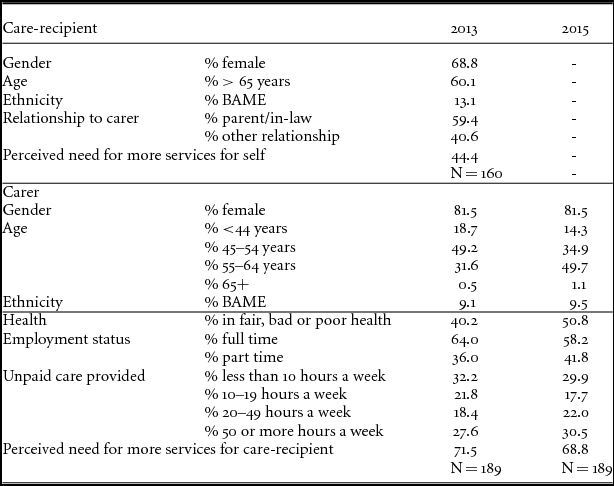
Table 2 shows that the majority of care-recipients who completed a questionnaire in 2013 and who were not living in a care home were female, aged 65 or older and the parent or parent-in-law of the person in our survey who provides unpaid care for them. The majority of carer-recipients and carers were from White (White British, Irish or Other White) backgrounds, with a minority from Black, Asian or Minority Ethnic (BAME) backgrounds. The majority of carers in our sample were female (82 per cent) and over 45 years old. In 2013, 40 per cent had fair, bad or poor health; in 2015, 51 per cent did. In 2013, 64 per cent of carers in our survey were working full time; in 2015, this was 58 per cent. A majority provided care for ten or more hours a week (68 per cent in 2013, 74 per cent in 2015) with around 30 per cent providing care for 50 or more hours a week. More than two-thirds of carers completing questionnaires at both time points said that the person they cared for needed more services: 72 per cent in 2013 and 69 per cent in 2015. In 2013 just under half of care-recipients (44 per cent) perceived unmet need for services for themselves
Sample characteristics of care-recipients and unpaid carers in Personal Social Services Research Unit (PSSRU) Survey 2013 and 2015

Notes: Data were not collected directly from care-recipients in 2015. Full time employment is defined as more than 30 hours a week; part time employment as 30 hours a week or less.
Barriers to receipt of services
Availability
In our qualitative analysis of interviews with carers one key expressed barrier was availability of services for the care-recipient. Some care-recipients received no services; others did not receive enough. Interviewees commented that services such as day centres and meals-on-wheels – key services for working carers – had closed. They also commented on reduced availability of supported employment and community transport. Following assessments, care-recipients were sometimes offered services but not sufficient to cover needs, or services were withdrawn or reduced following assessments. Another reason for non-availability was ineligibility, to which a contributory factor was increased eligibility thresholds. Some of our interviewees mentioned funding cuts as a reason for lack of availability:
Well, the thing is, whether you'd like it or not, the local authorities haven't got it to give any longer have they? With all the budgets and the way things are! #7134 (56-year old woman, left work to care)
And, unfortunately, with the situation the way it is, there are fewer and fewer nursing homes, residential homes, whatever. So you know, somebody – I defy anyone to walk away from their elderly parents and not care for them. #6037 (60-year old woman, left work to care, former carer)
Researcher: You said that the home care was withdrawn and then she'd got a lot worse . . .
Yeah. Oh, I mean that was really, really sad and so frustrating. It should never have happened. . . but you know, that looks as if it's gone forever now, doesn't it?. . . . I feel it is. Because if – you know – they're talking about [council name] have got to find another twenty million in cuts – where's it all going to come from?. . .So, it's not going to get better is it?. . . . I mean they're closing so many homes, it's frightening. . . .And not all elderly people can be cared for in their home, there comes a point where, you know, they need 24/7 and, you know, if you've got nurses or carers or whatever, they do a shift and they go home. But if it's a relative, it is 24/7. #6037 (60-year old woman, left work to care, former carer)
Lack of services had an effect on carers.
They did this assessment. . . and the social worker came and she said ‘well we're offering you eight hours’ and I just, I went hysterical. I went absolutely hysterical. I was screaming. . . . I couldn't believe it, in my wildest nightmares, I couldn't believe they'd go from fifty-five hours to eight. I couldn't, I just. . . it was unbelievable. Even now, I'm gob smacked. I got to the point and I just said ‘I can't do it. I cannot do it. . . . I cannot not sleep, I can't never have a night's sleep’. . . . So [social worker] went away and then a couple of days later . . . by this time I was in the worst depression, and you know, I had been going through a really bad time. Everyone wanted to put me on tablets. . . .and I'm saying ‘no. . .I'm not depressed because I'm depressed, I'm depressed because I can't fix this situation. And giving me tablets isn't going to fix this situation.’ You know, so it was really a horrendous time and she came back a couple of days later and said ‘I've had a meeting with the management and they're going to offer you forty-eight hours’. . . #8577 (59-year old woman, working carer)
It's [lack of transport-related services for disabled son] causing me a lot of stress if I'm honest. I feel really – I feel actually quite ill because the thought of – I mean yeah I can take him and do it, but the thought of in September having to send him on his own [to a new college] I don't even know if I can – I don't even know if I can do that, I – I'll have a go, I'll, you know, I'll try. [Son shouting in background]. He's saying no! #6494 (53-year old woman, working carer, took less well paid job nearer son's college)
Insufficient services also affected care–recipients. In one example, after a telephone assessment, care was completely withdrawn from a woman who was unable to cook or bathe without help and had limited mobility. Her daughter who cared for her only found out when her mother told her that carers were not coming. Her daughter said ‘within a fortnight – that was it – she was in pieces – you know - she was in a terrible state.’ #6037 (cited earlier)
In some cases, carers attempted to meet shortfall in service provision by trying to provide that care themselves. Voluntary organisations or sometimes carers themselves, particularly parent-carers, also tried to plug gaps by setting up and/or running services for the person they care for, such as specialist out-of-school clubs but this had problems of lack of capacity resulting in long waiting lists and limited availability, both barriers to receipt of services. Another way of trying to plug gaps was private funding. However, many carers or care-recipients could not afford to pay, or to pay for enough, or to pay much beyond the short-term. There were also concerns about committing to pay for something that they would not be able to sustain, and concerns raised about unaffordability of services. Again this acted as a barrier to service receipt.
Some of our interviewees had direct experience of lack of service availability, or sufficiency, or eligibility; however, others assumed these things occur because of the climate of cuts generally or from what they observe within the local authority for which many of them work. In these cases, carers did not consider or seek services as they assumed there would not be any or that the care-recipient would not be eligible.
Lack of information affected receipt of services in the following ways. It could be difficult to get information on what services were available, how to access them and eligibility including financial eligibility. Some interviewees commented that they ‘don't know where to look’. Working carers may have less available time and/or opportunity to contact relevant people during working hours. Overworked, and reduced numbers of, social and support workers appeared to be a contributory factor, as did lack of coordination between relevant services. One carer described how the person she cared for used to have an advisor but that now he no longer did: ‘I don't know where you go for the service now, to be honest with you’. Another described how turnover of social workers and lack of coordination between social and educational services meant delays resulting in no current service provision for her disabled daughter. The system could be complicated and difficult to understand. As some carers did not know what services were available, how to access them, or whether they were financially eligible, they did not seek services or assessments, nor were offered them. In this way they could become ‘lost in the system’, as one carer described it.
Characteristics of services
There was a broad theme encompassing characteristics of the services and several sub-themes. One sub-theme was the quality of the formal care provided. Formal carers were sometimes felt to have insufficient levels of sensitivity or skills (particularly for people with dementia). There were examples where they were unhelpful at best, neglectful and harmful at worst. This resulted in unmet need.
C. And I used to say, please sit at the side of my Mum. At the time she used to love doing word searches in books, and I used to say, sit and do her word search with her and play a game with the word search, because it was stimulating her and it was sort of close contact, and it's more fun if you're sat next to someone and motivating that way. And they never did. They used to come in, sit on the far end of the room, they'd spend five, ten minutes filling the timesheets in and ringing up to tell whoever they were that they were at this house, and that was it. And at one point I caught them on more than one occasion. . . . chatting to their friends on the phone on the other sofa. #3641 (57-year old woman, working carer, cancelled home care, considering early retirement)
C. We agreed a time for him to come in the morning [so carer could go to work] [but]. . . they were coming later and later and later. . . so obviously my dad was already trying to get up, trying to wander, he was wandering around the house. . . there were days when they'd come, they'd sort of ask him if he wanted to get ready. . . to get up or get washed or dressed, he'd say no so of course then they'd just leave him. . . then he was left for. . . four or five hours ‘til lunchtime, so he'd be wandering around the house in just his bed clothes, he wouldn't have had breakfast or anything like that. . . .The foods that he was being given, he was given a cold mashed potato sandwich one day. . . and if he was given fruit or something like that the fruit would just be left in front of him so he'd just have a banana put in front of him or an orange. Well my dad with dementia he didn't know how to peel an orange or peel a banana or anything like that, so every day I used to come home at lunchtime and he had – he literally hadn't eaten. #3397 (39-year old man, working carer, found alternative home care)
There were also sub-themes around quality of the service or agency: some carers commented on unreliability, poor organisation, visits being too short, a lack of continuity of care or carers not being paid enough.
C: It's not necessarily the carers themselves – their fault, but they've probably got, you know, ten people to get up in the morning or whatever and. . . they've been allocated three quarters of an hour to get that person. . . up, washed, dressed, fed, and – and everything and, you know, three quarters of an hour is not – it's not sufficient. #3397 (cited earlier)
This caused problems for working carers.
C: They were put in place to try and take some of the burden from my shoulders of going so regular, to make sure she ate, and she was clean etc., and I spent more time worrying about what they were doing or not doing for my Mum, and going more because I was checking whether they were doing what they were saying they were doing, that it became ridiculous really so we decided to forget the service and I'd just pick up where I left off before and carry on. #3641 (cited earlier)
Some of these service characteristics meant that, despite services being received, the needs of the care-recipient or the carer were not adequately being met, as illustrated above. In other cases, they acted as barriers to services being received at all. Past experiences of poor quality services could result in carers or care-recipients not seeking or ceasing receipt of services, although in other cases alternative service providers were sought. In some cases, indirect experience, what people heard or read, resulted in fears and concerns about quality of care and thus as barriers to seeking care. Poor quality care was one of the reasons given by some carers or care-recipients for not wanting services.
The process of obtaining services and support could act as another barrier. It could be unpleasant, traumatic, stressful and off-putting. The process was sometimes felt to have become harder with the cuts.
C. I don't think they realise how much pressure they put on people, and how much the cuts – and I know – I understand that the cuts have had to happen in a lot of areas – but I think the cuts on disabled people are far too big, far too fast, for people who are genuinely disabled. They put too much pressure on people that are disabled and they can feel belittled for being disabled. . . the pressure on him [disabled partner] because he has a disability, it doesn't help. For somebody who's lost their self-esteem anyway. . . and you've got to keep reliving something that's happened to you. . . the medicals and stuff. Cos if it hadn't been such – I don't know – like torment for him to keep doing it like, emotionally hard for him, I think he might have even gone on to do something maybe two or three years ago. #4646 (34-year old woman, working carer, took less well paid job nearer home).
The process could also be cumbersome, bureaucratic and time-consuming. In one example the carer ‘fought’ for two years to get a service put in place, then another year for a further service. In another example, the care package took so long to be put in place that the carer had to take two months off work as the person he cared for had no formal care during that time.
A further expressed service characteristic barrier was that for some there were no services available that were suitable or appropriate to needs. There were three main ways in which this could be the case: services not being age-appropriate, particularly for young adults; not being need-appropriate, especially for people with dementia but also for young adults with learning disabilities; not being culturally appropriate.
Another service characteristic barrier expressed was that services were not available or provided at times that fitted with, or covered, carers working hours. Thus some interviewees said that they could not work the hours they needed or wanted, and/or the care-recipient did not have all their care needs met. Lack of community transport could be a further barrier as without it, carers would need to disturb their working day to transport the care-recipient to and from services such as lunch club or daycare. Services were sometimes not provided at convenient or suitable times for the care-recipient, for example, not at usual or regular mealtimes or bedtimes, so did not adequately meet care needs such as help with eating or getting into bed.
Attitudes of carer and care-recipient towards services
Service characteristics were given as one reason for not wanting services: some carers did not want services because they were perceived as unsuitable, not appropriate to needs or not available at convenient times. There were concerns about the services that might be provided. Some carers had not thought about or considered having services. For some this was because of lack of information. In other cases, the carer had always provided care for the person cared for, and so had not considered other forms of provision of care.
Another sub-theme was that some carers felt they could provide care themselves, that they ‘manage’: ‘I don't think there's anything else we really could do [with] because I do everything really’. Some ‘managed’ with the help of other family members, such as siblings, also providing unpaid care. Some carers say that they managed even though ‘it was a struggle at times’. For some who said they were managing, other information suggests they were not, or only with difficulty, for example they were caring for long hours and/or there were impacts on their work, health and wellbeing.
Carers sometimes expressed conflict about receipt of services, although on other occasions they were very clear that they did not want them.
I think it would lessen the guilt but then maybe it might increase it because I have this – personally I've got this desire to want to do things, because I can. So, maybe it might – I don't know – I'm not sure – I'm not sure how I'd feel about that, because on the one hand it would – I'd think oh, right it's okay, cos somebody's with me mum, so that would release me. But then at the same time, somebody else would be doing that I feel I should be doing. So I'm not sure how that would – how I would feel about that. #2372 (49-year old woman, part-time working carer)
There was sometimes an interaction between the carer saying that they did not want services and the care-recipient not wanting them. For example, one reason some carers gave for not wanting services was because the care-recipient did not want anyone other than them providing care. Sometimes the carer agreed with this: that is, they wanted to be the only person providing care. Sometimes they did not, or did not exclusively.
There were other sub-themes, under the overall theme of care-recipient attitudes to services, and multiple and intersecting reasons given by some carers for care-recipients not wanting services. Firstly, characteristics of services, in particular quality or perceived quality of services. Services may not be wanted partly because of negative past experience or concerns about unsuitable services, in particular residential care. The process could be difficult, resulting in some care-recipients not wanting to pursue trying to get services.
Researcher: Why do you think he's not getting the services he needs?
Partly because he's – he went to so many appointments. . . and I think that got too much for him. So he got to the point where. . . he'd had enough. So partly because of that and partly because whenever we've tried to get anything he just never seems to meet the criteria. #4646 (cited earlier)
Another reason given was that some care-recipients did not want ‘strangers’ coming into the house, which several described as ‘intrusion’. In some cases this was related to fears about the quality of paid care. There was a cluster of sub-themes relating to privacy, independence, embarrassment, dignity and ‘stigma’ associated with social service care. Associated with this were themes of pride, and reluctance to admit needing help or accepting help. Extrinsic barriers, related to characteristics of the services, in some cases underlay or exacerbated this. However, these barriers also had intrinsic elements.
They don't like to admit that they can't do things. #6037 (cited earlier)
Sometimes elderly people feel ashamed having to admit to a third party that I am not being looked after by my own children. #8283 (50-year old man, working carer)
Researcher: And have you considered asking social services to assess your mother's needs?
No I haven't, for this reason: she's mortified at the thought of having help from anybody. #8829 (55-year old woman, working carer, reduced working hours to care)
Although, similarly to carers, some care recipients expressed not needing help, other information suggested differently:
C: She turned all this down, oh, two years ago. . . . She said ‘no, we'll manage’. Very proud people, they didn't want it. Mum said ‘no, I'm alright’. But she wasn't alright. #7134 (cited earlier).
Discussion
Unmet need for services
Unmet need for services was high in our study in both 2013 and 2015 and the lived experience of unmet need was starkly illustrated in the interviews. Just under half of care-recipients perceived unmet need for services for themselves in 2013. In both 2013 and 2015, two-thirds of carers felt that the care-recipient had some unmet need for services, although the two figures are not directly comparable. It is not surprising that unmet need remained high in our study, given that the study coincided with the particularly deep cuts to social care seen since 2009/10, during the ongoing period of fiscal austerity policies introduced by the Coalition Government in 2010, and accompanied by an increase in need for care (Fernandez et al., Reference Fernandez, Snell and Wistow2013; Burchardt et al. Reference Burchardt, Obolenskaya and Vizard2015; ADASS, 2016). As other research has also suggested (e.g. Burchardt et al. Reference Burchardt, Obolenskaya, Vizard, Lupton, Burchardt, Hills, Stewart and Vizard2016), shortfalls caused by cuts to publicly funded services may be met, in part, by self-funding and/or increased unpaid care, a point taken up again below. Despite this, unmet need was still high in our study and, had our study focused on unmet need for publicly-funded services, might have been even higher in 2015 than it was in 2013.
Our findings on the extent of unmet need are consistent with other recent research which identifies unmet need for services (Forder and Fernández, Reference Forder and Fernández2010; Vlachantoni et al., Reference Vlachantoni, Shaw, Willis, Evandrou, Falkingham and Luff2011; Burchardt et al., Reference Burchardt, Obolenskaya and Vizard2015; ADASS, 2016), including for working carers (Milne et al., Reference Milne, Brigden, Palmer and Konta2013; Brimblecombe et al., Reference Brimblecombe, Pickard, King and Knapp2016). Unmet need for services has implications for unpaid carers, and particular implications for working-age carers, as there may be resultant increased reliance on unpaid care. Unpaid care, particularly at higher intensity, is associated with higher risks of leaving employment (King and Pickard, Reference King and Pickard2013) and lack of services has consequences for higher-intensity carers’ employment (Pickard et al., Reference Pickard, King, Brimblecombe and Knapp2015). Disabled or older people whose needs cannot be met by unpaid carers, or can only partly be met, ‘must lead more restricted lives’ (Burchardt et al., Reference Burchardt, Obolenskaya and Vizard2015:53).
Barriers
The main barriers to receipt of services identified in our study were availability, characteristics of services and attitudes of carer and care-recipient to receiving services. These barriers have particular relevance for carers' ability to manage care and employment.
If services are not available, are unaffordable or the care-recipient is not eligible, care needs will have to be met in other ways, or not met at all. If needs are met, in whole or in part by unpaid carers, and that involves care for ten or more hours a week, then carers may have difficulty balancing employment and care and, as previously noted, may leave employment (King and Pickard, Reference King and Pickard2013). Carers may also make other accommodations to their working lives, for example, by taking less well paid work to be nearer the person they care for or for more flexible working conditions, contemplating early retirement or reducing hours of work (Arksey et al., Reference Arksey, Kemp, Glendinning and Tozer2005; Colombo et al., Reference Colombo, Llena-Nozal, Mercier and Tjadens2011).
Issues related to the skills of formal carers or the system of care, for example, unreliability, bad organisation, too-short visits, or lack of continuity of care, also impact on working carers. Carers need good quality, suitable, convenient, appropriate, reliable and trustworthy services to be able to balance work and care (Arksey et al., Reference Arksey, Kemp, Glendinning and Tozer2005; Yeandle et al., Reference Yeandle, Bennett, Buckner, Fry and Price2007; Arksey and Glendinning, Reference Arksey and Glendinning2008). If services are not suitable, carers and care-recipients may not seek or may stop services and again make accommodations to their working lives to provide care. If services are not available at suitable times carers cannot easily combine work and care. Problems with received services can have other impacts on working lives, such as disruption at work, need to care-manage whilst at work, absenteeism, or stress and anxiety. Our previous qualitative analysis showed that, when care-recipients received appropriate services, this enabled carers to work by, for example, providing care during working hours and/or reducing anxiety about the care-recipient while they were at work (Pickard et al., submitted).
In a broader context, cuts to social care services have reduced availability and eligibility thresholds (Fernandez et al., Reference Fernandez, Snell and Wistow2013; Burchardt et al., Reference Burchardt, Obolenskaya and Vizard2015; Franklin, Reference Franklin2015; ADASS, 2016; Glendinning, Reference Glendinning2016). There have been corresponding falls in income for charities providing social services: longitudinal analysis of charitable organisations in England and Wales found sizeable cumulative real income decline between 2008 and 2014 (Clifford, Reference Clifford2016) and, in our analysis, lack of availability through insufficient places, long waiting lists and piecemeal services by the voluntary sector were barriers for some to receipt of services. Barriers around continuity of care, low skills and short visits are examples of broader problems with pay and conditions and high turnover in the formal care sector (e.g. Colombo et al., Reference Colombo, Llena-Nozal, Mercier and Tjadens2011; SCIE, 2013).
Our study neither aimed to, nor is able to, say definitively what the impact of cuts to services had been on non-receipt of services and barriers to services. Rather it sought to present a picture of barriers faced by working carers and the people they care for during a time of decreased and decreasing service provision. However, it seems likely that, in a period when there was a 31 per cent (£4.6 billion) cut over five years in adult social care budgets in real terms (ADASS, 2016) and a 26 per cent reduction in the number of recipients of care between 2005/06 and 2012/13 (Fernandez et al., Reference Fernandez, Snell and Wistow2013), cuts at least played a part and many carers interviewed were of that view. Despite, in most cases, not being asked directly about the effects of cuts, what also emerged from the interviews is how the context of cuts to social care interacted with expressed barriers, and how the cuts impacted on carers in multiple ways. For carers in our study, cuts had often been a large part of the context of their experience of caring over the past two years. Many carers mentioned cuts spontaneously and the ways in which they mentioned them illustrated how they intersected with or underlay other barriers.
There was interaction in some cases between attitudinal barriers to receipt of services (for example, reluctance, fear, anxiety) and characteristics of services, in particular concerns about quality, appropriateness or trustworthiness. The process of trying to get services was a further barrier associated with reluctance to access services. Another was that carers feel that they can ‘manage’, sometimes despite other quantitative and qualitative evidence to the contrary. This may be related to expectations, often within the family, about who provides care or to concerns about the formal care alternatives. Additionally, it may be related to reluctance by carers to admit to needing or seeking help, something found in other studies (Brodaty et al., Reference Brodaty, Thomson, Thompson and Fine2005; Greenwood et al., Reference Glendinning2015). It may also be that some carers were actually managing, even in difficult circumstances, and individual and circumstantial factors may play a part. Glendinning and colleagues (Reference Glendinning, Tjadens, Arksey, Morée, Moran and Nies2009), commenting on apparent inconsistencies between objective ‘burden’ and experienced ‘burden’, suggested that these may be associated with the quality of relationship with the person receiving care, felt motivations and rewards of caring, and competing commitments such as paid work.
Some care-recipients did not want ‘strangers’ coming into the house, sometimes related to concerns about the quality of paid care. Arksey and colleagues (Reference Arksey, Kemp, Glendinning and Tozer2005) found similarly that care-recipients could be unwilling to accept assistance from paid carers working for independent sector providers, sometimes seen as ‘strangers’ or ‘intruders’. Relatedly, we found that privacy was a concern for some care-recipients, as was pride, independence and reluctance to admit dependency or accept help. This has been found in previous research, where again it was often linked to characteristics of services (Yeandle et al., Reference Yeandle, Bennett, Buckner, Fry and Price2007). In our study and our previous research, perceived unmet need for services was lower for care-recipients than carers (Brimblecombe et al., Reference Brimblecombe, Pickard, King and Knapp2016). Part of the reason may be reluctance to admit needing help: the question asks care-recipients about services for themselves and asks carers about services for care-recipients, that is, about help for others. Another part of the reason may be greater reluctance by care-recipients to receive formal services, for reasons outlined above.
The focus of the qualitative analysis in this paper was on barriers to receipt of services. However, many carers in our longitudinal study overcame barriers or did not experience them and the people they cared for received services (Pickard et al., submitted). The paper shows ways in which some carers overcame barriers, obtained or retained services and stayed in work. This included challenging cuts to services, finding different service providers, or making changes to their working lives to accommodate limitations in services. Their determination to remain in employment is consistent with previous research, which found that ‘carers made great efforts to stay in work as long as possible’ (Arksey et al., Reference Arksey, Kemp, Glendinning and Tozer2005: 150).
Policy implications
Barriers related to characteristics of services are relevant to policy and practice on personalisation of care, brought in by the UK government in 2007 (HMG, 2007) and extended in the recent Care Act to the requirement that all eligible adult social care users should have a personal budget (PB) (Care Act, 2014). This policy has the potential to remove or reduce some barriers to service use through its aim of improving choice and control (HMG, 2007). Findings on barriers associated with personalisation reflect our overall findings. For some people, PBs address some barriers by, for example, improving flexibility (Stevens et al., Reference Stevens, Glendinning, Jacobs, Moran, Challis, Manthorpe, Fernandez, Jones, Knapp, Netten and Wilberforce2011; NAO, 2016). For others, lack of availability of suitable services or lack of information act as barriers to their use (Newbronner et al., Reference Newbronner, Chamberlain, Bosanquet, Bartlett, Sass and Glendinning2011; Stevens et al., Reference Stevens, Glendinning, Jacobs, Moran, Challis, Manthorpe, Fernandez, Jones, Knapp, Netten and Wilberforce2011). Additionally, concerns have been raised that PBs can increase the risk of less well-regulated and potentially poorer quality services being received (Stevens et al., Reference Stevens, Glendinning, Jacobs, Moran, Challis, Manthorpe, Fernandez, Jones, Knapp, Netten and Wilberforce2011). Funding cuts have impacted on personalisation both through amount allocated and through reduced flexibility and choice resulting from, for example, the financial need by local authorities to keep block contracts for homecare (NAO, 2016). Indeed, there is ongoing debate about the extent to which personalisation will bring about greater ‘individualism, self-determination, choices and rights’ for disabled people, whether it is part of a neo-liberal austerity agenda or indeed both (see e.g. Stevens et al., Reference Stevens, Glendinning, Jacobs, Moran, Challis, Manthorpe, Fernandez, Jones, Knapp, Netten and Wilberforce2011; Power, Reference Power2014). As the recent NAO report and others have said, achieving the aims of personalisation needs adequate funding and support (NAO, 2016).
Findings on barriers associated with quality, appropriateness, suitability and reliability of services also have implications for service implementation, and the training and working conditions of formal careworkers (Colombo et al., Reference Colombo, Llena-Nozal, Mercier and Tjadens2011; SCIE, 2013). Recognising that careworkers’ working conditions can have a direct impact on service quality and cost, and on careworkers themselves, the Care Quality Commission (CQC) provided guidance on their recruitment and selection, staffing levels, training and development (CQC, 2010). Improving the quality of services may also reduce reluctance to use them for both carers and care-recipients.
If an aim of legislation, policy and practice is to support carers' employment then, given the importance of services to working carers, services need to be more widely available. This could also help meet other needs of carers and of service users. Our study focused on the role of social care services in supporting working carers’ employment but, for some carers, a multi-pronged approach may be needed, including flexible work conditions (see e.g. Colombo et al., Reference Colombo, Llena-Nozal, Mercier and Tjadens2011; Bouget et al., Reference Bouget, Spasova and Vanhercke2016).
Acknowledgements
This research was funded by the National Institute for Health Research (NIHR) School for Social Care Research (SSCR). The views expressed are those of the authors and not necessarily those of the funder or the Department of Health, NIHR or NHS. Responsibility for any errors lies with the authors. The authors wish to also thank the carers and disabled and older people who kindly gave their time to take part in this research.