


INTRODUCTION
This paper assesses the use, disposal and recovery in an urban environment of three well-represented types of Roman-period long-handled implements (sixty-eight ligulae, eighty-four spoon-probes and fifteen spatula-probes), along with thirty incomplete fragments of these instruments. Such objects are sometimes found in medical kits, but their more frequent recovery from occupation sites points to their being multi-purpose household or craft items. An opportunity to examine and define the possible functions of the instruments in Colchester Museums’ archaeological collection, uniting those from late twentieth- and twenty-first-century excavations in the town with those from earlier interventions and casual finds, was provided by a programme of improving the documentation of the collection and rationalising its storage. Other instruments in the collection more readily identifiable as the tools of medical or surgical practitioners, such as scalpels, forceps, hooks and dipyrenes, form part of a wider assessment of the Museums’ accessions relating to healthcare in the town.Footnote 1
A considerable proportion of the Colchester instruments come from the western suburb, where Temple 10, lying alongside the Colchester–London road as it issues from the Balkerne Gate, has been interpreted as a centre for both healing and ritual deposition.Footnote 2 The area west and north of the temple was used as a dumping ground for the town’s rubbish, blurring the distinction between urban debris and deliberately deposited temple votives.Footnote 3 Colchester’s nineteenth-century workhouse (the Union) lay in the same area and the inmates’ earth-moving activities, such as gardening or pit-digging, brought numerous Roman objects to light, some of which were acquired by the newly-established civic museum, as recorded in the Colchester Museum Reports (CMR). The conversion of the Union into St Mary’s Hospital in the 1930s led to further ground disturbance and artefact recovery.Footnote 4 In the 1970s and early 2000s archaeological excavations in advance of redevelopment provided a further source of material from the area.Footnote 5 How far all these activities have affected the artefact deposition and recovery rate compared to elsewhere in the town is assessed below.
MATERIAL AND CONDITION
Illustrated objects are listed in appendix 1 here and the full catalogue is in appendix 2 (see supplementary material). Catalogue numbers are in bold and prefixed by L for ligula, SP for spoon-probe, SPT for spatula-probe and P for probe fragments. Apart from a few bone items (L69–L71) and one of base silver (SP40), all are of copper-alloy. Three have silver inlay, in at least one case probably combined with contrasting black niello (SP1–SP2, SP23). The general condition and conservation of the objects is summarised in the introduction to appendix 2. Most are damaged in some way, while the blunting of some terminals more probably represents wear. Analysis of the metal forms part of an ongoing programme of research by the Roman and Early Medieval Alloys Defined (REMADE) team of the University of Reading. Items with complex mouldings, such as the spoon-probes, were generally cast, while the simpler rod-like ligulae were wrought.
FORM
The general forms taken by all three instruments are given here. The terminology associated with each, both in Britain and on the continent, is outlined in appendix 3 (supplementary material). Many of the items, especially the spoon-probes, match the variants established by Emilie Riha for these artefact types from Augst and Kaiseraugst (Augusta Raurica), Switzerland.Footnote 6 Summaries of these typologies are given in appendix 4 (supplementary material).
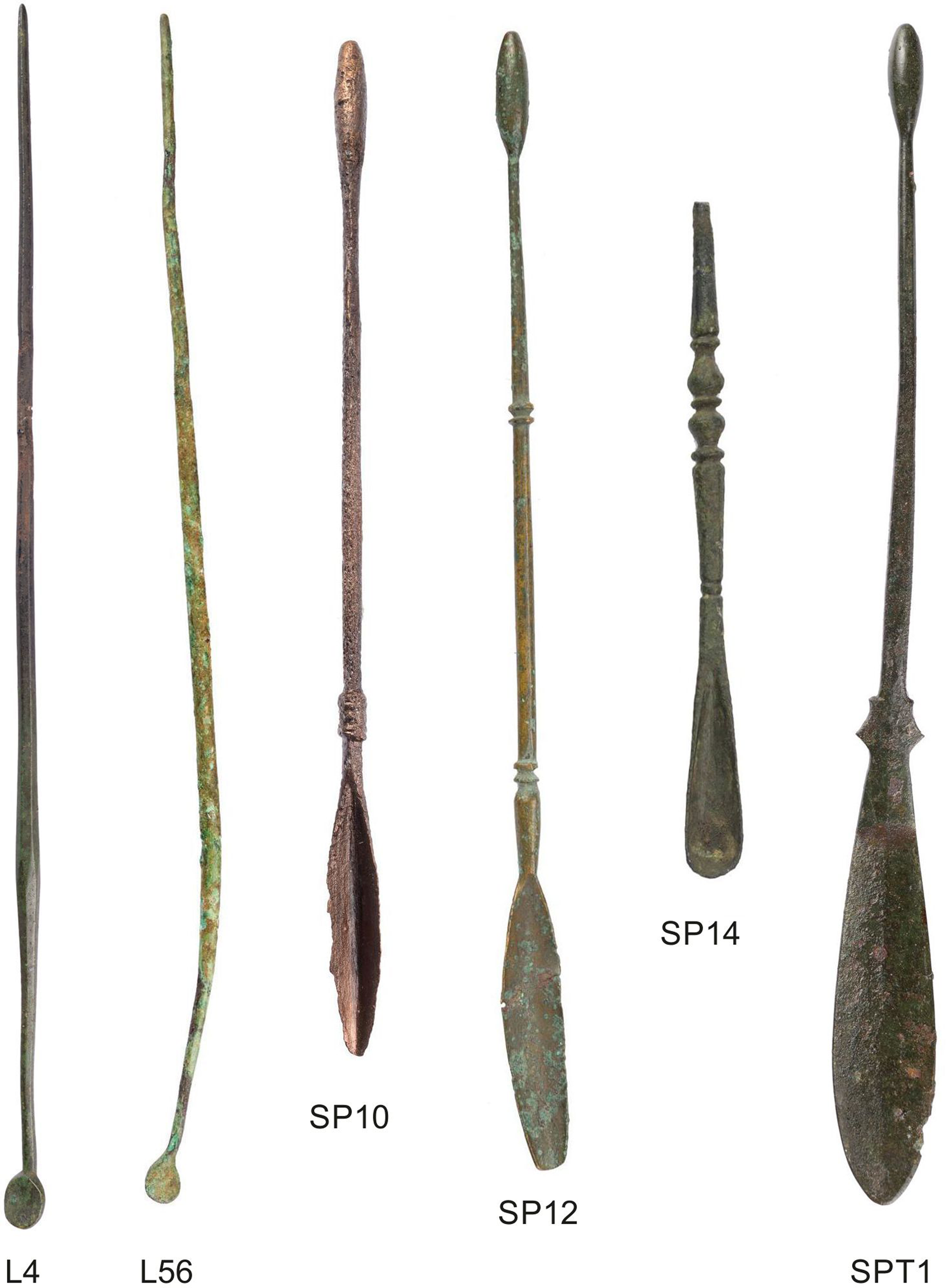
The ligula usually has a small flat disc (scoop) set at an angle at one end of a long thin shaft, but there are a few with the disc continuing the line of the shaft (fig 1, L4 and L56). Of the sixty-eight in the collection, the longest measures slightly over 180mm (the very tip of the shaft is missing), the shortest complete example is 85.4mm. The scoops vary in diameter from 4–7.5mm. Any ligula with a cupped scoop has been defined as a medical ear-probe.Footnote 7 That there are only four ear-probes compared to sixty-eight metal ligulae in the Museum’s collection arguably supports this distinction.Footnote 8
L4, Variant E ligula with an angled scoop; L56, Variant E ligula with a straight scoop; SP10, SP12 and SP14, Variant E spoon-probes; SPT1, Variant A spatula-probe. Scale 1:1. Photos: D Atfield; © Colchester Museums.

Spoon-probes are double-ended implements with an olivary probe at one end, a long concave or V-section spoon of varying form at the other and at least one moulded grip (fig 1, SP10, SP12 and SP14). Ralph Jackson preferred the term scoop probe,Footnote 9 but here we use spoon-probe to match the more familiar usage. There are eighty-four in the collection, the longest complete example measuring 174mm, the shortest (unbent) 131.5mm. Unless it has been reworked following breakage, at least one (SP18), appears never to have had an olivary probe at the opposite end but, following the precedent set by Riha,Footnote 10 it is still catalogued with the spoon-probes, as is the more ambiguous SP31.
Spatula-probes have a tongue- or leaf-shaped spatula at one end and an olivary probe at the other (fig 1, SPT1). None of those from Colchester has a grip on the shaft. There are only eight certain and up to seven probable examples in the collection. Three complete examples are between 143.5mm and 154mm long. Riha suggests that Variants A, D, E and G had a surgical use.Footnote 11 Certainly the comparative rarity of spatula-probes in general at Colchester may be an indication of a more specialised use and/or a shorter period of manufacture than for ligulae and spoon-probes.
Fragments
Given the rarity of medical ligula-probes,Footnote 12 incomplete copper-alloy ligulae in the collection are assumed to have been single-ended instruments. While this is also probably the case for the few catalogued bone ligulae, there is a double-ended example from Ham Hill, Somerset.Footnote 13
Very few of the spoon-probes are complete, but comparison with this and other assemblages shows that spoons with a broken shaft can, with a high degree of confidence, be assumed to have had a probe on the missing terminal, especially if the shaft is long and has one or more grips. As no spatula-probe with a grip has been found in the town, the probes with a grip but no spoon are also assumed to be from spoon-probes. Thirty probes with only a short part of a plain shaft remaining are probably also from spoon-probes, but there are examples from elsewhere of plain probe shafts terminating in a series of mouldings.Footnote 14
Not included here are particularly narrow olivary probes, about 2.5–3.5mm in diameter compared to the more usual 4.5–6mm. These are dipyrenes, medical instruments used where a particularly delicate probe or cautery was necessary.Footnote 15 There are three from Colchester, one of which is pierced.Footnote 16
TYPOLOGY AND DATE
That many of the Colchester and Augst/Kaiseraugst items are similar, especially the spoon-probes, suggests that they came from the same continental workshop or manufacturing hub (table 1). Although few of the Colchester instruments are from secure archaeological contexts pre-dating the destruction of the town by Boudica in ad 60/61, others closely match forms found at Augst/Kaiseraugst in first-century ad contexts earlier than or contemporary with the establishment of Colchester’s legionary fortress in about ad 44 and the early colony around ad 49.Footnote 17 They imply that at least some of those from post-Boudican contexts here may be residual, particularly any from redeposited destruction debris.
Numbers of Colchester metal ligulae, spoon-probes and spatula-probes by the variants from Augst/Kaiseraugst in Riha Reference Riha1986.

Table 1 Long description
A table comparing the numbers of different types of metal ligulae, spoon-probes, and spatula-probes. The table has 4 rows and 10 columns. The columns are labeled A, B, C, D, E, F, G, H, J, Uncertain, Unattributed fragments, and Totals. The rows are labeled Ligulae, Spoon-probes, Spatula-probes, and Total. Row 1: Ligulae: A, -, -, -, I, 53, n/a, n/a, n/a, 3, 11, 68. Row 2: Spoon-probes: A, 3, 3, 2, 3, 42, 1, -, 8, 1, 21, 84. Row 3: Spatula-probes: A, 5, 1, -, 1, -, -, -, -, 4, 3, 15. Row 4: Total: A, 8, 4, 2, 4, 95, 1, -, 8, 8, 35, 167.
Ligulae
Most of the Colchester ligulae fall within Riha’s plain Variant E, which first appears at Augst in the early first century ad.Footnote 18 The emphasis here on plain shafts is not always matched on other sites. For example, of sixteen ligulae from the area of the fort at Piercebridge, County Durham, five had some form of decoration on the shaft, usually at the neck, and six were pierced, three of them at a point where the shaft had been flattened for that purpose.Footnote 19 Others from the river Tees at Piercebridge were treated in the same way, which may be related to ritual practice.Footnote 20
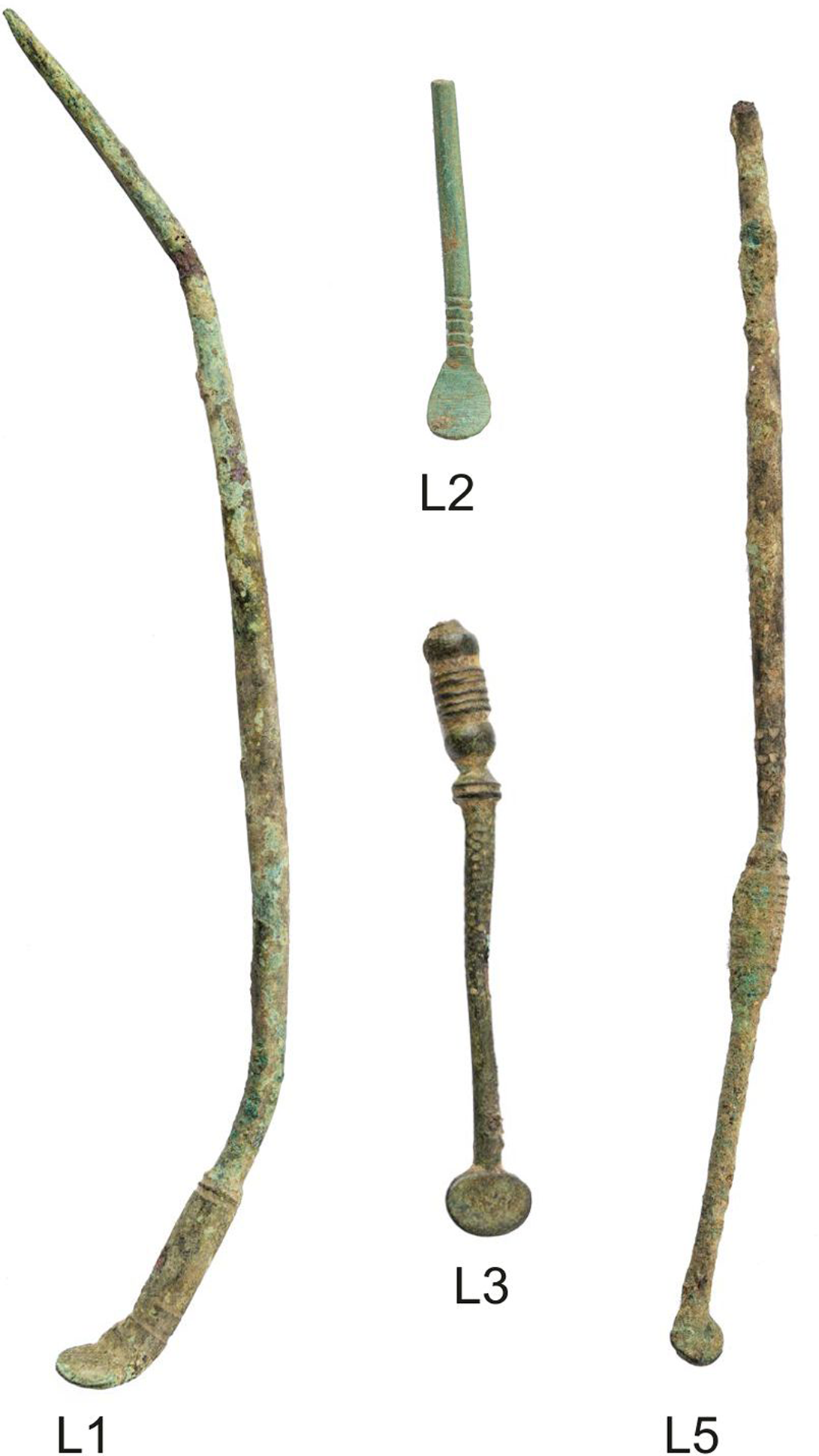
Only four Colchester ligulae have detailing on the shaft. One has a rectangular-section decorated zone immediately above the scoop, which places it within Variant A (fig 2, L1), although its polygonal section shaft is the distinguishing feature of Variant C.Footnote 21 A fragment with a spiral groove above the scoop is matched at Woodeaton, Oxfordshire (fig 2, L2).Footnote 22 Another, with a complex grip above round punch marks, is of Variant D, which is found at Augst in first-century ad contexts and because the grip is considered by Riha to be unequivocally medical (fig 2, L3).Footnote 23 No good parallel has been found for one with a particularly thick grip (fig 2, L5).
L1, Variant A/C ligula; L2, Variant A? ligula; L3, Variant D ligula; L5, ligula of unmatched form. Scale 1:1. Photos: D Atfield; © Colchester Museums.

Spoon-probes
There are eighty-four catalogued spoon-probes, one of which is base silver (SP40). Most belong to Riha’s Variant E, with a grip at the neck. Examples of the same variant are rarely of the same length, and their grips can take different forms.Footnote 24 A sufficiently large data-set may allow sub-types to be identified. Two Variant E spoon-probes from North Hill date to the Claudian period, and at least two from the St Mary’s Hospital site are from a Claudian–Neronian context.Footnote 25 These four may have a military connection, either having been brought to Britain by the army, early veteran colonists or Gallo-Roman traders exploiting the new market opened up at the conquest.
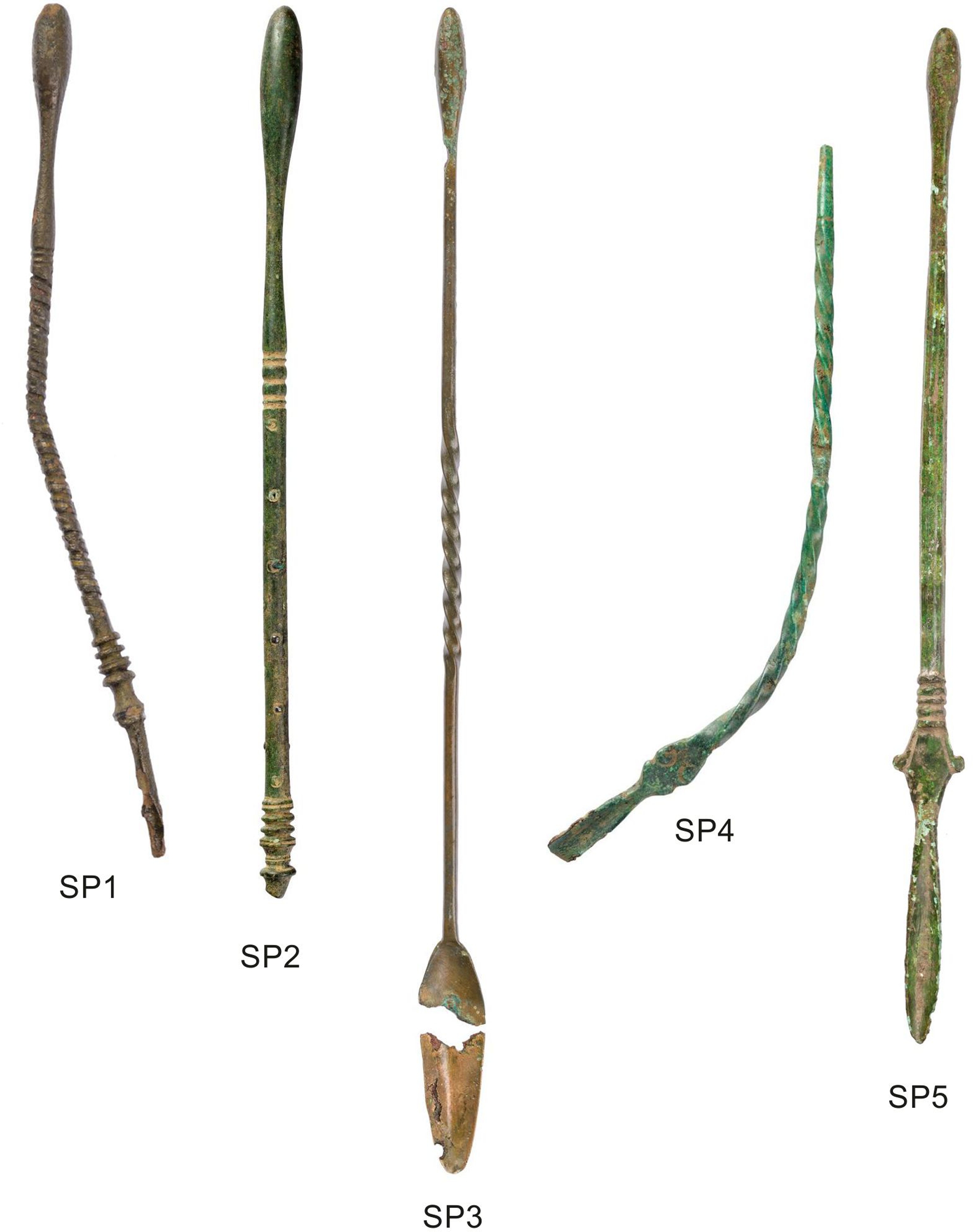
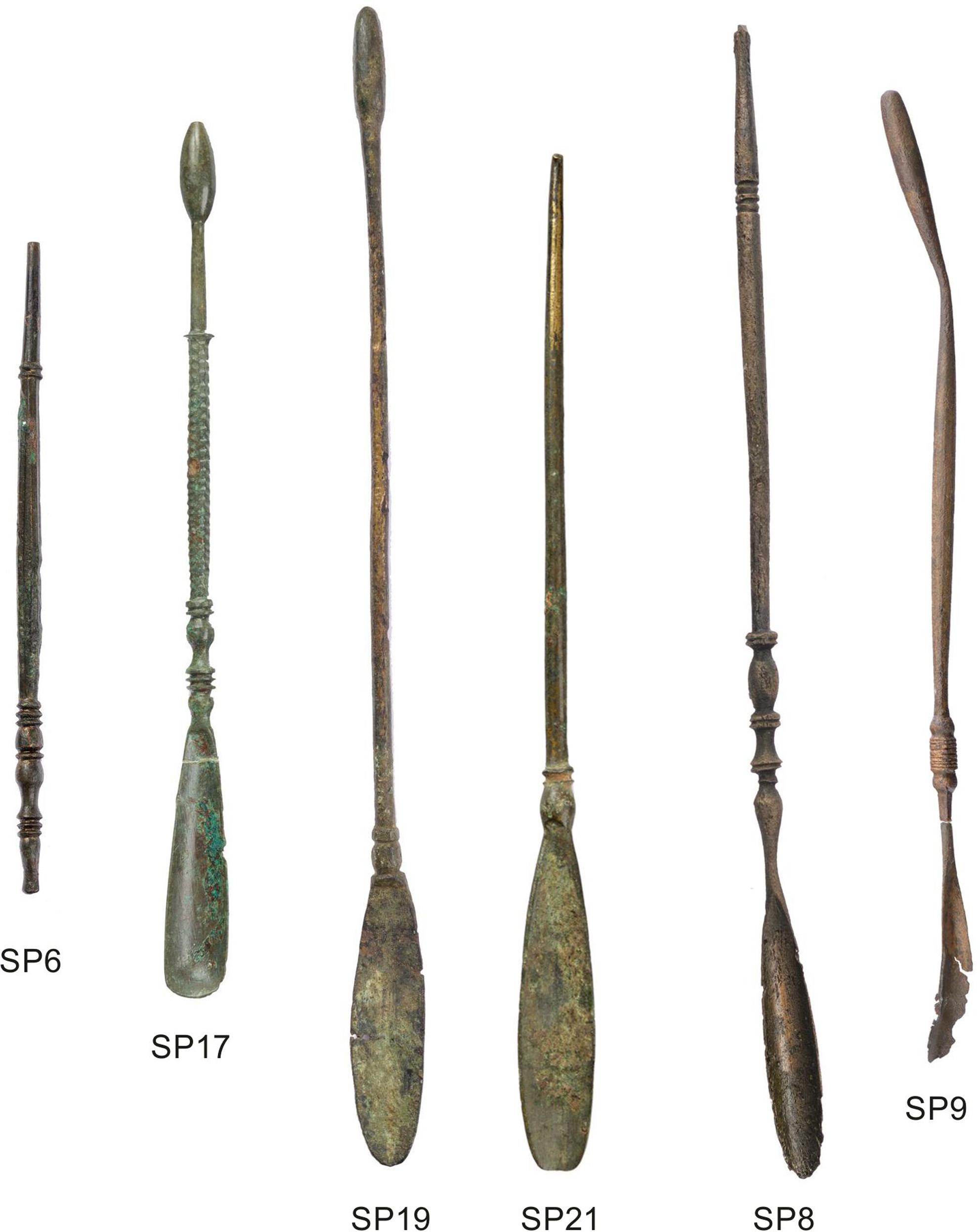
A few spoon-probes belong to other variants. One Variant A was inlaid with silver wire and a contrasting material, probably niello (fig 3, SP1), another has just silver wire (SP23), and a third has tiny ring-and-dot motifs on the shaft, some of which retain silver inserts (fig 3, SP2). A reliable Claudian date is provided for the latter by a similar example from Augst found with Tiberian–Claudian pottery and a Republican coin.Footnote 26 Three spoon-probes belong to Augst Variant B with twisted shaft (fig 3, SP3 and SP4).Footnote 27 One Augst Variant B has two lugs at the neck above a flat area marked by two contiguous incised circles, and this is almost replicated on SP4, which has two non-touching partial circles and appears to lack the lugs, although they may have been lost to decay. Spoon-probe SP 5 (fig 3) belongs to Augst Variant C.Footnote 28 It has a fluted shaft separated by mouldings from a long flat neck with short side volutes, giving the impression that the spoon rises from a calyx. It is also matched by a spoon-probe from Silchester and by one in the British Museum’s Blacas Collection that is almost certainly of continental origin.Footnote 29 Four Variant D spoon-probes (fig 4, SP6) also have a fluted shaft, and all have a grip above both the spoon and the probe, which is not always the case with the Augst examples.Footnote 30 A single item tentatively assigned to Variant F is from a second-century context. It has a long central panel of tiny punches that allies it to two examples from Augst, although its neck is comparatively short (fig 4, SP17).Footnote 31
SP1–SP2, Variant A spoon-probes; SP3–SP4, Variant B spoon-probes; SP5, Variant B spoon-probe. Scale 1:1. Photos: D Atfield; © Colchester Museums.

SP6, Variant D spoon-probe; SP17, Variant F spoon-probe; SP19 and SP21, Variant H spoon-probes; SP8–SP9, spoon-probes found in the same pit. Scale 1:1. Photos: D Atfield; © Colchester Museums.

Variant H has a wide and sometimes long bowl with a V-shaped profile (fig 4, SP19 and SP21).Footnote 32 There are at least five examples from Colchester, and probably three more. Most have a distinctive bead or pear-shaped moulding and one or more narrow reels immediately above the spoon. The earliest stratified example from Augst was in a later first- to early second-century context, but there are two in the National Archaeological Museum of Naples from the Campanian towns destroyed by Vesuvius.Footnote 33 The form is widespread, with examples from the eastern Mediterranean to western and northern Britain.Footnote 34 An exception in the Augst assemblage was made without a probe,Footnote 35 as was SP18 from Colchester.Footnote 36
With spoon-probes that fit into the Augst typology being so widespread, the question of workshop centres or local manufacture to a recognised standard is raised. Riha suggested that her Variants C and G were workshop groups, although assigning the more frequently-occurring Variants D and E to a single workshop was not possible as they differed so much in detail.Footnote 37 They may, though, have been produced by only a small number of workshops.Footnote 38
Spatula-probes
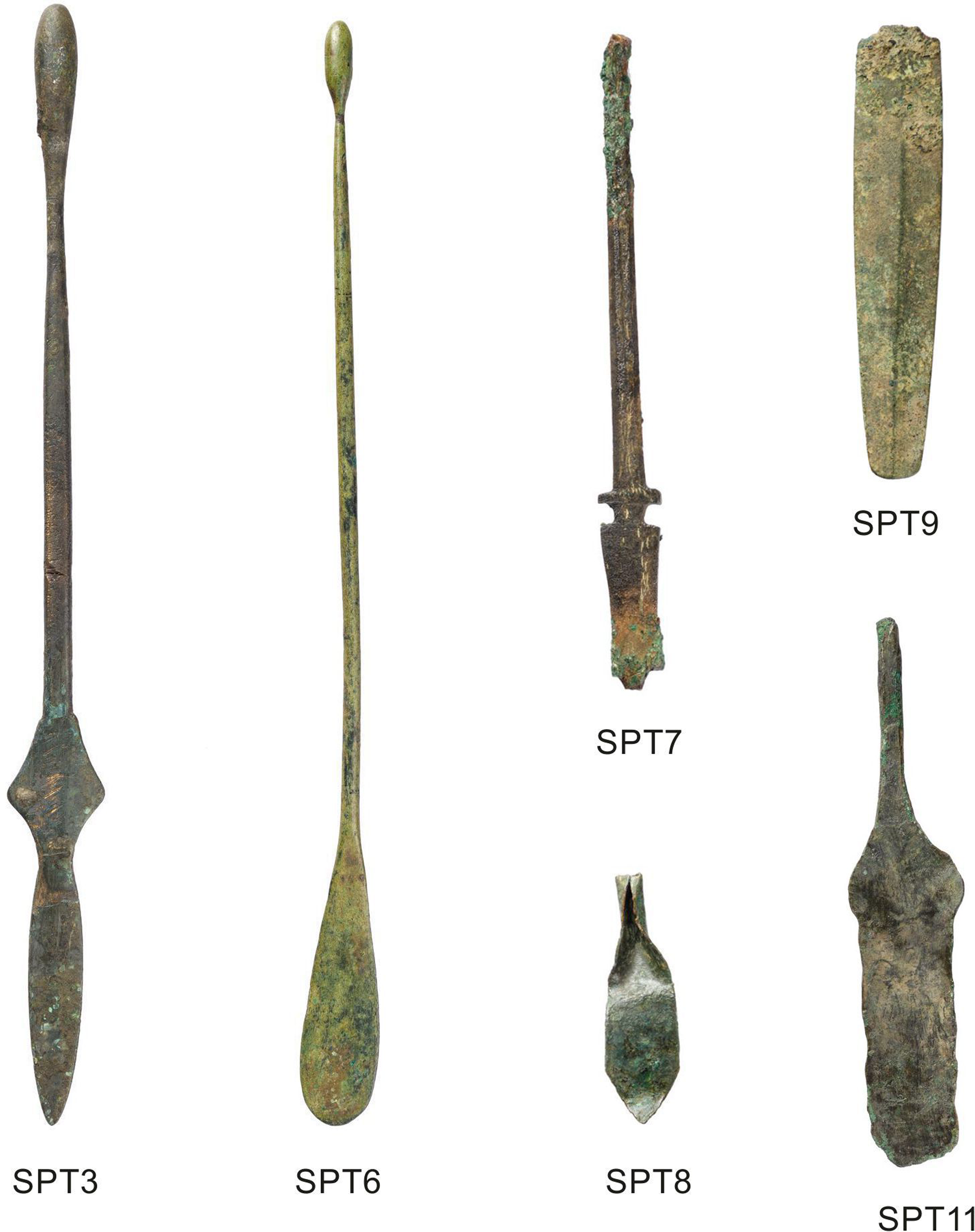
Five spatula-probes are of Riha’s Variant A (fig 5, SPT3) and one each of Variants B, D and J (fig 5, SPT6, SPT7 and SPT8).Footnote 39 Other Colchester items are less confidently placed. SPT11 (fig 5) has the hammered blade of Variant J but lacks its rolled shaft, and SPT9 (fig 5) has the low triangular-section blade seen on two examples of Variant C, but is too incomplete for positive identification. The enigmatic SPT12 may be a Variant J with rolled shaft and pointed blade but with no probe surviving it resembles a model spear.Footnote 40
SPT3, Variant A spatula-probe; SPT6, Variant B spatula-probe; SPT7, Variant D spatula-probe; SPT8, Variant J spatula-probe; SPT9, Variant C? spatula-probe; SPT11, Variant H or J spatula-probe. Scale 1:1. Photos: D Atfield; © Colchester Museums.

All the excavated examples from Colchester are from post-Boudican contexts apart from the Variant D, which is dated to the military occupation of ad 43–9 at Sheepen.Footnote 41 Variants A, B and J all first appear at Augst/Kaiseraugst in the early–mid first century, and Variants A, B and C have been found at Pompeii and in the eastern Mediterranean.Footnote 42 Variant As are among the instruments in sets of medical equipment from Bingen and Cologne in Germany, and two Variant Cs are in one from Paris.Footnote 43
Instrument sets?
Some instruments found in the same context may derive from the same set of instruments, whether or not they are stylistically similar. This applies in particular to two spoon-probes from a Claudian context on North Hill, one certain and one probable Variant E (fig 1, SP10; SP36), and to two Variant Es from an early second-century pit at Maldon Road (fig 4, SP8 and SP9).Footnote 44 To them might perhaps be added two Variant D spoon-probes from Balkerne Heights (SP26 and SP27).Footnote 45
METALLURGICAL ANALYSIS
by Peter Bray, Owen Humphreys, Kathryn Murphy and Keith NyakubayaFootnote 46
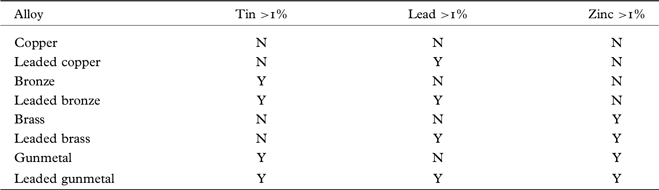
As a common category of object, long-handled toilet instruments are vital to our understanding of the production of these and other copper-alloy implements in the Roman world. Work by Riederer has examined 300 medical/toilet items found in Europe and the Eastern Mediterranean, establishing broad differences in the use of alloys between object types.Footnote 47 To date there has, however, been no similar large-scale study of these objects in Britain. To address this, a total of seventeen long-handled toilet instruments from Colchester have been chemically characterised using portable X-ray fluorescence. Readings were taken for sixty seconds using a Niton XL5+ portable X-ray fluorescence spectrometer. Whilst Riederer employs a complex system of alloy groupings, we consider that a simplified approach (table 2) is better for facilitating inter-site and diachronic comparison and for understanding the metalworking process.Footnote 48 Together with other objects from London Bloomberg, Vindolanda and northern Britain,Footnote 49 more than 150 long-handled toilet instruments from the province have now been studied, revealing striking differences with Riederer’s data.
Breakdown of the terminology used for copper alloys. N: not present; Y: present.

Table 2 Long description
A table comparing the presence of tin, lead, and zinc in various copper alloys. The table has 8 rows and 4 columns. The columns are labeled 'Alloy', 'Tin >1%', 'Lead >1%', and 'Zinc >1%'. The row labels are the names of different copper alloys. The values in the columns indicate the presence (Y) or absence (N) of tin, lead, and zinc in each alloy. Row 1: Copper, N, N, N. Row 2: Leaded copper, N, Y, N. Row 3: Bronze, Y, N, N. Row 4: Leaded bronze, Y, Y, N. Row 5: Brass, N, N, Y. Row 6: Leaded brass, N, Y, Y. Row 7: Gunmetal, Y, N, Y. Row 8: Leaded gunmetal, Y, Y, Y.
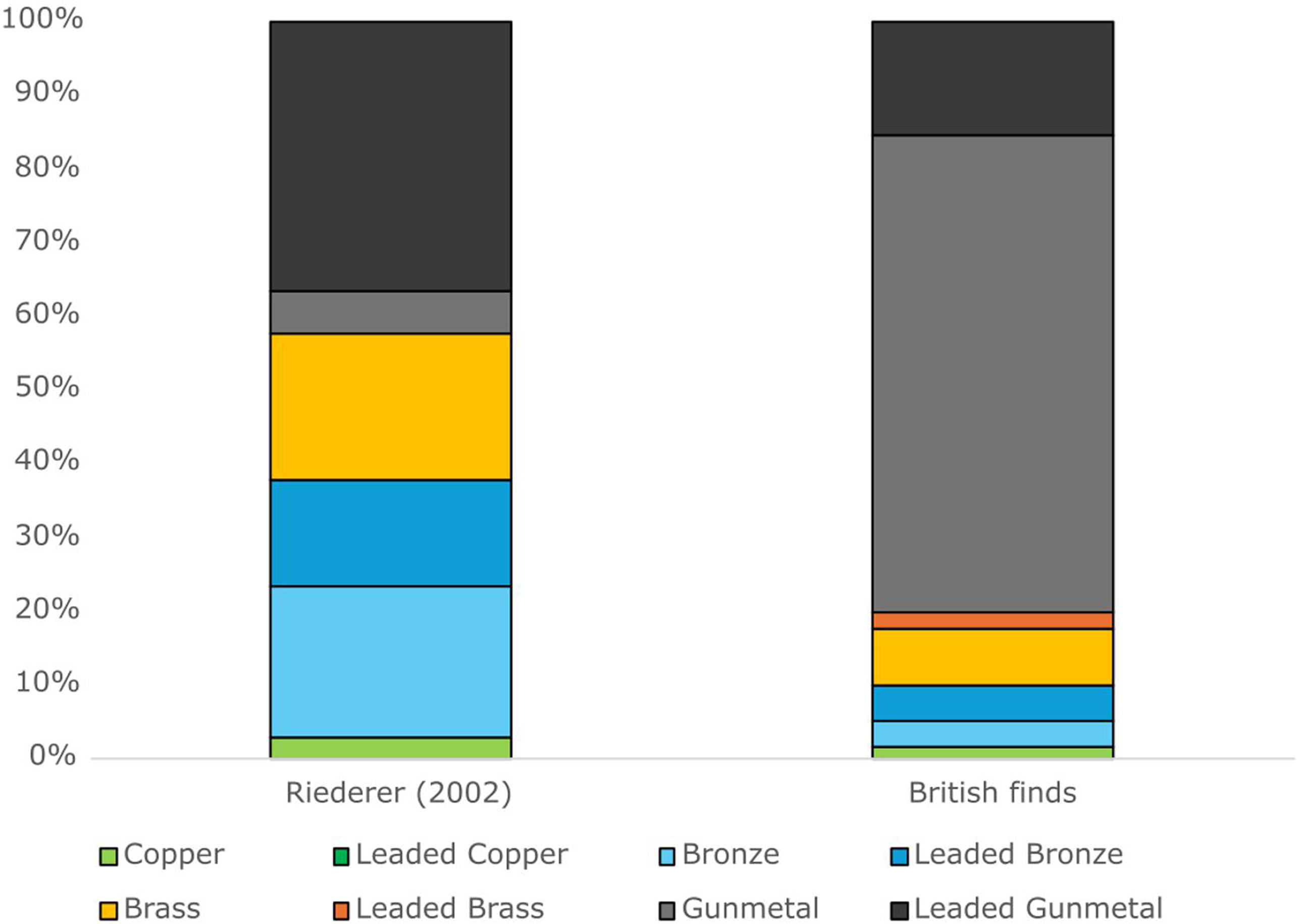
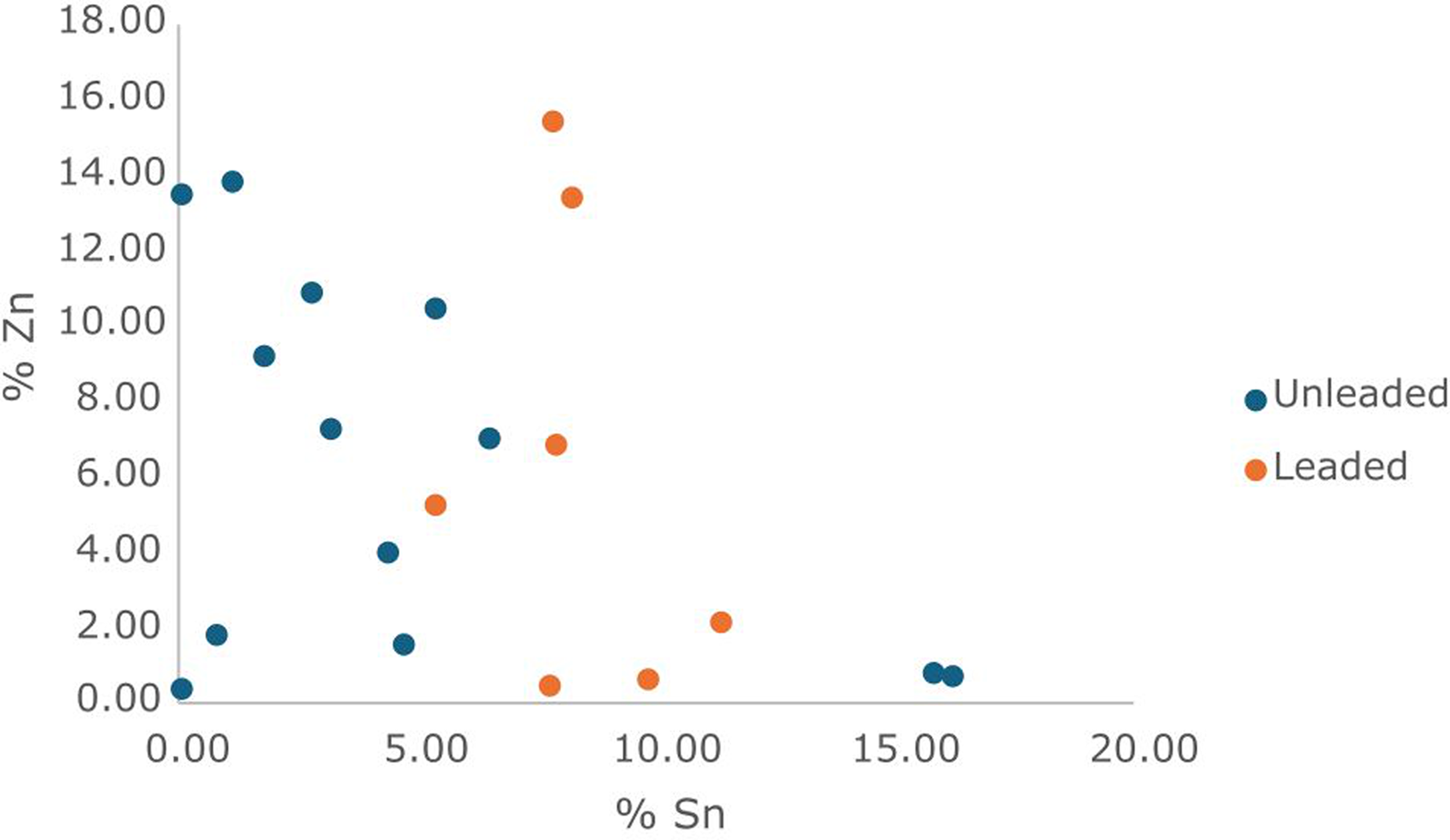
Whilst Riederer’s instruments were primarily bronze, brass or leaded gunmetal, the British finds are primarily unleaded gunmetal (fig 6), a distinction unaffected by the simplified approach. Within this gunmetal there are important distinctions. In early Roman London ‘dilute’ gunmetals were produced via a multi-stage alloying process, suggestive of specialised production. At Vindolanda, both the chemistry and chronology of the assemblage was more diverse, and the finds display a range of compositions more typical of mid–late Roman metallurgy, which employed leaded and low-zinc alloys more widely. This is suggestive of chronological change, with increasing use of recycled metal over time.
Graph showing the composition of long-handled toilet instruments from Britain (incorporating data from Dungworth Reference Dungworth1997 and unpublished REMADE analyses) compared to those analysed by Riederer (Reference Riederer2002). Chart: © REMADE, University of Reading.

Beyond the broad differences between object types identified by Riederer, this analysis also shows differences based on object typology and form. At both London and Vindolanda, (wrought) instruments without a grip employed more zinc, whilst lower zinc alloys were primarily used for more complex pieces with a grip (which could be wrought or cast).
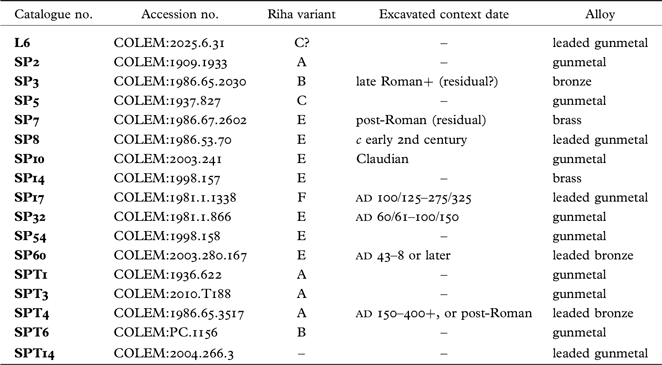
Although small, the assemblage of analysed instruments from Colchester reinforces an emerging picture of diversity in the composition of toilet instruments between sites, which has implications for our understanding of the production of these objects. The assemblage is also notable for some unusual objects that show more affinity with Riederer’s collections than is demonstrated at other British sites (table 3; fig 3, SP3; fig 4, SP17).
Alloy composition of the long-handled toilet instruments from Colchester.

Table 3 Long description
A table detailing alloy composition of long-handled toilet instruments from Colchester. The table has six columns: Catalogue no., Accession no., Riha variant, Excavated context date, and Alloy. It contains 16 rows of data. Row 1: Catalogue no., L6; Accession no., COLEM:2025.6.31; Riha variant, C?; Excavated context date, –; Alloy, leaded gunmetal. Row 2: Catalogue no., SP2; Accession no., COLEM:1909.1933; Riha variant, A; Excavated context date, –; Alloy, gunmetal. Row 3: Catalogue no., SP3; Accession no., COLEM:1986.65.2030; Riha variant, B; Excavated context date, late Roman+ (residual?); Alloy, bronze. Row 4: Catalogue no., SP5; Accession no., COLEM:1937.827; Riha variant, C; Excavated context date, –; Alloy, gunmetal. Row 5: Catalogue no., SP7; Accession no., COLEM:1986.67.2602; Riha variant, E; Excavated context date, post-Roman (residual); Alloy, brass. Row 6: Catalogue no., SP8; Accession no., COLEM:1986.53.70; Riha variant, E; Excavated context date, c early 2nd century; Alloy, leaded gunmetal. Row 7: Catalogue no., SP10; Accession no., COLEM:2003.241; Riha variant, E; Excavated context date, Claudian; Alloy, gunmetal. Row 8: Catalogue no., SP14; Accession no., COLEM:1998.157; Riha variant, E; Excavated context date, –; Alloy, brass. Row 9: Catalogue no., SP17; Accession no., COLEM:1981.1.1338; Riha variant, F; Excavated context date, A D 100/125–275/325; Alloy, leaded gunmetal. Row 10: Catalogue no., SP32; Accession no., COLEM:1981.1.866; Riha variant, E; Excavated context date, A D 60/61–100/150; Alloy, gunmetal. Row 11: Catalogue no., SP54; Accession no., COLEM:1998.158; Riha variant, E; Excavated context date, –; Alloy, gunmetal. Row 12: Catalogue no., SP60; Accession no., COLEM:2003.280.167; Riha variant, E; Excavated context date, A D 43–8 or later; Alloy, leaded bronze. Row 13: Catalogue no., SPT1; Accession no., COLEM:1936.622; Riha variant, A; Excavated context date, –; Alloy, gunmetal. Row 14: Catalogue no., SPT3; Accession no., COLEM:2010.T188; Riha variant, A; Excavated context date, –; Alloy, gunmetal. Row 15: Catalogue no., SPT4; Accession no., COLEM:1986.65.3517; Riha variant, A; Excavated context date, A D 150–400+, or post-Roman; Alloy, leaded bronze. Row 16: Catalogue no., SPT6; Accession no., COLEM:PC.1156; Riha variant, B; Excavated context date, –; Alloy, gunmetal. Row 17: Catalogue no., SPT14; Accession no., COLEM:2004.266.3; Riha variant, –; Excavated context date, –; Alloy, leaded gunmetal.
The Colchester instruments have a similar chemical profile to those from Vindolanda, suggesting a similarly broad date range (table 3). The full results are given in appendix 5 (see supplementary material). The objects without a grip sometimes have higher zinc than those with one, although this is not as clear a distinction as on other sites (fig 7). Some objects fit the ‘dilute’ gunmetal profile seen in early Roman London, and this includes the typologically early spoon-probe COLEM:1909.1933 (fig 3, SP2). This example also contained a small amount of silver from the inlays on the shaft.
Graph showing the tin and zinc content of the long-handled toilet instruments from Colchester. Chart: © REMADE, University of Reading.

Among the outliers is another early spoon-probe, COLEM:1981.1.1338 (fig 4, SP17), which is unusual for being a leaded gunmetal high in zinc. It is most probably an import and may belong to the group of leaded high-zinc gunmetals that Riederer identifies as the product of a specialised workshop, although the lead levels recorded are lower than in Riederer’s objects.Footnote 50 Spoon-probe COLEM:1986.65.2030 (fig 3, SP3) is an unleaded bronze. Given the rarity of bronze in other analysed instruments from Britain, this may also be an import. Its composition is similar to other wrought bronze artefacts, such as vessels, with the torc-twisted shaft of this example showing that it too was wrought.
FUNCTIONS
In his inventory of medical instruments in graves dating to the period of the Roman Empire, Ernst Künzl suggested that ligulae, spoon-probes and spatula-probes (and possibly other types of probes) were among a group of objects that were not enough to define the person with whom they were buried as a doctor, dentist or pharmacist unless indisputably medical implements were also present.Footnote 51 The other ambiguous items are stone grinding palettes, pestles and mortars, spoons of various forms, weighing scales, multi-compartment boxes and copper-alloy tubular étuis. Along with others,Footnote 52 Künzl defined the alternative use of these loan tools as the preparation and application of cosmetics and unguents.
Healthcare
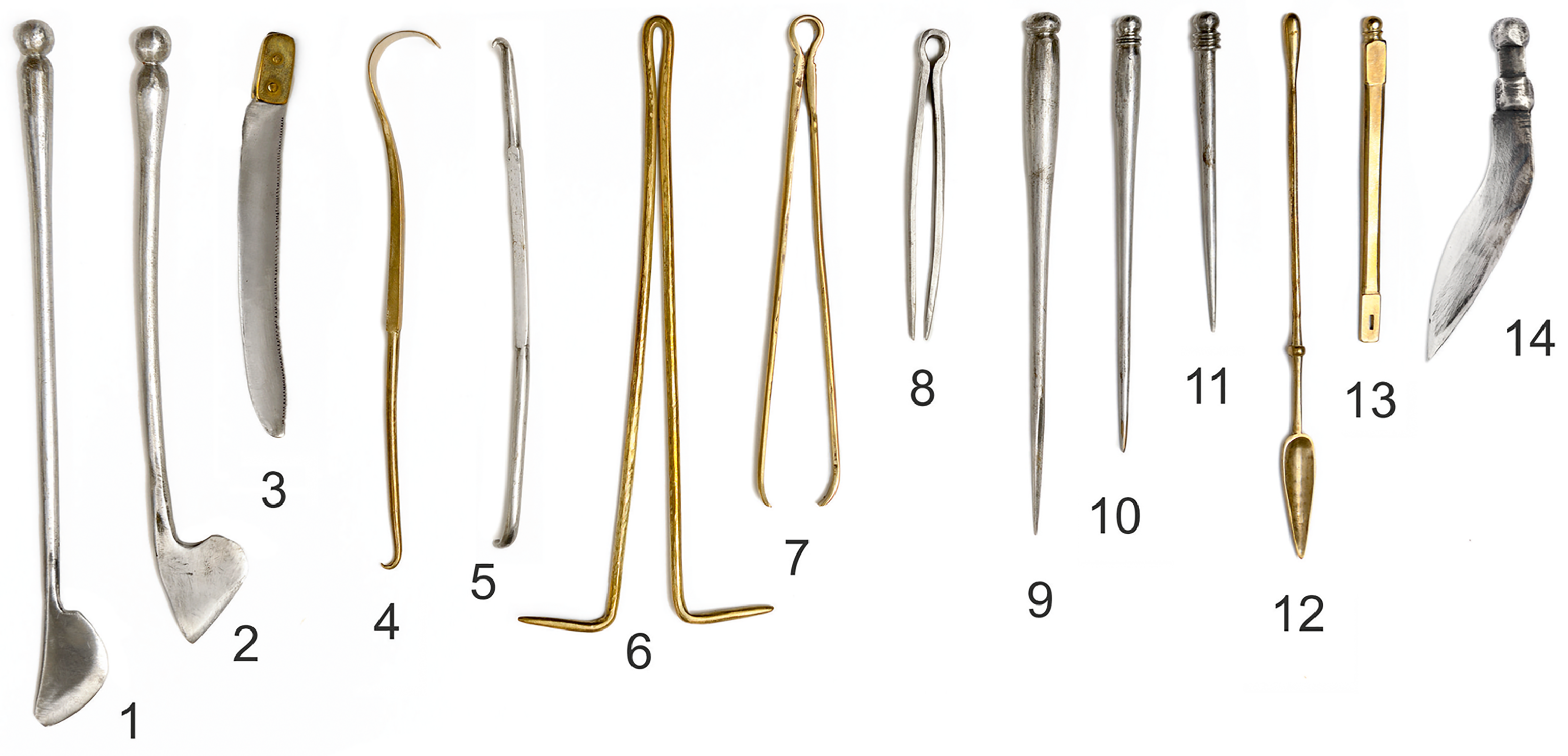
Ligulae can be found in the kits of medical practitioners, including dentists.Footnote 53 They could be used in minor surgery as a fine cautery or blunt hook, and as a dental scaler.Footnote 54 Spoon-probes and spatula-probes could be used in the measurement, preparation and application of powders, salves and other medications, as curettes and cauteries, in the removal of stones and in many other ways.Footnote 55 They are also found in sets of medical equipment, such as the spoon-probe in the conquest-period Doctor’s grave in the native British élite cemetery at Stanway near Colchester (fig 8).Footnote 56 A grave from Mayen, Germany, contained a slate palette, a spoon-probe and the remains of two salves, further evidence for medical use.Footnote 57 Numerous glass and pottery vessels, a multi-compartment box containing a variety of organic substances, an alabaster mortar, a wooden-handled knife, a stone grinding palette and an étui that contained two spoon-probes were found in the nineteenth century in a burial on the villa site at Saint-Médard-des-Prés, Vendée, France.Footnote 58 Previously considered to be the equipment of an artist, new work on the organic remains from this grave led to the group’s reinterpretation as an oculist’s kit.Footnote 59 Other spoon-probes found in both male and unsexed burials, perhaps with a stone grinding palette but with no other specifically medical equipment, have been interpreted as evidence that the deceased suffered from eye disease and was self-administering a medication, or was a pharmacist or doctor, or used them for preparing and applying cosmetics.Footnote 60
Replicas by Nodge Nolan† of the instruments in the Stanway Doctor’s kit. From left to right: two iron scalpels, iron saw, copper-alloy sharp and blunt hook, iron sharp and blunt hook, copper-alloy? retractor, copper-alloy forceps, iron forceps/tweezers, three handled? needles, copper-alloy spoon-probe, copper-alloy handle with fragment of an iron component, iron knife. Not to scale. Photo: D Atfield; © Colchester Museums.

Literacy
An alternative for both spoon-probes and spatula-probes is presented by a male grave from Salzburg, Austria, that held an inkwell, a stone palette, a spoon-probe, a knife and a bone strip, a variant form of the rulers found in sets of writing equipment.Footnote 61 Künzl suggested, from the form of the knife, that this might be the burial of a doctor, but Eckardt has proposed that some of these objects may have been used to make ink, especially if oak-apples were used to make iron gall ink.Footnote 62 In at least two other burials, spoon-probes were found in conjunction with an inkwell and other items associated with writing. One was in a grave from Emona (Ljubljana), Slovenia, along with an inkwell and a wax spatula used for preparing writing tablets.Footnote 63 The other had been deposited in a well-furnished mid–late first-century burial from Cologne, Germany, along with two spatula-probes, a ligula, an inkwell with the corroded remains of two styli, a stone palette, two bone-handled knives with silver fittings, a copper-alloy handle and some fragments of bone inlay or veneer from a wooden box, ceramic and glass vessels and a coin of Nero.Footnote 64 A rather more ambiguous sarcophagus burial from Cologne contained an inkwell, a Variant C spatula-probe, a surgical needle, a medical(?) hook, a razor, a picture lamp with an image of Hercules on the discus, pottery vessels, a notched stone strip (perhaps for making pills) and a glass egg.Footnote 65
In two of the inkwell graves the association between spoon-probes, spatula-probes, ligulae and a stone palette calls into question the assumption for other burials that, in the absence of medical equipment, these objects must have been used in the preparation and application of cosmetics.Footnote 66 While most of the burials listed by Künzl are antiquarian finds with no age or sex data attached to the human remains, two inhumations from Romania identified as male contained only a spoon-probe and a palette that he suggested were for cosmetic use.Footnote 67 These burials raise a number of questions concerning the reliability of osteological evidence, the use of the artefacts and the wearing of make-up. Whether the deceased were male or female, were these implements used to grind ink, pharmaceutical ingredients, cosmetic pigments or other substances?
The toilette
In the Roman world, the daily toilette made use of a wide range of implements that are generally gendered as either male or female, such as razors and mirrors.Footnote 68 We have seen above that spoon-probes and spatula-probes cannot be assumed to be gender-specific, and they are appropriately categorised by Bertrand as ustensiles servant manipuler les différentes substances, which covers their use as both pharmaceutical and toilet instruments.Footnote 69 The toilette-related uses proposed for ligulae include mixing unguents and cosmetics, scooping small quantities of them out of containers, pushing back the cuticle, painting on kohl or rouge or applying make-up to the eyelid.Footnote 70 A ligula and spoon-probe from Grave 567 in the northern cemetery at Emona have both been described as cosmetic spoons, as have bone ligulae, and a gilt bronze ligula from Vieux-Poitiers, Vienne, is best seen as a statement piece of cosmetic equipment rather than part of a medical professional’s kit.Footnote 71
Painting
The possible use of spoon- or spatula-probes in preparing pigments for use in wall-painting, perhaps even applying them, is particularly ambiguous. Some disulphide of arsenic from Silchester may have been used as an antiseptic or a painter’s pigment, and experimental work has found that several substances usually associated with wall-painting also made effective cosmetics.Footnote 72 As mentioned above, the Saint-Médard-des-Prés burial in France was considered to be that of an artist, but analysis of the organic residues has led to the reinterpretation of the equipment as that of an oculist.
BURIALS
Any of the uses defined above could be pertinent to a long-handled instrument found in an urban milieu, where medical practitioners of various types worked, texts were written, make-up was applied and walls were painted. Distinguishing the use to which any instrument was put is therefore difficult unless it came from a specific context or was found in association with less ambiguous items, such as the continental burials cited above that attest to, or at least imply, its use. Examples of such burials in Britain are very scarce, with the four summarised below being the most pertinent.Footnote 73
A spoon-probe was included in the set of surgical equipment placed in the richly-furnished conquest-period Doctor’s grave in the late Iron Age to early Roman cemetery at Stanway near Colchester (fig 8).Footnote 74 The age and sex of the deceased could not be determined from the cremated bone, but other factors pointed to this being the burial of an adult male.Footnote 75 The grave contained both imported and British-made objects, with the spoon-probe providing a visible form of Gallo-Roman acculturation in the sphere of pre-conquest medical treatment. Coming from the grave of an inhabitant of the Iron Age oppidum of Camulodunum, this is not considered as part of the Romano-British urban assemblage from Colchester assessed here.
The adult Grave 6635 from excavations in Kent is of very similar date to the Stanway burial, was again richly-furnished and contained both imported and British-made items.Footnote 76 The grave goods included a wooden multi-compartment box with copper-alloy internal walls and fittings, a spatula-probe and a limestone grinding palette with associated copper-alloy sliding cover that incorporated a small dish.Footnote 77 The sex of the deceased could not be determined and the burial may have included the remains of more than one person. The presence of metal vessels for ritual hand-washing and formal feasting implies that the deceased was male, but, while acknowledging that the box, palette and spatula-probe may have belonged to a pharmacist, the excavators preferred to associate them with cosmetics and to interpret this as a female burial.Footnote 78
Colchester Grave 302, the ‘Lockhart burial’, was found close to the pottery kilns at Sheepen in 1933.Footnote 79 Among the considerable number of grave deposits that had been placed inside an amphora were a copper-alloy probe with broken plain shaft (P22), a bone needle, a square wooden-framed high-tin leaded bronze mirror,Footnote 80 two brooches of unparalleled form, twenty small green and blue glass beads, some bone fittings from scrolls,Footnote 81 a bone-handled knife and several pottery vessels, some locally-made. Dating to the later second or early third century, this is almost certainly the burial of a female, probably an older adolescent or young adult, with the probe being part of a spoon-probe used in her toilette. The scroll fittings and perhaps the knife may alternatively be evidence that she was literate, with the spoon-probe used to prepare her ink.Footnote 82
In London, an adult male was buried in the late third century with a spoon-probe, tweezers, miniature black-burnished ware jar and coin of Severus.Footnote 83 The two metal instruments lay across the man’s throat, perhaps having been in a bag worn around his neck. He has been interpreted as an oculist, with the jar used to contain a salve.Footnote 84
Setting the rarity of long-handled instruments within burials against the number of graves excavated in Colchester’s Romano-British cemeteries and the quantities of the instruments recovered from the town and its suburbs, it seems that most were regarded as commonplace disposable equipment. In contrast, these four burials, two or possibly three being of medical professionals, point to a very different milieu, one in which spoon-probes were valued tools that defined the deceased’s status in the afterlife.
DISTRIBUTION
Ligulae, spoon-probes and spatula-probes have been found on both intra- and extramural excavated sites in Colchester, with their numbers boosted by casual finds. While widely spread, they are concentrated in the western suburb immediately outside the Balkerne Gate, the reasons for which are explored below.
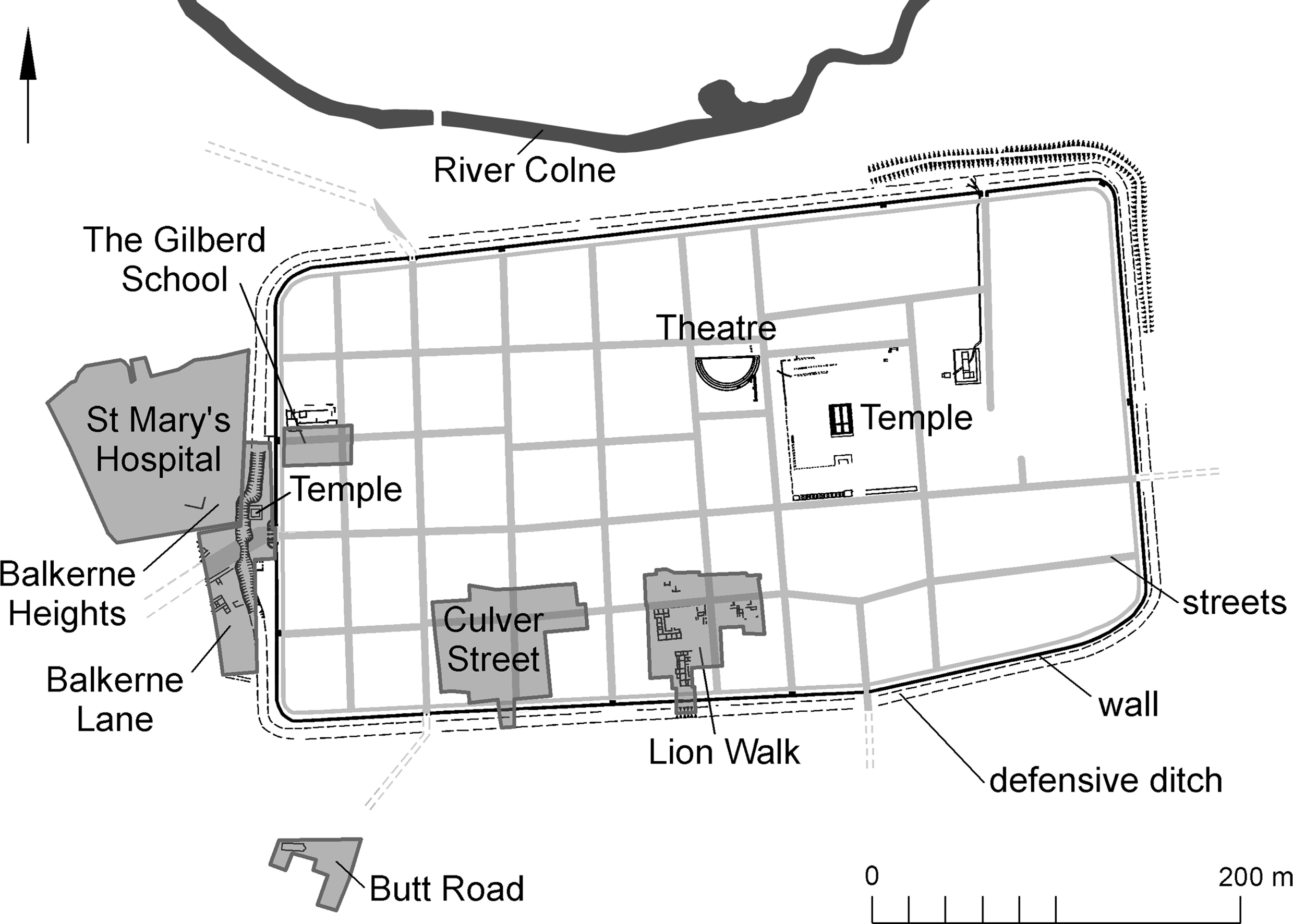
There have been comparatively few modern excavations in the eastern part of Colchester’s walled Roman town, much of which now lies within the Castle Park, while parts of the northern and eastern suburbs lie within the flood-plain of the river Colne, leading to a distinct western emphasis in site distribution terms (fig 9).Footnote 85 This bias is again reflected in many of the finds acquired by Colchester Museums from the nineteenth century onwards. As well as the early collection being dominated by burial groups from the town’s western cemetery,Footnote 86 up until the 1930s the find-spots given for casual accessions are dominated by the Union, later St Mary’s Hospital, which lay just outside the Balkerne Gate. With the exception of those from Sheepen, items from other sites pre-dating the late 1960s are comparatively rare and most are single finds (see appendix 6, supplementary material).
Roman Colchester, showing the sites mentioned in the text. Map: drawn by E Holloway; © Colchester Archaeological Trust.

Intramural v extramural
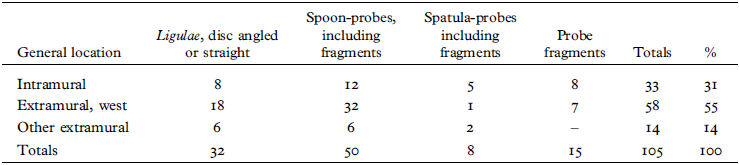
Given the western bias noted above, it is to be expected that considerably more long-handled instruments have been found on sites in the extramural western area than in the other suburbs combined. There are also substantially more than from within the walled town, even though the excavated intramural sites usually had a more prolonged period of use as well as a greater concentration of occupation and depth of archaeology (table 4). The 2001–2 St Mary’s Hospital and 2003 Balkerne Heights assemblages are included in table 4, but objects that pre-date the town wall have been omitted. The balance of the figures for bone hairpins from the same sites and in the same location groups is much the same (42:55:3 per cent). The difference between the suburbs is no doubt due not only to more Victorian and later redevelopment leading to more excavation in the west, but also to the area’s use in the Roman period for the dumping of urban detritus.Footnote 87
Distribution of long-handled instruments. Site-specific distribution is given in the online supplementary material.

Table 4 Long description
A table comparing the distribution of long-handled instruments across different general locations. The table has four rows and six columns. The columns are labeled Ligulae, disc angled or straight; Spoon-probes including fragments; Spatula-probes including fragments; Probe fragments; Totals; and %. The rows are labeled General location, Intramural, Extramural, west, and Other extramural. Row 1: General location, Ligulae, disc angled or straight, Spoon-probes including fragments, Spatula-probes including fragments, Probe fragments, Totals, %. Row 2: Intramural, 8, 12, 5, 8, 33, 31. Row 3: Extramural, west, 18, 32, 1, 7, 58, 55. Row 4: Other extramural, 6, 6, 2, -, 14, 14. Row 5: Totals, 32, 50, 8, 15, 105, 100. The table shows the distribution of long-handled instruments in different locations, with the extramural west area having the highest totals and percentage.
If the twenty-four per cent distinction for long-handled instruments between the intramural and western suburb assemblages is meaningful (it is just thirteen per cent for hairpins), then a factor other than the disposal of rubbish has enhanced the numbers of long-handled instruments in the west, and this, we propose, was the presence of Temple 10, which lay just outside the Balkerne Gate.
Temple 10: a healthcare hub?
Temple 10 on the Balkerne Lane site, Colchester Building 52, was of typical Romano-Celtic form with an ambulatory set around a cella. It had probably been constructed in the very late first or early second century, then sometime in the fourth century the ambulatory was demolished and its foundations robbed out. The cella was left intact and was presumably still in use until the end of the Roman period. Both before its construction, and at least until the use of the area for burials, the ground around the building was used for the dumping of household waste, particularly oyster shells.Footnote 88
An association of the building with Mercury has been suggested by several objects from the St Mary’s Hospital, Balkerne Heights and Balkerne Lane sites, including figurines of the god and a priestess.Footnote 89 His other attributes of a caduceus, winged hat and winged sandals, along with two of his three animal companions, are represented by model votives, figurines and brooches.Footnote 90 As he was the patron deity of travel, a temple dedicated to his worship outside the west gate of the town lay in an appropriate setting, next to the road leading both to and from London, Verulamium and the wider province. A complete figure-group of Mercury and his animal companions was found in a similar location outside the south-west gate of Verulamium, close to the road to Silchester.Footnote 91
Mercury had other roles: patron of eloquence and commerce, messenger of the gods and psychopomp, he was also associated with healing and, like Aesculapius the physician and the goddess Salus, might be shown with a snake.Footnote 92 On a figurine from Caistor St Edmund, Norfolk, he wears a torc with snake-head terminals, and in the healing spring of Néris-les-Bains, Allier, France, he is shown with a ram-headed snake.Footnote 93 As well as appearing on the model caducei found near Temple 10, simple snake images were also recovered there.Footnote 94 Medical implements, a scalpel and two stamps used to mark eye-salves came from the same area,Footnote 95 as did a grinding palette and a fragment of an alabaster vessel, both artefact types found in medical practitioners’ kits, including that of the Saint-Médard-des-Prés oculist.Footnote 96 Two other items that may have been credited with prophylactic powers might also be pertinent here, a copper-alloy mount cleverly combining images of phallus, bird and chariot, and a small second- to third-century mica-gilt bowl with phallic spout.Footnote 97
In this context, many of Colchester’s multi-functional long-handled instruments might plausibly be associated with healers working in or close to Temple 10. Bending some complete examples in a probable act of ritual mutilation has been noted around the temple, and can also be seen on other items such as metal needles, spoons, hairpins and small toilet instruments.Footnote 98 The inclusion of needles and spoons among these objects introduces the possibility that they, too, belonged to medical practitioners, as examples occur in a number of medical kits.Footnote 99
Votive deposition or waste disposal?
The disposal of waste in extramural areas of Roman towns is well-attested. It chiefly consisted of general household debris, but sometimes had an emphasis on particular types of material, such as craft waste, and may have been deposited as a single event or over a long period of time.Footnote 100 Distinguishing between deliberate deposits and the disposal of rubbish has been the subject of prolonged debate, particularly in London, where the finds from the Walbrook stream have been defined in the past as rubbish or ritual, but are now seen as undoubtedly both.Footnote 101 The same issue pertains for the medical instruments from the extramural rubbish dump (Schutthügel) outside the fortress at Vindonissa (Windisch), Switzerland.Footnote 102 Similarly, the concentration of medical and possibly medical artefacts in the area outside Colchester’s Balkerne Gate can be postulated as ritually connected to Temple 10 and the healing arts, but, given the dumping of general rubbish over at least the second and third century in both the area immediately around the building and further west and north, this interpretation must remain uncertain.Footnote 103
In the late Roman period, use of the St Mary’s Hospital site for burials, including some of high-status, implies that the area was no longer used for dumping, which provides a probable terminus ante quem for the long-handled instruments found there, coinciding with the demolition of Temple 10’s ambulatory. Did the temple cease to be a focus for healing, causing medical equipment to be dumped?
CONCLUSION
Unless their context provides an unambiguous interpretation, items of toilet and medical equipment are usually catalogued together.Footnote 104 Even when there is an intention to concentrate on only one of these functions, objects belonging to the other may creep in.Footnote 105 Use in the preparation of inks and possibly paints should now also be considered, further hampering precise interpretation.
The large numbers of ligulae and spoon-probes found at Colchester suggest that the majority were used in the home, although this may not necessarily be the case for the less frequently-found spatula-probes. Note also Riha’s suggestion that Variant D ligulae, one of which is in the Colchester assemblage, were medical instruments.Footnote 106 Identifying individual urban properties as those of healers introduces another difficulty, and it is generally only a disaster, such as the fire that destroyed a surgeon’s house in Rimini, or a concentration of implements, as on Silchester’s Insula ix, that might pinpoint a healer’s premises.Footnote 107 Gathering together here Colchester Museums’ urban and suburban assemblages of these long-handled instruments has substantially increased the number previously thought to come from the area adjacent to Colchester’s Temple 10. Despite use of this part of the western suburb as a rubbish dump, they suggest that, along with other items connected to healing and healing deities, the building was a focus for healthcare, perhaps particularly for the easily-spread eye diseases that appear to have plagued Roman-period populations.Footnote 108
The Colchester instruments examined here have been set against those in the Augst/Kaiseraugst typologies and some pieces have been matched to examples from other site assemblages, which, although smaller than that presented here, appear to be equally diverse and in some cases very different. No comparative study of a large urban assemblage drawing together both antiquarian and modern accessions held by a local museum in Britain has been attempted here, nor any concentrated look at the Romano-British assemblage as a whole, but the published excavation reports consulted suggest that both could be a fruitful field for typological work, perhaps leading to a clearer view of the forms used in medical treatment, well-dated chronologies, regional variations and differences in deposition by site type.
ACKNOWLEDGEMENTS
This paper is dedicated to the late Ralph Jackson, whose work on medical and cosmetic instruments was of great benefit to the study of Late Iron Age and Roman Britain. We would like to give particular thanks to the REMADE team for their contribution, Douglas Atfield for his photography and Colchester Museums for permission to reproduce the images. We are also grateful to Laurie Straiton (Colchester and Ipswich Museums), Laura Pooley and Emma Holloway (Colchester Archaeological Trust), Michael Marshall (Museum of London Archaeology) and Katie Manby and Hella Eckardt (Reading University) for all their help.
SUPPLEMENTARY MATERIAL
To view supplementary material for this article, please visit https://doi.org/10.1017/S0003581526100596.
ABBREVIATIONS AND BIBLIOGRAPHY
Abbreviations
- CAR 2Footnote 109
-
Crummy Reference Crummy1983
- CAR 3
-
Crummy Reference Crummy1984
- CAR 6
-
Crummy Reference Crummy1992
- CAT
-
Colchester Archaeological Trust
- CMRFootnote 110
-
Colchester Museum Reports
- LIMC
-
Lexicon Iconographicum Mythologiae Classicae, Artemis Verlag, Zurich/Munich
- REMADE
-
Roman and Early Medieval Alloys Defined
APPENDIX 1: SUMMARY CATALOGUE OF ILLUSTRATED ITEMS
Variants for all three artefact types are as in Riha Reference Riha1986. For descriptions and selected images from the Augst/Kaiseraugst assemblages, see appendix 4 in the supplementary material. Letters in bold refer to ligulae (L), spoon-probes (SP) and spatula-probes (SPT). L = length.
L1, fig 2. COLEM:1930.266. The Union; CMR 1931, 39. Variant A/C. L 114mm.
L2, fig 2. COLEM:1986.66.1714. Butt Road excavation. CAR 2, 266 (fiche), 1916. Variant A? L 30mm.
L3, fig 2. COLEM:PC.1078. Colchester? Unpublished. Variant D. L 51mm.
L4, fig 1. COLEM:JOS.1032.1. Colchester? Price Reference Price1888, 78. Variant E. L 161mm.
L5, fig 2. COLEM:1907.1307. Colchester. Unpublished. Variant uncertain. L 103mm.
L56, fig 1. COLEM:1998.165. Colchester?, Joslin Collection?. Unpublished. Variant E. L 155mm.
SP1, fig 3. COLEM:1986.65.3417. Lion Walk excavation. CAR 2, 60, fig 65, 1927. Variant A. L115mm.
SP2, fig 3. COLEM:1909.1933. Colchester Royal Grammar School, Lexden Road. CMR 1910, 11. Variant A, gunmetal. L 119.5mm.
SP3, fig 3. COLEM:1986.65.2030. Lion Walk excavation. CAR 2, 60, fig 65, 1926. Variant B, bronze. L 155.5mm.
SP4, fig 3. COLEM:2025.6.20. Colchester? Unpublished. Variant B. L 103.5mm.
SP5, fig 3. COLEM:1937.827. Sheepen School (now St Helena’s School). CMR 1937–44, 29. Variant C, gunmetal. L137mm.
SP6, fig 4. COLEM:2025.6.4. Colchester. Unpublished. Variant D. L 85.5mm.
SP8, fig 4. COLEM:1986.53.70. Maldon Road excavation. CAR 2, 61, fig 65, 1932. Variant E, leaded gunmetal. L 152.5mm.
SP9, fig 4. COLEM:1986.53.74. Maldon Road excavation. CAR 2, 60–1, fig 65, 1931. Variant E. L127.5mm.
SP10, fig 1. COLEM:2003.241. North Hill excavation. Dunnett Reference Dunnett1966, 45, no. 8, fig 7, 15. Variant E, gunmetal. L 132.5mm.
SP12, fig. 1. COLEM:1931.1595. National Bus garage, Queen Street. CMR 1932, 39. Variant E. L 147.5mm.
SP14, fig 1. COLEM:1998.157. Colchester? Unpublished. Variant E, brass. L 86.5mm.
SP17, fig 4. COLEM:1981.1.1338. Culver Street excavation. CAR 6, 154, fig 5.12, 469. Variant F, leaded gunmetal. L 115mm.
SP19, fig 4. COLEM:PC.1157. Colchester?, Acton Collection? Unpublished. Variant H. L 154mm.
SP21, fig 4. COLEM:1935.175. Colchester? CMR 1935–7, 26. Variant H. L 133.5mm.
SPT1, fig 1. COLEM:1936.622. Castle Park. CMR 1936–7, 26, pl 13, 5. Variant A, gunmetal. L 154mm.
SPT3, fig 5. COLEM:2010.T188. Colchester? Unpublished. Variant A, gunmetal. L 146mm.
SPT6, fig 5. COLEM:PC.1156. Colchester? Unpublished. Variant B, gunmetal. L 143.5mm.
SPT7, fig 5. COLEM:2003.208.8. Sheepen, 1930s bypass excavations. Hawkes and Hull Reference Hawkes and Hull1947, pl C, 23. Variant D. L 110mm when published, but probe and most of spatula now missing, L 83mm.
SPT8, fig 5. COLEM:1988.44.266. Gilberd School excavation. CAR 6, 213, fig 6.8, 98. Variant J. L 31mm.
SPT9, fig 5. COLEM:1909.1833.1. St John’s Abbey. Unpublished. Variant C? L 58mm.
SPT11, fig 5. COLEM:1986.67.5135. Balkerne Lane excavation. CAR 6, 63, fig 68, 1949. Variant H or J? L 67.5mm.



 Open access

