


A series of legislative bills sweeping across states propose a seemingly innocuous proposition: autonomous individuals should make their own medical decisions (or those for their children) without governmental (or private sector) interference. Framed as enhancing “medical freedoms,” legislators posit what the US Constitution (as well as multiple state constitutions) already recognize — namely that Americans are entitled to bodily autonomy under principles of liberty.Reference Annas 1 Such interests already protect individuals from unwarranted medical interventions, deter many forms of public health paternalism, and provide exemptions from nonconsensual research or other invasive measures.Reference Hodge 2
“Medical freedom” bills, however, go further. Legislators purport that fundamental rights to bodily autonomy are nearly absolute. Americans’ rights to make their own medical decisions are supreme, or so it goes, and thus should be insulated from legal exceptions that currently mandate medical tests, screenings, procedures, treatments, or vaccines. Imposing any requirements or conditions related to accessing additional treatments, work, school, or other public places framed under these proposed laws infringes basic freedoms.
Enhancing medical freedoms pursuant to these bills is legally flawed. Bodily autonomy is unquestionably constitutionally grounded, but not unconditional.Reference Hodge 3 It has always been subject to exceptions, 4 notably including state interests in assuring patient and public health pursuant to “police power” protections of the health, safety, and welfare of society.Reference Freund 5 Consequently, innumerable public health and safety laws passed over decades are just as constitutional as individual liberty interests. 6 As we examine below, to the extent medical freedom laws skew the balance between respecting liberty interests and protecting the public’s health, they threaten everyone’s freedoms.
“Medical Freedom” Legislative Proposals
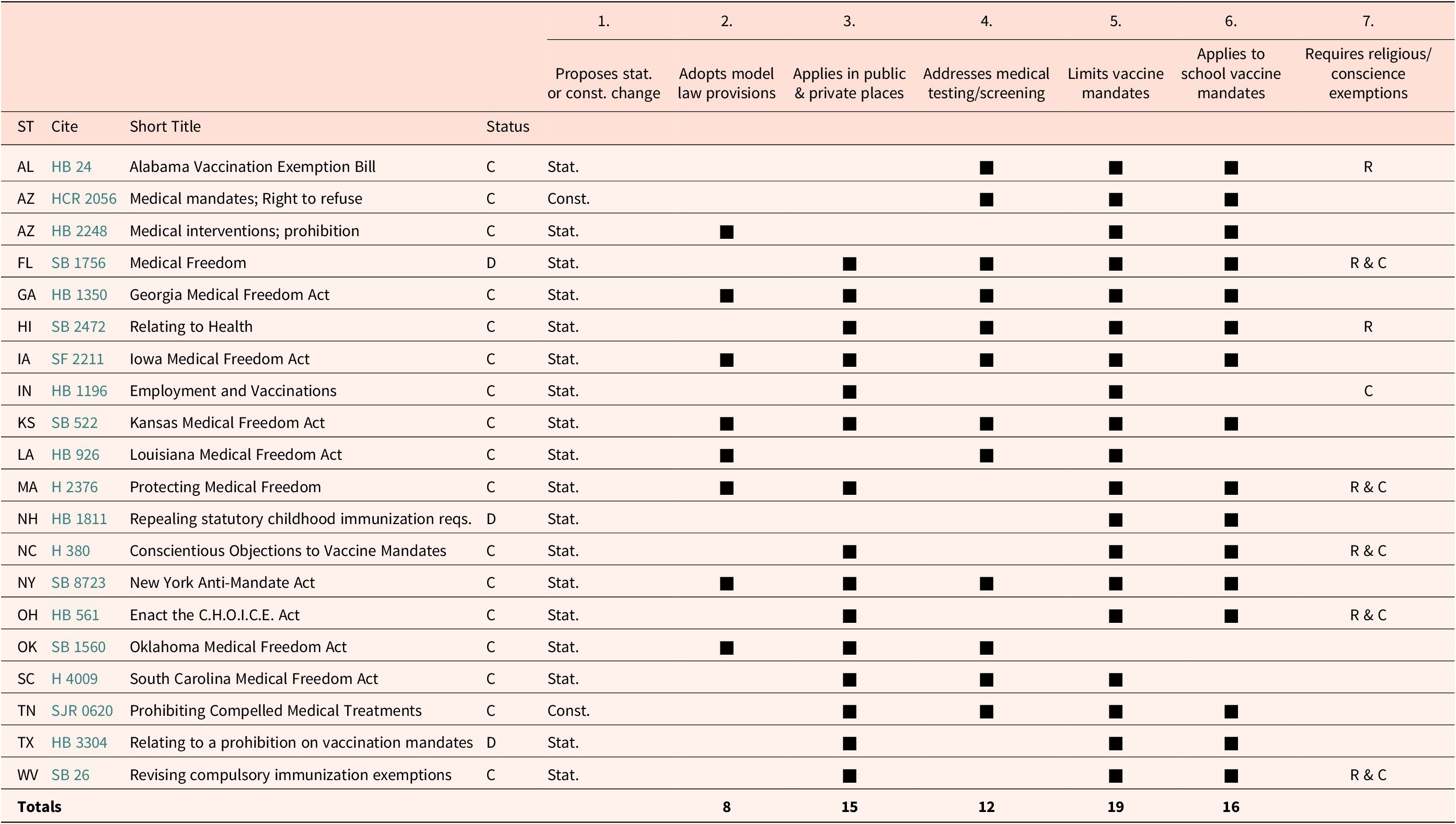
Multiple state medical freedom bills prioritizing individual healthcare autonomy over institutional or state-wide mandates mimic legislative reforms proposed via the “Model Medical Freedom Act” 7 (see Table - Select State Medical Freedom Bills 2025-2026). Bills in Tennessee 8 and Arizona 9 go so far as to propose state constitutional amendments recognizing refusals of medical mandates as fundamental rights.
Select State Medical Freedom Bills 2025-2026

Table Long description
A table with 11 columns and 22 rows. The columns are: State S T, Cite, Short Title, Status, 1. Proposes statutory or constitutional change, 2. Adopts model law provisions, 3. Applies in public and private places, 4. Addresses medical testing or screening, 5. Limits vaccine mandates, 6. Applies to school vaccine mandates, and 7. Requires religious or conscience exemptions.
Key data rows include:
* A L, H B 24, Alabama Vaccination Exemption Bill, Status C, Statutory change, addresses testing, limits mandates, applies to schools, requires Religious exemption.
* A Z, H C R 2056, Medical mandates; Right to refuse, Status C, Constitutional change, addresses testing, limits mandates, applies to schools.
* F L, S B 1756, Medical Freedom, Status D, Statutory change, applies in public and private, addresses testing, limits mandates, applies to schools, requires Religious and Conscience exemptions.
* G A, H B 1350, Georgia Medical Freedom Act, Status C, Statutory change, adopts model law, applies in public and private, addresses testing, limits mandates, applies to schools.
* I N, H B 1196, Employment and Vaccinations, Status C, Statutory change, applies in public and private, limits mandates, requires Conscience exemption.
* M A, H 2376, Protecting Medical Freedom, Status C, Statutory change, adopts model law, applies in public and private, limits mandates, applies to schools, requires Religious and Conscience exemptions.
* N Y, S B 8723, New York Anti-Mandate Act, Status C, Statutory change, adopts model law, applies in public and private, addresses testing, limits mandates, applies to schools.
* O K, S B 1560, Oklahoma Medical Freedom Act, Status C, Statutory change, adopts model law, applies in public and private, addresses testing.
* T N, S J R 0620, Prohibiting Compelled Medical Treatments, Status C, Constitutional change, applies in public and private, addresses testing, limits mandates, applies to schools.
* W V, S B 26, Revising compulsory immunization exemptions, Status C, Statutory change, applies in public and private, limits mandates, applies to schools, requires Religious and Conscience exemptions.
The Totals row at the bottom indicates:
* Adopts model law provisions: 8
* Applies in public and private places: 15
* Addresses medical testing or screening: 12
* Limits vaccine mandates: 19
* Applies to school vaccine mandates: 16
This table chronicles select, state-based “medical freedom” legislative proposals introduced between January 1, 2025 through March 31, 2026 available via public sources. Initial columns list the source state; legislative cite (+ hyperlink); short title; status [C (In committee), E (Enacted), or D (Died)]. Numbered columns 1-7 list specific facets of the legislation, including whether it (1) proposes statutory (Stat.) or constitutional (Const.) changes; (2) adopts provisions of the model Medical Freedom Act; (3) applies in public and private settings; (4) addresses medical testing or screening; (5) limits vaccine mandates; (6) applies to school vaccine mandates; and (7) requires religious (R) or conscience (C) exemptions. Absent specific text, boxes (■) in each column denote whether a proposal includes the noted criteria. Corresponding totals for relevant criteria are counted in the final row.
Collectively these bills promote autonomy by setting limits on state restrictions of individual decision-making. They prohibit or impede public and select private entities from mandating medical interventions (e.g., vaccines, medications, masks, biologics, swabs, genetic testing, and medical devices) as a condition of employment, education, or access to public areas and services. Bills in Georgia, 10 Louisiana, 11 and Oklahoma 12 prohibit ticket issuers (e.g., concert or sport events) from denying entry based on medical intervention statuses. Indiana’s bill specifies that employees must be free from “coercion” for refusing an immunization, including discrimination regarding tenure, compensation, or benefits. 13 Healthcare professionals in South Carolina could not be disciplined for even voicing concerns about medical mandates. 14
Diminishing vaccine requirements for school attendance is a prime target. North Carolina 15 and Ohio 16 would provide conscientious objection exemptions (along with existing religious and medical ones) to vaccinations for school and childcare attendance. New Hampshire 17 and New York 18 propose substituting childhood immunization recommendations in place of existing mandates. Alabama’s bill clarifies that a mere written declaration from a parent is sufficient to claim a religious exemption. 19 Massachusetts proposes that private entities cannot mandate vaccines unless they have been approved by the Food and Drug Administration (FDA) for at least three years. 20
Several acts limit state emergency powers previously invoked during the COVID-19 pandemic. Iowa 21 and Georgia 22 specify that medical freedom protections cannot be “suspended” or “nullified” during states of emergency or public health crisis. Regarding infectious outbreaks at school, bills proposed in Louisiana 23 and Iowa 24 state that “under no circumstance shall a healthy individual be excluded from public activities” based on declining a medical intervention “during an outbreak or public health emergency.” 25
Limited exceptions from proposed prohibitions in the bills include allowances for parental medical decisions for their children, individual medical exigencies, and compliance with federal laws, including Medicare or Medicaid-funded programs (e.g., Arizona 26 and Oklahoma 27). Violations of these proposed bills may be addressed through manifold enforcement mechanisms including (1) Attorney General suits (e.g., Georgia 28); (2) citizen suits for civil damages or injunctive relief (e.g., Massachusetts 29); (3) monetary fines (e.g., Indiana 30); (4) court-ordered injunctions (e.g., South Carolina 31); and (5) suspension of state-agency licensure for offending schools (e.g., Ohio 32).
Idaho successfully enacted similar legislation on April 4, 2025, 33 but most of the current bills are not expected to pass. Still, coordinated and repeated legislative efforts threaten the legal baseline governing fundamental public health interventions. By centering on concepts such as refusal, coercion, and conscientiousness, they recast medical interventions and vaccinations from public health goods into choices grounded in individual rights.
Health Repercussions of Maximizing Individual Autonomy
Laws restricting states from implementing reasonably justified public health mandates, such as vaccination, testing, or isolation, pose significant risks to the well-being of vulnerable populations, strain healthcare workers, and test the resiliency of health systems.
Public health policies are designed not only to protect individuals at large, but also to safeguard those most susceptible to severe outcomes.Reference Wingate 34 Government obligations to prevent harm to others have long been recognized as legitimate exercises of its powers consistent with principles of individual liberty.Reference Mill 35 When public health agencies and officials are prevented from acting decisively in the interests of health promotion, consequences extend far beyond personal choice.
The inability to mandate vaccinations is particularly concerning. Vulnerable populations, including immunocompromised individuals, pregnant people, older adults, and children, bear the greatest burden when public health protections are weakened.Reference Liu, Sun and Fisher 36 Many cannot be fully protected by vaccines due to medical contraindications or insufficient immune responses, leaving them highly susceptible to infection and severe disease.Reference Rubin 37 These individuals often depend on “herd immunity” (i.e.., when a sufficiently large proportion of the population is immune to a specific infectious disease). Herd immunity substantially reduces person-to-person transmission and indirectly protects those who cannot achieve full immunity.Reference Desai and Majumder 38 Without sufficient coverage, often sustained via long-standing vaccine mandates, outbreaks of infectious diseases inevitably occur, exposing vulnerable persons to substantial risks through no fault of their own.Reference Gostin, Reiss and Mello 39
Herd immunity is inherently fragile; even small fluctuations in baseline immunity rates can significantly undermine its effectiveness.Reference Omer, Yildrim and Forman 40 Declines in immunity rates within a single state can have outsized consequences for surrounding regions and the nation. Although medical freedom bills are often framed as state-level policy decisions, they ultimately impact national health outcomes, as evinced by recent measles outbreaks.Reference Xie 41
Restrictions on testing, treatment, isolation, and other public health measures further diminish protections. Vulnerable individuals face increased risks of contagion associated with routine daily activities in public areas and transit. What state legislators frame as “medical freedom” for the majority translates into unavoidable exposures and concomitant morbidity and mortality risks for vulnerable populations. This is the antithesis of public health protections that benefit all individuals.
Healthcare providers and systems also face heightened strain under weakened public health authority. Over the short term, disease outbreaks can drive surges in patient volume and increase disease severity. These exigencies contribute to exposure risk, overburden facilities, compound staffing shortages associated with burnout and attrition, and delay emergency and routine care for all patients.Reference Rubini 42 Widespread infections carry collateral damages later, resulting from long-term chronic conditions and expensive treatments from diseases like measles, Hepatitis B, and COVID-19. 43
Legal Challenges to State Medical Freedom Laws
State legislation upending the status quo of health protections, for better or worse, historically raise an array of legal challenges. Medical freedom laws are no different. Legal arguments against their enforcement may center on federal preemption, procedural due process errors in their passage, direct conflicts with existing state constitutional or other laws, and prospective liability themes by injured persons against complying entities. Imagine the claims of parents of children who succumbed to infectious diseases invariably through exposure at schools that were legally prevented from enforcing vaccine mandates. While a successful path to recovery must mire through sufficient proofs and immunity defenses, the specter of liability remains.
Chief among prospective legal challenges to medical freedom acts, however, include (1) constitutionally-grounded objections upending their enforcement and (2) violations of legal protections for persons with disabilities. Medical freedom acts expanding individual liberties contravene existing state legal requirements to protect the health, safety, and general welfare. 44
On multiple occasions, the US Supreme Court (SCOTUS) and lower federal and state courts have sustained the essential role, or duty, of states to protect the public’s health via their sovereign powers. 45 Such recognitions do not affirmatively obligate states to take all measures in promotion of communal or individual health. 46 State lawmakers regularly have to make tough choices about which public health programs or efforts to authorize based on multifarious factors (e.g., economics, efficacy, cost-benefit analyses).
However, state legislation that purposefully obviates existing, efficacious, and lawful public health practices in favor of medical freedoms skews the balance of liberty interests. “Real liberty for all could not exist,” as SCOTUS clarifies in Jacobson v. Massachusetts (1905), “under the operation of a principle which recognizes the right of each individual person to use his own, whether in respect of his person or his property, regardless of the injury that may be done to others.” 47 To the extent state medical freedom laws upend “real liberty,” they misalign constitutional balances between state public health policies and respect for personal freedoms. Affected public health agencies or others with sufficient standing must demonstrate these constitutional incongruities.
Proposed medical freedom laws also patently discriminate against persons with disabilities by denying them equitable access to society in violation of the Americans with Disabilities Act (ADA) and similar federal or state protections. The ADA requires “meaningful access” of persons with disabilities to public spaces. Public spaces are arguably not accessible if individuals with disabilities face disproportionate risks of serious harm. 48 Facially neutral policies that expose vulnerable populations to heightened danger, such as vaccination mandate prohibitions, arguably contravene the ADA by effectively excluding persons with disabilities from safely participating in public life. 49 Iowa’s bill, 50 for example, proposes seemingly neutral policies that result in “invisible barriers” 51 inhibiting entities from requiring proven safety measures essential to societal participation.
Courts have clarified that disability accommodations must be effective. In S.B. v. Lee (2021), a federal district court in Tennessee recognized that when health protections (e.g., masking during COVID-19) are weakened, alternative safeguards become “hazardously ineffective.” 52 Purposely diminishing the role of vaccines, as proposed in multiple medical freedom bills, breaches herd immunity, creates risks of “irreparable harm,” 53 and leaves no reasonable alternatives for persons with disabilities to safely access public spaces. Failure to anticipate and avoid predictable health risks to vulnerable populations is no defense under the ADA, 54 especially when benefits of existing accommodations are well known and efficacious.
Promoting medical freedoms through state legislation that denounce public health and health care achievements is ethically suspect, medically unwise, and legally challengeable on multiple grounds. Advocates promote the benefits that some may achieve through greater recognition of their personal freedoms, even at the expense of vulnerable persons. Yet the collateral harms of unconstitutional, discriminatory laws impact all populations, including those who perceive their liberty interests as supreme.
Acknowledgements
The authors thank Taylor Brown and Kimberly Hartle at ASU’s Center for Public Health Law & Policy, for their research and edits contributing to this manuscript.
Disclosures
The authors have nothing to disclose.

 Open access

